What’s new at Grant MacEwan University?

A couple of weeks ago I was invited to attend the MacEwan President’s Reception held at the Robbins Health Learning Centre. Hosted by retiring president Dr. Paul Byrne, the event was an opportunity for the roughly 50 people in attendance to get an update on what the university has been up to. One of the things that Dr. Byrne was very excited to talk about was MacEwan’s positive showing in The Globe and Mail’s Canadian University Report. We were reminded that John Day became Chair of MacEwan’s Board of Governors in July, and Dr. Byrne shared some of the achievements from the last year. Aside from that, the evening had three main areas of focus – new programs, the Bachelor of Music, and the Single Sustainable Campus Project.

One of MacEwan’s newest degrees is the Bachelor of Communication Studies (BCS):

“The BCS prepares graduates for strategic roles in business, traditional and new media, not-for-profit and public sector organizations. Graduates of the BCS program will have a variety of career opportunities to choose from, including communications advisor, consultant, producer, writer, editor, journalist, reporter, or commentator.”

The BCS starts in September 2011 along with a new Accounting major in the Bachelor of Commerce program, and a new Arts and Cultural Management diploma. New programs have been a major area of focus for MacEwan lately, as evidenced by the broad array of “We have a [program] for that.” advertisements that have appeared around the city. They now offer around 70 programs.

Another new program is the Bachelor of Music in Jazz and Contemporary Popular Music, one of the few music programs in Canada to focus on jazz and contemporary music. When the full program is up and running, it will have 350 students. MacEwan will continue to offer its Music Diploma program as well. Music students from the school kept us entertained throughout the evening!

MacEwan President's ReceptionMacEwan President's Reception

Though officials in attendance didn’t spend much time talking about it, the Single Sustainable Campus Project was definitely a focus, with information displays and a looping video available for everyone to look at. This video is a great introduction to and overview of the project:

The project will occur in three phases over the course of 20 years. The Centre for the Arts and Communications, currently located in the west end, will move downtown first, to a new home at the corner of 112 Street and 104 Avenue. The programs at South Campus will move next, followed by Alberta College Campus programs. One of the driving forces behind the project is enrollment. MacEwan currently has around 32,000 students, and that number is expected to grow significantly over the next decade. Sustainability, student satisfaction, and the LRT expansion are some of the other key factors. MacEwan received a $1 million Knowledge and Infrastructure Program (KIP) grant last year to kickstart the project, and is continuing to explore logistics and additional funding opportunities.

MacEwan President's ReceptionMacEwan President's Reception

Grant MacEwan University is an important part of Edmonton’s strong slate of education options, so it’s great to see the school growing and succeeding.  You can follow MacEwan on Twitter and on Facebook.

Edmonton Champions: Connect. Do. Win.

Today I’m very excited to help launch The Edmonton Champions Project:

The Edmonton Champions Project is a new network dedicated to continually identifying and celebrating the work of visionary individuals wherever they are, in our city and around the world. Led by a group of young Edmontonians and grassroots nonprofits artsScene Edmonton and Startup Edmonton, it’s part of a plan to transform Edmonton into a creative and entrepreneurial hub that connects us with each other and the world. Because together, we will shape Edmonton as a formidable community of champions, built to connect, do, and win in the entrepreneur economy of the future.

This is about mobilizing our best – a new community of champions who are visionary, relentless, and unstoppable, and who together, will define Edmonton’s place in the new global economy.

The project’s three pillars – Connect, Do, Win – are key to making our vision a reality.

We do a lot of connecting already, but there’s always room for improvement. artsScene Edmonton is an excellent way for young creative and business professionals to connect with each other, and with our city’s established arts organizations, through events like Behind the Scenes and TEDxEdmonton. Startup Edmonton is connecting designers, programmers, tech entrepreneurs, and investors, through events like Startup Drinks and DemoCamp. And there are so many other organizations doing a great job of connecting – Edmonton Next Gen with Pecha Kucha, Emerging Business Leaders, interVivos, JCI Edmonton, M.A.D.E. in Edmonton, to name just a few. We connect over coffee, we connect at tweetups, and we connect online. Great things happen when we get connected and work together.

Entrepreneurs are doers, they get things done. Entrepreneurship is something all of us can embrace, whether we’re artists, engineers, or MBA’s. Ideas are useless unless you can execute them, and that’s the mentality we need to fully embrace here in Edmonton. With so many intelligent, creative people, we’re bound to have some amazing ideas. If we can also put those ideas into action, with mentorship, investment, and other supports, we’re going to be very competitive in the new global economy.

As we say on the website:

Edmonton has always been a city of winners – a city of champions. We believe that being a champion extends beyond the realm of sport. Champions achieve excellence, overcome adversity, and have the will to win and succeed.

We need not be shy about our successes! Instead, let’s tell Edmontonians and the world about all of the people and organizations that make our city great. This is what The Edmonton Champions Project is all about.

I’ve put a lot of thought into how we can take Edmonton forward, and there’s no doubt in my mind that The Edmonton Champions Project is going to help.

If Edmonton is going to make its mark in this new global economy, the time to act is now. This is why we’re asking you as young leaders to stand with us. To connect, do, and win. Be an Edmonton Champion.

Stay tuned for more on The Edmonton Champions Project in 2011. If you’re interested, let’s get connected! Fill out our simple form here, follow us on Twitter and like us on Facebook.

Recap: Launch Party Edmonton 2

Tonight we held the second Launch Party here in Edmonton at the old Art Gallery space in Enterprise Square (you can read my recap of Launch Party 1 here). With over 200 people in attendance, awesome startups, and that signature Startup Edmonton vibe, I’d say the event was a big success!

Launch Party 2

If you haven’t already done so, I strongly recommend you check out Doug’s preview of the companies at Launch Party tonight. It’s a great rundown of what everyone is working on. Each company had a table tonight to demo their products and to chat with attendees. They also had the opportunity to make a short elevator pitch in front of the whole crowd (though due to the space configuration, I know some people couldn’t hear, sorry about that).

Here are the companies that participated tonight:

Some of these companies you may have already heard about, such as Fluik or Smibs.tv, both of which were recently written up in the Edmonton Journal. Others, such as Robot Rhythm, have been flying under the radar but are on to something really interesting. Either way, Launch Party is a great way for these companies to showcase some of the really innovative work that is happening right here in Edmonton.

Launch Party 2Launch Party 2

Launch Party is also a great opportunity for the companies to practice their elevator pitches. The space was a little tighter than it was at Launch Party 1, which made saying hello a necessity!

Launch Party 2Launch Party 2

Drinks, music, and great company made the evening an enjoyable one for everybody who braved the first onslaught of winter to attend. Thanks to everyone who came out tonight to support Edmonton’s thriving tech scene.

Launch Party 2Launch Party 2

For more on Startup Edmonton and to find out about future events, check out the website. You can also follow us on Twitter and on Facebook.

You can see the rest of my photos from the evening here.

The Alberta Party’s Big Listen

It’s hard to believe that nearly two months have passed since my Big Listen experience, but such is life. I meant to write something about it a long time ago, but that obviously didn’t happen! Given that the Alberta Party’s policy convention took place this past weekend, I thought now was as good a time as any to finally write something.

At the end of September, I took part in a Big Listen event. I was invited by Elaine Hyshka, VP of Communications for the Alberta Party. I’m interested in politics, obviously, and as a result I had some knowledge about the Alberta Party, but I didn’t know anything about the Big Listen process. I was told the evening would be “simply a gathering of friends to talk about their experiences, concerns and hopes related to living in Alberta.” Thankfully, that’s what it was.

The session was moderated by Michael Walters, the Alberta Party’s Provincial Organizer, and I can say with certainty that he made the evening for me. Michael is a gifted “people person”, and I thought he did a great job of facilitating our discussions. He got the Big Listen process started in March, and guided the team toward holding 100 Big Listen events reaching more than 1000 Albertans by the end of September, something they achieved.

The first activity was to break off into pairs to talk about our Alberta story. I was born here in Edmonton, but actually grew up elsewhere, primarily in Inuvik, NT. I came back for high school and university and have been here ever since. I think it’s interesting to consider why we’re here. Before I was old enough to decide for myself, I lived in Alberta because my family lived here. Now that I have the ability to go elsewhere, why do I stay? It was an intriguing way to start the event.

Next we got to the heart of the evening. We had three main discussion points. The first was to share some of the pressures we’re feeling here in Alberta. The next was to share our hopes and dreams for Alberta. And finally, we were asked to share what about Alberta we’re thankful for. All three were really enlightening and generated some great discussion. A really common pressure seemed to be the inability to share opinions about potentially controversial topics here in Alberta. Economic diversification was a common hope for the province. And most people agreed that Alberta’s future looks positive, so long  as we stay focused and take advantage of the opportunity before us.

That, in a nutshell, was the event. It was a small part of a much bigger process. Here’s how it works:

The event I attended was on the left side of that picture, and this past weekend’s policy convention was on the right side. All of the Big Listen events contributed toward draft policy that was ratified at the convention. The specific policy resolutions will be posted to the website this week, but here are some of the highlights. I thought Dave Cournoyer’s quote summed up the whole process quite nicely:

“This weekend demonstrated how Albertans with different political backgrounds, or no political experience at all, can work together to develop meaningful and positive goals,” said new Alberta Party member, David Cournoyer. “It’s not about leaning left or right, it’s about moving forward and ensuring the province achieves it’s full potential.”

You can read Dave’s closing remarks from the convention here, and he’s got some great photos from the weekend here.

It is my understanding that this process will continue, and that there will be additional Big Listen events in the future. As party President Chris LaBossiere said, “The listening isn’t done – in fact, it won’t ever be done.”

Adam Rozenhart, who was also at the Big Listen event I attended, recorded some of it for The Unknown Studio. You can listen to that here.

You can keep up with the Alberta Party on Twitter, Facebook, or their blog.

Edmonton Notes for 11/14/2010

I’ve been experimenting with another Edmonton-focused blog this week. I call it Edmonton Etcetera. As I come across Edmonton stuff online, I post it there. I see it as sort of in between Twitter and this blog. Check it out (here’s the archive of recent entries) and let me know what you think – I’ll write more about it later.

Here are my weekly Edmonton notes:

Sunrise
We’ve had great weather for November, and more than a few beautiful sunrises too.

Xmas Spirit
Houses around the city are getting ready for the holidays!

Holiday Light Up
If you’re looking to get into the Christmas spirit, check out the Green & Gold themed tree in Churchill Square.

A closer look at the City of Edmonton’s Downtown Arena Questionnaire

The City’s online questionnaire for the proposed downtown arena has received quite a lot of criticism, especially online. Twitter users have not been shy about calling it “leading” and questioning its intent. And that criticism has come up in face-to-face conversations I’ve had with people at arena consultation sessions and other events as well.

At the consultation sessions, officials have made it very clear that the questionnaire is meant simply to gather feedback, and is not intended to be a statistically valid survey. It feels like a survey though, so it’s no surprise that people treat it that way.

The introduction of the questionnaire reads:

This questionnaire is one of several methods being used to gather thoughts and concerns about a proposed downtown sports and entertainment facility. The feedback received will be provided to City Council to assist in their decision-making.

And it explicitly asks that you only fill it out once, though technically there’s nothing stopping you from filling it out dozens of times. There’s also no way to ensure that only people who live in Edmonton fill out the questionnaire.

Proposed Downtown Arena Consultation

I emailed the City with some questions on the survey, and they wrote back with detailed responses.

Was the questionnaire written by City staff? Calder Bateman staff?

A team worked on the online questionnaire. It was one of the early elements developed to support public input and was meant to be a quick and convenient way people could share their thoughts. It was never intended and not designed as a statistically valid, formal survey – but a technology-based tool for use by those who might not make the open houses in person. It means we will have a richer range of input to report on.

While other elements of the open house and discussion forums have evolved based on the input and suggestions we’ve received, we didn’t feel it appropriate to adjust the online questionnaire – so it has remained consistent with what was originally posted.

How many entries have you received to-date?

As of 4:00 p.m. Nov 9 we had 17,030 directly through the online questionnaire plus another 60 from those who called 311. We’re pleased with these results. It’s likely that people are seeing the online questionnaire as an option to attendance at the open house.

Any indication of how many received entries are duplicates?

No. At this point, we haven’t done an analysis on the questionnaire submissions. We really need to wait until the entire process concludes to get the full picture. There are a number of ways people are providing input including email, sticky notes, completion of the discussion feedback forms and the questionnaires. The inputs from all areas will be consolidated into the final report.

Are there any plans for a follow-up questionnaire later in the process?

There will be other opportunities for public involvement and input throughout the process, and another questionnaire might well be an option.

Are there any plans for a statistically valid survey?

We realize the online questionnaire only reflects the opinion of the people who complete it – it is not a representative analysis of what the population of Edmonton might think. The City will be very clear when presenting the results to ensure they are not considered a statistically valid sample of opinion.

A statistically valid survey continues to be a possibility. Our focus right now is on the current suite of public involvement opportunities.

I also asked my colleague Greg Pope, Analytics & Psychometrics Manager for Questionmark, for his thoughts and feedback on the questionnaire. He suggested this best practice guide (PDF) for good survey design as a starting point. Here are some of the comments & suggestions he had:

  • The current 1-5 “definitely” likert scale is unclear (no label for 2,3,4). Greg suggested an even number of choices (1-4) so that there is no “maybe” or “unsure” category.
  • “A rule of thumb is to try and keep all the questions on the same scale with the same values, so converting all questions to statements with a 4 point agreement scale would work well.”
  • “Another rule of thumb is to phrase the questions all the same way. It is not leading or misleading to ask “I want a new downtown arena built in Edmonton.” Because you are asking whether they agree or not with the statement. “
  • If the responses were going to be analyzed in any way, Greg said he would have asked some demographic questions. As a simple questionnaire, that’s probably not as important.
  • Another suggestion Greg had was to combine the open-ended fields into one at the end, to make it quicker to complete the questionnaire. He said there’s often sorting that has to happen anyway.

Good feedback to keep in mind if a survey is created in the future. Thanks to both Greg and the City of Edmonton for helping me out with this.

I think there are two key takeaways here. First, the online questionnaire is not a survey. Second, the City of Edmonton is consistent in treating the questionnaire as just another way for people to provide input. If you think the questions are leading, don’t fill it out. There’s nothing stopping you from emailing the City with your thoughts or calling 311. And if you can, attend one of the public consultation sessions.

Recap: Downtown Arena Public Consultation Session

Last night was the first of four City-hosted public consultation sessions on the proposed downtown arena. The sessions aim to gather input that will be provided to City Council. Roughly 150 people visited the Robbins Health Learning Centre throughout the evening, though only about a third of those stayed for the facilitated part of the session.

Proposed Downtown Arena Consultation

The first two hours of the session followed an open house format, with information displays, handouts such as a backgrounder (PDF), City officials available to answer questions, and opportunities for individuals to write questions or comments on sticky notes or in drop boxes. Promptly at 7pm, Margaret Bateman made a brief presentation (PDF) on the consultation process. The next two hours were facilitated discussion groups, where everyone had the opportunity to provide specific feedback on five key questions. Here are the questions as they were presented this evening:

  1. What’s your position on building a downtown arena?
    • If supportive, why?
    • If not, why not?
    • If conditional, why?
  2. If a new downtown arena project were to proceed, what do you think is important to consider in terms of:
    • Design?
    • Downtown connection and impact?
    • Impact on surrounding communities?
    • Community benefits/engagement?
    • Impact on the future of Rexall Place?
    • Any other issues?
  3. What about using a mix of private and public funding to fund a downtown arena?
    • Are you open to this? Why?
    • Not open to this? Why not?
    • Open under certain circumstances or conditions? If so, what are they?
  4. What do you think about other possible funding sources to cover arena costs? (some or all of these are options)
    • A ticket tax
    • A personal seat license or luxury box license
    • A community revitalization levy (which would require the facility be publicly owned)
    • Funding for non-arena infrastructure from other levels of government
    • Additional private investment
    • Any other sources?
  5. Do you have any final thoughts or views for Council?

I attended a “stakeholder” consultation last Thursday that followed a similar format, but asked slightly different questions. The first question in that session was: “Do you support building an arena to revitalize Edmonton’s downtown? If yes, why? If no, why not?” Talk about a leading question with a big assumption! Needless to say I was very pleased to see that the City (along with consultation partner Calder Bateman) had tweaked the questions this time around.

Proposed Downtown Arena ConsultationProposed Downtown Arena Consultation

My discussion group started off fine, but quickly descended into disagreement as a few very vocal members wanted to skip to the funding question right away. The City officials on hand handled the situation very well, and before long our group was back on track generating some useful discussion (the other groups didn’t seem to have any issues). Here are some of the comments from the group that I wrote down:

  • Unclear that the arena would actually bring people downtown
  • The arena will not generate tourism
  • Skepticism about an influx of commercial development surrounding the arena
  • Transit would need to be greatly improved, concern about the lack of an LRT stop right at the arena
  • What would happen to Rexall Place?
  • General feeling we would lose Canadian Finals Rodeo and maybe other events
  • Lots of concern over traffic congestion, some concern over parking
  • Feeling that the current ticket prices are already too high
  • Quite a bit of skepticism about the effectiveness of a CRL
  • Thought that spending the money on existing recreation centres would result in higher benefit to the community

As far as I could tell, my group was the most negative about the arena. The others seemed cautiously optimistic, and when everyone came together at the end of the evening for Margaret Bateman’s recap, that seemed to be the consensus. There was concern over treating the arena as the key to revitalizing downtown, and there was obviously lots of concern over the funding model, but there also seemed to be some optimism that the project could be a very good thing.

Proposed Downtown Arena Consultation

There are three more public consultation sessions currently planned:

If you can’t make it to any of those sessions, you can fill out the online questionnaire, call 311, or email downtownarena@edmonton.ca.

For more information, check out the City of Edmonton’s site, the Katz Group’s site, and the Why Downtown? site. You can follow updates on Twitter using #yegarena.

Whether you’re for or against the arena, or even if you’re unsure, it’s important to make your voice heard!

Two reasons journalists should learn to love Excel

I love Microsoft Excel, I really do. It’s currently the second highest item in my Start Menu, that’s how frequently I use it (now that I think about it, I should just pin it). I use it for all kinds of things – calculations, cleaning up data, and yes, generating graphs. It’s a really versatile tool, and it’s really easy to use (especially the latest version).

I often talk about changes I’d like to see in the mainstream media, and two important ones are context and presentation. There are so many stories that seem like they’re written in a vacuum. A story about housing starts is a good example, like this one from the Edmonton Journal yesterday. There’s 560 words there, words about numbers. Is that the best way to present that information? And even if you think it is, where’s the context? How do the housing starts this month relate to averages and historical numbers?

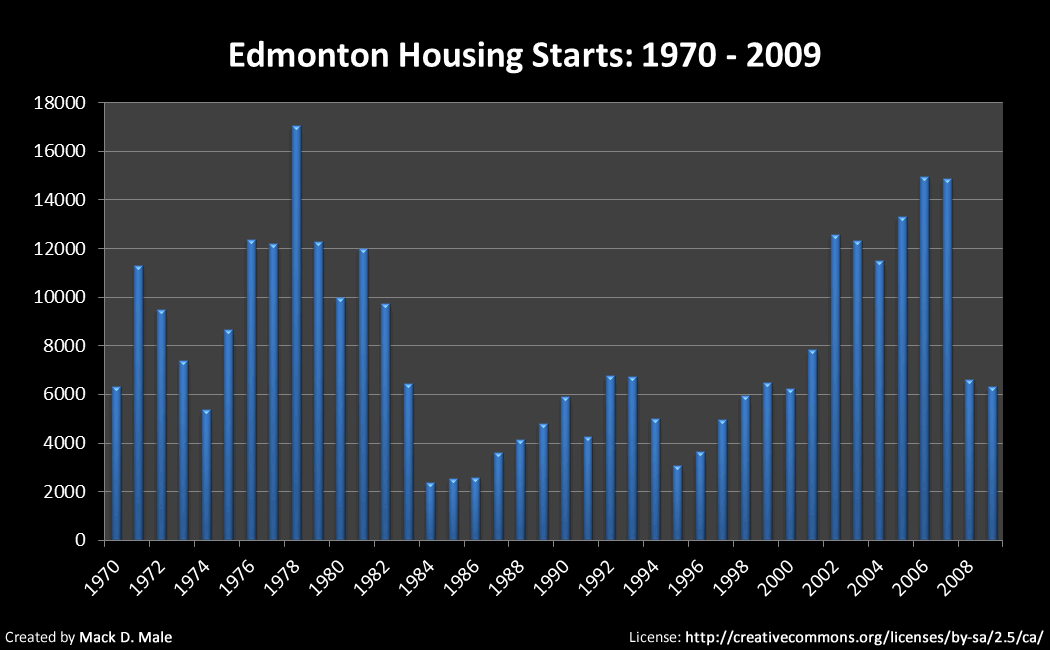
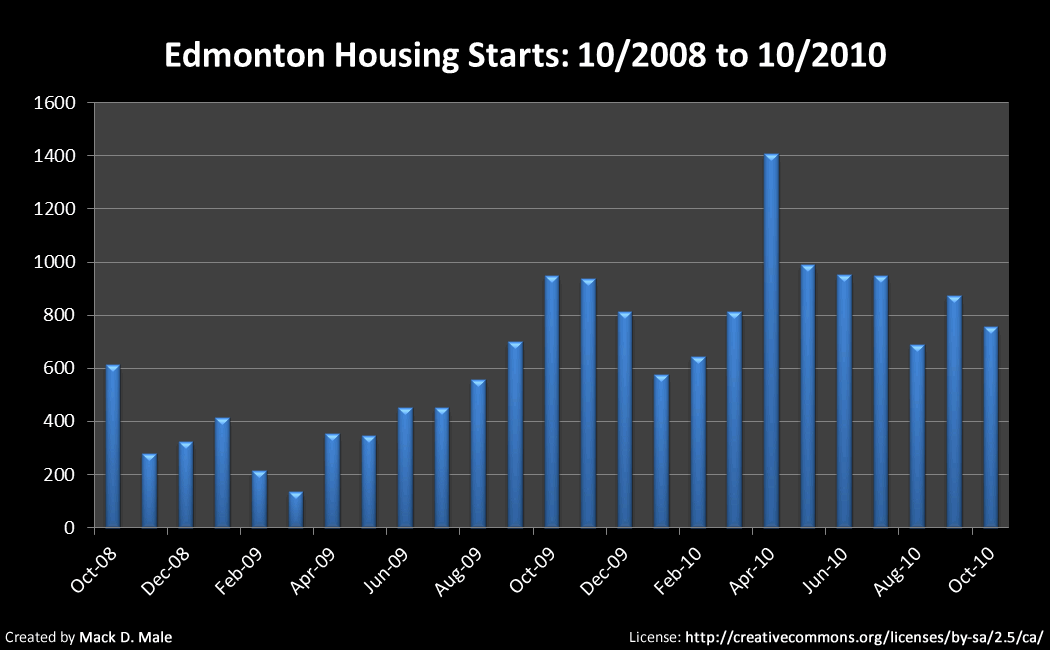
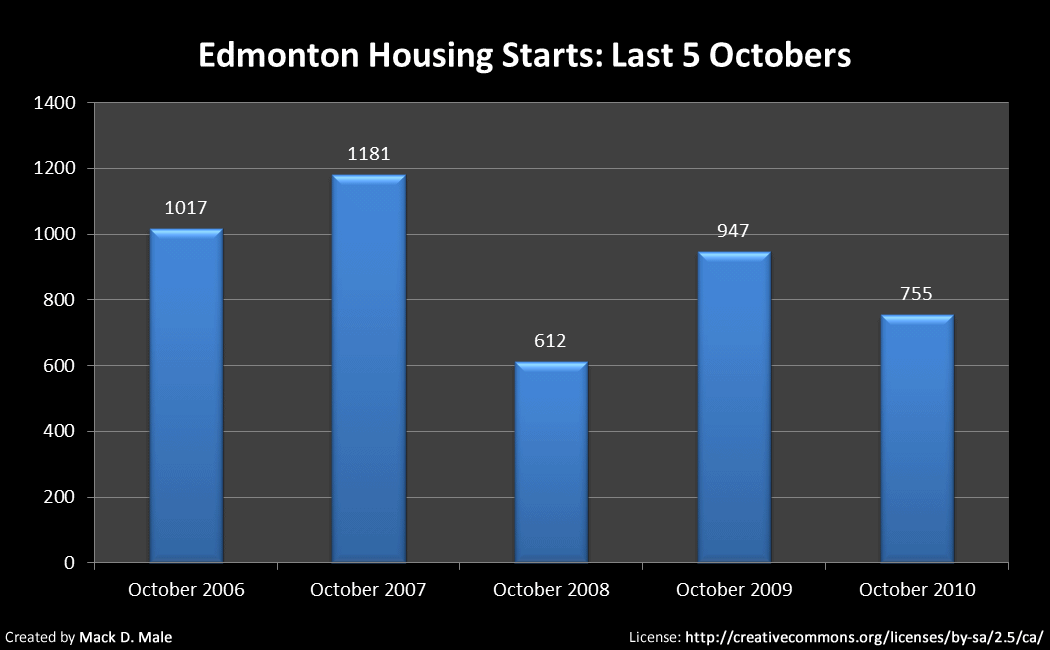
That’s the first reason that journalists should learn to love Excel – it can make providing context and better presentation easy. Here are three simple graphs, created with Excel, that tell you about housing starts in Edmonton.


This data comes from a PDF provided by the City of Edmonton. It shows annual housing starts since 1970. Copy and paste into Excel and you’re done!


This graph shows monthly housing starts from October 2008 until now. It uses data from the CMHC’s Reports & Publications section. Took maybe 10 minutes of copying and pasting.


This graph compares housing starts for this time of year from 2006 until now. Also comes from the CMHC.

Imagine if the article included graphs like these. The journalist could then focus on telling a more interesting story.

So, what’s the second reason journalists should learn to love Excel? Well, it can help them get their story right. Here’s what the Journal article starts with:

Despite a strong spring, the slowing trend in new-home construction became clear in October with housing starts dropping to their lowest level since June 2009 in the Edmonton region.

As you can see from the second graph above, that’s just not true. Is there a slowing trend? Maybe, if you just look from the spring to now. Was October the lowest level since June 2009? No. There were just 690 starts in August 2010. In fact, there were six months with lower housing starts since June 2009. I’m not sure what data the Journal was looking at, but it doesn’t appear to be CMHC data.

Add Excel to your toolkit. You won’t regret it.

UPDATE: Here’s the Journal story on August housing starts. Maybe if finding archived stories was easier, Dave Cooper, who wrote the story on October housing starts, could have consulted previous Journal articles to see that the lowest level was much more recent than June 2009.

Notes for 11/8/2010

Here are my weekly notes:

Edmonton Notes for 11/7/2010

Here are my weekly Edmonton notes:

Edmonton Sunrise
Beautiful sunrise from last Monday!

Cattle and AGA
Phenomenal photo by Darren Kirby.