VenturePrize 2007 with Leonard Brody

Post ImageEarlier today, Dickson and I attended the luncheon and awards ceremony for the 2007 VenturePrize business plan competition. As you probably know, we competed last year and narrowly missed out to ProExams (now ProTraining). The ProTraining guys invited us to join them at their table this year, and we happily accepted!

First of all, congratulations to the grand prize winner, Picomole Instruments, and to their competition – Business Infusions Inc. and Nirix Technology (I was pulling for Nirix as I had met and talked with CEO Steven Hsu in the past and was following their progress though the semi-finals). All of the elevator pitches and videos were very well done. In fact, I’d say the videos this year were far better than any of the videos created last year. Much flashier! The other big observation was that this year’s event seemed much smaller and a little more low-key than last year. I suspect this is because last year was extra special with the grand opening of Hall D.

The guest speaker today was Leonard Brody, who talked about Canada and entrepreneurship. Leonard is currently a director of NowPublic, a partner at Growthworks Capital, and has advised many of our country’s politicians. When he started his presentation, I wasn’t sure if it was going to be that good. That’s just the initial impression I got, perhaps because he was so distracted by the lapel microphone.

When he finally got things rolling though, I was impressed. He’s a great speaker and he’s obviously done his homework. Instead of sharing experiences however, Leonard chose to focus on statistics from recent research. Of course, statistics can be manipulated, so I took everything he said with a grain of salt. That said, he was pretty much preaching to the converted (at least with me). Some of the ideas he talked about:

  • In recent years, Canada is an economic wonder.
  • We need to do a better job of telling our story as Canadians.
  • Mobile phones are going to be huge.
  • My generation spends more time on media than work. And we have to multitask.
  • “Smart” is irrelevant.
  • Continuous partial attention (related to the multitasking).

Basically, the Gen-Yers and Millenials are taking over and they don’t do things the same way as previous generations. The workplace isn’t ready for them. And you should join Facebook (okay he didn’t say that exactly).

I’d say his presentation was the highlight of the afternoon for me. Like Dickson remarked, they needed “victory music” or something in the background when they announced the winner of the competition! The loud applause followed by silence was somewhat off-putting.

One final remark on the afternoon – lunch was delicious! And I actually ate it this year (too anxious last year to eat). The main course was Achiote Marinated Chicken Breast, Black Bean Orange Salsa, Basmati Rice, and Seasonal Vegetables. Dessert was good too: Mini Citrus Cheesecake on Rosemary Crust, topped with Brambleberry Compote and Orange Sour Cream Drizzle.

Congrats to Picomole, and thanks again to ProTraining for the invite.

Read: VenturePrize

Stop the madness – abolish DRM!

Post ImageHas DRM (digital rights management) ever accomplished anything positive? I find it really hard to believe that DRM has increased sales of music, movies, or any other protected content. In fact, I’d bet it has had the exact opposite effect. Just mentioning the acronym brings nothing but negative thoughts to mind.

I think it’s only a matter of time until DRM is gone. Steve Jobs doesn’t want DRM. EMI is willing to forget about DRM. And yesterday, thousands of online citizens proclaimed in a unified voice that they do not want DRM either. The writing is on the wall. The only question now is when DRM will disappear.

I can’t say it any better than Cory Doctorow:

AACS took years to develop, and it has been broken in weeks. The developers spent billions, the hackers spent pennies.

Instead of spending billions on technologies that attack paying customers, the studios should be confronting that reality and figuring out how to make a living in a world where copying will get easier and easier. They’re like blacksmiths meeting to figure out how to protect the horseshoe racket by sabotaging railroads.

The railroad is coming. The tracks have been laid right through the studio gates. It’s time to get out of the horseshoe business.

In the past, movie studios and record labels had to worry about content and distribution, but no longer. It’s clear now that distribution doesn’t need a helping hand. The sooner the studios and labels figure that out and stop wasting money on it, the better it’ll be for all of us.

Read: BoingBoing

Will Digg's implosion change the world?

Post ImageWow, just wow. Digg has imploded. This might seem comical at the moment, but I think May 1st, 2007 may go down in Internet history as a very critical day. Ryan Block has the best recap of what has transpired that I’ve seen:

Brace yourself: there is a revolt underway at Digg. Users are virulently spreading the HD DVD AACS decryption key against Digg’s wishes, with each removed post spawning dozens more in its place. But how did such a loyal userbase as Digg’s so quickly divert its all-consuming energy to defying — even damaging — the company to which it was so loyal?

The rest of his post explains the timeline. Basically it’s like this:

  • Someone posted the HD-DVD decryption key on Digg.
  • The story was removed, and that user was banned.
  • The story was reposted, and removed again.
  • Digg users then flooded the site with stories about the key.

As Ryan says, the web has just witnessed its first “massive, simultaneous revolt.”

When I started writing this post a few minutes ago, digg.com was down. Looks like it is back up now, but for how long? Digg’s founder Kevin Rose had this to say earlier tonight:

We hear you, and effective immediately we won’t delete stories or comments containing the code and will deal with whatever the consequences might be.

If we lose, then what the hell, at least we died trying.

If there was ever a reason to start realizing the power of the web, this is it. Who cares what happens to Digg…what does this event mean for the web and society in general? I’m not sure how yet, but I think Digg’s implosion might just have changed the world.

Read: Ryan Block

Tell us about Internet Explorer 8!

Post ImageThe 72-hour conversation that Microsoft likes to call Mix is over tomorrow, and so far, there has been absolutely no news about Internet Explorer 8. As I like to say, the silence has been deafening! Oh there’s been lots of news about Silverlight (Colin has a number of great posts), but nothing about IE8. A quick search shows that Miguel de Icaza (among others, undoubtedly) noticed this as well:

Someone mentioned (and I forget whom it was) that talk about IE8 was strangely missing from the whole conversation. There were no announcements about new upcoming features in IE, no mention of whether IE8 will support what-wg nor any future plans.

It makes sense that Silverlight should have its day to shine, but seriously, IE8 is important! Why not drop even a few tidbits about what to expect? Firefox 3 received a ton of press back in February when it became clear that the nextgen browser would support offline applications.

Maybe Microsoft is keeping quiet about IE8 to let the “we love all platforms and browsers” message permeate the blogosphere.

I should point out that the IE team posted this almost two weeks ago:

We will have more information to share about the next release in the future, but MIX07 is too early yet to discuss specifics.

All I want are tidbits, not specifics!

UPDATE: Mary Jo Foley has written a post describing what was mentioned about IE8 at Mix today. Mostly general stuff, like security being the top priority.

Read: IE Blog

New Pricing for Amazon S3

Post ImageLate last night Amazon sent an email to S3 customers announcing an upcoming pricing change. Storage costs will remain the same, but the price for bandwidth is going to change:
Current bandwidth price (through May 31, 2007)
$0.20 / GB – uploaded
$0.20 / GB – downloaded

New bandwidth price (effective June 1, 2007)
$0.10 per GB – all data uploaded

$0.18 per GB – first 10 TB / month data downloaded
$0.16 per GB – next 40 TB / month data downloaded
$0.13 per GB – data downloaded / month over 50 TB

$0.01 per 1,000 PUT or LIST requests
$0.01 per 10,000 GET and all other requests

They claim that if the pricing had been applied to usage for March 2007, about 75% of customers would have seen their bill decrease. In some cases however, the price change makes things significantly more expensive, as this thread points out:

Uploading 1GB of 4K files will cost $2.72 instead of $0.20

We haven’t yet figured out how Podcast Spot will be affected, but I suspect we’ll see a slight decrease. I’m also interested to hear from Don MacAskill on SmugMug.

UPDATE: Don talks about the new pricing model here and says they’ll save money.

Read: S3 Forums

Analyzing my posting habits

I have been blogging for about three and half years now, and lately I’ve been wondering about my posting habits. Do I tend to post at a certain time of day? How about a certain day of the week? I certainly don’t try to – I just post when I have something to share.

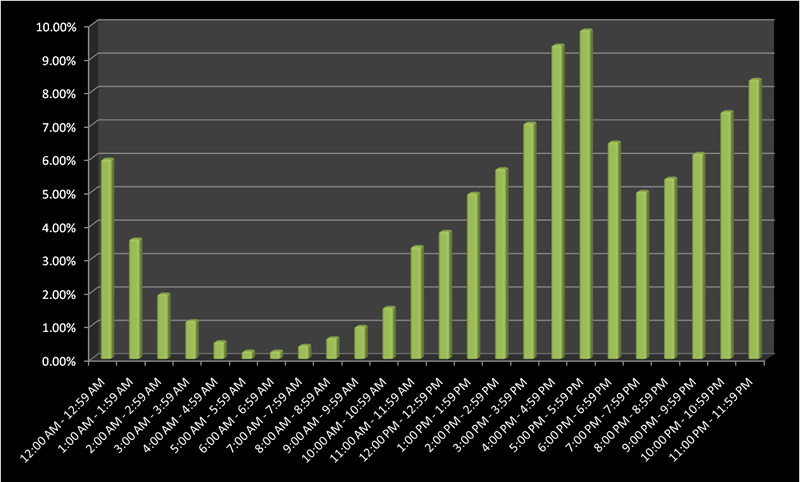
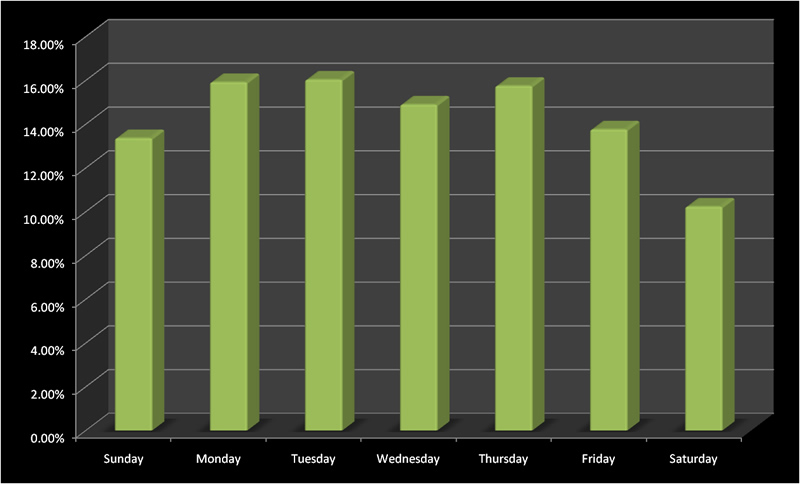
I ran the numbers tonight, and here’s what I found (click on a graph to enlarge). The percentage on the Y-axis means “percentage of my posts”. For days of the week:

Looks like my post frequency drops off on the weekend, but not as much as I thought it might. For hours of the day:

Looks like I am definitely a late-afternoon/evening blogger! This is quite a bit different than the blogosphere as a whole.

When I do these numbers again, I’ll have to figure out how many posts are made on days where I post more than once. I’d also like to find out what the average number of words/characters per post is, but that calculation is a little more involved.

Kind of a neat exercise, I have to say. It’ll be interesting to see how these statistics change in another three and a half years!