Does high speed rail have a future in Alberta?

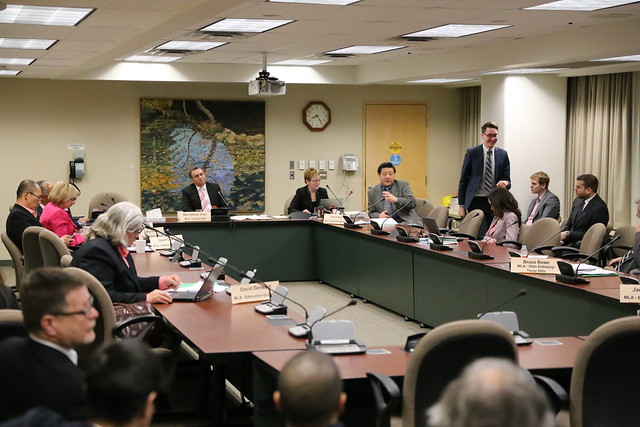
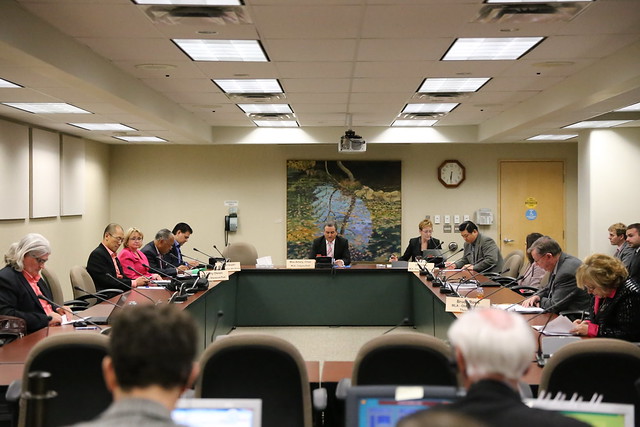
Last week I attended a public meeting on high speed rail in Alberta (which I typically abbreviate ABHSR). The issue is being considered by the Standing Committee on Alberta’s Economic Future, an all-party committee consisting of 18 MLAs. As part of the process, the committee has now heard from the public in Calgary, Red Deer, and Edmonton, and is encouraging additional written submissions by March 31. I hope at least a few Albertans take them up on that, because their “public” meeting was poorly publicized and required going past three security checkpoints.
Alberta High Speed Rail Public Meeting

Here’s the stimulus provided by the committee on the idea:

  • It could offer service between Edmonton and Calgary (including a stop in Red Deer) with a trip time of one to two hours at speeds of 200-500 km/h.
  • One-way ticket prices have been estimated at between $66 and $142.
  • Capital costs have been estimated at $2.5 to five billion, but could be significantly higher.
  • A route would be chosen and land would be acquired along the route for tracks and stations.
  • Overpasses or underpasses would likely have to be built to accommodate many of the road crossings or, alternatively, bridges above any roads the track would cross could be constructed.

Clearly the idea is intriguing. A hundred bucks to get to Calgary in less time than it would take to drive? Sign me up! Driving is stressful, I could read or do some work on the train, there are lots of positives, for sure. But is Alberta ready? Is this an investment we’re prepared to make now?

There were some interesting viewpoints put forward at the meeting. Some felt the time is right, and that a project like this could allow us to harness the talents of all the smart, creative, and innovative people we have throughout the province. Others expressed concern that our population isn’t big enough to warrant such a project. And still others argued that automated, driverless cars are coming and will make the entire idea irrelevant (as exciting as the work Google and others are doing in this area is, there are significant hurdles still to overcome, so I’m not holding my breath).

Technically, the project sounds feasible. A few speakers talked about Maglev technology that has been deployed in a number of other places, notably in Asia. One speaker, Deryck Webb, said Maglev combined with vacuum tubes was the way to go (what he described sounded very similar to Elon Musk’s Hyperloop). I think the key issues are financial and political, not technical.
Alberta High Speed Rail Public Meeting

The issue last came up in 2009, when a report was issued assessing the potential for service between Calgary and Edmonton. At the time I wrote:

“I personally think if the province is going to be spending money on transit, it should be on city and regional transit. Both Edmonton and Calgary could use the assistance to improve their respective transit systems…”

I still feel that way today. If we’re going to spend a few billion dollars, let’s spend it on LRT first.

This is the message our local leaders are sending to the Province. One of the written submissions the committee has received thus far was from the Edmonton International Airport. President and CEO Tom Ruth wrote the following:

“Given the lack of local networked options in the Edmonton Region, we agree with the position of the City of Edmonton and the Edmonton Economic Development Corporation (EEDC) that the priority should be to ensure there are fully developed networks in advance of HSR; including Light Rapid Transit (LRT) service fully developed within the Edmonton Region, with connectivity to EIA. Until these intra-regional options are fully built out, the utility of HSR is severely limited.”

Maybe high speed rail is in Alberta’s future, but I hope it’s after we have developed the LRT networks in Calgary and Edmonton.

You can see the full transcript of last week’s public meeting here (or in PDF here). You might also be interested in the Reddit thread on the issue. If you’d like to submit something to the committee, send it to economicfuture.committee@assembly.ab.ca. The deadline is March 31, and all submissions and the identities of their authors will be made public.

Media Monday Edmonton: Update #102

Here’s my latest update on local media stuff:

You can follow Edmonton media news on Twitter using the hashtag #yegmedia. For a great overview of the global media landscape, check out Mediagazer.

So, what have I missed? What’s new and interesting in the world of Edmonton media? Let me know!

You can see past Media Monday Edmonton entries here.

Edmonton Notes for 3/2/2014

Here are my weekly Edmonton notes:

Headlines

Precious Treasure
Cool shot titled ‘Precious Treasure’ by Dave Sutherland

Upcoming Events

Edmonton Light
Edmonton Light by Jeff Wallace

A vision for the future of transportation in Alberta

The Province is currently working on a new long-term transportation strategy for Alberta. Over the last two months, public discussions have been held throughout Alberta and in the spring, an online survey will be released.

“This Strategy – which will focus on all forms of transportation, connections and ways to move people and products – provide an overarching vision for Alberta’s transportation system over the next 50 years. It will also help guide government decisions on transportation investments, policies and programs.”

That’s a big challenge. But it’s exciting to consider!

Since I missed the meeting here in Edmonton, I took a look at the feedback form. It includes a number of questions that aim to capture what the public thinks about the strategy. One of the first deals with the proposed vision for the Transportation Strategy for Alberta:

“A world-class transportation system that is safe, sustainable and innovative, and that supports Alberta’s economy and quality of life.”

I suppose there’s nothing wrong with that, but it just seems rather bland, doesn’t it? It’s very expected. And phrases like “world-class” are just meaningless. The proposed vision is also incredibly similar to others. For instance, here is Transport Canada’s vision:

“A transportation system in Canada that is recognized worldwide as safe and secure, efficient and environmentally responsible.”

Needless to say, I’m not a fan of the proposed vision. It doesn’t tell me anything about what transportation in Alberta will look like in the future, especially as you could credibly argue that it reflects the current state of Alberta’s transportation system.

welcome to alberta
Welcome to Alberta by Magalie

What could it be instead? Well let’s consider the context.

The shift from rural to urban has been dramatic in Alberta. According to the 2011 federal census, more than 56% of Albertans now live in population centres larger than 100,000 people in size, and 83% live in urban areas of any size (compared to 81% nationally). We’re an urban province now more than ever. The economic power of cities cannot be ignored.

We know that vehicles are dangerous. According to the World Health Organization, “road traffic injuries are the eighth leading cause of death globally, and the leading cause of death for young people aged 15-29.” Here in Alberta, traffic fatalities have declined significantly from 2007 through 2011, but there are still too many of them. We also know that vehicles have a negative impact on the environment. They contribute to global warming, they contribute to smog, and they take up an incredible amount of land that could otherwise be used more productively.

There are lots of other factors to consider, but I think these are the two most important. Reducing our dependence on vehicles and recognizing the importance of cities should be central any vision of the future of transportation in our province. Unsurprisingly, the two biggest cities in Alberta have already recognized this.

Our neighbours to the south have the Calgary Transportation Plan, which says:

The decisions made today about where and what to build will affect Calgarians for 100 years or more – just as decisions made in the past affect us today. Going forward, the transportation system must perform a wide variety of roles and consider the context of surrounding land uses, be they natural or manufactured. It must provide more choice for Calgarians – realistic choices that are convenient, affordable and attractive. These choices include walking, cycling, transit, high occupancy vehicles (HOV or carpooling) and single-occupant vehicles (SOV).

Here in Edmonton, we have the Transportation Master Plan, The Way We Move. It is even more aggressive:

We are building a 21st century city, shaping an Edmonton that will meet the needs of our diverse and growing urban and regional population. Growing environmental concerns, acknowledgment of the ongoing investment needed to maintain our transportation infrastructure and the rapid growth of our city demand a shift in transportation priority setting. It is a shift from single passenger vehicle use to more public transit; from building outward to a compact urban form. From an auto oriented view of transportation to a more holistic view of an interconnected, multi-modal transportation system where citizens can walk, bike, bus and train efficiently and conveniently to their desired location.

I recognize that Calgary and Edmonton have a completely different context and set of challenges than the rest of the province does, but I think their transportation strategies are informative. Let me also say that I don’t think creating a vision statement is easy. I know a lot of hard work, thought, and difficult discussions are needed to come up with them. That said, I’ll take a stab at it.

Here’s my attempt at crafting a stronger vision for the future of transportation in Alberta:

An innovative and sustainable transportation system that emphasizes high occupancy vehicles and strengthens the global competitiveness of Alberta’s urban areas.

What do you think?

Want to solve the space problem for the arts in Edmonton? Stop shaving that yak!

In software development there’s an expression we use to avoid scope creep. “Don’t shave that yak!” we’ll say. It’s shorthand for staying focused and working on solving the problem at hand, not other problems that we might notice along the way. As far as I know the phrase comes from a Ren & Stimpy episode and was coined by Carlin Vieri, a Ph.D. at MIT back in the 90s.

“Yak shaving is what you are doing when you’re doing some stupid, fiddly little task that bears no obvious relationship to what you’re supposed to be working on, but yet a chain of twelve causal relations links what you’re doing to the original meta-task.”

I quite like Seth Godin’s example of yak shaving. This GIF illustrates it well too:

yak shaving

I was chatting with someone in the arts community recently about the Edmonton Downtown Academic & Cultural Centre project, and I remarked, “I just don’t know how we got from ‘arts organizations need space’ to ‘a $1 billion project is the answer’.” But thinking about it later, I realized that I know exactly how we got there. We’re shaving the yak.

It was back in November 2011 that the Mayor’s Arts Visioning Committee released its recommendations for how we could “lift Edmonton to international recognition as a city of the arts by the year 2040.” They followed a public engagement process, learned about the challenges facing the arts in Edmonton, and developed recommendations to try to address them.

One of the challenges identified was space:

“Edmonton artists and arts advocates described a critical need for additional creation, rehearsal, exhibit and performance space. Developing or designating new arts space is paramount to the vision in this report.”

It’s worth noting that this wasn’t a new challenge – The Art of Living identified it in 2008 too. As a result, many of the recommendations dealt with space. The third recommendation was titled “Downtown Arts District and Performance Centre” and was relatively simple:

“The City of Edmonton endorse, in principle, a landmark performing arts centre (PAC) downtown, and designate land for such a development in the city core.”

The report goes on to detail the need and provides background and context. I understand from my conversations with those in the arts community that there is a real need for more space, especially smaller, black-box space that is multi-purpose.

So that’s the problem we’re meant to be solving: a lack of performance and rehearsal space. How did we start shaving the yak? I think it went something like this:

City Council put up $100,000 for the newly created Edmonton Performing Arts Centre Foundation to develop a business case. In developing the business case, the foundation connected with the University of Alberta which expressed a desire to link its music and art & design programs with the downtown arts community. There’s not enough money for all of that, so the vision needed to be made broader. The “revitalize downtown!” mantra evidently worked for others, so the group decides to go after that as part of the vision. To compete with the other big, fancy space known as the arena, a big, fancy space known as the Galleria was designed. In order to pay for that, a commercial office tower was added to the plan, along with a new campus for the University of Alberta. But those projects were deemed unrealistic unless there was a connection to the new Royal Alberta Museum and the LRT.

Before you know it, the group has taken arts out of its name completely, and we’re talking about a $40 million dollar pedway.

Weren’t we supposed to be finding new space for the arts? Stop shaving that yak!

Media Monday Edmonton: Update #101

Here’s my latest update on local media stuff:

Ellie!
We met Ellie in July at the Avenue Goes to the Dogs event!

  • I can’t remember where I saw this link, but I’m looking forward to reading the Verification Handbook: A definitive guide to verifying digital content for emergency content.
  • Have you noticed the new paging that the Journal has added to its website? It looks like this:

paging

  • How annoying! First of all, it’s rare that an article is long enough to warrant that functionality (there’s usually only a paragraph or two on the second page). But worse than that, when I click either “2” or “View as one page”, it jumps back to the top of the screen (I’m using IE11). I have no idea why they introduced this. It doesn’t even do a page load, so it can’t be for page views.
  • While I am complaining about the Journal, I think the ads have gotten worse. I want the ads to be there so that they can make some money, but they’re so intrusive and they slow the page so much that I’m tempted to use an ad-blocker just to make the site usable. This is what the front page looked like for me tonight:

edmonton journal

You can follow Edmonton media news on Twitter using the hashtag #yegmedia. For a great overview of the global media landscape, check out Mediagazer.

So, what have I missed? What’s new and interesting in the world of Edmonton media? Let me know!

You can see past Media Monday Edmonton entries here.

Edmonton Notes for 2/23/2014

The Sochi 2014 Winter Olympic Games wrapped up today, and like most of you I was up by 5am to watch the Canadian men’s hockey team defeat Sweden 3-0 to take the gold medal. In case you missed it, ATB Financial lit up its new building downtown every time Canada scored:

Canada finished 3rd in the medal standings with 10 gold and 25 medals total, one less than our haul in Vancouver four years ago. Edmonton-born athletes did well too. Now attention turns to the Paralympic games, with the opening ceremonies taking place on March 7.

And if you’re like me, you’re now counting down to World Cup 2014 – just 108 days to go!

Here are my weekly Edmonton notes:

Headlines

Upcoming Events

Parka Patio Party
Sharon getting a drink from the vodka ice luge at Latitude 53’s Parka Patio Party on Saturday night. More photos here.

International Open Data Day in Edmonton

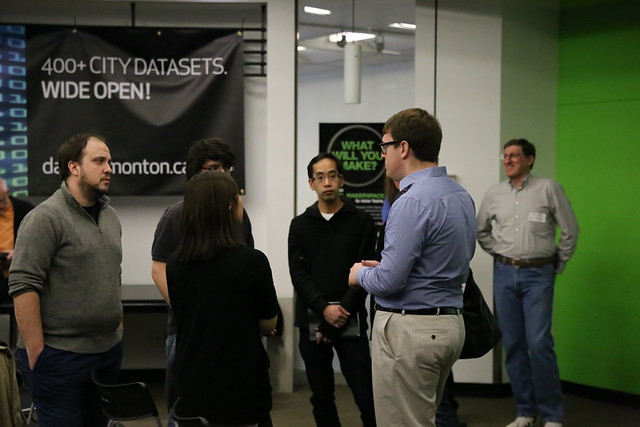
Today is Open Data Day around the world, and here in Edmonton we celebrated with a hackathon at the Edmonton Public Library’s new Makerspace. A few dozen people came out to learn more about open data, to hear ideas from others, and to start exploring and building.

International Open Data Day Hackathon

The day started off with “speed data-ing”, where anyone who wanted to could pitch an idea to the room. Once the pitches were done, there were a lot of great conversations taking place as everyone figured out how they wanted to spend their time for the rest of the day. Teams slowly self-assembled, and then everyone got to work.

International Open Data Day Hackathon

At the end of the day, teams had the opportunity to show off the progress they had made throughout the day. One team worked on visualizing open datasets so that they could be more easily accessed and used by educators. Another team looked at visualizing how many dogs there are and which breeds are most popular in different areas of the city. The winning idea was a visualization of tree data in Edmonton. Hackathons are typically longer than just a few hours, so it was impressive to see what everyone was able to come up with given the time constraints!

International Open Data Day Hackathon

There has never been a better time to be an open data developer in Edmonton. The City of Edmonton’s open data catalogue now contains more than 400 datasets, and the Citizen Dashboard that sits atop the catalogue recently won a national public-sector leadership award. The Government of Alberta’s open data catalogue also has more than 400 datasets now, and it only launched last May. The Government of Canada recently expanded and updated its large open data catalogue. And just this week, Strathcona County launched its own data catalogue featuring more than 60 datasets.

International Open Data Day Hackathon

Many other cities around the world hosted hackathons today too. Here’s what Open Data Day is about:

Open Data Day is a gathering of citizens in cities around the world to write applications, liberate data, create visualizations and publish analyses using open public data to show support for and encourage the adoption open data policies by the world’s local, regional and national governments.

Open Data has come a long way over the last few years. It has been adopted by governments around the world both large and small, and even organizations like the G8 have adopted an Open Data Charter. Countless apps and services have been developed to take advantage of all that information, and I think the best is yet to come. If you’re looking for an open data primer, check out the Government of Canada’s Open Data 101 or check out the Apps Gallery.

Thanks to the City and EPL for hosting a fun and creative day at the Makerspace! You can see more photos from the day here.

The lights are on at Edmonton’s Outdoor Neon Sign Museum

Dozens of Edmontonians braved the cold tonight to join Mayor Iveson, Councillor McKeen, Councillor Knack, and Downtown Business Association Executive Director Jim Taylor for the official launch of the Edmonton Neon Sign Museum on 4th Street Promenade. After probably a bit too much talking, the signs were introduced and the lights came on one-by-one.

Neon Sign Museum

Here’s an overview of the museum:

The primary purpose of this project is to develop an outdoor historic neon sign museum in downtown Edmonton to celebrate the history of neon signage in the city, and to create an engaging outdoor space for cultural tourism as part of the bustling 104th Street Promenade. This unique museum fosters activity and walking traffic in the surrounding area, acting as a light-based form of urban beautification for downtown Edmonton.

The project has been years in the making. Work began in 2008 and the museum has been consistently championed by city planner David Holdsworth, who originated the idea.

The City of Edmonton Heritage Planning has been collecting the historic neon signs at The City of Edmonton Archives over the past few years, salvaging them from both demolished buildings and from buildings where new businesses moved in and removed the signs. The City has collected twelve signs that represent some of the early signage styles and iconic signage forms in Edmonton. The Museum will continue to grow as additional signs – a goal of 30 total – are added in the coming years. Each of the current signs has an accompanying plaque with text panels that tell the stories of the signs, and by doing so the signs speak to the history of Edmonton.

For more on the history of the project, check out Omar’s piece.

Neon Sign Museum

The museum currently features signs from Mike’s News Stand, Canadian National Railway freight-telegrams, Northern Alberta Railway, XL Furniture, W.W. Arcade, Cliff’s Auto Parts, an unidentified drugstore, and Canadian Furniture. Signs still to come are from the Princess Theatre, Pantages Theatre, the Georgia Baths, and a second sign from the W.W. Arcade.

Neon Sign Museum

Sponsors of the museum include the City of Edmonton and the Alberta Sign Association, and community partners include TELUS, the Downtown Business Association, and The Places.

You can see more photos here. Stay tuned for much better photos from the local Flickr group as well!

Recap: DemoCamp Edmonton 24

democampEdmonton’s 24th DemoCamp took place tonight at the Telus Centre on the University of Alberta campus. DemoCamp is “an event that brings together developers, creatives, entrepreneurs and investors to share what they’ve been working on and to find others in the community interested in similar topics.” You can read my recap of our last DemoCamp here. There was a pretty good turnout tonight, and lots of new faces in the crowd.

We had seven demos tonight, three of which were projects created at the recent 24 hour Computer Engineering Club Hackathon. In order of appearance:

  • Gregg and Stephen showed us Industry Mailout‘s new email editor. The existing editor hasn’t really been changed since 2004, so a fresh approach was long overdue. The new editor looks very slick, and in addition to being easier to use with a live preview, it’s more advanced too. Users can easily include tweets and other elements in their templates. It also supports Liquid.
  • Ross and Andrew were up next to show us their project from the hackathon called Stall. It’s a mobile app that lets you play mini games simply by scanning a QR code that has been placed somewhere. So imagine getting into an elevator, scanning the QR code, and playing a quick game. They also implemented a high score feature, so you could try to top the leaderboard in that elevator. Cool stuff!
  • Our third demo was from Michael who showed us Renturly. It’s an app that helps to match buyers and sellers in off-market, NPN (non-performing note), and REO (real estate owned) real estate. I must admit I don’t understand the business, but I gathered that this isn’t a tool you’ll use to buy your next house. It’s for people looking to buy and sell apartment buildings, hotels, and golf courses. I’m not really sure where the name comes in or why the logo is a bird, but it sounds like Renturly already has a number of paying customers.
  • Next up was Indragie and Ali who showed us their Smartwatch Light Bulb Controller, which took first place at the hackathon. Their solution enabled a Pebble smartwatch to control the color and state of a wifi-connected lightbulb (they used LIFX). It was neat to see such a visual demo that just worked! Currently it requires a server and a phone, and it requires everything to be on the same wifi network, but in theory they could make it run from the cloud.
  • Our fifth demo was from Myst.io. Logan and his team showed off the cross-platform API using Visual Studio! Myst makes it easy for developers to add features to their games like cloud saving, multiplayer, and achievements. It sounds like their API is fairly complete, though they are still working on the deployment and management.
  • Sixth was Ranek who showed us his hackathon project called URSA. As he himself admitted, it solves a problem that students try to solve every couple of years – a better way to search and select from the University of Alberta’s course catalogue. His solution did look pretty slick, and there are lots of potential improvements he could make. Interestingly it doesn’t simply scrape data, but actually gets the bulk of it from an LDAP server the university makes available. Progress!
  • The final demo of the evening was from Kris, Damien, and their team, who showed us GameSys. They work in the online gaming (as in casino) space, and showed us some nifty tech that can help to detect fraud, collusion, and other “abhorrent” behavior in online poker. We basically saw a Virgin-branded poker game being played, followed by a peek at the admin interface they would use on the backend to detect foul play.

Here are some video highlights from the event:

All of tonight’s demos were relatively quick – I don’t think anyone used their full seven minutes actually! I am really happy to see what Industry Mailout is up to as their service is used by so many local organizations (I feel like I interact with it daily due to all the email newsletters I get). I loved seeing all of the cool projects that students were able to create in just 24 hours, it’s really impressive. Even if their solutions don’t have a commercial future, it’s great to see such creativity.

Great job to all the demoers!

Here are the upcoming events and other announcements that were highlighted at DemoCamp:

  • Startup Edmonton is hosting an open house each Friday afternoon. It’s a great opportunity to check out the space and to find out what it is like to be a member.
  • The next Go Meetup is on Monday night. There are also meetups for Ruby, Python, and many other technologies so check them out! One of the newest is an AWS Meetup, the first meeting of which will be during lunch on March 20.
  • There’s an interesting lunch event coming up next Wednesday called Lunchalytics. Taking place at Startup Edmonton, the event’s theme is Predictive Analytics in the Public Sector.
  • TEDxEdmonton is coming back this summer with the theme of “uncertainty”. They’ve recently changed the date to June 14 to watch for future details in the weeks ahead.

Keep an eye on the Startup Edmonton Meetup group for more upcoming tech events.

See you at DemoCamp Edmonton 25!