Thank You!

I just wanted to take a minute to say thanks!

Vue Weekly’s Best of Edmonton 2012 awards were published the week of September 20:

We asked your thoughts on over 150 categories—Yeah, we know, it was a little much. But we had over 1000 responses and upwards of 15 000 individual vote, so thanks for coming out, Edmonton.

This blog was named “Best Local Blog” and I was also named “Best Local Twitterer”. Needless to say, I was absolutely thrilled when I found out! I am also really happy that What the Truck?! was named “Best Local Pop-up Event”. What’s great about these awards is that Edmontonians decided who won, not a jury or other committee. That makes the recognition even more meaningful.

Best of Edmonton 2012

I want to give props to Sharon, Rev, Kikki, and Brittney who were all recognized alongside me in the Blog & Twitter categories. Check them out! Hopefully in future years we’ll see even broader recognition of the Edmontonians who are doing amazing things for our community through technology and the web.

As always, thanks for reading!

Rethinking Public Involvement #1

How can we get more Edmontonians involved in municipal issues? How can the City improve the way it informs and involves the public? This is the first in a series of posts on that topic.

I have been thinking extensively about Public Involvement lately (the City’s official term for public consultation, community engagement, stakeholder participation, etc). I try to keep on top of the various public involvement opportunities that are running at any given time, and have completed my share of surveys, feedback forms, and have attended many open houses and other events. It’s important to me to remain informed, but also to be able to provide input on issues that I care about. I feel a responsibility as a citizen to take some initiative and to get involved.

In the past I have been critical of the City’s public involvement efforts, and I still think there’s a lot of room for improvement. The Public Involvement Handbook (PDF) could do with an update – it was last modified in 2008. Improved consistency with vocabulary would make a huge difference – right now “open house”, “public consultation”, “information session”, and other terms are used interchangeably. A new or improved online consultation manager would also be positive – it lacks many of the features that would make public involvement easier to follow, such as iCal or email subscriptions/notifications. Those are all minor suggestions though, and I think the City needs to make more fundamental changes to really move the needle on this issue.

“What’s the purpose?”

I don’t think the answer to this should be “to inform citizens” nor do I think it should be “to gather input”. I think the purpose should really be tied to the project outcome. Are we building a bridge? Then the purpose of the public involvement is to build the best bridge possible. Informing citizens about the project and gathering input are two of the ways we’re going to achieve that.

I think this approach to defining the purpose scales up to the City level too. Why does the City conduct public involvement? To make Edmonton the best place to live, work, learn, and play.

“What’s the context?”

In my experience, this is missing from nearly every single public involvement opportunity the City conducts. Take a public involvement event focused on the Downtown LRT Connector, for instance. It will have all sorts of information about the Connector itself, and maybe even a little about the larger LRT Network Plan, but very little if anything about other projects related to or happening around the Connector. Nor will it include any history about projects that have happened in the past. There’s no context! I know that focusing the public involvement activity is important, but citizens need to be able to understand where the project fits into the grand scheme of things and why it matters.

“What have I missed?”

For most projects, public involvement activities take place over months or years. That means that citizens may be coming into them at different points and with varying levels of knowledge/experience. Despite this, I find that most public involvement activities make it difficult for citizens to get involved later in the process because there are a lot of assumptions made about what has already happened. Some work has been done recently to address this – I like the timeline graphic the Transportation folks use:

Project Lifecycle

This makes it easy to think about the status, where are we in the timeline, but it still doesn’t help a citizen who wants to get involved at the Design phase understand what has already happened and how they can best dive in. In addition to clearly identifying “where we are” there needs to be a way for citizens to quickly find out “what you missed”.

While there are many improvements that could be made to the way the City conducts its public involvement activities, I think addressing these three fundamental questions would make a big difference. I don’t think we should throw out what already exists either, because there’s a lot of solid foundational work there, but I do think we can and should work to make it better.

Despite clear public input, Edmonton’s draft Food & Agriculture Strategy lacks recommendation to preserve agricultural land

The City of Edmonton released the draft of its Food and Urban Agriculture Strategy yesterday. The 94 page document is called “fresh” and is labeled “version 3”. I’ll be digesting it (and the other 8 associated documents) over the next week or so, but I wanted to share something that I noticed right away. Despite clear public input that Edmonton should preserve agricultural land, the strategy makes no such recommendation. Instead, a “framework” is provided to aid City Council in its decision.

As I wrote back in July, the contentious part of the strategy relates to land use and the preservation of agricultural land within city limits, particularly in the northeast. Deciding what to do with municipal land should never be easy – we should be forced to seriously consider options to make the best decision for the city. Ultimately the decision rests with Council, but I’m disappointed that given the clear feedback on this issue from the public, the Advisory Committee responsible for the strategy chose not to make a clear recommendation.

Section 5.9, under the heading “The Complexity of Issues”, reads:

The Direction to Integrate Land for Agriculture was the most difficult the Advisory Committee tackled. The Committee agreed that some prime agricultural land must be protected for future use and generations, identifying that a need exists for food production within Edmonton. At the same time, Committee members agreed that given the diverse interests represented across the Committee, it could not, and should not be the body to determine how much land should be protected versus developed in specific locations in the Urban Growth Areas. These decisions should be made through existing regulated processes by City Council.

A recommendation is very different than a Council vote. There’s no way the Advisory Committee could have been “the body to determine how much land should be protected versus developed.” Its recommendation to “treat food waste as a resource”, for example, does not detail the specific amounts of food waste that should be dealt with, so why would the Advisory Committee be expected to detail the amount of land to be preserved? The rationale for avoiding a clear recommendation on this issue leaves me unsatisfied.

The Advisory Committee was made up of “fourteen citizens from different parts of Edmonton and with different interests in the food and agriculture sector.” I suppose it should be no surprise that farmers and land developers would differ over what to do with a piece of land. Stakeholders and other citizens were much less divided on the issue, however. Let’s take a look at some of the other documents that were released alongside the draft strategy.

First, we have the Public Opinion Survey Report. It outlines the results of the survey the City ran from June 4 to June 23 (a total of 2,269 people participated). In the open comment box in the section on growing and producing food, the feedback was clear:

“…a number of clear themes emerged, the most emphatically expressed being to preserve arable land, particularly in the Northeast corner of the city.”

Of the 1388 people that left additional comments, 349 or 25% mentioned the importance of preserving municipal agricultural land, the largest of any theme.

Next we have Stakeholder Group Summary for Round 1 and Round 2. In the first round, there were “differing opinions about land use when it comes to agriculture in the City” with passionate arguments on both sides. The second round was much less ambiguous. “The vast majority of respondents agreed that providing land for growing food was a sound direction for Edmonton.”

Finally, there’s the Citizen Panel Report. The sixty-six panelists settled on ten “best of the best” strategies and in their cover letter encouraged City Council and the Advisory Committee to begin implementing them as recommendations. Their top two both deal with preserving agricultural land:

Strategy 1: Create and/or amend zoning, bylaws, fees, and taxes to prohibit developments on good fertile agricultural land, particularly the northeast farmland.

Strategy 2: Maximize spaces and places within the City of Edmonton for urban growing and food production. Develop systems for permanent and ongoing identification, inventory, and assessment of urban spaces for urban growing. The inventory includes identifying the water and soil suitability for a variety of local crops. Create accountable and objective monitoring.

There was a quite a range of participants on the panel, both in terms of age but also background. As you might expect, there were differing opinions on many issues, but the importance of preserving agricultural land was much less controversial:

Panellists were not always in agreement and throughout the Citizen panel there was in depth discussion, dialogue and areas of disagreement. However, the panellists did agree to put forward the overall strategies as outlined in this document. They also clearly articulated a critical need for political will and leadership on issues related to food and agriculture, and the importance of using municipal policy tools to protect existing agricultural land within Edmonton’s city boundaries. Participants also repeatedly expressed, in the strongest possible terms, their desire to see these recommendations treated as high-priority action items.

From the online survey to the stakeholder groups to the citizen panel, the feedback is clear: preserving agricultural land within the City’s boundaries is important. It’s too bad that a clear recommendation to reflect that is not found in the draft strategy.

The draft strategy will be discussed at a non-statutory public hearing on October 26, and you’re encouraged to provide input before that date. There are two open houses taking place this week, downtown on Wednesday and in Old Strathcona on Thursday, and so far they are the only two opportunities to learn more about the draft strategy. You can provide input at those events, by filling out the online survey, and of course by contacting your Councillor at any time.

Here is some other reaction to the draft strategy that you should read:

Recap: DemoCamp Edmonton 19

It has been so long since our last DemoCamp – number eighteen took place way back in March! A lot has happened in the interim, most notably that Startup Edmonton has completely moved into the Mercer Warehouse and it has definitely become the home of startups in our city. It’s really great to see the energy and momentum continually building! Even with all of that activity however, DemoCamp remains an important part of the ecosystem. It’s a great opportunity to see what local entrepreneurs are building and to connect with lots of people in the community.

DemoCamp Edmonton 19
Cam introducing the evening

Tonight’s event was back at the Telus Centre on the University of Alberta campus, and featured five demos (in order of appearance):

  • Patrick Pilarski from the Alberta Innovates Centre for Machine Learning (AICML) kicked things off with a very cool demo that involved a robot! He leads the organization’s Adaptive Prosthetics Project, which is focused on creating intelligent artificial limbs for amputees. In the demo he used sensors on his own arm to control the arms of a small robot, but also to train the algorithm. This video probably explains it better than I can – it’s so great that we have stuff like this happening in Edmonton:

  • Tim Tuxworth was up next to show us Go-Taxi. This was the first demo that I can remember to feature a live Skype video call as Tim called a taxi driver to help with the demo! Unfortunately he ran into some technical issues, but I think everyone got the idea. The app helps taxi companies manage requests, and helps clients book a taxi and see its current location on a map. It’s a neat idea!
  • Next up we had Brandon Webber and Tim Fletcher who demoed Monogram. Essentially it provides a public profile on the web for Instagram users, but that’s just the start. Eventually Monogram will support other services like Vimeo, SoundCloud, and Etsy. It’s a very beautifully designed tool! With Instagram working on a web presence though, they’ll need to get some other services supported quickly.
  • Our penultimate demo was by Rakesh Soni who showed us LoginRadius. It’s a suite of products that help businesses integrate “social infrastructure” such as login, analytics, and sharing. The idea is that LoginRadius is easier to integrate than all of the various social networking APIs, so you as the developer only have to learn one thing. I was happy to hear it was built with .NET and runs on Azure!
  • The duo of Sean Solbak and Shawn Sidoruk had the final demo of the evening, DibsIn. It’s a mobile app that allows shoppers to view a list of deals in the area. So if you’re downtown, you might see a deal at That Hat. When you redeem a deal, you get to spin a virtual “Price is Right” wheel to determine the exact amount of the discount. It’s pretty slick, and they have over 20 local merchants participating already!

I’m a fan of diving straight into the demo, so I could have done without some of the preamble and intro video stuff that went on tonight, but I think the demos went pretty well for the most part. Kudos to the audience for asking some great questions tonight! I also want to give props to Monogram and DibsIn because both feature “Made in Edmonton” on their websites!

DemoCamp Edmonton 19DemoCamp Edmonton 19

There were a bunch of announcements throughout the evening about some cool stuff coming up:

  • Startup Edmonton has a number of courses coming up. Everybody Can Code runs on Monday evenings throughout October, for instance. Check out the full list here.
  • Edmonton Girl Geek Dinners will have another event coming up soon – stay tuned to their Twitter feed for details!
  • The fall session of Preflight for Tech Startups begins on October 1st.
  • TEDxEdmonton Education takes place on October 13 at the Winspear Centre. It’s going to be an amazing day full of discussion about how learning is impacting our schools, workplaces and industries.
  • Registration is now open for WordCamp Edmonton 2012! This year’s event runs November 16-17.
  • It seems like there’s always something interesting happening in the Startup Edmonton space. Check the calendar for more events!

See you at DemoCamp Edmonton 20!

Should MSI funding be used for Edmonton’s downtown arena?

Even if you’re optimistic and think the Katz Group and the City can resolve their current differences, let’s not forget that the arena project is short at least $100 million. Under the current agreement, that amount is slated to come from “other orders of government” such as the province. Over the last year or so, various ministers have stated that the province will not be providing any new funding for the arena. In May, Municipal Affairs Minister Doug Griffiths said:

“The province is not going to write a separate cheque for a particular project. We provide MSI funding for every municipality in the province, which is $896 million this year. We have proposed that’s going to increase. The reason why we do so is municipalities can choose what their priorities are.”

While the downtown arena project would certainly be eligible under the Municipal Sustainability Initiative (MSI), I have long wondered if it would really make sense to use our limited funding for that purpose. How much MSI funding do we have? What have we already spent? Can we really count on an increase? These are some of the question I’ll explore below.

What is the Municipal Sustainability Initiative (MSI)?

MSI is a way for the province to provide cities, towns, and other municipalities in the province with funding for infrastructure projects. From the MSI website:

In 2007, the $11.3 billion MSI program was announced to provide predictable, sustainable funding for our province’s municipal infrastructure projects to keep our municipalities strong.

The objectives of the program are:

  • To work in partnership with municipalities to manage growth pressures;
  • To provide municipalities with sustainable funding; and
  • To support infrastructure needs.

All eligible municipalities in the province receive an amount each year that is calculated based on the following formula:

  • 48% is allocated on a per capita basis;
  • 48% is allocated based on education property tax requisitions;
  • 4% is allocated based on kilometers of local roads.

A wide range of municipal projects are eligible for MSI funding, which means that each municipality can decide where the money is best spent.

How much MSI funding will the City of Edmonton receive?

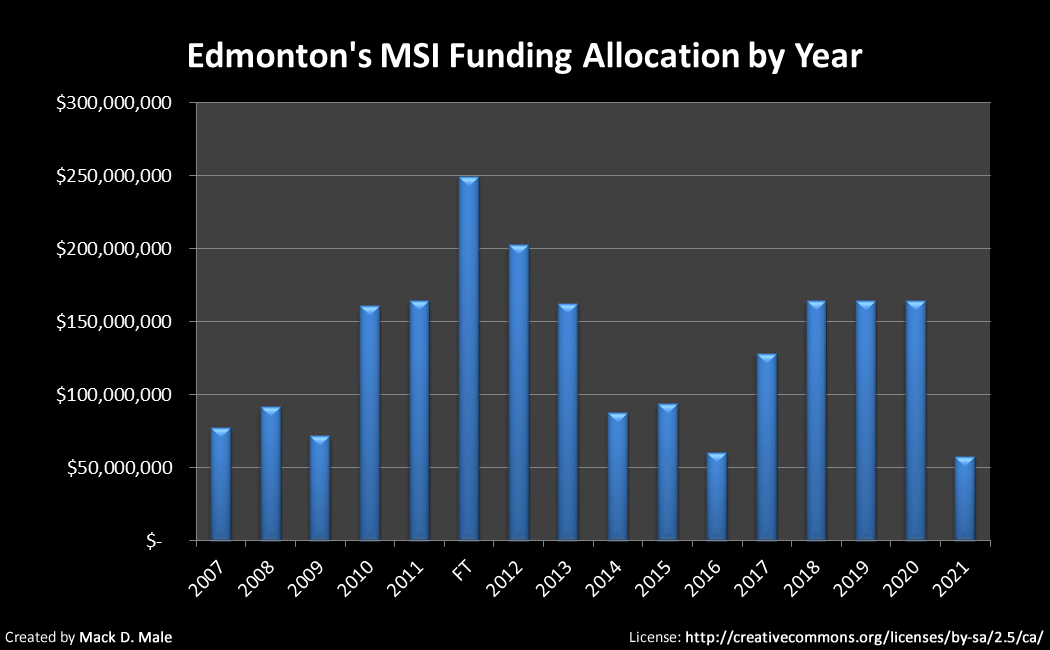
Edmonton is slated to receive a total of $2.1 billion by the end of 2021. From 2007 through 2011, we received about $567 million. In order to take advantage of favorable economic conditions, Council also decided to fast-track another $250 million or so, which means we have used roughly $850 million in MSI funding already. This chart shows the amount of funding per year (with FT designating the fast-tracked amount):

That means we have roughly $1.3 billion still to come over the next ten years. The projected amounts for 2012-2021 take into consideration repayments on the fast-tracked amount. The City’s fast-tracking strategy requires an annual repayment of $57 million, including interest for five years, reducing the amount of MSI available in 2012-2016 by $285 million.

What have we spent our funding on so far?

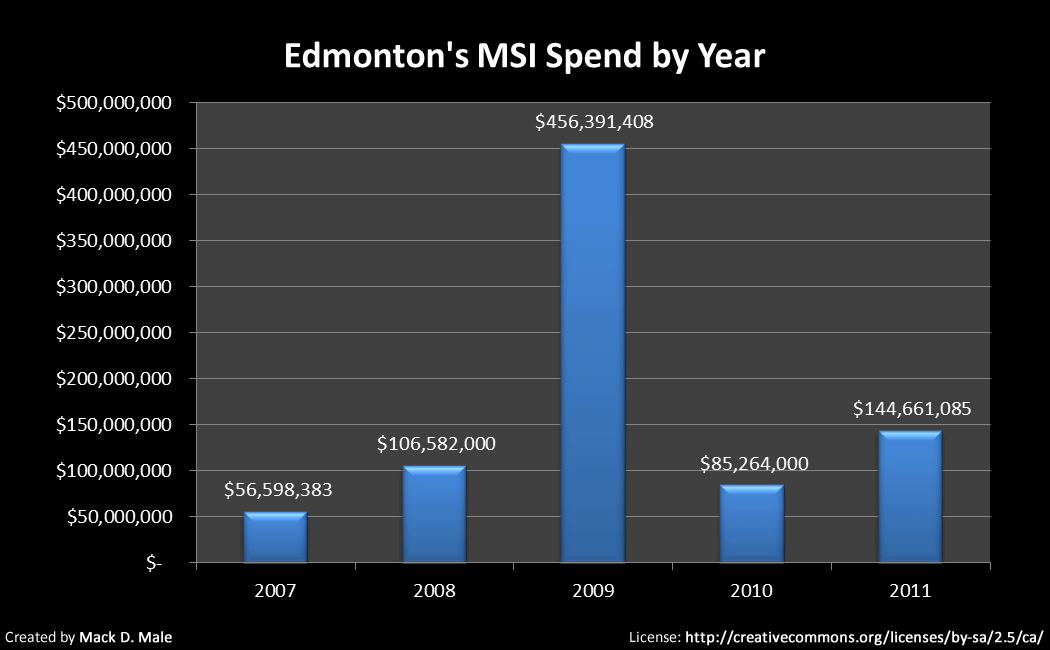
The MSI website provides a list of accepted projects by year for each municipality in PDF. I extracted the data for Edmonton, and organized it in a spreadsheet. Based on the description, I categorized each project as either “new” or “existing” to indicate whether it was for a new asset or to rehabilitate/upgrade/repair an existing one. I also assigned each project a category such as “Parks” or “Transit”. Here’s what we have spent per year:

The total spent is roughly $850 million. The big jump in 2009 was the fast-tracked funding, which allowed us to take advantage of lower construction costs.

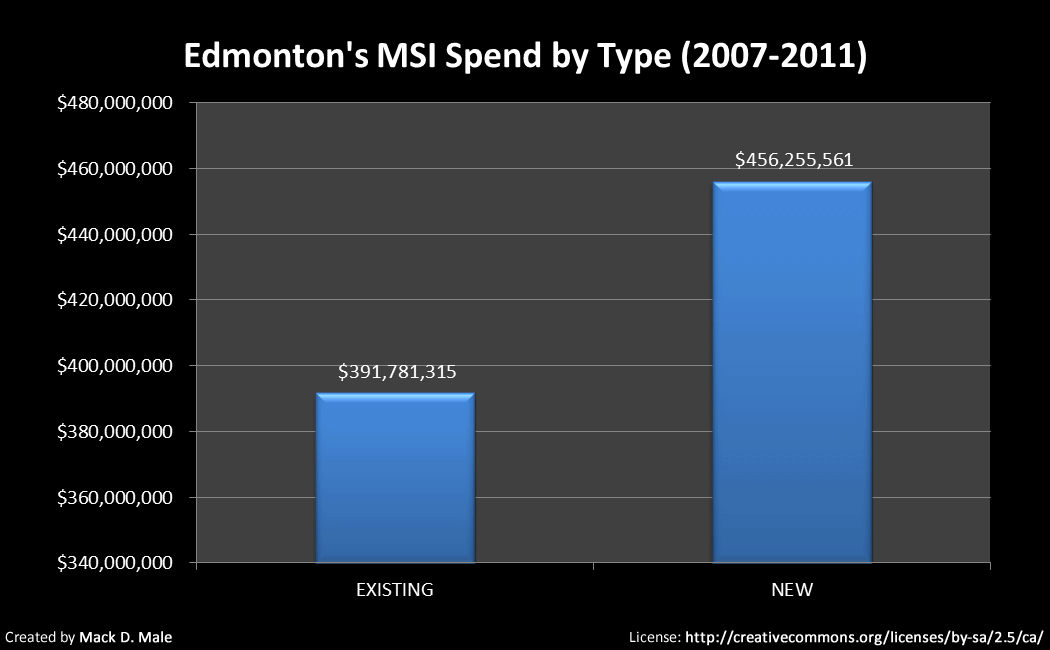
Here’s the breakdown of new vs. existing:

As you can see, roughly 53% of our MSI funding has been spent on “new” projects.

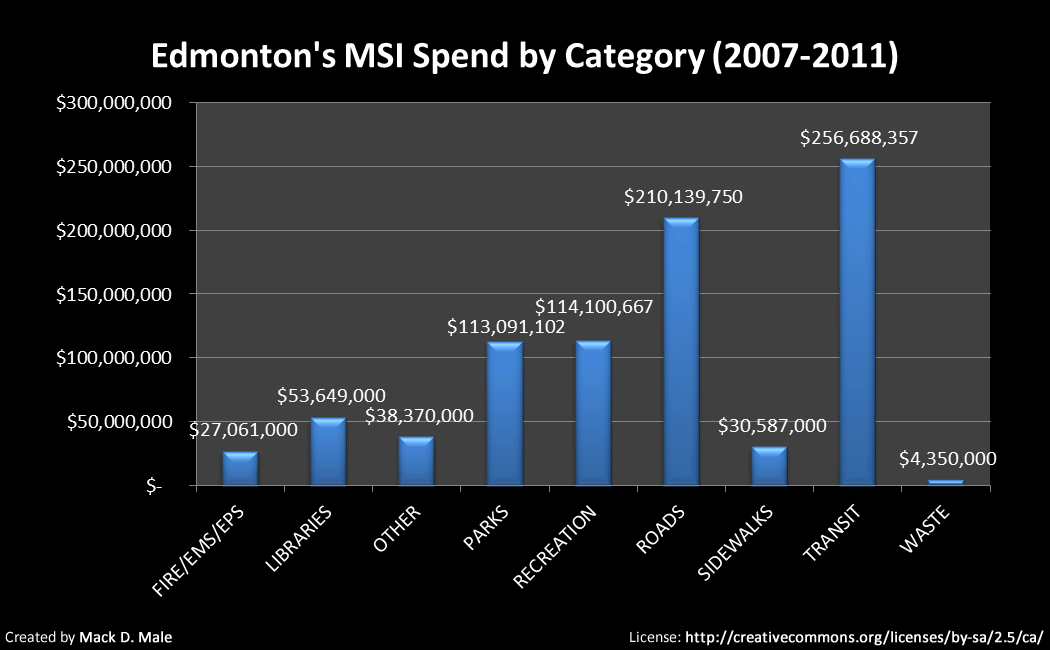
Here’s the breakdown by category:

The bulk of our MSI funding has been spent on transit and roads. Parks and recreation facilities are the only other two categories that have received more than $100 million in funding.

A total of 82 capital projects were listed, with an average project cost of $9.9 million. No project has cost more than $100 million. The largest project we have constructed so far was the new Centennial Garage in southwest Edmonton, which had a total project cost of $99 million ($89.3 million of which came from MSI). It would be fair to call that project an anomaly however – only one other project, to rehabilitate several roads for $61 million, came with a price tag greater than $40 million.

Can we count on an MSI increase in the future?

MSI funding has always been tied to the economy. The amount allocated to municipalities over the first five years of the program was reduced due to weaker than anticipated revenues. The City of Edmonton had expected to receive $802 million over the 2007-2011 period, about $235 million more than the $567 million it ended up receiving. That does not bode well for an increase in the future.

Both Calgary and Edmonton have been pushing for an improved funding framework with the commitment to develop a big city charter. The outcome of that initiative, slated to be considered by the Legislature in the spring, could impact the way Edmonton receives funding from the province.

Should we use MSI funding for the arena?

According to the City, the average age of Edmonton’s infrastructure assets is 30 years. At the end of 2011, more than 150 neighbourhoods required renewal. An average annual reinvestment of $400 million over the next three years, plus an average annual reinvestment of $450 million over the 2015-2021 period, is the minimum amount of funding required to renew Edmonton’s existing infrastructure to achieve a reasonable state of repair. This is a big challenge, and MSI funding provides only a piece of the pie.

As shown above, our MSI spend has been more or less equally split between new projects and upgrades or rehabilitation of existing assets. A total of $87.5 million was spent on seven new recreation facilities (either brand new, or additions to existing) from 2007 through 2011. Would we have rather spent all of that on the arena? A number of new projects would need to be postponed if funding was allocated instead to the arena. A total of $384.8 million was approved by Council for recreation and cultural projects in the 2012-2014 Capital Budget.

In a poll earlier this year, two-thirds of Edmontonians opposed provincial funding going toward the new arena. An equal number supported fast-tracking the southeast LRT line to Mill Woods. It would seem that the use of MSI funding thus far more or less aligns with the desires of Edmontonians, with the largest share going toward transit projects (though not all of that was LRT-related).

This decision would ultimately need to be made by City Council, and as we approach an election next year, I’m not sure many councillors would be willing to take money away from important neighbourhood renewal projects or new facilities like libraries and parks for the arena.

Was today’s downtown arena news a setback or a setup?

Today behind closed doors City Council discussed a request from the Katz Group for more public money for the downtown arena project. In a letter to City Manager Simon Farbrother, the Katz Group’s John Karvellas wrote:

“…we believe the City has significant capacity beyond its commitment of $45 million to help fund the arena, which by all accounts is the catalyst for the CRL itself and which can help to fund so many other important projects to benefit downtown and the entire city.”

Council voted simply to reaffirm its commitment to the funding arrangement that was agreed upon nearly a year ago. Though the Katz Group letter outlines rising costs, it seems as though the request was actually for new concessions. And that didn’t sit well with Council. Only Councillors Sloan and Diotte voted against the motion (they had also voted against the funding deal).

Much of the discussion about today’s news has focused on the absurdity of a last-minute request from the Katz Group. Many have been critical of Daryl Katz’s decision to remain quiet and unseen, suggesting the approach has led to distrust among Edmontonians. And of course, Mayor Mandel’s statement that “frustrated” is a better word than “optimistic” has for many turned the arena from a done deal in to a big question mark.

But I’m not so sure. What if instead of a major setback, today was actually a major setup?

There’s a few things that don’t sit well in my mind. First, the timing is highly suspect. Two weeks ago the Downtown Business Association released a report that suggests $4.8 billion of investment could take place downtown in the next five years. Last week the Chamber of Commerce warned of a “massive setback” if the arena is not built. In between all of that, the province announced its financial outlook and said that revenues will fall short of projections, so a boost from that level of government doesn’t seem any more likely now than it did a year ago. Were the DBA and Chamber announcements simply well-orchestrated PR efforts designed to try to force the City’s hand? One wonders how much influence the Katz Group exerted.

Secondly, there’s much more than just the arena riding on the CRL. Municipal projects including the arena make up half of the DBA’s forecasted $4.8 billion, and most rely on the downtown CRL being approved. If there’s no arena, there’s no CRL, and if there’s no CRL, it’s back to the drawing board on how to fund all of the other initiatives. Talk is cheap yes, but I really do think that most on Council believe in the importance of a strong downtown. The prospect of putting all of the positive momentum and recent progress at risk must not be sitting well with them.

Thirdly, I just can’t get past that suggestion in the widely-circulated Katz Group letter that the City actually has the ability to contribute more money than previously agreed to. That seems like an odd thing to bring up now, at this juncture. Whether it is true or not, the seed has been planted.

Lastly, I think the Katz Group’s statement from this afternoon is quite strange. It focuses on the amount of time and money the organization has invested into the project, but remains optimistic about getting the issues resolved:

“The Katz Group is committed to continuing to work with the City to find creative solutions that work for both sides so that we can get on with the business of ensuring the Oilers’ long-term sustainability and accelerating the revitalization of the downtown core.”

Even more interesting, the statement seems to leave open the possibility that a larger deal can still be arranged:

“We have also offered to pay a fair share of arena construction costs above $450 million as part of a comprehensive package that makes economic sense.”

All of these things have me feeling as though today was more of a setup than anything else. Definitely to position the agreed upon $450 million limit as too low, and maybe even for a white knight to swoop in and save the deal, as I tweeted this afternoon. Could Katz himself now come forward in public with an increased financial offer and make Council look like the bad guys for refusing to match the increased funding requirements? Could someone on Council, perhaps someone angling for the Mayor’s chair next October, have a trick up his or her sleeve? Or perhaps most intriguing of all, could this finally be an opening for the province to step in and look like the heroes for salvaging the deal?

I guess we’ll find out soon enough.

Brad Ferguson is ‘all in’ as EEDC’s new President & CEO

One month into his new role as President & CEO of Edmonton Economic Development Corporation (EEDC), Brad Ferguson is still trying to get a handle on an organization that many would say is in need of change. Starting a new job is tough enough, but Brad’s new position comes with its own unique mix of history, politics, and public scrutiny. Despite that, Brad insists he is ready to tackle the challenges and bring about significant, positive changes. “I have never been so on for something in my life, since maybe when I was starting my own company,” he told me as our coffee interview got underway last week. “I’m fired up, I really am!”

Brad Ferguson

Though he has lived in a number of different places, Edmonton has always been Brad’s home. He earned a B.A. in Economics and B.Comm in Finance from the University of Alberta. A job at Proctor & Gamble took him away from the city in the mid-nineties, but he soon returned to start a family and “really setup shop.” After P&G, Brad spent time at KPMG and TkMC (Sierra Systems) before starting his own management consultancy Strategy Summit Ltd. in 2002. He has made a career out of advising organizations on how to become more competitive to facilitate growth.

He was not thinking about the EEDC job at first, but a series of conversations in recent months changed Brad’s mind. A number of individuals encouraged him to throw his hat into the ring, so he did. After going through the headhunting and formal interview process, Brad started to feel as though he might be selected. “I became downright competitive about it!” He had come to realize that the opportunity was too important to pass up, and he wanted the job.

At just 43 years of age, Brad will bring a perspective to EEDC that the organization has not had in fifteen years. His two most recent predecessors, Ron Gilbertson and Allan Scott, were both 55 when they took the job. Before them, Jim Edwards was 61 when he took over from Rick LeLacheur, the organization’s first president and CEO who was about six months older when he started than Brad is today. EEDC is often criticized as an “old boys club”, so the board’s decision to move ahead with Brad as the new leader reflects a willingness to change.

Established in 1993, EEDC is wholly owned by the City of Edmonton. The organization’s mandate includes the promotion of economic development and tourism, as well as the management and development of the Shaw Conference Centre and Edmonton Research Park. Or as Brad put it, the organization is made up of four very different business units. “We have a major facility and caterer, real estate, tourism, and economic development.” With 130 full-time employees, 650 part-time employees, and a $36 million annual budget, EEDC is a major force in our city yet many Edmontonians wonder what the organization does. Brad wants to change that.

“It’s about being externally focused,” he said. “It’s about demonstrating value to the community.” He acknowledges that structural changes are necessary, not only to change EEDC’s image, but to enable it to deliver on its mandate. “The structure has to mesh with strategy and be aligned to organizational outcomes.” He admits to feeling some public pressure to make changes as well.

That process will take time, but it starts this fall when Brad will take a series of directional statements to the board in an effort to get authorization to further explore the options. He hopes to present a set of recommendations by the end of the year. “I have three phases,” he explained. “Focusing the organization, building leadership capacity, and bringing about a cultural shift.” He’s not sure exactly what that change will look like, but he knows where he wants the organization to end up. “Our structure needs to build confidence and clarity in the marketplace.”

One of the first people Brad called after starting work was Richard Andersen, President and CEO at Northlands. “I want to bring resolution and clarity to the question of Shaw versus Expo,” Brad told me. Competition between the Shaw Conference Centre and Edmonton Expo Centre can sometimes be unhealthy, as each focuses on winning the client instead of ensuring the client comes to Edmonton and has the best experience possible. Like EEDC, Northlands has also struggled in recent years to defend its existence, a problem that only got worse when they were left out of discussions on the downtown arena. Under Andersen’s leadership however, there are signs that things are beginning to change for the better, and Brad certainly holds his counterpart in high esteem. “Richard is an incredible operator and leader in this community.”

The open approach to collaboration will be important as Brad charts a new course for EEDC. “No one organization is responsible for economic development,” he told me. “It’s a system, and it’s important to be supportive of other organizations.” While the amalgamation of the various economic entities in the nineties helped to bring clarity and efficiency to Edmonton’s economic development efforts, perhaps the time has come to reassess that structure. Perhaps EEDC doesn’t need to be in four different businesses.

Even if a breakup is not in the cards for EEDC, there is certainly room for greater coordination with other organizations. Just days after Edmonton Tourism’s joint initiative with Travel Alberta to bring former Bachelorette star Ashley Hebert and her fiance J.P. to Edmonton made headlines, Brad admitted that he learned a lot from the experience. “I have learned who they are,” he quipped. Then, becoming more serious, “I have made it known internally that I want to understand the ROI on this.” Brad was quick to support his staff however, explaining that experimentation and creativity are needed and should be cultivated. As for the collaboration with Travel Alberta, Brad was happy the two organizations were able to work together on a project. Still, he recognizes there is work to do. “There should be a joint context, a joint set of priorities.”

One of Brad’s earliest memories of Edmonton was a walk through the river valley when he was about eight years old. “I remember the green and gold of the leaves,” he recalled. “It felt like a new phase for me.” That same spot, near the Royal Glenora, had an impact on him later too when a conversation about the negative economic situation in Edmonton weighed heavily. In the latest phase of his career, Brad finds himself in a much healthier city, faced with the opportunity to have a major impact.

There are many Edmontonians that have shaped the leader Brad is today, and many that he admires greatly, but two stand out. “Sandy Mactaggart recognized there was opportunity here,” Brad said. “He was a city builder and is still a great philanthropist.” The other is Rod Fraser, perhaps best known as the former President of the University of Alberta. “He is one of the great communicators,” Brad said. “He talked about the university being indisputably recognized internationally as one of a handful of the best organizations.”

EEDC has been vocal about its vision to make Edmonton one of the world’s top five mid-sized cities by 2030, but Brad is not sold on that. “Visions are never achievable,” he told me. “They have to be long-lasting.” The implication is that being a top five mid-sized city is completely reasonable and achievable. “Let’s declare ourselves there, up the bar, and figure out what’s next.” He would rather see us really stretch. After all, as the saying goes, no one gives you power, you just take it.

So what would a stronger vision sound like? “The vision should be to consistently outperform every economic jurisdiction in North America for the next twenty years.” An audacious and yet very measurable statement. “That means when the price of oil fluctuates, we still need to outperform, so that’s resiliency.” The focus on North America rather than simply the world is important, because Brad says the “continental approach is where we want to perform.”

Whenever Edmonton’s aspirations are discussed, two words seem to get thrown around more than any other: world class. “I don’t subscribe to those words a lot,” Brad declared. When pushed for a definition, he said the first thing is we need to be proud of whatever we’re calling world class. And secondly, “it has to be relevant and respected by people outside of our borders.” He did have praise for the downtown arena, perhaps the project most often associated with the term. “I think the arena is a bold, dynamic project, that has the ability to spark the creativity and interest of whole lot of other developers,” he said. “I want to compliment the City for having the courage to really entertain this and to be involved as a partner.”

One word that Brad has been using very consistently and deliberately since taking over as CEO is “complacency.” To him, it perfectly captures one of Edmonton’s biggest challenges. “It’s our number one enemy,” he said. “Right now the economy feels strong, but there are some dark clouds looming.” It’s clear that Brad has thought a lot about the subject, and has strong feelings about how to avoid becoming complacent. “We need to change to a culture of competitiveness,” he told me. “We need to have a hunger to compete.” Despite his cautions about complacency, Brad does feel that Edmonton is more resilient and diversified today than ever before. And he notes that significant opportunities lay ahead for the city. “A number of the things Edmonton has – education, food, water – are things the world wants,” Brad said.

Ensuring we can articulate Edmonton’s story to the world is going to be an important piece in making the most of those opportunities. “There’s a real need to tell our city’s story better,” Brad declared. “I compliment the mayor for his leadership on this.” Noting that everyone has an opinion on the topic, he doesn’t think any one group can fully articulate what Edmonton’s story is. “I think a common language will emerge,” he said. “Something to do with the opportunity to contribute.” Whatever the story is, Brad hopes it has an impact on the way Edmontonians feel about Edmonton. “We have to build a little more pride in how we talk about our city,” he said.

Capital Ideas Edmonton Mixer

While Brad will absolutely need to lead the way as a retooled EEDC works to make Edmonton the economic jurisdiction to beat, he recognizes that he won’t be alone in that quest. “There are so many great people that want to help build this city,” he said. “Part of my job is to help them make something happen.” He stresses that his door is open, and that he’ll be both accessible and proactive. “Everyone can expect my call!”

Despite the economic turmoil taking place around the globe, Edmonton’s economy has remained strong and healthy growth is forecasted for the years ahead. Of course EEDC has a role to play in that, but it’s an indirect one that requires clear direction and strong collaboration. Ensuring EEDC has the right people, strategies, and relationships to play a significant role in that growth is absolutely something Brad must tackle. He’s ready to do just that.

“I want to fundamentally up the value of the organization to the community and to the City of Edmonton.”

Why I deleted my digital music collection

I deleted my digital music collection on the weekend. More than thirty thousand tracks, taking up over 160 GB of space, all gone. It took me years to collect all of those songs, but just minutes to get rid of them. The story of my digital music collection is probably not very unique, but it does illustrate just how far technology has come in such a short period of time.

It started, of course, with Napster. Everyone was talking about Y2K until Napster came along and stole the spotlight. Like so many others, I downloaded the software and quickly found myself searching through thousands of songs. I tried Kazaa and a bunch of other services too. Those services opened my eyes to what was possible and introduced me to a bunch of new artists. Eventually I learned about BitTorrent. No other service came close to matching the convenience, selection, quality, or speed of BitTorrent. I never had a favorite site, but I did use Suprnova, The Pirate Bay, and Mininova.

Once I realized how useful having music in the MP3 format really was, I used MusicMatch, and later Windows Media Player, to rip nearly all of the CDs my family owned (which, let me tell you, was quite a few). One of the first MP3 players I had was Creative’s Nomad Jukebox. It was huge (and looked very much like a discman), but it had a 6 GB hard drive. I loved my original iPod, well except for the battery life. In 2004, I got the Creative ZEN Touch for Christmas (which despite the name did not have touch functionality). I had a variety of other MP3 players over the years, and my favorite was probably the iPod Touch.

Score! iPod touch!
Purchasing my iPod Touch from the Apple Store in NY in 2007

I have purchased one and only one album with DRM. If I remember correctly, it was Social Code’s A Year at the Movies. Though I had read a lot about artists earning more from concerts than albums, I wanted to try to do the right thing. Turns out syncing it to my devices was not easy. Moving the album to a new computer was even harder. The experience was so horrible that I vowed to never purchase DRM-enabled music ever again.

I tried lots of different software for managing my growing library, but nothing worked better than Windows Media Player. I have never been a fan of iTunes, which is quite possibly the worst software ever written for Windows. Most other apps just fell over when I added the entire library, but WMP just kept working. I spent quite a bit of time organizing songs, making sure they had the right metatags, adding album art when WMP couldn’t identify it automatically.

Now I find myself wondering why I ever put in all that effort. The answer of course, is that I didn’t have any other options. You couldn’t buy digital music at first, and then when you could, it was laden with DRM. Streaming music services didn’t exist probably because Internet connections were slow and intermittent. The “cloud” wasn’t yet a thing.

I haven’t touched any of my downloaded music in months. That’s why I deleted it. I’ve been a paying customer of Rdio for exactly a year now, and I love it. With over 12 million songs in the catalogue, there’s rarely something I want to listen to that isn’t available on Rdio. It works on all my devices and in pretty much any browser. It connects to Facebook to automatically share what I am listening. The audio quality is fantastic. Every album and song is labeled correctly and has album art. It’s amazing that I get all of that for just $4.99 per month. Streaming music services have most definitely arrived!

I know some people prefer to “own” their music libraries, but I have never felt that desire. I never built a massive physical media collection like a lot of people did, so I guess I never developed any attachment to “owning an album”. For me, listening to the music I want, when I want, where I want, is really all that matters. Five or ten bucks a month to have access to an impossibly large collection, on any device, at any time, is totally worth it to me.

As much as I love Rdio, I think I’ll probably switch to Xbox Music when it becomes available. For me it’s all about the ecosystem, and I have chosen Microsoft’s. An inexpensive service that works on my computers, my Xbox, and my phone with a first-class experience on each? Yes, please.

Walk or run for a cause in Edmonton in September

There are dozens of fundraising walks and runs in Edmonton throughout the year, but perhaps the busiest month of all is September. Every weekend this month, Edmontonians will be walking or running to raise funds for a variety of worthy causes.

Powered by ShareEdmonton, here is a list of more than 20 fundraising walks taking place in September:

Edmonton Gorilla Run September 8 Victoria Park
Walk Now for Autism Speaks September 9 Rundle Park
Run FASD Edmonton September 9 Emily Murphy Park
Ovarian Cancer Canada Walk of Hope September 9 Sir Wilfrid Laurier Park
Walk a Mile in Her Shoes September 11 Churchill Square
Climb of Hope Run September 15 Victoria Park
Freedom Relay Edmonton September 15 Emily Murphy Park
Butterflies & Bowties: Thyroid Cancer Run/Walk September 16 Hermitage Park
Life Without Limits Challenge September 16 Rundle Park
ASSIST Walk & Run September 16 Louise McKinney Riverfront Park
A Walk/Run for Child Survival September 16 Victoria Park
Take Back the Night September 21 Alex Taylor School
Open Minds Walk & Run September 22 Rundle Park
Shinerama Fun Run September 22 TBA
Edmonton Heartbeat Run September 23 Louise McKinney Riverfront Park
Scotiabank AIDS Walk for Life September 23 Churchill Square
Ride for Diabetes Research September 28 Churchill Square
Light the Night Walk September 28 Victoria Park
Kenya Run for Water September 29 Emily Murphy Park
Walk for Children with Apraxia of Speech September 29 Rundle Park
Sight Night Edmonton September 29 Kinsmen
CIBC Run for the Cure September 30 Churchill Square

You can always see the latest charitable events at ShareEdmonton in the Causes category. You can download an iCal feed here.

I unfortunately won’t make it to Walk a Mile in Her Shoes this year, but it was lots of fun when I participated last year! It’s always entertaining to see the guys walking in high heels, so head down to support them on September 11.

Walk a Mile in Her Shoes

I have participated in the AIDS Walk a few times, and I am always amazed at how many people take part. If all the events listed above have strong turnouts, there could be a significant amount of money raised this month!

AIDS Walk For Life 2009

Do you know of another fundraising walk or run taking place this month? Let me know!

Celebrities will never be Edmonton’s cheerleaders

There’s no such thing as bad publicity – isn’t that how the saying goes? That might have been a good maxim in the past, but I’m not so sure that Travel Alberta and EEDC would agree with it in the current social media-laden world. Both agencies have taken a virtual beating over the last week for their decision to spend $20,000 to bring former “Bachelorette” star Ashley Hebert and her fiancé J.P. Rosenbaum to Edmonton. The couple was flown in from New York, stayed at the Fairmont Hotel MacDonald, visited the Art Gallery of Alberta, the Old Strathcona Farmers Market, and the Edmonton International Fringe Theatre Festival, and ate at Joey’s. They seemed to have a good time, judging by their tweets, and both Travel Alberta and EEDC have been defending the expense. But questioning whether or not the trip was worth it for us is just one of the many questions that Edmontonians have been asking.

Perhaps the first question is: why Ashley and J.P.? The answer is demographics. Despite having eight seasons under its belt, “The Bachelorette” remains an incredibly successful show for ABC. And significantly, it performs very well in the all-important 18-34 demographic. In fact, the show is #1 in its timeslot for that demographic. Reaching potential visitors in the 18-34 age group is an important target for Travel Alberta and EEDC. Those are the folks that have the disposable income and ability to visit, and they’re also the group that might want to move here to work or to start a family.

Another question that comes to mind is, what do we get in return? Travel Alberta and EEDC will tell you that the return on investment comes in the form of media coverage. Incredibly, they think that we’ve earned at least $250,000 in media coverage. I suspect that figure is based predominately on the number of page views a website gets. Well let me tell you, I could put up a website with photos of the trip and spend a couple of hundred dollars and within hours I’d have hundreds of thousands of page views, but they’d all be completely worthless. Take a look at the coverage that EEDC has been highlighting. Here’s the “coverage” that appeared on CBSNews:

cbsnews

How is that photo supposed to make anyone want to visit Edmonton? Or how about this article or this blog post. Would anyone seriously look at that and say, you know, I want to visit Edmonton! I know that you have to stay top-of-mind if you want to be considered, but it feels like we’re deluding ourselves here. I think the most valuable exposure we got from this trip was the tweets from Ashley and J.P. themselves, yet that doesn’t appear to have been factored into that $250,000 number.

Let’s assume that bringing Ashley & J.P. was a good investment because of the target demographic we want to reach and the media coverage that we received as a result. Did the itinerary align with that? The couple stayed at the Fairmont Hotel MacDonald. Aside from the fact that the hotel doesn’t seem to match the couple’s style, it’s probably not the first place a 25-year-old visitor might consider. Why not have them stay at The Matrix or The Metterra hotels? The folks at Hotel Mac are fantastic, and I’m sure they took great care of Ashley and J.P., but it doesn’t seem like the right choice. I certainly can’t complain about the activities – the Fringe, the AGA, and the OSFM are all excellent stops (though I would have preferred to see them at the City Market Downtown). Sending the couple to Joey’s for dinner, however, was shocking to me. Travel Alberta talks a good game about culinary tourism, but this makes me question everything about their efforts on that front. You fly them all the way to Edmonton to eat at a chain? I know that independent restaurants can sometimes be trickier to work with, but if you’re not going to do it right don’t do it at all. You know which restaurant is not on Dine Alberta’s list of those that serve local food? Joey’s.

Could Travel Alberta and EEDC have taken a different approach? If you’ve seen “The Bachelorette” (judge me if you must but I have) you’ll know that the show is really more of an extended travel commercial than an emotional quest for true love. The bachelorette and her potential suitors fly all over the world to attractive, romantic destinations. Beaches, mountains, and busy cobblestone streets are all common sights. If reaching viewers of “The Bachelorette” is important, why not work to have Edmonton and Alberta featured as one of the destinations on the show itself? At least that way we’d be able to showcase our natural beauty and probably one or two interesting activities too. Maybe Travel Alberta and EEDC have tried to make that happen, I’m not sure, but it does seem like the return would have been greater.

I really hope that Travel Alberta and EEDC both review this experiment and learn from it. We need creative and innovative approaches to attracting tourism and investment to Edmonton, but that still has to align with strategic objectives. I would hate to see the individuals responsible for this reprimanded – instead I hope they are recognized for their initiative but educated about the importance of providing context. The uproar over this relatively minor $20,000 expense could have been almost completely avoided. And while it’s great to see Travel Alberta and EEDC working together on something, it seems to me that a few more discussions about shared objectives should have taken place first.

Ultimately, I don’t think we should ever count on celebrities to be Edmonton’s cheerleaders. Sure they might tweet something about how much they loved Edmonton, but at the end of the day that has very little impact, and there’s no guarantee that media coverage will result. The connection between bringing celebrities to Edmonton and the increased tourism and economic activity that may result seems tenuous at best. Instead of focusing on a few celebrities here and there, let’s focus on the 1.2 million people that already have a strong connection to Edmonton. Let’s provide Edmontonians themselves with the confidence, tools, and common language to tell others just how great Edmonton is and why they should come here to live, work, or play.

I’d spend $20,000 on that, wouldn’t you?