Recap: Public Meeting on Proposed Arena & Entertainment District in Downtown Edmonton

Last night at MacEwan’s City Centre Campus the City of Edmonton held a Public Meeting on the proposed Arena & Entertainment District (on ShareEdmonton). I don’t know what the final attendance numbers were, but my rough guess is that about 100 people were in the room. There were a number of City representatives on hand, led by Scott Mackie from the Planning & Development department. Councillors Batty and Henderson also attended. From the Katz Group, Jim Low, Bob Black, and Steve Hogle were all there, along with Simon O’Byrne from Stantec, and Ray Davis from Bunt & Associates.

Public Meeting on AED RezoningPublic Meeting on AED Rezoning

The purpose of the meeting was to provide information on and to gather feedback about a proposed rezoning from DC2.500 to a new AED zoning. Such a change would require an amendment to either the existing Capital City Downtown Plan or the new one that Council is expected to approve this summer.

The night started with a brief presentation from Scott Mackie, as well as introductions of all the representatives:

Next Jim Low gave an overview:

The final (and very long) presentation was from Simon O’Byrne (only about the last two minutes are missing):

That was followed up by questions and comments from the audience, which I unfortunately had to miss (but it was live-tweeted, see below). I’m not sure why the Katz Group and its representatives got to talk for 45 minutes; I thought that’s why they held their own open house a couple weeks ago? Maybe that’s just how these things go.

Here’s a map of the area that the Katz Group would like rezoned:

Here are the tweets tagged #yegarena that were posted two hours before, during, and two hours after the public meeting (in reverse chronological order):

You can get the full version here. Here’s a quick Wordle I made with that data (removing usernames and the hashtag):

Both @journalistjeff and @bingofuel did an awesome job live-tweeting the meeting!

If you’d like to learn more about the rezoning process, you can do so here. I was pleased to see the City actively promoting its Planning Academy at the meeting. The proposed rezoning is tentatively scheduled to go to a public hearing on June 28, but that date could change – stay tuned to #yegarena for updates.

Public Meeting on AED RezoningPublic Meeting on AED Rezoning

You can see the rest of my photos from the event here.

UPDATE: Check out Jeff’s excellent recap here.
State of the Edmonton Twittersphere – April 2010

Welcome to the fourth State of the Edmonton Twittersphere of 2010, my look at the intersection of Twitter and Edmonton, AB. You can see last month’s stats here.

For information on the data, definitions, and other background, click here.

For April 2010:

# of local users: 7673 (a decrease of 422 from March)
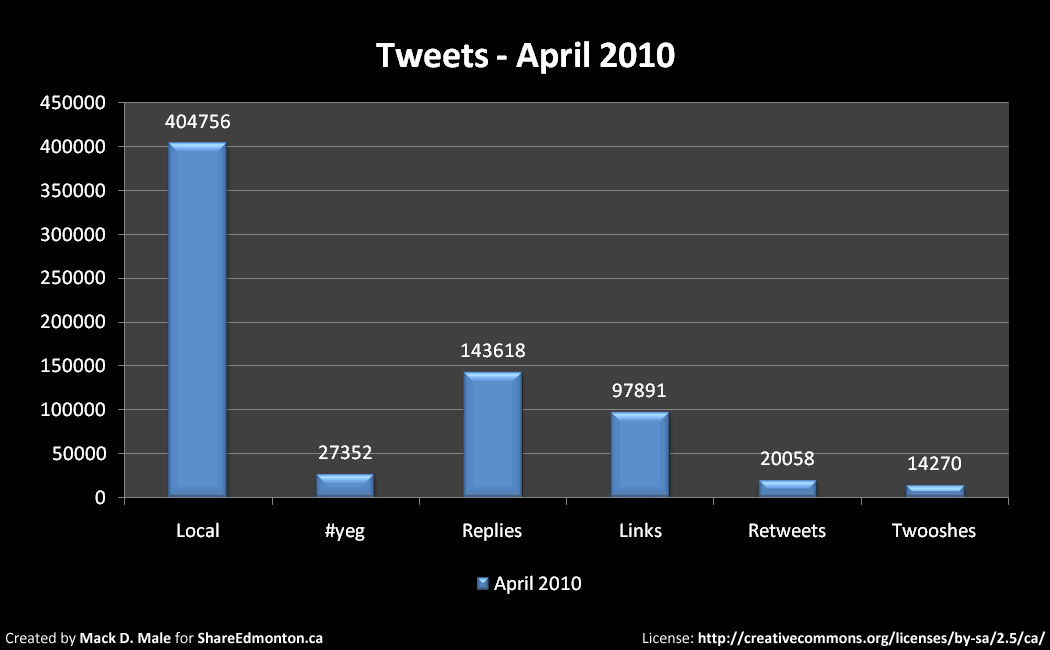
# of tweets by local users: 404756
# of tweets by local users containing #yeg: 27352 (6.8%)
# of tweets by local users that were replies: 143618 (35.5%)
# of tweets by local users containing links: 97891 (24.2%)
# of tweets by local users that were retweets: 20058 (5.0%)
# of tweets by local users that were twooshes: 14270 (3.5%)

Here are the numbers above in graphic form:

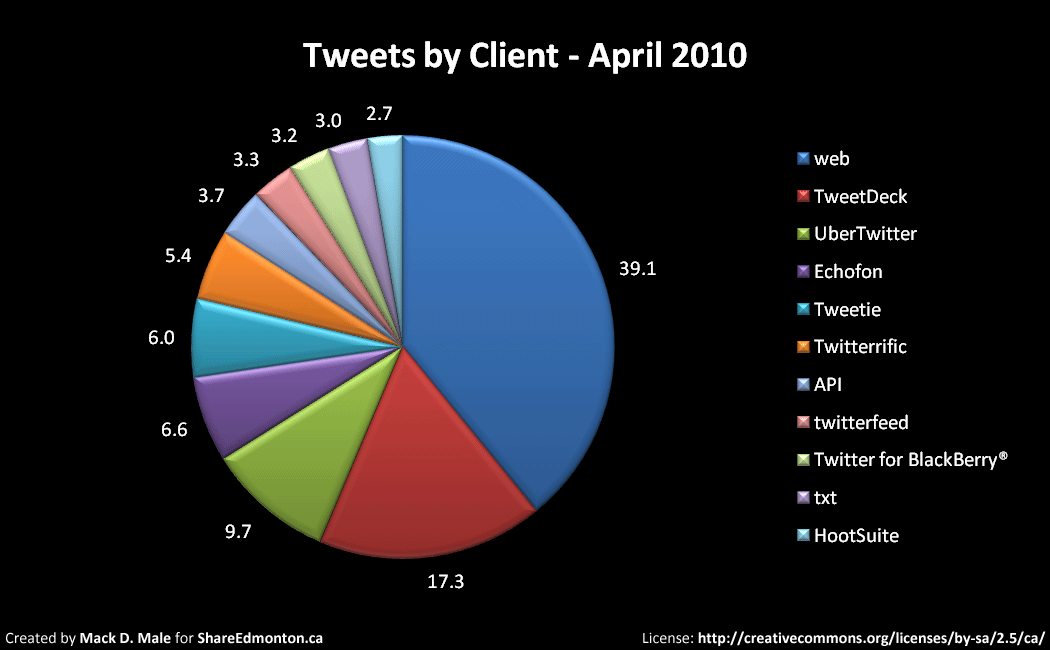
Here are the top clients used by local users for posting updates – looks like Twitter for BlackBerry is rising quickly:

Some other interesting stats for the month:

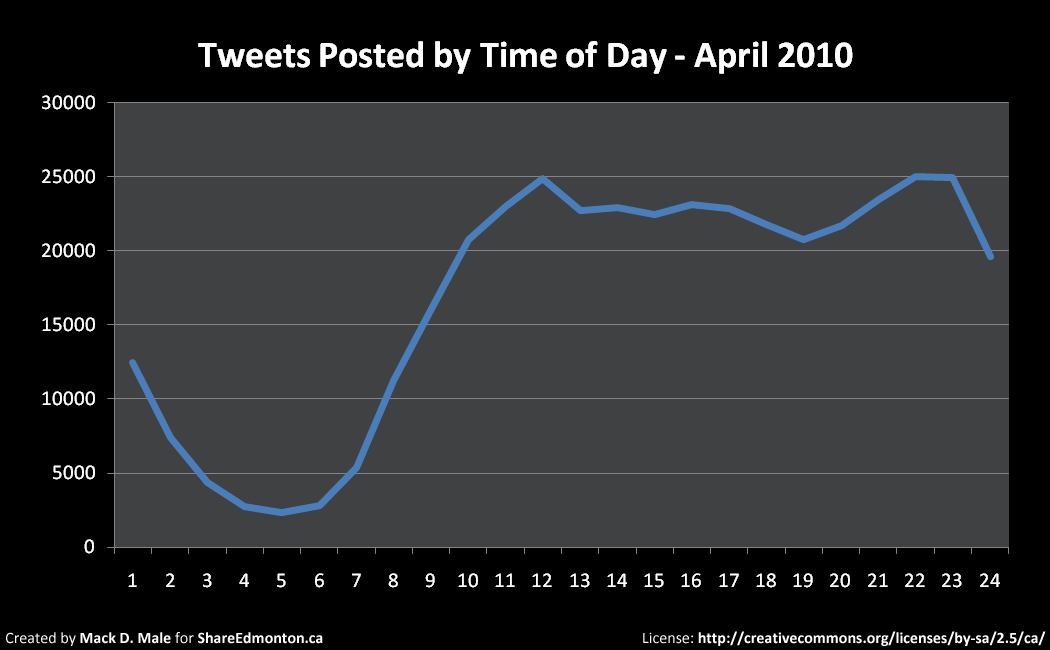
  • Just under 51% of all local tweets were posted between 9 AM and 5 PM.
  • Local users posted roughly 9.4 tweets per minute in April (compared to 9.3 tweets per minute in March).
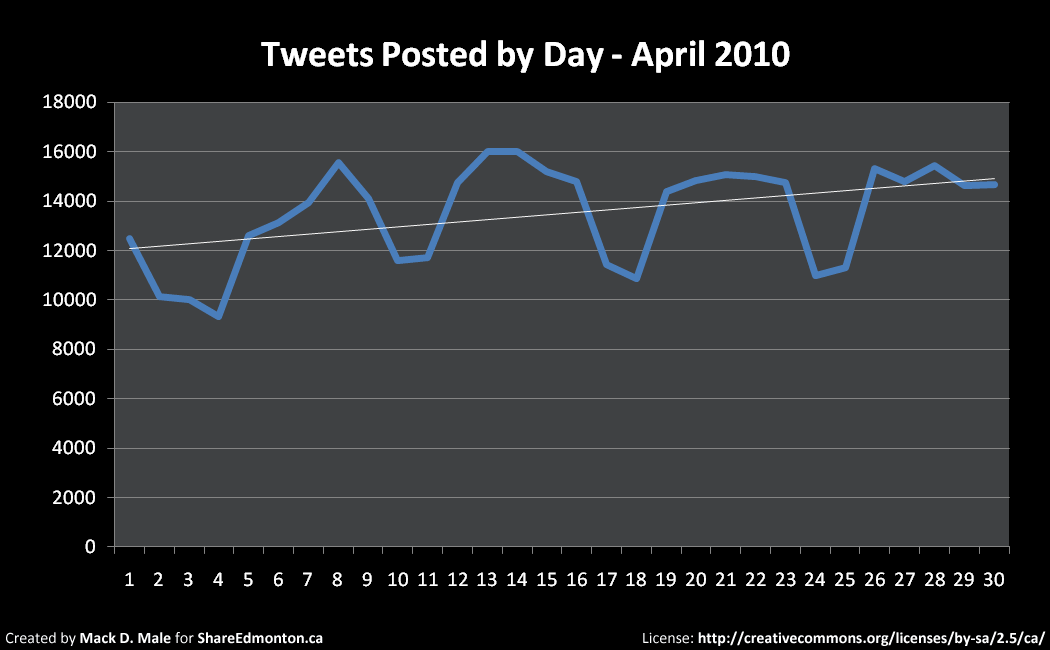
  • The day with the most local tweets posted was April 13 at 16015. On average, 13492 local tweets were posted each day (compared to 13449 in March).
  • Of the 143618 replies posted by local users this month, 49910 or 34.8% were to other local users.
  • A total of 1572 users posted 50 times or more in March. In comparison, 1075 users posted just once.

Here are the top ten most followed local users:

  1. Pat_Lorna
  2. revtrev
  3. randyfritz
  4. dancinginlife
  5. LesM
  6. dragonage
  7. DrBarryLycka
  8. NHL_Oilers
  9. patkSTEREOS
  10. redneckmommy

Here are the top ten most listed local users:

  1. randyfritz
  2. revtrev
  3. dragonage
  4. paradepro
  5. redneckmommy
  6. DaBaby
  7. dancinginlife
  8. NHL_Oilers
  9. Pat_Lorna
  10. edmontonjournal

Here are the top ten most active local users:

  1. EdmontonBizcaf
  2. Lekordable
  3. rootnl2k
  4. etownmelly
  5. DWsBITCH
  6. Gen22
  7. frostedbetty
  8. CommonSenseSoc
  9. PsychicJay
  10. EdmontonCP

Here are the top ten most active local users using #yeg:

  1. edmontonjournal
  2. WeatherEdmonton
  3. EdmCa
  4. DebraWard
  5. oilersff
  6. iNews880
  7. cbcedmonton
  8. livingsanctuary
  9. ctvedmonton
  10. Tamara_Stecyk

Here are the top ten most replied to local users:

  1. frostedbetty
  2. ZoomJer
  3. britl
  4. CommonSenseSoc
  5. angelzilla
  6. Jenaseegalet
  7. GuitarKat
  8. bingofuel
  9. adampatterson
  10. Wildsau

Here are the top ten most retweeted local users (by other local users):

  1. edmontonjournal
  2. mastermaq
  3. ctvedmonton
  4. cbcedmonton
  5. CityofEdmonton
  6. BrentWelch
  7. dantencer
  8. bingofuel
  9. sonic1029
  10. iNews880

Final Thoughts

I did some additional work on my algorithm for identifying local users, which accounts for the drop in users from last month. I think it’s more accurate now. I think the “most retweeted” list is useful for measuring influence, though it alone doesn’t tell the whole story.

UPDATE: Just to clarify, the most retweeted list only accounts for standard-style retweets (those using Twitter’s retweet feature or those starting with RT @) made by other local users. I hope to improve this over time.

Civic Smart Card coming to Edmonton?

At today’s Executive Committee meeting Councillors will discuss a report on Smart Card Solutions, the result of an inquiry Mayor Mandel made back in February. You might remember that the Transportation & Public Works Committee had approved a recommendation that ETS implement a smart card solution. But why should ETS be the only ones to benefit? That’s the thought that prompted the mayor to ask for more information.


A civic smart card would be something like the cards pictured above, presumably more like a modern credit card with a little chip embedded inside. It could serve two primary purposes: payment, like a gift card you’d get at Starbucks, but also identity, like a digital driver’s license.

The new report sidesteps the question about what it would take to implement a civic smart card that would work for all City services, including the Edmonton Public Library, essentially saying that a business case would need to be made, and that more research needs to be done to find similar solutions implemented elsewhere. I suppose that’s prudent, but I would think based on the TPW report that they’d have some idea (the estimate for an ETS solution was close to $23 million, which would pay for itself within 15 years).

Some highlights from the report:

  • Administration would contact the provincial and federal governments “to investigate possible synergies in respect to pilot projects around identity management.” Apparently both have already started exploring similar ideas.
  • ETS, Community Services, EPL, EFCL, and the University of Alberta are just a few of the potential partner organizations mentioned.
  • In response to the mayor’s question about engaging the public: “For a civic smart card to be successful and fully adopted by Edmontonians, Edmontonians must be engaged in the design and implementation planning process as well as the actual implementation of a solution.” Administration would leverage “every channel from town hall meetings to social media.”
  • For the IT folks reading this: “Administration should also engage the IT community by creating a project advisory group made up of Edmonton’s best and brightest technology minds…”

By improving Edmonton’s livability, the civic smart card supports the City’s strategic plan. What are the next steps?

The Information Technology Branch will take the lead, working with city departments and external stakeholders to develop the value assessment to determine if this initiative should be considered in the 2012-2014 capital budget. This project will provide a test case for the new IT governance framework which is being designed to allow the city to make the right technology investment decisions.

I really love the idea of a civic smart card for Edmonton. A quick Google search reveals lots of examples of transit cards, and even some parking cards, but not much for city-wide cards. As Councillor Iveson pointed out back in October, when writing about a smart card for ETS, “this isn’t leading edge stuff anymore. This is now an established practice.” I agree – ETS absolutely needs this. Something city-wide is quite intriguing, however, and I think Edmonton would be one of the innovators there.

Let’s get it done!

If you want to follow along with today’s meeting, you can do so here.

Putting incidents at the Stanley Milner library into perspective

The Stanley Milner Library was in the news a lot last week thanks to a few violent incidents that happened outside the main entrance. Mayor Mandel suggested moving the entrance to the back, away from Churchill Square, an idea that EPL CEO Linda Cook doesn’t agree with (more on this from Colby). I don’t either. I’d much rather see the sidewalk widened, and perhaps the bus stop moved.

Then I got to thinking – maybe we’re making a big deal out of nothing.

This is based on data from the Edmonton Sun (and I used IBM’s Many Eyes to get the proportions right). There were 1.4 million visits and just 728 incidents in 2009. Incidents here include everything from “noisy patrons to public intoxication”. How many violent crimes are there? I’m guessing a lot less.

I’m not trying to downplay the violent crimes that have occurred, but if so many people use the library without incident maybe the entrance isn’t the issue.

OpenID Connect

I’ve been doing some work with OpenID and OAuth lately, making use of the excellent DotNetOpenAuth library. I am pretty much a beginner when it comes to these technologies, but I have been able to get up-to-speed fairly quickly. I was a big fan of Facebook Connect, and I quite like the new Graph API too (which uses OAuth 2.0). Though it was easy to develop against, I think the biggest benefit of Facebook Connect was the excellent end user experience. It was consistent and simple.

In contrast, OpenID is a little more cumbersome, and a lot less consistent. The discussion on how to make it easier and sexier has been going on for a while now. It seems like some significant progress will be made this week when OpenID Connect is discussed at the Internet Identity Workshop. What is OpenID Connect?

We’ve heard loud and clear that sites looking to adopt OpenID want more than just a unique URL; social sites need basic things like your name, photo, and email address.

We have also heard that people want OpenID to be simple. I’ve heard story after story from developers implementing OpenID 2.0 who don’t understand why it is so complex and inevitably forgot to do something. Because it’s built on top of OAuth 2.0, the whole spec is fairly short and technology easy to understand. Building on OAuth provides amazing side benefits such as potentially being the first version of OpenID to work natively with desktop applications and even on mobile phones.

Chris Messina has some additional thoughts on the proposal here:

After OpenID 2.0, OpenID Connect is the next significant reconceptualization of the technology that aims to meet the needs of a changing environment — one that is defined by the flow of data rather than by its suppression. It is in this context that I believe OpenID Connect can help usher forth the next evolution in digital identity technologies, building on the simplicity of OAuth 2.0 and the decentralized architecture of OpenID.

It sounds very exciting – I hope OpenID Connect becomes a reality!

U of A Chancellor Linda Hughes on Community Engagement & Public Policy

Last night Sharon and I attended a talk with University of Alberta Chancellor Linda Hughes, part of the Edmonton Speaker Series created by the Edmonton Community Foundation, E4C, and the Edmonton Social Planning Council. Linda was the first female editor-in-chief of a Southam newspaper and was also its first female publisher (of the Edmonton Journal) so I was really interested in hearing her thoughts on community engagement given her experience in the media industry.

Linda started the evening by introducing A Joyful Noise Choir, a choir “for people who believe they cannot sing.” They performed three or four songs for us – it was a welcome surprise and a great way to start off!

A Joyful Noise Choir

After returning to the stage, Linda explained why she thought it would be a good idea to start with the choir. She said it was the perfect metaphor for what community is all about – individually, the choir members didn’t feel they could sing, they didn’t have a voice, but collectively, they sang beautifully. I couldn’t help but think of the wisdom of the crowd as she said this – the best crowds are those with great diversity, just like the choir (men, women, old, young, etc).

Linda spent most of her time talking about the importance of education, bombarding the audience with the same statistics that U of A President Dr. Indira Samarasekera shared during the EEDC Annual Luncheon last month. She started, however, by relating how disconnected from public policy she had to be while working at the Edmonton Journal. Unable to publicly support an issue, or make a donation to a party, or otherwise seem unbiased, Linda felt ill-prepared when she took on the role of Chair of the Mayor’s Committee to End Homelessness here in Edmonton. Obviously, she got the hang of it pretty quickly! She said that what she learned was that it’s not just about “being political” but rather about getting informed and pursing an issue you’re passionate about.

A little aside…as I’ve written here before, I have difficulty accepting the notion that journalists are unbiased. They’re human, and they have opinions and a bias – it’s natural. Why can’t we just accept that and move forward? It’s really only an issue if you read just a single opinion. If you think critically and seek out a number of viewpoints and opinions, like you should be doing, then you’re not going to be misinformed.

Linda transitioned from the “you need to be informed” train of thought into discussing the importance of education. She shared some of the experiences she’s had during her time as Chancellor at the U of A, as well as some of the great research that has come out of the university and had a positive impact on the community here and abroad. My favorite example was Acticoat, a bandage that uses silver to speed up healing and reduce the frequency with which bandages must be changed. Acticoat is the world’s first commercial medical application of nanotechnology, and it was created at the University of Alberta. Very cool.

Linda closed by imploring everyone in the audience to help make education the top public policy issue. She explained that education is the key to solving all of the other issues that we’re passionate about.

Though I was hoping for a little more on the media perspective, I enjoyed Linda’s talk! Next up in the series is Sheila Watt-Cloutier, a 2007 Nobel Peace Prize nominee, who will be speaking in September.

In Search of the Northern Lights by way of Edmonton

As I mentioned back in January, I’ve been doing a little work for EEDC, hosting travel media when they come to visit Edmonton. Usually it’s just a casual lunch, which I really enjoy – I get to learn a little about where they’re from and they get to ask me anything about Edmonton! The only thing I don’t like about the experience is that I don’t always get to see the result of their trip (because the article or video or audio clip is generally created for audiences somewhere else in the world). Fortunately, that’s not always the case!

A couple of months ago I had lunch with a group of four travel journalists from the UK. Twitter came up as we were chatting, and I learned that one of them, Sarah Foden, was on Twitter! A couple of weeks ago she sent me a tweet to say that the video she created for her trip was online. Here it is (click the image below, I can’t seem to embed the video):

sarahfoden

Her video is called “In Search of the Northern Lights” and Edmonton was just one stop along the way. She wrote:

Fortunately, as I discovered, the great thing about visiting both northern Alberta and the city of Edmonton is that these places are about so much more than the Northern Lights.

It turns out that Sarah’s video is now one of the top videos on Sky.com (the company she works for). Congrats Sarah!

As someone who loves to promote Edmonton, it’s great for me to get another perspective on how our city is being portrayed abroad. Can’t wait to do it again!

Thoughts on Connections 2010

On three Thursday evenings in April the City of Edmonton hosted an event called Connections 2010, designed to connect residents with City staff to learn about programs, services, and projects. Organized by the Office of Great Neighbourhoods, Connections 2010 brought more than 40 City departments and programs together under one roof.

The first was held on the southside on April 15 at Taylor University College. The second was held on April 22 for westside residents at the Mayfield Inn & Suites. The third and final event was held on April 29 at the Alberta Aviation Museum, and that’s the one I finally made it out to.

Connections 2010Connections 2010

Upon arriving I was greeted and given a quick rundown of what to expect: booths spread throughout the venue, and a stage in the back corner that would have different presentations every half hour. I missed the first on Capital City Clean-up, but arrived just in time to hear Councillor Batty speak about EXPO 2017. There were about a dozen people who listened to the brief pitch.

Next I walked around the museum, stopping at a number of the booths to chat with the City staff who were present. There were some really great displays – my favorites were the one explaining where your tax dollars go, and the Safe Communities one that featured a speed gun and display to see how fast you were walking. I also had a great chat with a young lady from the Waste Management branch.

Connections 2010Connections 2010

Eventually I made my way to the garbage can that a number of people were painting. It was destined for the African Centre, part of a program to beautify trash receptacles at community centres around the city. I’m really not an artist, but I was convinced to help paint a small part of it:

Connections 2010

It was kind of fun actually!

In total I probably spent about an hour and a half at the event. I thought it was a decent event, but there’s lots of room for improvement. Here are my thoughts:

  • Attendance was pretty disappointing. Maybe 100 About 210 people attended the evening I was there, and I’m told that was the busiest night of the three.
  • The silver lining to the low attendance was that City staff from various departments had the opportunity to learn about one another.
  • I found out from Treena Schmidt, one of the event organizers, that the booths were laid out according to the Transforming Edmonton themes – the way we move, the way we grow, etc. I thought that was pretty smart! It’s great to see more City events/programs thinking in the context of the bigger picture.
  • I’m not sure the venue choices were particularly good. I would rather have seen one closer to downtown, maybe at the MacEwan campus or in Enterprise Square. Another idea would be to host one of the nights at a high traffic location, like a shopping mall or something.

I also asked Treena if her team had consulted with any other similar events, and she said was very honest and said no. I mentioned Everyone for Edmonton, which I immediately thought of as I walked through Connections. I think the thoughts I wrote about how to improve that event are all relevant for Connections as well, in particular the need for a “hook”. Why not showcase local artistic talent at the event? Local performances can be a great draw. You can get information on all of the City’s programs and services online. I think there needs to be something else to attract people.

There’s probably also something to be said for improved promotion. I think the Great Neighbourhoods team organized this year’s series of events pretty quickly, so hopefully they’ll have more lead time next year. I think there’s a solid base they can build upon, and I look forward to an improved Connections series next year!

You can see the rest of my photos from the event here.

Recap: Edmonton Arena District Open House

Yesterday Edmontonians had the opportunity to visit the Art Gallery of Alberta to learn more about the proposed Edmonton Arena District (EAD). At least that was the intent of the open house – I’m not sure how many people actually came away with a better idea of what the proposed downtown arena is all about or how it’ll become a reality. Representatives from the Katz Group, Stantec Consulting, Bunt & Associates, and Anschutz Entertainment Group were on hand to answer questions, and there was a number of images and other bits of information on display.

Edmonton Arena District Open House

Clearly the downtown arena is a topic that many Edmontonians find interesting. When I visited the open house at around 11:15am, it was already at capacity (200 people at at time). By 5:00pm, the total number of visitors was close to 2000. In all, around 2650 people stopped by. It’s great that EAD is working to involve the public in its plans, and I’m very happy that so many people took the time to learn more.

Edmonton Arena District

For those of you who have been following this issue, there wasn’t anything new presented. None of the big questions were answered: proposed funding models, or details on cost. I did ask some questions about parking (I want less not more), and got almost a word-for-word response from the FAQ page. The only additional bit of information that was provided to me was that there would be “seven LRT platforms within a few blocks of the area.” I’m really not sure where that number comes from.

Edmonton Arena District Open HouseEdmonton Arena District Open House

A quick scan of the #yegarena hashtag on Twitter yesterday suggested a good mix of negative and positive tweets. I decided to run all 110 tweets through OpenAmplify, a semantic web service I’ve been experimenting with. It can identify topics, people, and other items and can determine the attitude expressed toward each one (the polarity). Here’s what I found (polarities below zero are negative, zero is neutral, and polarities above zero are positive).

#yegarena (so all the tweets, effectively)

  • Mean polarity: 0.53
  • Min polarity: –0.6
  • Max polarity: 1

winter garden

  • Mean polarity: 0
  • Min polarity: –0.15
  • Max polarity: 0

So tweets were slightly more positive than negative on the arena, and slightly negative on the winter garden. OpenAmplify also assigned a polarity of –1 to Katz and 1 to Zack Stortini (who made an appearance). This is highly unscientific, of course, but I still think it’s interesting. FWIW, this is very similar to the result found by Tweet Sentiments.

You can see the rest of my photos from the open house here.

Talking Open at Technocon 2010

I’ve spent the last two days at Technocon 2010, a technology conference jointly hosted by the City of Edmonton and the University of Alberta for their respective IT employees (about 450 of which have attended). With six keynotes and more than fifty breakout sessions on a range of topics (everything from “Fulfillment and Freedom” to “BlackBerry Enterprise Server”) there has been a little something for everyone.

I’m closing the show this afternoon with a keynote on the topic of “open”, which is one of the three themes for the conference (the other two are “world class” and “transformation”). Keeping in mind that I stand between the audience and home-time, I’m going to keep things light and brief. Here are my slides:

The key thought I want to share is that open government is fundamentally about the relationship between government and citizens and less about technology. And related to that, we should avoid the temptation to jump on the open government bandwagon just because it’s the hot new thing, and focus instead on making sure we improve that relationship. Both sides have a role to play, and I hope to bring some of the citizen perspective to the audience. And of course, one of my key messages is that we can work together.

You can watch it live here. Thanks to Technocon for having me!