Tony Caterina on the issues in 2009

It’s not surprising that City Councillors are often in the news, offering comment, explanations, and other thoughts on the latest decisions and issues. Some are generally in the news for positive reasons, others, not so much. Ward 3 councillor Tony Caterina is one of the members of council who seems to be mentioned for negative reasons more than positive ones (thanks to Dave for the photo). I mean, he’s even got his own hashtag on Twitter to track all of the bizarre things he says and does! I thought it would be interesting to take a look back at Caterina’s quotes throughout 2009. Ideally I could just point you to his voting record online, but we’re not there yet, so quotes will have to do!

A note on the data: I decided to make it simple and to only look at quotes from the Edmonton Journal. I searched the Canadian Newsstand database (anyone with an Edmonton Public Library card can access it for free) for “tony caterina” in the Edmonton Journal for any date in 2009. A total of 71 articles were found, up to December 3rd. For each one, I looked for direct quotes. I also added some quotes from articles written after December 3rd.

First off, here’s a Wordle of all the quotes:
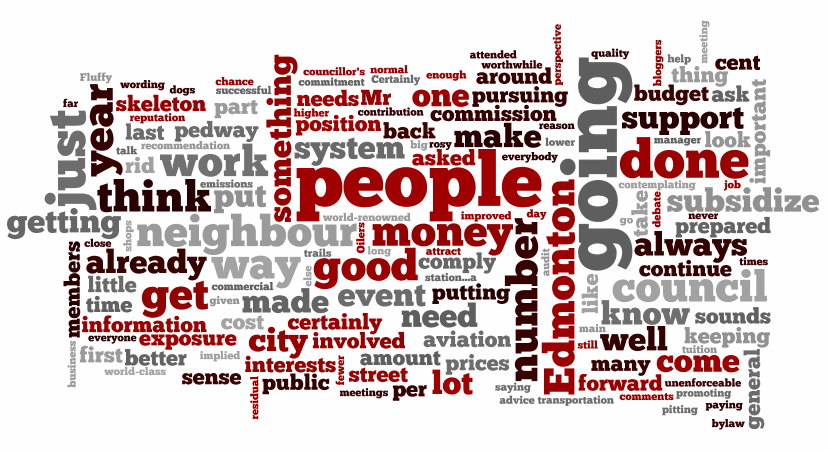
And here, by subject, is a selection of Tony Caterina quotes on the issues in 2009. You can download all of the quotes I found here in PDF.

On the City Centre Airport:

"We’re talking about closing aviation down, and businesses, and putting people on the unemployment line. Really, that doesn’t make sense."

"In regards to economic development, it’s critical … here we are contemplating getting rid of something that’s already here. That just doesn’t make sense to me."

"If we’re not going to talk about the possibility of improved aviation service, what are the possibilities? From our perspective on council, we will want to push for that to be part of the debate."

On the Edmonton Indy:

"It’s not a cost, it’s an investment into promoting Edmonton as a world-class city. We made a decision as council to support this event because it is world-renowned … Given the exposure we have had, it’s money well spent."

"The publicity, you can’t even put a price tag on it. The Indy is being seen by countries around the world."

On EXPO 2017:

"The prudent thing would be to get a…firm commitment from the province and the federal governments (that) if this bid is successful, they are prepared to support the $2.3 billion."

On Budget 2010:

"We have gone all year asking administration to work on this budget, three per cent (plus) two per cent for (neighbourhood) renewal. They have certainly done that. It’s a very fair budget to everyone. If we don’t accept this recommendation on this after a full year’s work, then going forward from this, any time we ask them to do something, where’s the credibility?"

On Jasper Avenue:

"The pedway system is there. Certainly, we’re not going to get rid of that, but there probably needs to be better planning for the buildings that are going up. The main floor has to be commercial, more so. They should be concentrating on getting merchants back on the street so people have a reason to be outside, and not just in the pedway system. To bring people back on the street, you need something for people to attract them -clothiers and shoe shops."

On the York Hotel:

"They make everybody else look bad. The majority in the…industry are good operators, but you have the few who, they can’t comply or won’t comply."

On cats:

"I don’t know what it is about me, I’ve always denied that I like cats but I’m always the first one they come to."

"When it’s a cat involved, there are more people saying ‘just keep Fluffy, I’m not paying 250 bucks for it. It seems dogs have more value."

On infrastructure:

"We’ve been so far behind in infrastructure repairs. The more we can get done, the better. There are a little sharper pencils putting the prices out. This will help go a long way to making sure we come in with a very very reasonable tax rate for next year."

On the U-Pass:

"There’s enough residual benefits, from (lower) carbon dioxide emissions and fewer vehicles…We subsidize (student) tuition, we subsidize transit, we subsidize all kinds of things, but they’re an important group."

On the new ward system:

"Even with the system that we have now, you’re running against each other. There’s always a chance that one incumbent, as happened in the last election, or both, could be defeated. I don’t think that’s an issue for consideration."

On bike trails:

"There’s a limited amount of money and we have to look after higher priorities. Edmonton already has a lot of paths for a winter city — about 1,000 kilometres of bike trails and roads — so I think we’ve done a good job."

On the Citizen Panel:

"How many members, how many panels, do we need? We might as well just ask the public where to put the money. That’s a big part of the councillor’s responsibility. It sounds good to have public involvement, but at the end of the day that’s what council is here for."

On the idling bylaw:

"All it’s going to do is pit neighbour against neighbour. I would have to agree with my constituents that have phoned in to say this sounds like the silliest thing we have done here in a number of years. I think this is a little excessive. People in general are good. They understand the environment and will do what they can in order to mitigate their contribution to … pollution."

On bloggers (thanks Dave for saving it):

"A number of bloggers — who knows where they come from — are treated as gospel."

As you can see, not all of the quotes are negative. As an aside, I think Scott McKeen wrote more about Caterina than anyone else this year. He must love him 😉 In quite a few articles, Caterina is mentioned as the only councillor to vote for or against something. He likes to be different, I guess! I couldn’t find a quote, but earlier this year Caterina said he worked longer hours and spent fewer nights at home when he worked in the private sector. That’s no surprise though, as Caterina apparently likes to get out of his duties as a city councillor.

Some other related reading you might be interested in:

Anyone else looking forward to more fun with #toncat next year? Election day is October 18, 2010.

Social Media and Ask Premier Ed

Yesterday CBC Edmonton’s John Archer called to get my take on the “Ask Premier Ed” campaign, Premier Ed Stelmach’s latest foray into the world of social media (as you know I don’t like to be called a social media expert, there’s no such thing). The premier has had a Twitter account for a little over a year now, but it has always been used to broadcast messages, never to interact with Albertans (in Twitter-speak, that means @PremierStelmach doesn’t post replies). The idea with the “Ask Premier Ed” campaign was to get Albertans to post questions on Twitter or on the premier’s website. I thought the idea had potential, but unfortunately, I don’t think it has turned out as well as it could have. It certainly hasn’t changed the premier’s broadcast-style communication (see DJ’s great overview of Stelmach’s communication issues).

Over the last couple of weeks, many Albertans have submitted questions. Yesterday, Premier Stelmach started posting responses. He’s doing that using YouTube videos. In each video, the premier is seated behind his desk with a laptop (and a bunch of other interesting things visible). He gets a question from the laptop, then answers it unscripted (of course the questions are probably prescreened).

Is “Ask Premier Ed” social media? I would say no. The campaign uses Twitter to crowdsource questions, and YouTube to host video responses to some of those questions, but that’s it. Social media is about more than just having an account. It’s about people, and about the interactions between people. How do you have interactions? On Twitter there are replies. On YouTube there are comments and video responses. People use those mechanisms to have a conversation, to have a dialogue. That’s what’s missing from “Ask Premier Ed”.

Here’s what I told CBC:

"If people are asking questions on Twitter, for instance, I might ask the question and then you might respond to it and somebody else might chime in and there’s a bit of a dialogue going on around the question," Male said.

"That’s the kind of thing that would be great for the premier to be participating in …and that’s what’s missing here."

The funniest part of the article is this:

Stelmach spokesperson Tom Olsen said the video responses are a lot like having a conversation with Stelmach in a coffee shop.

Like having a conversation in a coffee shop? Really?

A couple of suggestions for Premier Stelmach and his team:

  • Answer questions as they come in, on Twitter! Make use of that reply function.
  • Some answers just can’t fit into 140 characters, I get that – post them on a blog! That way Albertans can continue discussing it in the comments and on their own blogs.
  • Instead of one ten minute video for a few questions, why not one short video per question and answer?
  • Why not display the question on screen as Premier Stelmach looks at his laptop? The video is pretty high quality – how hard could it be to add an overlay or two?

And don’t forget – as you start conversing with Albertans, rather than just broadcasting to them, use your human voice! We’re all humans, after all.

Don’t get me wrong, I think it’s great that Premier Stelmach and his team have a Twitter account and are at least trying. That’s more than you can say for a lot of politicians. I just think they have room for improvement!

You can listen to a radio clip at CBC (link on the right) and look for the story on CBC Television tonight with Kim Trynacity at 5:30 and 6.

Also: Check out this post from DJ Kelly, posted on December 3rd. He’s way ahead of me!

A local technology gem: 3D Interactive (3DI)

Like many in the local technology community, I was introduced to 3D Interactive Inc. (3DI) at the last DemoCamp. Founded in 2005, 3DI creates “advanced interactive simulation software for design visualization and training systems”. Or put another way, they take the powerful technology behind today’s video games, and apply it to business uses. At DemoCamp, Andrew Czarnietzki showed us 3DI’s training simulation for a Caterpillar Wheel Loader, which is used by the U.S. Army, among others. While he used a mouse and keyboard that night, he said that 3DI had a more realistic simulator back at the office. I knew I had to check it out, and when he heard I was interested, 3DI’s Dave Chan offered to give me a tour of 3DI. I happily accepted, and spent an hour and half there last week.

3D Interactive

The Wheel Loader simulator is pretty cool, and yes I was lucky enough to get to sit in the driver’s seat! The simulator has three pedals, a steering wheel, a joystick, and even a key ignition. I drove the loader around and as I did, Dave explained some of the features, and it became clear that 3DI is pretty passionate about realism. Dave pointed out that when you turn the Wheel Loader on, the gauges on the dashboard all light up and move just as they would in a real machine – most other simulation software just uses a static image for the dashboard. Another cool feature was that static objects become dynamic as you move closer to them. There was a tire on the ground ahead of me that I drove towards. When I was close enough to interact with it, the simulation software turned the tire into something I could pick up – Dave said the change from static to dynamic is important for performance reasons, but it’s done in such a way that you don’t even notice it. The simulator, which took about 5 months to complete, features a number of “missions” such as backfilling, truck loading, etc. And to make it more realistic, you can do them at night or during the day!

Another simulation Dave showed was for a Wheel Tractor-Scraper. Operators are supposed to do a complete inspection of the machine before using it, and the software enables this for training. You can move around the machine, and as you do you check off the items you’re meant to inspect. The simulator will randomly insert problems or issues. The entire simulator was completed in about 7 months, whereas the competition’s timelines were longer than 18 months.

3D Interactive

I also got to see a snubbing unit simulator, built for Nisku-based Snubco, a world-leader in rig assist snubbing units. It’s a first in the world, and will have a significant impact on the market. Snubbing is controlling the pressure to allow the insertion or removal of pipe or tools into an active natural gas or steam well, which is an extremely difficult process. The training for a snubbing unit operator is easily about 3 years, and conventional training methods don’t let you explore the “what if” scenarios. With 3DI’s simulator, which took about 4 months to complete, the training time is greatly reduced, and trainees can go through a number of scenarios with the exact controls they’d have available in the field so that if they encounter an issue, they know what to do. Actually the controls themselves were rather interesting – the panel can be easily localized (apparently China is a big market for this). And in case you’re wondering, yes, there’s a lot of math involved to ensure everything is modeled accurately!

3D Interactive

The training simulators all use the Epic Unreal 3 engine, augmented by 3DI’s other technologies. 3DI also creates design visualizations however, which use their own systems, such as pureLIGHT, a global lighting system. Dave showed me three such visualizations. The first was something they created for the City of Edmonton’s Fire Rescue Services. It’s an interactive model of a house to help train firefighters. With a couple of clicks you can see a completely finished house or just the frame (to learn about how the walls are constructed, etc). You can also simulate a garage with a vehicle in it, or a messy garage, or an empty one! The second visualization was for a new building for BP Energy, designed by Gensler. It was designed to help BP and Gensler see what the interior spaces might look like, with floor plans, furniture, and lighting all simulated. One of the floors in the building is for oil futures trading, and it featured an insane number of desks and computers! The third visualization I saw was very quick – 3DI created an interactive model of the new Art Gallery of Alberta building, which was apparently used for fundraising and other promotional purposes.

BP Trade Floor ModelArt Gallery of Alberta Model

I met around five developers while I was there, all of them busy working on new projects. One developer told me he was working on “Dirt 2.0”. See 3DI doesn’t just model a Wheel Loader, they model entire environments. The new dirt system will enable 3DI simulations to have more realistic dirt, sand, and gravel, that leaves tire tracks as you drive through it or that falls realistically as you start to dump it out. The dirt system is just one of many that 3DI is working on to bring a new level of realism to simulations.

Thanks for the tour Dave! I was really impressed with 3D Interactive after DemoCamp, and the tour only reinforced that feeling. They’re an Edmonton tech company doing amazing things that have an impact around the world.

Leveraging Technical Expertise Locally (LTEL) Application Deadline: December 15

Just a reminder that if you’re planning to participate in the Leveraging Technical Expertise Locally (LTEL) initiative, you have until next Tuesday to declare your interest! If this is the first you’ve heard of LTEL, check out my recap of last month’s open house. Expressing interest is easy – just fill out this online form. You’ll need to provide your personal and business contact details, as well as:

  • A description of your solution in 100 words or less
  • An overview of your solution in 200 words or less (no I don’t know how the description and overview are different)
  • The top 10 features of your solution
  • The technical specifications of your solution
  • Direct & indirect benefits and costs of your solution
  • An explanation of how your solution will address the technical and operational needs of the customer and end-user
  • A preliminary timeline for your solution

Interestingly, there’s also room for three team member profiles, and comments on product differentiation, commercialization potential, and financial considerations. So if you have sales projections or plans to look for investment, you can mention that up front.

The website has a number of useful documents that might be of interest, including a scan of the current Lost & Found form and tag (pictured above). You can also download the City’s IT standards, which have been clarified:

The City does not wish to dictate the technologies proposed by the applicant, however, the solution must run in the City’s technical environment, as City staff are expected to use the application on a daily basis. In addition, the City is open to considering proposals that include hosting of the proposed application.

Emphasis mine – that’s great to hear!

If you’re chosen to continue, the next step in the process is to present your solution to the selection panel on January 28, 2010. Your solution doesn’t need to be complete by that date – mockups, prototypes, or whatever you’re comfortable presenting is fine. The selection will be announced on February 3, 2010.

For more information, check out the LTEL site. If you have questions or other concerns, email LTEL@edmonton.ca. Have a great idea for a new Lost & Found system? Apply now!

Alumni outreach at the University of Alberta

A little over a month ago, Avenue Edmonton’s Top 40 Under 40 for 2009 was announced and I was fortunate enough to make the list. So many people have said “congrats” in tweets, wall posts, emails, and other messages, and I really appreciate all of them, thank you! I was somewhat surprised, however, to receive a letter and a follow-up email from the University of Alberta’s Office of External Relations.

The letter itself was fairly standard, and basically said that as I am a graduate of the University they wanted to offer congratulations. The email was from Jen Panteluk, a Development Officer at the Office of External Relations. She invited me to meet for coffee, and I happily accepted. We met at Credo Coffee yesterday afternoon and had a great chat about what I do, what she does, and about social media and the University of Alberta.

I learned that Jen is meeting with as many U of A grads on the list as she can, and that the idea to do so was hers. Alumni Affairs rightly or wrongly has a reputation of only reaching out to alumni when they are able to contribute back to the University financially. Jen decided to do something about that perception, and that’s why she pitched the idea of meeting with the Top 40 Under 40 grads. I think it’s fantastic!

Jen and I talked about social media quite a bit, and how effectively local schools are using it. Slowly but surely the various U of A departments are starting to embrace social media. For instance, you can keep up with Alumni Affairs on Twitter and on Facebook. There’s a long way to go, however!

If you’re on Twitter, use the hashtag #ualberta for U of A related stuff. SU President Kory Mathewson and his colleagues are hoping it becomes the standard, because it’s less ambiguous than the rival #uofa. Makes sense to me!

We need to preserve our local, digital, cultural artifacts

As Edmonton continues its climb toward global status, I think it’s important that we consider the digital cultural artifacts that we create along the way. It’s rare that something big happens in Edmonton (or anywhere in the world for that matter) without a website or other online presence of some kind being created. That online presence is important in the weeks and months leading up to an event, but it’s just as important after the fact too. We need to start considering that from the beginning.

Think about big events that Edmonton has hosted in recent years. The 2001 World Championships in Athletics should come to mind. If you do a search for Edmonton 2001, you’ll find:

And linked from the official IAAF website and many other pages that show up in the results, is the the Edmonton 2001 website, at http://www.2001.edmonton.com/. The problem is, that site no longer exists.

What would happen if the IAAF took down the page they are hosting? It doesn’t have to happen on purpose, it could be an unfortunate side effect of a redesign, server relocation, etc. The article at Wikipedia is pretty sparse, containing mainly result information. And the mention on the EEDC site is insignificant. It’s almost as if the event didn’t happen.

Additionally, I’d argue that none of the links that still exist tell the story of Edmonton 2001. The effort that went into it, the many volunteers and organizations that made it happen, the effect it had on the city, etc. I think it’s important that we capture that information, and that we do so online, where it is easily accessible by all.

Another more recent example would be the ICLEI World Congress, held in June 2009. The City of Edmonton has a brief page devoted to the event, but most of the information exists at the ICLEI site. That’s fine, but again we’re relying on someone else for the information, and we’re missing an opportunity to tell our story. The advantage that the ICLEI had over Edmonton 2001 is that many bloggers wrote about the event and many photographers posted photos, and their content will likely continue to exist for quite some time. The new Transforming Edmonton blog will help too, I think.

The idea of digital preservation applies to smaller-scale events too. Try to find an online presence for the 2005 K-Days (now Capital EX), the year the event’s attendance record was set. Or try to find out about the 2008 Fringe festival.

I recognize that there’s costs associated with preserving our online cultural artifacts. Someone has to pay for them, and someone has to maintain them. And if we go that extra step and treat some online presences as legacy projects with updates and other information to tell our story, there’s obviously costs associated with that too. I think the costs would be quite minimal, however, and definitely worth it.

Perhaps this is something for the Edmonton Heritage Council to tackle? Or the Edmonton Historical Board? Or maybe just you and me. Either way, we need to start taking digital preservation more seriously.

Edmonton’s improved online City Council meeting agendas & minutes

A little over a week ago a new online system for Edmonton City Council’s meeting agendas and minutes went live. The long overdue update brings a number of improvements for public access, notably an integrated view of all information on the same screen. As someone who frequently accesses the agendas and minutes, I’m really happy the old system is gone, and at least so far, I think the new one is great!

The previous system for managing agendas and minutes, built in-house about 15 years ago, was called OCCTOPUS (Official Council and Committee Tracking Output Publishing and Updating Services). If you’ve never used it, consider yourself lucky! Based on Microsoft Word documents, OCCTOPUS was clunky and awkward to use. To get at the details for an agenda item, you often had to click through four connected Word documents. It always reminded me of the ETS Trip Planner, which loves to spawn dozens of new windows.

If you want to see the old system, check out the minutes for the November 10th Council meeting. Then compare that to the new system, by looking at the minutes for the November 24th Council meeting. I think you’ll agree that the new one is much better!

Some of the improvements & features of the new system include:

  • No more Word documents! Agendas and minutes now appear in HTML.
  • You can access the agenda, minutes, supporting materials, and archived video for a meeting from within the same screen.
  • Archived video and supporting materials (often PDF reports) appear in column on the right side and open with a single click.
  • If you really want to, you can get a print view of the agenda or minutes with a single click.

Aileen Giesbrecht, Director of Governance and Legislative Services in the Office of the City Clerk, told me that the project to replace OCCTOPUS started in the summer of 2007, and in the fall of 2008 SIRE Technologies was awarded the contract. SIRE provides “legislative management technology” for county and local governments, and offers a number of off-the-shelf solutions or modules. According to Sarah Ellington of SIRE Technologies, the City of Edmonton is using three such modules: Agenda Plus, Minutes Plus, and Workflow. Each of the modules have been configured to meet the City’s requirements for formatting, business processes, etc. The City of Edmonton’s implementation is the first major SIRE project in Canada.

The biggest challenge in getting the new system in place, according to Aileen, was simply “finding the time to make it happen.” The work isn’t finished yet, either! The project currently improves access primarily for the public, and Aileen and her team are now working on improving access internally too. She said the related internal systems being implemented will help with ease of use and will support the City’s paperless strategy.

The proposed 2010 budget for Corporate Services (PDF), which mentions $164,000 for operational maintenance and support of SIRE, offers some additional insight into what’s next:

Operational funding of SIRE will allow for: Maintenance of SIRE software, including ‘Agenda and Minutes Plus’ and web integration between SIRE and our current ‘Thunderstone’ web-based search function; licences associated with SIRE software, including access for Councillors (‘Agenda To Go’), as well as access for City Clerks and other Administrators, Bi-annual updates to the SIRE software suite; and one staff position to coordinate and maintain the entire SIRE system.

The new system isn’t perfect – it still uses Windows Media for video, and it would be nice to be able to click directly from an item on the agenda to the corresponding item in the minutes – but it’s much better than what we had previously. I think it’s great that the City is working to improve access to information for citizens, and I hope this is just the beginning (think: open data).

The Story Behind the Transforming Edmonton Blog

Today the City of Edmonton is launching its first official blog, called Transforming Edmonton. In some respects, it might be fair to say that a City of Edmonton blog was inevitable. After all, the City has a growing social media presence and is using its experience to experiment further. The reality is that the existence of the Transforming Edmonton blog was anything but a matter of time!

Though many City employees are involved, Raffaella Loro has been the driving force behind the new blog since March of this year. In fact, she has been working to get the City blogging since at least 2006. As an early NextGen volunteer, Raffaella suggested the group start a blog to engage with volunteers. The City seemed ready to support the project, but the idea just didn’t pan out at the time. While she was disappointed, Raffaella didn’t give up. When the opportunity arose early this year during her tenure in the environment department at the City, she pitched the idea of starting a blog again. This time, the idea was met with enthusiasm.

The original goal was to start the blog in time for the ICLEI Conference in June, but that was a busy time for everyone involved, followed by the summer, and it just didn’t materialize. Raffaella used the delay to refine the concept, and realized that an environmental focus was too limited. I like the way she described it to me:

Just as individuals have a perspective when writing their blogs, the City has a perspective too. The Vision and Strategic Plan represent the City’s perspective, and that will come through on the blog.

The Transforming Edmonton blog will consist of human interest stories and other content that illustrate the City’s progress on realizing the Vision and delivering on the Strategic Plan. Or put another way, the blog will “share stories about how the City is working on transforming itself.” This is reflected in the blog’s sections: Economic Diversity, Environment, Financial Sustainability, Livability, Transportation, and Urban Form.

It’s important to note that the blog is a pilot at this point. It’s an experiment. Raffaella won’t be the only author – she has been busy over the last month recruiting other City employees to contribute content. A large number are on board already, but that support will have to continue to grow for the blog to be successful. The initial goal is to have two new posts about each category per month. Comments are encouraged, though they will be moderated in accordance with the blog’s Comment & Trackback Policy. Where appropriate, posts will link to non-City of Edmonton websites.

In our conversation, Raffaella suggested that the blog is about encouraging a cultural shift in the way the City of Edmonton operates. Whether or not that happens remains to be seen, but so far I think the project is on track. It makes use of the City of Edmonton’s existing social media profiles, rather than creating new ones. Transparency is a key focus of the blog, demonstrated by the fact that it will serve both external and internal audiences (there is no separate internal-only blog). And though it is quite different from some of the City’s other online initiatives, the Transforming Edmonton blog was relatively inexpensive to create – essentially just staff time.

Raffaella had lots of praise for the many individuals at the City of Edmonton who have played a role in getting the Transforming Edmonton blog up and running, in particular Jason Darrah and the other members of the Social Media Advisory Committee. She said “it’s the right time for the City to be doing this” and I completely agree. Kudos to Raffaella for persevering and making the blog a reality. It might take a while, but I think the blog is going to have an incredibly positive impact on the City and its residents.

Check out the Hello World post and welcome Transforming Edmonton to the blogosphere!

Edmonton launches bid for EXPO 2017

Today the City of Edmonton officially launched its bid to represent Canada in the international competition to host EXPO 2017. The bid is the result of many months of work by the Edmonton Expo 2017 staff, as well as volunteers and others. It was presented today to both the Province of Alberta and Heritage Canada.

You can download the bid in PDF here.

There are three key components to the bid: theme, site and benefits & legacies. Here’s the theme:

Harmony of Energy and Our Future Planet is a theme with breadth and scope sufficient to accommodate future developments that might lie ahead, ensuring a sustainable, high-quality legacy at the conclusion of EXPO 2017. The theme will position Canada as a leader and innovator in new approaches to energy and sustainability, far beyond the traditional energy sources of oil, gas, coal and hydro.

To arrive at this theme, Expo staff surveyed key local officials, talked with BIE, ran focus groups throughout Alberta, and engaged a number of volunteers and other community members. I think that while “energy” is perhaps a little obvious for an Albertan city, it does play to our strengths, and it presents us with an opportunity to establish Edmonton and Alberta as being about more than just oil and gas energy.

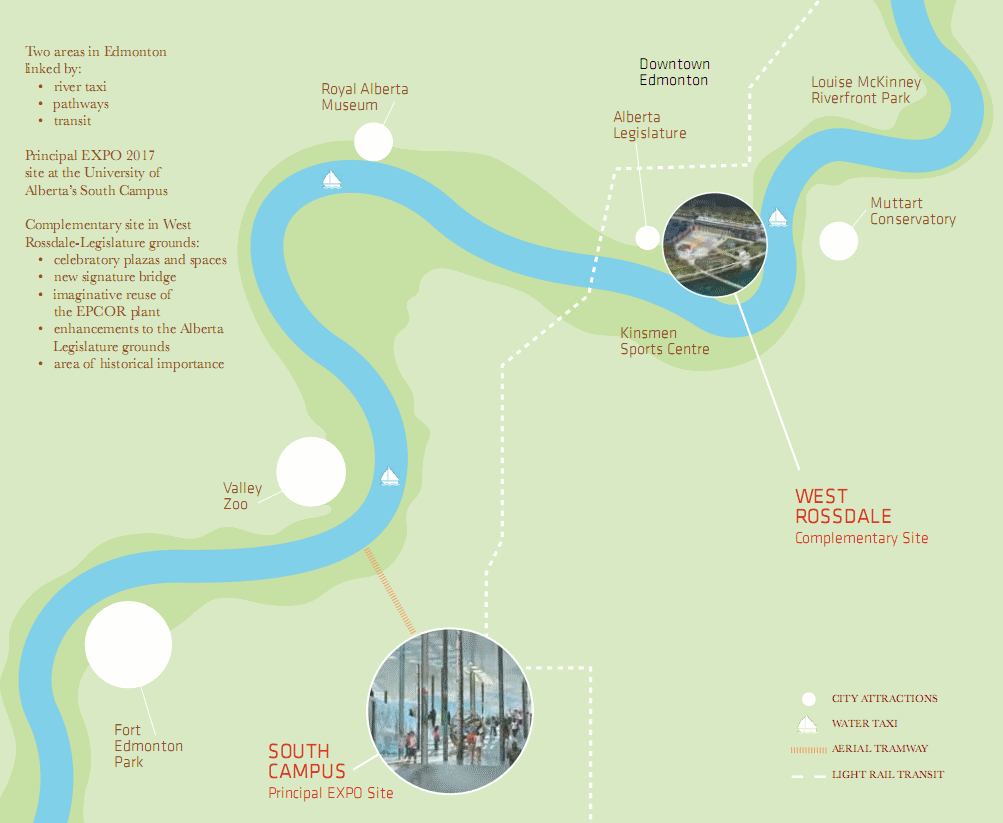
The second component is the site. The proposed main site is South Campus, with West Rossdale as the proposed secondary site. The two sites are linked by the River Valley, and would also be linked by LRT and water taxi for Expo. South Campus was selected because of its size and potential for growth. West Rossdale was selected for its historical significance. Here’s a map of the proposed sites:

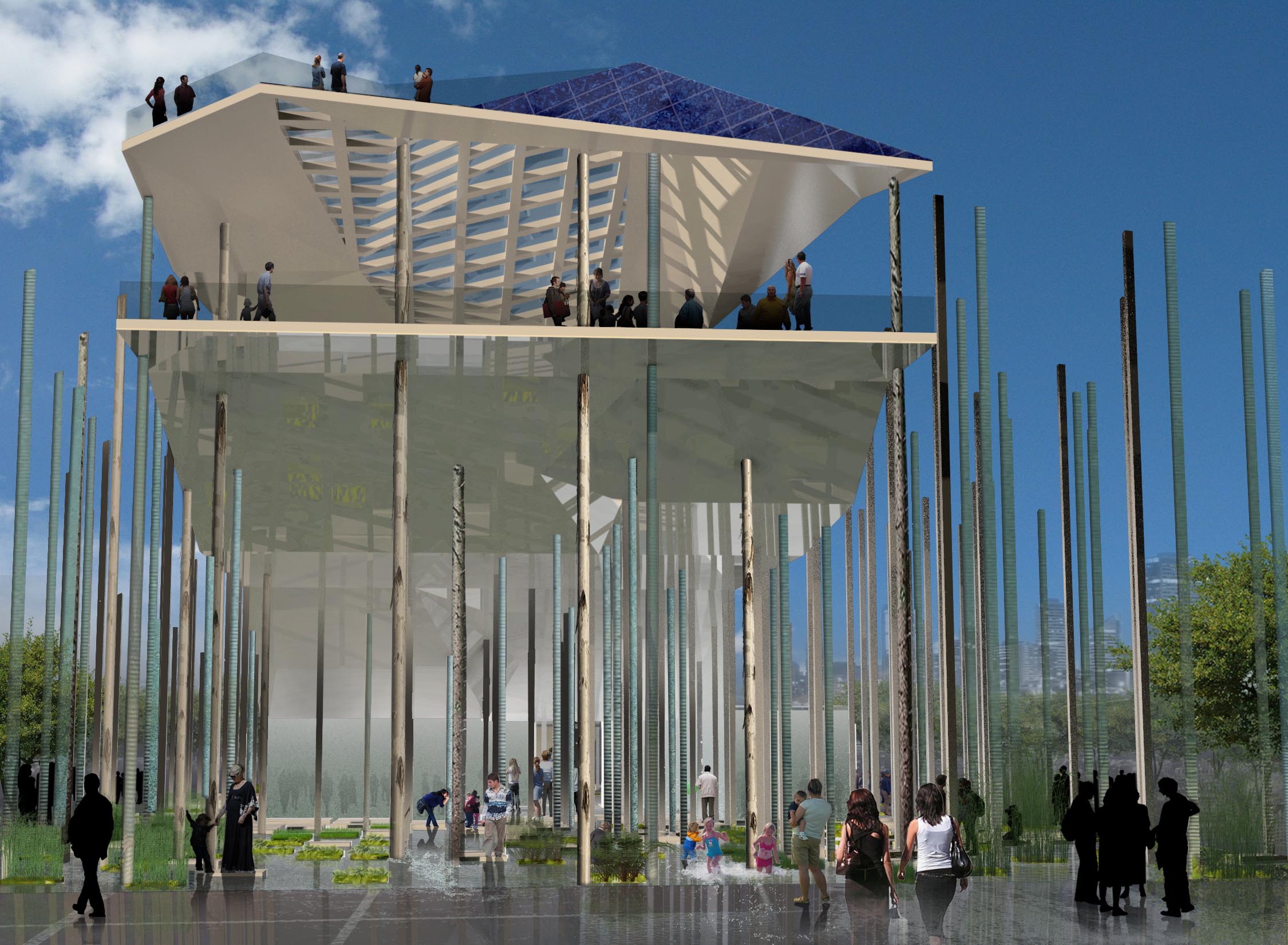
Here’s a rendering of what the entrance of the main site might look like:

Here’s a rendering of a potential Canada pavilion:

Here’s a rendering of a potential Alberta pavilion:

The bid highlights the redevelopment of the Legislature grounds, as well as the construction of a signature bridge connecting downtown and the south side.

The third key component of the bid is the benefits that hosting EXPO 2017 would provide, as well as the legacies it will leave behind. They are outlined as:

  • Knowledge
  • Putting Edmonton, Alberta, and Canada on the World Map
  • Transforming Community Spirit and Pride
  • Creating an Inclusive and Accessible EXPO
  • Sharing Canadian Culture
  • Appreciating Cultural Diversity
  • Promoting Arts & Culture
  • Positive Economic Impact
  • City Building
  • Growing a Tourism and Trade Destination
  • Leadership in Environmental Stewardship and Sustainability
  • Creating Global Change

Those are quite broad and high level, but as EXPO 2017 is such a large event, it will touch on all of the above areas. Check out the bid document for more detail on each.

Where do we go from here? The timeline looks like this:

  • The bid process:
    • Spring 2010 – Selected by the Government of Canada
    • June 2011 – Submission of the international bid
    • October 2011-January 2012 – Enquiry mission by the BIE
  • And if selected:
    • June 2 or 3, 2017 – Opening day
    • July 1, 2017 – Canada’s 150th anniversary
    • September 2 or 3, 2017 – Closing day
    • Fall 2017-2018 – Legacy plans come into effect

Next week City Council will have to decide whether or not to approve $500,000 to continue EXPO 2017 operations until the national bid decision is made.

A couple of other relevant details:

  • It is my understanding that the site will feature no public parking. Transit is the focus!
  • Estimates call for 5.3 million visits, 1.9 million uniques (nearly half from out of province)
  • That translates to roughly 56,000 visits per day for three months (to put that into perspective, Capital EX recorded roughly 72,000 visits per day).
  • Close to 40,000 person years of employment would be created.
  • The event would boost Canada’s GDP by $2.6 billion, $2.3 billion of which would go directly to Alberta’s economy.

Edmonton EXPO 2017 LaunchEdmonton EXPO 2017 Launch

There’s a lot of information to read through, and until today few people except the Expo staff had seen it all. I’m going to take some time to digest things and I encourage you to do the same. I think the Expo team has done a great job of pulling everything together, but I think they have a lot of work to do in engaging the average citizen. They also have to make the financial case.

In general though, I’m very excited for the possibility of Edmonton hosting EXPO 2017. I think it could be another key part of our journey to becoming a world-class city.

You can see the rest of my photos from today’s launch here. Stay tuned to the website for updates, as well as Twitter and Facebook.

Reboot Alberta: Tweets & Blogs

A very interesting event took place in Red Deer this weekend called Reboot Alberta. Participants discussed the state of politics in Alberta, and explored ways to “reboot” things. I was invited, but decided to stay home. I’m not as well-versed in provincial politics as others and I was unsure what I would be able to contribute. Perhaps it would have been a good learning opportunity for me, but I got the impression that Reboot Alberta was (like ChangeCamp) looking for participants rather than observers. That said, I think I’ll start participating now!

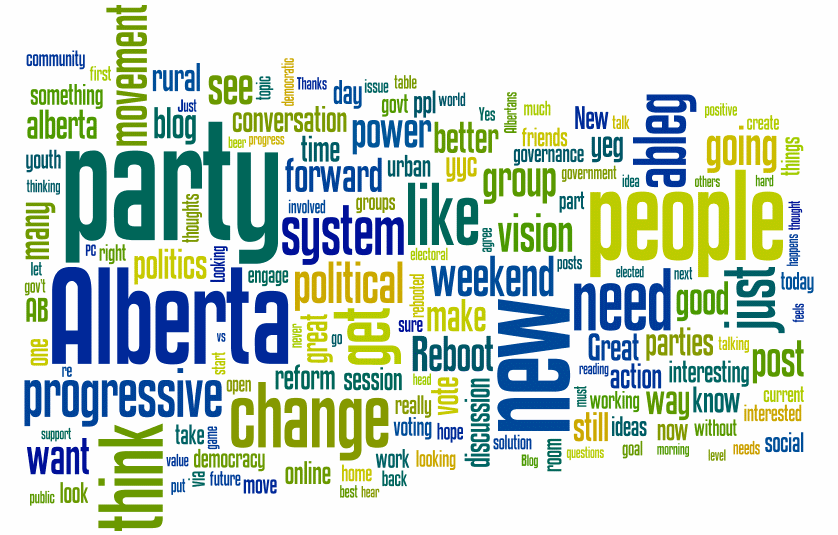
There were a lot of tweets and blog posts written over the weekend, and during the week leading up to the event. I counted 1243 tweets with the #rebootab hashtag from November 21 until last night around midnight. After removing the hashtag, RT, and usernames, this is what you get if you combine them into a Wordle:

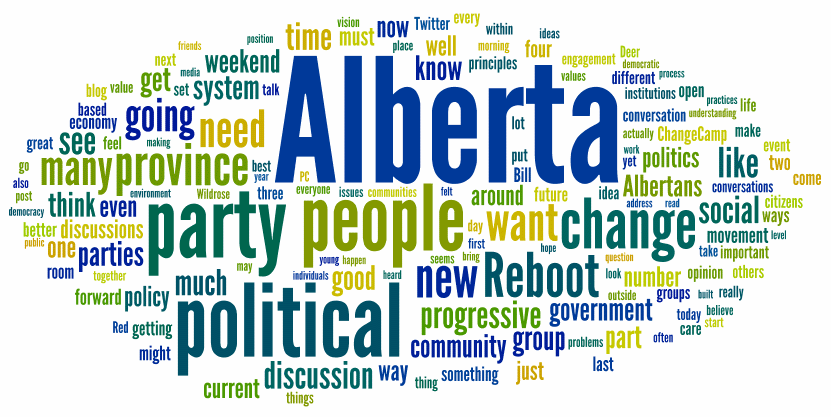
Likewise, there were a lot of blog posts written, with many more on the way I’m sure. Here’s a Wordle for them:

And here are the blog posts I included for that:

Watch for many more posts from participants and others, and be sure to check out Reboot Alberta.