The City of Edmonton is failing at public involvement

In my opinion, the City of Edmonton needs to completely transform its public involvement practices. Over the last few years there has been the odd glimmer of hope that things are changing for the better, but I don’t think progress is actually being made. Sometimes it even feels like we’re moving backwards.

Here’s an excerpt from Mayor Mandel’s Swearing-In Address on October 26, 2010 (PDF):

Looking ahead to some of the major projects entering the consultation stage – the arena, LRT design and EXPO 2017 – it’s clear that we need to refine our consultation process and vastly improve how we communicate with our citizens.

Methods are changing, people contribute their opinions and receive information in different ways, and we are not keeping pace.

A City with a bold creative vision has to be able to communicate clearly with its citizens – we simply must do better here.

And from better process will come better solutions – ones where our citizens can witness their impacts and know that together we’ve all done the best for Edmonton.

Nothing has changed in the five months since he gave those remarks, and there’s no indication that anything is going to change.

The most recent example is the Walterdale Bridge project. There are so many issues I almost don’t even know where to begin. It’s a good illustration of some of the larger issues plaguing the public involvement process.

Oh look City of Edmonton, a dictionary!

The terminology used for public involvement is inconsistent and confusing. What’s the difference between an open house, an information session, and a community consultation? All three have been used on the Walterdale Bridge project, and I’m sure you have seen other terms used for other events. Can I always give feedback? Are some events more heavily geared toward sharing information than others? Does the name imply a certain stage of the process? There’s absolutely no way to tell based on the terminology used.

There are a bunch of other terms that are poorly defined as well. Who’s a stakeholder, for instance?

No consultation on the consultation itself?

Why doesn’t anyone ever ask how we’d like to be consulted on something? Is a bunch of private meetings with “important stakeholders” followed by an information sharing session open to the general public always the best approach? Why don’t more consultations make use of the vast array of effective technologies we have at our disposal? It wasn’t without fault, but at least the online questionnaire on the arena project was different. I think one of the simplest ways we could improve the public involvement process would be to gather feedback on how the process should work before starting it.

What’s happening?

Do you know when the public involvement process for the Walterdale Bridge started? Me neither. The first time the public became aware of the process was on November 15, three days before the first open house. Some “selected stakeholder groups” were interviewed prior to that event, but when? A couple of weeks before? Or years before as the issue popped up with each rehabilitation?

I went to the open house on November 18, and wrote about it here. At the bottom of that post, I captured the “next steps” as they were presented. There would be an interim plan in January, followed by a public information session (different from an open house apparently) in February or March, and then the final plan would go to Council in April. I added my email to the contact sheet at that event.

The update that was presented to TPW on January 25, 2011 came and went without any notice. No press release, no email. Unless you’re checking the agenda of each Council and committee meeting, there’s almost no way you’d have found out about that update. Part of the information shared at that meeting was an update on the public involvement process. The report mentioned the stakeholder interviews and the open house, then finished with this:

The balance of the Public Involvement Plan, to be undertaken in February and March, will be comprised of a series of meetings with key stakeholder groups to further discuss options and recommendations that will have been developed since the November Open House, in addition to another widely publicized public Information Session.  The purpose of this Information Session will be to communicate the content of the final report to City Council.  This Information Session will be held in late March.

So basically if you wanted to provide input but you didn’t attend the November open house, too bad. Unless of course you’re part of those secretive stakeholder groups that may or may not have taken place – no update on those was ever provided.

Finally we come to yesterday’s “widely publicized public information session”. The open house in November got a press release, this one didn’t. The only notice that went out about the event, in addition to a tweet the day of, was an email sent on March 14 to people who signed up at the November open house. That and the web page was updated, though unless you constantly check it, you’d never know that. Hardly a “widely publicized” event, if you ask me.

Actually there is one other way you could have found out about the event – at the City of Edmonton’s Public Involvement Calendar. That would be the calendar without email or text notifications, no RSS feeds, and no ability to search by keyword. None of those events show up in the much more functional Events Calendar, for some unacceptable reason.

You mean you didn’t see my tweet?

Sometimes there are comment forms, other times there are sticky notes, sometimes you participate in a group discussion with someone recording notes, and other times you fill out a survey. There are two problems. First, it’s not clear what I need to do to ensure my comments are going to be read and considered. Second, nearly all of those mechanisms for providing input require me to physically attend an event!

There are so many tools that we’re simply not making use of. It doesn’t even have to be Twitter or whatever the popular online service at the moment is. Why can’t I just send an email? Why can’t I fill out the survey online? Why can’t I just send a link to my blog post?

The very, very, very few speaking for many.

The January update boasted that the November open house was “heavily attended” at 225 participants. Just 80 comment forms were submitted, and there’s no word on how many sticky notes were written. Yesterday’s event apparently had around 150 attendees. Just 15 interviews of “stakeholder groups” were conducted.

We’re a city of nearly 800,000 people, and we’re basing the public involvement part of the decision on 80 comment forms and 15 interviews? I truly believe more people want to provide feedback, it’s just too difficult to do so at the moment.

At the November open house, the City shared a number of alignment and style options for a replacement bridge. Yesterday, they declared they had chosen the arch. There’s no opportunity to question this. It’ll go to Council without any additional public involvement.

Just going through the motions…

I want to be engaged. I want to contribute and help to make the outcome a better one for Edmonton. But all too often it feels like the City is simply going through the motions when it comes to the public involvement process. I can see why the vast majority of citizens find it hard to get engaged. Look at how much work it took to keep up-to-date on the Walterdale Bridge project!

The Walterdale Bridge Public Involvement Plan violated City policy.

Did you know the City of Edmonton actually has a policy on public involvement? Policy C513 (Word) outlines how administration should involve the public when making recommendations to Council. Let’s ignore for a minute that the policy itself absolutely needs to be improved (“…designed to involve the appropriate people at the appropriate time in the appropriate way…”). The trademarks of any City of Edmonton public involvement process are meant to be: clear purpose, consistent approach, and commitment to involve. The “commitment to involve” is pretty hard to get wrong as it is described in the policy, but the Walterdale Bridge public involvement process completely missed the boat on the first one, in my opinion, and we have to trust that the consistent approach was achieved.

Clear purpose is achieved by using the “Continuum of Public Involvement” which essentially states that you start by sharing information to raise awareness, then you consult people to test ideas and build commitment, then you share decision making with stakeholders.

  1. Sharing Information
  2. Consultation
  3. Active Participation

This was not followed with the Walterdale Bridge project. There was no information sharing or awareness building at the start, instead there were consultations with stakeholders. That’s supposed to be the third step of the continuum, not the first! Then we got the November open house, which combined steps one and two. It doesn’t seem like steps four or five, partnering with stakeholders to make a decision, ever took place.

Consistent approach is meant to be achieved using the City of Edmonton Public Involvement Roadmap:

  • Understanding the overall project
  • Defining the purpose and outcomes of public involvement
  • Clarifying the public involvement commitment
  • Public involvement process details
  • Developing the public involvement plan

Did this happen? Maybe, but it was never shared. The public doesn’t know the purpose or outcomes of the public involvement, nor did we know the process details. There was no plan available.

We simply must do better.

The Walterdale Bridge project is not unique. The same problems plague the vast majority of Edmonton’s public involvement efforts. I’ve been to so many open houses, or information sessions, or whatever you want to call them, where attendees have expressed their frustration at the lack of clarity about the process, or the fact that they feel the consultation is happening too late in the process.

In October 2009, I wrote about the proposed Centre for Public Involvement. I’m going to repeat the opening statement of the prospectus:

The timing is right for establishing the proposed Centre. In reality, the timing is probably late by ten years.

Toward the end of 2010, there was finally some movement and the Centre is now being organized. It took more than a year to get started, when we’re already so far behind.

Is this really the best we can do? I think we can do better. We simply must do better.
More than just email: Google Apps goes live at the University of Alberta

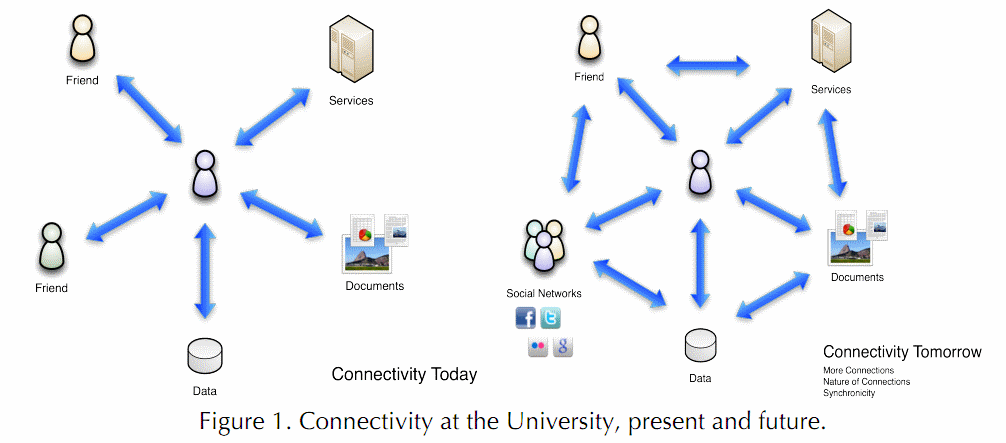
Today officials at the University of Alberta will flip the proverbial switch and 40,000 students will get access to the university’s deployment of Google Apps for Education, a significant milestone for a journey that began back in November 2008. The U of A’s move to Gmail has been talked about for quite some time, but the switch is about more than just email. This is an important step toward building the IT campus of the future – a mobile, connected community of staff, students, faculty, and alumni.

Our goal is to create the most mobile, connected academic community in Canada: anyone, anywhere, any time.

You can learn more about the broader vision here in PDF.

When Academic Information & Communication Technologies (AICT) was given the task of examining the University of Alberta’s email systems, they didn’t realize just how unwieldy email on campus had become over the years. With more than 80 mail servers spread across campus supporting nearly 150,000 accounts, it was definitely becoming difficult to audit, manage, and support. Six months after they began looking into the issue, AICT started exploring Gmail. In September 2009 the University of Alberta began legal discussions with Google, and over the next year negotiated the various contracts. There were lots of very valid concerns about privacy and security, and the university tackled those head on. There is no data mining, and there are no ads under the agreements that were finally signed in December 2010 (PDF).

Jason Cobb, Issues & Communication Manager to the VPs at the University of Alberta, explained some of the driving forces behind the migration to Google Apps. Improving the quality of the experience was really important, as was improving security. The shift will enable the university to reduce infrastructure costs, which should lead to some broader cost savings (he noted that no positions would be lost) and some productivity gains, as the mundane task of managing email can now be removed. “Most importantly, we’re trying to be transformational, not just transitional,” Jason told me. That means enabling collaboration in ways that just weren’t possible without a system like Google Apps. That’s why the U of A is adopting the full suite of apps, rather than just Gmail.

Other universities around the world have adopted Google Apps for Education of course, but the U of A is definitely one of the biggest to take on a project of this scope. Many other Canadian universities are now understandably interested in following the U of A’s lead (and Google is no doubt keen to see that happen as well). You can bet they’ll be paying close attention to the rollout.

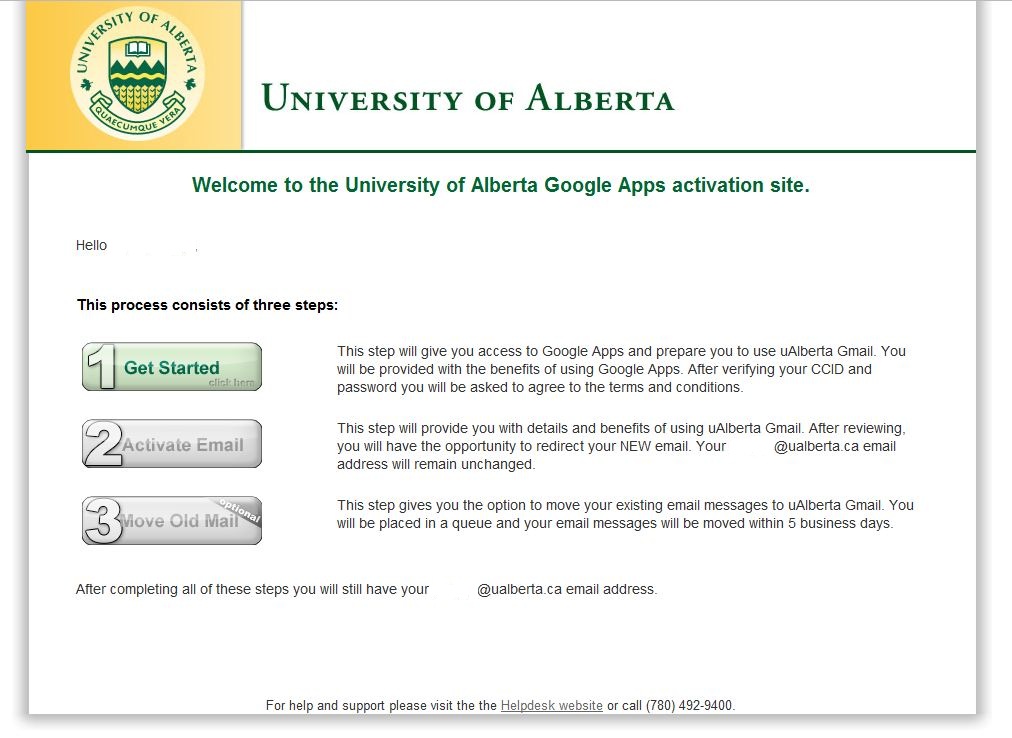
The 80 mail servers that AICT identified are generally broken up by subdomain. Central Mail refers to the default @ualberta.ca account that all students receive, while many faculties and departments have managed their own email on separate servers, with addresses such as @cs.ualberta.ca (for the Computing Sciences department). The switch today starts with Central Mail. Students will follow a simple three-step process to convert their email to Gmail.

The first step is to understand and agree to the terms and conditions. The second step is to activate the Google Apps account, which will cause all new email sent to the student’s email account to appear in Gmail rather than in Central Mail. And the third step is to migrate any old emails into the new system (a process which can take a few hours). Students retain the exact same @ualberta.ca email address, and automatically get access to the other pieces of Google Apps such as Calendar, Documents, Chat, Groups, and more. They have the choice of switching for now – in October, Central Mail is scheduled to become read-only and students will have to switch at that point.

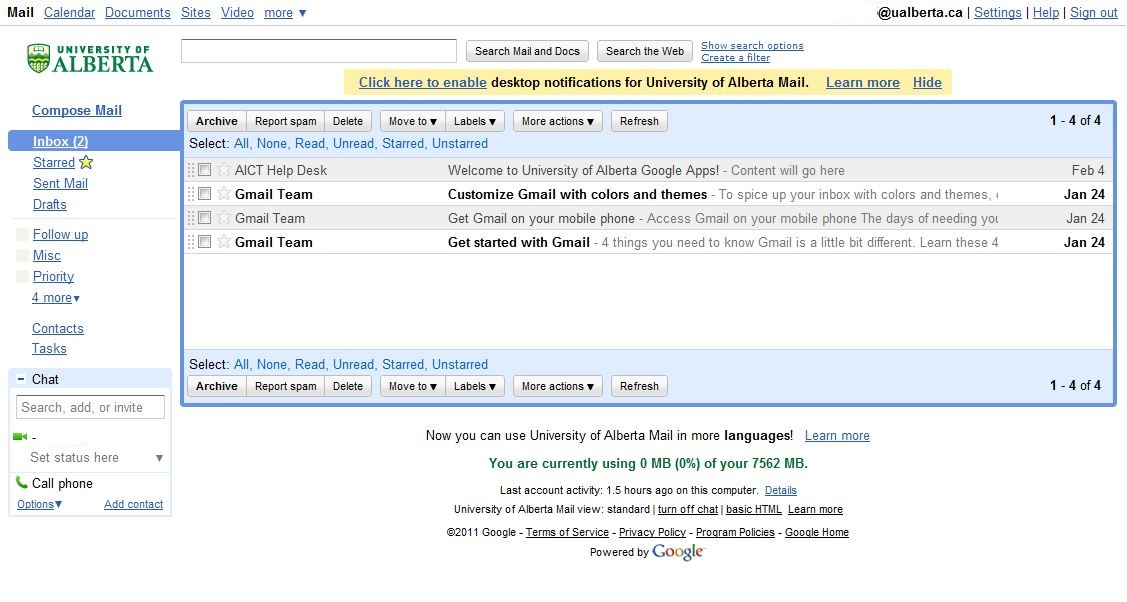
After completing the switch and logging in, students will be presented with the “launch pad” that will serve as the entry-point to Gmail and the other apps. When Simon Collier, Network Administrator with AICT, demoed the system for me last week, he wasn’t quite sure what to show! It really is just Gmail. The only differences are the University of Alberta logo and the lack of ads (it looks like there are one-line ads above the inbox, but those are actually RSS feeds…AICT chose to leave them enabled so that students have the option of turning the feature on or off).

The U of A has done some interesting things to make this happen. They’ve implemented single sign on, which has been rolled out for BearTracks as well. This means that Google never actually gets the user’s password, they just get a one-way hash. Security remains entirely within the University of Alberta. AICT has also done some work to make the migration process possible. Initially, they tested a migration tool hosted by Google and calculated that it would take two and a half years to migrate everything! That was unacceptable obviously, so they found another way. Now the university hosts the migration tool, and they estimate it would take just two to three weeks to migrate everything. How much data are we talking? As of mid-February, Central Mail was home to more than 228 million messages, taking up approximately 30 terabytes of space!

The next phase of the project is to migrate the other mail servers. It’s a more difficult task, because there is more business process involved. The migration will start right away with a staggered list based on failing hardware, age of hardware, business needs, and other factors. The goal is to have the vast majority of users migrated to Google Apps within a year, and to have everything completely migrated within 18 months.

The new system supports collaboration in a variety of ways. One of the simplest features is auto-complete on the “to” line when composing an email. Start typing a name and you’ll see matches from the entire campus directory! Likewise, you can now pull up anyone’s free/busy status in the calendar, which Jason emphasized will make scheduling meetings much simpler than in the past. The ability to share and edit documents using Google Docs is another big win for collaboration, especially given the new discussion features that Google recently introduced.

It’s not hard to see how this can be expanded in the future. Closer integration with BearTracks is something AICT is working on, so you can imagine registering for your courses and having your calendar get updated automatically. Perhaps students could be added to automatically created Groups for each of their courses. There’s a lot of opportunity to build atop the platform, and work is already underway to examine the possibilities.

The move to Gmail and Google Apps is a big deal, but it really is just the beginning. This is an initial step to better position the University of Alberta for the future:

We can’t be evolutionary in the changes that need to happen to our core IT infrastructure; we must be revolutionary. We must position ourselves to support the mobile, connected IT campus of the not-so-distant future, else we run the risk of being regarded as increasingly irrelevant to the needs of our students, staff and faculty.

It’s exciting to see the University of Alberta moving so boldly to make this vision a reality!

UPDATE: Here’s the official U of A post on the switch.

UPDATE2: Here’s the official Google Enterprise post on the adoption of Google Apps.

Edmonton Notes for 3/20/2011

I’m writing this using the excellent free wi-fi at the Edmonton International Airport. So glad we have this now. Here are my weekly Edmonton notes:

Trees on 105 Street
This is what 105 Street looks like north of 107 Avenue now that the City removed a number of trees to make way for the North LRT extension.

Mural
There’s a beautiful mural on 107 Avenue, except that it is hidden most of the winter by snow!

Giant Puddle
This is the biggest puddle (aka mini-lake) I have seen, located at 104 Street and 103 Avenue downtown. You?

First look at Canada’s new Open Data portal: data.gc.ca

Yesterday the Government of Canada launched its open data portal at data.gc.ca. Open Data is one of three Open Government Initiatives, the other two being Open Information and Open Dialogue. Stockwell Day, President of the Treasury Board and Minister for the Asia-Pacific Gateway, issued a statement today on the launch:
“Today, I am pleased to announce the next step in our government’s commitment to enhancing transparency and accountability to Canadians. The expansion of open government will give Canadians the opportunity to access public information in more useful and readable formats, enable greater insight into the inner workings of the Government and empower citizens to participate more directly in the decision-making process.”

He goes on in the statement to say that Canada has historically led the way in providing information to citizens. Lately though, we’ve definitely fallen behind. I’m glad to see us moving forward once again. This development is no doubt the result of lots of work by many passionate Canadians, such as David Eaves. Here’s what he posted yesterday:

The launch of data.gc.ca is an important first step. It gives those of us interested in open data and open government a vehicle by which to get more data open and improve the accountability, transparency as well as business and social innovation.

David does a good job in that post of highlighting some of the issues the site currently faces, such as some problematic wording in the licensing, so I won’t repeat that here. Instead, I figured I’d do what I always do when I get new datasets to play with – make some charts!

The open data portal says there are 261,077 datasets currently available. Just 781 of those are “general” datasets, the rest are geospatial. That’s an impressive number of geospatial datasets, but they are somewhat less accessible (and perhaps less interesting) to the average Canadian than the general datasets. It looks like you need to be able to work with an ESRI Shape File to use most of them.

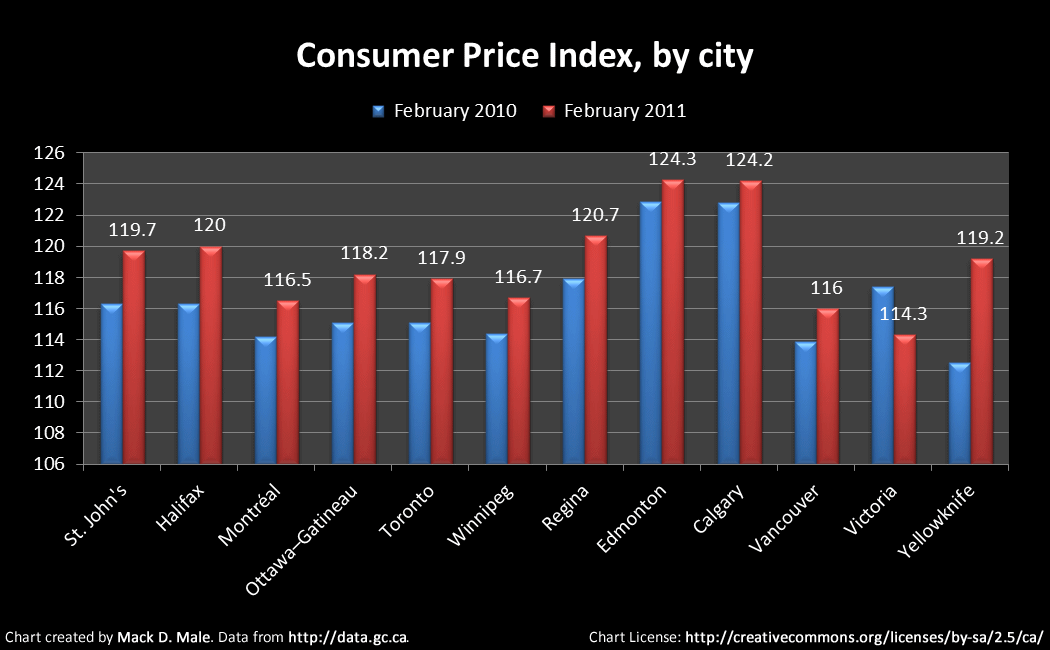
There are lots of general datasets you might find interesting, however. For example, here’s the Consumer Price Index by city:

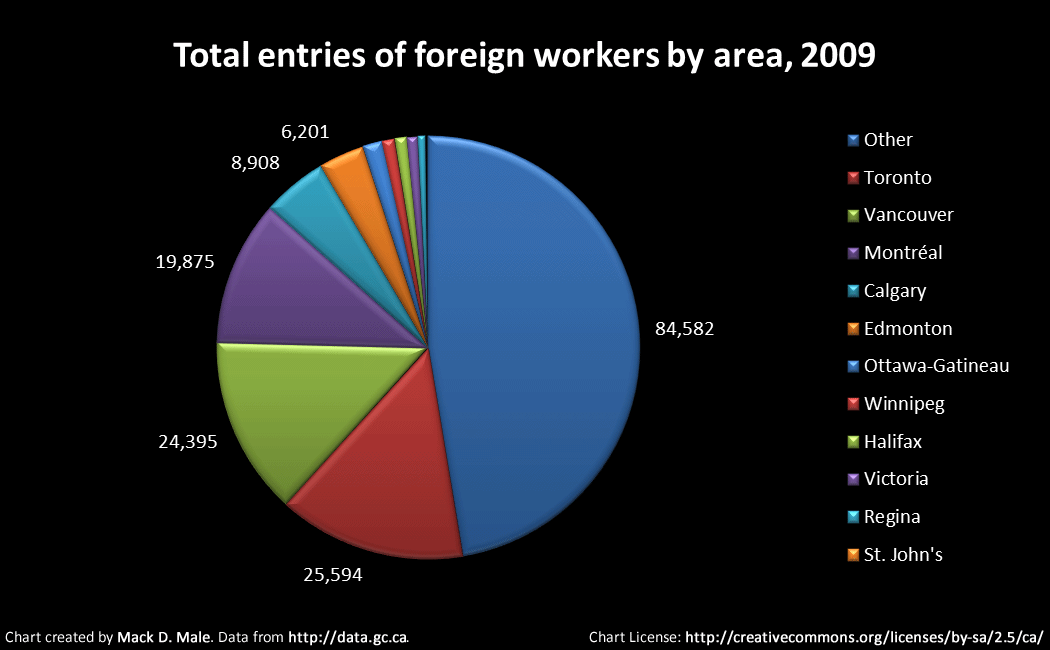
Here’s another dataset I thought was interesting – the number of foreign workers that have entered Canada, by region:

Have you ever wondered how much of each type of milk Albertans consume? You can find that out:

There’s actually a fairly broad range of datasets available, such as weather, agriculture, economics, and much more. As David said, it’s a good first step.

I’m excited to see more ministries get involved, and I hope to see the number of datasets available increase over time. I’d also love to see the licensing change, perhaps by adopting the UK Open Government License as David suggested. Exciting times ahead!

Roundtable with Edmonton Members of Parliament

Like Dave, I was invited to a roundtable discussion with Edmonton’s MPs earlier this week. Edmonton-Mill Woods-Beaumont MP Mike Lake has been holding constituent roundtables for a while now, and as the new chair of the Edmonton CPC Caucus Mike wanted to try the approach with his colleagues and a wider group of constituents. Here’s how Mike describes the roundtable approach:

Generally attended by ten to fifteen constituents, each meeting is designed to facilitate discussion about issues specifically raised by those at the table. In contrast to a typical town hall meeting, the roundtable, with its smaller group format, allows for greater interaction among the participants.

Mike made sure to invite a broad group for this first roundtable – there were lots of different viewpoints represented at the table! The MPs introduced themselves first (Tim Uppal, Peter Goldring, Brent Rathgeber and Mike were present for the whole meeting, Laurie Hawn had to step out shortly after we began), and then we went around the table. Each constituent provided a brief introduction and was asked to raise up to three issues that they wanted to discuss. I decided to mention two issues, one of local importance and one more applicable to Canada as a whole:

  1. LRT. As I have said many times before, LRT is perhaps the most important thing we need here in Edmonton to become the city we want to be. A strong, effective, and healthy public transit system is at the heart of becoming a more vibrant, sustainable city. So far, I don’t think Edmonton has received the support we require from the federal government.
  2. Internet. The usage based billing debate will rage on, though the federal government has said it will overturn any decision by the CRTC to move ahead with the plan. I think we need to shift the discussion, however. Canada’s competitiveness when it comes to telecommunications is abysmal at best. The cost of Internet and mobile service in Canada is far higher than most of the rest of the world, and that is negatively impacting our ability to compete globally.

It turns out that Mayor Mandel and City Council met with the MPs right before we did, and they talked a lot about LRT. We didn’t discuss it much in our roundtable, so I hope Council got the message across.

As the Parliamentary Secretary to the Minister of Industry, Mike has had a lot of exposure to the usage based billing issue (he’s also on the Industry, Science and Technology committee). Dave and I shared our thoughts (he raised the same issue I did) and Mike did a nice job of explaining the issues to some of the other people in attendance. We did get into a brief side discussion on the CRTC that was rather interesting. I made some notes to do some additional research.

Some of the other topics that our group of nine constituents talked about included:

  • Our lack of a national homelessness strategy.
  • The size of government, and government debt.
  • The F-35 Joint Strike Fighter (Laurie Hawn aggressively took on the issue, stating that the information in the media is wrong).
  • The federal impact on health care.
  • Immigration, foreign trained professionals, and temporary foreign workers.
  • The justice system and the continual problem of criminals getting back onto the streets.
  • Western alienation.
  • Student finance and the cost of tuition.

I thought Mike did an excellent job of keeping us on track and on topic. We went just five minutes over our scheduled time, after everyone agreed to extend the discussion slightly. Initially I felt that Mike was being somewhat defensive, talking about what the government is doing as he went down the list of issues, but that feeling soon passed as it became clear he was providing some context to the discussions. As much as it was an opportunity for us to talk about our issues, it was also an opportunity for the MPs to tell us about the work they are doing, and I appreciated hearing it from them directly. I just wish the other MPs spoke up a little more often (Mike did a lot of the talking).

I enjoyed the discussion, and the two hours flew by as a result. I hope Mike and his fellow Edmonton MPs found the session useful and that they do it again in the future! Thanks to Mike for the invite!

Still Trending Down: Computing-related graduates in Alberta

If we’re serious about shifting the Alberta Advantage, I think we need to focus on technology. If we really want to be in the sweet spot of adding lots of value, participating in the economy of the future, and being globally competitive, we need smart people who can be creative and innovative in the appropriate sectors and industries. Technology is absolutely going to be at the heart of any sector or industry that will enable us to be world-class and trendsetting, there’s just no question about it.

That’s why this graph absolutely shocked me:

The data comes from the University of Alberta, but I think it is representative of the province as a whole.

The number of students graduating in the fields of Computing Science and Computer Engineering in Alberta is trending downward, with no correction in sight. How can we build the economy of the future when the picture looks like this?

Here’s a bit more detail – with the number of graduates broken out by degree/program:

I haven’t looked, but I suspect enrollment numbers would be similar (that is, I don’t think an incredible number of students register in computing-related programs and then switch out).

Bill Gates has been talking about the need for more students to take up computer science for years now. There’s more demand than supply, even when you factor in immigration. The need for us to stay competitive in this regard is well-documented. It looks like we’re falling further behind.

I don’t know what the answer is. I don’t know how we get more students interested in computer-related degrees. But I do think it is important to consider this data when we talk about the success of our provincial technology sectors, and indeed when we consider shifting the Alberta Advantage.

Media Monday Edmonton: Title Junk

I’ve been thinking of writing this post for a while now. Back in December John Gruber wrote about title junk, also known as “poorly designed web page titles”. It is something I have thought about more and more since launching Edmonton Etcetera, because I link to so many things using essentially just the title of the web page. I like relatively clean titles, but unfortunately as John wrote, “an awful lot of websites use patterns for page titles that are ugly, hard-to-scan, and/or just plain stupid.” Let’s find out which local media websites are the worst culprits!

Here are the front page titles for some local media sites (in no particular order):

  1. Edmonton Journal | Latest Breaking News | Business | Sports | Canada Daily News
  2. Edmonton Sun
  3. CBC Edmonton | News, weather, video, audio, traffic, blogs and features
  4. iNews 880 On Radio. On Line. On Demand. – Edmonton CHQTAM
  5. CTV Edmonton – Edmonton News, Breaking News, Weather, Education, Mobile, Lottery Results, Contests
  6. Global Edmonton
  7. MasterMaq’s Blog – Edmonton Blogger
  8. Only Here for the Food
  9. the edmontonian: awesome since 2009
  10. daveberta.ca
  11. City and Dale – Edmonton Happenings & Style
  12. Vue Weekly :: Edmonton’s Alternative News, Arts, Music, Film and Food Weekly
  13. SEE – Edmonton. News. Entertainment. Life. Weekly.
  14. The Charrette
  15. Metro – Edmonton : Home

And here are the article page titles for those same sites:

  1. Edmonton police detonate Groat Road pipe bomb
  2. Penguins beat up Oilers | myOilers | Sports | Edmonton Sun
  3. MLAs hold emergency health care debate  – Edmonton – CBC News
  4. iNews 880 On Radio. On Line. On Demand. – Edmonton CHQTAM
  5. CTV Edmonton – Man accused in death of Alta. mother makes first court appearance – CTV News
  6. Alberta opposition succeeds in push for emergency health-care debate
  7. Edmonton Notes for 3/13/2011 at MasterMaq’s Blog
  8. Only Here for the Food » Blog Archive » For the Love of Food: Eat Alberta 2011
  9. Divorceapalooza with CraigyFerg – the edmontonian: awesome since 2009
  10. gary mar’s peeps – supporters secret facebook group revealed. | daveberta.ca
  11. City and Dale – Edmonton Happenings & Style – Win 2 Tickets to Western Canada Fashion Week
  12. Revitalizing debate  :: Front :: VUE Weekly
  13. SEE – Edmonton News & Views – News & Views – Exploring Our Complicated Provincial Psyche
  14. The Charrette » Blog Archive » The Heart of the City: getting people downtown
  15. Metro – Alberta health minister called in conflict

There’s a little bit of everything there, from nice and clean, to full of junk. There are all kinds of delimiters too – colons, dashes, arrows, pipes, etc. I think what is perhaps most interesting is the variety! Aside from the Edmonton Journal and Global Edmonton (which appear to have the same CMS), and a couple of the WordPress sites, they’re all different.

I like the cleanness of the Edmonton Journal’s article headlines, but I think including the source would be better. I love the “awesome since 2009” tagline of theedmontonian. And I despise the lack of anything meaningful in the iNews880 article titles – they’re completely useless as page titles.

I’ve thought about what to use on my own blog, and could never really decide. Source: Headline? Headline – Source? I’ve changed my page titles more than a few times. I settled on the “at” delimiter most recently, which I’m still not 100% sold on, for one reason only: it sounds appropriate when you read it aloud.

The bottom line is that page titles matter. They should be written for humans, not software!

What do you think?

Edmonton Notes for 3/13/2011

Here are my weekly Edmonton notes:

Sharon and I went to see Hunchback at The Citadel tonight. It was a great show, though Nevermore remains my Catalyst Theatre favorite. Hunchback runs until March 27 in the Shoctor Theatre.

City Market
The City Market is back downtown, in City Hall until it opens again on 104 Street.

Caution
Warm weather has returned! You know what that means. Photo by one42chrisp.

What’s the population of Edmonton’s downtown? Depends on the time of day.

Revitalizing our downtown is constantly in the news lately thanks to the proposed arena project. I’m glad that the issue is top-of-mind for so many people at the moment, and I hope we can keep that interest going. I think everyone agrees that Edmonton’s downtown does not currently represent our city as well as it should.

There are lots of factors that go into revitalizing an area. Probably even more that go into revitalizing a downtown. But there’s one factor in particular that for me stands out above all others. Residents.

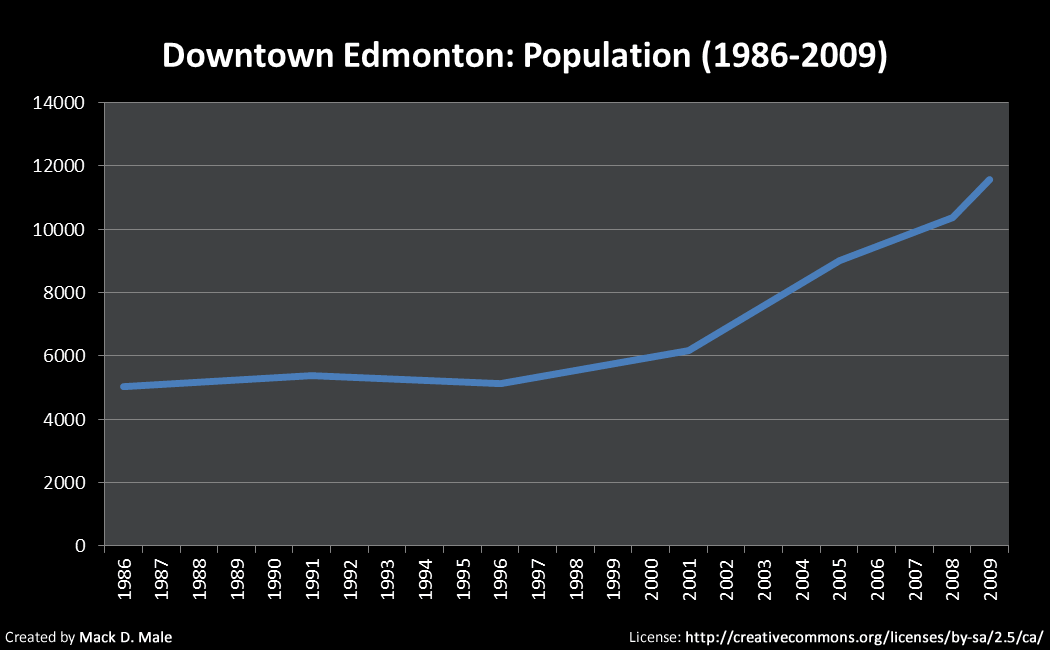
I think if you really want to revitalize an area, you need to get more people living there. We’ve already seen this play out in Edmonton to a certain extent. Here’s what our downtown population growth has looked like since 1986:

Keep in mind the population has really only slightly more than doubled in that time. Not what you would call really significant growth. And yet look at all of the positive changes we have seen downtown in that time! This article by Lawrence Herzog from 2003 covers some of the changes up to that point quite nicely. People regularly point to 104 Street as a positive example of change downtown. It’s why Sharon and I bought here.

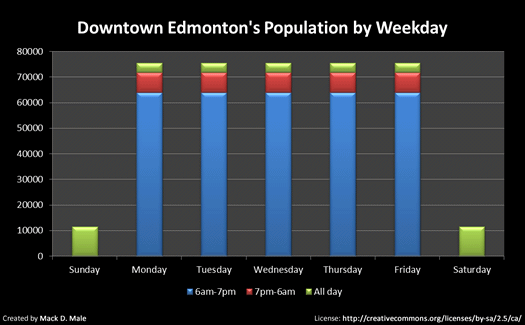
The factor that most often comes up as vital to revitalization however, is the number of people working downtown. Sometimes the argument made is quite compelling too. Whenever I hear that argument, I think of this graph:

It’s incredible how widely the population varies from the weekend to a weekday. And this doesn’t even take into account students and all of the other groups of people that might be downtown on a weekday. Is our downtown population 12,000 or 68,000? It absolutely depends on the time of day!

Why does nearly everything downtown close so early on weekdays? Why is almost nothing open downtown on Sundays? Why isn’t downtown changing as fast as we’d like it to? I think that graph tells a very significant part of the story (see below for an explanation and sources).

The numbers are certainly not encouraging:

  • As of 2009, downtown Edmonton’s population was 11,572. That’s just 1.5% of our total population.
  • As of 2010, downtown Edmonton’s workforce was roughly 67,700. That’s just over 10% of our total labour force.
  • Current plans call for the addition of just 12,200 new residents residential units over the next 35 years, and an increase in residents to 24,000 by 2030. We more than doubled the population in 23 years, why are we slowing down for the next 35 years? That’s about the same pace as we have seen over the last 20 years.
  • According to the Downtown Business Association’s most recent employee survey (PDF), just 6% of people who work downtown also live downtown. This despite downtown being one of our two biggest employment centres (the other being the University of Alberta, which is just a short LRT ride away).

So I don’t buy the argument that we need more people working downtown. If anything, we need more of the people who work downtown to choose to live there also. We need to want to make the changes downtown needs, and we need to make decisions that support that. If we want to meaningfully revitalize downtown, this picture has to change!

There’s a lot more to this discussion of course, but I find this to be a useful way to remind myself of the importance of residents. What do you think?

Sources: Municipal Census 2009, 2010 Downtown Resident Survey (PDF), 2010 Downtown Employee Survey (PDF), 2010 Business Recruitment Resource (PDF). The surveys come from the Downtown Business Association, and I used them to calculate the numbers in the graph. The times, 6am to 7pm, come from the Employee Survey. On weekdays, the green portion is essentially the number of people who both live and work downtown, which is an average of the 6% of employees who say they live downtown and the 29% of residents who say they work downtown. There are a bunch of assumptions made, of course, such as the assumption that if you’re a downtown resident and you don’t work downtown, you work and are somewhere else between 6am and 7pm.

Media Monday Edmonton: Week in Review #3

Here’s my third week in review:

You can follow Edmonton media news on Twitter using the hashtag #yegmedia. For a great overview of the global media landscape, check out Mediagazer.

So, what have I missed? What’s new and interesting in the world of Edmonton media? Let me know!