Will Edmonton be a second-class city without the new arena?

Last week City Council was again discussing the proposed downtown arena. Though Administration provided an update at the Wednesday meeting, it certainly didn’t feel like much new information was brought forward. Details on the proposed Community Revitalization Levy (CRL) were delayed yet again, this time until the first week of April. The meeting did not go well.

Mayor Mandel seemed to be upset that progress had stalled. He wants Council to make a decision in the next month or so:

“It’s enough already. I think we’re going around too many circles and let’s make a decision.”

But there was another comment he made that stood out:

“Either we build a new arena or we become a second-class city, which in my mind we don’t want to be.”

I’ll admit that comment even surprised me. Does Mandel really think we can’t be a first-class city without building the new arena? Is the project really a make-or-break one for Edmonton? Boosterism has long been a part of this debate, something Dave covered back in January. And as our Mayor I think Mandel needs to be Edmonton’s greatest champion, a role he has definitely not shied away from while in office. But is there no hope for Edmonton if the arena project doesn’t go ahead?

“My choice of words probably wasn’t right,” Mandel admitted when I asked him about it. “It’s just that when opportunities come up, you have to make a decision. Edmonton in the past hasn’t made an effort to seize opportunities that have come up.” It’s a good point, I think. You can’t simply wait for things to come along, you have to go out and get them. If we want to take Edmonton forward, we need to make a concerted effort to do so. “You’ve got to fight for things,” Mandel said.

Mandel stressed the need to improve our downtown. “Cities are evaluated by their downtowns, not their suburbs. Edmonton’s downtown has a long way to go.” I asked if that meant we had to have the arena. “There’s millions of ingredients that go into it,” he said. The arts community and our IT sector were just a few of the examples he cited. He of course thinks the arena is one of those ingredients, however. “The arena with a good financial deal will make Edmonton better.”

Stephen Mandel at Candi{date} Sept 29, 2010

When discussions get intense, people say things without fully thinking them through. I think that’s what happened to Mandel last week with the second-class comment, but he’s certainly not the only one who has made regrettable comments. Is it true that “the anti-arena faction is out in full force” as David Staples suggested (archive) a couple of weeks ago? I think it is, and there have certainly been some puzzling comments from them as well. The debate needs people on both sides, to help us tease out the details and ultimately arrive at the best decision for Edmonton. Mandel has decided to support the arena. Others have decided to fight it. A good debate is healthy for Edmonton.

On Saturday, Gary Lamphier writing in the Edmonton Journal reminded us that there are many key questions about the project that have yet to be answered (archive):

Although Mayor Stephen Mandel seems determined to wrap up the Seinfeldian arena "debate" — such as it is — in early April and push the project ahead at Mach speed, it’s hard to see why with so many key questions unresolved.

With weeks to go before a pivotal report on the project is presented to city council — following which councillors may have little time to reflect on it before they vote — it’s puzzling that so many key questions remain unanswered.

Today, Danny Hooper writing in the Edmonton Sun offered some compelling reasons to move ahead with the project (archive):

We are not the arctic outpost some think of us. This is a vibrant, energetic, resourceful, caring, and fun community, yet I don’t think our downtown best makes that statement. And I think it should.

Where some see a downtown that feels dull, disjointed, and at times lifeless, I see a blank canvas. The Katz group have at least brought out the paint and offered their vision of what our city centre could be. Of what it should be. And we’re all welcome to pick up a brush.

Maybe it comes down to perspective, as is so often the case with difficult questions such as this one. Do you choose to see the arena as Mayor Mandel does, as an opportunity to enhance our downtown that we should at least make an effort to capitalize on? Or do you choose to see the arena as those against the project do, as an expensive pet project that will do little to help Edmonton’s core?

There are no guarantees in this debate. Edmonton will not be relegated to “second-class” status if the project dies, nor will Edmonton automatically be world-renowned if it goes ahead. There’s obviously no secret recipe either, or we’d have already turned downtown around. Whether you support the arena or not, it’s important to recognize that revitalizing our downtown and becoming the city we want to be will take much more than any single project.

Edmonton Notes for 3/6/2011

Don’t forget I post Edmonton-related items throughout the week at Edmonton Etcetera. Here are my weekly Edmonton notes:

edmonton north
A window on Edmonton that you don’t often see. Wonderful! By amber_rsm.

Pecha Kucha Night: Edmonton #9

Last night was Edmonton’s ninth Pecha Kucha Night, a completely sold out event held at the Royal Alberta Museum. It was the first time in Edmonton that Pecha Kucha has been sold out in advance of the doors opening. Last night was also the first PKN in Edmonton to be live-streamed, thanks to the Edmonton Journal. You can check out their video archive here. Edmonton Next Gen also recorded the event, and will be posting video to YouTube in the near future.

In order of appearance, these were the presenters at PKN9:

  1. Mack Male, Edmonton Blogger
  2. Bryce Croucher, Print Designer
  3. Dr. Kim Raine, Co-Director & Professor
  4. Kevin Kossowan, Food Writer
  5. Joseph Ahorro, Researcher and Ph D Candidate
  6. Duncan Kinney, Sustainability Nerd
  7. Jennifer Hoyer, Librarian
  8. Jennifer Livermore, Architectural Technology Student, Closet Activist, Renovator
  9. Nadine Riopel, Philanthropy Enthusiast
  10. Sean Healy, Software Developer & Man About Town and Adam Rozenhart, Digital Strategist & Man About Town

Our hosts for the evening were Ryan Stark and Next Gen’s new Community Co-Chair, Tegan Martin-Drysdale. They once again used iPad’s during their introduction to the evening, which was very obviously scripted. I kind of wish they had gone a bit more free-form and had some fun with it. Their job really was to keep things on track however, and they did just that.

Pecha Kucha Night 9

Overall I thought last night’s presentations were pretty good. Most people even decided to leave the cue cards and other notes behind! The evening had its usual up and down feel as topics varied from serious to funny and presenters brought different levels of energy to the stage. I was up first, so I did my best to set the bar high! I felt like my talk went well, but I’ll be writing more about that later.

Without a doubt my favorite talk of the evening was Sean and Adam’s finale. They did such a great job of presenting a topic that is of great interest to nextgenners in a completely accessible and fun way. Who knew you could talk about curbing suburban growth and the importance of public transportation in that way?! Their six minutes and forty seconds were filled with laughter, cheers, and some light-hearted jabs at Councillor Iveson and Mayor Mandel. Sean and Adam absolutely nailed it – great job guys!

Kevin’s talk on his family’s food system was another favorite of mine. He did a great job of talking about something personal without sounding self-interested. He was authentic, funny, and got his story across very effectively. If you haven’t already checked out his blog, do it now. I also really enjoyed Nadine’s talk on philanthropy. I thought she gave us food for thought and I loved her ignore-the-images-and-just-talk approach. It doesn’t always work, but for Nadine it did. Aside from myself, Nadine was the only other presenter who had spoken at PKN before, and I’m glad she was able to put PKN5 behind her. Duncan’s talk on energy was really great as well – I especially enjoyed his graph on the percentage of Albertans that are awesome.

Joseph, Kim, and Jennifer L. had the more serious talks of the evening. Jennifer H. delivered a really interesting talk on storytelling, and Bryce was perhaps the most memorable of all the presenters last night. He broke all the rules and basically went on a high-energy rant for 7 or 8 minutes!

Pecha Kucha Night 9Pecha Kucha Night 9

Twitter was busy as always, this time with the hashtag #pkn9. Since midnight on March 4, there have been 974 related tweets posted here in Edmonton. Here are your top ten #pkn9 tweeters:

  1. EdmNextGen
  2. TamaraStecyk
  3. zsaher
  4. SavageTiner
  5. DebraWard
  6. britl
  7. Sirthinks
  8. ZoomJer
  9. Neumanic
  10. stellal

Here’s a word cloud of #pkn9 tweets from that same time period (with #pkn9, #yeg, and RT removed):

If you’d like to read through the stream, you can do so here. I archived it (seemed appropriate given my topic).

Pecha Kucha Night 9Pecha Kucha Night 9

Some other thoughts on the evening:

The next Pecha Kucha Night in Edmonton, known as PKNX, is scheduled to take place in June at the Alberta Aviation Museum. Thanks to Edmonton Next Gen for another great event, to all of the volunteers for making it happen, and to everyone who attended or watched online! Stay tuned to @EdmNextGen for updates.

You can see the rest of my photos from last night here.

Media Monday Edmonton: Week in Review #2

Here’s my second week in review:

I was fortunate enough to take part in an informal conversation on local media on Thursday evening. It was a great discussion, and I came away with lots to think about. I was reminded of this post from April 2009: Newspapers, cities, and the local web.

You can follow Edmonton media news on Twitter using the hashtag #yegmedia. For a great overview of the global media landscape, check out Mediagazer.

So, what have I missed? What’s new and interesting in the world of Edmonton media? Let me know!

Meet me on the bridge: The Edmonton City Centre Redevelopment

It was 1974 when City Centre Place was completed, part of the Edmonton Centre development across from Churchill Square. The shopping mall we now know as Edmonton City Centre has had an interesting history, to say the least. TD Tower was added to the complex in 1976, and Oxford Tower and the Sutton Place Hotel followed in 1978. As Christopher Leo notes (archive), downtown was the place to be back then:

In the 1970s, downtown Edmonton was the retail centre of the metropolitan area, and the city had a policy of sustaining that role by supporting the viability of residential neighbourhoods near the centre of the city and placing limits on the amount of permitted suburban shopping centre development.

The development of West Edmonton Mall by the Triple Five Corporation in the 1980s had a significant negative impact on downtown Edmonton, and on the City Centre mall in particular. The policy limiting suburban shopping centre development was forgotten. As a result, efforts to restore life to downtown began and Triple Five came along with a solution: Eaton Centre. Christopher has documented the ups and downs of that project very thoroughly, so suffice it to say that what was eventually built in 1987 was a mere shadow of the original vision.

The two malls staggered along until 1999 when the Eaton’s chain went bankrupt. It was around that time that Randy Ferguson came to Edmonton on a mission to straighten things out. He remembers his boss at Oxford Properties, Jon Love, telling him two things before he left. “Go get the job done in the best interest of the community and this company,” and “remember one thing: that’s my hometown”. Randy’s journey began on January 2, 2000.

“There was very little energy downtown,” he recalled. Eaton Centre and Edmonton Centre had separate identities. Thinking back to the amount of space they took up downtown Randy told me how he felt: “it was depressing.” He had a job to do however, and his first task was to convince the Oxford board that they should spend money in Edmonton, their weakest market. “We said, don’t think about this as a retail play.” Randy pointed out that 40% of the office space downtown fed into the property. Four office tower lobbies and two hotels directly. The board gave Randy the go-ahead, but with a budget of just $44 million.

Randy and his team made a number of big changes over the next few years. Randy felt that a department store facing Churchill Square was inappropriate, so they convinced The Bay to move to the other side of the mall, to the vacant Eaton’s location. They turned the basement of the now empty east side into a parkade, and managed to attract Sport Check, Winners, and CBC. There were challenges along the way, of course. In the fall of 2001, Randy had arranged to have the western executives in charge of CBC’s TV and Radio divisions come to Edmonton so that he could pitch the idea of consolidating CBC’s properties in the mall downtown. The morning of the presentation was September 11. Needless to say the deal didn’t happen until many months later!

City Centre Wide Bridge

Merging the separate Eaton Centre and Edmonton Centre identities was an important aspect of the redevelopment. Randy wanted to do something architecturally to combine the two properties, and thought about a pedway bridge. “I think our bridges are terrible,” he told me. “They’re ugly, utilitarian, and generic.” In fact, Randy dislikes our pedway bridges so much that he pitched the idea of wrapping each one in scenes depicting the events taking place at the 2001 World Championships in Athletics. Unfortunately, the City didn’t go for it.

Randy wanted the bridge joining the properties to be more than just a pathway, he wanted it to be iconic. That’s how he came up with the wide bridge concept. “I wanted it to become the meeting place,” he recalled. “You know, ‘let’s go for coffee…meet me on the bridge!’” He envisioned a Starbucks and a patisserie on the main level of the bridge, with the rest of the space available for seating. They built a second level as well, a space that Randy thought would make an excellent wine bar. “We put two circular staircases on the bridge, ran power, and even roughed in plumbing.” As it turns out, Randy’s vision was never fully realized. “It has never been programmed the way I imagined it.” Today the bridge is home to a Tim Horton’s, a Telus Mobility kiosk, and a few retailers including a Bell store. The second level is empty and inaccessible. That’s unlikely to change anytime soon, due to the leases that are in place.

Edmonton City Centre Wide Bridge

Randy and his team had to be creative in order to achieve everything they wanted with the redevelopment project, which was finished in 2003. “We accomplished an $80 million spend on a budget of $44 million,” he said. He had spent some time studying funding programs elsewhere in North America, and came across a tax increment financing (TIF) project in Florida. “I liked it because it had a direct connection to rehabilitating the area, and it had a sunset, it wasn’t forever.” Randy worked with Al Maurer, City Manager and Randy Garvey, then the GM of Finance at the City of Edmonton, to see if he could make such a program work here. Alberta’s CRL legislation didn’t exist yet, so they could only apply the tax increment from the City to the project, the school taxes could not be touched. They followed the sunset model, whereby 100% of the tax increment went to the project in year one, 90% in year two, and so on. Randy thinks it might be the first example of a TIF used in Alberta.

City Centre Wide Bridge

When the time came to build the wide bridge, Randy again was out of money. Recognizing that it technically wasn’t on land that Oxford owned, they applied for a local improvement levy. The City studied the legislation and agreed that the funding mechanism was appropriate, so that’s where the money for the bridge came from. Further funding for the redevelopment project came through the creative use of a Commercial Mortgage Backed Security, something that would never happen today given the current recession.

Given his history with the concept, I asked Randy for his thoughts on the idea of using a CRL to help pay for the downtown arena. “I am a huge fan of CRL or TIF – it can make things happen that otherwise wouldn’t.” He doesn’t think the proposed formula is the best one, however. “I believe the school tax portion of CRL should be sacred, it shouldn’t be in play,” he told me. Randy also feels the sunset approach is better than 100% for 20 years as the current legislation allows. “We need to benefit from that growth, along with the guys that are making the investment.” He suggested that the City should get some local experience at the bargaining table, someone like Randy Garvey.

Randy supports the proposed arena project, even though it is competition for ProCura where he is COO. “It’s about critical mass. It’s about creating a new day.”

Media Monday Edmonton: How fast are local media websites?

On the web, page speed matters. If your site takes too long to load, people will go elsewhere. Google proved this by purposefully slowing down its search engine. They found that even just half a second caused fewer searches. Bottom line: users love fast sites!

With that in mind, I decided to look at local media sites – how fast or slow are they? Rather than looking at page load times, I decided to use YSlow to determine the performance of each site. Lots of factors can impact the amount of time a page takes to load (your ISP, the speed of your computer, where you are geographically,etc), but everyone has to download the same amount of data for a web page, so I figured YSlow is a little more fair than a stopwatch.

Here are the fourteen sites I looked at (you can download all the data here):

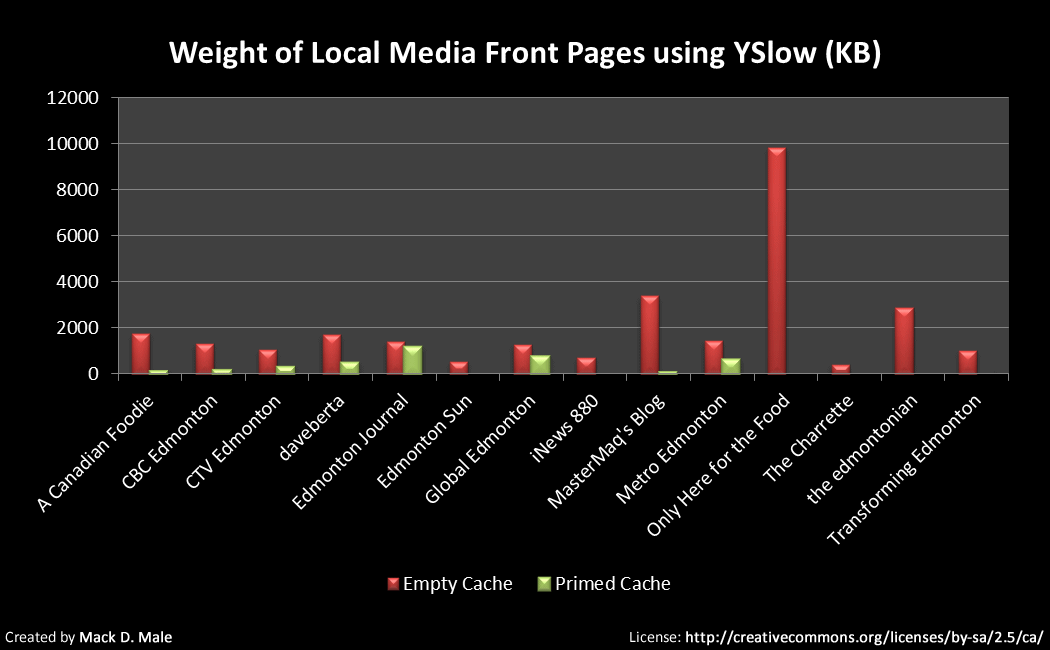
As you can see, none of the sites received an “A” grade. The only one to receive a B was Only Here for the Food. The grade can be somewhat misleading, however. Here’s what the front page performance for each site looks like:

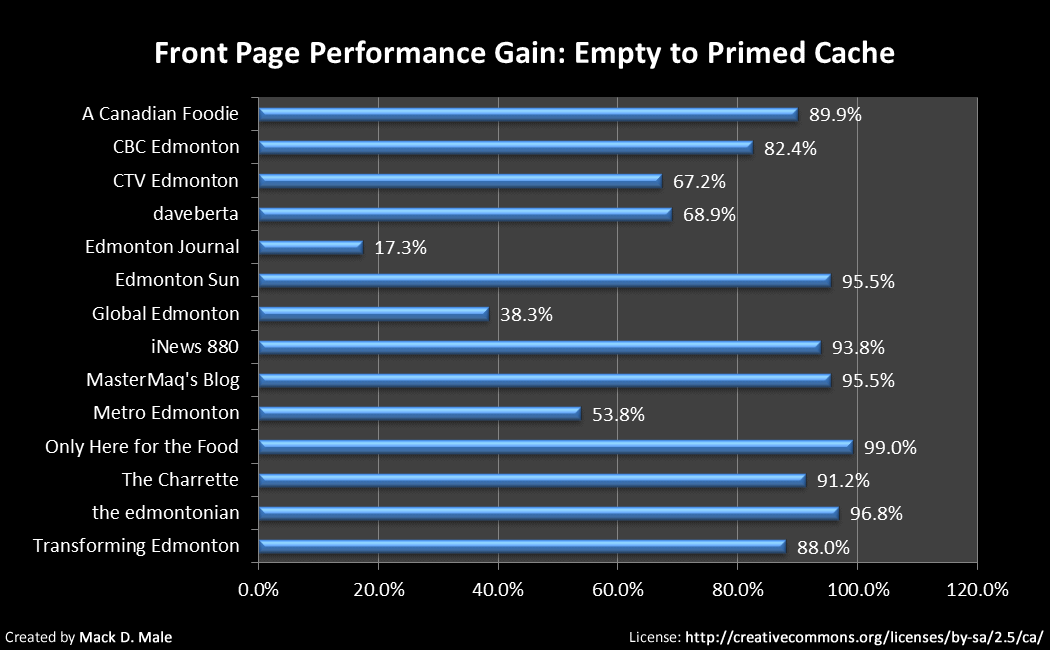
It turns out that Sharon’s blog is the heaviest of them all with an empty cache (the first time you visit the site). This is due to the large number of images she has on her site. In fact, almost all of the weight of the page is due to the images. If you look at the primed cache (subsequent visits to the site) then the Edmonton Journal is the heaviest. The Edmonton Journal has the worst performance improvement going from an empty to a primed cache:

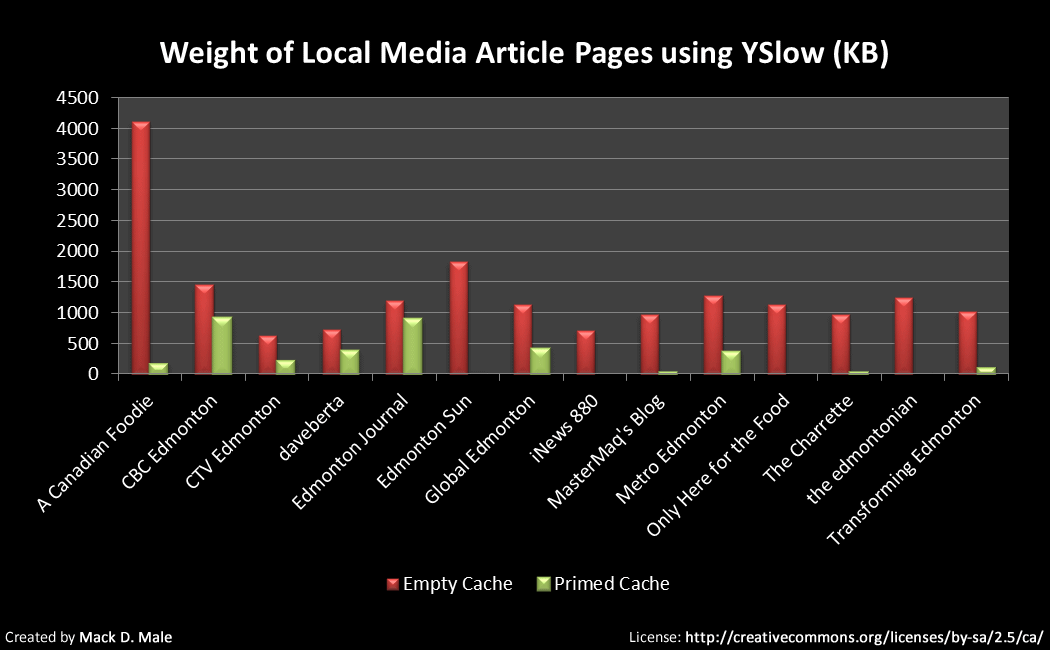
To be fair, I decided I should compare an “article page” on each site as well. With social media in particular, an article page is more likely to be a visitor’s entry point to the site. For this test, I simply clicked on the top article on each site:

One caveat: I used the second story for iNews 880, because their top story was over 25 MB in size! Evidently they think it is fine to embed full size, uncompressed images.

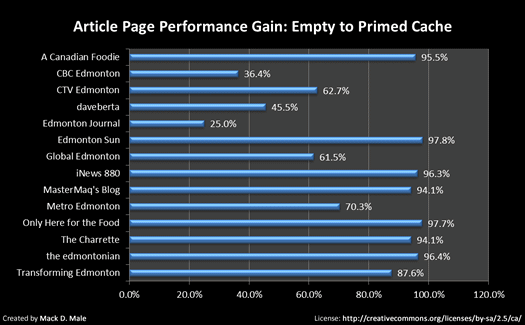
As you can see, Valerie’s blog is the heaviest, again due to the number of pictures she has. Once again, the Edmonton Journal has the worst performance improvement going from an empty to a primed cache:

Final Thoughts

I thought there would be more of a difference between the new and traditional media sites, but there isn’t really. In general the heaviest part of the blogs is images and the heaviest part of the traditional media sites is Javascript, but there are exceptions. On average, the first time you visit the front page of one of these sites you’re going to have to download just over 2 MB. On a 56.6 Kbps dial-up connection, that would take you nearly 5 minutes. On a typical high-speed connection, it’s more like less than 10 seconds.

I think perceived performance is often more important than actual performance, but that’s obviously harder to measure. In my experience, most of these sites load fairly quickly. When I do notice a speed issue, it’s usually because the page I am trying to load has a lot of stuff on it.

Another thing I learned from this exercise is that all of the sites have room for improvement!

What has your experience been like? Which sites do you find slow?

Edmonton Notes for 2/20/2011

Here are my weekly Edmonton notes:

Silver Skate Festival
Art Burn at the Silver Skate Festival

Blue Bay Station
Blue Bay Station by Kurt

Edmonton Twilight Rush-Hour
Twilight Rush Hour by POD

Art Burn at the Silver Skate Festival

The recent temperature plunge came at the worst possible time for the Silver Skate Festival. It was easily thirty below with the windchill this evening, and you could really feel it in the relatively wide open Hawrelak Park. To be honest, had it not been for the fact that Sharon and I had agreed to guest judge the 2011 Art Burn fire sculpture competition, we might not have made it out tonight. But I’m glad we did, because it was quite the show! And what’s a winter festival without a little cold, right?

There were six Art Burn fire sculpture artists: Maria Butler, Randall Fraser, Will Truchon, Tanya Garner-Tomas, Vergilio le Paz and Marissa Kochanski. Here’s a little photo tour of the evening.

Silver Skate Festival
We arrived early enough to check out the awesome snow sculptures.

Silver Skate Festival
Some artists were still busily working!

Silver Skate Festival
Sharon just had to sit in the Yelp throne.

Silver Skate Festival
Gather around the fire, that’s how you keep warm!

Silver Skate Festival
Vibe Tribe performed just before the Art Burn.

Silver Skate Festival
I know they had fire in their hands, but I bet they were still freezing.

Silver Skate Festival
This was Marissa Kochanski’s sculpture before the burn.

Silver Skate Festival
Here it is during the burn. Her sculpture was the winner!

Silver Skate Festival
More sculptures burning!

Silver Skate Festival
Randall Fraser’s “hand” sculpture was another favorite.

You can see the rest of my photos here.

Sunday night is “Fire in the Belly”, during which a larger communal sculpture created by the artists will be ignited. So if you missed out on the fire tonight, you still have an opportunity tomorrow! Just make sure you bundle up.

Thanks to Erin and Ritchie for having us, and congrats on another successful year!

City’s Standing As Metropolis Declared To Hinge On Coliseum

Recently I have been doing some research on the history of Rexall Place. I thought it would be useful to understand what happened in the past when trying to make sense of our current downtown arena debate. As part of that research, I spent some time at the City of Edmonton archives. I wasn’t sure what to expect or how to approach my research, so I simply asked for anything related to the construction of the Coliseum. Sherry Bell, Reference Archivist at the Archives, was incredibly helpful and came back with a thick file folder labeled “File 1, 1963-1974”. She told me it was the first of many, just the tip of the iceberg.

Coliseum History at the Archives

I read through the entire folder, taking notes as I went. The documents inside, mostly clipped Edmonton Journal articles, tell the story of how the Coliseum came to be, from the push for a downtown arena in the early 1960s through to the construction of what we now call Rexall Place in the early 1970s.

The title of this post comes from an article in the Edmonton Journal published on September 12, 1963. In it, Alderman Les Bodie made his case for the proposed downtown coliseum of the day, saying:

“I think the successful city will be the one with a stable economic base combined with a stimulating economic climate, and the coliseum will be a major factor in attracting interest in our city.”

It was one of many gems I found in the file, some of which I have shared below, and some of which I’ll share in future posts.

In total, I recorded 93 headlines (I skipped some). Here’s the breakdown of the articles I looked at by year:

Lots was written early on in the debate, and less was written as construction got underway and progressed. Here’s a sample of the headlines:

  • Coliseum Site Studied – May 11, 1963
  • City Approves $10 Million Coliseum Plan – June 25, 1963
  • City Has ‘Escape Hatch’ If Coliseum Voted Down – August 29, 1963
  • City’s Standing As Metropolis Declared To Hinge On Coliseum – September 12, 1963
  • Mayor Hits Coliseum Critics – September 24, 1963
  • Coliseums Seem To Spark Growth – September 28, 1963
  • Coliseum Complex Rejected By Almost Half Ratepayers – October 17, 1963
  • Mayor Anticipates Verdict On New Coliseum Proposal – March 1, 1965
  • A Coliseum Or A New Arena? – March 25, 1965
  • Alderman Warns City Taxpayers Will Have To Subsidize Coliseum – July 20, 1966
  • Ex arena to be constructed just north of Gardens – April 22, 1972
  • Oilers won game but public the real winner – November 11, 1974

I was immediately struck by how similar today’s debate is to the debate in the 1960s. In short: a downtown arena is proposed and tied to the future of the city, people argue over the location and other details, but the process really gets stuck on the money.

One of the first documents I found in the file was a pamphlet published by The Hamly Press (which as far as I can tell no longer exists) entitled, “the Coliseum Plebiscite: a test of our Faith in Edmonton as a Great Metropolis of the North West”. Here are some of the statements found inside:

  • “A downtown showplace that will publicize Edmonton as a progressive, positive-thinking city, developing rapidly in all phases of modern city live and endeavor.”
  • “The Coliseum Complex will lead the way in revitalizing downtown activity.”
  • “A Vital Necessity for Downtown Development!”
  • “Construction of the Coliseum Complex will be the city’s first step in the fulfilment of Edmonton’s remarkable plan for the renewal of the downtown city centre. There is little doubt that perseverance with this project now will be a decisive factor in the eventual completion of the entire Civic Centre plan.”
  • And a quote from Mayor Roper: “This plebiscite will be a test of the vision of the ratepayers of our city. How much do we want Edmonton to lead all Canada in bold, imaginative downtown development?”

Edmonton Journal writer Ben Tierney, working in the City Hall Bureau, wrote a lot about the proposed project. In a September 24, 1963 article entitled “Other Cities Find Value in Coliseums” he highlighted what he saw as “three basic benefits”:

  1. Attraction of major sports, entertainment and cultural events that the city could not otherwise hope to obtain.
  2. Attraction of outside dollars to the city through increased convention activity as well as non-local attendance at coliseum events.
  3. Increased tax revenue for the city through construction of new downtown building encouraged by the coliseum’s construction, and a revitalized city centre.

Sounds familiar, doesn’t it?

Of course, the initial plan never came to fruition, and subsequent attempts to rescue it failed also. On October 17, 1963 the Edmonton Journal reported the results of the plebiscite that would have authorized the City to borrow $14,250,000 to finance the coliseum:

“The coliseum complex was strongly backed by the former city council, the Edmonton and District Labor Council, the Edmonton Chamber of Commerce and Jaycees, the Edmonton Exhibition Association, the Edmonton Area Civic Centennial Committee, and the Edmonton Building and Construction Trades Council.”

“55% of voters favored the two money bylaws…but a 2/3 majority was required. Opposition to the project centered on the costs involved.”

Over the next ten years, various attempts to salvage the idea were made, but ultimately the cheaper Edmonton Coliseum was built instead. I wonder how different things might have been had the downtown complex gone ahead?

Recap: Startup Weekend Edmonton 2

Edmonton’s second Startup Weekend was held this past weekend at the Computing Sciences Centre on the University of Alberta campus. It was a fantastic event that saw seven teams create some really interesting things in just 54 hours. Around 50 people participated – lots of programmers, some designers, some writers, and many others. Here’s how the weekend played out.

Friday night was pitch night. Fifteen people got up and made an elevator pitch for one or more ideas, which we stuck up giant post it pages on the walls all around the room. Everyone then had a few minutes to walk around and chat with the idea people, to determine which team they wanted to work on. In the end, seven teams were formed, with sizes ranging from two people to more than a dozen. Teams did a little bit of brainstorming and preparation that night, but I don’t think any code was written.

Startup Weekend Edmonton 2

Saturday was a work day, with teams arriving and getting started around 9am. The atmosphere was exciting if a little relaxed. People lingered at lunch and dinner, taking advantage of the opportunities to chat with others. Some people stayed working past 11pm that night, while others went home to relax or out to party after a long day of hard work.

Startup Weekend Edmonton 2

Most people arrived again Sunday morning around 9:30am, focused on completing as much work as possible before demo time. It was interesting to see the shift in atmosphere from Saturday to Sunday – no time was wasted on food or breaks on Sunday. People called out tasks and things like “it’s checked in!” as they worked furiously. Getting everyone to leave the building for Original Joe’s as 6pm approached was challenging!

Startup Weekend Edmonton 2
Team Victory working right down to the wire at Original Joe’s.

There was a great turnout for the demos. Here’s what was built:

  • A flash-based gamed called Flatlander, a 2D game similar to minecraft.
  • Eartonic, an iPhone app that helps train people to learn music by ear.
  • Google Earth Sounds, a really interesting tool that enables people to add sounds to Google Earth. It’s such a great idea – with StreetView you can see what a street looks like, so why not find out what it sounds like too?
  • Swift, an attempt to make the experience of sending and finding invoices easier.
  • Another game, called Rubber Chicken Assassin. You take a photo of your friend with your iPhone, then beat them with a rubber chicken. It could then share a fun obituary on Facebook!
  • Helping Manual, a crowdsourced website to answer questions like “how do I get a social insurance number”. It’s targeted at communities such as the homeless or immigrants & newcomers, as well as the people who work with those communities. Another really great idea.
  • Team Victory, the team I was on, built LaunchWith.me. It’s part project directory and part people finder. We focused on a single question – would you work with someone again? LaunchWith.me is a way to answer that for colleagues you’ve worked with at companies, on projects, and in groups. You can check out a screencast here.

The weekend was a great opportunity to meet new people, to work with someone you might not otherwise had have the chance to, and to use and learn new technologies. I did all of those things, and also felt the sense of accomplishment that comes from working together to go from idea to working product in such a short period of time. It sounds so cliché, but it’s amazing what you can accomplish if you focus and work hard! Check out Rachelle’s recap for more.

I would like to see more even team sizes at our next Startup Weekend, tentatively scheduled for the fall, but part of the magic of the weekend is that the outcome is entirely up to attendees. Everyone had a role to play this weekend, even on the large teams, so if you have hesitated about attending because you’re not a programmer, keep that in mind for the next event!

Thanks to everyone who participated this weekend, and to everyone who came out to see the demos! You can see the rest of my photos here.