Recap: Downtown Arena Public Consultation Session

Last night was the first of four City-hosted public consultation sessions on the proposed downtown arena. The sessions aim to gather input that will be provided to City Council. Roughly 150 people visited the Robbins Health Learning Centre throughout the evening, though only about a third of those stayed for the facilitated part of the session.

Proposed Downtown Arena Consultation

The first two hours of the session followed an open house format, with information displays, handouts such as a backgrounder (PDF), City officials available to answer questions, and opportunities for individuals to write questions or comments on sticky notes or in drop boxes. Promptly at 7pm, Margaret Bateman made a brief presentation (PDF) on the consultation process. The next two hours were facilitated discussion groups, where everyone had the opportunity to provide specific feedback on five key questions. Here are the questions as they were presented this evening:

  1. What’s your position on building a downtown arena?
    • If supportive, why?
    • If not, why not?
    • If conditional, why?
  2. If a new downtown arena project were to proceed, what do you think is important to consider in terms of:
    • Design?
    • Downtown connection and impact?
    • Impact on surrounding communities?
    • Community benefits/engagement?
    • Impact on the future of Rexall Place?
    • Any other issues?
  3. What about using a mix of private and public funding to fund a downtown arena?
    • Are you open to this? Why?
    • Not open to this? Why not?
    • Open under certain circumstances or conditions? If so, what are they?
  4. What do you think about other possible funding sources to cover arena costs? (some or all of these are options)
    • A ticket tax
    • A personal seat license or luxury box license
    • A community revitalization levy (which would require the facility be publicly owned)
    • Funding for non-arena infrastructure from other levels of government
    • Additional private investment
    • Any other sources?
  5. Do you have any final thoughts or views for Council?

I attended a “stakeholder” consultation last Thursday that followed a similar format, but asked slightly different questions. The first question in that session was: “Do you support building an arena to revitalize Edmonton’s downtown? If yes, why? If no, why not?” Talk about a leading question with a big assumption! Needless to say I was very pleased to see that the City (along with consultation partner Calder Bateman) had tweaked the questions this time around.

Proposed Downtown Arena ConsultationProposed Downtown Arena Consultation

My discussion group started off fine, but quickly descended into disagreement as a few very vocal members wanted to skip to the funding question right away. The City officials on hand handled the situation very well, and before long our group was back on track generating some useful discussion (the other groups didn’t seem to have any issues). Here are some of the comments from the group that I wrote down:

  • Unclear that the arena would actually bring people downtown
  • The arena will not generate tourism
  • Skepticism about an influx of commercial development surrounding the arena
  • Transit would need to be greatly improved, concern about the lack of an LRT stop right at the arena
  • What would happen to Rexall Place?
  • General feeling we would lose Canadian Finals Rodeo and maybe other events
  • Lots of concern over traffic congestion, some concern over parking
  • Feeling that the current ticket prices are already too high
  • Quite a bit of skepticism about the effectiveness of a CRL
  • Thought that spending the money on existing recreation centres would result in higher benefit to the community

As far as I could tell, my group was the most negative about the arena. The others seemed cautiously optimistic, and when everyone came together at the end of the evening for Margaret Bateman’s recap, that seemed to be the consensus. There was concern over treating the arena as the key to revitalizing downtown, and there was obviously lots of concern over the funding model, but there also seemed to be some optimism that the project could be a very good thing.

Proposed Downtown Arena Consultation

There are three more public consultation sessions currently planned:

If you can’t make it to any of those sessions, you can fill out the online questionnaire, call 311, or email downtownarena@edmonton.ca.

For more information, check out the City of Edmonton’s site, the Katz Group’s site, and the Why Downtown? site. You can follow updates on Twitter using #yegarena.

Whether you’re for or against the arena, or even if you’re unsure, it’s important to make your voice heard!
Two reasons journalists should learn to love Excel

I love Microsoft Excel, I really do. It’s currently the second highest item in my Start Menu, that’s how frequently I use it (now that I think about it, I should just pin it). I use it for all kinds of things – calculations, cleaning up data, and yes, generating graphs. It’s a really versatile tool, and it’s really easy to use (especially the latest version).

I often talk about changes I’d like to see in the mainstream media, and two important ones are context and presentation. There are so many stories that seem like they’re written in a vacuum. A story about housing starts is a good example, like this one from the Edmonton Journal yesterday. There’s 560 words there, words about numbers. Is that the best way to present that information? And even if you think it is, where’s the context? How do the housing starts this month relate to averages and historical numbers?

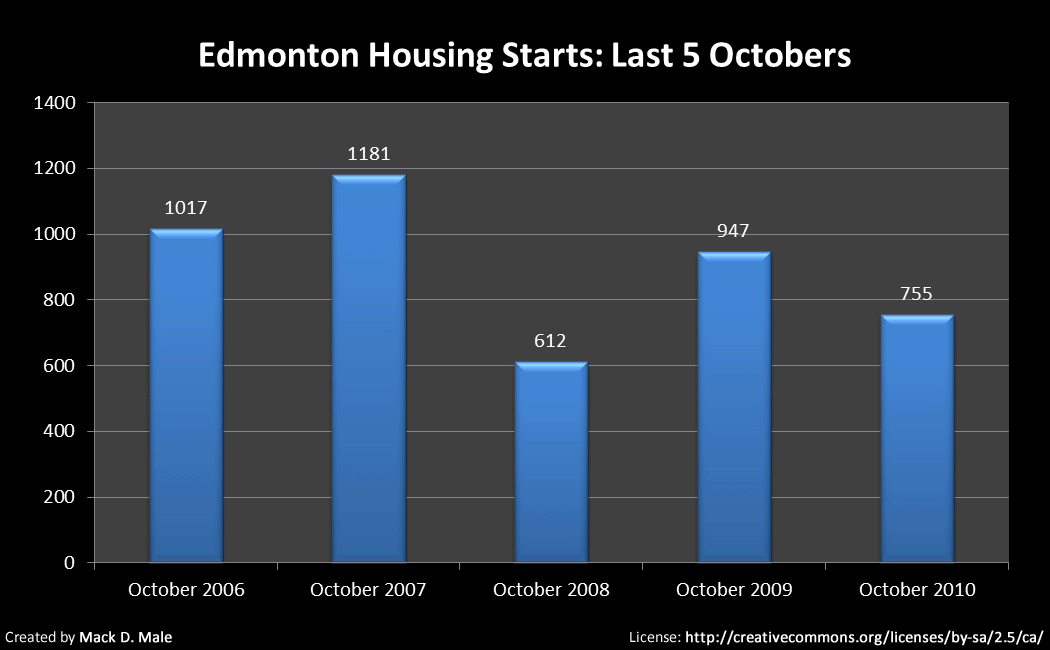
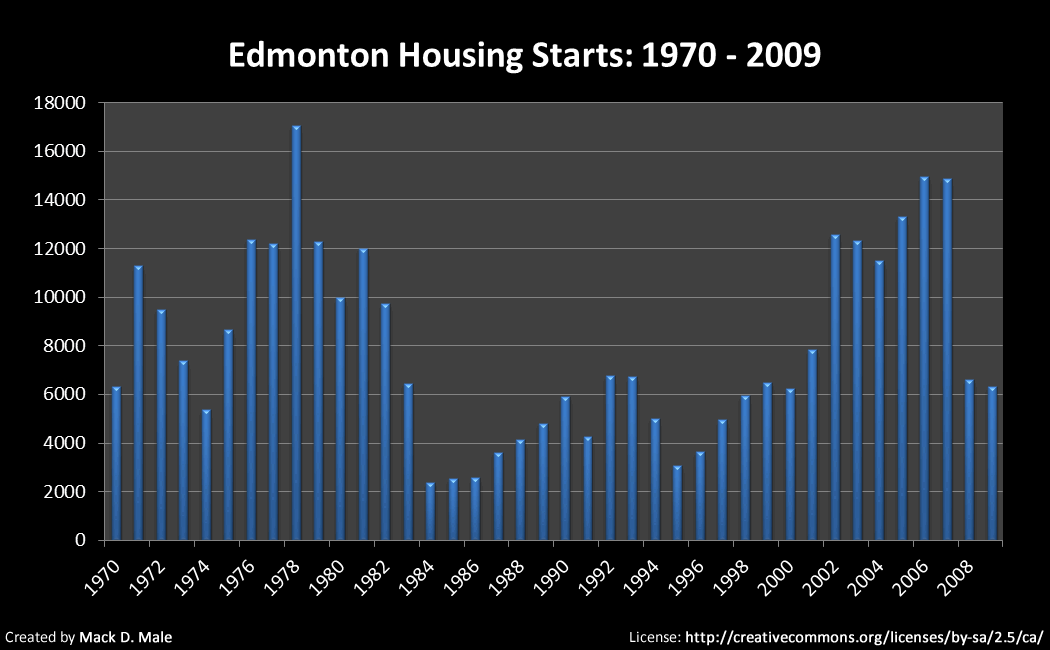
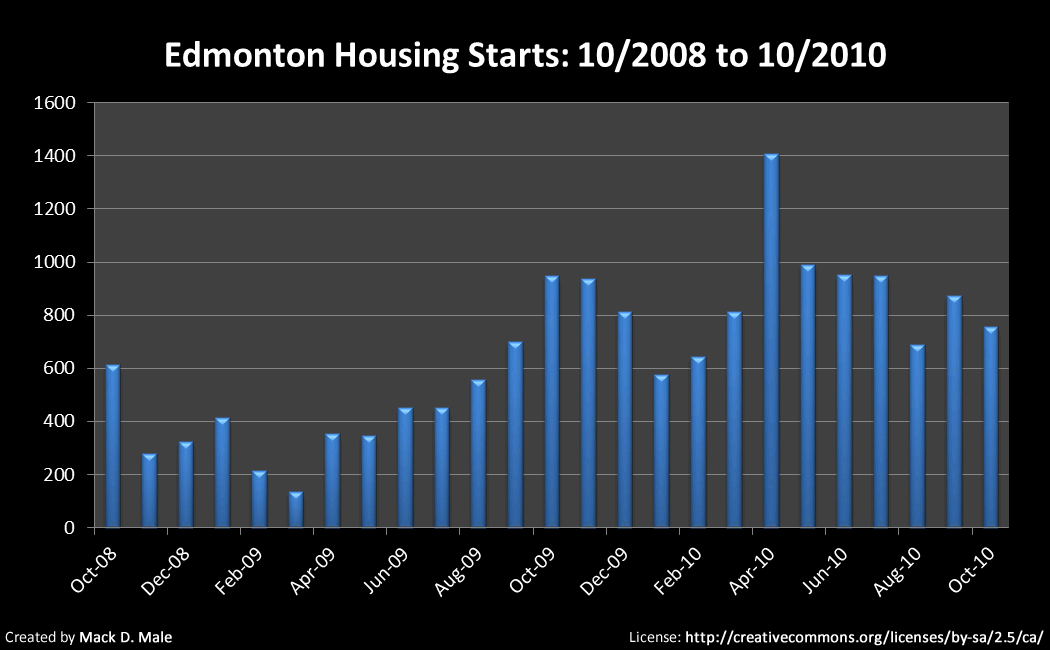
That’s the first reason that journalists should learn to love Excel – it can make providing context and better presentation easy. Here are three simple graphs, created with Excel, that tell you about housing starts in Edmonton.


This data comes from a PDF provided by the City of Edmonton. It shows annual housing starts since 1970. Copy and paste into Excel and you’re done!


This graph shows monthly housing starts from October 2008 until now. It uses data from the CMHC’s Reports & Publications section. Took maybe 10 minutes of copying and pasting.


This graph compares housing starts for this time of year from 2006 until now. Also comes from the CMHC.

Imagine if the article included graphs like these. The journalist could then focus on telling a more interesting story.

So, what’s the second reason journalists should learn to love Excel? Well, it can help them get their story right. Here’s what the Journal article starts with:

Despite a strong spring, the slowing trend in new-home construction became clear in October with housing starts dropping to their lowest level since June 2009 in the Edmonton region.

As you can see from the second graph above, that’s just not true. Is there a slowing trend? Maybe, if you just look from the spring to now. Was October the lowest level since June 2009? No. There were just 690 starts in August 2010. In fact, there were six months with lower housing starts since June 2009. I’m not sure what data the Journal was looking at, but it doesn’t appear to be CMHC data.

Add Excel to your toolkit. You won’t regret it.

UPDATE: Here’s the Journal story on August housing starts. Maybe if finding archived stories was easier, Dave Cooper, who wrote the story on October housing starts, could have consulted previous Journal articles to see that the lowest level was much more recent than June 2009.

Notes for 11/8/2010

Here are my weekly notes:

Edmonton Notes for 11/7/2010

Here are my weekly Edmonton notes:

Edmonton Sunrise
Beautiful sunrise from last Monday!

Cattle and AGA
Phenomenal photo by Darren Kirby.

Notes on the Downtown LRT Connector Concept Plan

On Tuesday evening the proposed Concept Plan for the Downtown LRT Connector was presented to the public at a very well attended event. The plan is the next step in the process that really kicked off on June 21 when City Council approved a street-level downtown LRT route. The proposed 2.1 km route will serve as a connector for the future West and Southeast LRT lines, with 5 stops and opportunities for transfers to the existing LRT system in the downtown core. The route runs primarily along 102 Avenue, connecting to the West LRT via 107 Street on 104 Avenue and to the Southeast LRT on 102 Avenue near 96 Street.

The Downtown LRT Connector was mentioned as a catalyst project for the Capital City Downtown Plan more than once. It forms an importance piece of both the six-legged LRT Network Plan and the so-called Downtown-University circulator.

Here’s what it looks like (the purple line):

Downtown LRT Connector

The Downtown LRT Connector will use low-floor LRT vehicles, which is the style all future LRT development will use (when possible). Low-floor LRT requires less infrastructure and enables step-free, street-level boarding. And yes, low-floor LRT will work in our winter climate!

Downtown LRT Connector: The Quarters in Winter

There are five proposed stops along the route:

  1. Campus Stop – Located diagonally between 108 Street/104 Avenue and 107 Street/102 Avenue. Land acquisition would be required, including the AADAC building. Potential for development around the stop. Serves MacEwan and NorQuest. Features a third track, which could be used as a staging area to prepare for large events, etc.
  2. 105/106 Street Stop – Located in between the two streets, where there are currently parking lots. Land acquisition would be required.
  3. Centre West Stop – Located across from Manulife Place, in between 102 Street and 101 Street. Requires no land acquisition. Would feature dedicated bicycle lanes in both directions.
  4. Churchill Square Stop – Located across from the Stanley Milner library. Requires no land acquisition. A second set of escalators/elevators would be built on the northwest corner of the 99 Street/102 Avenue intersection. Easy connections to existing LRT.
  5. Quarters Stop – Requires no land acquisition. Some traffic impacts: 102 Avenue at 96 Street would be closed to through traffic, and a single eastbound lane would be provided from 97 Street to maintain local access.

Here’s a rendering of the Churchill Square stop:

Downtown LRT Connector: Churchill Square Stop

The question & answer session covered a lot of topics. Here are a few notes I took:

  • The Downtown LRT Connector would use a different signal system. Rather than an exemption (the current LRT always has right-of-way) the LRT would receive priority, but may hold at stations to allow traffic to clear.
  • Buses that currently run along 102 Avenue would of course be re-tooled to feed into the LRT system.
  • The bicycle lanes in the concept plan are primarily shared lanes, but there’s the potential for dedicated lanes in the future.
  • The location of the Quarters stop is further west than would be ideal, but as it dives into an underground tunnel to join the Southeast LRT there isn’t much flexibility. There are significant grade changes.

I also asked about the City Market, as the route would run right through the middle of it. I was told that the City has already had conversations with the City Market, and that they’re confident they’ll make it work (either spreading out along 102 Avenue a little more, or potentially just leaving everything the way it is…but with a train running through every 15 minutes).

I’m particularly excited for this route, living at 104 Street and 102 Avenue. It’ll mean I’m a block or less from both the existing LRT (at Bay/Enterprise Square) and the new lines (at 105/106 Street). Can’t wait to see it happen!

You can download the Downtown LRT Connector Information Booklet here (PDF).

The Concept Plan will be presented to the Transportation & Public Works Committee at a non-statutory public hearing on December 8, after which it will be forwarded to City Council for review in January 2011. You can check out the Downtown LRT Connector page for more information.

Reimagine Tower Renewal Summit in Edmonton

Next Tuesday, Manasc Isaac Architects are hosting a luncheon at the Fairmont Hotel Macdonald featuring John Woelfling of New York’s Dattner Architects (on ShareEdmonton). This is the latest in a series of events known as the Reimagine Tower Renewal Summit. Here’s the event description:

In this luncheon hosted by Manasc Isaac Architects, Woelfling will present on the renewal of the Peter W. Rodino Federal Office Building in Newark, New Jersey. The P3 modernization project utilizes a true re-skinning strategy, a first for North America. The smart skin increases energy efficiency, provides more effective fresh air ventilation, allows the building to be renovated while still occupied and dramatically transforms the building’s identity.

I was invited to the event and am looking forward to it. I’m not an architect (obviously) but I am interested in ways to transform Edmonton’s urban form, and this seems like a useful addition to the toolkit. Manasc suggests that “a reimagined building” (or a re-skinned building) can result in lower operating costs, reduced energy consumption, and improved day-lighting, among other things.

Some of you might remember Shafraaz Kaba’s talk at TEDxEdmonton last March, where he discussed the reimagining of the old Dell call centre building, now the Servus building. Here’s the before and after:

Servus Credit Union

Shafraaz pointed out that the benefits go deeper than just the exterior of the building. People are more productive when there is lots of natural light, etc.

One of the Pecha Kucha talks I remember most was Myron Belej’s from the very first PKN in Edmonton (slides in PDF here). He talked about Urban Color, and showed a before & after for a variety of Edmonton buildings. I remember being struck by just how much of a difference it can make when the building is not beige. Manasc Isaac’s ideas go beyond just color, of course, but I think the two are related.

Here are some more visuals from Manasc Isaac that demonstrate the re-skinning idea:

Stanley Milner Library
The Stanley Milner library downtown – it always comes up in discussions about redevelopment.

Chancery Hall
Chancery Hall

Associated Engineering
Associated Engineering building, apparently so ugly “it stops traffic in its tracks”. There’s a re-skin on the way for this building already.

If you’re interested in attending the event, you can register here. And if you’re in Calgary, they’re doing the event there too on November 10th.

How Friday’s AMBER Alert unfolded on Twitter

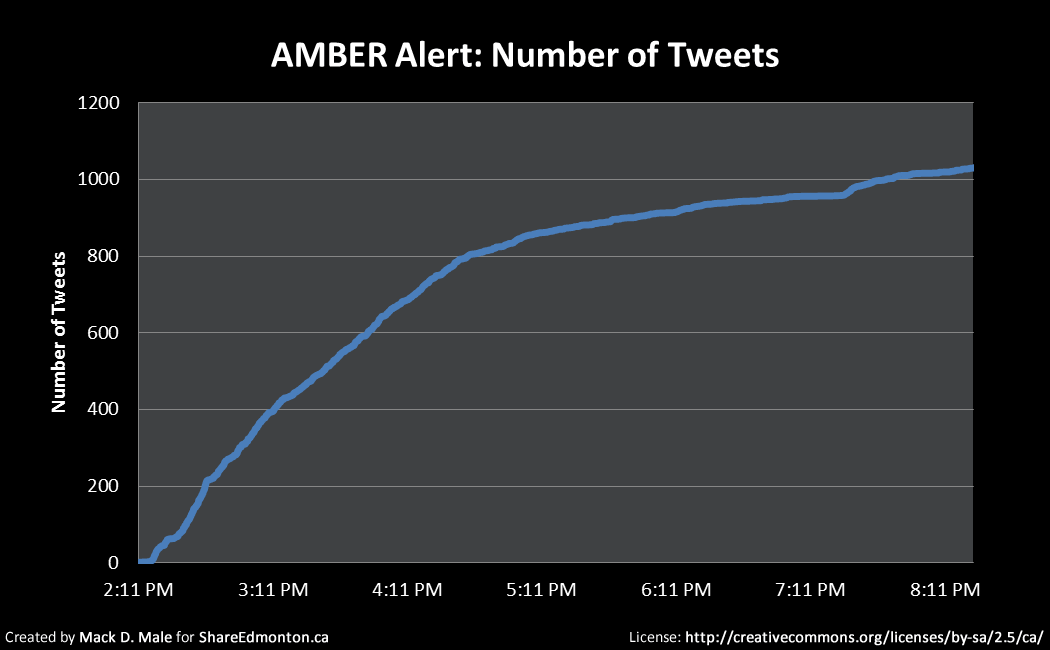
On Friday afternoon, RCMP issued an AMBER Alert for 12-year-old Jacob Telford. Thankfully, he was found “in good condition” after just a few hours. For a while that evening, it seemed like every tweet in Edmonton was related to the incident. At one point during the evening, @tkoriordan said “So I’ve been away from Twitter all day. Somebody want to fill me in on what I missed?” to which @Kiri_W replied “About a billion amber alert retweets.” Curiosity got the better of me, so I looked at the data to see how the AMBER Alert unfolded on Twitter.

Here are the first four tweets that appeared:

Just heard about amber alert, young boy from #shpk, check out alert and key an eye out

1st time I have hear the emerg broadcast have a real emerg. Its ano amber alert for a little boy missing from Sherwood Park

Amber Alert in #YEG child abducted in #sherwoodpark. #Edmonton #AMBERALERT!

AMBER ALERT: 12-year-old Jacob Telford taken from Sherwood Park last night – White 2002 Ford Taurus – BC Plate: V2P4J3

Actually, Rob McAnally had one up before the main CTV Edmonton account did, but it seems that tweet has since been deleted. CTV posted the first link to a new story at 2:29 PM (that link has since been clicked over 1000 times).

From Matthew’s first tweet at 2:11:17 PM until 7:23:43 PM when Jeremy Lye’s tweet appeared declaring that the AMBER Alert had been cancelled (the first to do so), a total of 958 tweets were posted (mentioning either the AMBER Alert or Jacob Telford). That works out to just over 3 tweets per minute (in the first hour, it was nearly 7 tweets per minute). By 5 PM the next day, the total number of related tweets had grown slightly to 1126.

Of those, 983 were retweets. Here’s what the retweets looked like:

They weren’t quite the first to tweet the start or end of the AMBER Alert (they were about six minutes behind both times), but CTV Edmonton was definitely the most visible account to do so, and that is reflected in the number of retweets they received.

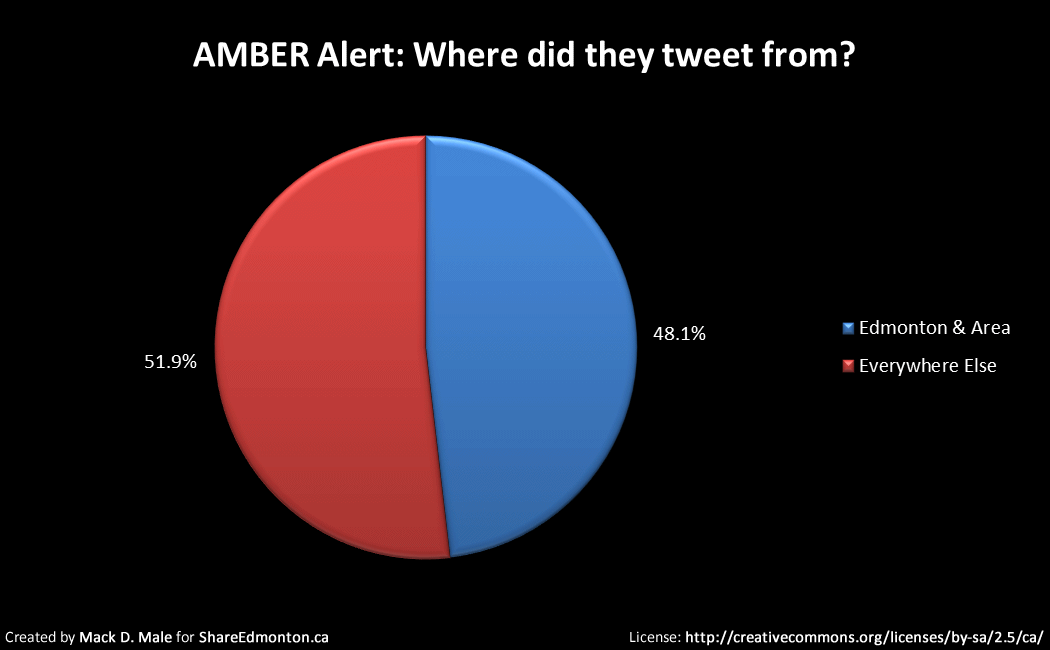
In total, 710 different Twitter users tweeted (or retweeted) about the incident. Just less than half were located in the Edmonton area, while some were as far away as Brazil, Russia, and Kuwait (based on the location in their profiles). I suppose there’s always a chance that their retweets could have helped (maybe they have followers in Canada) but I still have to wonder why someone who is so far away would tweet about something like this. Is it because it’s easy to click the retweet button? Is it because we all like to feel as though we’re helping? I’m not sure.

If you add up the number of followers those 710 users have, you get a potential reach of more than 288,000 users. That’s not accounting for overlap though, so the actual number is probably quite a bit less. And not all of those users will have been online to see the tweets. Still, there’s no question that the AMBER Alert was seen far and wide on Friday.

Here’s what I found interesting about all of this:

  • 85% of all the tweets posted about the incident appeared before we knew the boy was safe
  • 60% of all the tweets posted about the incident were simply retweets of CTV Edmonton’s tweets
  • It took less than 20 minutes for the first news story link to appear
  • After 24 hours, almost no one was tweeting about it anymore

You can learn more about the AMBER Alert Program here.

Notes for 10/31/2010

Here are my weekly notes:

Sharon with the new mailboxes!
Sharon likes the new Canada Post mailboxes!

Edmonton Notes for 10/31/2010

Happy Halloween! Here are my weekly Edmonton notes:

Ed Stelmach meets with mayors of Edmonton & Calgary
Mayor Mandel and new Calgary Mayor Naheed Nenshi met with Premier Ed Stelmach on Thursday.

This blog has posters!
Local fashion blog The Edmonton Vestiary has posters!

State of the Edmonton Twittersphere – August 2010

Welcome to the eighth State of the Edmonton Twittersphere of 2010, my look at the intersection of Twitter and Edmonton, AB. You can see last month’s stats here.

For information on the data, definitions, and other background, click here.

For August 2010:

# of local users: 8488 (an increase of 261 from July)
# of tweets by local users: 481605
# of tweets by local users containing #yeg: 35965 (7.5%)
# of tweets by local users that were replies: 167831 (34.8%)
# of tweets by local users containing links: 144532 (30.0%)
# of tweets by local users that were retweets: 34282 (7.1%)
# of tweets by local users that were twooshes: 16012 (3.3%)

Here are the numbers above in graphic form:

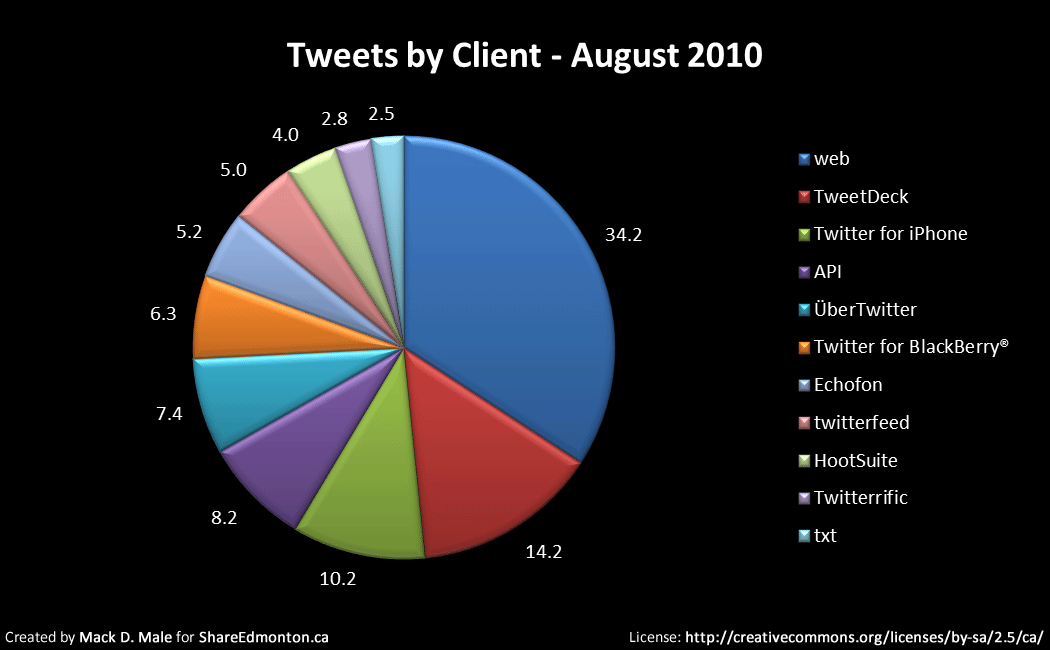
Here are the top clients used by local users for posting updates – BlackBerry apps really dropped off this month for some reason:

Some other interesting stats for the month:

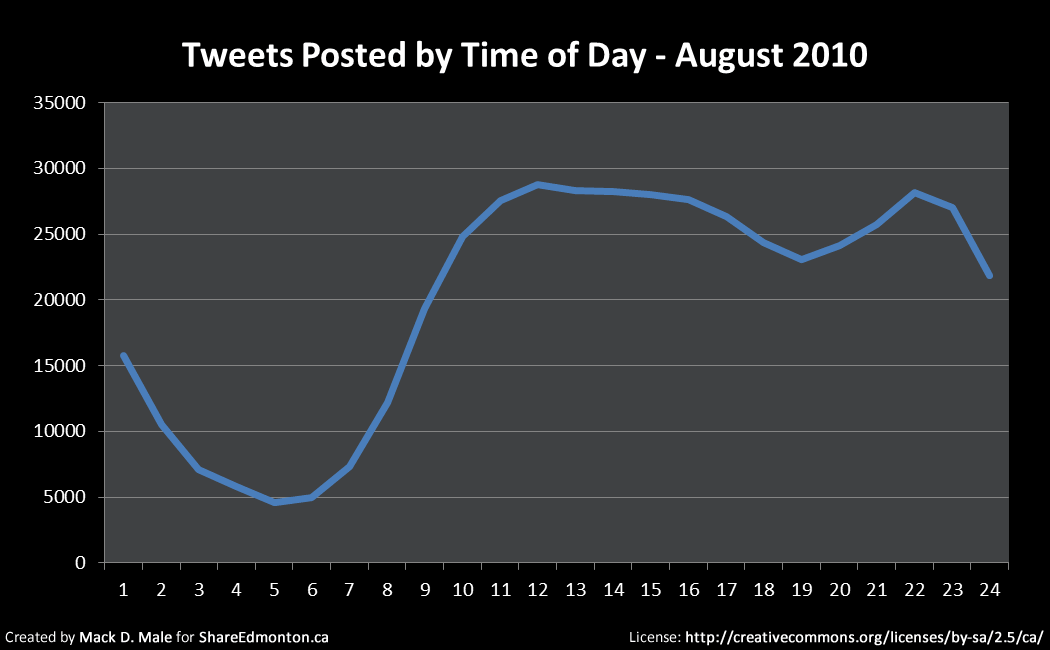
  • Just under 51% of all local tweets were posted between 9 AM and 5 PM.
  • Local users posted roughly 10.8 tweets per minute in August (compared to 10.0 tweets per minute in July).
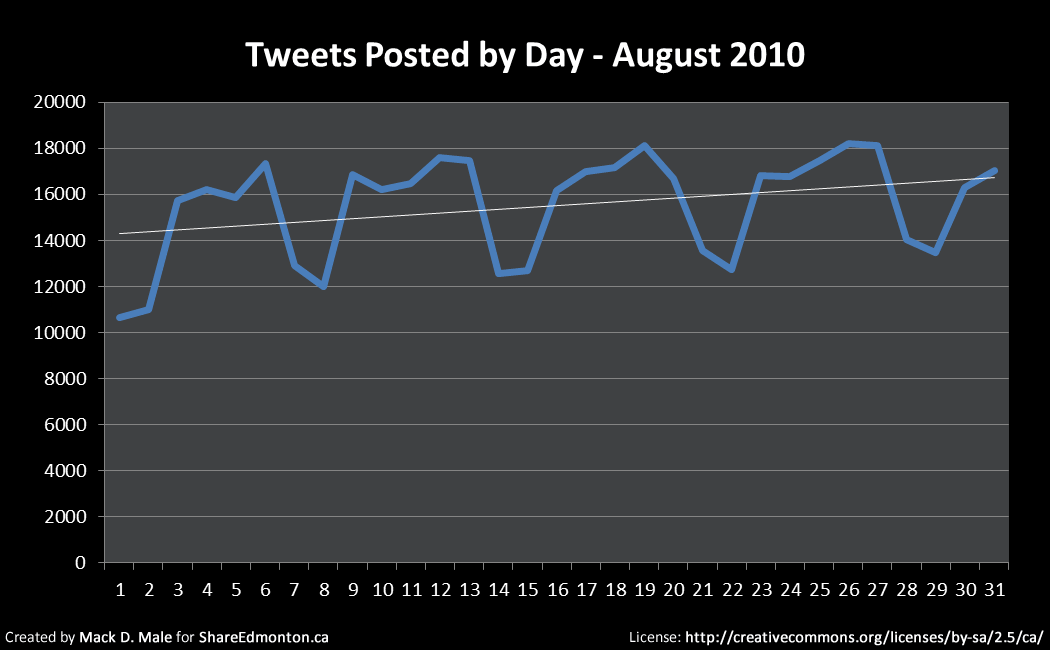
  • The day with the most local tweets posted was August 26 at 18232. On average, 15536 local tweets were posted each day (compared to 14390 in July).
  • Of the 167831 replies posted by local users this month, 65767 or 39.2% were to other local users.
  • A total of 1727 users posted 50 times or more in August. In comparison, 1199 users posted just once.


Here are the top ten most active local users (not including bots):

  1. rootnl2k
  2. DWsBITCH
  3. Lekordable
  4. CommonSenseSoc
  5. MariahEBelle
  6. DJPh03NiX
  7. gcouros
  8. kristenloverton
  9. fraygulrock
  10. Sirthinks

Here are the top ten most active local users using #yeg (not including bots):

  1. edmontonjournal
  2. Sirthinks
  3. iNews880
  4. ctvedmonton
  5. DebraWard
  6. cbcedmonton
  7. CommonSenseSoc
  8. lindork
  9. livingsanctuary
  10. mastermaq

Here are the top ten most replied to local users:

  1. PoisonLolita
  2. CommonSenseSoc
  3. ZoomJer
  4. Sirthinks
  5. Wildsau
  6. SaySandra
  7. britl
  8. DebraWard
  9. Rainyfool
  10. lindork

Here are the top ten most retweeted local users (by other local users):

  1. edmontonjournal
  2. ctvedmonton
  3. mastermaq
  4. CityofEdmonton
  5. yegfoodbank
  6. cbcedmonton
  7. iNews880
  8. Paulatics
  9. britl
  10. EnvisionEdm

Final Thoughts

Better late than never right? It has been a long time since I’ve posted any Twitter stats! A vacation, the election, all kinds of stuff has kept me busy. I think the August stats represent the start of a big increase in election-related tweets. You can see a number of #ecca users in the lists above, and there were 580 tweets posted in August using the #yegvote hashtag.

For August, the number of retweets jumped quite a bit because of changes I made to my analysis code. Previously I only counted tweets that started with “RT @” or tweets that were new-style retweets (using the retweet button). This time, I counted retweets that contained additional text as well. It’s common for users to post a retweet like “LOL! RT @…” and now those are included. The number of retweets therefore jumped from 21528 (old way of calculating) to 34282 (new way of calculating).

Considering it was the end of summer, I’m a little surprised that the average number of tweets posted per day went up!

UPDATE: @burnstand pointed out that the day with the most tweets, August 26, was the day Lady Gaga was in town.