There’s just two weeks left for Council until the summer break which runs from July 15 through August 12.
Here’s my look at what Council will be discussing in the week ahead.
Meetings this week
You can always see the latest City Council meetings on ShareEdmonton.
The Government of Alberta introduced Bill 21, the Modernized Municipal Government Act, on May 31, 2016 and is conducting public consultation over the summer. The City has been involved in the review of the MGA since the process began back in 2013. And it sounds like they have a lot of feedback:
- “Bill 21 failed to fully address the City’s requests in several areas as was formally requested by the City through the provincial consultation process.”
- “Bill 21 was also silent on over 30 policy amendments that were requested by the City over the review process.”
- “In addition, there are numerous amendments requested directly by Assessment and Taxation that were not addressed in the legislative changes proposed in Bill 21 (or the preceding Bill 20, 2015). These amendments were initially provided Administration-to-Administration in June 2014, at the same time as the City’s Council Approved Municipal Government Act Submission. These amendments are being updated and will be readvanced through the same process.”
To provide feedback to the Province, the City has created a 21 page submission of recommendations ready for Council approval. The document covers recommendations related to governance and administration, assessment and taxation, and planning and development. For instance, the City is looking for “additional municipal taxation powers”, the ability to “establish controlled corporations without Ministerial approval”, and for municipalities to “receive the flexibility to determine the appropriate uses for reserve land within their jurisdiction.”
It is expected that amendments to Bill 21 resulting from the consultation process will be introduced in the Legislature during the fall sitting, and that the bill will pass by the end of the year. The City has created a website discussing the Municipal Government Act Review and outlining its activities related to the process. There are also plans for “a comprehensive communications strategy” that will share the City’s position and will support Councillor communication with constituents.
This report and the associated 129 page Chinatown Economic Development Plan provides recommendations and actions from the first phase of the Chinatown Plan development process. It is hoped that a new plan will make it easier to resolve the challenges the area faces.
The Chinatown Economic Development Plan outlines four key strategies:
- Establish an Economic Development Zone
- Utilize and Enhance Physical Assets
- Address Safety and Security
- Create Destination
As you may know, Edmonton actually has two Chinatowns – the north is the commercial zone while the south is the cultural zone. The report recommends focusing just on Chinatown North to “target resources, investments and implementation activities to build on strengths for a destination that can grow and be promoted to a broader array of visitors.” It is expected that The Quarters will support Chinatown South and the Chinese Garden (in Louise McKinney Riverfront Park).
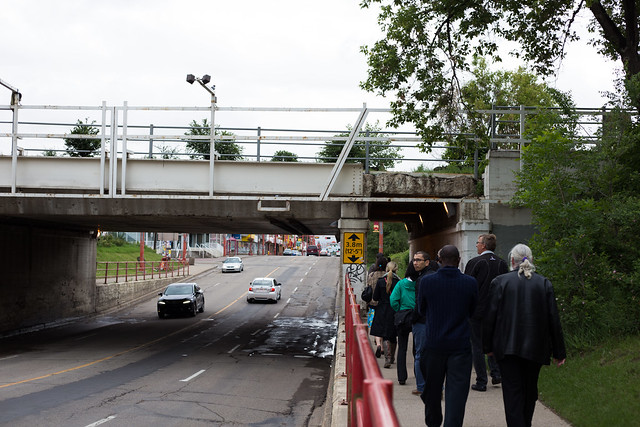
The 97 Street bridge that separates North and South Chinatown
I think it’s safe to say there’s an overall perception that Chinatown “is greatly impacted by the clustering of social service agencies and general social disorder.” The recommendations in the report “call for continued relationship building, partnerships, and exploring other policing or security options that will incrementally improve the perception of the area.” This is not likely to satisfy the business and community leaders in the area.
There are the usual recommendations about branding, creating promotional materials, and building a website to improve tourism and marketing. “Edmonton’s Chinatown is well positioned to deliver a unique authentic cultural experience being proximally located to additional upcoming major attractions within the downtown and already offering an array of authentic cultural dining and retail offerings,” the report says.
Curiously, the report calls for the creation of a new organization called the “Chinatown Economic Development Group” to provide governance for the area. It’s true that there is a need “to go beyond established stakeholders to engage in a dialogue about future growth and planning for development” but I’m not sure that yet another group is the right solution. There’s already the City, Chinatown BRZ, Chinese Benevolent Association, Edmonton Chinese Youth Leadership Council, developers, and business owners. Those groups have failed to work together effectively thus far, so is it really realistic to think they can overcome their differences as part of a new organization?
The next step is to undertake phase 2 including the development of the Urban Interface Plan. The goal of that plan is to “resolve the concerns around the 97 Street rail bridge and to decide a location for the Harbin Gate.” Once that report is complete, the final Chinatown Plan will be presented to Council.
More than 1.8 million square feet of office space is currently under construction in downtown Edmonton. That is “the greatest amount of office space under construction…in more than three decades, and exceeds the 35-year development forecast prepared in 2010.” The population is growing too, and is expected to grow from nearly 9,000 in 2014 to as high as 23,000 in 2036. Since 2010 when the Capital City Downtown Plan was approved, “several re-zonings within Downtown increased the developable floor area capacity by 2.6 million square feet.” The arena and entertainment district is responsible for nearly half of that, with five Direct Control Provisions responsible for the rest.
For this report it’s important to understand what the Floor Area Ratio (FAR) is:
“Floor Area Ratio (FAR) represents the total floor area of a building divided by the total area of a lot. It is used to limit the overall mass and intensity of a building or development. As the total buildable area allowed, FAR is used to balance the height and density of the building, controlling the overall mass of the development.”
So a FAR of 1.00 could be a 1,000 square foot building on a 1,000 square foot lot and that building could either be one storey on the entire lot or two storeys with 500 square feet on each floor on half the lot.
As the report outlines, landowners are motivated to puruse additional height and FARs through Direct Control Provisions as this can “significantly increase the value of land to which they apply.” And this increase in value can then be leveraged for financing purposes. But it also has an impact on the perceived opportunity for adjacent lands and can result in rising prices that discourage other developers from entering the market. “This can result in these sites being “frozen” and less likely to be developed or sold to another developer,” the report says. “This phenomenon is a primary reason so few Direct Control sites have developed among those approved prior to the new Downtown Plan in 2010.”
The nut of the report is this paragraph:
“A small number of developments built under Direct Control Provisions with additional floor area height and density may not fundamentally alter the identity and character of a neighbourhood. However, a greater number of Direct Control Provisions with increased floor area opportunity in the McKay Avenue and Warehouse Campus residential neighbourhoods (areas where height and floor area is limited), may diminish the intended outcome for those neighbourhoods.”
Translation? A really tall tower on one site might be appealing for the impact it’ll have on the skyline, for the apparent “prestige” that comes along with height, and for the increased profits and/or reduced financial risks for the developer. But it could also mean that instead of development occurring on multiple sites, only the tall tower goes ahead. Look at it this way: would you rather have three 20-storey towers or one 60-storey tower? For areas like the Warehouse Campus district, definitely the former.
On the other hand, many Direct Control Provisions that produce a significant lift in value get negotiated to ensure there are public good contributions in exchange, like affordable housing, public art, and other contributions to the local economy. The problem is that these negotiations are not formalized in any way. The City is hoping to change that:
“Administration recommends that a comprehensive city-wide policy or framework be developed to formalize the review of the Direct Control Provision process. This framework would include the preparation of pro formas and establishment of a menu of public good contributions based on “lift in value”.”
“Improving the Direct Control Provision review process will provide Administration, project proponents, the development industry, community members, and City Council, with clear and updated understanding of how these applications will be reviewed and expectations to be met.”
Such a framework would take between 12 and 18 months to develop, according to the report. I think a framework to formalize all of this would be great for Edmonton, but let’s not forget that Council can vote against Administration’s recommendations anyway.
Changes could be coming to LRT Park and Ride lots starting September 1. The recommendation Council will consider includes the following changes:
- “That up to 50 percent of parking stalls in the LRT Park and Ride parking lots be made available for paid parking.”
- “That the fee charged for a parking stall at LRT Park and Ride parking lots be increased from $40 to $50 per month (plus GST).”
- “That paid hourly parking stalls be provided at LRT Park and Ride parking lots at a rate reflecting the combined transit fare and local short term parking market rates.”
Currently, free and paid park and ride is available at Clareview, Belvedere, Stadium, and Century Park. Paid parking was introduced in January 2011 and was intended to help offset the maintenance costs of the lots, estimated at $799,000 per year (total). It has proven to be quite popular with waiting lists in place at all four stations – 410 people for Clareview, 220 people for Belvedere, 149 people for Stadium, and a whopping 3,540 people for Century Park.
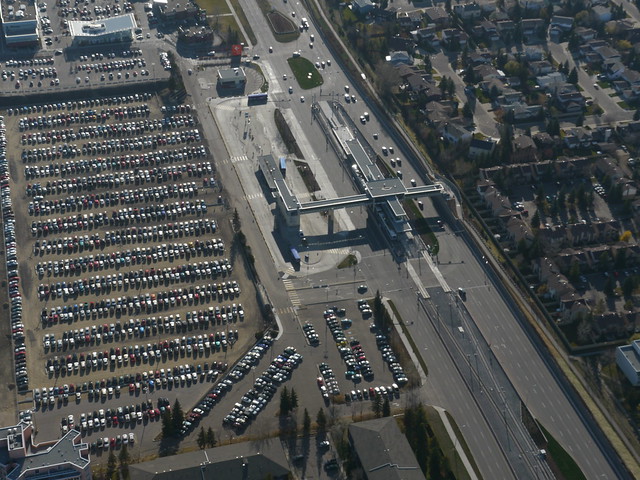
Photo by City of Edmonton
So the recommended changes listed above are meant to deal with this situation. Why not just building more parking at LRT stations? Because that “is contrary to the City’s goal of moving towards more Transit Oriented Developments surrounding LRT stations.” If Council approves the changes, the expected impacts include:
- “Total paid parking stalls will increase from 556 to 1,978.”
- “Total free parking stalls will decrease from 3,441 to 1,977.”
- “Annual paid parking revenue generated will increase from $266,880 to $1,186,800 (Gross revenue increase of $919,920).”
ETS did undertake a survey on this and received over 4,000 responses, but the results didn’t skew one way or the other:
“Results of the survey did not provide a clear direction as the results were mixed, competing and varied, with a group of users that are requesting that the parking lots remain free of charge to ensure transit is affordable and others who are willing to pay for a reserved parking stall to ensure they have a parking spot for a worry-free commute.”
It’s a challenge, no doubt. If Council doesn’t like the recommendation, they could go in one of four other directions. They could make all parking free, they could make even more parking paid, they could choose to building additional lots and parkades, or they could simply decide to make no changes.
In related news, Northlands has announced it will open 654 of its parking stalls to paying transit riders for $75/month.
The Integrated Infrastructure Services department, first announced in October 2015, “represents a fundamental shift in how the City will develop and deliver capital projects.” This report provides an overview of why the department was created and what it will achieve for citizens.

One of the first things the City did after forming the new department was to develop vision, mission, and values statements to guide decision making. “We inspire trust among citizens and Council in our commitment and ability to deliver quality infrastructure,” reads the vision. Can you tell the department was formed in the aftermath of the Metro Line, 102 Avenue Bridge, and Walterdale Bridge fiascos?
Along with those statements comes a new business model, which consists of seven principles: Agency, Integration, Sustainability, Comprehensive planning, Never content with project management expertise, Continous improvement, and Role clarity is the key to accountability. The report highlights a number of improvements that have come as a result of this new model, using words like “better”, “greater”, and “improved”, but there are no measurable data points to be found.
The department now contains five branches:
- Infrastructure Planning and Design
- Infrastructure Delivery
- Business Planning and Support
- Building Great Neighbourhoods
- LRT Delivery
The City is “actively recruiting” for all five branch manager positions. The goal is to have the new organizational model up and running for Q1 2017.
So what have they accomplished and what’s still to come?
“Over the last six months, there has been a focus on improvements in transparent communication with City Council, management of strategic risks, and enhancing relationships with industry partners. Transformation work in the next half of 2016 will be focused on developing more details within the organizational structure and establishing core department processes.”
There could also be changes to the capital budgeting process, with more detail expected in Q4 2016:
“Budget decisions supported by a greater level of detail in design will require an additional investment in projects at an earlier stage, similar to the recent approach to the Lewis Farms Recreation Centre project, where budget was provided to complete a portion of design to inform a future capital budget request.”
It sounds like the new department remains a work in progress, but the City certainly feels as though it is on the right track.
Other interesting items
- There’s a recommendation that Administration prepare a service package to fund a three-year business plan for the Edmonton Screen Industries Office and Advisory Council to replace the Edmonton Film Commission. The startup funding needed is estimated at $150,000. If approved, Council would consider the service package this fall as part of the Supplementary Operating Budget Adjustment process.
- A report recommends that $91,000 be allocated to help repair the Citadel Theatre’s roof in addition to the amount allowed under the Community Facility Partner Capital Grant Program. The City’s total contribution to the $1,091,000 project will be $363,667 if this is approved.
- The City is planning to spend between $50 million and $75 million to replace 40 diesel buses in 2017 and another 44 diesel buses in 2018 (these are all 40-foot, low-floor buses).
- Administration is recommending that an agreement with ENMAX for $800,000 be approved to complete the design base memorandum for the district energy system for downtown.
- Although in Edmonton we have the Percent for Art program, there is no public art policy that relates specifically to transit infrastructure. The Edmonton Transit System Advisory Board recommends changing that with a draft transit-specific public art policy.
- A new report outlines the TOD and Park & Ride strategies for Century Park. “The overall goal for Century Park site is to realize the timely development of the high density transit oriented development and the corresponding staged reduction of the Park and Ride facility while maintaining and attracting additional transit users.”
- Engelman Construction Ltd. has approached the City with “a proposal to locate a shipping container housing development in the Boyle Renaissance project area of The Quarters Downtown.” The site is the former York Hotel east of 96 Street and north of 104 Avenue and the City is prepared to sell the land at market value (roughly $966,000).
- The annual report from the Women’s Advocacy Voice of Edmonton is now available.
- A total of $82,879 is recommended in project funding for six projects under the Community Arts Project Grant program.
- A total of $4,927,733 in grants is recommended from the $6,858,865 total budget for the Community Facility Partner Capital Grant for 2016.
- The City is engaging with EPCOR for the potential development of a renewable energy utility in Blatchford. The next step is for Council to approve a memorandum of understanding so that the engagement can move ahead.
- Councillor McKeen had previously made an inquiry about tree canopies along urban streets, and the response from Administration is now available. “The value of the publicly owned portion of our urban forest is more than $1.4 billion (2015 Corporate Tree Policy Assessment), according to an international standard referred to as the “trunk formula” which takes into account replacement costs, size of tree, locations, species and several other factors.”
Wrap-up
You can keep track of City Council on Twitter using the #yegcc hashtag, and you can listen to or watch any Council meeting live online. You can read my previous coverage of the 2013-2017 City Council here.







 MasterMaq's Blog