
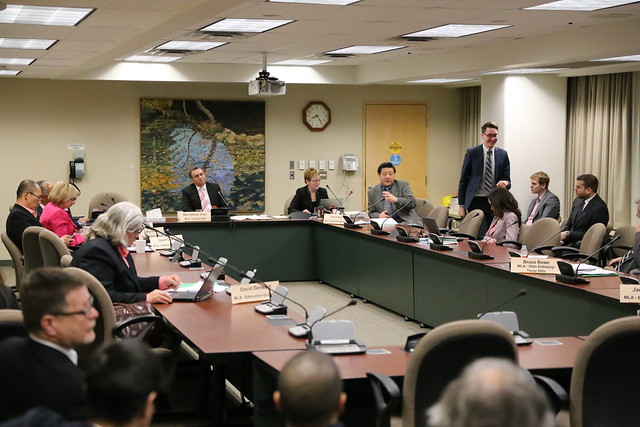
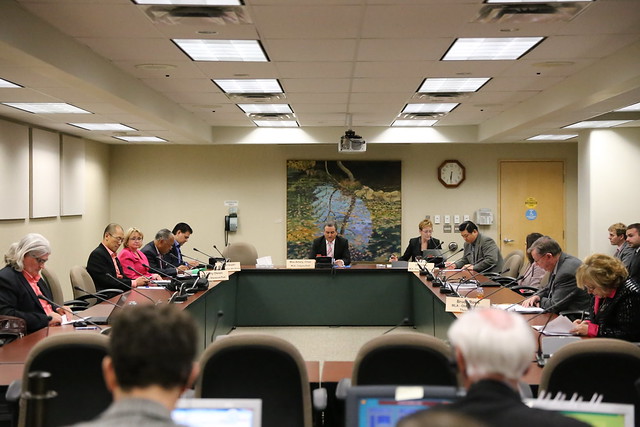
Last week I attended a public meeting on high speed rail in Alberta (which I typically abbreviate ABHSR). The issue is being considered by the Standing Committee on Alberta’s Economic Future, an all-party committee consisting of 18 MLAs. As part of the process, the committee has now heard from the public in Calgary, Red Deer, and Edmonton, and is encouraging additional written submissions by March 31. I hope at least a few Albertans take them up on that, because their “public” meeting was poorly publicized and required going past three security checkpoints.
Here’s the stimulus provided by the committee on the idea:
- It could offer service between Edmonton and Calgary (including a stop in Red Deer) with a trip time of one to two hours at speeds of 200-500 km/h.
- One-way ticket prices have been estimated at between $66 and $142.
- Capital costs have been estimated at $2.5 to five billion, but could be significantly higher.
- A route would be chosen and land would be acquired along the route for tracks and stations.
- Overpasses or underpasses would likely have to be built to accommodate many of the road crossings or, alternatively, bridges above any roads the track would cross could be constructed.
Clearly the idea is intriguing. A hundred bucks to get to Calgary in less time than it would take to drive? Sign me up! Driving is stressful, I could read or do some work on the train, there are lots of positives, for sure. But is Alberta ready? Is this an investment we’re prepared to make now?
There were some interesting viewpoints put forward at the meeting. Some felt the time is right, and that a project like this could allow us to harness the talents of all the smart, creative, and innovative people we have throughout the province. Others expressed concern that our population isn’t big enough to warrant such a project. And still others argued that automated, driverless cars are coming and will make the entire idea irrelevant (as exciting as the work Google and others are doing in this area is, there are significant hurdles still to overcome, so I’m not holding my breath).
Technically, the project sounds feasible. A few speakers talked about Maglev technology that has been deployed in a number of other places, notably in Asia. One speaker, Deryck Webb, said Maglev combined with vacuum tubes was the way to go (what he described sounded very similar to Elon Musk’s Hyperloop). I think the key issues are financial and political, not technical.
The issue last came up in 2009, when a report was issued assessing the potential for service between Calgary and Edmonton. At the time I wrote:
“I personally think if the province is going to be spending money on transit, it should be on city and regional transit. Both Edmonton and Calgary could use the assistance to improve their respective transit systems…”
I still feel that way today. If we’re going to spend a few billion dollars, let’s spend it on LRT first.
This is the message our local leaders are sending to the Province. One of the written submissions the committee has received thus far was from the Edmonton International Airport. President and CEO Tom Ruth wrote the following:
“Given the lack of local networked options in the Edmonton Region, we agree with the position of the City of Edmonton and the Edmonton Economic Development Corporation (EEDC) that the priority should be to ensure there are fully developed networks in advance of HSR; including Light Rapid Transit (LRT) service fully developed within the Edmonton Region, with connectivity to EIA. Until these intra-regional options are fully built out, the utility of HSR is severely limited.”
Maybe high speed rail is in Alberta’s future, but I hope it’s after we have developed the LRT networks in Calgary and Edmonton.
You can see the full transcript of last week’s public meeting here (or in PDF here). You might also be interested in the Reddit thread on the issue. If you’d like to submit something to the committee, send it to economicfuture.committee@assembly.ab.ca. The deadline is March 31, and all submissions and the identities of their authors will be made public.


 MasterMaq's Blog