Recap: What the Truck?!

Last Friday night we held What the Truck?!, Edmonton’s food truck extravaganza, at Beaver Hills House Park downtown on 105 Street and Jasper Avenue. I think it’s safe to say that the event was a big success! The weather mostly cooperated, hundreds of people were downtown on a Friday evening in a park that is usually empty, and seven of our city’s best food trucks sold lots of food. It was a great feeling to see a relatively simple idea come together to result in a memorable evening.

What The Truck?!
Photo by Devin.

We did the best we could to prepare the food trucks and our volunteers for setup, but it was still a stressful couple of hours. We staggered the arrival times of each truck, but it was still tricky trying to fit them all in the park! We knew the space was small, and we wanted the casual feel that would result, but we didn’t realize how difficult it would be to navigate the poles, trees, and other obstacles in the park. Not to mention the fact that we were on downtown’s busiest street, blocking both cars and pedestrians while we maneuvered the trucks into place! Everyone stayed calm and got the job done, however.

What The Truck?!
Our volunteers – The Fenskes, Thom, and Su.

All of the trucks were situated around the circle with their windows facing inward, except for Funky Pickle. That was not intentional – it was simply a byproduct of the fact that we ran out of space to turn their trailer around! It really highlighted for me that most of our food trucks in Edmonton are actually trailers, which need to be towed by an actual truck or other vehicle. By far the easiest vendor to get setup was The Lingnan – the only one that is a self-contained truck.

What The Truck?! What The Truck?!

When the event officially got underway at 4pm, it was sunny and hot. It wasn’t long though before the sky turned dark and cloudy and the rain threatened. But it didn’t rain very hard or for very long. Not that it would have mattered – it was so neat to see absolutely no one bolt from the lines when it did start raining! Instead, a few umbrellas casually appeared.

What The Truck?!

All of the trucks were popular, but Filistix definitely had the most consistently long line of the evening (due partially to popularity and partially to the fact that they move far fewer units per hour than Funky Pickle does, for example). It was great to read the comments on Twitter after the event. Things like “Filistix was definitely worth the wait” and “Crepes from Fork & Spoon Brigade – Best. Thing. Ever.” It also seemed that long-time fans of Eva Sweet used the event as an opportunity to try a waffle with all the toppings for the first time. That people were feeling adventurous was reinforced by the fact that Carnival Cravings sold far more “OMG! Mini Donuts” than is typical.

What The Truck?!

During our early planning for the event, we briefly considered having live music at the event. We decided against it, to keep things simple and to ensure the focus was on the food trucks. Instead we asked the Urban Monks DJs to provide some music to help liven up the event. They did a great job, and even created a food-inspired playlist!

What The Truck?!

It was great to see so many families at the event, and to see people using the picnic tables and even just sitting on the grass in the park. It’s such a wonderful and generally underutilized space! Mayor Mandel, Councillor Iveson, and Councillor Henderson were among the VIPs that attended, and it was cool to see such a mix of familiar and new faces throughout the evening. One of those new faces was Luca Levesque, who stopped by to shoot a great video of the event:

Sharon and I had some key goals we wanted to achieve before we could call the event a success. At the top of that list was that the vendors were successful. Considering nearly every truck ran out of food before the evening was done, I think we can say we achieved that one! Filistix was so tapped out they couldn’t even make it to the City Market the following morning! The feedback we received from all of the food trucks that participated was really positive.

A few thank-yous are definitely in order. Thank you to everyone who came to the event! Thank you to our volunteers for all your help! Thank you to Thomas and Marc for the great music! Thank you to Gabe for the fun logo! Thank you to our sponsors for your support! Thank you to the vendors for taking a chance and sticking with us! And thank you to everyone else who helped us out and made the event a success.

Sharon & Mack
Sharon & I. Photo by Chris.

Are we going to do What The Truck?! again in the future? Based on how well the first edition went, yes, definitely. We hope to do it again sometime in September and have already started some preliminary planning (and have been in touch with some new food trucks too!). Stay tuned to the website for updates. We’ll also be doing some blogging over the summer about the things we learned along the way with regards to parking lots, permits, bylaws, etc.

what the truck?!

Check out Sharon’s recap of the event here. You can see more photos from the evening here.

What the Truck?! Edmonton’s Food Truck Extravaganza

I love street food. When Sharon and I were in San Francisco last year, it was the burrito from the San Buena Taco Truck that I enjoyed most. And we both loved stumbling upon Off the Grid, a food truck festival. When I was in London earlier this year I made a special trip just to visit Daddy Donkey, an extremely popular burrito truck. And back at home here in Edmonton, no trip to the City Market is complete without a stop at one of our food trucks, such as Eva Sweet for a delicious waffle. Food trucks are not only a great source of tasty eats, they also encourage activity on the street. There’s a lot to love about food trucks and carts!

For these reasons and more, Sharon and I began thinking about having a food truck festival here in Edmonton. And today, we’re happy to announce that it’s happening!

What the Truck?!
Friday, June 24, 2011 from 4pm to 8pm
Beaver Hills House Park, 105 Street & Jasper Avenue

What the Truck?! is a celebration of Edmonton’s food trucks, combining street food with pedestrianism and downtown vibrancy. Join us for eats and beats in the heart of the city.

We’re so excited for this event, and we hope that you’ll come out to help make it a success! There is no admission fee – just show up and enjoy some excellent food from our seven vendors. If you’re planning to come, please RSVP on Facebook to give us a better sense of numbers. The event will also feature the musical stylings of the Urban Monks DJs, Marc Carnes and Thomas Scott. Shout out to Gabe Wong for designing an awesome logo for us!

The work we’ve done to make What the Truck?! a reality has been educational, to say the least. One of the reasons I wanted to make this event happen was that I think it’s a good example of a little thing that can help to revitalize downtown. With that in mind, we originally planned to hold it in an empty parking lot (we tried a couple different ones). It turns out that isn’t as simple as you might think (if you go the ask-for-permission route, that is). We’ve also learned quite a bit about the City’s Street Vending Program. Let’s just say there’s room for improvement. I think there’s a lot we could do to help the local food truck scene grow and prosper!

I’ll be writing more over the next couple of weeks about the journey, what we learned along the way, and where we can potentially improve things. In the meantime, I hope you’re as excited as I am for What the Truck?!

See you there!

Megaprojects aren’t enough to revitalize Edmonton’s downtown

Edmonton’s downtown has been the centre of attention lately, with a number of exciting megaprojects making headlines in recent weeks. As someone who has bought into the “as goes your downtown, so goes your city” mantra, I think the progress is good. But I firmly believe we need more than megaprojects to turn downtown around, and I’m not sure the little things that will positively impact downtown get the attention they deserve and require.

Downtown Panoramic

The most talked about megaproject is of course the $450 million arena:

“I’m elated. This is, to my mind, the start of a dream come true to rebuild our downtown.”
– Mayor Mandel, City of Edmonton and Katz Group reach arena deal (Archive)

Another megaproject is the $340 million Royal Alberta Museum:

“The aspirations of the city to revitalize its downtown, complete (with its) arts district, meshed with the province’s need for a new home for the Royal Alberta Museum.”
– Premier Stelmach, Royal addition to downtown (Archive)

Yet another megaproject is the $275 million redevelopment of the Federal Building:

“A different type of downtown? Step by step, piece by piece, we’re putting the puzzle together.”
– Paula Simons, Federal Building quietly takes shape (Archive)

Another one is the City Centre Airport, which Jim Taylor talked a lot about at the DBA luncheon yesterday. There are lots of other headlines and articles related to these megaprojects, and all seem to convey the message that collectively the megaprojects will revitalize downtown. Or that interest in downtown as a result of these projects is enough. But for these megaprojects to return the fullest return on investment possible, we need to do more. We need to make many, many smaller improvements in conjunction with the big ones. We can’t forget the little things!

To me, increasing the number of downtown residents is the key to downtown revitalization. We need a good mix of residential densities, types, and uses in the core. And we need more of the people who work downtown to choose to live there as well. Just having a new arena or museum isn’t going to be enough to get people to make that choice.

Mini-Edmonton
Photo by Jason Bouwmeester

The good news is that there are lots of small things we can do to make downtown a more attractive place to live, work, and play. Here are ten ideas that I have been thinking about, in no particular order:

  • Relax jaywalking laws downtown. I’ve had colleagues from London visit and they’re shocked that people wait at red lights! There and in many other cities, pedestrians are free to cross whenever the street is clear. I will readily admit that I cross the street on red lights all the time when the coast is clear. I think we need to make downtown a better place for pedestrians. It might seem like that’s what jaywalking laws are meant to do, but I think they actually reinforce the idea that vehicles have the priority instead. We need vehicles to slow down, and to come second to pedestrians.
  • Add scramble intersections. These are the intersections where traffic stops in all four directions, allowing pedestrians to cross the street in any direction, including diagonally. Again this helps to make downtown a more walkable, friendly place for pedestrians. This has been suggested for inclusion in the Jasper Avenue New Vision revitalization project, but we need to ensure it happens.
  • Prioritize downtown street cleaning. As soon as the snow is gone, the streets downtown should be cleaned. First impressions make a difference, and visitors are not impressed when they step outside and find themselves in a huge cloud of dust and gravel.
  • More projects like Todd Babiak’s Interventions and the Alley of Light. We need to make better use of underutilized spaces, and we could definitely do with some additional color and flair downtown. Let’s treat more of our blank walls and empty parking lots as canvases ready to be put to use. Maybe we need a community-edited database of available spaces?
  • Make public art a priority. Related to the previous point, development projects are supposed to include funding for public art, but the rules are not enforced. Capital Boulevard is moving ahead without funding for public art, for example.
  • Improve transit information displays. Downtown is already our primary hub for transit, and that role is going to be reinforced by the LRT expansion, particularly with the Downtown LRT Connector. Let’s add digital display boards to the big bus stops. They could use scheduled information for now, and be switched over to live GPS data when that system goes live across ETS. Let’s make the experience of using transit downtown even better than it already is.
  • Get rid of the portable toilets and add permanent ones. Having a place for people to go is better than having no place at all, without question. But why half-ass it? Let’s spend the (relatively small amount of) money to add permanent toilets downtown. There are lots of examples to draw upon, such as the beautiful and highly-effective public urinals that Matthew Soules Architecture designed for Victoria.
  • Add recycle bins alongside garbage cans. You may have seen the nice, silver receptacles that combine garbage, paper, and bottle recycling around the city, but there aren’t many downtown (aside from Churchill Square). We’re already a pretty green city, and this would help drive that message home downtown.
  • Require green roofs on new developments. They’ve done it in Toronto, why not here? There are many, many benefits that come from green roofs. And hey, we’ve already got one thanks to Williams Engineering.
  • Get rid of parking minimums throughout downtown. There’s a five-year pilot project in place for the warehouse district, but I think it’s a no-brainer. If you can sell a condo or rent a space without parking, then why not do it? Otherwise we’re effectively just subsidizing vehicles. This is a good way to spur development and hopefully infill, considering that it can cost developers between $30,000 and $70,000 per stall to create.

I’ve got my share of “bigger” ideas as well, such as doing whatever it takes to make the space behind the Stanley Milner library a proper usable square, perhaps alongside a larger revitalization of the building. Another one would be closing Rice Howard Way to vehicles and extending it to the top of the river valley.

I’m sure I’m just scratching the surface with this list, but the point is that there’s a lot more that goes into downtown revitalization than megaprojects. What are your ideas?

Recap: DBA Annual Spring Luncheon & DECL AGM

I suppose every day is a ‘downtown day’ for me given that I both live and work here, but today felt especially downtown-focused. Of course the arena news was still fresh this morning and most people I came across throughout the day were talking about it. At lunch I was fortunate enough to be a guest of EEDC at the Downtown Business Association’s annual spring luncheon, where some City Centre Airport news was released. And this evening I joined Sharon at the Downtown Edmonton Community League’s annual general meeting.

DBA Annual Spring Luncheon

The spring luncheon is one of two annual luncheons produced by the DBA. Held at The Westin, there was a packed house for the presentation of the DBA’s 2010 Annual Report. Jim Taylor, Executive Director of the DBA, highlighted some of the activities from the past year, and in what has become an annual tradition, presented the Downtown Beat Officers with a new bicycle.

All five finalists in the City Centre Redevelopment competition were present at the luncheon. Mayor Mandel couldn’t be there in person, so a pre-recorded video was played instead. In the video he referenced the “decision” made yesterday regarding the competition, which got a chuckle from everyone (because, of course, they couldn’t decide). Simon Farbrother took the stage and surprised us with the announcement that the list of five had been trimmed to three:

  • Perkins + Will, Vancouver, B.C.
  • Foster & Partners, London, U.K.
  • KCAP Architects, Rotterdam, Netherlands

The final decision will be made by City Council on June 22.

Guests at the luncheon were also reminded that the Downtown Core Crew starts again next week. You can book the team of summer students for tours and other special events!

You can read about past luncheons here, and watch for the annual report to be posted online here.

DECL AGM

Tonight’s DECL AGM was held at the Yellowhead Brewery on 105 Street. It was fairly well attended for a community league AGM! President Chris Buyze presented his annual report highlighting a number of successes:

  • On-going community events such as Al Fresco, CornFest, and the first annual EFCL Day.
  • The completion and passing of the new Capital City Downtown Plan in July 2010 (with the zoning portion passing in December 2010). Chris had personally been involved in consultations for more than 5 years!
  • Participation in various downtown and city-wide issues and initiatives, such as the ONEdmonton Downtown Vibrancy Task Force and the Jasper Avenue Hospitality Committee.
  • Embracing social media to connect with residents!

Chris also highlighted a couple of challenges that DECL met, including conveying concerns with the proposed downtown arena and the development of a new 2-year strategic plan.

DECL AGM DECL AGM

There were also two presentations this evening. We received a brief update on the Alley of Light project, and Alex Abboud talked about Homeward Trust and the work that they are doing in our community. Watch for a new Homeward Trust website next month, and check out Find Furnishing Hope, a social enterprise offering quality, low-cost previously used furniture located at 5120 122 Street.

There was also the official business of the AGM this evening, with a few board members moving on and a few new faces joining the board: Scott McKeen, Sharon Yeo, and Sebastian Hanlon. Questions and discussion covered the arena, the intersection at 105 Street & 104 Avenue, and electronic signs and billboards downtown. We also took a quick trip outside to look at Scott Property where hopefully a park will be built before long!

Edmonton’s Downtown Arena moves ahead with agreement framework

The Katz Group scored a major victory tonight as City Council voted in private to approve an “agreement framework” for the proposed downtown arena. The framework is the basis for the two sides to negotiate a formal Master Agreement, which will require final approval by City Council. While not a final binding agreement, tonight’s deal nevertheless allows the project to move forward.

Here is the full motion and amendments as voted on back on April 6 (tonight’s was largely the same – see here):

Edmonton Downtown Arena Motion(function() { var scribd = document.createElement(“script”); scribd.type = “text/javascript”; scribd.async = true; scribd.src = “http://www.scribd.com/javascripts/embed_code/inject.js”; var s = document.getElementsByTagName(“script”)[0]; s.parentNode.insertBefore(scribd, s); })();

The vote tonight succeeded 8-5. Who voted in favor of the framework? Who voted against?

For: Mandel, Krushell, Loken, Leibovici, Batty, Henderson, Anderson, Sohi
Against: Sloan, Gibbons, Caterina, Iveson, Diotte

The document outlines $350 million in funding for a $450 million arena. Where does the other $100 million come from?

Answering questions from the media tonight, Mayor Mandel would only say “other orders of government.” There is no confirmation on where the remaining amount will come from, but it is hoped that the Province will support the project.

How much of the total cost will be funded by a CRL?

The motion only states that $20 million be directed at the arena from a CRL. The remaining $105 million (the City’s maximum contribution will be $125 million) could come from direct tax revenues. However, the agreement framework page states that $45 million would come from a CRL. The final mix is likely to change.

What happens to Rexall Place and Northlands?

The motion specifies that City administration will continue “to work with Northlands to ensure the City understands their financial challenges and how these can be addressed.” Answering questions this evening, City Manager Simon Farbrother said that Edmonton cannot sustain two arenas. It would appear that Northlands has lost its seat at the table.

Will the City own the arena? Will it receive the revenue?

Under the agreement, the City would own the building and land. The Katz Group would be responsible for all maintenance, upgrades, operating and capital expense costs. The City also retains the right to access the facility four weeks a year. As for revenue, the motion only states that the City “negotiate options for potential revenue sharing.”

What will the arena look like?

The City stated tonight that the arena will contain 18,500 seats and 350 parking stalls. The design process will still need to happen once the project moves ahead.

What are the next steps?

The City and the Katz Group will now work to complete the Master Agreement. They’ll also be working to secure the remaining $100 million, likely from the Province.

Twitter was buzzing with the news tonight. Here are a few of the tweets that caught my eye:

#yegcc just came back in public – voted on a motion to approve a framework for #yegarena deal – details to be kept in private. Passes 8-5.

News conference upcoming at City Hall for major #yegarena announcement.

City announces framework to build arena!

City and Katz Group agree on agreement framework to build arena http://bit.ly/ipraRy #yegarena #yeg

The City of Edmonton and Katz Group agree to framework that “sustains NHL hockey in #yeg for 35 years.” #yegarena #Oilers

Mandel stresses optimism, forward momentum, believes holes in plan will come together now that framework of deal in place. #yegarena

This arena will built just when the construction labour and materials market explodes. I’m guessing it comes in at $700 million. #yegarena

This arena situation is just like the airport situation; everyone knew it was going to happen, it was just a matter of when. #yegarena #yeg

NOTE: #yegarena dissenters. A friendly reminder; you have until JULY 17th to file your plebiscite application. Just saying.

It’ll be interesting to see what happens next! Much more to come, stay tuned.

Roundup: The Royal Alberta Museum is moving downtown

It’s amazing how big news can just seemingly drop from the sky sometimes! Yesterday’s big announcement here in Edmonton was that the Royal Alberta Museum will be rebuilt downtown:

A new comprehensive Royal Alberta Museum will be built in downtown Edmonton starting this year, featuring twice as much gallery space, direct connections to public transit, proximity to the Arts District, and the ability to host major international exhibits and rare artifacts. The new museum will be equipped to showcase both Alberta’s history and its natural wonders, and will be free of the limitations of the current museum site.

The new museum is expected to cost $340 million and is set to open by 2015. Budget 2011 includes $180 million over the first three years of the project, which includes $30 million from the Federal government. Here’s a rough rendering of the building:

For a better look, check out this video from the Province introducing the new concept:

[googlemaps https://www.youtube.com/embed/xkbxfUSWgh0″ frameborder=”0″ width=”524″ allowfullscreen=”allowfullscreen”>

Here’s where the site is located (click here for Street View):

Lots has been written/recorded about the project already. Here are some of the things I have come across that are worth checking out.

From the Edmonton Journal:

The current museum will stay open for the next four years. Discussions are just starting on what to do with the old museum and the rest of the property in Glenora, although a portion will eventually house a new residence for the lieutenant-governor.

“Right now, I can tell you it’s not going to be condos,” Alberta Culture Minister Lindsay Blackett said. He said it’s “very unlikely” the land will be sold to private developers.

From the CBC:

Stelmach said the museum land could be the future home of the Edmonton terminal for a high-speed rail line to Calgary. Land for a Calgary station was purchased in 2007.

Paula Simons picked up on that as well at The Edmonton Commons and added:

There’s no denying the real attractions of this site. It would be accessible by LRT – especially if the city were to “activate” the dormant LRT stop, known as Future Station, that’s already roughed in under the Brownlee Building. It would be linked to the existing pedway system. It would be a block east of that proposed arena and entertainment district, assuming such a thing actually comes to be built. It would be a way to push attractive development into the Chinatown/Boyle/McCauley area. It would make the Churchill Square/City Hall precinct a true arts centre. And it would be a fabulous companion to the AGA – a tourist draw in the heart of the city core. It might also help to give impetus to develop on the Station Lands site directly to the north – and even integrate with possible plans to turn Mary Burlie Park, just to the north of the proposed RAM site, into a Chinese garden and cultural centre.

From Global Edmonton:

The decision to move to a new location was made because of size constraints at the old location, and because the construction process would have forced the museum to close for a significant amount of time while the construction was in progress. As a result, the province says the cost to build on a new location will be less than the cost of trying to redevelop the old site.

From CTV Edmonton:

This spring, a competitive bidding process will seek out a private sector consortium to design and build the new facility.

Finally, while I like the spirit of David Staples’ latest column, it’s unfortunate that most of the words are dedicated to the arena, not the RAM. Still, it is great news for downtown!

What else have you come across that is worth sharing?

Recap: Designing Downtown – Between Two Cities

Tonight Sharon and I attended a panel discussion at the Art Gallery of Alberta organized by M.A.D.E. in Edmonton called Designing Downtown: Between Two Cities. It was an interesting evening for the event to take place, because across the street at City Hall our City Council was discussing the proposed downtown arena project (they voted to move ahead with negotiations) and also because today was Vancouver’s 125th birthday. Ryan Jespersen was our host for the evening, and Todd Babiak was the moderator for the discussion. Unfortunately, there wasn’t much time for that discussion to take place – the panelists used most of the time for their “introductions” (as is often the case).

Gene Dub, founder and principal at Dub Architects Ltd., kicked things off with a little show and tell. He talked about some of the projects he has worked on since establishing his firm in 1975, and highlighted four things that he has tried to focus on with his downtown development efforts: housing, heritage, infill, and commentary. Some of the interesting projects he showed pictures of included the City Market Affordable Housing, the Alberta Hotel, the McKay Avenue School Restoration, and City Hall.

Gene talked about the Seventh Street Lofts project as well, noting that it is a unique mix of a 1950s building, a 1929 brick building (the John Deere warehouse), and a new infill building in the middle. It turns out that when he purchased the northernmost building (1950s) he tried but failed to purchase the small parking lot right on 104 Avenue as well, which I have embedded above. Tonight he told the audience that he has since purchased that lot, and has plans to build an office tower there. He showed a rendering of a beautiful glass building!

107 Street Annex
107 Street Annex, courtesy of Dub Architects

Next up was Mathew Soules, an assistant professor at the University of British Columbia’s School of Architecture and the director of Matthew Soules Architecture in Vancouver. As much as I loved listening to Matthew’s very cerebral talk about Vancouver, it was his section of the evening that caused us to go completely off schedule. He had some really interesting things to say about Vancouverism, and I thought he did a great job of breaking it down and explaining it. The fact that the model can be broken down into building blocks is fascinating. One of the more interesting things he said about coming back to Edmonton was that it was refreshing compared to Vancouver. That is, the environment there is so “total” – completely planned, manicured, etc. – that it tends to lack the grittiness and messy vitality that Edmonton has.

Designing DowntownDesigning Downtown

Our third speaker was Shafraaz Kaba, an architect and planner at Manasc Issac Architects Ltd. right here in Edmonton. He spent some time talking about the firm’s interest in reskinning or “reimagining” existing buildings, a discussion which inevitably led to some more negativity directed toward the Associated Engineering building! He also talked about the Capital Modern Tour that Sharon and I went on back in 2008 (Shafraaz was our tour guide on that excursion) and made mention of the importance of preserving buildings such as the CN Tower. Shafraaz also had some of the most memorable statements of the evening, saying for example that “Edmonton has all kinds of plans, we’re good at making plans – what we’re not good at is implementation.” He also posed the very thought-provoking question, “why in the world do we have air conditioning in Edmonton?” Surely there must be a better way to heat and cool our buildings by making better use of our natural climate!

Our fourth and final speaker was Trevor Boddy, a graduate of the University of Alberta who is now a Vancouver-based architecture critic/curator urbanist. He has written books and articles, and is currently working on the TownShift: Suburb Into City ideas competition. He touched on Vancouverism as well, but showed it from a different perspective than Matthew. He also made some memorable statements, most notably: “Edmonton only gets one more chance to get downtown right.” I really liked some of the examples he showed (such as powering a water feature using the heat generated from a server farm located underneath) but I also thought he made some of the best points. He said you can’t fix downtown without also addressing some of the issues in the suburbs, that the arena project is a 1970s way of solving the problem, and that one of the most painful things Edmonton needs to overcome is the way our metropolitan governance model works (I really agree with the last point).

Designing DowntownDesigning Downtown

By the time we got through all of that, there wasn’t much time for questions, and to be honest my mind had started to drift toward the arena issue at City Council! One of the obvious questions that was asked was how the lack of an architecture school has harmed Edmonton, to which Trevor had a great response. He said that you get the school after you have the architecture, not the other way around, and pointed to organizations such as M.A.D.E. and Edmonton on the Edge as the foundation for what could eventually become an architecture school.

The key takeaway seemed to be that getting the discussion happening, with events such as tonight’s panel or the upcoming PKN X, is the key toward cracking the downtown nut. Thanks to all of the organizers for making the event happen! You can see a few more photos here.

UPDATE (4/18/2011): I added the 107 Street Annex rendering, courtesy of Dub Architects. It is labeled “Lot 162, Block 6, Plan B2”.

What’s the population of Edmonton’s downtown? Depends on the time of day.

Revitalizing our downtown is constantly in the news lately thanks to the proposed arena project. I’m glad that the issue is top-of-mind for so many people at the moment, and I hope we can keep that interest going. I think everyone agrees that Edmonton’s downtown does not currently represent our city as well as it should.

There are lots of factors that go into revitalizing an area. Probably even more that go into revitalizing a downtown. But there’s one factor in particular that for me stands out above all others. Residents.

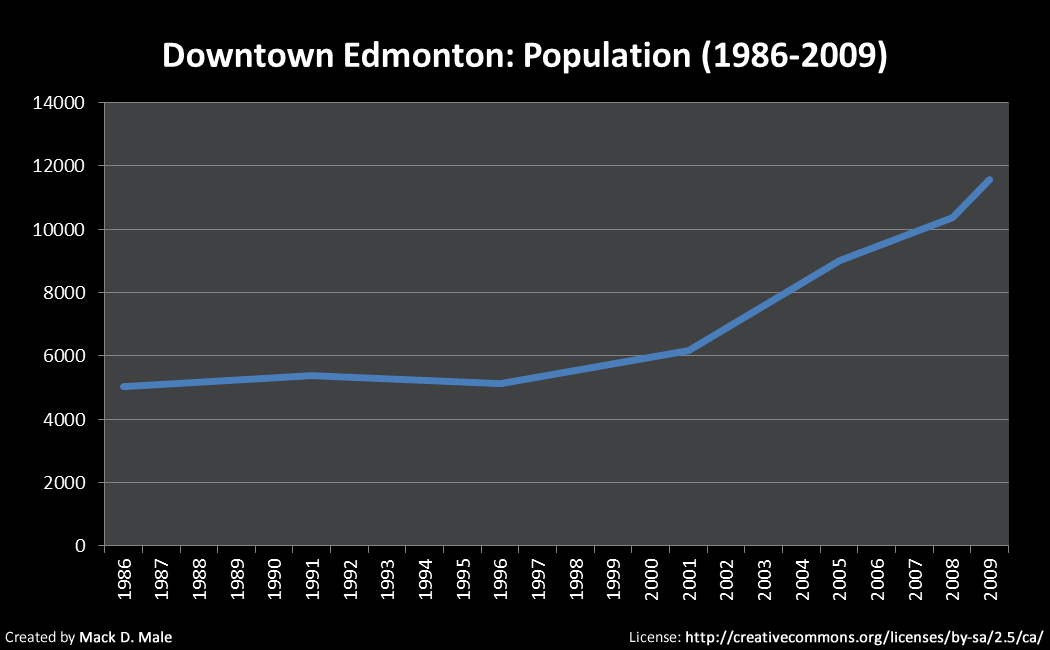
I think if you really want to revitalize an area, you need to get more people living there. We’ve already seen this play out in Edmonton to a certain extent. Here’s what our downtown population growth has looked like since 1986:

Keep in mind the population has really only slightly more than doubled in that time. Not what you would call really significant growth. And yet look at all of the positive changes we have seen downtown in that time! This article by Lawrence Herzog from 2003 covers some of the changes up to that point quite nicely. People regularly point to 104 Street as a positive example of change downtown. It’s why Sharon and I bought here.

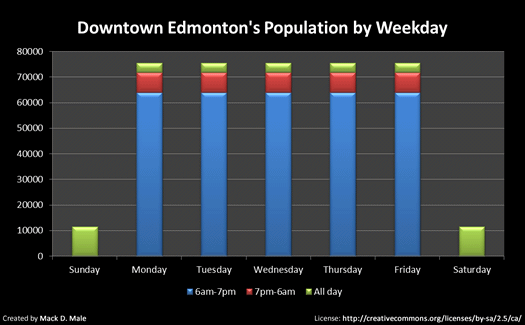
The factor that most often comes up as vital to revitalization however, is the number of people working downtown. Sometimes the argument made is quite compelling too. Whenever I hear that argument, I think of this graph:

It’s incredible how widely the population varies from the weekend to a weekday. And this doesn’t even take into account students and all of the other groups of people that might be downtown on a weekday. Is our downtown population 12,000 or 68,000? It absolutely depends on the time of day!

Why does nearly everything downtown close so early on weekdays? Why is almost nothing open downtown on Sundays? Why isn’t downtown changing as fast as we’d like it to? I think that graph tells a very significant part of the story (see below for an explanation and sources).

The numbers are certainly not encouraging:

  • As of 2009, downtown Edmonton’s population was 11,572. That’s just 1.5% of our total population.
  • As of 2010, downtown Edmonton’s workforce was roughly 67,700. That’s just over 10% of our total labour force.
  • Current plans call for the addition of just 12,200 new residents residential units over the next 35 years, and an increase in residents to 24,000 by 2030. We more than doubled the population in 23 years, why are we slowing down for the next 35 years? That’s about the same pace as we have seen over the last 20 years.
  • According to the Downtown Business Association’s most recent employee survey (PDF), just 6% of people who work downtown also live downtown. This despite downtown being one of our two biggest employment centres (the other being the University of Alberta, which is just a short LRT ride away).

So I don’t buy the argument that we need more people working downtown. If anything, we need more of the people who work downtown to choose to live there also. We need to want to make the changes downtown needs, and we need to make decisions that support that. If we want to meaningfully revitalize downtown, this picture has to change!

There’s a lot more to this discussion of course, but I find this to be a useful way to remind myself of the importance of residents. What do you think?

Sources: Municipal Census 2009, 2010 Downtown Resident Survey (PDF), 2010 Downtown Employee Survey (PDF), 2010 Business Recruitment Resource (PDF). The surveys come from the Downtown Business Association, and I used them to calculate the numbers in the graph. The times, 6am to 7pm, come from the Employee Survey. On weekdays, the green portion is essentially the number of people who both live and work downtown, which is an average of the 6% of employees who say they live downtown and the 29% of residents who say they work downtown. There are a bunch of assumptions made, of course, such as the assumption that if you’re a downtown resident and you don’t work downtown, you work and are somewhere else between 6am and 7pm.

Will Edmonton be a second-class city without the new arena?

Last week City Council was again discussing the proposed downtown arena. Though Administration provided an update at the Wednesday meeting, it certainly didn’t feel like much new information was brought forward. Details on the proposed Community Revitalization Levy (CRL) were delayed yet again, this time until the first week of April. The meeting did not go well.

Mayor Mandel seemed to be upset that progress had stalled. He wants Council to make a decision in the next month or so:

“It’s enough already. I think we’re going around too many circles and let’s make a decision.”

But there was another comment he made that stood out:

“Either we build a new arena or we become a second-class city, which in my mind we don’t want to be.”

I’ll admit that comment even surprised me. Does Mandel really think we can’t be a first-class city without building the new arena? Is the project really a make-or-break one for Edmonton? Boosterism has long been a part of this debate, something Dave covered back in January. And as our Mayor I think Mandel needs to be Edmonton’s greatest champion, a role he has definitely not shied away from while in office. But is there no hope for Edmonton if the arena project doesn’t go ahead?

“My choice of words probably wasn’t right,” Mandel admitted when I asked him about it. “It’s just that when opportunities come up, you have to make a decision. Edmonton in the past hasn’t made an effort to seize opportunities that have come up.” It’s a good point, I think. You can’t simply wait for things to come along, you have to go out and get them. If we want to take Edmonton forward, we need to make a concerted effort to do so. “You’ve got to fight for things,” Mandel said.

Mandel stressed the need to improve our downtown. “Cities are evaluated by their downtowns, not their suburbs. Edmonton’s downtown has a long way to go.” I asked if that meant we had to have the arena. “There’s millions of ingredients that go into it,” he said. The arts community and our IT sector were just a few of the examples he cited. He of course thinks the arena is one of those ingredients, however. “The arena with a good financial deal will make Edmonton better.”

Stephen Mandel at Candi{date} Sept 29, 2010

When discussions get intense, people say things without fully thinking them through. I think that’s what happened to Mandel last week with the second-class comment, but he’s certainly not the only one who has made regrettable comments. Is it true that “the anti-arena faction is out in full force” as David Staples suggested (archive) a couple of weeks ago? I think it is, and there have certainly been some puzzling comments from them as well. The debate needs people on both sides, to help us tease out the details and ultimately arrive at the best decision for Edmonton. Mandel has decided to support the arena. Others have decided to fight it. A good debate is healthy for Edmonton.

On Saturday, Gary Lamphier writing in the Edmonton Journal reminded us that there are many key questions about the project that have yet to be answered (archive):

Although Mayor Stephen Mandel seems determined to wrap up the Seinfeldian arena "debate" — such as it is — in early April and push the project ahead at Mach speed, it’s hard to see why with so many key questions unresolved.

With weeks to go before a pivotal report on the project is presented to city council — following which councillors may have little time to reflect on it before they vote — it’s puzzling that so many key questions remain unanswered.

Today, Danny Hooper writing in the Edmonton Sun offered some compelling reasons to move ahead with the project (archive):

We are not the arctic outpost some think of us. This is a vibrant, energetic, resourceful, caring, and fun community, yet I don’t think our downtown best makes that statement. And I think it should.

Where some see a downtown that feels dull, disjointed, and at times lifeless, I see a blank canvas. The Katz group have at least brought out the paint and offered their vision of what our city centre could be. Of what it should be. And we’re all welcome to pick up a brush.

Maybe it comes down to perspective, as is so often the case with difficult questions such as this one. Do you choose to see the arena as Mayor Mandel does, as an opportunity to enhance our downtown that we should at least make an effort to capitalize on? Or do you choose to see the arena as those against the project do, as an expensive pet project that will do little to help Edmonton’s core?

There are no guarantees in this debate. Edmonton will not be relegated to “second-class” status if the project dies, nor will Edmonton automatically be world-renowned if it goes ahead. There’s obviously no secret recipe either, or we’d have already turned downtown around. Whether you support the arena or not, it’s important to recognize that revitalizing our downtown and becoming the city we want to be will take much more than any single project.

Meet me on the bridge: The Edmonton City Centre Redevelopment

It was 1974 when City Centre Place was completed, part of the Edmonton Centre development across from Churchill Square. The shopping mall we now know as Edmonton City Centre has had an interesting history, to say the least. TD Tower was added to the complex in 1976, and Oxford Tower and the Sutton Place Hotel followed in 1978. As Christopher Leo notes (archive), downtown was the place to be back then:

In the 1970s, downtown Edmonton was the retail centre of the metropolitan area, and the city had a policy of sustaining that role by supporting the viability of residential neighbourhoods near the centre of the city and placing limits on the amount of permitted suburban shopping centre development.

The development of West Edmonton Mall by the Triple Five Corporation in the 1980s had a significant negative impact on downtown Edmonton, and on the City Centre mall in particular. The policy limiting suburban shopping centre development was forgotten. As a result, efforts to restore life to downtown began and Triple Five came along with a solution: Eaton Centre. Christopher has documented the ups and downs of that project very thoroughly, so suffice it to say that what was eventually built in 1987 was a mere shadow of the original vision.

The two malls staggered along until 1999 when the Eaton’s chain went bankrupt. It was around that time that Randy Ferguson came to Edmonton on a mission to straighten things out. He remembers his boss at Oxford Properties, Jon Love, telling him two things before he left. “Go get the job done in the best interest of the community and this company,” and “remember one thing: that’s my hometown”. Randy’s journey began on January 2, 2000.

“There was very little energy downtown,” he recalled. Eaton Centre and Edmonton Centre had separate identities. Thinking back to the amount of space they took up downtown Randy told me how he felt: “it was depressing.” He had a job to do however, and his first task was to convince the Oxford board that they should spend money in Edmonton, their weakest market. “We said, don’t think about this as a retail play.” Randy pointed out that 40% of the office space downtown fed into the property. Four office tower lobbies and two hotels directly. The board gave Randy the go-ahead, but with a budget of just $44 million.

Randy and his team made a number of big changes over the next few years. Randy felt that a department store facing Churchill Square was inappropriate, so they convinced The Bay to move to the other side of the mall, to the vacant Eaton’s location. They turned the basement of the now empty east side into a parkade, and managed to attract Sport Check, Winners, and CBC. There were challenges along the way, of course. In the fall of 2001, Randy had arranged to have the western executives in charge of CBC’s TV and Radio divisions come to Edmonton so that he could pitch the idea of consolidating CBC’s properties in the mall downtown. The morning of the presentation was September 11. Needless to say the deal didn’t happen until many months later!

City Centre Wide Bridge

Merging the separate Eaton Centre and Edmonton Centre identities was an important aspect of the redevelopment. Randy wanted to do something architecturally to combine the two properties, and thought about a pedway bridge. “I think our bridges are terrible,” he told me. “They’re ugly, utilitarian, and generic.” In fact, Randy dislikes our pedway bridges so much that he pitched the idea of wrapping each one in scenes depicting the events taking place at the 2001 World Championships in Athletics. Unfortunately, the City didn’t go for it.

Randy wanted the bridge joining the properties to be more than just a pathway, he wanted it to be iconic. That’s how he came up with the wide bridge concept. “I wanted it to become the meeting place,” he recalled. “You know, ‘let’s go for coffee…meet me on the bridge!’” He envisioned a Starbucks and a patisserie on the main level of the bridge, with the rest of the space available for seating. They built a second level as well, a space that Randy thought would make an excellent wine bar. “We put two circular staircases on the bridge, ran power, and even roughed in plumbing.” As it turns out, Randy’s vision was never fully realized. “It has never been programmed the way I imagined it.” Today the bridge is home to a Tim Horton’s, a Telus Mobility kiosk, and a few retailers including a Bell store. The second level is empty and inaccessible. That’s unlikely to change anytime soon, due to the leases that are in place.

Edmonton City Centre Wide Bridge

Randy and his team had to be creative in order to achieve everything they wanted with the redevelopment project, which was finished in 2003. “We accomplished an $80 million spend on a budget of $44 million,” he said. He had spent some time studying funding programs elsewhere in North America, and came across a tax increment financing (TIF) project in Florida. “I liked it because it had a direct connection to rehabilitating the area, and it had a sunset, it wasn’t forever.” Randy worked with Al Maurer, City Manager and Randy Garvey, then the GM of Finance at the City of Edmonton, to see if he could make such a program work here. Alberta’s CRL legislation didn’t exist yet, so they could only apply the tax increment from the City to the project, the school taxes could not be touched. They followed the sunset model, whereby 100% of the tax increment went to the project in year one, 90% in year two, and so on. Randy thinks it might be the first example of a TIF used in Alberta.

City Centre Wide Bridge

When the time came to build the wide bridge, Randy again was out of money. Recognizing that it technically wasn’t on land that Oxford owned, they applied for a local improvement levy. The City studied the legislation and agreed that the funding mechanism was appropriate, so that’s where the money for the bridge came from. Further funding for the redevelopment project came through the creative use of a Commercial Mortgage Backed Security, something that would never happen today given the current recession.

Given his history with the concept, I asked Randy for his thoughts on the idea of using a CRL to help pay for the downtown arena. “I am a huge fan of CRL or TIF – it can make things happen that otherwise wouldn’t.” He doesn’t think the proposed formula is the best one, however. “I believe the school tax portion of CRL should be sacred, it shouldn’t be in play,” he told me. Randy also feels the sunset approach is better than 100% for 20 years as the current legislation allows. “We need to benefit from that growth, along with the guys that are making the investment.” He suggested that the City should get some local experience at the bargaining table, someone like Randy Garvey.

Randy supports the proposed arena project, even though it is competition for ProCura where he is COO. “It’s about critical mass. It’s about creating a new day.”