City’s Standing As Metropolis Declared To Hinge On Coliseum

Recently I have been doing some research on the history of Rexall Place. I thought it would be useful to understand what happened in the past when trying to make sense of our current downtown arena debate. As part of that research, I spent some time at the City of Edmonton archives. I wasn’t sure what to expect or how to approach my research, so I simply asked for anything related to the construction of the Coliseum. Sherry Bell, Reference Archivist at the Archives, was incredibly helpful and came back with a thick file folder labeled “File 1, 1963-1974”. She told me it was the first of many, just the tip of the iceberg.

Coliseum History at the Archives

I read through the entire folder, taking notes as I went. The documents inside, mostly clipped Edmonton Journal articles, tell the story of how the Coliseum came to be, from the push for a downtown arena in the early 1960s through to the construction of what we now call Rexall Place in the early 1970s.

The title of this post comes from an article in the Edmonton Journal published on September 12, 1963. In it, Alderman Les Bodie made his case for the proposed downtown coliseum of the day, saying:

“I think the successful city will be the one with a stable economic base combined with a stimulating economic climate, and the coliseum will be a major factor in attracting interest in our city.”

It was one of many gems I found in the file, some of which I have shared below, and some of which I’ll share in future posts.

In total, I recorded 93 headlines (I skipped some). Here’s the breakdown of the articles I looked at by year:

Lots was written early on in the debate, and less was written as construction got underway and progressed. Here’s a sample of the headlines:

  • Coliseum Site Studied – May 11, 1963
  • City Approves $10 Million Coliseum Plan – June 25, 1963
  • City Has ‘Escape Hatch’ If Coliseum Voted Down – August 29, 1963
  • City’s Standing As Metropolis Declared To Hinge On Coliseum – September 12, 1963
  • Mayor Hits Coliseum Critics – September 24, 1963
  • Coliseums Seem To Spark Growth – September 28, 1963
  • Coliseum Complex Rejected By Almost Half Ratepayers – October 17, 1963
  • Mayor Anticipates Verdict On New Coliseum Proposal – March 1, 1965
  • A Coliseum Or A New Arena? – March 25, 1965
  • Alderman Warns City Taxpayers Will Have To Subsidize Coliseum – July 20, 1966
  • Ex arena to be constructed just north of Gardens – April 22, 1972
  • Oilers won game but public the real winner – November 11, 1974

I was immediately struck by how similar today’s debate is to the debate in the 1960s. In short: a downtown arena is proposed and tied to the future of the city, people argue over the location and other details, but the process really gets stuck on the money.

One of the first documents I found in the file was a pamphlet published by The Hamly Press (which as far as I can tell no longer exists) entitled, “the Coliseum Plebiscite: a test of our Faith in Edmonton as a Great Metropolis of the North West”. Here are some of the statements found inside:

  • “A downtown showplace that will publicize Edmonton as a progressive, positive-thinking city, developing rapidly in all phases of modern city live and endeavor.”
  • “The Coliseum Complex will lead the way in revitalizing downtown activity.”
  • “A Vital Necessity for Downtown Development!”
  • “Construction of the Coliseum Complex will be the city’s first step in the fulfilment of Edmonton’s remarkable plan for the renewal of the downtown city centre. There is little doubt that perseverance with this project now will be a decisive factor in the eventual completion of the entire Civic Centre plan.”
  • And a quote from Mayor Roper: “This plebiscite will be a test of the vision of the ratepayers of our city. How much do we want Edmonton to lead all Canada in bold, imaginative downtown development?”

Edmonton Journal writer Ben Tierney, working in the City Hall Bureau, wrote a lot about the proposed project. In a September 24, 1963 article entitled “Other Cities Find Value in Coliseums” he highlighted what he saw as “three basic benefits”:

  1. Attraction of major sports, entertainment and cultural events that the city could not otherwise hope to obtain.
  2. Attraction of outside dollars to the city through increased convention activity as well as non-local attendance at coliseum events.
  3. Increased tax revenue for the city through construction of new downtown building encouraged by the coliseum’s construction, and a revitalized city centre.

Sounds familiar, doesn’t it?

Of course, the initial plan never came to fruition, and subsequent attempts to rescue it failed also. On October 17, 1963 the Edmonton Journal reported the results of the plebiscite that would have authorized the City to borrow $14,250,000 to finance the coliseum:

“The coliseum complex was strongly backed by the former city council, the Edmonton and District Labor Council, the Edmonton Chamber of Commerce and Jaycees, the Edmonton Exhibition Association, the Edmonton Area Civic Centennial Committee, and the Edmonton Building and Construction Trades Council.”

“55% of voters favored the two money bylaws…but a 2/3 majority was required. Opposition to the project centered on the costs involved.”

Over the next ten years, various attempts to salvage the idea were made, but ultimately the cheaper Edmonton Coliseum was built instead. I wonder how different things might have been had the downtown complex gone ahead?

Expanding the Shaw Conference Centre (again)

The Shaw Conference Centre is once again in the news. City Council’s Executive Committee will receive a report tomorrow that suggests the facility needs to be expanded. That recommendation should not be a surprise. On July 22, 2009, City Council passed this motion:

That Edmonton Economic Development Corporation prepare for Council’s approval a long-term (30 – 40 year) development plan to address the needs of the convention market in Edmonton.

If you ask EEDC what should happen with the convention market, of course they’re going to focus on the facility that they operate.

Shaw Conference Centre

The Edmonton Journal’s editorial board published a piece on the issue today. Here’s the key paragraph, in my opinion:

But there are plenty of reasons for caution. Taxpayers have just spent $150 million to expand Northlands’ rival convention and trade show facility, the new Expo Centre. Is there really an economic case to be made for two competing super-facilities, each publicly funded, run by two competing civic agencies?

Competition is a generally a good thing, but increasingly I find myself wondering why we have both Northlands and EEDC. Two organizations, both largely funded by taxpayers. If they weren’t competing, would things have turned out differently? Would the above recommendation have been different? Would we still have gone ahead with the Edmonton Expo Centre when we did? The success of that facility, which is still being paid off, has been questioned by many. Though as the City’s Chief Economist told me, that skepticism might be a little unfair. “It was developed and then we ran into a sour economy. You need to give them a full business cycle.”

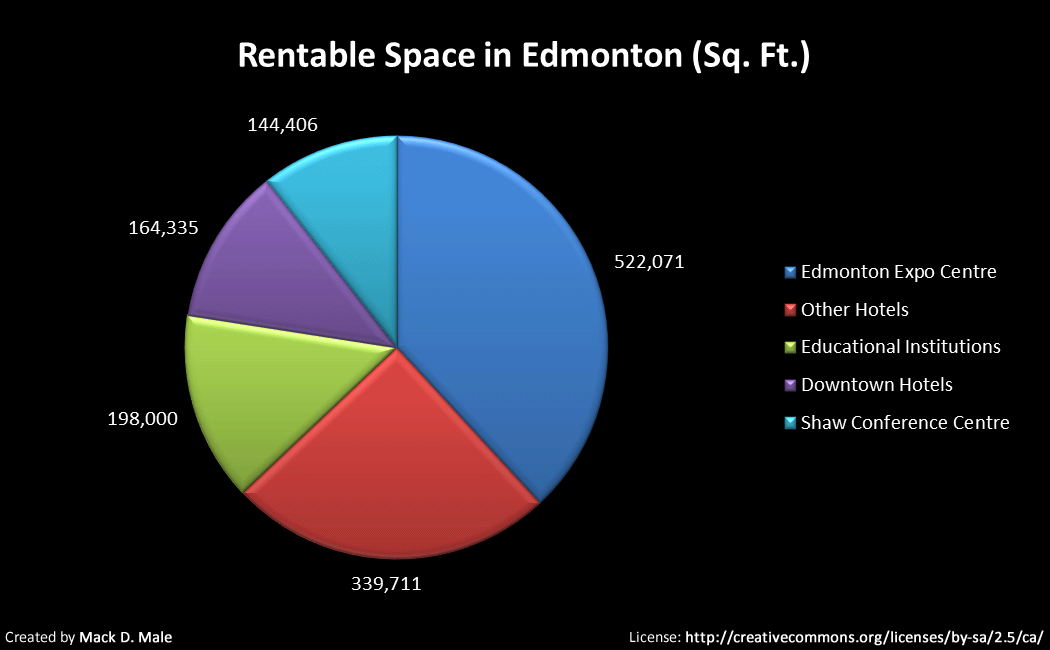
Here’s what the current breakdown of rentable convention space looks like in Edmonton, according to the report:

There’s no denying that the amount of space at the Shaw Conference Centre (SCC) is significantly less than at the Expo Centre. But that alone is not reason enough to expand the facility. Here are the most up-to-date statistics on SCC usage, provided to me by EEDC:

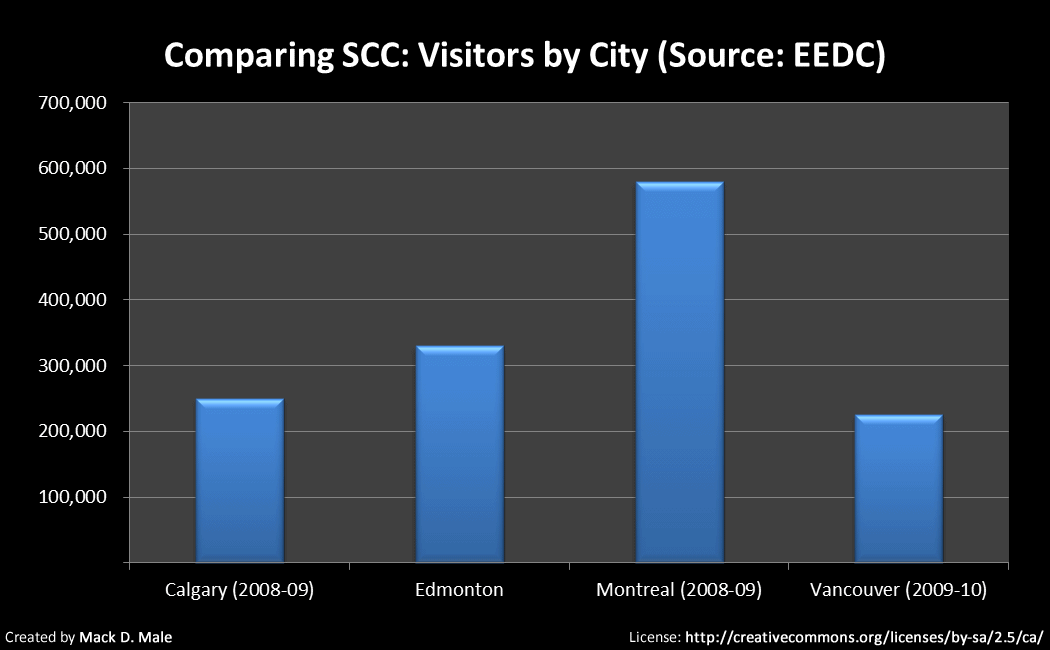
  • In an average year, SCC receives 330,230 visitors (based on the last five years). A visitor is a person who has attended a function at SCC.
  • The split in visitors is roughly 70% regional versus 30% non-regional.
  • There are 20 to 25 days per year where SCC has no or the least number of bookings.
  • Using 2006 as a typical year and defining 75% occupancy as full, SCC was fully booked 115 days out of the year.

Compared to a few other Canadian conference venues, SCC’s visitor stats stack up quite nicely:

I’m not sure exactly which facilities they were comparing with, but clearly SCC is being used. EEDC says that over the last two and half years, it has turned away approximately 40 conventions and trade shows for future years. And apparently none of those have decided to go with the Expo Centre instead, which should have had the necessary space, presumably because they wanted to be downtown.

If we’re going to add more convention space, I think downtown is the place to do it. But I agree with the Journal’s position, “it’s also important that we not simply assume that if we build it, they will come.” So I guess I am left with a few key questions:

  • Why was the Hall D expansion so limited? If we got the forecasting wrong then, are we going to get it right this time? Are we really looking ahead 30 years?
  • Is expanding SCC really the best way to add more convention space downtown?
  • Despite the lip service paid to cooperation in the report, can Northlands and EEDC really work together to grow Edmonton’s convention market?

The next steps outlined in the report include finalizing the business case for the expansion. According to EEDC’s own backgrounder, the earliest an expansion would be completed is at least seven years from now.

Aside #1: Think back to 2004 and consider all of the technology that didn’t exist. Will large conventions as we think of them today still happen in 2018?

Aside #2: The report contains what might just be my least favorite phrase ever: “Festival City in a Box”.

Aside #3: It turns out I have an Edmonton Journal article on my desk from September 12, 1963 (I’ll explain later). Apparently we held just 42 conventions in 1962, far behind Toronto’s 657, Calgary’s 172, or even Regina’s 57. Even Moncton had more conventions than we did at 48. Our conventions in 1962 attracted 17,932 visitors who spent a total of $1,869,000, or $104 per person.

Winter Light 2011: Illuminations featuring Circus Orange

It was cold outside tonight, but Churchill Square was still full of people for Winter Light’s Illuminations. This year the event featured Yukigassen, a Japanese snow battle sport, roving performers, the Illuminations Choir, and the Edmonton premiere of Circus Orange, a Toronto-based pyrotechnic circus troupe. They performed TRICYCLE, “a dramatic fusion of live music, clown, circus, dance, aerial performance, mechanics, pyrotechnics and fire arts.” It was amazing.

Winter Light Illuminations 2011
Perfect night for a stroll in Churchill Square!

Winter Light Illuminations 2011
Warming up by the fire.

Winter Light Illuminations 2011
I love the way City Hall looks at night, all lit up.

Winter Light Illuminations 2011
The tricycle in front of the Art Gallery of Alberta.

Winter Light Illuminations 2011
She got everyone’s attention then led the crowd to the tricycle.

Winter Light Illuminations 2011
The large crowd followed the tricycle throughout the square. It was great!

Winter Light Illuminations 2011
The fire looked awfully close to the trees! You can see a video of it here.

Winter Light Illuminations 2011
A few kids were scared of these guys!

Winter Light Illuminations 2011
Circus Orange takes flight!

Winter Light Illuminations 2011
Don’t you love seeing the square full of people?

Winter Light Illuminations 2011
They took the front wheel of the tricycle off and put the acrobat inside!

Winter Light Illuminations 2011
Then it lit up!

Winter Light Illuminations 2011
And there were fireworks!

You can see the rest of my photos here.

Tonight’s event did a lot of things right, in my opinion. They finally spent some of the large Winter Light budget – I can’t imagine that Circus Orange was cheap! It was a fantastic show that looked expensive, with lots of lights, fire, props, and a crane. It was worth it. Another thing I loved was that they used the entire square. The tricycle started at the Art Gallery and the large crowd followed it to Three Bananas and back through the square toward City Hall, with different stops along the way. The storytelling aspect was great too, with the scary stilt guys and the clown who never spoke in English. Lots of fun for everyone!

The temperature doesn’t matter. You know what people do when it’s cold? They dance to keep warm. It adds to the experience! And tonight, the people who stayed until the end were rewarded, with a big finale that even featured fireworks. For a few minutes, I forgot that I was cold!

Kudos to Winter Light for a great event. Let’s have more of this please!

Happy Anniversary to the Art Gallery of Alberta!

This weekend the Art Gallery of Alberta celebrates the one year anniversary of its new building in Churchill Square. It’s hard to believe that it was a year ago that the ribbon cutting took place and Edmontonians were clamoring to get a peek at the beautiful facility.
And what a year it has been! Here are some of the highlights of 2010:

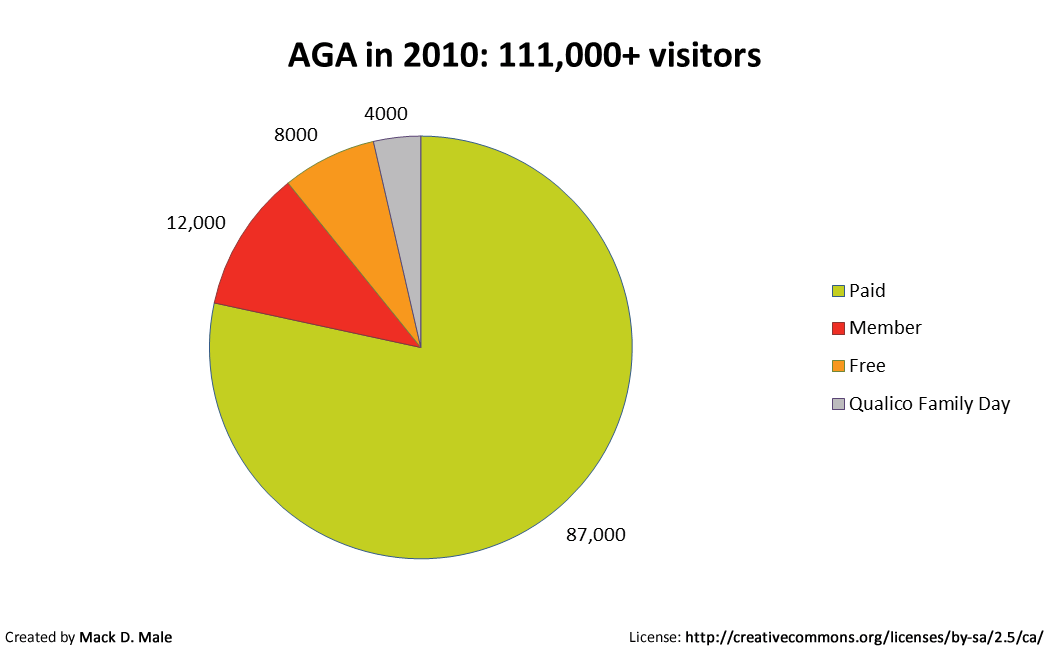
  • Attendance more than quadrupled since 2009 – more than 111,000 visitors!
  • Of that number, approximately 87,000 were paid admission, which significantly surpassed the target of 65,000.
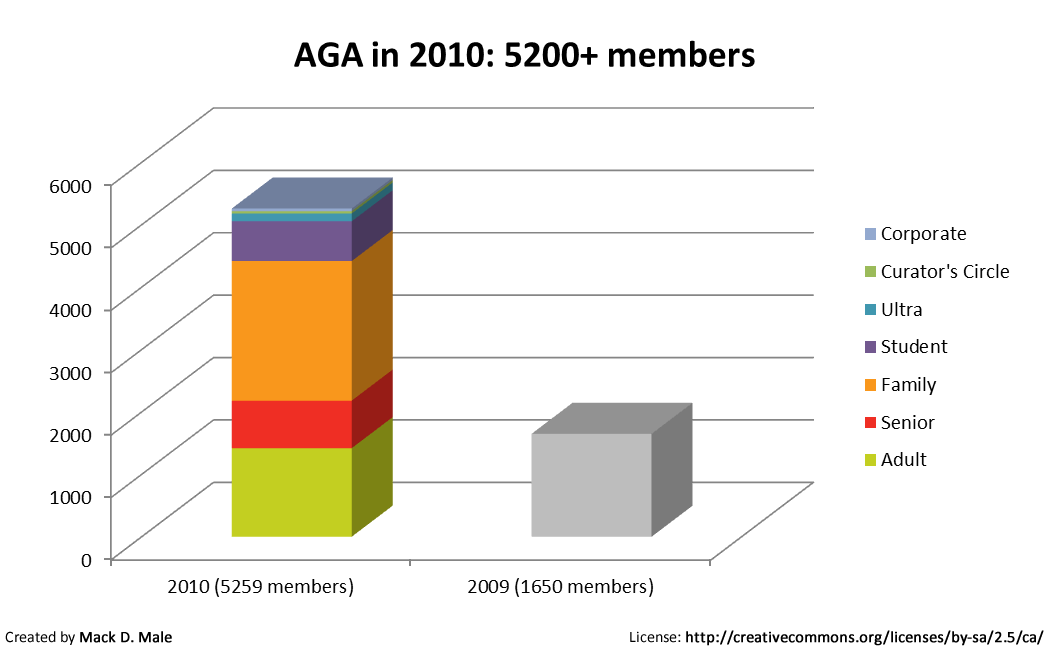
  • The number of AGA members increased from 1650 to 5300!
  • A total of 17 exhibitions were presented, 5 of which were dedicated to Alberta arists.
  • Roughly 4700 people in total attended the 395 public tours that were given. In addition, 146 private tours were given to a total of 3150 visitors.
  • School programs grew from 5000 students in 2009 to 14,500 last year.
  • A total of 367 private and corporate events, 24 wedding receptions, and 62 wedding photos sessions took place.

Here are a few graphs to help illustrate the success of 2010:

One of the highlights for me personally was the Refinery series of events. There were three in 2010, and each one was more popular than the last. Over 1700 people attended Refinery, and 800 of those were at the most recent event (it was so popular, people had to be turned away). I wrote about the second Refinery here. The 367 private and corporate events is significant as well. I attended dozens of events that took place at the AGA last year, it’s a great venue.

And who could forget the exhibitions! From Edgar Degas, Francisco Goya, and Edward Burtynsky to Warner Bros., Jonathan Kaiser, and Laura St. Pierre, we had a little bit of everything. I particularly enjoyed the Warner Bros. cartoons and Janet Cardiff & George Miller Bures’ Storm Room.

While the building was the most obvious “new” thing from 2010, let’s not forget that the AGA launched a new restaurant, logo, a new website, and established a presence in social media last year as well. All of those things helped the organization win a variety of awards:

  • Metal Construction Association Presidents Award for Overall Excellence
  • Institutional Winner: Alberta Construction Magazine 2009 Top Projects
  • 2010 Edmonton Economic Development Corporation Recognition Excellence Award
  • Best Cultural Institution 2010 by See Magazine
  • Zinc Restaurant was named one of the Best New Restaurants of 2010 by Where Magazine
  • Allan Scott was named Outstanding Volunteer Fundraiser by the Edmonton Association of Fundraising Professionals

Interview with Gilles Hébert, AGA Executive Director

The numbers for 2010 are certainly impressive. I asked Gilles to reflect on the past year. “It’s quite remarkable,” he told me. “The challenge is to maintain the momentum and continue to grow our audience.” In the first two months after the new building opened to the public, more than 30,000 people visited. “Lots of people came initially just to see the inside of the building,” Gilles said. Now he says people are coming back for the programming. “We exist because of the program, not because we have a cool building.”

Gilles said the AGA has seen the most interest in its contemporary programming, which he described as “pretty cool”. The success of the AGA’s contemporary exhibitions has driven interest nationally too. “People are looking to us for these big ambitious shows,” he told me. “They’re drawn in by the level of enthusiasm that is palpable in this community.”

Looking ahead to 2011, Gilles told me the challenge is generating buzz in places other than Edmonton. “There is no other institution like us in this province – we have a provincial mandate.” One of the ways the AGA is doing that is through social media. “We’re finding that these new forms of communication are really driving interest and allowing people to connect with what we’re doing.” He said their social media activities are actually becoming more valuable than traditional printed material and paid advertising, at least in terms of driving audience.

Gilles told me he is really looking forward to the celebration this weekend. “We are so proud to celebrate this milestone.”

Art Gallery of Alberta

Sunday Celebration

The anniversary celebration takes place on Sunday from 11am until 5pm. Here’s a brief description of what to expect:

The day includes the launch of the official AGA building book, presentations by the Citadel Theatre, Alberta Ballet and the Edmonton Opera, exhibition tours, as well as cupcakes for the first 500 visitors.

It should be a great day! You can see the event on ShareEdmonton here. And if you just can’t wait until Sunday, tonight is opening night for the Brian Jungen exhibition which features three sculptural installations.

If you’re taking photos this weekend, be sure to add them to the AGA pool on Flickr. Be sure to follow the Art Gallery of Alberta on Twitter.

You can see my photos of the AGA here. If you’d like a bit of background on the new building, check out my recap of architect Randall Stout’s talk.

Yes! For Edmonton Position Statement on the Proposed Downtown Edmonton Arena

Yes! For Edmonton sent the following position statement on the proposed arena to the media this afternoon:

I have been privy to some of the discussions about this, and was opposed to the statement being released because it kind of suggests that everyone who signed up to support the group on the airport issue automatically supports this one too. I don’t believe that is the case.

There are people in the organization who wanted to make a statement on the arena, and that’s fine. The more people who share their thoughts and opinions, the better. But I don’t think it is clear who Yes! For Edmonton speaks for, and that causes me some concern as the group approaches future issues.

It’s not clear whether this position statement will be posted on the Yes! For Edmonton website or what other updates will be made.

ONEdmonton Downtown Vibrancy Task Force letter to City Council regarding the Proposed Downtown Edmonton Arena and Entertainment District

ONEdmonton is a group of local leaders that have come together a few times over the last year to discuss how we can make Edmonton one of the world’s top 5 mid-size cities. The first subcommittee, called the Downtown Vibrancy Task Force, was launched in November after the larger group identified that our urban core is the top priority. I have been fortunate enough to be part of both groups.

Today, our task force sent a letter to City Council regarding the proposed Downtown Arena and Entertainment District:

The task force is a group of majority, not consensus. At the last meeting, the majority of the task force members voted the arena project as the top near-term priority in Edmonton’s downtown.

The task force members include: Chairperson Randy Ferguson (Procura), Bob Black (Katz Group), Dr. Paul Byrne (MacEwan), Carolyn Campbell (University of Alberta), Michael Janz (Public School Trustee, EFCL), Terry Kilburn (Avison Young), Bernie Kollman (IBM Canada), David Majeski (RBC), Mack Male, Doug McConnell (Dialog), Scott McKeen, Honourable Anne McLellan (Bennett Jones), Carol Neuman (Edmonton Next Gen), Simon O’Byrne (Stantec), Ian O’Donnell (Downtown Edmonton Community League) Keith Shillington (Stantec), Paul Verhesen (Clark Builders), Sheila Weatherill (EPCOR), Richard Wong (Sutton Place Hotel), and Ralph Young (Melcor). Representatives from EEDC facilitate the task force.

I don’t think anyone on the task force considers the arena project a done deal, nor do they think the issue is a simple one, and this is reflected in the letter. My read of what the task force is saying here is this: there’s potential with the arena project to positively impact our urban core, so let’s keep things moving and figure out how to make that happen.

UPDATE: I originally left out Ian O’Donnell and Sheila Weatherill, because they joined us after the first meeting. My mistake. EEDC has posted the list here.

Northlands by the numbers

Today Northlands made a presentation to City Council. Chair Andrew Huntley and President Richard Andersen talked about the impact that the organization has in Edmonton, and answered questions related to the proposed downtown arena. Here’s an at-a-glance look at Northlands:

Most of those numbers come from the 2009 Northlands Annual Report (PDF). Northlands breaks its business into four areas: Northlands Major Events, Agriculture, Racing and Gaming, and Sales, Hospitality and Client Services. Racing and Gaming accounts for both the most revenue and the most expense – that area of the business lost over $7 million in 2009.

As David Staples noted, I don’t know how they get to 2500+ events.

Some other numbers, from the presentation this morning:

  • $5.8 million is the base cost of operating Rexall Place each year
  • $10.9 million is the cost of operating Rexall Place if you include hockey
  • $17.1 million is the cost of operating Rexall Place after including all other events
  • $1.1 million is the amount the Oilers contribute towards those operating costs
  • $2.2 million is the amount the City of Edmonton contributes toward those operating costs each year (adjusted for inflation)

The Oilers pay Northlands $1 to rent Rexall Place – that agreement is set to expire on June 30, 2014. Northlands pays the City of Edmonton $1 to rent the land its facilities are located on – that agreement is set to expire in 2034.

You can learn more about Northlands here, and you can see their answers to City Council’s questions here (PDF).

Proposed Downtown Arena: Response to Council’s Questions

Back in July, City Council asked questions of Administration, the Katz Group, and Northlands regarding the proposed downtown arena district. A lot of questions. Today, the responses to those questions are being made available in preparation for the December 10 meeting (read them here). Here are a few questions and answers that I have extracted.

Mayor Mandel asked Administration: How many parking stalls are in downtown Edmonton that are within 8-10 blocks of the new proposed arena site?

Data from a parking study prepared as a background report for the Capital City Downtown Plan (Capital City Downtown Plan) in 2008 and recent calculations indicate approximately 46,100 total parking stalls exist within a 10 block radius from the proposed arena site.  Of these, approximately 2,700 are on-street metered parking, 17,300 are off-street surface parking, and 26,100 are located within a parkade (i.e. structured parking).

Councillor Caterina asked Administration: Why was the 5th best location chosen rather than #1 – Jasper Avenue, #2 – Northlands, etc.?

The confidential HOK Study does not prioritize the proposed locations.  Rather, it identifies the essential components required to attract major sporting and entertainment events and identifies location issues and the criteria necessary for a successful facility development.  The proposed location for the district is a viable choice when factoring in the various criteria identified in the HOK Study, particularly related to the challenges/opportunities of land assembly.

Councillor Leibovici asked Administration: Can a condition of a CRL be a guaranteed revenue stream?  In other words if projected development does not occur as anticipated can the City require that the Katz Group provide a guarantee to cover debt servicing costs?

A risk assessment is part of the requirement for the CRL.  The CRL plan must identify expected and alternative funding sources in the event the development does not occur.  Alternative revenues to make up any shortfall in expected revenues from a CRL would be discussed as part of a negotiation with the Katz group.

Councillor Leibovici asked Administration: What are the projections for the Edmonton Convention Market? Part of the answer:

From Mike Fitzpatrick, VP & General Manager of the Shaw Convention Centre: The Shaw Conference Centre is routinely turning away convention business due to a lack of downtown convention space; when that happens these events are almost always forced to select another city.  In the nine months from January to September 2010 we have already turned away 13 future convention bookings.

Councillor Sohi asked Administration: Have discussions taken place with the Province regarding the CRL model?

Administration has had preliminary discussions with the province on the use of a CRL for arena development.

Councillor Anderson asked the Katz Group: Is the $100 m Katz dollars cash or land?

There are a number of ways to deliver $100m  in value, but we recognize that this will have to be done in a fashion that is acceptable to the City.

Councillor Iveson asked the Katz Group: Please explain exactly how a Location Agreement works from the Franchise perspective, including the contemplated duration of the agreement.

A location agreement would be a term of the lease pursuant to which the Oilers would play in the new building.  It would bind the Oilers to playing only in that building for the full term of the lease.  We are prepared to sign a long term lease in a new downtown arena that would bind the team to Edmonton for the  term of that lease.  We expect a term of 25 years or more.

Councillor Sloan asked the Katz Group: Forbes has shown consistently over the past 3 years that the Oiler net operating income is better than the Calgary Flames anywhere from $3 million to $10 million per year?

That is not accurate based on our information.

Councillor Sohi asked the Katz Group: Are two arenas viable in Edmonton?

No.

Councillor Thiele asked the Katz Group: If no new downtown arena district is built in Edmonton and the Oilers will not play in a renovated Rexall Place, where will they play?

Our singular focus is upon negotiating a mutually satisfactory agreement with the City of Edmonton that will facilitate the construction of a new downtown arena.  We are confident that this can be achieved.

The complete list of questions and answers is available here. At the December 10 meeting, Northlands will be giving a presentation, the questions and answers will be discussed, and Administration will be talking about the public consultation that took place.

The issue will come before Council again on January 17. You can see more information here.

Reimagine: Achieving a Sustainable Building Stock in Edmonton

A few weeks ago I attended Manasc Isaac’s Reimagine Tower Renewal Summit 4 (see my preview). John Woelfling from Dattner Architects in New York was the guest speaker, and he shared a wealth of information on the renewal of the Peter W. Rodino Federal Office Building in Newark, New Jersey.

Reimagine Tower Renewal Summit

John covered all aspects of the renewal project, from cooling & heating plant upgrades to egress improvements and façade upgrades. They were able to achieve a significant increase in the energy efficiency of the building, and it looks much nicer now too! A lot of the information was over my head, but you can download John’s presentation here if you’re interested (PDF, 10 MB).

Peter W. Rodino Federal Office BuildingPeter W. Rodino Federal Office Building

One slide in particular from John’s presentation stuck with me. To help set the context, he showed this graph:

As you can see, the vast majority of new office construction in Manhattan occurred back in the 1970s and 1980s. Why is that significant? Building codes and regulations were far less likely to consider energy efficiency at the time. An office tower built today is far more likely to be energy efficient than one built in 1970. It wasn’t until the Brundtland Report was published in 1987 that the term “sustainable development” was defined.

I have been thinking about that graph ever since, wondering if the situation here in Edmonton was similar, and trying to wrap my head around the problem of having an old and inefficient building stock. I spent some time on the website for The Way We Green, and came across this discussion paper from Klaas Rodenburg of Stantec. Titled Achieving a Sustainable Building Stock, the paper discusses the very thing I have been thinking about. Here’s a key excerpt:

Buildings are directly responsible for more than a third of all energy used and more than 50% of natural resources consumed in Canada. As a significant part of the problem, buildings also present part of the solution.

Although buildings look permanent, they are actually replaced or renewed on a perpetual basis. Municipalities can take advantage of this continual renewal cycle to significantly grow their stock of sustainable buildings by expecting higher standards for new buildings and encouraging existing building owners to engage in green renovations. Building codes are slow to change and focus on life safety, health and accessibility and not environmental performance.

The paper goes on to discuss voluntary rating systems such as LEED, and identifies strategies our city could employ to achieve a more sustainable building stock.

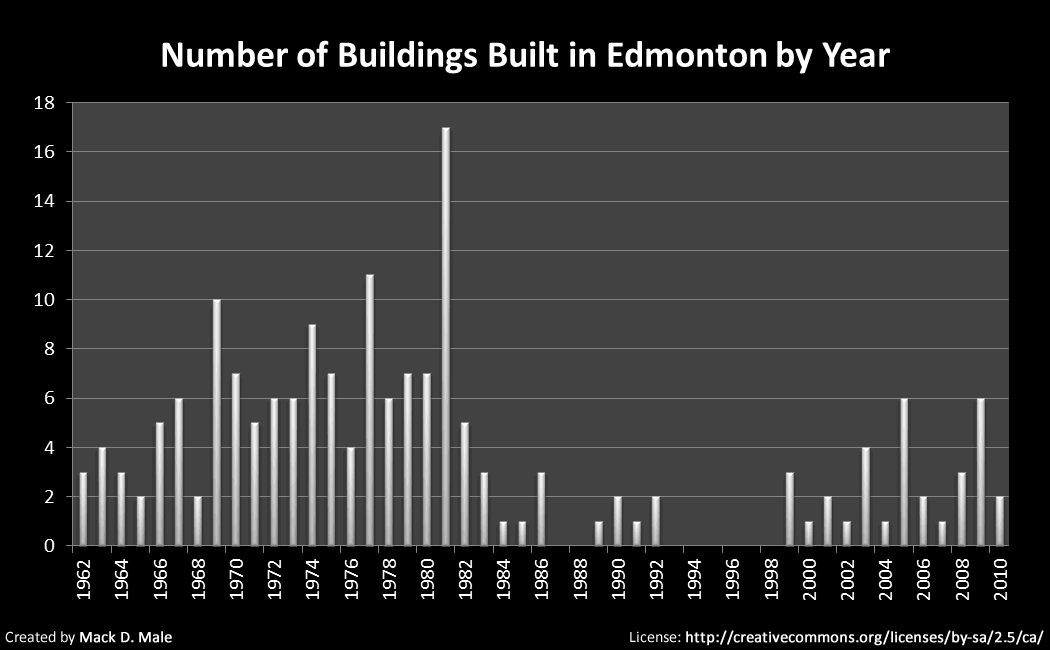
So what does our building stock look like? I turned to SkyscraperPage.com to help find the answer. They’ve got a pretty good database of Edmonton buildings – it currently contains 283 completed buildings. Of those, 183 have a “year built” associated with them. Here’s what you get with a little Excel magic:

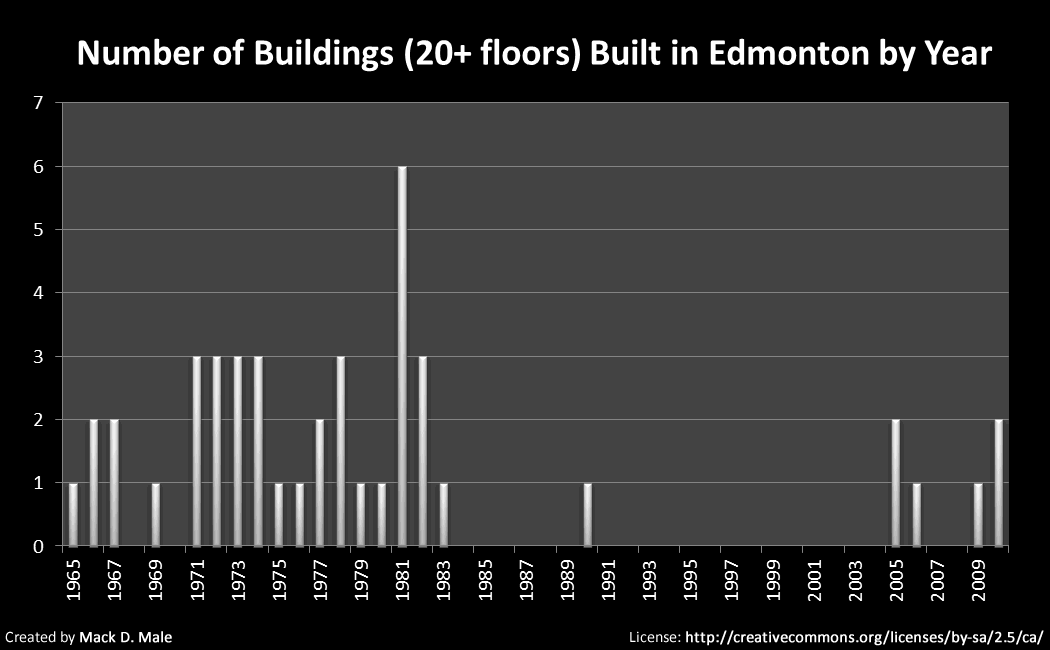
Very similar to the Manhattan chart (though the SkyscraperPage data includes both residential and office buildings). Most of Edmonton’s buildings were built prior to the mid 1980s. Here’s what it looks like when you focus just on buildings that have 20 or more floors:

Yikes! All of the buildings on the right side of that graph are residential too: One River Park, The Century, The Jasper Properties, ICON I, ICON II, and Quest.

Obviously we need to ensure that any new buildings we are constructing are energy efficient. As Rodenburg says in his discussion paper, they must “exceed existing codes and standards by a significant measure.” I think that is happening to a certain extent – being LEED certified is something we hear quite a bit about now.

The graphs above suggest that perhaps we should pay more attention to our existing building stock as well. There’s a number of strategies we could use to make our older buildings more efficient, including the increasingly popular idea of reskinning.