Edmonton’s Hot to Huddle 2010 Grey Cup Festival Parade!

Downtown Edmonton has been full of energy this week for the Grey Cup Festival, but today’s parade took it to another level! Here are some of the highlights.

I’d say green was definitely the dominant color in the crowds – they even brought chairs!

2010 Grey Cup Parade

The Snowbirds criss-crossed the sky a few times!

2010 Grey Cup Parade

2010 Grey Cup Parade

Bryan Hall was the Grand Marshall for the parade.

2010 Grey Cup Parade

Each of the teams had a Nissan Cube.

2010 Grey Cup Parade

They also had cheer teams. The Eskimos cheer team even did some stunts!

2010 Grey Cup Parade

A favorite from the Capital Ex parade returned – the West Jet plane!

2010 Grey Cup Parade

I thought the Coast Hotels float was creative.

2010 Grey Cup Parade

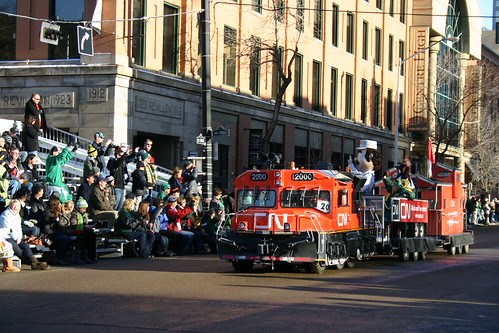
The CN float was really well done too.

2010 Grey Cup Parade

These poor kids had the worst job, following the horses.

2010 Grey Cup Parade

The Riders’ cheer team received a warm welcome!

2010 Grey Cup Parade

As did the rest of the Roughrider supporters.

2010 Grey Cup Parade

They even had pyrotechnics. How can you go wrong with that?!

2010 Grey Cup Parade

It really was a sea of green for a while.

2010 Grey Cup Parade

This one was my favorite of the parade:

2010 Grey Cup Parade

This guy remarked “buying fans one Candy Cane at a time!” as he passed by.

2010 Grey Cup Parade

I love that this guy is a Calgary fan.

2010 Grey Cup Parade

There was loud applause as our Armed Forces passed by.

2010 Grey Cup Parade

Attendance wasn’t as large as the Capital EX parade, but given the temperature, I’d say it was still a very strong turnout!

You can see the rest of my parade photos here (over 140 in all).

Reclaiming Edmonton’s Lost Spaces: Alley of Light

A couple of weeks ago I linked to the Edmonton on the Edge website, after I had come across their page on “reclaiming lost spaces”. The organization, which consists of members from the University of Alberta, Edmonton Design Committee, ISL Engineering, Edmonton Federation of Community Leagues, and M.A.D.E. in Edmonton, among others, recently explored the idea of reclaiming two of Edmonton’s lost spaces: the alley behind Sobeys on 104 Street, and the alley behind the Melton Building on 103 Street. They settled on the alley behind Sobeys, and worked with around 40 individuals from the area to start imagining how the space could be transformed.

The project, led by former City Councillor Michael Phair and EIDOS Landscape Architect Peter Spearey, has been dubbed the “Alley of Light” and there’s an open house coming up on Sunday, December 5 for anyone interested to provide input. I live less than a block away from the alley, so I’m excited about the opportunity to help transform it into something more. Here’s what the alley looked like tonight:

Alley of Light

You can see that it is dark, and not exactly inviting. Even during the day, the alley does not “create a sense of ownership and pride amongst community members”, one of the goals of the Reclaiming Lost Spaces project. Aside from the Christmas lights in the tree nearest to the street, there’s not much there. Though I wasn’t sure what to make of them at first, the red illuminated cones outside Lit are a welcome addition to the street. They add some color and, well, some light!

Aside from Lit, one of the first things that came to mind for me when I heard the name “Alley of Light” was the Illuminate Yaletown event that I went to in Vancouver last year. It featured some impressive light-as-art installations, like this one:

Illuminate Yaletown

I’d love to see some improvements to the alley that would work both during the day and at night. Think of a water installation during the day that becomes illuminated at night, something like that. It’s a little difficult to see in this photo, but even during daytime events such as Al Fresco the space is underutilized at the moment. It would be great for the space to be welcoming both day and night.

Here’s one idea for the alley:

Alley of Light

The main idea there is the beams of light extending from the Sobeys building, as well as getting rid of the fence and smoothing out the park. There are all kinds of opportunities, and if you’d like to see some more or even provide your own, I encourage you to come to the open house:

WHO: You and your friends!
WHAT: Alley of Light Open House
WHEN: Sunday, December 5 from 2pm to 4pm
WHERE: Enterprise Square, Main Atrium
WHY: To help reclaim one of Edmonton’s lost spaces!

Next steps and additional information will be provided at the open house. Anyone and everyone is invited, so spread the word!

Transforming Edmonton’s Downtown East: Boyle Renaissance & The Quarters

Last week I stopped by the open house for Boyle Renaissance & The Quarters, two projects that together will transform the eastern part of Edmonton’s downtown. The Quarters is a revitalization project made up of five distinct districts, extending east-west from 97 Street to 92 Street and north-south from 103A Avenue to the top of the river valley (approximately 40 hectares). Boyle Renaissance is a smaller redevelopment effort, focused on the area between 95 Street and 96 Street, from 103A Avenue north to the LRT tracks (essentially two and half city blocks).

There were maybe 20 people in attendance, not counting the City officials and representatives from the related architectural firms. In addition to the more than 25 information displays setup around the room, there were a number of small presentations on the plans.

Boyle Renaissance / The Quarters Open House

An update on Boyle Renaissance:

  • Boyle Renaissance started with a Concept Plan in 2008, and is now an evolving Master Plan composed of two phases. The project will create a community that brings together affordable and market housing opportunities, along with services such as childcare, park space, and social space.
  • The first Boyle Renaissance Advisory Committee (BRAC I) started meeting in May 2008. Its final report was submitted to the City of Edmonton in October 2008.
  • Council directed that the concept continue to evolve, so BRAC II was formed in March 2009. Its final report was published in March 2010. You can see the recommendations to council here.
  • Phase 1 project partners include The City of Edmonton, Government of Alberta, YMCA, Boyle Street Community League, and the Capital Region Housing Corporation (CRHC), among others. The Edmonton Oilers Community Foundation is no longer involved in the project.
  • The YMCA Welcome Village is a key component of phase 1, and will include 150 affordable housing units, a family resource centre and a daycare. The City is contributing $3.5 million while the Government of Alberta has committed $24 million.
  • The City of Edmonton is also contributing $6 million towards a new Community Centre, a joint initiative with the Boyle Street Community League.
  • Though none have come forward yet, the City is actively looking for potential partners to occupy the York Hotel building.
  • Updated documents aren’t online yet, but you can see the information displays here.
  • “We’re not building buildings, we’re helping to build a community.”


Part of the current Boyle Renaissance site plan, facing north.

A ground breaking ceremony for phase 1 is taking place on Wednesday morning.

Boyle Renaissance / The Quarters Open HouseBoyle Renaissance / The Quarters Open House

An update on The Quarters:

  • The revitalization project began in 2006, with the Area Redevelopment Plan being passed in April 2009.
  • The Quarters is one of the first areas in Edmonton to have a community revitalization levy (CRL). The boundary was approved in 2008. It is expected that final approval of the CRL from both Council and the Province of Alberta will come in 2011.
  • Once fully developed, it is anticipated that The Quarters could accommodate a population of nearly 20,000 people. The area is currently home to just 2400 residents.
  • The area is made up of five districts: four quarters, with a linear park corridor known as The Armature at the centre.
  • The Civic Quarter is envisioned as as an extension of the downtown and arts district. The Heritage Quarter is named for the location of Edmonton’s original downtown. The McCauley Quarter will contain smaller scale buildings and is largely residential. The Five Corners Quarter is named for the intersection at 95 Street and Jasper Avenue, and will feature taller buildings and a higher overall density.
  • The Armature itself is composed of smaller pieces, from north to south: Meridian Gateway, New City Park, The Promenade, Jasper Plaza, and River Gate Park. Principles identified in the presentation include: sustainable, accessible, green, seasonal, brighter, and creative.
  • The Armature was described as the “showpiece”.
  • The Twin Towers at Jasper Avenue and 95 Street will add to the density of the Five Corners Quarter.
  • Though each quarter will have a unique character, there are plans to “brand” the entire area, so you know when you’re in The Quarters.

Here are a few images I pulled from the Urban Design Plan (16 MB PDF).


Rendering of The Quarters.


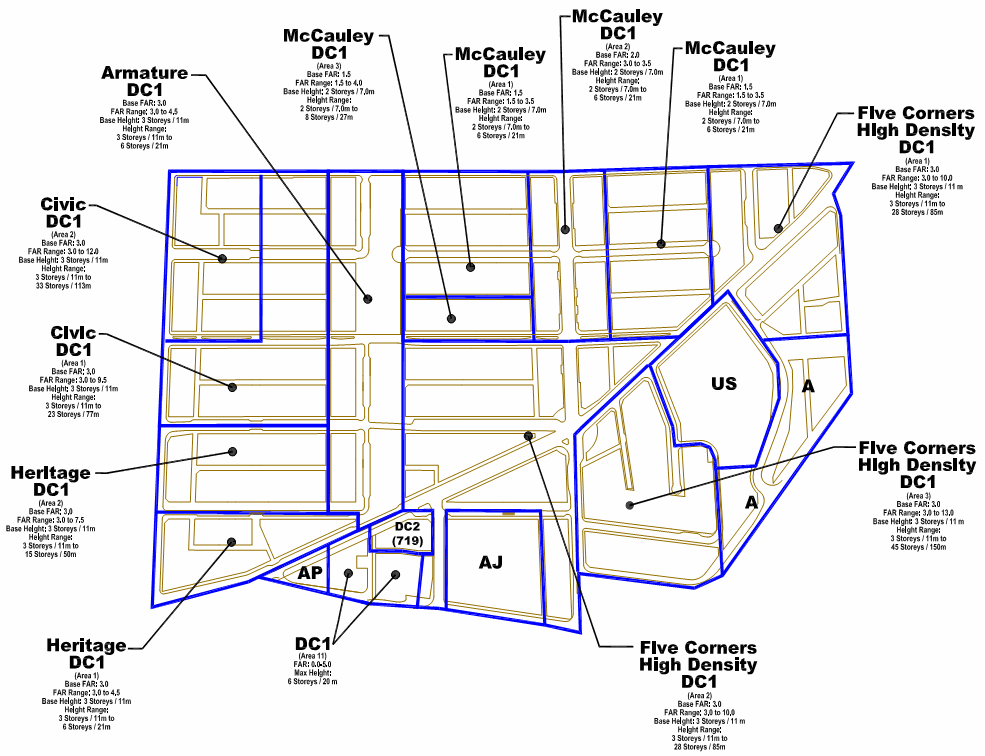
Zoning for The Quarters.


Rendering of Five Corners.

Though some might say it has been in the works for too long, The Quarters is a very exciting project for Edmonton. The area east of downtown is definitely in need of revitalization, and this plan to bring thousands of residents into the area will help accomplish that.

Boyle Renaissance / The Quarters Open House

It’s a shame that the beautiful information displays shown at the open house are not available online (at least not yet). Hopefully we’ll see more information about these projects online soon!

What’s new at Grant MacEwan University?

A couple of weeks ago I was invited to attend the MacEwan President’s Reception held at the Robbins Health Learning Centre. Hosted by retiring president Dr. Paul Byrne, the event was an opportunity for the roughly 50 people in attendance to get an update on what the university has been up to. One of the things that Dr. Byrne was very excited to talk about was MacEwan’s positive showing in The Globe and Mail’s Canadian University Report. We were reminded that John Day became Chair of MacEwan’s Board of Governors in July, and Dr. Byrne shared some of the achievements from the last year. Aside from that, the evening had three main areas of focus – new programs, the Bachelor of Music, and the Single Sustainable Campus Project.

One of MacEwan’s newest degrees is the Bachelor of Communication Studies (BCS):

“The BCS prepares graduates for strategic roles in business, traditional and new media, not-for-profit and public sector organizations. Graduates of the BCS program will have a variety of career opportunities to choose from, including communications advisor, consultant, producer, writer, editor, journalist, reporter, or commentator.”

The BCS starts in September 2011 along with a new Accounting major in the Bachelor of Commerce program, and a new Arts and Cultural Management diploma. New programs have been a major area of focus for MacEwan lately, as evidenced by the broad array of “We have a [program] for that.” advertisements that have appeared around the city. They now offer around 70 programs.

Another new program is the Bachelor of Music in Jazz and Contemporary Popular Music, one of the few music programs in Canada to focus on jazz and contemporary music. When the full program is up and running, it will have 350 students. MacEwan will continue to offer its Music Diploma program as well. Music students from the school kept us entertained throughout the evening!

MacEwan President's ReceptionMacEwan President's Reception

Though officials in attendance didn’t spend much time talking about it, the Single Sustainable Campus Project was definitely a focus, with information displays and a looping video available for everyone to look at. This video is a great introduction to and overview of the project:

The project will occur in three phases over the course of 20 years. The Centre for the Arts and Communications, currently located in the west end, will move downtown first, to a new home at the corner of 112 Street and 104 Avenue. The programs at South Campus will move next, followed by Alberta College Campus programs. One of the driving forces behind the project is enrollment. MacEwan currently has around 32,000 students, and that number is expected to grow significantly over the next decade. Sustainability, student satisfaction, and the LRT expansion are some of the other key factors. MacEwan received a $1 million Knowledge and Infrastructure Program (KIP) grant last year to kickstart the project, and is continuing to explore logistics and additional funding opportunities.

MacEwan President's ReceptionMacEwan President's Reception

Grant MacEwan University is an important part of Edmonton’s strong slate of education options, so it’s great to see the school growing and succeeding.  You can follow MacEwan on Twitter and on Facebook.

A closer look at the City of Edmonton’s Downtown Arena Questionnaire

The City’s online questionnaire for the proposed downtown arena has received quite a lot of criticism, especially online. Twitter users have not been shy about calling it “leading” and questioning its intent. And that criticism has come up in face-to-face conversations I’ve had with people at arena consultation sessions and other events as well.

At the consultation sessions, officials have made it very clear that the questionnaire is meant simply to gather feedback, and is not intended to be a statistically valid survey. It feels like a survey though, so it’s no surprise that people treat it that way.

The introduction of the questionnaire reads:

This questionnaire is one of several methods being used to gather thoughts and concerns about a proposed downtown sports and entertainment facility. The feedback received will be provided to City Council to assist in their decision-making.

And it explicitly asks that you only fill it out once, though technically there’s nothing stopping you from filling it out dozens of times. There’s also no way to ensure that only people who live in Edmonton fill out the questionnaire.

Proposed Downtown Arena Consultation

I emailed the City with some questions on the survey, and they wrote back with detailed responses.

Was the questionnaire written by City staff? Calder Bateman staff?

A team worked on the online questionnaire. It was one of the early elements developed to support public input and was meant to be a quick and convenient way people could share their thoughts. It was never intended and not designed as a statistically valid, formal survey – but a technology-based tool for use by those who might not make the open houses in person. It means we will have a richer range of input to report on.

While other elements of the open house and discussion forums have evolved based on the input and suggestions we’ve received, we didn’t feel it appropriate to adjust the online questionnaire – so it has remained consistent with what was originally posted.

How many entries have you received to-date?

As of 4:00 p.m. Nov 9 we had 17,030 directly through the online questionnaire plus another 60 from those who called 311. We’re pleased with these results. It’s likely that people are seeing the online questionnaire as an option to attendance at the open house.

Any indication of how many received entries are duplicates?

No. At this point, we haven’t done an analysis on the questionnaire submissions. We really need to wait until the entire process concludes to get the full picture. There are a number of ways people are providing input including email, sticky notes, completion of the discussion feedback forms and the questionnaires. The inputs from all areas will be consolidated into the final report.

Are there any plans for a follow-up questionnaire later in the process?

There will be other opportunities for public involvement and input throughout the process, and another questionnaire might well be an option.

Are there any plans for a statistically valid survey?

We realize the online questionnaire only reflects the opinion of the people who complete it – it is not a representative analysis of what the population of Edmonton might think. The City will be very clear when presenting the results to ensure they are not considered a statistically valid sample of opinion.

A statistically valid survey continues to be a possibility. Our focus right now is on the current suite of public involvement opportunities.

I also asked my colleague Greg Pope, Analytics & Psychometrics Manager for Questionmark, for his thoughts and feedback on the questionnaire. He suggested this best practice guide (PDF) for good survey design as a starting point. Here are some of the comments & suggestions he had:

  • The current 1-5 “definitely” likert scale is unclear (no label for 2,3,4). Greg suggested an even number of choices (1-4) so that there is no “maybe” or “unsure” category.
  • “A rule of thumb is to try and keep all the questions on the same scale with the same values, so converting all questions to statements with a 4 point agreement scale would work well.”
  • “Another rule of thumb is to phrase the questions all the same way. It is not leading or misleading to ask “I want a new downtown arena built in Edmonton.” Because you are asking whether they agree or not with the statement. “
  • If the responses were going to be analyzed in any way, Greg said he would have asked some demographic questions. As a simple questionnaire, that’s probably not as important.
  • Another suggestion Greg had was to combine the open-ended fields into one at the end, to make it quicker to complete the questionnaire. He said there’s often sorting that has to happen anyway.

Good feedback to keep in mind if a survey is created in the future. Thanks to both Greg and the City of Edmonton for helping me out with this.

I think there are two key takeaways here. First, the online questionnaire is not a survey. Second, the City of Edmonton is consistent in treating the questionnaire as just another way for people to provide input. If you think the questions are leading, don’t fill it out. There’s nothing stopping you from emailing the City with your thoughts or calling 311. And if you can, attend one of the public consultation sessions.

Recap: Downtown Arena Public Consultation Session

Last night was the first of four City-hosted public consultation sessions on the proposed downtown arena. The sessions aim to gather input that will be provided to City Council. Roughly 150 people visited the Robbins Health Learning Centre throughout the evening, though only about a third of those stayed for the facilitated part of the session.

Proposed Downtown Arena Consultation

The first two hours of the session followed an open house format, with information displays, handouts such as a backgrounder (PDF), City officials available to answer questions, and opportunities for individuals to write questions or comments on sticky notes or in drop boxes. Promptly at 7pm, Margaret Bateman made a brief presentation (PDF) on the consultation process. The next two hours were facilitated discussion groups, where everyone had the opportunity to provide specific feedback on five key questions. Here are the questions as they were presented this evening:

  1. What’s your position on building a downtown arena?
    • If supportive, why?
    • If not, why not?
    • If conditional, why?
  2. If a new downtown arena project were to proceed, what do you think is important to consider in terms of:
    • Design?
    • Downtown connection and impact?
    • Impact on surrounding communities?
    • Community benefits/engagement?
    • Impact on the future of Rexall Place?
    • Any other issues?
  3. What about using a mix of private and public funding to fund a downtown arena?
    • Are you open to this? Why?
    • Not open to this? Why not?
    • Open under certain circumstances or conditions? If so, what are they?
  4. What do you think about other possible funding sources to cover arena costs? (some or all of these are options)
    • A ticket tax
    • A personal seat license or luxury box license
    • A community revitalization levy (which would require the facility be publicly owned)
    • Funding for non-arena infrastructure from other levels of government
    • Additional private investment
    • Any other sources?
  5. Do you have any final thoughts or views for Council?

I attended a “stakeholder” consultation last Thursday that followed a similar format, but asked slightly different questions. The first question in that session was: “Do you support building an arena to revitalize Edmonton’s downtown? If yes, why? If no, why not?” Talk about a leading question with a big assumption! Needless to say I was very pleased to see that the City (along with consultation partner Calder Bateman) had tweaked the questions this time around.

Proposed Downtown Arena ConsultationProposed Downtown Arena Consultation

My discussion group started off fine, but quickly descended into disagreement as a few very vocal members wanted to skip to the funding question right away. The City officials on hand handled the situation very well, and before long our group was back on track generating some useful discussion (the other groups didn’t seem to have any issues). Here are some of the comments from the group that I wrote down:

  • Unclear that the arena would actually bring people downtown
  • The arena will not generate tourism
  • Skepticism about an influx of commercial development surrounding the arena
  • Transit would need to be greatly improved, concern about the lack of an LRT stop right at the arena
  • What would happen to Rexall Place?
  • General feeling we would lose Canadian Finals Rodeo and maybe other events
  • Lots of concern over traffic congestion, some concern over parking
  • Feeling that the current ticket prices are already too high
  • Quite a bit of skepticism about the effectiveness of a CRL
  • Thought that spending the money on existing recreation centres would result in higher benefit to the community

As far as I could tell, my group was the most negative about the arena. The others seemed cautiously optimistic, and when everyone came together at the end of the evening for Margaret Bateman’s recap, that seemed to be the consensus. There was concern over treating the arena as the key to revitalizing downtown, and there was obviously lots of concern over the funding model, but there also seemed to be some optimism that the project could be a very good thing.

Proposed Downtown Arena Consultation

There are three more public consultation sessions currently planned:

If you can’t make it to any of those sessions, you can fill out the online questionnaire, call 311, or email downtownarena@edmonton.ca.

For more information, check out the City of Edmonton’s site, the Katz Group’s site, and the Why Downtown? site. You can follow updates on Twitter using #yegarena.

Whether you’re for or against the arena, or even if you’re unsure, it’s important to make your voice heard!

Notes on the Downtown LRT Connector Concept Plan

On Tuesday evening the proposed Concept Plan for the Downtown LRT Connector was presented to the public at a very well attended event. The plan is the next step in the process that really kicked off on June 21 when City Council approved a street-level downtown LRT route. The proposed 2.1 km route will serve as a connector for the future West and Southeast LRT lines, with 5 stops and opportunities for transfers to the existing LRT system in the downtown core. The route runs primarily along 102 Avenue, connecting to the West LRT via 107 Street on 104 Avenue and to the Southeast LRT on 102 Avenue near 96 Street.

The Downtown LRT Connector was mentioned as a catalyst project for the Capital City Downtown Plan more than once. It forms an importance piece of both the six-legged LRT Network Plan and the so-called Downtown-University circulator.

Here’s what it looks like (the purple line):

Downtown LRT Connector

The Downtown LRT Connector will use low-floor LRT vehicles, which is the style all future LRT development will use (when possible). Low-floor LRT requires less infrastructure and enables step-free, street-level boarding. And yes, low-floor LRT will work in our winter climate!

Downtown LRT Connector: The Quarters in Winter

There are five proposed stops along the route:

  1. Campus Stop – Located diagonally between 108 Street/104 Avenue and 107 Street/102 Avenue. Land acquisition would be required, including the AADAC building. Potential for development around the stop. Serves MacEwan and NorQuest. Features a third track, which could be used as a staging area to prepare for large events, etc.
  2. 105/106 Street Stop – Located in between the two streets, where there are currently parking lots. Land acquisition would be required.
  3. Centre West Stop – Located across from Manulife Place, in between 102 Street and 101 Street. Requires no land acquisition. Would feature dedicated bicycle lanes in both directions.
  4. Churchill Square Stop – Located across from the Stanley Milner library. Requires no land acquisition. A second set of escalators/elevators would be built on the northwest corner of the 99 Street/102 Avenue intersection. Easy connections to existing LRT.
  5. Quarters Stop – Requires no land acquisition. Some traffic impacts: 102 Avenue at 96 Street would be closed to through traffic, and a single eastbound lane would be provided from 97 Street to maintain local access.

Here’s a rendering of the Churchill Square stop:

Downtown LRT Connector: Churchill Square Stop

The question & answer session covered a lot of topics. Here are a few notes I took:

  • The Downtown LRT Connector would use a different signal system. Rather than an exemption (the current LRT always has right-of-way) the LRT would receive priority, but may hold at stations to allow traffic to clear.
  • Buses that currently run along 102 Avenue would of course be re-tooled to feed into the LRT system.
  • The bicycle lanes in the concept plan are primarily shared lanes, but there’s the potential for dedicated lanes in the future.
  • The location of the Quarters stop is further west than would be ideal, but as it dives into an underground tunnel to join the Southeast LRT there isn’t much flexibility. There are significant grade changes.

I also asked about the City Market, as the route would run right through the middle of it. I was told that the City has already had conversations with the City Market, and that they’re confident they’ll make it work (either spreading out along 102 Avenue a little more, or potentially just leaving everything the way it is…but with a train running through every 15 minutes).

I’m particularly excited for this route, living at 104 Street and 102 Avenue. It’ll mean I’m a block or less from both the existing LRT (at Bay/Enterprise Square) and the new lines (at 105/106 Street). Can’t wait to see it happen!

You can download the Downtown LRT Connector Information Booklet here (PDF).

The Concept Plan will be presented to the Transportation & Public Works Committee at a non-statutory public hearing on December 8, after which it will be forwarded to City Council for review in January 2011. You can check out the Downtown LRT Connector page for more information.

Reimagine Tower Renewal Summit in Edmonton

Next Tuesday, Manasc Isaac Architects are hosting a luncheon at the Fairmont Hotel Macdonald featuring John Woelfling of New York’s Dattner Architects (on ShareEdmonton). This is the latest in a series of events known as the Reimagine Tower Renewal Summit. Here’s the event description:

In this luncheon hosted by Manasc Isaac Architects, Woelfling will present on the renewal of the Peter W. Rodino Federal Office Building in Newark, New Jersey. The P3 modernization project utilizes a true re-skinning strategy, a first for North America. The smart skin increases energy efficiency, provides more effective fresh air ventilation, allows the building to be renovated while still occupied and dramatically transforms the building’s identity.

I was invited to the event and am looking forward to it. I’m not an architect (obviously) but I am interested in ways to transform Edmonton’s urban form, and this seems like a useful addition to the toolkit. Manasc suggests that “a reimagined building” (or a re-skinned building) can result in lower operating costs, reduced energy consumption, and improved day-lighting, among other things.

Some of you might remember Shafraaz Kaba’s talk at TEDxEdmonton last March, where he discussed the reimagining of the old Dell call centre building, now the Servus building. Here’s the before and after:

Servus Credit Union

Shafraaz pointed out that the benefits go deeper than just the exterior of the building. People are more productive when there is lots of natural light, etc.

One of the Pecha Kucha talks I remember most was Myron Belej’s from the very first PKN in Edmonton (slides in PDF here). He talked about Urban Color, and showed a before & after for a variety of Edmonton buildings. I remember being struck by just how much of a difference it can make when the building is not beige. Manasc Isaac’s ideas go beyond just color, of course, but I think the two are related.

Here are some more visuals from Manasc Isaac that demonstrate the re-skinning idea:

Stanley Milner Library
The Stanley Milner library downtown – it always comes up in discussions about redevelopment.

Chancery Hall
Chancery Hall

Associated Engineering
Associated Engineering building, apparently so ugly “it stops traffic in its tracks”. There’s a re-skin on the way for this building already.

If you’re interested in attending the event, you can register here. And if you’re in Calgary, they’re doing the event there too on November 10th.

Edmonton Election 2010: Inner City Issues at The Learning Centre

It’s pretty clear that technology is playing a big role in this year’s election. Lots of candidates now have websites and a presence on social networking sites, and there are an increasing number of places you can look online for more information. We’re fortunate in Edmonton to have lots of opportunities to meet candidates in person too, such as at City or community organized forums, many of which are either streamed online or live-tweeted by those in attendance.

But what about Edmontonians that don’t have regular access to the web? Or Edmontonians whose reading skills are in need of improvement? Some people simply don’t feel comfortable attending a forum or talking to candidates in person, so how can they have a voice in this election? I was happy to discover that The Learning Centre (I am a board member) was making an effort to help people in the inner city get involved.

The Learning Centre

Daniel Johnson, a sessional instructor in the Faculty of Native Studies at the University of Alberta, has been a volunteer at The Learning Centre since being introduced to it through the Humanities 101 program. Recently, he decided to try to get people that use The Learning Centre and Boyle Street Community Services (BSCS) thinking about the election. For the last few weeks, Daniel and other volunteers have been running an informal session called “Inner City Issues” in the Boyle Street drop-in. The goal was to get people talking about the issues they care about. Daniel would write down their questions and thoughts on the whiteboard, and then he’d ask other people what they thought. As you can see below, they’ve come up with not only questions, but also lots of ideas.

As the election draws near, the focus of the session will shift toward helping people be prepared to vote, ensuring they know where to go, what identification is required, etc. And everyone will continue to have the opportunity to voice their concerns.

The Learning Centre

Daniel also organized two candidate forums, held at The Learning Centre on September 30 and October 7. Mayoral candidate Daryl Bonar was joined by Ward 6 candidates Brian Kaptiza and Jane Batty at the first forum, and Mayor Stephen Mandel was on hand for yesterday’s forum. I wasn’t able to attend the first forum, but Daniel told me that there was a great turnout, with lots of questions and animated discussion.

I was able to check out yesterday’s forum, however. Mandel arrived late but stayed for quite a while to answer more than two dozen questions. There were about 25 people in attendance, a little less than at the first forum. There were a range of issues brought up, but homelessness and housing issues (bed bugs, basement suites, etc) dominated the discussion. Other issues that came up were policing, transit (not enough passes or tickets in the Donate-A-Ride program), helping those with mental illness, the amount of garbage downtown, school closures, safe injection sites, and the downtown arena. The airport and EXPO were mentioned once or twice, but were definitely not the focus!

I thought Mandel did a good job of answering questions for the most part, though he did get a little defensive on occasion. Most people in the room wanted to see more action on helping the homeless, though a few did explicitly thank Mandel for the work the city has been doing under his watch. What impressed me most was that people didn’t just have questions, they had ideas for possible solutions too. Things like using recently closed schools for transition housing, or offering a free downtown bus route. One person even suggested that Mayor Mandel go homeless for a night, to see what it’s really like. He replied: “I’ll think about it!”

I think it’s great that Mandel, Bonar, Kapitza, and Batty took the time to meet with people in the inner city. It’s a group that is often overlooked, even as we tout the statistics of the Housing First program and other service agencies. Kudos to Daniel and his fellow volunteers for making it happen!

The weekly inner city issues session will continue to run next Thursday at 1pm at the BSCS drop-in centre, and on October 18, there will be buses available throughout the day to bring people from BSCS to the polling station.

Recap: Katz Group reaches out to Nextgeners on the Edmonton Arena District

Last night the Katz Group hosted an “off the record” meeting downtown to talk about the proposed Edmonton Arena District with “nextgeners”. Most of the nearly 60 people in attendance heard about the event through the Edmonton Next Gen’s weekly newsletter. Given that the last news update on their website was posted on July 23, I was curious to hear what Bob Black had to say.

Bob’s presentation lasted just under an hour, and was followed by a question and answer session. The newest piece of information to me was related to some concepts the Katz Group has come up with for street activations. The concepts are very much a work-in-progress, and will be shared more widely in the future after they are further developed.

Both Paul and Bruce have already written about the meeting, but here are my notes and favorite quotes (all quotes are attributed to Bob Black):

  • Much of the presentation was a recap. The district is 12 acres on the north side, 4 acres on the south side.
  • The current plan is for the arena to be centered on the north side, surrounded by a practice rink, office towers, and other development. The south side could host a hotel and a condo building.
  • As Bob walked through diagrams and concepts, he made sure to point out changes they have made based on feedback.
  • “We believe our project can contribute significantly to putting Edmonton on a new foundation for business.”
  • Bob called the July meeting with City Council “a watershed moment” in the history of the EAD project, because it gave them a process to follow.
  • “We think there’s more opportunity for live entertainment in Edmonton, and we intend to put it into the district.” Bob described two additional live entertainment venues that would be part of the complex, in addition to the arena itself. He talked fondly about the old Sidetrack Cafe.
  • “The project will be phased. To expect that all 16 acres be developed at once is not realistic.” In questions after the presentation, Bob confirmed that the arena would be built first, but couldn’t give specifics about the rest of the development.
  • Bob talked about the seasons, and explained the idea of a sidewalk-arcade. In the summer, activity would spill onto the sidewalk. In the spring/fall, the arcade could have roll-down shades, and in the winter, it could even be heated.
  • Bob also talked at length about the winter garden, perhaps the most controversial part of the proposed development thus far. He explained that it was created to solve a critical design issue – they don’t want to impair traffic on 104 Avenue, and they want to ensure the safety of patrons after large events. He mentioned the current “lemming” effect after hockey games, where large groups of people quickly “get the heck out of dodge.”
  • The winter garden is intended to be a year-round gathering place, and the Katz Group clearly sees it as the centrepiece of the development. Bob called it the “statement piece” and said it could be Edmonton’s “postcard snapshot”.
  • The winter garden would be roughly 1 acre in size, suspended 32 feet above 104 Avenue. Despite criticism that the winter garden moves pedestrian traffic off the street, Bob said that it “ties the arena into the downtown”.
  • The presentation did touch on the Oilers and its finances. “The Oilers are the only team in the NHL that do not receive non-hockey revenues.”
  • In response to a few questions about what the development would look like and how it would be funded, Bob said: “Until you have a project you can’t make the full investment required for architecture and costing.” He did spend some time explaining the CRL as well.
  • Bob proactively tackled the notion that we could simply retrofit Rexall Place. He explained the expense that would be required, and pointed out that renovating Rexall wouldn’t allow the Katz Group to achieve its goals. “We’re looking to change the nature of entertainment in Edmonton.”
  • In response to a question about what would happen to Rexall Place, Bob replied: “What happens to Rexall if the project goes ahead is not up to the Katz group.” He also pointed out that Northlands has not shown any desire to dialogue on the issue.
  • Parking of course came up in the presentation. Bob’s slides showed that there are roughly 8470 parking spaces available within a 10 minute walk from the EAD, and roughly 5075 within a 5 minute walk. Bob said the current plan is to build between 1500 and 3000 parking stalls in the EAD.
  • When asked about the Greyhound bus station and other surrounding development that might be considered “urban blight”, Bob said he has high hopes that Gene Dub will do something with the land when the bus station lease expires.
  • When asked about sustainability, Bob said the vision is to be “absolutely green”.
  • The very first question that was asked of Bob was what happens to the less fortunate who may be displaced by the development, or who simply can’t afford to access the facilities. Bob reiterated that some elements of the EAD are intended to be public gathering spaces, and did confirm that dialogue with agencies and other partners is ongoing, but said that “you can’t always reach every demographic.”
  • Some of the projects Bob referenced as potential examples during his presentation include: Hudson Yards in New York, Rockefeller Center in New York, British Museum in London, BCE Place Galleria in Toronto (which is actually classified as public art by the City of Toronto), and Fulton Street Transit Centre in New York.
  • Bob finished with his call to action, asking anyone with values similar to the Katz Group, to help. “We believe now is the time where Edmonton needs to be bold.”

Edmonton Arena District Meeting

The Katz Group has gotten a bit of a free ride in the media over the summer thanks to the City Centre Airport issue, but they’ve used that time to continue consultations with a wide range of individuals and organizations.

Check out the #yegarena hashtag on Twitter for updates.

I should point out that I did have permission to tweet and write about the event. I don’t think it was really meant to be off-the-record; the Katz Group just wanted the chance to chat without the media around. But of course, nextgeners like me are never far from an Internet-enabled device!