The arena deal is dead, but the City of Edmonton came away the victor

After a heated discussion on the arena yesterday afternoon, City Council voted to cease all negotiations with the Katz Group and directed Administration to explore alternatives. Here are the three motions they passed:

  1. As a result of Mr. Katz’s letter and unwillingness to have an open discussion with Council and the frustration of the Interim Design Agreement, all negotiations and ongoing City work related to the October 26, 2011, framework cease immediately.
  2. That Administration provide a report, as soon as possible, to City Council to report on the completion of the cessation of negotiations and the status of the City’s current, transferable investments in a potential downtown arena project.
  3. That Administration provide a report outlining a framework for Council to explore potential avenues to achieve the long term goals of sustainable NHL Hockey in Edmonton.

That means the arena as we know it is dead, but it doesn’t mean that a new arena is completely off the table. With that third motion, Administration is empowered to explore alternatives to working with the Katz Group, which could mean the City builds a new arena by itself. Here’s the full video of Mayor Mandel and City Manager Simon Farbrother answering questions about yesterday’s meeting:

Supporters of the arena will no doubt lament the fact that we appear to be no further ahead than we were four years ago, but I don’t think that’s true. Here are some of the reasons that I think the City and Council came away the victors in this whole debacle:

  • The City owns the land. No matter what happens with the arena, that land was a great investment. And I’d much rather have the City own it than some speculator who is just going to sit on it.
  • The City owns the design of the arena. Last October, Council directed Administration to spend $30 million to get the design completed to 60%. The City can take this design to a new partner or use it as the basis for building the arena itself.
  • The City now has a head start on a CRL for downtown. I think a case could be made for a downtown CRL even without the arena. Maybe it would be scaled back, but all the work that has already been done to develop the CRL plans could be reused.
  • Council no longer look like the bad guys & gals. I’m no fan of the way that Council handled the negotiations over the last couple of years, but fortunately for them Katz handled things even more poorly!
  • It may seem as though Katz has the upper hand with the ability to move the team elsewhere, but that has always been an empty threat and remains so. The NHL still wants hockey in Edmonton, and I honestly believe that Katz wants to keep the Oilers here too. If anything has changed, it’s that the NHL would be even less likely to allow a move now that Council has done everything it can to work with the Katz Group.

I’m less confident this will actually come to pass, but I was encouraged by comments made yesterday by one of the Councillors that the “unprecedented” use of in-camera sessions should be avoided in the future. It’s clear that the private meetings did more harm than good in progressing the deal and getting Council what they wanted, and I hope that means Council will avoid in-camera sessions in the future.

The arena is getting all the attention right now, but in the grand scheme of things, there are far more important issues for Council to be dealing with. More than 150 neighbourhoods need renewal and it’s going to take billions to maintain all of that infrastructure. At the same time, Edmonton’s population and economy continue to grow much faster than the national average and that means big pressures in terms of where we put new infrastructure, how we move people efficiently throughout the city, etc. As soon as they were done with the arena issue yesterday, Council starting talking about the LRT.

Back to business.

If you care about local food & urban agriculture, tell your Councillor

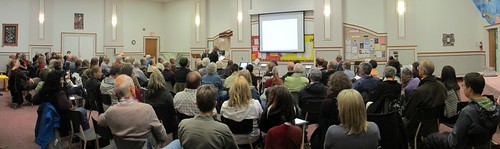
In an effort to connect City Council with constituents to discuss the Food & Agriculture Strategy, the Greater Edmonton Alliance (GEA) organized two ward meetings in advance of the public hearing on October 26. The first took place on Tuesday at the Robertson Wesley United Church, and while the councillors for wards 2, 3, 4, 6, 7, and 8 were invited, only Councillor Henderson attended. GEA officials told us that Councillor Krushell had responded and that she was unable to attend, and that Councillor Loken had responded and wanted to meet privately with GEA (he confirmed to me he is waiting for GEA to confirm a meeting, GEA has told me they want a public meeting, not a private one).

GEA Local Food Ward Meeting

The meeting was scheduled to last one hour, and GEA officials did a good job of sticking to that schedule. Unfortunately most of the hour was spent bringing everyone up-to-speed on the issue, and on GEA’s efforts thus far. We heard from Elizabeth Smythe from GEA’s Local Food Team, Debbie Hubbard, who served as GEA’s representative on the Food & Ag Strategy Advisory Committee, and Monique Nutter, Co-Chair of GEA’s Local Food Team. Monique concluded her remarks with a call-to-action for citizens and a request that Councillor Henderson respond by October 22:

Unfortunately, pressures are mounting to push decisions on this land forward quickly in a way that denies the time to explore options and, more concerning, marginalizes the voices of citizens.

We are here tonight to ask our City Councillors to work with us to ensure the Citywide Food and Agriculture Strategy provides the necessary information to enable good decisions.

Finally, we got to hear from Councillor Henderson. “I’m not the one that needs to be convinced,” he started, gesturing to the empty chairs that had been set aside for his colleagues on Council. He received a loud ovation for his attendance from the crowd.

Asked whether he felt the strategy sufficiently answered questions about what to do with the land in the northeast, Councillor Henderson responded: “I absolutely do not have enough information yet.”

In his remarks, Councillor Henderson noted that whatever support might have existed for preserving the land in the northeast back when the MDP was passed now appears to be gone. What happened? The answer might be found in a blog post by former GEA organizer Michael Walters:

The campaign to “preserve farmland” in northeast Edmonton was never an either-or endeavor. It was never about opposing development. It was about making something amazing in Northeast Edmonton.

In short, he feels the conversation has shifted from wondering where our food will come from in the future to a debate over sprawl and farmland. A debate he feels is unwinnable.

It was a strategic decision to tie the creation of the Food & Agriculture Strategy to the development of the three Urban Growth Areas. Whether that was the right strategy or not remains to be seen, but at the moment things feel far more uncertain than they did three years ago. There are some good things in the strategy and it would be a shame to see them held up or abandoned because of the land use issue in the northeast. At the same time, what other leverage do proponents of preserving the land have? The Growth Coordination Strategy has already been made much less comprehensive, and the Integrated Infrastructure Management Plan has already been approved as a “framework”, rather than as a plan of Council as originally identified.

“What happens if we delay the entire strategy?” Councillor Henderson wondered aloud at the meeting. “I’m uncertain about what happens next.”

GEA Local Food Ward Meeting

Councillor Henderson also reminded everyone in attendance that this is a regional land issue. “The essence of this is the fixation in this province with the primacy of property rights,” he said. Michael Walters notes the responsibility to deal with the issue has been floating back and forth for years:

The Capital Region Board has shown little courage in facing this question and in fact handed back the responsibility for addressing protection of farmland to the province in 2010. So for the City of Edmonton to pass this decision to the regional board cements an existing culture of timidity in dealing with this issue.

This is despite clear input to the Capital Region Board on the issue of preserving agricultural land:

In the quantitative survey, a significant majority (60 percent) of residents said agricultural lands should be preserved and protected. This support was consistent across the region.

How can we address the ongoing lack of action? How can we get City Council to pay attention? Liane Faulder says a “noisy, loud, foot-stomping and engaged” food movement is needed:

City council may well get away with doing precisely nothing of any substance to deal with the issue of urban agriculture because nobody is going to make them. There’s not a single council member who has shown any real interest in the urban food debate.

In other words, if you care about this issue, you need to get involved now!

GEA Local Food Ward Meeting

The next meeting takes place on Thursday evening at 7pm at St. Theresa’s Parish (7508 29 Avenue). Councillors Sloan and Diotte have apparently confirmed their attendance, and the councillors for wards 5, 9, 10, and 12 have been invited.

Don’t forget the non-statutory public hearing on the Food & Agriculture Strategy takes place on Friday, October 26. If you want to speak at the hearing, fill out this form.

The story of how I fell out of love with driving

When I got my current car, a 2005 Honda Civic, my Dad bought me a gas mileage book and told me to record each and every time I filled up. I have been diligently recording the date, odometer reading, number of litres, gas price per litre, and total cost of each fillup ever since. I also record notes on some fillups, such as out-of-town trips. A couple of weeks ago, inspired by Nora Young’s trip to Edmonton to discuss self-tracking, I finally decided to digitize the records. It occurred to me that this was the first bit of self-tracking I ever did. I know that I drive far less today than I did when I got the car, and I wanted to be able to visualize that. You can see the charts below, but to really understand them, I need to share a bit of history with you first.

The moment I turned 14, I was ready to get my learner’s permit. Like most guys my age I desperately wanted to drive, even if I needed to have an adult with me. I got the study guide, but didn’t spend too much time with it. As a result, when I went to write the test, I failed by one question (it was something to do with uncontrolled railway crossings if I remember correctly). I made sure to not let that happen again, and the second time I passed with no problems. I was living with my Grandma at the time, and she was great about letting me drive. Whenever we went to the grocery store or if she was dropping me off somewhere, she’d happily take the passenger seat.

I took lessons from AMA to learn how to drive a manual transmission, and took the driver’s test soon after I turned 16. With only a few minor hiccups I passed, and was free to drive on my own (fortunately I got in just before the GDL program took effect, so I had no limitations). When I was in high school, I drove a lot. I thought nothing of crossing the city to get somewhere or to drive a friend home. Gas prices were quite a bit lower at the time than they are today, but looking back it still seems incredibly wasteful how much I would drive.

When I started attending the University of Alberta, I would frequently drive. Sometimes I’d park at campus, other times I would get a ride with a friend, but most times I would park at the Stadium LRT Station and take the train the rest of the way (also handy because my office was downtown). I would sometimes take the bus, but I never made that a habit.

Shortly after I graduated in the spring of 2007, I started working at Questionmark. Our office was located near The Brick warehouse in the northwest part of the city, and I was still living with my Grandma in the southeast. That meant driving about 60 kilometers every day, and it meant driving the very busy Whitemud. I looked at taking the bus, but it would have taken about 45 minutes and required a transfer.

In May 2008, I moved into an apartment in Oliver with my sister. That cut the distance to work significantly, though I still drove every day. Roughly a year later, with our local team growing at Questionmark, we decided to move the office downtown to the Empire Building. I started taking the bus to and from work every day, because it was just a short trip (about a 15 minute ride) and I didn’t want to pay for parking.

In the summer of 2010, Sharon and I moved into our current place on 104 Street. I’m now just a short walk away from the office (Google estimates 9 minutes), which means I walk to and from work every day. As we have written before, I absolutely love it.

To recap quickly:

  • June 2005 to July 2007: I drove pretty much everywhere.
  • July 2007 to May 2008: I drove across the city to get to work every day. I regularly drove other places.
  • May 2008 to May 2009: I still drove to work every day, but the distance is much shorter.
  • May 2009 to July 2010: I took the bus to work, and drove only on evenings and weekends.
  • July 2010 to present: I walk to work, and avoid driving whenever possible.

Here’s what that behavior looks like on a graph:

distance by year

I think the four big shifts are pretty evident in that graph. Slowly but surely, I have been reducing any dependence on my car to get around.

Out of interest, here’s what that behavior cost me at the pump:

spend by year

I wish I had kept records prior to 2005, because I know the price of gas was quite a bit less when I first started driving.

What’s not captured in this data is how my attitude toward driving has changed over the years. It sounds counterintuitive, but the less time I spent behind the wheel the less I enjoyed it. I remember arguing with Sharon back in my university days about how terrible our public transit system was (she has always been a regular user). I loved driving and wanted nothing to do with the bus. Today we use the car maybe once a week, for trips to Superstore, to visit family, or to get out of town, and I regularly complain if I need to drive for pretty much any other reason. I would much rather walk or take the bus. I now find driving quite stressful! I’m sure that the shift from driving to walking has positively impacted my health. It has no doubt lowered my carbon footprint by quite a bit as well.

Also missing from the above charts are the other changes that have made my move away from the car possible. Without question, being able to use Google Maps to lookup bus routes has been hugely beneficial. Text messaging at bus stops has also made the experience of using the bus much more positive. My experience traveling in other cities has no doubt had a big impact on me as well. The are lots of things to consider.

As much as I would like to go car-free, it’s just not a very realistic option in Edmonton at the moment. I’m hopeful that will change however, and that our next car will be our last (though I recognize that other life changes may significantly affect that plan).

In an effort to better understand my behavior and potentially change it, I have been tracking my travel habits every day this year. In January, I’ll be able to show you a full year of data, including how often and how far I traveled by foot, bicycle, automobile, bus, train, plane, etc. Stay tuned!

TEDxEdmonton Education: Discussing the evolution of learning in the City of Learners

Hundreds of Edmontonians will gather at the Winspear Centre on Saturday for a special TEDxEdmonton event focused on learning.

In the spirit of ideas worth spreading, join us for a special edition of TEDxEdmonton around a conversation on how learning is evolving and impacting our schools, workplaces and industries. We’ll come together to kickstart a discussion on learning among students, educators, entrepreneurs, artists, scientists, and community leaders. How do we disrupt the status quo and replace traditional approaches to learning? How do we leave the politics of education behind to focus on impact and innovation?

TEDxEdmonton Education is open to anyone interested in the topic, and will bring a number of intriguing speakers together for what should be a very inspiring day. You’ll hear from some local folks such as Ashlyn Bernier of the Graduate Students’ Association at the University of Alberta as well as some special guests from out-of-town like Stephanie Lo, Product Manager of TED’s Education initiative. The full line-up looks amazing!

tedxedmonton education

Education is a topic I have been thinking about a lot lately, mainly from two perspectives: technology and cities. I’m unfortunately going to be out of town on Saturday, but I wanted to share a few thoughts in advance of the event.

Massively Open Online Courses

It’s shocking to me that we, more or less, teach the same way today as we have for centuries, despite incredible advances in technology. A teacher or professor in front of dozens of students in a classroom is typically the image that comes to mind when we talk about teaching and learning. Is that really the best we can do?

I was inspired recently by Daphne Koller’s TED Talk in which she discusses the emerging trend toward online education. She’s a co-founder of Coursera, which is one of the popular new platforms for MOOCs – massively open online courses. Coursera, edX, and other platforms are enabling a really interesting new way of learning. Instead of a few hundred students in a classroom, these online courses bring potentially hundreds of thousands of students together from all over the world. There’s still a professor and there are still lectures (delivered via video on-demand) and there are still readings, but there’s a lot that is different too. For starters, they’re free!

Here is Daphne’s talk:

I decided to take a course to experience first-hand what a MOOC is like. I signed up for the Introduction to Sustainability, taught by Jonathan Tomkin from the University of Illinois. There are lots of reasons that people might take this course – maybe they’re looking for academic credit, maybe they’re looking to advance their careers, or maybe like me they are just interested in the topic. I admit I haven’t been keeping up with the course as well as I should have, but already I have gotten a lot out of it. One of the most interesting things to me is the “How to Pass the Class” page, which states:

I recognize that this is no ordinary course. You may have different perspectives and different goals for this course than some of your peers or than I could have anticipated. Therefore, I want to empower you to customize this course to meet your needs. To this end, I have designed multiple “badges” you can earn through participation in this course.

Here’s a look at those badges:

coursera pass the course

This is great! If you want to take the “traditional” approach, you can simply do all the quizzes. But there are other options now. I like the idea of doing a project, because it provides an opportunity to really apply what you’ve learned. Most interesting of all are the forum badges – you can pass the class simply by interacting with your peers. I say simply but that’s probably not the right word because I think there’s an incredible amount of learning that can happen through that interaction. Some students have even formed in-the-flesh study groups in their cities!

I don’t know if MOOCs are the future of learning, but so far I like what I see.

City of Learners

As you may know, Edmonton has been declared a City of Learners. Through the Edmonton Learning Initiative, the City is trying to make lifelong learning a core value of our community. The initiative has adopted UNESCO’s four pillars of education:

  1. Leaning to know – understanding how we learn
  2. Learning to do – emphasis on the knowledge component of tasks
  3. Learning to live together – educate to avoid conflict or peacefully resolve it
  4. Learning to be – the complete development of the mind body, intelligence and sensitivity

These are quite broad of course, but so is learning!

Thinking about the education system more specifically, we can see from the 2012 Municipal Census that roughly 24% of Edmontonians were identified as students. Here’s the breakdown by level:

edmonton students

Edmonton has long been recognized as a leader in public education, and Edmonton Public Schools has been singled out as a model district. It’s encouraging to see achievement results that show the continued success of EPSB’s approach. I’m also a big fan of initiatives like City Hall School, which provides Grade 1-9 students with the opportunity to learn more about how the city works. It has been a big success, so perhaps we should consider expanding it to other levels? Fieldston’s City Semester in New York sounds like the kind of course I could only have dreamed about in high school.

The University of Alberta has a publicly stated goal to become one of the top 20 universities in the world by 2020, and while that sounds audacious it also seems attainable. Edmonton is fortunate to have a number of great post-secondary institutions, and we should not take that for granted. Here’s just one post on why universities matter so much:

Universities appear to function as an important social leveler. Nations with larger numbers of great universities have lower income inequality (with a negative correlation of -.475 between the two). And universities are part of the mix of institutions that lead to higher levels of happiness and well-being across societies.

There are all kinds of reasons that having strong educational institutions here in Edmonton will make our community stronger, but is education also something we could be exporting to other places? This post by Avnish on Alberta’s labour shortage proposes a really interesting idea:

In an era where governments are scaling back funding to post-secondary education, India presents itself as a lucrative opportunity. Alberta’s colleges and universities can make up funding shortfalls by expanding into India, with its large market, significant growth potential, and cheaper start-up and operating costs.

The argument is that we could tap into India’s labour pool with this approach.

One of the biggest reasons to think about education in relation to cities is the economy. Edmonton enjoys one of the lowest unemployment rates in the country, hence the labour shortage referenced above. We need trained, skilled workers not only to fill the jobs we currently have available, but to create new ones too. We’re in a resource-based economy, but attracting and inventing new industries will be important for our long-term viability. It can be tempting to equate the “creative class” with education, but Richard Florida cautions against that:

The creative class is not just a proxy measure for college graduates. Roughly three-quarters of college grads in America work in creative class jobs, but four in ten members of the creative class—16.6 million workers—do not have college degrees.

They may never have been college students, but they’re absolutely learners.

There are just so many aspects of education in relation to the city that could be explored! I’ll leave you with part of Council’s declaration:

As a City of Learners, we celebrate the excellence our community has already achieved in learning, and we set our sights on even greater success for individuals, institutions, industry and our city as a whole. The challenges of a complex and competitive world demand nothing less than conceiving of learning as an organizing principle in our community.

TEDxEdmonton Education

I can’t wait to hear about all of the interesting ideas and conversations that come out of TEDxEdmonton Education this weekend! Tickets are $99 and that includes a full day pass plus lunch and snacks. The official after party is Edmonton’s fourth Timeraiser, a unique art auction where you bid in volunteer hours.

Ticket Giveaway: Edmonton Comic & Entertainment Expo

Adam West. Billy Dee Williams. Charisma Carpenter. These are just a few of the special guests you’ll find later this month at Edmonton’s premier pop culture show, the Edmonton Comic & Entertainment Expo. This new event grew out of a partnership between the Edmonton Toy & Comic Show and the Calgary Expo:

Whether you’re a connoisseur of sci-fi, horror, gaming, fantasy, animation, toys, and comic books, or you simply have a keen interest in pop culture, then this is the show for you. The Edmonton Expo will feature vendors, exhibitors, celebrities, and artists, from every nook and cranny of the pop culture universe, not to mention the many hours of fantastic programming included with admission.

The event takes place on October 20 and 21 at, appropriately, the Edmonton Expo Centre. Check out the detailed schedule here. You can see the event on ShareEdmonton here.

Ticket prices range from $15 for a single day to $150 for a VIP pass and are on sale now at Ticketmaster. I was fortunate enough to be contacted by the show’s PR folks recently with some tickets to give away! Here’s what is up for grabs:

A family pack of Edmonton Expo tickets (2 Adult tickets and 2 Children ages 10 and under) and priority seating at the Whedonverse Panel, where Sean Maher and Charisma Carpenter will lead a discussion on what it has been like working within the Whedonverse and the benefits their careers have had working beside legendary writer, producer, and director Joss Whedon.

To enter the contest, simply leave a comment below identifying an “Edmonton superhero”. It can be a real person or a character you make up!

Entries will be accepted until 11:59pm on October 17, 2012. I will contact the randomly chosen winner by e-mail by October 18, 2012.

Good luck!

Media Monday Edmonton: Righting the ship at the Edmonton Journal

After a year full of change, the Edmonton Journal of 2013 and beyond will be a very different newspaper than the one you’ve come to know. In fact, if the transition goes according to plan, you won’t think of it as a “newspaper” at all. Instead you’ll think of it as “the most valued source of information about our community…accessible when and where our readers want.” That’s the Journal’s vision statement, and its leaders would suggest that the changes made over the last few months were all in support of that goal. While that may be true, there’s also the business reality of being owned by a larger organization that continues to lose millions of dollars every quarter in an industry undergoing dramatic change. With a leaner organization and a greater focus on increasing revenue, can the Journal (and Postmedia) really turn things around?

Edmonton Journal

“Everyone agrees the old business model for newspapers is challenged,” says Edmonton Journal Editor in Chief Lucinda Chodan. “No one has figured out an alternative that allows us to pay a large newsroom full of journalists good wages to continue to do fine contextual journalism that sheds light on important local, national and international issues.” The truth is, we have never really paid for the news. As usual, Clay Shirky sums it up well: “We have, at most, helped pay for the things that paid for the news.” Newspapers produced bundles of content and sold ads against that content, but the realities that allowed that to work in the print world no longer exist in the digital world. “Newspapers, as a sheaf of unrelated content glued together with ads, aren’t just being threatened with unprofitability, but incoherence,” Shirky wrote.

Solving that problem is not trivial, and it’s harder still when the business needs to continue to operate. That has led to the deep cuts at newspapers all over North America. Here in Canada, Postmedia hopes to cut spending by $120 million over the next three years, and it has made changes across the chain in an effort to do just that. In August came one of the biggest yet: all of its newspapers now use shared pages built at a central facility in Hamilton for non-local content. Instead of each newspaper selecting and editing national and international stories, they’ll all print the same thing. The initiative, dubbed OneTouch, meant the loss of 20 full-time equivalent jobs (FTEs) at the Edmonton Journal.

We’ve seen a number of other changes happen here in Edmonton already this year. In June, the Journal stopped publishing the TV Times, which resulted in numerous complaints and the direct loss of 96 subscribers. Starting July 1, the Journal dropped the Sunday edition. As of the end of August, that had resulted in the direct loss of 320 subscribers and many more complaints. And while the impact of the stoppage of rural home delivery is hard to quantify, it could be significant (the paper is still available in grocery stores, gas stations, and other locations in rural areas). In August, the Journal announced it would outsource the actual printing of the newspaper to Great West Newspapers, starting in 2013. A total of 70 full-time jobs would be cut as a result.

In September the Journal’s six-day average circulation was 95,706 (total of everyone who bought a paper, subscriber or otherwise), so while the number of actual subscribers lost as a result of the changes seems relatively small, the impact on headcount has likely had a much larger effect. Both Cam Tait and Nick Lees are no longer full-time employees, though both are writing weekly columns. Ed Struzik is another recently departed member of the newsroom, after he requested a buyout. Those are just the most recent names you recognize to leave, however. Dozens of former staffers are gone, and that has likely had a very real psychological effect both inside and outside the organization.

More changes are on the way. Fortunately, it sounds as though most others will be focused on increasing revenue rather than simply cutting costs. Yes, you might soon find yourself paying for content that was previously “free”. In August, four of Postmedia’s newspapers launched paywalls. “You can’t spend millions of dollars on content and just give it away,” Postmedia chief executive officer Paul Godfrey said. A paywall here in Edmonton is virtually guaranteed, and will launch sometime this fall according to Chodan.

Another big change on the way is “product differentiation.” The key here is for the Journal to stop thinking of itself as a newspaper, and instead as a news organization utilizing a variety of platforms, print being just one of them. That should enable it to take advantage of the opportunities provided by each platform – there are things you can do with a tablet that just aren’t possible on paper. I don’t think the printed newspaper will ever go away completely, just as vinyl records have not vanished, but there are big advantages to this strategy of treating print as just another platform. You might pay more for a tablet application that brings you interactive features, for instance.

It’s an example of how the Journal is becoming more deliberate about finding new revenue streams. This doesn’t mean you’ll see sponsored news articles, however. “We don’t expect our journalists to build revenue into their considerations when they are gathering and disseminating news,” Chodan says. Instead, think of e-books and other non-newspaper products. “Many newspapers are now creating new revenue streams around (often primarily digital) content that has high reader interest, good journalism and revenue attached.”

The Journal took a big step down this path over the summer with the launch of Capital Ideas. The goal is to bring local entrepreneurs together to share what they know, and so far the events have been well-received. Generating revenue from that effort hasn’t been a focus yet, but that’ll have to change eventually. If it works, Capital Ideas could become a model for other Journal-led projects. “We are examining the ways that we can add value to readers’ lives…then figuring out how to make the financials add up,” Chodan said.

Edmonton Journal Building

There’s no guarantee that any of these efforts will bear fruit, of course. We have seen past initiatives fail to deliver, most recently The Bridge. If the new projects don’t turn out well, there’s always the possibility of additional cuts, either to staff or to the six-day print schedule as we have seen elsewhere. For instance, September 29 was the final daily edition of The Times-Picayune in New Orleans. It now prints just three days a week, a widely-discussed change that led to a number of protests. It’s a reminder that things could get worse before they get better.

Without question we’ll look back on 2012 as a difficult year for the Journal, with job cuts and other big changes, but there is reason to be optimistic for the future. “If you count all platforms, readership of newspapers has never been higher,” Chodan said. “It’s just a matter of monetizing that readership in some reasonable fashion.”

The question is, can the Edmonton Journal figure out the monetization puzzle before it’s too late?

Edmonton Notes for 10/7/2012

Happy Thanksgiving! Here are my weekly notes:

Good Morning YEG
Foggy Morning in Edmonton by Darren Kirby.

Here are some upcoming events:

rainbow ramp
Rainbow Ramp by trav

Why hasn’t there been any public involvement for the Growth Coordination Strategy?

One of the most important sections in The Way We Grow, Edmonton’s Municipal Development Plan, is the one that deals with the Growth Coordination Strategy. It is section 3.1 that earned the document the nickname “The Way We Sprawl” for specifying that just 25% of housing growth should happen in mature neighbourhoods. That shortcoming aside, the section is important because it aims to make land development in Edmonton more sustainable, predictable, and strategic. Section 3.1.1.6 explains the purpose of the Growth Coordination Strategy:

Develop a growth coordination strategy to address timing and phasing of new residential growth in developing and planned neighbourhoods. The strategy will relate to the City’s strategic goals, current and future public infrastructure investment, long term financial sustainability and the amount, location and pace of population and employment growth; and will establish:

  • Expectations for completing developing neighbourhoods
  • Expectations for initiating new Neighbourhood Structure Plans

Another important point is found in section 3.1.1.10:

The Growth Coordination Strategy will address demand for land, housing units, and housing choice at the regional, city-wide and sector level.

You might find the topic kind of dry but make no mistake, ensuring Edmonton can “manage future public obligations and growth opportunities” is of great importance to our city.

Edmonton from Above
Photo by Dave Cournoyer

Despite the importance of the Growth Coordination Strategy, there are just two full-time employees at the City working on it and thus far there has been no official opportunity for public involvement. The first public draft (version 6) of the strategy (PDF) was released in May, but I understand based on conversations with City employees that that is not the same document slated to go to Council in November. A new draft is currently under development that reduces the scope of the strategy, primarily by stripping it of any objective related to infill development. A similar document focused on mature and developing areas would be left to an as yet unplanned and unfunded follow-up project. That means that Council will be considering a document that no citizen has had the opportunity to provide input on, not to mention one that does not seem to meet the requirements specified in the MDP.

No one I talked to knows (or refused to say) why the timeline for this strategy was set so aggressively. There is no doubt in my mind that powerful, well-funded behind-the-scenes lobbying has taken place. After all, without the Growth Coordination Strategy, Food & Ag Strategy, and Integrated Infrastructure Management Plan, new development in Edmonton’s urban growth areas cannot take place. Furthermore, we know from the January 26, 2011 Executive Committee meeting (see this report) that the “discussions began between Administration and Industry on the content of the Growth Coordination Strategy” as early as July 2010.  I think that pressure from “Industry” partially explains why there hasn’t been any public involvement, but it doesn’t explain why the City has put so little funding into the development of this important document.

The Calgary Approach

Calgary has a number of similar documents and initiatives underway. One is called Geodemographics but the big one appears to be the Corporate Framework for Growth and Change:

The Corporate Framework for Growth and Change will guide the future sequencing of growth in Calgary to ensure investments in infrastructure and services are within the financial capacity of The City. The Corporate Framework for Growth and Change is an integral part of Calgary’s Municipal Development Plan (MDP) and growth management.

Note both the timeline and frequency of public involvement for the development of that document. It began in February 2011 and the first public involvement opportunities – a series of stakeholder meetings, plus a blog post open to public input – took place in September and October of that year. A series of stakeholder meetings and forums have been hosted throughout 2012. To be fair, Calgary took a different approach, with Council approving a set of principles early on and the rest of the project unfolding in four phases, but the fact remains that a significant amount of public involvement has taken and continues to take place.

Another thing to note about Calgary’s project – there are at least ten individuals working on it:

A team from across City Departments called the Corporate Growth Management Project (CGMP) team, has been assembled to create the Framework for Growth and Change.

Edmonton and Calgary both pay lip service to managing growth, but only Calgary seems willing to back that up with the necessary funding.

Designing New Neighbourhoods

In contrast to the Growth Coordination Strategy, the Designing New Neighbourhoods project has unfolded much more predictably with multiple opportunities for public input. The outcome of that project is a set of guidelines for Edmonton’s new neighbourhoods. Section 4.1 of the MDP directed the creation of these guidelines, but unlike the Growth Coordination Strategy, technically nothing depends on their existence.

The draft guidelines are slated to go to Council “in early 2013” and already a number of public involvement opportunities have taken place. In May, there was a series of blog posts and an IdeaScale site was created to harvest ideas from citizens. The project team also encouraged the use of Twitter to suggest ideas, a positive step for public involvement at the City!

Importantly, the project also has a Design Team that is “made up of a diverse group of about 30 people from the local development, urban design, and home building industries, as well as members of the City’s Administration, the Edmonton Federation of Community Leagues, Edmonton’s Schools Boards, and the University of Alberta’s City-Region Studies Centre.” That same post talks about the inclusion of external consultants too.

The City of Edmonton’s page on Public Involvement states:

The City of Edmonton is committed to involving the people affected by the decisions it makes. We seek diverse opinions, experiences and information so that a wide spectrum of information is available to decision makers.

Designing New Neighbourhoods seems to meet that commitment, but unfortunately, the Growth Coordination Strategy does not.

The Ongoing Abatement of Section 3.1 of the MDP

I’m very concerned that the potential impact of Section 3.1 of the MDP has been continually eroded over the last two years. In February 2011, City Council passed a motion (item 6.16) that redefined eight Neighbourhood Structure Plans from “new” to “existing” which means they are no longer subject to the completion of the Growth Coordination Strategy and other documents. Futhermore, it authorized the preparation of six other Neighbourhood Structure Plans.

Only Councillors Henderson, Iveson, and Sloan opposed the motion. In his remarks on the motion, Councillor Henderson said “I really do think this is an undermining of what we passed in the MDP” and that “our tools to deal with how we grow and when we grow in this city – we’re giving them away.”

Why did this happen? It’s not as though Edmonton is running out of places for people to live. Prior to the motion in February 2011, there were 41 Neighbourhood Structure Plans approved (between 1984 and 2010) and at various stages of development. Together, those plans have a planned capacity of 116,000 resident units yet just 19,000 units have been developed. That means 84% of the development in those areas is still outstanding. There should not be such a rush to develop new land.

Again, I think politics are at play. Our current City Council has been good to the development industry, but with a new Mayor and Council slated to take office next fall, there’s no guarantee that will continue. Better to get as much approved now as possible, if you’re in the land development industry. Unfortunately for citizens this means our city continues to sprawl, more or less free of any restrictions. Sooner or later the cost of that sprawl is going to catch up with us.

Rethinking Public Involvement #1

How can we get more Edmontonians involved in municipal issues? How can the City improve the way it informs and involves the public? This is the first in a series of posts on that topic.

I have been thinking extensively about Public Involvement lately (the City’s official term for public consultation, community engagement, stakeholder participation, etc). I try to keep on top of the various public involvement opportunities that are running at any given time, and have completed my share of surveys, feedback forms, and have attended many open houses and other events. It’s important to me to remain informed, but also to be able to provide input on issues that I care about. I feel a responsibility as a citizen to take some initiative and to get involved.

In the past I have been critical of the City’s public involvement efforts, and I still think there’s a lot of room for improvement. The Public Involvement Handbook (PDF) could do with an update – it was last modified in 2008. Improved consistency with vocabulary would make a huge difference – right now “open house”, “public consultation”, “information session”, and other terms are used interchangeably. A new or improved online consultation manager would also be positive – it lacks many of the features that would make public involvement easier to follow, such as iCal or email subscriptions/notifications. Those are all minor suggestions though, and I think the City needs to make more fundamental changes to really move the needle on this issue.

“What’s the purpose?”

I don’t think the answer to this should be “to inform citizens” nor do I think it should be “to gather input”. I think the purpose should really be tied to the project outcome. Are we building a bridge? Then the purpose of the public involvement is to build the best bridge possible. Informing citizens about the project and gathering input are two of the ways we’re going to achieve that.

I think this approach to defining the purpose scales up to the City level too. Why does the City conduct public involvement? To make Edmonton the best place to live, work, learn, and play.

“What’s the context?”

In my experience, this is missing from nearly every single public involvement opportunity the City conducts. Take a public involvement event focused on the Downtown LRT Connector, for instance. It will have all sorts of information about the Connector itself, and maybe even a little about the larger LRT Network Plan, but very little if anything about other projects related to or happening around the Connector. Nor will it include any history about projects that have happened in the past. There’s no context! I know that focusing the public involvement activity is important, but citizens need to be able to understand where the project fits into the grand scheme of things and why it matters.

“What have I missed?”

For most projects, public involvement activities take place over months or years. That means that citizens may be coming into them at different points and with varying levels of knowledge/experience. Despite this, I find that most public involvement activities make it difficult for citizens to get involved later in the process because there are a lot of assumptions made about what has already happened. Some work has been done recently to address this – I like the timeline graphic the Transportation folks use:

Project Lifecycle

This makes it easy to think about the status, where are we in the timeline, but it still doesn’t help a citizen who wants to get involved at the Design phase understand what has already happened and how they can best dive in. In addition to clearly identifying “where we are” there needs to be a way for citizens to quickly find out “what you missed”.

While there are many improvements that could be made to the way the City conducts its public involvement activities, I think addressing these three fundamental questions would make a big difference. I don’t think we should throw out what already exists either, because there’s a lot of solid foundational work there, but I do think we can and should work to make it better.

Despite clear public input, Edmonton’s draft Food & Agriculture Strategy lacks recommendation to preserve agricultural land

The City of Edmonton released the draft of its Food and Urban Agriculture Strategy yesterday. The 94 page document is called “fresh” and is labeled “version 3”. I’ll be digesting it (and the other 8 associated documents) over the next week or so, but I wanted to share something that I noticed right away. Despite clear public input that Edmonton should preserve agricultural land, the strategy makes no such recommendation. Instead, a “framework” is provided to aid City Council in its decision.

As I wrote back in July, the contentious part of the strategy relates to land use and the preservation of agricultural land within city limits, particularly in the northeast. Deciding what to do with municipal land should never be easy – we should be forced to seriously consider options to make the best decision for the city. Ultimately the decision rests with Council, but I’m disappointed that given the clear feedback on this issue from the public, the Advisory Committee responsible for the strategy chose not to make a clear recommendation.

Section 5.9, under the heading “The Complexity of Issues”, reads:

The Direction to Integrate Land for Agriculture was the most difficult the Advisory Committee tackled. The Committee agreed that some prime agricultural land must be protected for future use and generations, identifying that a need exists for food production within Edmonton. At the same time, Committee members agreed that given the diverse interests represented across the Committee, it could not, and should not be the body to determine how much land should be protected versus developed in specific locations in the Urban Growth Areas. These decisions should be made through existing regulated processes by City Council.

A recommendation is very different than a Council vote. There’s no way the Advisory Committee could have been “the body to determine how much land should be protected versus developed.” Its recommendation to “treat food waste as a resource”, for example, does not detail the specific amounts of food waste that should be dealt with, so why would the Advisory Committee be expected to detail the amount of land to be preserved? The rationale for avoiding a clear recommendation on this issue leaves me unsatisfied.

The Advisory Committee was made up of “fourteen citizens from different parts of Edmonton and with different interests in the food and agriculture sector.” I suppose it should be no surprise that farmers and land developers would differ over what to do with a piece of land. Stakeholders and other citizens were much less divided on the issue, however. Let’s take a look at some of the other documents that were released alongside the draft strategy.

First, we have the Public Opinion Survey Report. It outlines the results of the survey the City ran from June 4 to June 23 (a total of 2,269 people participated). In the open comment box in the section on growing and producing food, the feedback was clear:

“…a number of clear themes emerged, the most emphatically expressed being to preserve arable land, particularly in the Northeast corner of the city.”

Of the 1388 people that left additional comments, 349 or 25% mentioned the importance of preserving municipal agricultural land, the largest of any theme.

Next we have Stakeholder Group Summary for Round 1 and Round 2. In the first round, there were “differing opinions about land use when it comes to agriculture in the City” with passionate arguments on both sides. The second round was much less ambiguous. “The vast majority of respondents agreed that providing land for growing food was a sound direction for Edmonton.”

Finally, there’s the Citizen Panel Report. The sixty-six panelists settled on ten “best of the best” strategies and in their cover letter encouraged City Council and the Advisory Committee to begin implementing them as recommendations. Their top two both deal with preserving agricultural land:

Strategy 1: Create and/or amend zoning, bylaws, fees, and taxes to prohibit developments on good fertile agricultural land, particularly the northeast farmland.

Strategy 2: Maximize spaces and places within the City of Edmonton for urban growing and food production. Develop systems for permanent and ongoing identification, inventory, and assessment of urban spaces for urban growing. The inventory includes identifying the water and soil suitability for a variety of local crops. Create accountable and objective monitoring.

There was a quite a range of participants on the panel, both in terms of age but also background. As you might expect, there were differing opinions on many issues, but the importance of preserving agricultural land was much less controversial:

Panellists were not always in agreement and throughout the Citizen panel there was in depth discussion, dialogue and areas of disagreement. However, the panellists did agree to put forward the overall strategies as outlined in this document. They also clearly articulated a critical need for political will and leadership on issues related to food and agriculture, and the importance of using municipal policy tools to protect existing agricultural land within Edmonton’s city boundaries. Participants also repeatedly expressed, in the strongest possible terms, their desire to see these recommendations treated as high-priority action items.

From the online survey to the stakeholder groups to the citizen panel, the feedback is clear: preserving agricultural land within the City’s boundaries is important. It’s too bad that a clear recommendation to reflect that is not found in the draft strategy.

The draft strategy will be discussed at a non-statutory public hearing on October 26, and you’re encouraged to provide input before that date. There are two open houses taking place this week, downtown on Wednesday and in Old Strathcona on Thursday, and so far they are the only two opportunities to learn more about the draft strategy. You can provide input at those events, by filling out the online survey, and of course by contacting your Councillor at any time.

Here is some other reaction to the draft strategy that you should read: