Expanding the Shaw Conference Centre (again)

The Shaw Conference Centre is once again in the news. City Council’s Executive Committee will receive a report tomorrow that suggests the facility needs to be expanded. That recommendation should not be a surprise. On July 22, 2009, City Council passed this motion:

That Edmonton Economic Development Corporation prepare for Council’s approval a long-term (30 – 40 year) development plan to address the needs of the convention market in Edmonton.

If you ask EEDC what should happen with the convention market, of course they’re going to focus on the facility that they operate.

Shaw Conference Centre

The Edmonton Journal’s editorial board published a piece on the issue today. Here’s the key paragraph, in my opinion:

But there are plenty of reasons for caution. Taxpayers have just spent $150 million to expand Northlands’ rival convention and trade show facility, the new Expo Centre. Is there really an economic case to be made for two competing super-facilities, each publicly funded, run by two competing civic agencies?

Competition is a generally a good thing, but increasingly I find myself wondering why we have both Northlands and EEDC. Two organizations, both largely funded by taxpayers. If they weren’t competing, would things have turned out differently? Would the above recommendation have been different? Would we still have gone ahead with the Edmonton Expo Centre when we did? The success of that facility, which is still being paid off, has been questioned by many. Though as the City’s Chief Economist told me, that skepticism might be a little unfair. “It was developed and then we ran into a sour economy. You need to give them a full business cycle.”

Here’s what the current breakdown of rentable convention space looks like in Edmonton, according to the report:
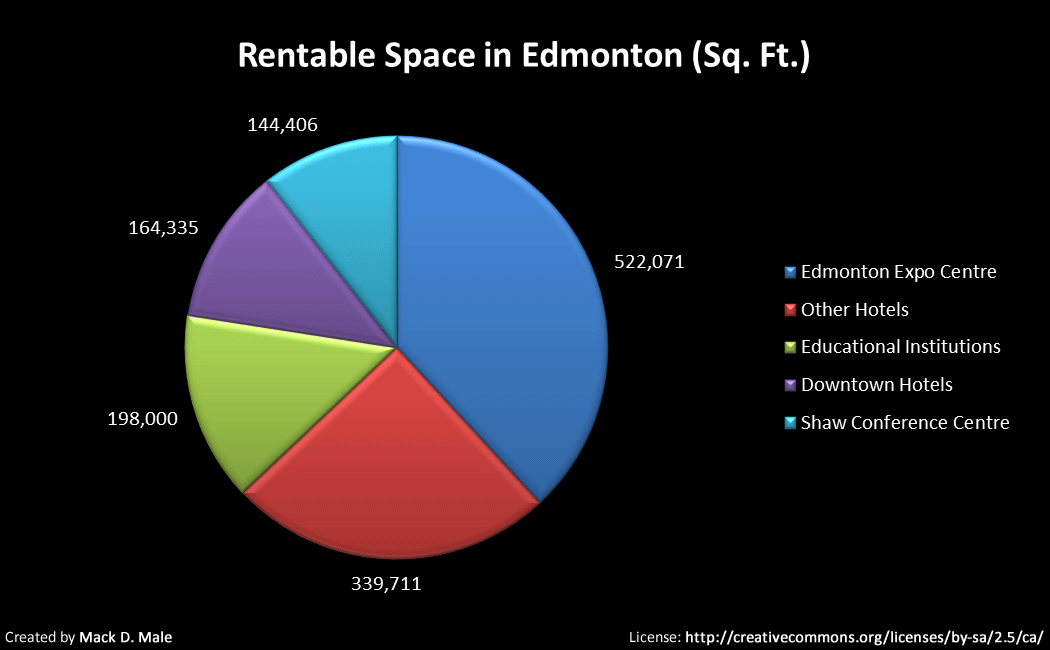
There’s no denying that the amount of space at the Shaw Conference Centre (SCC) is significantly less than at the Expo Centre. But that alone is not reason enough to expand the facility. Here are the most up-to-date statistics on SCC usage, provided to me by EEDC:

  • In an average year, SCC receives 330,230 visitors (based on the last five years). A visitor is a person who has attended a function at SCC.
  • The split in visitors is roughly 70% regional versus 30% non-regional.
  • There are 20 to 25 days per year where SCC has no or the least number of bookings.
  • Using 2006 as a typical year and defining 75% occupancy as full, SCC was fully booked 115 days out of the year.

Compared to a few other Canadian conference venues, SCC’s visitor stats stack up quite nicely:
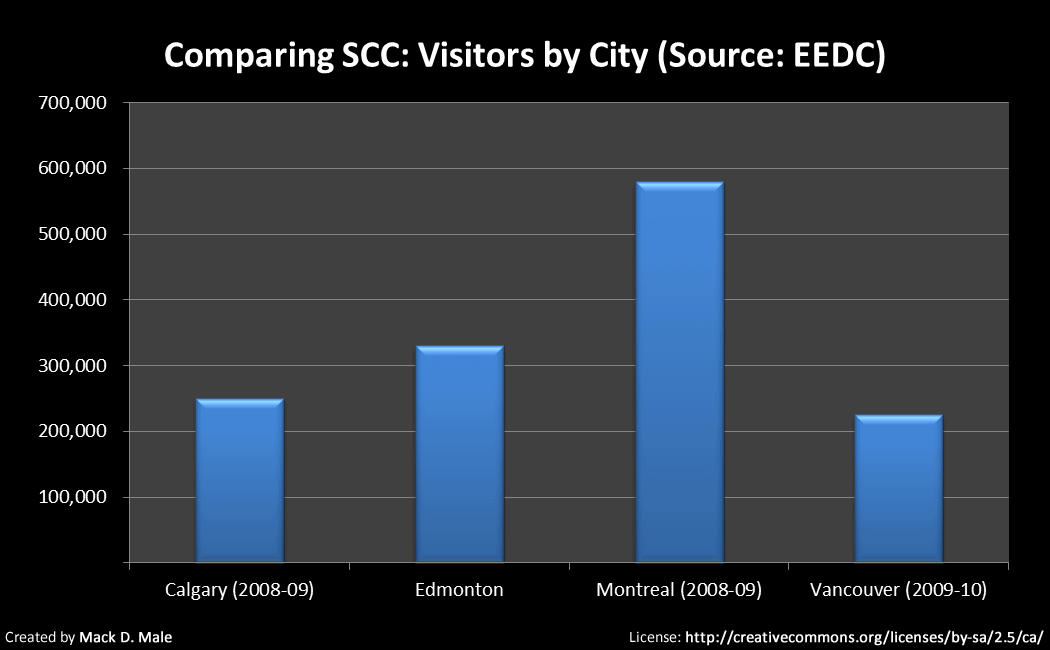
I’m not sure exactly which facilities they were comparing with, but clearly SCC is being used. EEDC says that over the last two and half years, it has turned away approximately 40 conventions and trade shows for future years. And apparently none of those have decided to go with the Expo Centre instead, which should have had the necessary space, presumably because they wanted to be downtown.

If we’re going to add more convention space, I think downtown is the place to do it. But I agree with the Journal’s position, “it’s also important that we not simply assume that if we build it, they will come.” So I guess I am left with a few key questions:

  • Why was the Hall D expansion so limited? If we got the forecasting wrong then, are we going to get it right this time? Are we really looking ahead 30 years?
  • Is expanding SCC really the best way to add more convention space downtown?
  • Despite the lip service paid to cooperation in the report, can Northlands and EEDC really work together to grow Edmonton’s convention market?

The next steps outlined in the report include finalizing the business case for the expansion. According to EEDC’s own backgrounder, the earliest an expansion would be completed is at least seven years from now.

Aside #1: Think back to 2004 and consider all of the technology that didn’t exist. Will large conventions as we think of them today still happen in 2018?

Aside #2: The report contains what might just be my least favorite phrase ever: “Festival City in a Box”.

Aside #3: It turns out I have an Edmonton Journal article on my desk from September 12, 1963 (I’ll explain later). Apparently we held just 42 conventions in 1962, far behind Toronto’s 657, Calgary’s 172, or even Regina’s 57. Even Moncton had more conventions than we did at 48. Our conventions in 1962 attracted 17,932 visitors who spent a total of $1,869,000, or $104 per person.

ONEdmonton Downtown Vibrancy Task Force letter to City Council regarding the Proposed Downtown Edmonton Arena and Entertainment District

ONEdmonton is a group of local leaders that have come together a few times over the last year to discuss how we can make Edmonton one of the world’s top 5 mid-size cities. The first subcommittee, called the Downtown Vibrancy Task Force, was launched in November after the larger group identified that our urban core is the top priority. I have been fortunate enough to be part of both groups.

Today, our task force sent a letter to City Council regarding the proposed Downtown Arena and Entertainment District:

The task force is a group of majority, not consensus. At the last meeting, the majority of the task force members voted the arena project as the top near-term priority in Edmonton’s downtown.

The task force members include: Chairperson Randy Ferguson (Procura), Bob Black (Katz Group), Dr. Paul Byrne (MacEwan), Carolyn Campbell (University of Alberta), Michael Janz (Public School Trustee, EFCL), Terry Kilburn (Avison Young), Bernie Kollman (IBM Canada), David Majeski (RBC), Mack Male, Doug McConnell (Dialog), Scott McKeen, Honourable Anne McLellan (Bennett Jones), Carol Neuman (Edmonton Next Gen), Simon O’Byrne (Stantec), Ian O’Donnell (Downtown Edmonton Community League) Keith Shillington (Stantec), Paul Verhesen (Clark Builders), Sheila Weatherill (EPCOR), Richard Wong (Sutton Place Hotel), and Ralph Young (Melcor). Representatives from EEDC facilitate the task force.

I don’t think anyone on the task force considers the arena project a done deal, nor do they think the issue is a simple one, and this is reflected in the letter. My read of what the task force is saying here is this: there’s potential with the arena project to positively impact our urban core, so let’s keep things moving and figure out how to make that happen.

UPDATE: I originally left out Ian O’Donnell and Sheila Weatherill, because they joined us after the first meeting. My mistake. EEDC has posted the list here.

Recap: ONEdmonton Leaders Forum #2

Yesterday morning was the second ONEdmonton Leaders Forum, hosted by EEDC at the Shaw Conference Centre. After a good experience at the first one, I was excited for another opportunity to chat with everyone and eager to see if the organizers would indeed make more time for that. EEDC Board Chair Henry Yip and EEDC President Ron Gilbertson gave very brief introductory remarks, and we got down to business.

Our moderator for the day was Anne McLellan. She started by presenting the following question (I’m paraphrasing a bit):

What are your top five opportunities, challenges, and priorities for Edmonton as we work toward becoming one of the world’s leading mid-size cities?

She then numbered everyone off into 8 groups, and we started discussing. For about half an hour, groups talked amongst themselves, with each member having the chance to share their top 5 issues (or less). This exercise was something I was prepared for, given my Pecha Kucha 7 talk, so I started in my group. Here are the three I shared:

  1. Density
  2. Storytelling
  3. Creative Economy

I added “Living Local” after everyone had shared their issues, and I agreed with most of the table who mentioned EXPO 2017. There were some other duplicates, but I wrote down over 20 things from our group alone. It was a great discussion and it was really interesting to hear where everyone was at. Some of the more memorable things mentioned at my table were “winter city”, “homelessness”, and “waterfront development”.

During a short break the organizers tallied up all the lists to identify the overall group’s top 10 opportunities, challenges, and priorities. Here’s the result (issue with percentage of the group that identified it):

  1. Downtown revitalization (46%)
  2. Crime (29%)
  3. Education / R&D (29%)
  4. Transportation / Infrastructure (25%)
  5. Homelessness (19%)
  6. Brand / Identity (19%)
  7. River Valley Development (17%)
  8. Regional Partnerships (15%)
  9. Promoting the city (15%)
  10. Aboriginal Integration (14%)

A moderated discussion followed, which of course felt like it wasn’t long enough. A few really good comments were made. One I’ll share was from Homeward Trust Executive Director Susan McGee, who said that language is important, and that the word “integration” in #10 on the list probably was not the best choice of words. I thought it was a great point.

Crime & Safety

We finished off the morning with a presentation from EPS Deputy Chief of Police Norm Lipinski. He shared some really great information about the EPS approach, as well as some positive stories about crime in Edmonton. Here are the EPS objectives:

  1. Reduce Crime
  2. Reduce Disorder
  3. Enhance Traffic Safety
  4. Maintain Public Trust

Some of the ways they accomplish those objectives are through community policing, hot spot management, offender management, and business practices. He mentioned the broken window theory, and said he was a big fan of having a visible presence. Norm’s takeaways were that overall crime is down in Edmonton over the last three years, that the rate of solving crime is up, and that we have a top tier police service (also a very young police service). He finished with a funny slide comparing his appearance to that of Kevin Bacon (the resemblance is uncanny). A discussion followed his presentation but I had to leave so I missed it.

I thought the second ONEdmonton forum was great – kudos to EEDC for acting on the feedback for the first event to make this one a success. I look forward to the next forum, where we’ll hopefully start trying to address the execution side of becoming one of the world’s top five mid-size cities.

Edmonton IT Community: What are your top 5 needs?

Along with a few other usual suspects I’ve been invited to take part in an informal IT Circle later this week. The goal is to come to some consensus about what the top 5 or 10 needs of local startups and growing IT companies are, so that we can start trying to address them. I feel very strongly that we need to be doing more for the tech community in Edmonton, particularly the part of the community that is often overlooked – web & software. I’ve written about this in the past, most notably here.

The meeting is being hosted by EEDC, who I openly criticized in that post. I’m encouraged by the progress I’ve seen them make over the last six months – I think they’re really making an effort to listen, to learn, and slowly to participate in the community. I hope to see that trend continue, through this meeting and other initiatives.

So now I need your help. If you’re a member of the local IT community, whether it’s biotech, public sector, startups, or something else, what are your top needs? What’s on your wishlist? How can we make the tech community in Edmonton better? Let me know, and I’ll bring that to the table this week. Thanks!

FWIW, here are a few on my list:

  • Micro/seed funding. Small amounts of money to enable entrepreneurs to try things out.
  • Exposure to external experience. How can we connect with people who in other places that could teach us a lot?
  • Storytelling. I talk about this a lot…how can we do a better job of telling local success stories to others?

In Search of the Northern Lights by way of Edmonton

As I mentioned back in January, I’ve been doing a little work for EEDC, hosting travel media when they come to visit Edmonton. Usually it’s just a casual lunch, which I really enjoy – I get to learn a little about where they’re from and they get to ask me anything about Edmonton! The only thing I don’t like about the experience is that I don’t always get to see the result of their trip (because the article or video or audio clip is generally created for audiences somewhere else in the world). Fortunately, that’s not always the case!

A couple of months ago I had lunch with a group of four travel journalists from the UK. Twitter came up as we were chatting, and I learned that one of them, Sarah Foden, was on Twitter! A couple of weeks ago she sent me a tweet to say that the video she created for her trip was online. Here it is (click the image below, I can’t seem to embed the video):

sarahfoden

Her video is called “In Search of the Northern Lights” and Edmonton was just one stop along the way. She wrote:

Fortunately, as I discovered, the great thing about visiting both northern Alberta and the city of Edmonton is that these places are about so much more than the Northern Lights.

It turns out that Sarah’s video is now one of the top videos on Sky.com (the company she works for). Congrats Sarah!

As someone who loves to promote Edmonton, it’s great for me to get another perspective on how our city is being portrayed abroad. Can’t wait to do it again!

Recap: 2010 EEDC Annual Luncheon

Today I joined hundreds of other Edmontonians at the 2010 EEDC Annual Luncheon, held at the Shaw Conference Centre. The event was an opportunity for EEDC to share its accomplishments over the past year, and to provide thoughts and guidance on the economic outlook for our city. Outgoing EEDC board chair Randy Ferguson got things underway with some thoughts on two of his favorite subjects: downtown, and EXPO 2017. Randy reiterated how important a downtown is to a city, and said that we must have the courage and commitment to make EXPO happen.

Next up was EEDC President & CEO Ron Gilbertson. Something that Ron has been showing a lot lately is the Edmonton Economic Dashboard, which grades our city on eight different aspects. Here’s where we are today:

  • Income/GDP – A
  • Retail Sales – A
  • Unemployment – B
  • Insolvency – C
  • Office Vacancy – A
  • Housing – B
  • Air Service – B
  • Inflation – A

Overall, that gives us a B+. Looking long-term, Ron gave Edmonton an A, saying:

Though Edmonton was not immune from the 2009 global decline, our economic fundamentals remain strong. Few economies have as bright prospects over the coming decades as Edmonton and northern Alberta.

EEDC Annual LuncheonEEDC Annual Luncheon

The 2010 EEDC Awards of Excellence were also handed out:

EPCOR President & CEO Don Lowry, Innovotech President Ken Boutilier, and AGA Chair Allan Scott were all on-hand to accept the awards on behalf of their respective organizations.

University of Alberta President Dr. Indira Samarasekera closed out the event with a phenomenal speech about the importance of working together (which you can read online here in PDF, or here). She focused on innovation, smarts, and creativity, and shared some really interesting and scary statistics (such as the low percentage of Albertans that go to post secondary). My favorite part though, was the beginning:

“I would like each of you to take your trusty digital device – Blackberry, iPhone, Palm, whatever you use – from your belt or pocket, or out of your bag and purse, and hold it in your hand,” she instructed. “Now, take a second moment to take a good look at it. In your hand, you hold the symbol of innovation. We call them smart phones. These smart phones have transformed our lives – our social lives, our business lives, our family lives, even our emotional and physical well being.”

It was a great way to start. She said one of our biggest challenges is speed – we have shorter incubation times than ever before, and we need to keep up (Innovotech’s Ken Boutilier talked about that too in his remarks). She also said that we need some BHAGs – Big Hairy Audacious Goals. And she stressed that both the City and the University desperately need to diversity their talent and economic bases. Dr. Samarasekera is a great speaker, and was definitely the highlight of the luncheon.

You can read the 2009 EEDC Annual Report here in PDF. Stay tuned to @EEDC on Twitter for updates.

Recap: ONEdmonton Leaders Forum

Yesterday morning was EEDC’s first ONEdmonton Leaders Forum. The series of events aims to “bring together the region’s most influential leaders to discuss key topics affecting our community.” I am honored to have been invited to participate, likely to represent “youth” along with Cary Williams and a few others. Just over 90 of the 150 or so invited leaders attended the event, and while I’m not going to name any names (aside from the speakers) rest assured it was a very impressive collection of individuals.

The morning started with a welcome and overview from EEDC Board Chair and COO of ProCura, Randy Ferguson. He invited EEDC President & CEO Ron Gilbertson to set the stage for the event. Ron talked about where Edmonton is today (one of 307 mid-size cities in the world) and where we’d like to be. He focused on two key areas: economic success, and quality of life, referencing the Conference Board of Canada’s prosperity ratings as he went. After providing some context, Randy and Ron shared EEDC’s Vision (PDF):

To ensure Edmonton is recognized as one of the world’s top 5 mid-size cities by 2030.

I like it, and I think others in the room did too. That’s the vision the group will be aligning on and working toward achieving. The idea is to try to speak with one voice, hence the title of the forum.

After a quick break, we heard from four speakers:

  1. Reg Milley, President & CEO, Edmonton Airports. Reg talked about the new Stop The Calgary Habit campaign, and about the importance of a healthy local airport. The slogan for the campaign, “when you go south, so does your air service” says it all. Reg implored everyone to “shop local” for air travel.
  2. Jim Taylor, Executive Director, Downtown Business Association. Jim talked about the incredible transformations that have happened downtown in the last decade, and a little about what’s coming. He mentioned that the “cumulative story” is what’s important – all of the changes in aggregate are pretty impressive.
  3. Sol Rolingher, C.St. J., Q.C., Duncan & Craig LLP, River Valley Alliance Chair. Sol talked about the importance of preserving, protecting, and enhancing the river valley, and about local heritage. He has been working with others to preserve some Edmonton artifacts throughout the river valley. I thought he was an incredible speaker, very passionate. He also gave everyone a copy of this awesome map.
  4. Dave Mowat, President & CEO, ATB Financial, EXPO Bid Committee. Dave, with a little help from Randy, talked about the EXPO 2017 bid. I got the feeling that many in the room are excited for the bid, because it’s an opportunity to achieve big things all at once. There was nothing new for me in the presentation, but it was still a good overview.

Unfortunately, there wasn’t a lot of time for questions or further discussion, but it sounds like they’ll be working on improving that for future forums. I would have made the following comment, had there been time:

We know we have successes here, but we often don’t do a very good job of telling our story. Like Jim’s “cumulative story” on downtown, or the thriving local tech startup scene (reference by someone else in the group). We need to become better storytellers in order to achieve the vision.

Looking forward to the next forum!

What’s next for Edmonton Stories?

The last time I wrote about Edmonton Stories, I questioned the value of the initiative. Here’s what I wrote back in September:

I think Edmonton Stories is a great concept, and I’m glad to see that Edmontonians are contributing stories. The project was created to help market the city elsewhere though, and I don’t think it is accomplishing that yet.

I didn’t see any connection between the fantastic collection of stories that Edmontonians had contributed to the site and the marketing of Edmonton to others. Based on the reaction to that post, I don’t think I was alone in wondering what the next step was for Edmonton Stories.

Last week I sat down with Mary Pat Barry, Communications Branch Manager at the City of Edmonton, to try to get an answer to that question. We talked for about an hour in her office at City Hall, looking at the website itself, statistics, a case study, and marketing materials. The fact that I had been critical of the project in the past didn’t seem to bother Mary Pat. Not because she didn’t care, but because she was so excited to convince me of the value of Edmonton Stories. She could see the bigger picture, and she wanted me to see it too.

First, here are the latest statistics (May 14, 2009 to January 31, 2010):

  • 272 stories posted
    • 176 user generated
    • 55 containing video
    • 5 containing audio
    • 6 non-English language stories
  • 515 comments posted (100 stories have comments)
  • Users in 3,929 cities from 162 countries have visited the site
  • Total Visits: 203,685
  • Total Unique Visitors: 162,313
  • Total Page Views: 542,488
  • Time on Site: 00:01:42
  • 59.3% of visitors came from outside Edmonton

The statistics have also been broken down into two phases: the contesting phase (May 14 to September 15) and the post-contesting phase (September 16 to January 31). The number of visits and page views have both declined from the first phase to the second, but after talking to Mary Pat, I’m not sure that matters much.

At its core, Edmonton Stories is all about labor and visitor attraction. It exists because the old or standard ways of attracting skilled labor or visitors to Edmonton either are not very effective, or are very expensive. It exists because the best people to share why Edmonton is a great city are Edmontonians themselves. With that in mind, I think it’s useful to think of Edmonton Stories as a two-stage project:

  1. Gather stories from Edmontonians
  2. Attract labor and visitors using those stories

Mary Pat said she was “awed” with regards to the first stage. That so many Edmontonians took the time to write and share their stories is not something to take lightly. The collection of stories is a great asset.

The second stage is the answer to what’s next. Instead of just explaining it to me, Mary Pat showed me a recruitment partnership case study with the Edmonton Police Service (EPS).

In the fall of 2009 EPS was set to launch a recruiting initiative in select locations in the United States (Seattle, Cleveland and New York City). Confident that the EPS Recruiting Unit could effectively extol the attractiveness of the police service and the work it demands, EPS turned to the City of Edmonton for advice on how they might promote Edmonton as a potential home for recruits and their families.

The City of Edmonton’s solution? Edmonton Stories. The idea was to use the content on EdmontonStories.ca, the personal, tangible experiences of real people, in a targeted way to help EPS recruit new members. I remember reading about the recruitment efforts, but the news articles never mentioned that Edmonton Stories was involved. Here’s what Edmonton Stories did to help:

  • Built a dedicated page featuring stories written by Edmonton police officers: http://www.edmontonstories.ca/eps
  • Created a guide for on-site recruits describing how best to use the dedicated page
  • Produced branded “conversation cards” to hand out at hiring fairs
  • Promoted the dedicated EPS page on Twitter, Facebook, and Google AdWords.

The experiment was a great success. Edmonton Stories had 6.7 times more visitors from Cleveland after the recruitment fair, and 8.1 times more visitors from New York City (the first city, Seattle, was sort of used to figure things out). According to candidate surveys, 74% had not considered Edmonton as a place to live before the recruitment fair, while after, 76% reported they would likely or very likely relocate to Edmonton, and 84% planned on submitting an application to EPS within the next six months. Most importantly, EPS received an “unprecedented” number of detailed applications from potential recruits met at the recruitment fairs. The total number is 6, but for an application process that can take 18 months, that’s seen as very successful.

It’s difficult, of course, to separate the effect Edmonton Stories had on the campaign from the rest of the EPS recruitment efforts, but those involved feel Edmonton Stories had a significant impact.

The City of Edmonton can now take what was developed for the EPS and apply it to other industries. They can provide specific industry stories, the recruiters guide, conversation cards, and much more to recruiters to help attract talent to Edmonton. The stories that Edmontonians have shared are finally being put to use.

I asked Mary Pat if the focus on helping recruiters would take away from maintaining the website itself. While she conceded that less effort has been put into attracting new stories, she said that the website certainly remains a focus. She highlighted two things – translations and a redesign. The team is working on 19 languages for 36 stories, with 10 languages available at launch. The translations take time, because Edmonton Stories works to get approval from each of the authors before posting. The redesign, live as of today, brings a fresh look, a news section, new ways of discovering stories, and tighter integration with social media services.

I think that asking whether or not Edmonton Stories is delivering a return on investment is still a fair question. However, it’s clear to me now that there’s direction and a way for the site to deliver on its core objective of attracting labor and visitors to Edmonton. I think the EPS case study is exciting, and demonstrates that Edmonton Stories can provide value.

Torch Relay Reporter Chris Wheeler comes to Edmonton

Today I had the pleasure of hosting Chris Wheeler, a video journalist capturing the Olympic Flame as it makes its way throughout the country. I was asked by EEDC a few weeks ago if I’d be interested in the opportunity, and I said absolutely. I love Edmonton and I love meeting new people, so it was good fit for me! EEDC regularly hosts travel media from around the world, something that most Edmontonians probably don’t know, but which absolutely makes sense to do.

DISCLOSURE: I got paid for my time today, but I am not getting paid for this blog post.

Chris is the iCoke Torch Relay Reporter, a project of Coca-Cola, the Canadian Tourism Commission (CTC), and Tourism BC. This is the seventh time that Coca-Cola has sponsored the Olympic Torch Relay! So far the videos have been getting lots of views and Chris says that as he works his way west, the excitement is definitely building.

I started today by meeting Chris at the airport. He was in Saskatoon until very early this morning, and I quickly learned that the last 75 or so days of his life have consisted of “wake up, shoot footage all day, then edit/upload/sleep/travel”. It’s a grueling schedule, but one that Chris is passionate about!

Welcome to Edmonton

We first made our way to the new Art Gallery of Alberta, where we got a very brief tour amongst all the construction that is still going on. Chris interviewed AGA Board Chair Allan Scott, and I think was really amazed at how long he has been working to make the new AGA a reality for Edmonton. I’m very excited for the new AGA building, which officially opens on January 31, and I can’t wait to see it all finished!

Torch Reporter in Edmonton!

Next we walked to Blue Plate Diner for a quick lunch – tasty as always! It was really interesting to hear from Chris about the places he’s been on the trip, and some of the challenges he has faced along the way. One of the biggest, of course, is bandwidth. Chris shoots all his videos in high-definition, so even after editing and finalizing a video the files are still quite large, and hotels typically don’t have the fastest Internet. It’s pretty amazing that Chris has managed to continue posting new videos every few days!

Lunch at Blue Plate Diner

Our next stop was West Edmonton Mall, and more specifically, Sea Lions’ Rock. We didn’t know what to expect, but it turned out that Chris was able to get up close and personal with Pablo, the largest of the sea lions. Chris got to hug Pablo, and even got a big kiss! We also stayed for the scheduled show, something I haven’t seen in quite a while. It’s very entertaining, and is definitely something to check out at least once! Right after we left, Rick Mercer and Danielle Smith showed up for a shoot. Both Chris and I are RMR fans, but resisted the temptation to interrupt them.

Torch Reporter in Edmonton!

Torch Reporter in Edmonton!

Chris is in Edmonton all day tomorrow as well, filming the Torch Relay and related festivities (on ShareEdmonton). After that he’ll be on his way to other locations in Alberta and eventually, back to Vancouver for the 2010 Winter Olympics. Best of luck with the remainder of your trip Chris!

Thanks again to EEDC for the opportunity. You can see the rest of my photos from today here. Keep an eye on Chris’ YouTube channel for the Edmonton video, which should be up in a few days.

EEDC’s 2010 Economic Outlook Luncheon

Today I had the pleasure of attending the 2010 Economic Outlook Luncheon, hosted by Edmonton Economic Development Corporation (EEDC) at the Shaw Conference Centre. More than 700 people attended. In addition to lunch and networking, the event featured an expert panel offering insight into the year ahead. The panelists included:

  • Hon. Iris Evans, Minister of Finance & Enterprise, Government of Alberta
  • Leo de Bever, CEO, Alberta Investment Management Corporation (AIMCo)
  • John Hokanson, retired entrepreneur
  • Dave Mowat, CEO, ATB Financial
  • Dr. Mike Percy, Dean of the School of Business, University of Alberta

Lesley MacDonald moderated, and EEDC President & CEO Ron Gilbertson gave the opening and closing remarks. Each panelist had an opportunity to make some remarks, and then members of the audience could ask questions. I live tweeted the event – here are some of the highlights:

  • Opening remarks from EEDC’s Ron Gilbertson: Canada’s economy is above average, Alberta and Edmonton average in Canada. #yeg
  • Iris Evans: over $1 billion, that’s the amount of aerospace and defence projects in #Alberta. #yeg #yyc
  • Leo de Bever: to have financial sustainability in #Alberta going forward, we need productivity growth.
  • John Hokanson says the livestock industry in #Alberta is shrinking at an alarming rate, affecting the entire agriculture industry.
  • John Hokanson says #Alberta and #yeg government spending are on unsustainable trajectories.
  • Dr. Mike Percy says it’s capital investment, particularly oilsands, that will lead #Alberta out of the recession, not consumers. #yeg
  • Dr. Mike Percy says a climate change policy in Canada not integrated with the US would be "insane at best". #yeg
  • Dr. Mike Percy says looking ahead, expect growth of about 2% in #Alberta, and it’ll be more robust north of Red Deer. #yeg
  • John Hokanson says young ppl entering the #Alberta workforce recently have no idea what goes into a day’s work. #yeg
  • Iris Evans says the new Alberta Art Gallery will be a very positive thing for #yeg and we need to recognize that.
  • Ron Gilbertson: #Alberta is one of the highest wage regions in North America. To compete, we need increased productivity. #yeg

I enjoyed economics enough during my time at the University of Alberta to minor it the subject, but I admit I felt quite rusty listening to the comments today. Especially Dr. Percy’s – he spoke with such confidence, knowledge, and ease. As you can imagine, I found John Hokanson’s dig at youth rather annoying. And I had no idea that Alberta’s aerospace industry was a billion dollar business. A quick Google search turned up this article (PDF):

The aviation and aerospace industry is comprised of firms that make aircraft and aircraft parts, perform aircraft maintenance, offer aircraft-related services and invent new technologies. The industry generates $1.3 billion in annual revenue, is home to 5,000 jobs exclusive of the airlines and airports, and exports 40 per cent of its products and services.

Fascinating! Apparently Canada’s aviation and aerospace industry is the fourth largest in the world, generating more than $22 billion in annual revenue.

EEDC's 2010 Economic OutlookEEDC's 2010 Economic Outlook

I thought the panelists sounded relatively optimistic, and though there are definitely challenges ahead, Edmonton and Alberta seem well-positioned to emerge from the recession to start experiencing growth once more.

One other thing I wanted to mention was the Edmonton Journal advertisement that everyone received. It was a small cardboard box advertising that the Journal is “Mobile Ready!” on both the iPhone and BlackBerry. Inside was a card with instructions on adding a shortcut for a variety of devices, as well as a small “EJ” screen cleaner. I think pushing mobile right now is a smart move, and I thought the advertisement was very well done.

Thanks to Jenifer Christenson for inviting me out today!