More than 3 million text messages were sent for ETS bus schedules in 2011

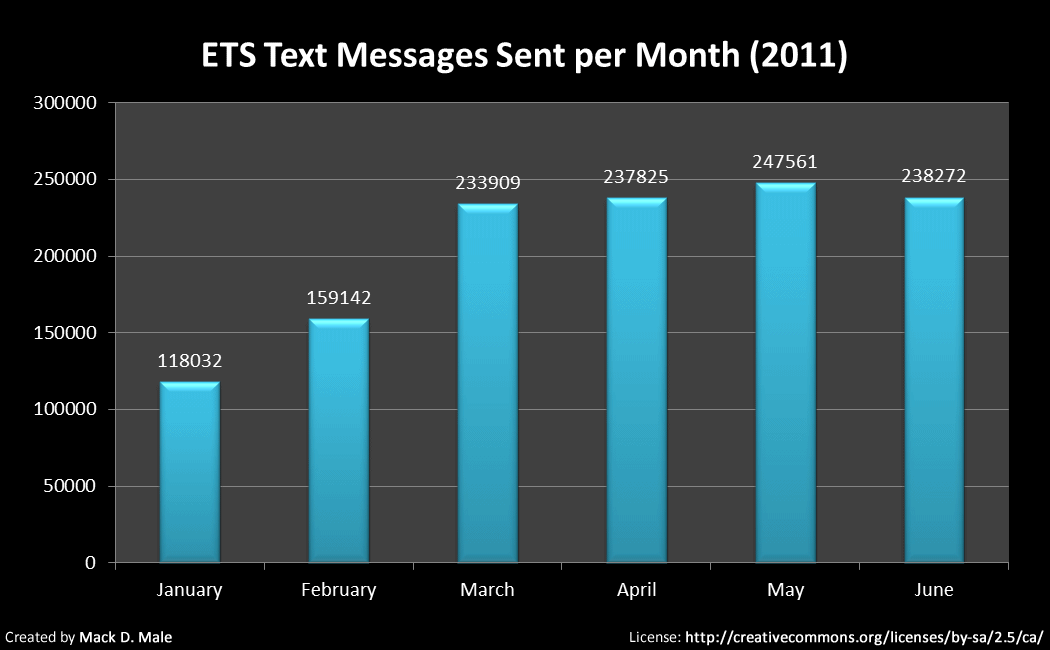
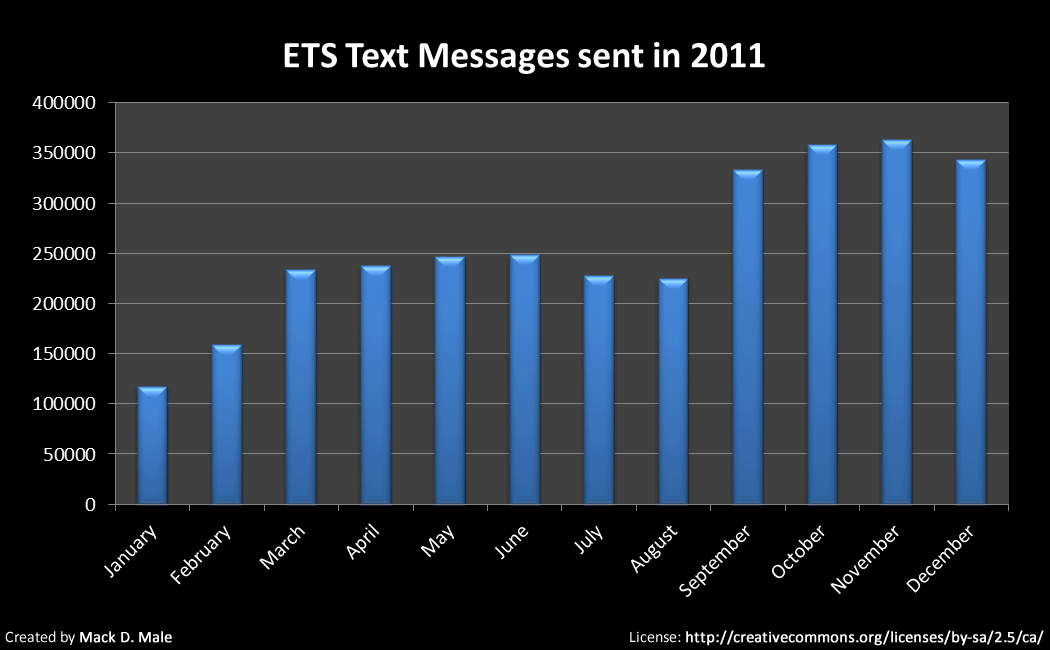
A little over a year ago Edmonton Transit (ETS) introduced bus schedules via text message. Simply send a message to 31100 from your cell phone with the bus stop number, and ETS will respond with a list of upcoming routes and times. It’s a fantastic service that I have used dozens of times over the last year, and clearly I’m not alone. A little over 3.1 million messages were sent last year! Here’s the monthly breakdown:

ets text messages in 2011

Back in June, when I wrote about the launch of the advertising component to the service, about 1.2 million messages had been sent, or 7050 per day. By the end of the year, the daily average had risen to 8494. You can see that the increase is due in large part to the back to school season – the number of messages sent jumped from 225,730 in August to 333,877 in September.

As expected, increased use of the text messaging service has led to a decrease in the number of calls made to BusLink, the automated 24-hour telephone line for transit information. Nathan Walters from ETS told the Journal that the number of calls dropped by 340,000 in the first nine months of last year to 2.8 million. I suspect it dropped even further when school started up again.

It’s great to see people embracing initiatives like this! ETS recently launched an updated Trip Planner that contains a number of new features like the ability to subscribe to email alerts for planned detours and bus stop closures, and there are additional technology-related services on the way. Should be an exciting year for connected transit riders!

Photo Tour: ETS Centennial Garage

About two months ago at the Youth Summit on Sustainable Transportation I had the opportunity to tour Edmonton Transit’s Centennial Garage, located at Ellerslie Road and 156 Street. The name commemorates Edmonton Transit’s 100th anniversary of service. The facility, which officially opened on April 10, 2010, primarily serves neighbourhoods in the west and southwest parts of Edmonton.

ETS Centennial Garage

The garage has space to store and maintain at least 250 buses, but is also home to administration offices as well as dispatch and support. More than 250 fleet services and bus operations staff work at the facility (that includes 200 operators).

ETS Centennial Garage ETS Centennial Garage

The building is massive, encompassing 7.1 acres (or 313,000 square feet, approximately five football fields). The budget for the garage was $99 million, $89.3 million of which came from the Municipal Sustainability Initiative (MSI). It was designed and built to LEED Silver standards, with features such as a solar wall for heating. Croy D. Yee Architect Ltd, Morrison Hershfield Limited, Earthscape Consultants, and Clark Builders were involved in the design and construction of the building.

ETS Centennial Garage

Some of the building materials used include 31 miles of electrical conduit, 1325 imperial tons of steel (structural steel was made up of 90% recycled content), 11,800 cubic metres of concrete (27.5% was reycled content), 3300 sprinkler heads, and 81 miles of in slab heating pipe.

ETS Centennial Garage

The Centennial Garage is the first garage in Edmonton designed to handle ETS’ 13 articulated buses, with a special hoist that can lift the 20-metre, three-axled vehicles.

ETS Centennial Garage

The storage part of the garage was fairly empty when we visted, as most buses were out on the road. It as neat to see the buses that were present parked nose to tail in long lines.

ETS Centennial Garage

ETS Centennial Garage

The high pressure wash system is what gets the buses nice and clean on the way into the garage. Apparently they had to turn the pressure down from the original setting, because it was causing the decals and advertising on the buses to come right off! In addition to being powerful, the system was specifically designed to cut down on water use by more than half.

ETS Centennial Garage

There are state-of-the-art systems in the building for monitoring carbon monoxide levels and maintaining comfortable heat and humidity. Energy modeling results indicate that the Centennial Garage is 33% more energy efficient than a typical building of its size and type.

ETS Centennial Garage

The ride out to the garage seemed to take forever (it’s really far south west) but it was definitely worth it to get a closer look at one of the facilities that keeps ETS running smoothly!

ETS Centennial Garage

You can see more photos from the tour here.

Edmonton Transit (ETS) Text Messaging: Statistics & Advertising

About six months ago, Edmonton Transit launched its text messaging service which enables riders to get schedule information via a simple SMS text message to 31100. The service was really well received, even though it was described by ETS as a pilot. I use the service almost every time I need to hop on a bus, and it works great! I’m definitely not the only one using the service either, as the latest statistics show.

usage stats

You can see that the initial growth was quite impressive, with usage doubling from January to March. Nathan Walters, Strategic Marketing Supervisor at ETS, told me that the adoption curve was “slightly steeper than expected” but that it is following projected usage quite closely. Since then usage has plateaued a little, probably due in part to the school year ending. Nathan said that usage of the service is probably going to be somewhat seasonal, just like BusLink.

As of Monday afternoon, just over 1.2 million messages had been sent, which works out to about 7050 messages per day. For comparison, Winnipeg Transit was delivering about 6000 messages per day back in May. Not a bad start at all!

text ads

When the service launched back in January, ETS said it would open up the ability to advertise on the text messages some time in the spring (the last 40 characters of each message are reserved for advertising). That service officially launched on June 17.

Advertising on the ETS Text Messaging Service provides a direct way to reach thousands of commuters riding the transit system every day. As an ETS text messaging advertiser, you have the opportunity to customize your campaign by location, time, bus route and even budget. This opportunity is affordable, tailored and easy to manage.

You can register for an account here and start advertising right away. The price can be as low as a penny per ad, but it is market-driven. Basically you buy credits and then place bids. You can customize your ads by specific bus stops, routes, time, and mobile phone provider. There’s a user guide in PDF here with more information.

demographic stats
(click for a larger version)

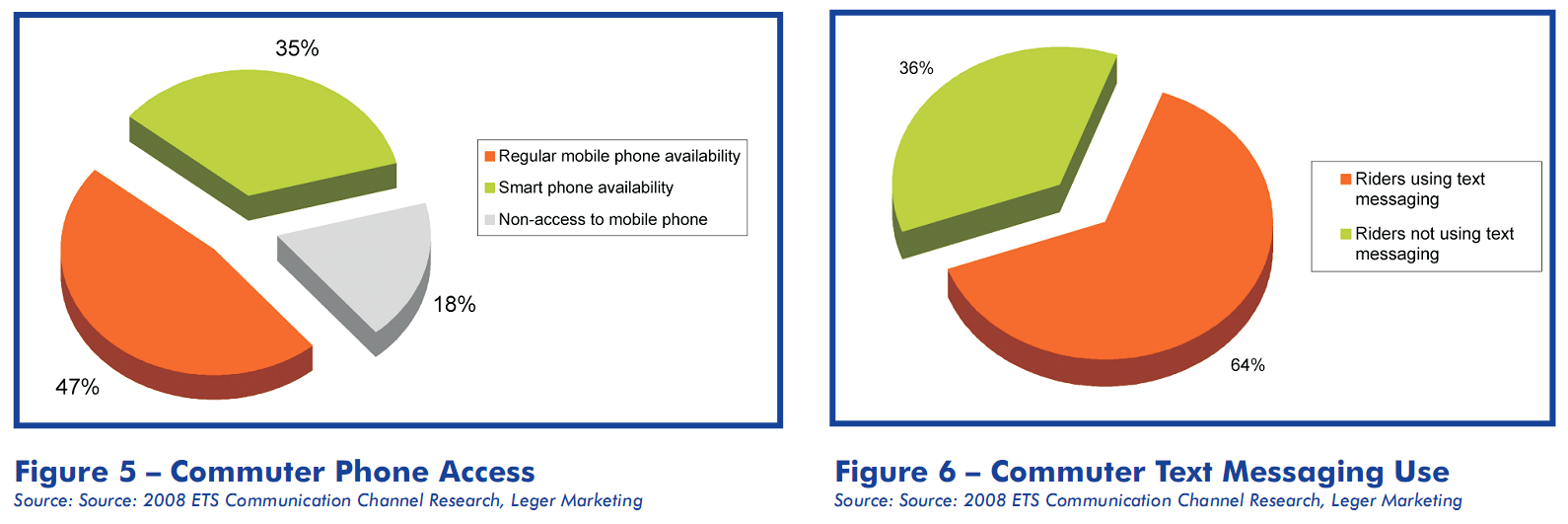
I’d encourage you to check out the Text Messaging Ad Media Kit in PDF too, as it contains a ton of useful information about the service. Some of the demographic information is a bit old, but it is still instructive.

You can learn more about the ETS text messaging service here.

Leading the Way: LRT Dance Party in Edmonton

Ever wonder what a dance party on the LRT would look like? I had the opportunity last weekend to find out! The Saturday evening activity for delegates of the 2011 Youth Summit on Sustainable Transportation was a DJ Dance Party on a chartered ETS LRT train.

LRT Dance Party

While we were touring the D.L. MacDonald LRT Garage in the afternoon, staff were busy getting the train prepared, adding streamers, disco balls, and lights to the interior. DJ Rob Wong also got setup with all of his gear and two giant speakers, one at each end of the train. After a quick dinner, we all boarded the party train! The train circled the garage a few times, apparently to make the most of our time.

LRT Dance Party

We then travelled the length of the LRT line, from Clareview all the way to Century Park, before travelling back as far as Churchill Station to let some people off downtown. In all, we spent about an hour and half on the train.

The music was loud, and slowly but surely most people started dancing! It was easier than you’d think to dance on the moving train, though whenever there was a sudden jolt it was just another reason for everyone dancing to yell and cheer. There were a few people who chose to just sit through the entire experience. It kind of reminded me of a high school dance in that way – slow to get going, with some people sitting off to the side the entire time.

Here’s DJ Rob doing his thing:

LRT Dance Party

Most of the dancing happened as we passed through a station. People on the platform would look at the train with bewilderment, and occasionally someone would give a thumbs up or clap. Faces filled with confusion just made everyone on the train dance and cheer even more! It became pretty obvious who among us were the exhibitionists. Here’s what it looked like for someone on the platform:

Unsurprisingly, the best part of the trip was the underground portion where it was darker. Tinted windows, dimmed lights, and some…uh, lubricant…would have made the dance party more like a dance party and less like a bunch of people moving around on the train! Maybe I’m just getting old.

That said, it was still a lot of fun. I absolutely love the concept of taking the LRT, normally seen as somewhat mundane (trains just get you from A to B), and using it for a completely different purpose. I think everyone enjoyed themselves! Obviously ETS doesn’t normally charter trains for this purpose, but I think they could if they wanted to. It’s certainly a unique experience!

You can see more photos here, and see more videos here.

Bringing Smart Bus technology to Edmonton

On Tuesday the Transportation & Public Works Committee will receive a report on Smart Bus technology. In short, Smart Bus technology is actually a collection of technologies that will help modernize Edmonton Transit’s entire fleet of nearly 1000 buses. It includes things like automated stop announcements, automated vehicle monitoring, and yes, GPS location services.

There are a number of reasons that this technology is becoming necessary. For instance, between 2000 and 2009:

  • Annual ridership increased from 43 million to 68 million (60% increase)
  • Annual service hours increased from 1.56 million to 2.08 million (30% increase)
  • Annual passenger concerns increased from 8,327 to 13,616 (60% increase)

During the same timeframe, the number of staff to manage service and concerns increased from 25 to 30, which is just a 20% increase. In other words, “staffing has not kept pace with the growth and complexity of the increased workload.” I would add that if we really want to shift Edmonton’s transportation modes, we need to ensure our transit system is modern and efficient.

That’s where Smart Bus technology comes in. The technologies include:

  • Automatic Vehicle Location
  • Computer-Aided Dispatch
  • On-board Mobile Data Terminals
  • Real-Time Passenger Information Systems
  • Automated Stop Announcements
  • Automated Vehicle Monitoring

What will those technologies do for the day-to-day transit rider? Automated Vehicle Location and Real-Time Passenger Information Systems means no more waiting outside when it is 30 degrees below zero for a bus that is running late – you’ll be able to see the real-time location of your bus using the web or a mobile device. Computer-Aided Dispatch and On-board Mobile Data Terminals means that three buses on your route will never be running together – they’ll be evenly spaced out and thus will stay closer to the schedule because ETS control will know where they are and can provide direction. Automated Vehicle Monitoring means fewer buses broken down on the road, and fewer spare buses sitting in the garage – it’ll help ETS monitor the health of its vehicles to ensure they stay on the roads.

The other technology, Automated Stop Announcements, is really what drove this report in the first place. In some jurisdictions, calling out stops has become law, and there have been fines handed out when drivers failed to call out stops. There is no such legislation here, at least not yet, but we shouldn’t have to wait for that to happen. Automated Stop Announcements is an important accessibility feature of modern transit systems, and helps to support Edmonton’s diverse community of transit riders.

The report has been written to highlight the direct benefits to Edmontonians, but there’s important benefits for ETS itself too. The fleet size for 2011 is 959 buses, and that number is not getting any smaller. It’s amazing how much is done manually at the moment, and how “in the dark” ETS control is most of the time. There is no live telemetry from buses right now, which means any information control does receive is via radio transmission. I have heard that even on a normal day, there are a couple thousand calls into control from drivers. Furthermore, bus maintenance is difficult at best right now. There is scheduled maintenance of course, oil changes, etc., but really until a bus breaks down and must be towed into the garage, ETS doesn’t know if something is wrong. And because of the size of the fleet, the garage is packed – buses are parked nose to tail. The automated vehicle monitoring would let ETS know if something was wrong on a bus currently on the roads, and would enable them to pull problem buses into a “trouble lane” when they come back into the garage.

In the implementation details, the report says that tapping into the City’s open data catalogue “could” be possible. I think that once we have GPS technology on the buses, making that information available to citizens is vitally important and should be considered a “must”. In other cities with the technology, coffee shops have mounted LCD screens that show when nearby buses have arrived (kind of like airport display screens). Citizens always know where the bus is simply by glancing at their mobile device. ETS cannot be expected to write all of that software – Edmontonians will, as long as the data is made available (likely as an API rather than in the catalogue, because the data is “live”).

According to the report, outfitting the entire fleet with all of this technology would cost $32.7 million, and would cost $4.3 million to operate each year. It would take between three and five years to roll out completely. A pilot has been proposed (for 50 buses covering 2 routes) which would cost $3.4 million and would likely start by September 2012. For budgetary purposes, a second option has been included, which is just the Automated Stop Announcements. That would cost $11.5 million to equip the entire fleet, and would cost $1.2 million  to operate each year. The corresponding pilot would cost $2 million.

City Council likes options, but they shouldn’t have one in this case. Going with just part of the technology doesn’t make sense. It’ll deliver only partial benefits today, and will cost much more in the future to add the other technologies (which we will have to do at some point). Furthermore, if the Smart Bus technologies are separated, that opens the door for multiple vendors and thus integration problems. I really hope Council recognizes the importance of having all of the Smart Bus technology together at once and doesn’t delay unnecessarily (though I do think it would be worthwhile to figure out if/how Smart Bus technology can be deployed alongside the proposed civic smart card).

I think $33 million to make Smart Bus technology happen across the entire ETS fleet is worth it. The notion of using commodity GPS systems (like cheap cell phones) is attractive, but probably unrealistic given the harsh environment of a bus (hardware needs to be hardened and you can’t be running out to replace components all the time) and other operating requirements. The suite of Smart Bus technologies will provide major benefits to both riders and to ETS itself. And to be frank, the proposed budget is a rounding error compared to the amount of money we plan to spend on LRT, and we need buses to efficiently feed our LRT system to really get the return on investment that is possible.

Let’s bring Smart Bus technology to Edmonton!

You can see the report and attachments here, and you can follow along on Tuesday here.

Edmontonians rank public transportation as the City’s top priority

If it were up to me, that would be the headline on the front of every newspaper and at the top of every news broadcast in Edmonton today. The result was buried in the middle of a report that goes to Council on Monday on the proposed downtown arena, but that makes it no less significant in my mind.

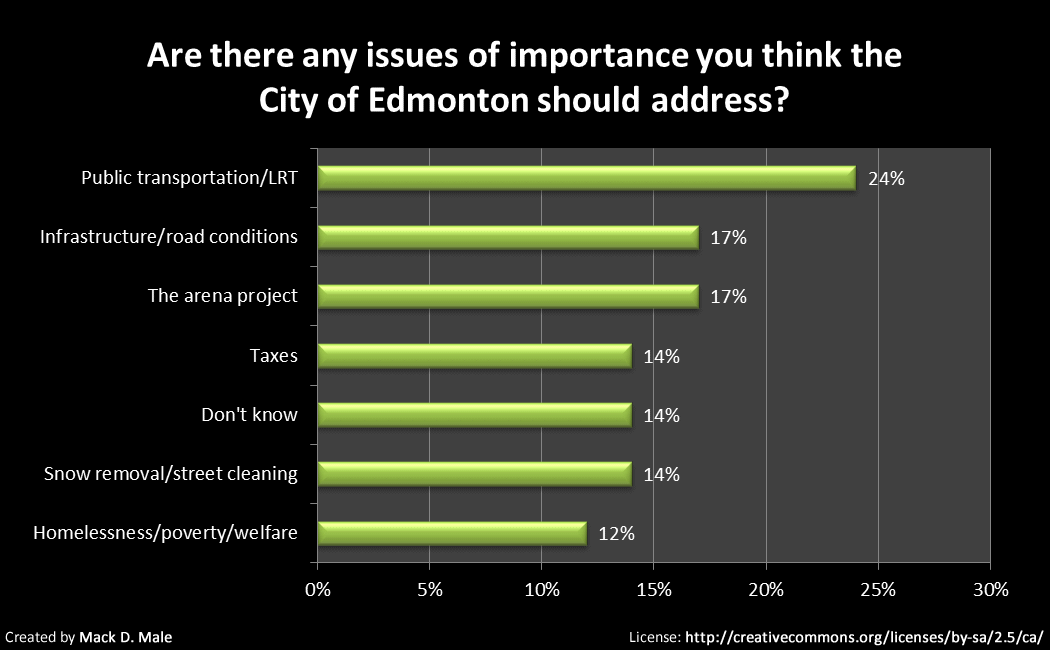
Edmontonians who participated in a statistically valid phone survey from December 20 to December 23 were asked what the key issues are that the City of Edmonton should address. Public transportation, and specifically LRT, came out on top.

The City is addressing this, of course, with an expansive plan to extend the LRT to all corners of the City. Shifting Edmonton’s Transportation Modes is also one of the goals in the City’s 10-year strategic plan, and public transportation is the key to achieving that. But we have to keep pushing. As the City’s Chief Economist John Rose said:

“[LRT is] the urban equivalent of an enabling technology – if you have it, you can do a lot of great things.”

Public transportation is costly – both to build and to operate. No question about that. But it’s worth it, and more importantly, Edmonton’s future success depends on it.

It’s important to remind ourselves, not to mention City Council, that improved public transportation is what Edmonton needs above all else.

Edmonton Transit (ETS) now offers schedule information via SMS text messaging

Today Edmonton Transit (ETS) officially launched its new text messaging service. You can now send an SMS text message to 31100 from virtually any cell phone to get bus schedule information for free (standard messaging rates may apply). The service is yet another example of the GTFS feed that ETS released in 2009 paying dividends.

The way it works is simple – text the bus stop number you’re interested in to 31100 and you’ll get a response like this (using 1859 as an example):

1859 (111) 01:26P 01:56P (112) 01:06P 01:36P (2) 01:08P 01:23P ETS – THE EVERY DAY WAY

That’s the stop number, followed by each route with two upcoming times for each. If you’re interested in just a particular route, say the 2, simply text the stop number followed by the route number, and you’ll get upcoming times for just that route at that stop:

1859 (2) 01:08P 01:23P 01:38P 02:08P ETS – THE EVERY DAY WAY

ETS has produced two videos that demonstrate how it works (they were filmed just before Christmas). Here’s part 1:

And here’s part 2:

Starting next week you’ll also be able to create a profile on the website to setup favorite routes and stops specific to your daily routine.

The ability to get route & stop schedules via text messaging might be new here in Edmonton, but it’s not a new concept elsewhere. Transit riders in Vancouver have had that functionality for years, first unofficially thanks to a couple of enterprising students, and later as an official service from TransLink. The story is somewhat similar here. Local developers Sean Healy and Joel Jackson hacked together a service called TXT.2.ETS back in March of last year, something they won a prize for in the Apps4Edmonton competition. They subsequently met with ETS representatives and talked about what an official service might look like.

I talked to Nathan Walters, Strategic Marketing Supervisor for ETS, about the new service yesterday. He told me the service is run by Vancouver-based Upside Wireless (presumably their Transit SMS product). Nathan confirmed that it uses the same GTFS data that anyone can download from the City of Edmonton’s open data catalogue. “The GTFS feed made things significantly easier, and brought the service to market a lot faster,” Nathan told me. He also said it “speaks to how much we stand behind that information.”

Though it is a pilot, don’t expect the service to shut down any time soon. Instead, ETS plans to monitor usage, gather feedback, and will be conducting market research later this year, and will re-evaluate and improve the service as necessary. In fact, if all goes well, the service will pay for itself and perhaps even drive an additional return to the City via the advertising service that will launch in the spring. The last 40 characters of the messages sent back to commuters will be allocated toward advertising (the “ETS – THE EVERY DAY WAY” part in the example above). I think that’s a smart move.

It turns out the service has actually been live for about a month, in testing by Upside and City of Edmonton employees. Apparently there has been quite a bit of buzz internally at the City about it. Today was not the planned launch date, but the accidental release of parts of the outdoor marketing campaign pushed things up. Nathan confirmed that we’ll see lots of advertising for the new service, including billboards, benches, and transit shelters. He sounded pleasantly surprised that they had been able to keep the service under wraps for so long (no doubt the holidays helped in that regard).

I had to ask Nathan the question he’s undoubtedly going to be asked over and over now that the text messaging service is live: scheduled information is great, but when are we going to get live information, perhaps via GPS? His answer: “The technologies that transit uses are always evolving, and the service will evolve as well.” In other words, nothing to announce, and don’t hold your breath.

I also asked about the shortcode, 31100. Nathan said they briefly considered a repeating number (such as TransLink’s 33333) or something like “txtets” but realized that using letters would be problematic considering most modern smartphones do not have traditional numeric keypads. They settled on 31100 because it offered great potential for the future. Just like 311, other departments at the City could make use of the shortcode for their services as well. Nathan confirmed that at least one business unit outside of transportation has already expressed interest in exploring that possibility.

This new service is exciting and will have a positive impact on the daily commute for thousands of Edmontonians. But it’s more than that. ETS made a decision to open up its data to anyone for free, and they continue to see a return on that very minimal investment. Releasing the GTFS data feed has resulted in Google Maps support, apps for the iPhone, and now text messaging. Importantly, all ETS had to do for all of this to happen was focus on its core competency – providing transit service. It’s a success story that other business units at the City of Edmonton should be very eager to replicate.

Having said that, I would have preferred to see a solution from a local company or even the adoption of Sean & Joel’s project, but I realize there are other considerations. As the Apps4Edmonton competition evolves, I hope we’ll see the City adopting more of the solutions that Edmonton’s talented entrepreneurs create.

The new text messaging service is a great way to start 2011. In fact, Nathan said it “sets the tone for the year” and indicated that ETS was going to be looking at additional opportunities to work with the community on other services as 2011 unfolds. I can’t wait!

You can learn more about the service here, and you can find additional Apps for ETS here. Check out the Open Data catalogue for ETS data and more, and follow the #yegtransit hashtag on Twitter for ETS-related updates.

UPDATE: Does the new text messaging service work for the LRT? The answer is yes! If you know the stop numbers, that is. The route for the LRT is always 201, but here are the stop numbers you need.

Station Name North Stop # South Stop #
Clareview 7797 7797
Belvedere 7692 7830
Coliseum 1889 1742
Stadium 1981 1723
Churchill 1691 1876
Central 1863 1935
Bay/Enterprise Square 1985 1774
Corona 1926 1891
Grandin/Government Centre 1754 1925
University 2969 2316
Health Sciences/Jubilee 2014 2019
McKernan/Belgravia 9982 9981
South Campus 2116 2115
Southgate 2114 2113
Century Park 4982 4982


Hopefully they can make it more user friendly in the future.

Edmonton Transit’s new lost & found system: Foundtastic by Hybrid Forge

A little over a year ago, the City of Edmonton held an open house for a new initiative known as Leveraging Technical Expertise Locally (LTEL). The initiative was created as a way to allow the City to gain access to innovative local technology companies who may not otherwise have the scale or resources to participate in a traditional RFP process. The pilot project was a replacement for Edmonton Transit System’s electronic lost and found system. A total of fourteen local companies proposed solutions and the field was narrowed to six finalists in January: Hybrid Forge, Aldata, Aurora Bar Code, Damaag, Stage 2, and XEA Services.

Hybrid Forge was selected in February, and they started work on their lost and found solution in early spring. Called Foundtastic, the application goes live today and tomorrow at the City of Edmonton.

Foundtastic

I caught up with Geoff Kliza and Chad Smith from Hybrid Forge, as well as Loren Andruko and Bruce Beecher from the City of Edmonton, to talk about the process and the new solution.

Geoff and Chad told me they “underestimated the seriousness with which ETS treats lost and found.” This is good news for you, the transit user! Here’s how the process worked before Foundtastic:

  1. You lose something on the bus in the morning.
  2. Later that day, at the end of his/her shift, the driver collects all the items found on the bus and hands them off to the dispatcher at the garage (there are six garages, plus DATS, and the ETS security officers who also find items).
  3. The dispatcher does the paperwork for the lost items and prepares them for transport to Churchill Square.
  4. The items are transported to Churchill Square, and the items are entered into an Access database.
  5. By the middle of the next day, your item has been catalogued at Churchill Square and is ready for staff to respond to your requests.

Certain items are special, of course. For passports, driver’s licenses, cell phones, or other easily identifiable items, ETS will proactively try to contact individuals. But for the most part, that’s the process. There are signoffs along the way, so that ETS can track items from bus to customer.

There are a number of issues with that process. Two of the most obvious issues are the disconnect between the paper trail and the database at Churchill Square and the time delay between an item being found and that item being searchable. If you called on the same day you lost your item, staff would tell you to call back the next day because they’d have no way of knowing if something was found until it was in the Access database.

Foundtastic solves both of these problems, and more. The process is largely the same, except that dispatchers no longer need to catalogue items on paper. Instead they enter them into the system directly. A paper manifest is still kept at each garage, but it is printed now, reducing the likelihood of mistakes or illegible handwriting. And by enabling each location to add the items into the database directly, the delay for customers is also removed. Now staff can tell you the same day if its likely that your item was found or not. Auditing is greatly improved now too. The system records whenever a change is made, whereas in the past something could be scribbled and crossed out on paper, making it difficult to track.

I asked whether the idea of using scanners or photographs as part of the process was considered. Maybe using barcodes at the garage and Churchill Square to further automate the process of ensuring that everything that was found made it to the station. Both sides looked at the idea, but ultimately decided that the costs outweighed the benefits.

Chad told me that like most software projects, the scope evolved and changed over time. Instead of “here’s the problem, give us a solution” it evolved into more of an agile development process. When it became clear that the paperwork could be reduced by allowing dispatchers to enter items directly, a slight business process change was required. That’s where Loren came in – he played a key role in the process, acting as the key connector between the City and Hybrid Forge. Chad remarked that Hybrid Forge “would not have been successful if Loren had not gotten involved” in the project. Loren was equally as positive about working with Hybrid Forge, saying he would love to work with them again.

One of the most interesting things I learned is that Foundtastic is software-as-a-service, which means Hybrid Forge is responsible for hosting the application. At the open house, it was specifically stated that the solution would have to run in-house, so I’m quite pleased to see that the City relaxed that requirement (they indicated they would as the deadline for submissions approached). Foundtastic is an important system, but it’s not mission critical, so it was a great opportunity for the City to experiment with SaaS.

Foundtastic

An interesting challenge that Hybrid Forge ran into was the interface. As you can see, they’ve created an attractive user interface, but it was actually scaled back somewhat from their original designs. The application needs to be efficient for staff to use, so maintaining the Access-like data entry interface was important. While tabbing from column to column and making extensive use of the keyboard is the way Access works, that’s not typical on the web. Hybrid Forge used jQuery to maintain that experience for users. For those of you interested in the technical side of things, Foundtastic is built using ASP.NET MVC 2.

With Foundtastic, the City of Edmonton received a cost-effective piece of software, with a user interface that isn’t typical of City applications, and the opportunity to explore SaaS. For Hybrid Forge, the opportunity to showcase what they can do and the ability to count the City of Edmonton as a customer were both positive outcomes. And for you, the transit user, improved customer service is the big win.

The idea that the LTEL project would be a way for local companies to springboard into a larger market seems somewhat less successful, however. While the City has arranged contracts and such to ensure that Foundtastic could be used in other departments, there are no immediate plans for that to happen. And Hybrid Forge would of course need to spend the time and money to identify opportunities and market their solution if they wanted to sell it to customers beyond the City, something they’re not likely to do as a company focused on custom solutions rather than product development. It seems that aspect of the project is something that TEC Edmonton could have helped with, but they were not involved beyond the initial selection process.

I asked all four gentlemen if they’d do the LTEL process again, and if they’d recommend it to other software companies or other departments at the City. All said yes. That to me suggests that the pilot was a success! Of course, there are lots of improvements that will be made, and Bruce said the City is now operationalizing the process, and that an LTEL2 seems likely. I hope it happens.

In the next six to eight weeks, another key aspect of Foundtastic will go live. Instead of having to call ETS to check if your lost item was found, you’ll be able to fill out a form on the website. You’ll be asked for some identifying criteria, and the system will tell you whether or not it’s likely that your item was found (it’s important to avoid specifics, to reduce the potential for abuse) and what the next steps are to retrieve it. It’s another improvement to the customer service experience made possible by Foundtastic.

Kudos to Geoff, Chad, and the team at Hybrid Forge for showing the City of Edmonton what local software development companies are capable of. And kudos to the City for experimenting with something new. It’ll be interesting to see how LTEL evolves!

LRT Expansion was never just icing on the Edmonton EXPO 2017 cake

Allow me to begin with a passage from the executive summary of The Way We Move, the City of Edmonton’s current Transportation Master Plan:

We are building a 21st century city, shaping an Edmonton that will meet the needs of our diverse and growing urban and regional population. Growing environmental concerns, acknowledgment of the ongoing investment needed to maintain our transportation infrastructure and the rapid growth of our city demand a shift in transportation priority setting. It is a shift from single passenger vehicle use to more public transit; from building outward to a compact urban form. From an auto oriented view of transportation to a more holistic view of an interconnected, multi-modal transportation system where citizens can walk, bike, bus and train efficiently and conveniently to their desired location.

The City of Edmonton is working to achieve this vision through the LRT Network Plan, as well as other initiatives. This vision does not ignore automobiles, but it certainly places greater emphasis on public transit.

At the top of the list of benefits that EXPO 2017 could have brought to Edmonton was funding for infrastructure. Was it the best way to try to get higher levels of government to commit to funding something that Edmonton so desperately needs? Perhaps not. But make no mistake about it: funding for LRT expansion was never just icing on the EXPO 2017 cake. Expanding our LRT network is vital for Edmonton’s future. Here’s what Councillor Don Iveson wrote nearly a year ago:

Projects like this require the alignment of at least two and, properly, three orders of government. It will require the relentless pressure of citizens on Councillors, but more particularly on MLAs and MPs.

He was right then and still is today. Our quest to be Canada’s host city for EXPO 2017 might have failed, but we cannot allow our plans for LRT expansion to fail as well.

At a news conference yesterday, Transportation GM Bob Boutilier questioned why Edmonton had not received the same level of federal support as Toronto has when it comes to funding for public transit, saying “I just think we’re owed. It’s time.” But he also suggested that LRT expansion plans would be delayed by a year or two now that EXPO is no longer in the picture, something that would potentially save money.

This is unacceptable.

It’s unacceptable that the expansion is being delayed, and it’s unacceptable that it’s Boutilier and not Council questioning the federal government’s support.

Why would LRT expansion have been fast-tracked with EXPO 2017 but not without it? Back in April, Boutilier said that meeting the deadline of 2017 was “do-able” with some creativity, noting that “we cannot use the conventional approach to building transit that we’ve used in the city up to this point.” A few weeks later, he suggested a board of directors to oversee the construction as a way to speed up the project. At the time, the cost of the expansion was pegged at “more than $3 billion”. It has since been narrowed down to $3.4 billion. So either it was going to cost significantly more than Boutilier was letting on, or the cost savings of delaying by a year or two are negligible.

I think Boutilier has one of the toughest jobs at the City of Edmonton, overseeing one of the most vital and controversial parts of the business, so I don’t envy the tough decisions he has to make. Boutilier should definitely be willing to make noise about the lack of resources he has, but in the same week that we lost EXPO, I would have liked to have heard some Councillors speak up for LRT as well. Instead, that job has been left to Boutilier and to EXPO bid committee chair Tony Franceschini. I’ve seen only Councillor Ben Henderson comment, saying “I personally don’t want to see us slow down.” Councillor Kerry Diotte also remarked on funding, “With the feds these days, who knows?”

I want my City Council to stand up for The Way We Move. If there’s a window of opportunity with regards to the federal government as a result of the EXPO decision, take advantage of it. Ask Administration to keep going, not to slow down. Make some noise. Show some of the emotion that Mayor Mandel showed on Monday.

The loss of EXPO shouldn’t be an excuse for us to slow down with LRT expansion. It should be a catalyst for increased pressure to get the job done.

Notes on the Downtown LRT Connector Concept Plan

On Tuesday evening the proposed Concept Plan for the Downtown LRT Connector was presented to the public at a very well attended event. The plan is the next step in the process that really kicked off on June 21 when City Council approved a street-level downtown LRT route. The proposed 2.1 km route will serve as a connector for the future West and Southeast LRT lines, with 5 stops and opportunities for transfers to the existing LRT system in the downtown core. The route runs primarily along 102 Avenue, connecting to the West LRT via 107 Street on 104 Avenue and to the Southeast LRT on 102 Avenue near 96 Street.

The Downtown LRT Connector was mentioned as a catalyst project for the Capital City Downtown Plan more than once. It forms an importance piece of both the six-legged LRT Network Plan and the so-called Downtown-University circulator.

Here’s what it looks like (the purple line):

Downtown LRT Connector

The Downtown LRT Connector will use low-floor LRT vehicles, which is the style all future LRT development will use (when possible). Low-floor LRT requires less infrastructure and enables step-free, street-level boarding. And yes, low-floor LRT will work in our winter climate!

Downtown LRT Connector: The Quarters in Winter

There are five proposed stops along the route:

  1. Campus Stop – Located diagonally between 108 Street/104 Avenue and 107 Street/102 Avenue. Land acquisition would be required, including the AADAC building. Potential for development around the stop. Serves MacEwan and NorQuest. Features a third track, which could be used as a staging area to prepare for large events, etc.
  2. 105/106 Street Stop – Located in between the two streets, where there are currently parking lots. Land acquisition would be required.
  3. Centre West Stop – Located across from Manulife Place, in between 102 Street and 101 Street. Requires no land acquisition. Would feature dedicated bicycle lanes in both directions.
  4. Churchill Square Stop – Located across from the Stanley Milner library. Requires no land acquisition. A second set of escalators/elevators would be built on the northwest corner of the 99 Street/102 Avenue intersection. Easy connections to existing LRT.
  5. Quarters Stop – Requires no land acquisition. Some traffic impacts: 102 Avenue at 96 Street would be closed to through traffic, and a single eastbound lane would be provided from 97 Street to maintain local access.

Here’s a rendering of the Churchill Square stop:

Downtown LRT Connector: Churchill Square Stop

The question & answer session covered a lot of topics. Here are a few notes I took:

  • The Downtown LRT Connector would use a different signal system. Rather than an exemption (the current LRT always has right-of-way) the LRT would receive priority, but may hold at stations to allow traffic to clear.
  • Buses that currently run along 102 Avenue would of course be re-tooled to feed into the LRT system.
  • The bicycle lanes in the concept plan are primarily shared lanes, but there’s the potential for dedicated lanes in the future.
  • The location of the Quarters stop is further west than would be ideal, but as it dives into an underground tunnel to join the Southeast LRT there isn’t much flexibility. There are significant grade changes.

I also asked about the City Market, as the route would run right through the middle of it. I was told that the City has already had conversations with the City Market, and that they’re confident they’ll make it work (either spreading out along 102 Avenue a little more, or potentially just leaving everything the way it is…but with a train running through every 15 minutes).

I’m particularly excited for this route, living at 104 Street and 102 Avenue. It’ll mean I’m a block or less from both the existing LRT (at Bay/Enterprise Square) and the new lines (at 105/106 Street). Can’t wait to see it happen!

You can download the Downtown LRT Connector Information Booklet here (PDF).

The Concept Plan will be presented to the Transportation & Public Works Committee at a non-statutory public hearing on December 8, after which it will be forwarded to City Council for review in January 2011. You can check out the Downtown LRT Connector page for more information.