Media Monday Edmonton: Week in Review #1

Like many others, I’m interested in the continual evolution of journalism and media. And given my passion for Edmonton, I’m particularly interested in that evolution at a local level. Where have we been, and where are we going? What’s next?

I’m not particularly interested in the distinction between “traditional media” and “new media”, though I recognize there are instances in which treating the two separately can help our understanding of the changes that are going on. Taking the long view, however, I see the entities the terms represent merging.

I’d like to start devoting an entry each Monday to this changing landscape (it’s all about experimentation, right?). Some weeks it’ll be a review of relevant news (like what you see below), other weeks it might be an opinion, or a critique, or an interview, or some statistics, or something I haven’t thought of yet. Hopefully I can keep it interesting for both me and you!

Here’s my first week in review:

You can follow Edmonton media news on Twitter using the hashtag #yegmedia. For a great overview of the global media landscape, check out Mediagazer. The big news today is of course the Huffington Post acquisition by AOL.

So, what have I missed? What’s new and interesting in the world of Edmonton media? And what would you like to see me write about in future Media Monday entries? Let me know!
Two reasons journalists should learn to love Excel

I love Microsoft Excel, I really do. It’s currently the second highest item in my Start Menu, that’s how frequently I use it (now that I think about it, I should just pin it). I use it for all kinds of things – calculations, cleaning up data, and yes, generating graphs. It’s a really versatile tool, and it’s really easy to use (especially the latest version).

I often talk about changes I’d like to see in the mainstream media, and two important ones are context and presentation. There are so many stories that seem like they’re written in a vacuum. A story about housing starts is a good example, like this one from the Edmonton Journal yesterday. There’s 560 words there, words about numbers. Is that the best way to present that information? And even if you think it is, where’s the context? How do the housing starts this month relate to averages and historical numbers?

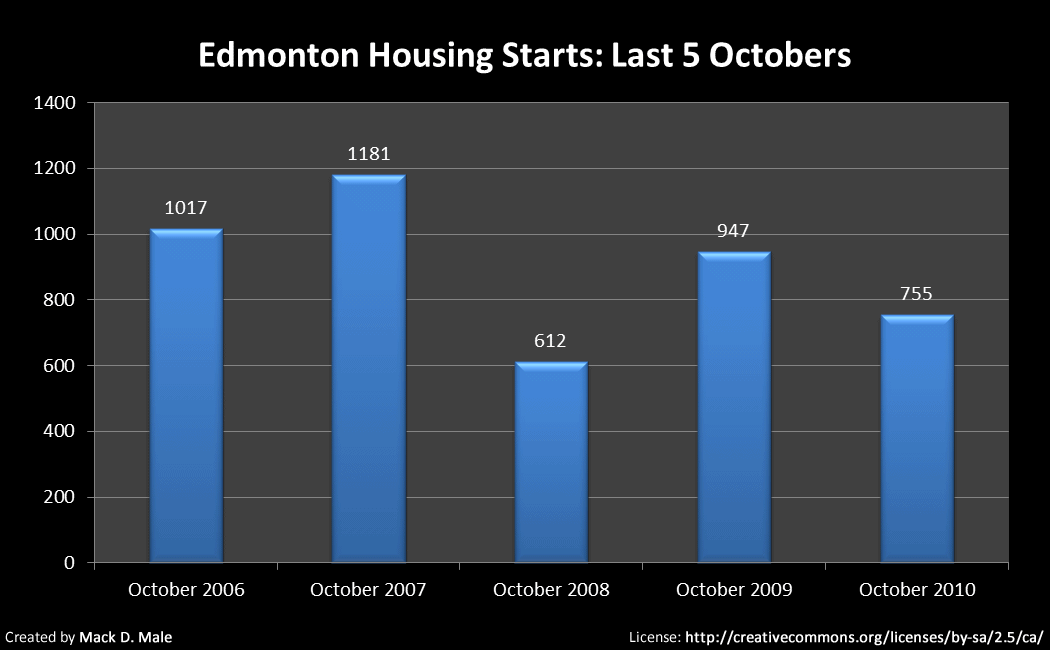
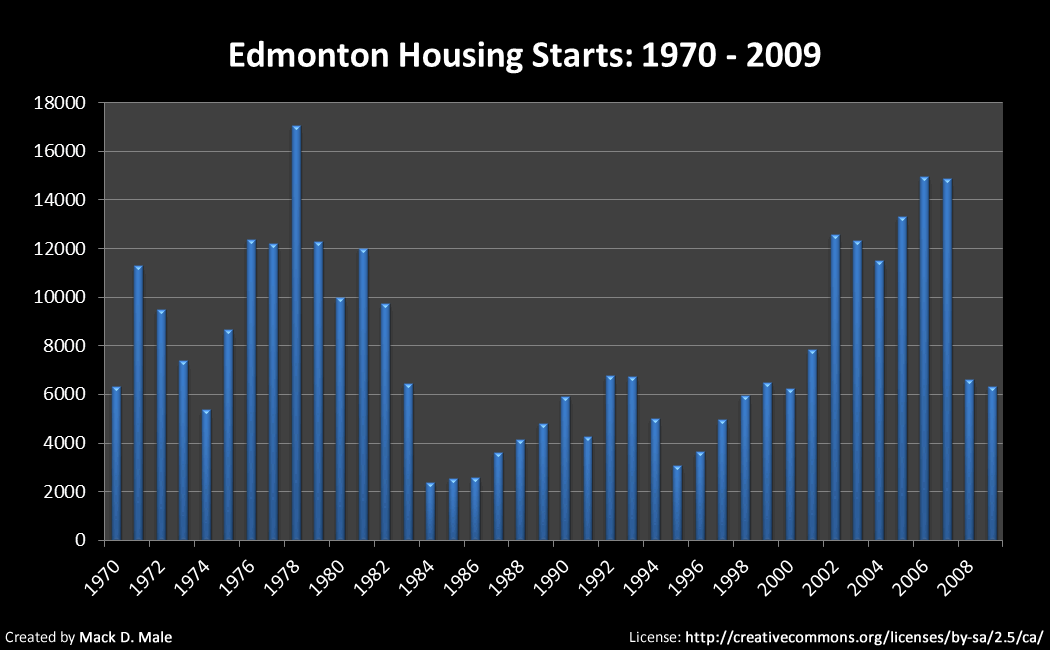
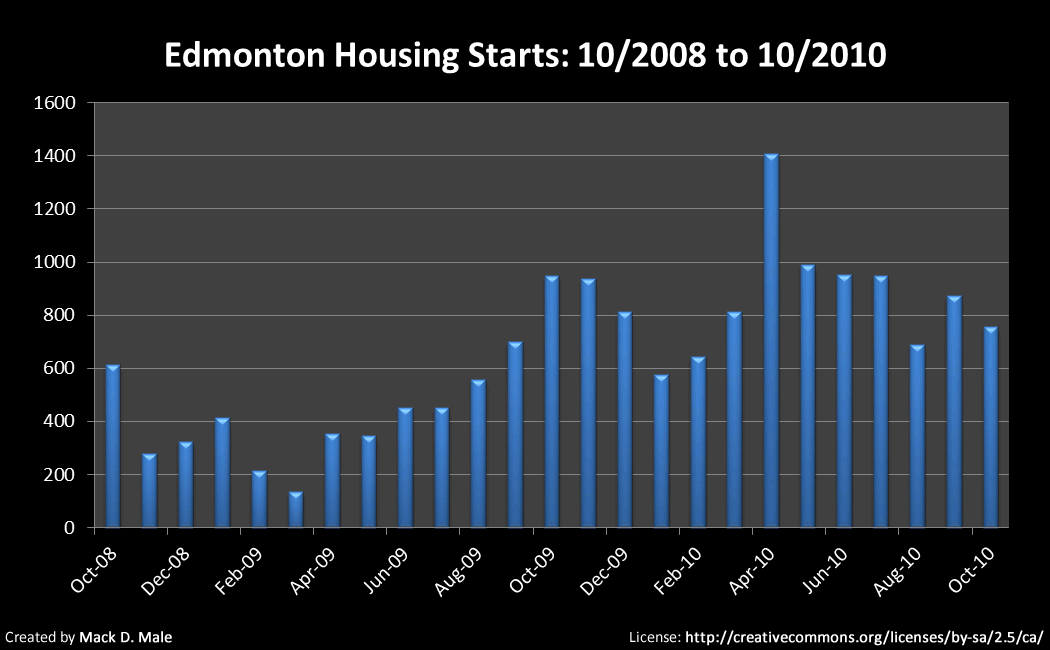
That’s the first reason that journalists should learn to love Excel – it can make providing context and better presentation easy. Here are three simple graphs, created with Excel, that tell you about housing starts in Edmonton.


This data comes from a PDF provided by the City of Edmonton. It shows annual housing starts since 1970. Copy and paste into Excel and you’re done!


This graph shows monthly housing starts from October 2008 until now. It uses data from the CMHC’s Reports & Publications section. Took maybe 10 minutes of copying and pasting.


This graph compares housing starts for this time of year from 2006 until now. Also comes from the CMHC.

Imagine if the article included graphs like these. The journalist could then focus on telling a more interesting story.

So, what’s the second reason journalists should learn to love Excel? Well, it can help them get their story right. Here’s what the Journal article starts with:

Despite a strong spring, the slowing trend in new-home construction became clear in October with housing starts dropping to their lowest level since June 2009 in the Edmonton region.

As you can see from the second graph above, that’s just not true. Is there a slowing trend? Maybe, if you just look from the spring to now. Was October the lowest level since June 2009? No. There were just 690 starts in August 2010. In fact, there were six months with lower housing starts since June 2009. I’m not sure what data the Journal was looking at, but it doesn’t appear to be CMHC data.

Add Excel to your toolkit. You won’t regret it.

UPDATE: Here’s the Journal story on August housing starts. Maybe if finding archived stories was easier, Dave Cooper, who wrote the story on October housing starts, could have consulted previous Journal articles to see that the lowest level was much more recent than June 2009.

Would you trust a citizen plumber to work on your toilet?

That’s one of the questions, referring to citizen journalism, that Edmonton Journal columnist Dan Barnes asked last week in this all-over-the-place piece. Was it rhetorical? Maybe, but I’ll bite anyway.

I know you’re not supposed to answer a question with a question, but I wonder what Dan meant by citizen plumber? Did he mean someone whose experience with plumbing is limited to some fancy new tool, or did he mean someone who simply lacks the license but has all of the necessary interest, skills, experience, and knowledge of a plumber-minus-the-citizen? My point is that its easy to misuse the label “citizen journalist” and to paint with too broad a brush.

It’s also really difficult to define. I wonder how Dan defines it? Maybe he thinks I’m a citizen journalist because my platform is this blog. But what about “mainstream journalists” who have blogs – aren’t they also citizen journalists then? If we can’t define it with the tools or platform, maybe we can define it with the kinds of content the citizen journalist produces. But there again, what’s the distinction between someone who rewrites a press release for a newspaper and someone who does an interview for a blog post? Is the only distinction the employer?

Why do we need that label anyway? What would happen if we dropped the term “citizen” and just called them journalists? Both tell stories, after all.

Dan Barnes and I would be on the same level, that’s what would happen. And my guess is that Dan wouldn’t be able to deal with that.

It’s worth mentioning that Dan’s argument is not new or unique. Though at least one other “mainstream journalist” has used the term “citizen plumber” before, the straw man is most often made with a “citizen neurosurgeon” or a “citizen dentist”. As always, Techdirt does a nice job of dealing with that:

Most people seem to recognize the basic difference between reporting on something and cutting into someone’s brain. And, many people also recognize that most reporters themselves are often not experts in the field they’re reporting on — and what participatory journalism and the internet enable is the ability for actual experts on the topic to take part in the discussion and reporting as well.

I don’t think it’s that difficult to recognize the differences between a plumber and a journalist, either. There are only so many ways to fix a leaky pipe, but a myriad of ways to interpret and write about something, for instance.

The reality is that journalism is not a constant, it’s not static or unchanging. Like most things worth caring about, journalism is constantly evolving, and whether Dan likes it or not, journalists who don’t work for the mainstream media are here to stay.

I can understand why we’d be hesitant to call the first guy I described above a plumber, but it’s pretty clear that the second one is a plumber. If we call them both just plumbers, do we risk cheapening the term? If we call them both “citizen plumbers”, do we risk preventing the second guy from making an impact?

What if the new tool that plumber #1 uses turns out to be a plunger, or Drano, all of a sudden enabling millions of people to deal with simple plumbing problems on their own, and thereby freeing up the non-citizen plumbers to focus on more difficult problems? That’s the real risk, in my opinion, with putting too much weight behind a label. We risk overlooking the significant contributions that both can make to plumbing overall.

Still not convinced Dan? Maybe you’ll enjoy this story (from way back in 2006!):

Witness the power of the humble tools of citizens’ media. A citizen dentist used them to become a journalist. He used them to give the world a unique and human perspective on a story where too much is unreported. He gained an appreciative and supportive audience around the world. He helped give birth to a new medium. And journalism is all the better for it.

Give a citizen dentist a blog and he’ll change the world? Maybe not, but he might just impact journalism for the better.

Recap: MediaCamp Edmonton Initial Meeting

Tonight we held an initial planning meeting at Credo Coffee for an event called MediaCamp. I have wanted to hold a local event to bring mainstream (or old) media together with social (or new) media for some time, and last week Karen Unland provided the necessary spark when she tweeted about a hacker event that took place recently in London, UK. A bunch of us very quickly settled on a hashtag – #yegmediacamp – and we got the ball rolling on Google Wave.

MediaCamp Edmonton PlanningMediaCamp Edmonton Planning

The meeting tonight was appropriately informal, and gave everyone an opportunity to meet one another and share ideas. We went around the circle with introductions and initial thoughts, and then discussed what MediaCamp might look like. Karen probably has better notes than I do, but here are some of the things I wrote down:

  • Should it be a small event or a large one? The consensus seemed to be “go big”.
  • Would an event focus on business models? Technology? Something else?
  • BarCamp is pretty unstructured, TransitCamp had a bit more structure but used the same kind of model. What’s the right approach for MediaCamp? The consensus seemed to be that we have some structure.
  • Lightning Thoughts was something that everyone thought was a good idea – quick, five minute demos.
  • Multiple streams or not? We want to break down silos and encourage input from everyone.
  • Will they come? How do we remove barriers to entry? How can we ensure a good mix of mainstream media folks and social media folks?
  • As with most of these events, connections are perhaps the greatest outcome.
  • Potential dates: April 10, May 8
  • It was decided we’d loosely follow the ChangeCamp structure, striking subcommittees to focus on sponsorship/budget, volunteers, day-of, etc. The first step – create a Google Group to get everyone connected.

I agree with Bruce that labels seem to be a necessary evil, so I’ll use them here. The common thread seemed to be, “let’s work together”. What can old media learn from new media, and just as importantly, what can new media learn from old media?

I was quite impressed with the turnout, especially since it was just a planning meeting. Here’s who made it out tonight: Karen, Cam, Asia, Alain, Dave, Rachelle, Kelly, Jeff, Eugene, Brittney, Diane, Jas, Curtis, Reg, Bruce, Marty, Kerry, and myself. I know there were many more who wanted to come but couldn’t make it work!

Please follow along on Twitter, and join the Google Group. I think there’s a lot of excitement around MediaCamp, and I’m eager to see what comes of it!

Recent media links & thoughts

I read a lot about new media, journalism, publishing, news, etc. I always try to think about the things I read from both a global and a local perspective. Here are some thoughts on the things I’ve read recently.

From Jeff Jarvis:

I’m not so sure journalism is storytelling anymore.

Jeff points out that saying “journalism = storytelling” is limiting. Journalism is about more than the story, it’s a process. I agree completely. Data, algorithms, aggregators – all are aspects of journalism. They always have been, of course, but their importance/visibility has been heightened lately, thanks to new tools and technologies.

From paidContent.org:

Time Warner’s CNN is taking a stake in hyperlocal aggregator Outside.in—the latest example of a big media organization making a play in the hyperlocal space.

Smart move, just like MSNBC’s purchase of EveryBlock. And the news today that Google is in talks to buy Yelp. The dollars are starting to flow toward local/hyperlocal news companies. You know how the saying goes: follow the money.

From TechCrunch:

So what really scares me? It’s the rise of cheap, disposable content on a mass scale, force fed to us by the portals and search engines.

From ReadWriteWeb:

In my view both writers and readers of content will need to work harder to get quality content. Right now ‘quantity’ still rules on the Web, ‘quality’ is hard to find.

Lots of others have already discussed the “content farm” issue that made the rounds in the blogosphere last week. My view on it is pretty simple: readers need to become more active. There’s so much information so easily available that you can’t afford to passively consume the news. You have to seek out sources and recommendations. Certainly we’ll get better tools (aggregators, filters, search engines) but I think readers need to make more of an effort. See also: Content farms v. curating farmers.

From Clay Shirky:

…one of the things up for grabs in the current news environment is the nature of authority. In particular, I noted that people trust new classes of aggregators and filters, whether Google or Twitter or Wikipedia (in its ‘breaking news’ mode.)

I called this tendency algorithmic authority.

Fascinating. I think there’s incredible opportunity, both globally and locally, to take advantage of this. Who do you trust for your news? Is it the same people/organizations that you trusted five years ago?

From Unlikely Words:

Ken Auletta from the New Yorker wrote a book about Google, “Googled: The End of the World as We Know It” and before he published it, he cut the last chapter of 25 media maxims.

Now you can read them online. A few of my favorites:

  • Passion Wins
  • Adapt or Die
  • Digital is Different
  • Don’t Ignore the Human Factor

And finally, one of my favorite new tools: Times Skimmer. We need more innovation like that at the local level!

Friday musings on hyperlocal news

A couple weeks ago, Matthew Hurst created the Hyperlocal page on Wikipedia. Previously, the Hyperlocal redirect went to Local News. Here is Matthew’s rationale for the change:

One of the reasons behind separating these two is that hyperlocal content, and especially blogging, is not simply content about a location and of a particular geographic granularity. It is intended for people resident in that location and, importantly, it is written by residents of the location. Local news does not require the later.

According to the article, hyperlocal content is characterized by three major elements:

  1. It refers to entities and events that are located within a well-defined, community-scale area.
  2. It is intended primarily for consumption by residents of that area.
  3. It is written by an individual resident in that area.

I think this definition is missing a few things.

Much of what I write on this blog could be considered hyperlocal under the above definition (assuming Edmonton falls under the well-defined, community-scale part). The same could be said of The Edmonton Journal, however, which is why I think the current definition on Wikipedia is missing something. The most obvious addition would be a fourth point about being locally owned/operated.

I like that the definition does not mention any particular medium, such as blogging, but rather leaves it open. However, I’m not sure the third point is general enough. The phrase “written by” suggests that we’re talking about the traditional article format, with sentences and paragraphs. I think hyperlocal is much more than that. Consider sites like EveryBlock, which contain hyperlocal news created by software (though I suppose EveryBlock conflicts with the locally owned/operated concept, but you get the idea). Sure humans wrote the software, but the content produced for consumption comes from an algorithm. Shouldn’t that count?

Another thought – what about the people who create hyperlocal content, whether writers or programmers or other creatives? Should we call them Hyperlocal Journalists? Before you journalist types get all defensive, consider that there are twenty types of journalism listed on Wikipedia. What’s the harm in adding one more? 🙂

Finally, I think there’s a place for aggregators and curators in the hyperlocal ecosystem. Perhaps another defining characteristic of hyperlocal content is that it is spread all over the place. Aggregators and curators can sift through all of that content to help make it more discoverable.

The future of local news gathering in action

On Saturday morning Sharon and I walked to the City Market Downtown, as we often do on the weekends. Along the way, near 107th Street and 102nd Avenue, we came upon a parade of firefighters. I immediately took out my camera to snap some photos, and also used my BlackBerry to post one to Twitter via TwitPic. We followed them up the street until they turned toward Jasper Avenue, taking a few more pictures. They were a somber group, so we assumed it was a memorial march of some kind, but we didn’t know the details.

Firefighters remember Station Captain Al HarrisFirefighters remember Station Captain Al Harris

For the next couple hours, I sent BlackBerry messages back and forth with Brittney at iNews880. She had seen my TwitPic, and wanted to write a story about the march. I always tell her she can use my photos, but she asks anyway which is nice. Brittney and her team figured out what the march was for, wrote the story, and posted it with my TwitPic. When I got home, I uploaded the rest of my photos and they added them to the story.

That’s the future of news gathering in action.

Now I realize that iNews880 and some other media organizations regularly use photos from contributors but I think what’s significant here is that the story started with the photo. Would they have written about it had I not posted a TwitPic? Maybe, maybe not. In this case they saw the photo, tracked down what it was about, and were able to produce a story.

Here’s a quote you might have heard:

In journalism, there has always been a tension between getting it first and getting it right. – Ellen Goodman

In this case, I got it first and iNews880 got it right. Note that doesn’t mean that I got it wrong and iNews880 was way behind. We simply worked together to make the story happen. This is the kind of news gathering that can scale. So many of us walk around with mobile Internet devices, always ready to post a message or a photo.

What comes next? Aggregation, of course.

You’re asking the wrong question

Last week’s issue of SEE Magazine was a “theme” issue, focusing on the future of the media industry (“print in peril”). In addition to this interesting article, there was a panel comprised of four local newspeople with lots of experience: Linda Hughes (U of A, formerly Edmonton Journal), Ron Wilson (CBC), Jeremy Lye (iNews880), and Roy Wood (MacEwan, formerly Edmonton Journal). They discussed a range of things, including the fact that the industry didn’t develop these problems overnight. The general consensus is that journalism is important, but what it looks like in the future is up in the air.

Of course, you can’t have an article on the future of media without asking who’s going to write about City Council, and the panel didn’t disappoint! Linda Hughes asks:

But with breaking news and local-level news, who is going to go sit in a courtroom all day for a three-paragraph story that is important to know about but isn’t sexy and is just part of the pubic discourse? Who is going to do that? Bloggers often provide a lot of insight, but most bloggers are not going to go to sit in city council committee meetings for five hours to keep track of what city council is doing.

Ask a sports writer about the future of news and he’ll probably use this defense, even though he never sets foot inside City Hall! It’s the easy way out, and it’s an incredibly common response lately from journalists in the hot seat. To make things worse, SEE asked the question again later in the piece:

If newspapers and mass media outlets do dwindle, then, who will be the watchdogs in society to ensure politicians don’t run wild? Who will pay for the investigative reporters who can zero in on one thing for months and all of a sudden have the biggest story of the year?

Sigh. There will still be passionate individuals who follow specific topics and do investigative reporting. Probably more now than ever thanks to easy publishing systems (blogs, wikis, Twitter, etc). And they’ll produce much more interesting content than someone who does it just because they get paid to.

Let’s ignore that argument for a minute, however. Asking how to pay a journalist to sit through meetings to get three paragraphs is still the wrong question!

The real question is, why have we ever had to pay someone to sit through five hours of City Council committee meetings? Let’s get rid of that absurd need altogether and this discussion becomes irrelevant.

This is why I’m so excited about ChangeCamp and the possibilities it represents. If we can change the way our government communicates with us, the need for a newspaper filter could go away altogether.

Let’s focus less on how we’re going to pay a journalist to sit with Council all day and more on how we can get Council to communicate with us in a meaningful way. If we can do that, the journalist will have much better things to cover!

Twitter and the future of journalism

twitter logo On Friday, David Schlesinger from Reuters posted an entry to his blog discussing Twitter and the future of journalism. David had been tweeting from the World Economic Forum, and found that his updates beat the Reuters newswire. No big surprise, but it prompted a bunch of questions:

Is it journalism?

Is it dangerous?

Is it embarrassing that my tweets even beat the Reuters newswire?

Am I destroying Reuters standards by encouraging tweeting or blogging?

David’s answers are: Yes, Potentially, No, and No. I love that someone in the “mainstream” media is able to answer these questions honestly and openly!

His entire post is filled with wonderful quotes, such as:

I have no idea what journalism will look like in five years except that it will be different than it is now. That’s a great thing, I believe.

Fantastic outlook on things, in my opinion. Twitter is changing journalism and news media for the better. Ignore it at your own peril. I can’t say it any better than David himself:

If I don’t beat the Reuters wire with a live tweet because I deliberately hold back, someone else will. If I don’t beat the Reuters wire because I’m slow or inattentive, someone else will.

There’s something to be said for holding back, providing context, and thoughtfully articulating a story or idea. But when you’re talking about breaking and spreading the news, speed is the name of the game, and nothing at the moment does it faster or more effectively than Twitter.

Another way to look at it is chunking. Give me bite-sized chunks as the news happens, and when I have time later, I’ll explore the topic in more detail. Twitter is perfect for chunking news.

Take a couple minutes and read the entire post. I’m looking forward to reading it again in a year – I suspect it won’t seem so unique and refreshing by then!

Social Media and Local News in Edmonton

My favorite media/journalism/news blogger is Jeff Jarvis. His blog, BuzzMachine, is a treasure trove of information and insight on how the web is transforming the world of news media. Jeff has spent a lot of time thinking about local news specifically, a topic I am very interested in. Yesterday he wrote a post summarizing his thoughts on where local news might go. These are the highlights for me:

“The next generation of local (news) won’t be about news organizations but about their communities.”

“News will emerge from networks.”

“Do what you do best and link to the rest will be a foundation of the future architecture of news.”

“News will find new forms past the article, which will include any media, wiki snapshots of knowledge, live reports, crowd reports, aggregation, curation, data bases, and other forms not yet created.”

I encourage you to read the entire post, it’s definitely worth it.

Thinking about Jeff’s post made me wonder what local news organizations here in Edmonton are doing to prepare for the future. Are they focused on communities? Are they creating networks? Are they specializing and linking elsewhere? Are they supporting news beyond the article?

In general, I think the answer to those questions is no. An examination of how local news organizations are using social media is somewhat encouraging, however. Why look at social media? Generally speaking, I think blogs, social networks, etc., address all four areas – communities, networks, linking & sharing, and life beyond the article.

These are some of the traditional sources for local news here in Edmonton, with links to their social media activities:

As you can see, there are quite a few organizations that still haven’t gotten their feet wet with social media (unless I missed some links – one thing all these sites have in common is that they are terribly messy and hard to navigate). The Journal appears to be the most active, with a Facebook application, Twitter account, and blogs and podcasts on its site. The relatively new iNews880 is similarly active. All the organizations offer RSS feeds except for Global Edmonton, Citytv Edmonton, and SEE Magazine (the Edmonton Sun recently added feeds).

These days, I get most of my local news from four main sources:

The trend I have noticed is that breaking news starts with the traditional organizations but is spread by individuals through services like Twitter, Connect2Edmonton, and Facebook (and good old-fashioned word of mouth too). Organizations like The Journal have people dedicated to gathering the news, so it makes sense that they’d be the ones to break the news (most of the time). They could definitely be doing a better job of interacting with the community and forming networks online to spread that news, however. And they pretty much do nothing beyond the article, at least at the moment (heck the Journal won’t even hyperlink URLs inside their articles).

Take yesterday’s story about the new arena concept, for instance. I first heard about the news on C2E. I understand that Citytv was the first traditional source to pick up on the story. I spread the news via Twitter and my blog, and others did the same. Today articles appeared in The Journal, on CBC Edmonton’s site, and elsewhere, but they didn’t really offer anything new, and they didn’t provide links to the images, video, maps, or other bits of information readers might be interested in.

I like the vision for local news that Jeff Jarvis has suggested, but it seems to me that the local organizations aren’t leading the way into that future. Instead, individuals are dragging them into it. I wonder if that will always be the case?