Media Monday Edmonton: Title Junk

I’ve been thinking of writing this post for a while now. Back in December John Gruber wrote about title junk, also known as “poorly designed web page titles”. It is something I have thought about more and more since launching Edmonton Etcetera, because I link to so many things using essentially just the title of the web page. I like relatively clean titles, but unfortunately as John wrote, “an awful lot of websites use patterns for page titles that are ugly, hard-to-scan, and/or just plain stupid.” Let’s find out which local media websites are the worst culprits!

Here are the front page titles for some local media sites (in no particular order):

  1. Edmonton Journal | Latest Breaking News | Business | Sports | Canada Daily News
  2. Edmonton Sun
  3. CBC Edmonton | News, weather, video, audio, traffic, blogs and features
  4. iNews 880 On Radio. On Line. On Demand. – Edmonton CHQTAM
  5. CTV Edmonton – Edmonton News, Breaking News, Weather, Education, Mobile, Lottery Results, Contests
  6. Global Edmonton
  7. MasterMaq’s Blog – Edmonton Blogger
  8. Only Here for the Food
  9. the edmontonian: awesome since 2009
  10. daveberta.ca
  11. City and Dale – Edmonton Happenings & Style
  12. Vue Weekly :: Edmonton’s Alternative News, Arts, Music, Film and Food Weekly
  13. SEE – Edmonton. News. Entertainment. Life. Weekly.
  14. The Charrette
  15. Metro – Edmonton : Home

And here are the article page titles for those same sites:

  1. Edmonton police detonate Groat Road pipe bomb
  2. Penguins beat up Oilers | myOilers | Sports | Edmonton Sun
  3. MLAs hold emergency health care debate  – Edmonton – CBC News
  4. iNews 880 On Radio. On Line. On Demand. – Edmonton CHQTAM
  5. CTV Edmonton – Man accused in death of Alta. mother makes first court appearance – CTV News
  6. Alberta opposition succeeds in push for emergency health-care debate
  7. Edmonton Notes for 3/13/2011 at MasterMaq’s Blog
  8. Only Here for the Food » Blog Archive » For the Love of Food: Eat Alberta 2011
  9. Divorceapalooza with CraigyFerg – the edmontonian: awesome since 2009
  10. gary mar’s peeps – supporters secret facebook group revealed. | daveberta.ca
  11. City and Dale – Edmonton Happenings & Style – Win 2 Tickets to Western Canada Fashion Week
  12. Revitalizing debate  :: Front :: VUE Weekly
  13. SEE – Edmonton News & Views – News & Views – Exploring Our Complicated Provincial Psyche
  14. The Charrette » Blog Archive » The Heart of the City: getting people downtown
  15. Metro – Alberta health minister called in conflict

There’s a little bit of everything there, from nice and clean, to full of junk. There are all kinds of delimiters too – colons, dashes, arrows, pipes, etc. I think what is perhaps most interesting is the variety! Aside from the Edmonton Journal and Global Edmonton (which appear to have the same CMS), and a couple of the WordPress sites, they’re all different.

I like the cleanness of the Edmonton Journal’s article headlines, but I think including the source would be better. I love the “awesome since 2009” tagline of theedmontonian. And I despise the lack of anything meaningful in the iNews880 article titles – they’re completely useless as page titles.

I’ve thought about what to use on my own blog, and could never really decide. Source: Headline? Headline – Source? I’ve changed my page titles more than a few times. I settled on the “at” delimiter most recently, which I’m still not 100% sold on, for one reason only: it sounds appropriate when you read it aloud.

The bottom line is that page titles matter. They should be written for humans, not software!

What do you think?

Media Monday Edmonton: Week in Review #3

Here’s my third week in review:

You can follow Edmonton media news on Twitter using the hashtag #yegmedia. For a great overview of the global media landscape, check out Mediagazer.

So, what have I missed? What’s new and interesting in the world of Edmonton media? Let me know!

Media Monday Edmonton: Week in Review #2

Here’s my second week in review:

I was fortunate enough to take part in an informal conversation on local media on Thursday evening. It was a great discussion, and I came away with lots to think about. I was reminded of this post from April 2009: Newspapers, cities, and the local web.

You can follow Edmonton media news on Twitter using the hashtag #yegmedia. For a great overview of the global media landscape, check out Mediagazer.

So, what have I missed? What’s new and interesting in the world of Edmonton media? Let me know!

Media Monday Edmonton: How fast are local media websites?

On the web, page speed matters. If your site takes too long to load, people will go elsewhere. Google proved this by purposefully slowing down its search engine. They found that even just half a second caused fewer searches. Bottom line: users love fast sites!

With that in mind, I decided to look at local media sites – how fast or slow are they? Rather than looking at page load times, I decided to use YSlow to determine the performance of each site. Lots of factors can impact the amount of time a page takes to load (your ISP, the speed of your computer, where you are geographically,etc), but everyone has to download the same amount of data for a web page, so I figured YSlow is a little more fair than a stopwatch.

Here are the fourteen sites I looked at (you can download all the data here):

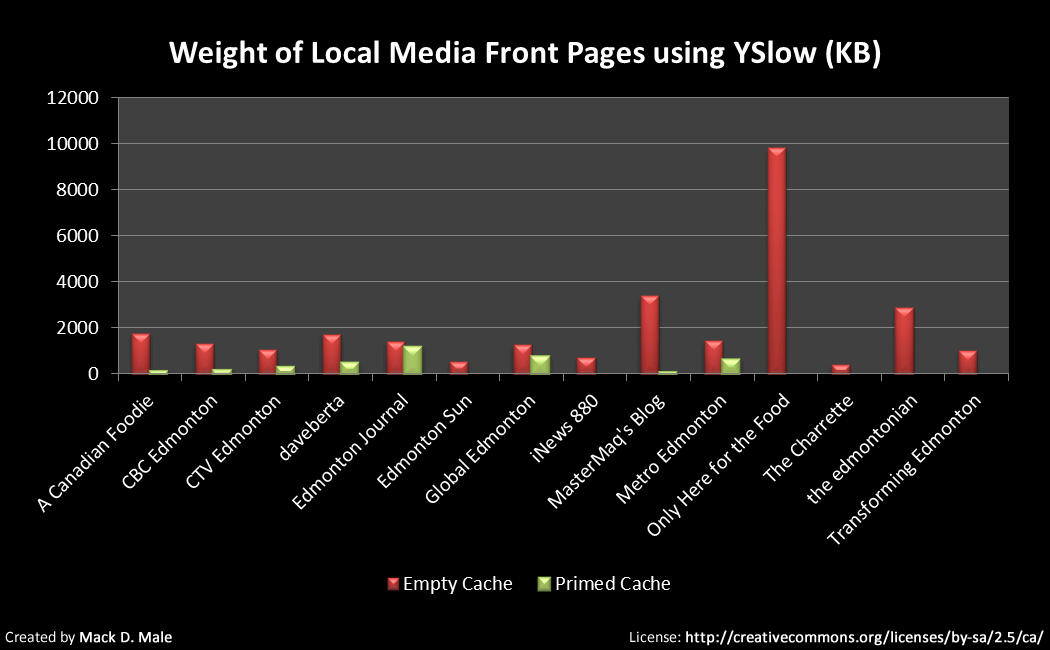
As you can see, none of the sites received an “A” grade. The only one to receive a B was Only Here for the Food. The grade can be somewhat misleading, however. Here’s what the front page performance for each site looks like:

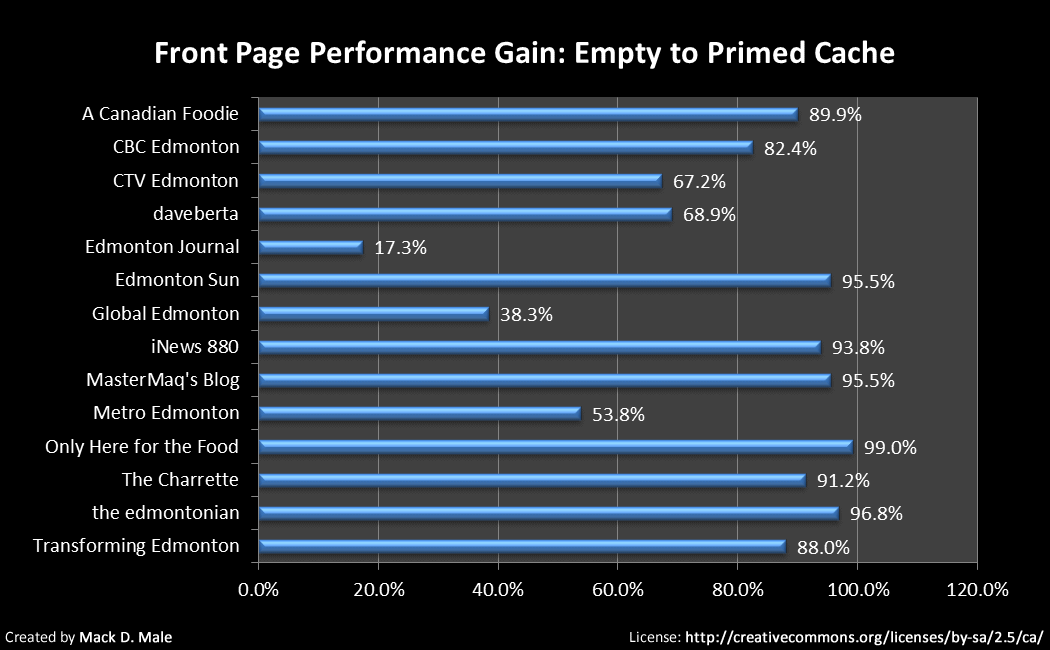
It turns out that Sharon’s blog is the heaviest of them all with an empty cache (the first time you visit the site). This is due to the large number of images she has on her site. In fact, almost all of the weight of the page is due to the images. If you look at the primed cache (subsequent visits to the site) then the Edmonton Journal is the heaviest. The Edmonton Journal has the worst performance improvement going from an empty to a primed cache:

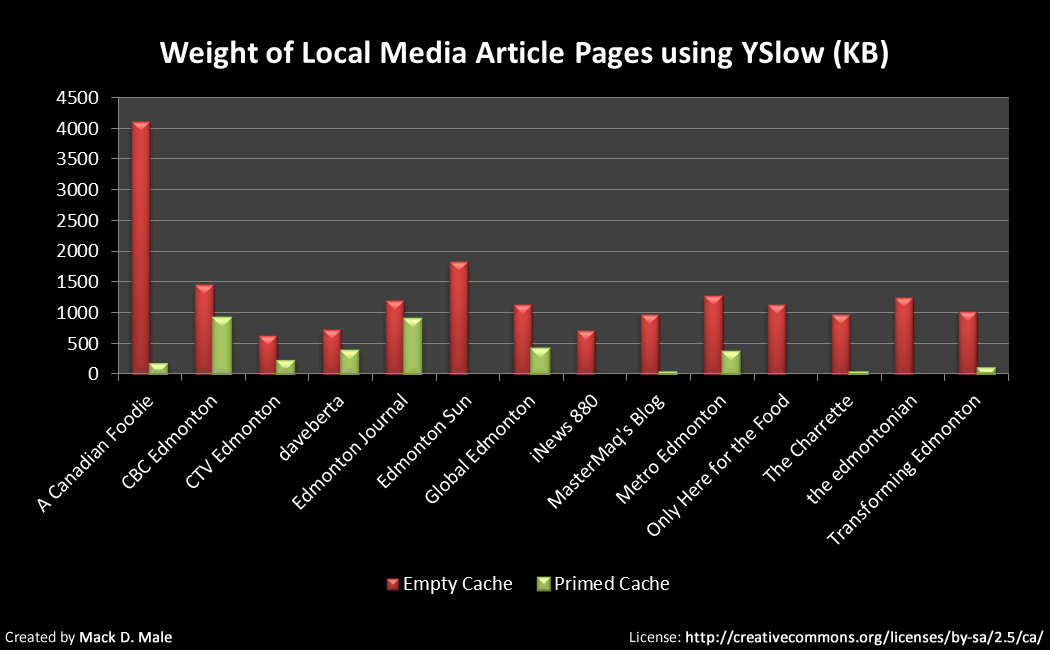
To be fair, I decided I should compare an “article page” on each site as well. With social media in particular, an article page is more likely to be a visitor’s entry point to the site. For this test, I simply clicked on the top article on each site:

One caveat: I used the second story for iNews 880, because their top story was over 25 MB in size! Evidently they think it is fine to embed full size, uncompressed images.

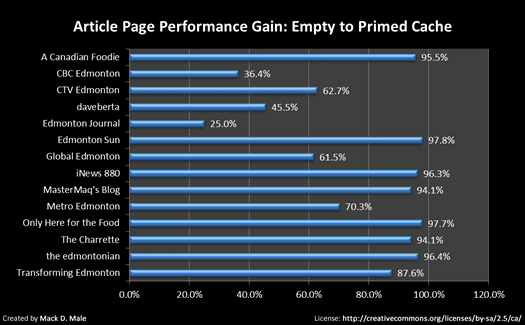
As you can see, Valerie’s blog is the heaviest, again due to the number of pictures she has. Once again, the Edmonton Journal has the worst performance improvement going from an empty to a primed cache:

Final Thoughts

I thought there would be more of a difference between the new and traditional media sites, but there isn’t really. In general the heaviest part of the blogs is images and the heaviest part of the traditional media sites is Javascript, but there are exceptions. On average, the first time you visit the front page of one of these sites you’re going to have to download just over 2 MB. On a 56.6 Kbps dial-up connection, that would take you nearly 5 minutes. On a typical high-speed connection, it’s more like less than 10 seconds.

I think perceived performance is often more important than actual performance, but that’s obviously harder to measure. In my experience, most of these sites load fairly quickly. When I do notice a speed issue, it’s usually because the page I am trying to load has a lot of stuff on it.

Another thing I learned from this exercise is that all of the sites have room for improvement!

What has your experience been like? Which sites do you find slow?

Media Monday Edmonton: Meet the new West Edmonton Local

Last week a new media organization launched here in Edmonton, one that is quite unlike any of the others. West Edmonton Local is a project of Grant MacEwan University’s journalism program focusing on news in the west end of our city. It’s a website, an experiment in hyperlocal news, and a fantastic learning tool for MacEwan students. I talked to the new site’s editor-in-chief Archie McLean and two of its journalists about the project.

“As much as possible, we want to be an authoritative voice for the west end,” Archie told me. I think that statement says a lot about the new project – it might be easy to dismiss it as just thing for students, but to do so would be a mistake. West Edmonton Local is the real deal. “There’s a market for local news,” he declared. Chelsey Smith, one of the site’s contributors, agreed saying “there’s definitely a need for something like West Edmonton Local.”

Archie became the chair of the program back in August, and even then he was thinking about the idea of a local news site. “What’s the best way to channel the output and collective interest of 20 journalism students?” Traditionally, students would have had to write a couple of big articles during the term, giving them limited opportunity to work with editors. For Archie, that would mean 20 big articles all coming in at the same time. “It doesn’t reflect the media reality,” he told me. West Edmonton Local changes the approach – instead of learning to do journalism, students are doing journalism and learning from that experience.

Students are tasked with writing articles every week, and they also need to include a multimedia component. They’ll also do a few feature pieces throughout the term. They’re using Flickr for photos, and might also include Google Maps, video, slideshows, and other rich content. Chelsey told me “it’s a major time commitment, but everyone is so excited about it.” I also talked with Pamela Di Pinto, who highlighted the big head start the project is giving students career-wise. “It’s not often that my work gets published anywhere, so to actually have my name online is pretty cool.” Archie echoed that, saying that the skills students are gaining with West Edmonton Local will be valuable when they move to other organizations.

In addition to Archie wearing the editor-in-chief hat, the site has two student editors that alternate every two weeks. The Managing Editor helps with the articles and content, and the Community Engagement Editor (apparently the title has changed a few times now) focuses on Twitter, Facebook, and other aspects of the project. Chelsey is the Community Engagement Editor until Wednesday, and said she has focused on tweeting links and posting stories to Facebook, so that more than just the feature articles are read. “We want people commenting on our stories on the website, so it’s important to spread the news.”

The site officially went live on February 7. Archie and the team decided to focus on the west end partly because that’s where the MacEwan program exists, but also because the community seemed like it might be receptive to the idea. “It has a distinctive feel, it was Jasper Place until really not that long ago,” Archie told me. The project’s “boundaries” are west of 124 Street, and south of 111 Avenue to the river. There’s lots of potential news stories in the area, such as the Stony Plain revitalization, the LRT extension, etc. The boundaries are just guidelines, however. If there’s news that is relevant to the west end communities, West Edmonton Local will cover it.

While hyperlocal sites are nothing new, there aren’t many of them here in Canada, and certainly not from journalism schools. One of the sites Archie looked at was Mission Local, a hyperlocal site focused on the Mission district in San Francisco. The “trouble” section was borrowed from that site. Crime is one aspect, but there are other things covered in the trouble section, such as noise bylaw complaints, graffiti, etc. Stuff that is relevant to people in the community, but which might not meet the threshold to be covered in something like the Edmonton Journal.

Archie told me that the biggest challenges the project has faced so far are quality control and workflow. “It’s an ongoing challenge to keep a consistent voice.” The journalists are students of course, so they’re learning as they go, and they all have different abilities and experience. Workflow has also been a challenge, partially because the site is running on WordPress. Students pitch their own story ideas, and post the article in draft form. An editor comes in and checks things over, making any necessary adjustments (Chelsey commented that one of things she has learned so far is the importance of editing). Final approval is given from either Archie or Lucas Timmons, the production editor, and then the article goes live. Multimedia follows a slightly different workflow.

One of the most obvious questions about West Edmonton Local is what happens after school is over. “Worst case scenario is that it lives for a few months and then goes away, but ideally we want to keep it going over the summer,” Archie told me. He has applied for some grant money that would allow a student to work over the summer, carrying it through until the next term. Eventually advertising revenue could cover the operational costs, which at this point are quite small. Partnerships is another aspect of the site that Archie and the team are exploring. They’ve focused primarily on getting everything up and running so far, but are eager to speak with organizations in the community about how to work together.

The team sounded happy with the launch and the attention the site has received thus far. Pamela said the experience has been great, and that she’s excited to see the site grow. She also praised the work Archie and Lucas have put into the site. “They really are helping us out, getting our names out there.” Archie, perhaps unsurprisingly, said it is the students that should get the credit. “They’re putting the content up, and content is king.”

For now the site seems to be running fairly smoothly, but discussions about how to improve it are ongoing. “It’s so young, it could go anywhere,” Chesley remarked. Archie stressed that the team is looking for feedback at this stage. “We genuinely want suggestions from people on what we can do better.” If you have a comment or suggestion, tweet @westedlocal, leave a comment on Facebook, or get in touch with Archie.

For Archie, seeing West Edmonton Local come to life has been a great experience. “It was an opportunity to try building a news site from the ground up,” Archie told me. “It’s potentially an infinite amount of work.” His passion for the project definitely showed during our conversation however, so he seems up to challenge. He also knows this is a unique opportunity. “We don’t have any baggage, so we have the freedom to take chances.”

Congratulations to everyone involved in West Edmonton Local on what you have accomplished so far. I look forward to seeing the project grow and evolve!

Media Monday Edmonton: Week in Review #1

Like many others, I’m interested in the continual evolution of journalism and media. And given my passion for Edmonton, I’m particularly interested in that evolution at a local level. Where have we been, and where are we going? What’s next?

I’m not particularly interested in the distinction between “traditional media” and “new media”, though I recognize there are instances in which treating the two separately can help our understanding of the changes that are going on. Taking the long view, however, I see the entities the terms represent merging.

I’d like to start devoting an entry each Monday to this changing landscape (it’s all about experimentation, right?). Some weeks it’ll be a review of relevant news (like what you see below), other weeks it might be an opinion, or a critique, or an interview, or some statistics, or something I haven’t thought of yet. Hopefully I can keep it interesting for both me and you!

Here’s my first week in review:

You can follow Edmonton media news on Twitter using the hashtag #yegmedia. For a great overview of the global media landscape, check out Mediagazer. The big news today is of course the Huffington Post acquisition by AOL.

So, what have I missed? What’s new and interesting in the world of Edmonton media? And what would you like to see me write about in future Media Monday entries? Let me know!

Two reasons journalists should learn to love Excel

I love Microsoft Excel, I really do. It’s currently the second highest item in my Start Menu, that’s how frequently I use it (now that I think about it, I should just pin it). I use it for all kinds of things – calculations, cleaning up data, and yes, generating graphs. It’s a really versatile tool, and it’s really easy to use (especially the latest version).

I often talk about changes I’d like to see in the mainstream media, and two important ones are context and presentation. There are so many stories that seem like they’re written in a vacuum. A story about housing starts is a good example, like this one from the Edmonton Journal yesterday. There’s 560 words there, words about numbers. Is that the best way to present that information? And even if you think it is, where’s the context? How do the housing starts this month relate to averages and historical numbers?

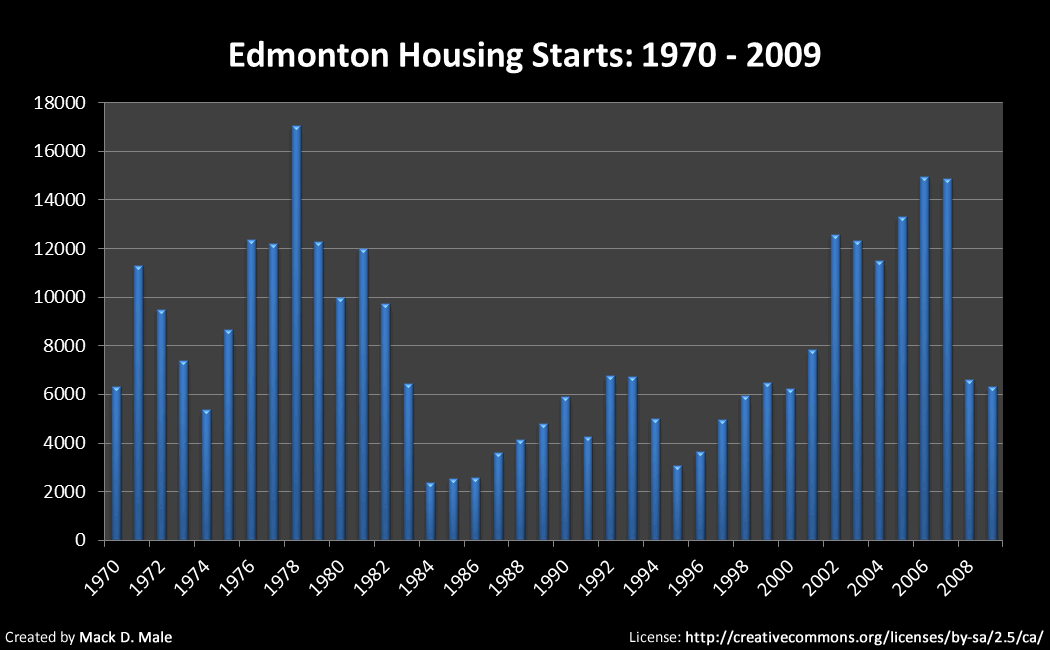
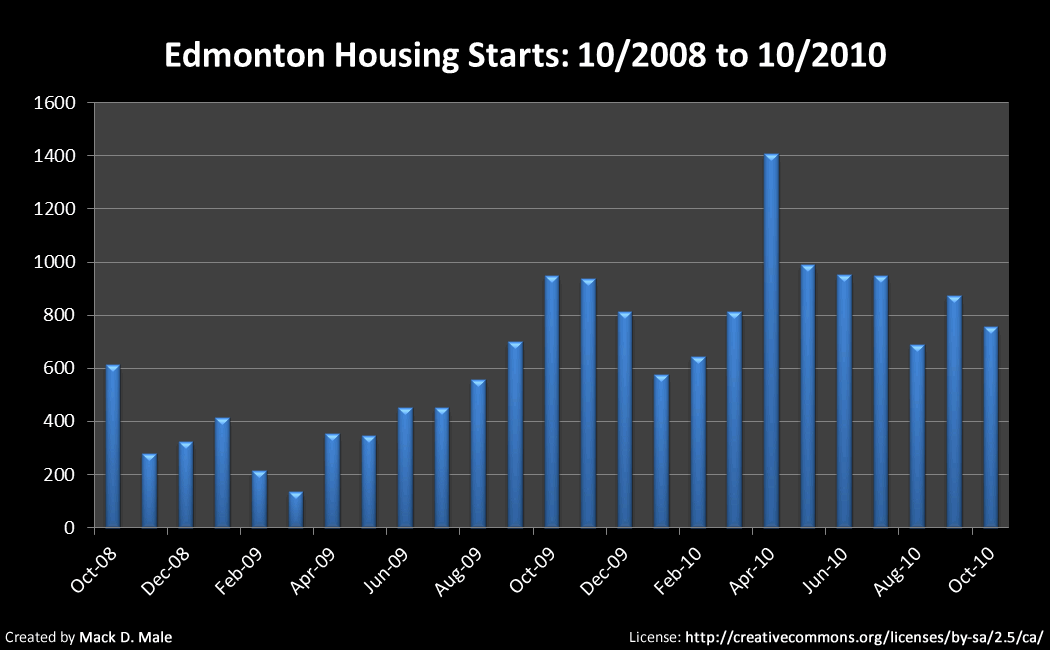
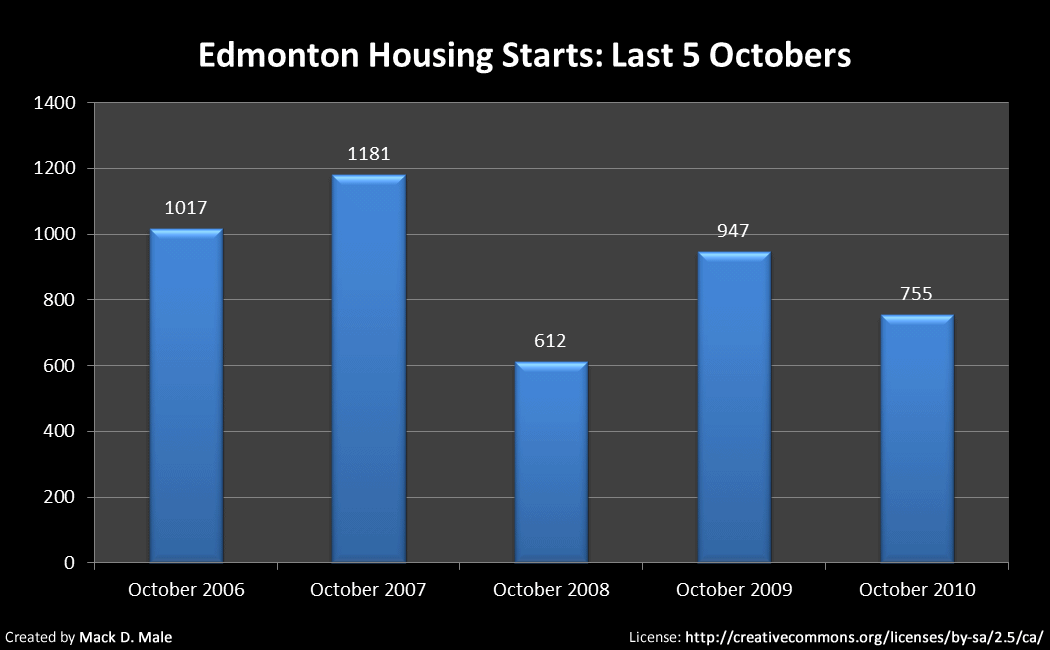
That’s the first reason that journalists should learn to love Excel – it can make providing context and better presentation easy. Here are three simple graphs, created with Excel, that tell you about housing starts in Edmonton.


This data comes from a PDF provided by the City of Edmonton. It shows annual housing starts since 1970. Copy and paste into Excel and you’re done!


This graph shows monthly housing starts from October 2008 until now. It uses data from the CMHC’s Reports & Publications section. Took maybe 10 minutes of copying and pasting.


This graph compares housing starts for this time of year from 2006 until now. Also comes from the CMHC.

Imagine if the article included graphs like these. The journalist could then focus on telling a more interesting story.

So, what’s the second reason journalists should learn to love Excel? Well, it can help them get their story right. Here’s what the Journal article starts with:

Despite a strong spring, the slowing trend in new-home construction became clear in October with housing starts dropping to their lowest level since June 2009 in the Edmonton region.

As you can see from the second graph above, that’s just not true. Is there a slowing trend? Maybe, if you just look from the spring to now. Was October the lowest level since June 2009? No. There were just 690 starts in August 2010. In fact, there were six months with lower housing starts since June 2009. I’m not sure what data the Journal was looking at, but it doesn’t appear to be CMHC data.

Add Excel to your toolkit. You won’t regret it.

UPDATE: Here’s the Journal story on August housing starts. Maybe if finding archived stories was easier, Dave Cooper, who wrote the story on October housing starts, could have consulted previous Journal articles to see that the lowest level was much more recent than June 2009.

CKUA Radio Network’s Fall 2010 Campaign

I spent a couple hours with the folks at CKUA Radio Network this summer talking about social media. They’ve been quite successful with it already, amassing more than 7500 fans on Facebook and more than 1500 followers on Twitter (and more importantly they have fairly high levels of engagement). While I was there, they invited me to check out the fall fundraising campaign, an offer I finally took them up on this morning!

CKUA Fall 2010 Campaign

CKUA started in 1927 at the University of Alberta, and has undergone a number of changes since that time. It has existed in its current form since 1994 when Access sold the network to the non-profit CKUA Radio Foundation. Though it went silent for a month in 1997, the network has been going strong ever since. The history is evident throughout their downtown studios, with lots of black and white photos on the walls.

CKUA Fall 2010 Campaign

Though many of the callers were from Alberta (CKUA has 17 transmitters in the province) there are a significant number of donors from around the world. CKUA started streaming its broadcast online on February 29, 1996, the first radio station in Canada to do so. There’s an updated list of cities from which donors have made pledges here in PDF.

CKUA Fall 2010 Campaign

While I was there, Allison Brock and David Ward were on-air. They’re one of the popular announcer teams of the campaign, an Allison in particular is known for her ability to really drive donations (as much as $25,000 in a single hour). Just before I left, Allison announced Double Your Dollars (DYD), a really popular hour during which any new donations are matched by an existing pool of DYD funds. As soon as she said it on the radio, every phone lit up!

CKUA Fall 2010 Campaign

Most of the volunteers answering the phones have been volunteering for years. They’re dedicated and efficient! Every time a new donor calls, everyone around the table rings a bell to celebrate. It certainly adds to the energy in the pledge room!

CKUA Fall 2010 Campaign

The current campaign started on October 14 and finishes tomorrow at midnight. The goal is $625,000, and so far CKUA has raised just over $410,000 (you can see the updated amount on their website). You can donate online, or you can call 1-800-494-2582.

Thanks to CKUA for letting me go behind-the-scenes this morning! You can see the rest of my photos here.

Edmonton Election 2010: Video Resources & Statistics

With less than five days to go until the election, time is running out for candidates to spread their message and for Edmontonians to get informed. I suspect there will be lots of people “cramming” over the weekend! Currently, 90 out of the 112 candidates running in this election have a website. Most of those websites have information on issues, platforms, etc. That information is great, but it can be hard to get a sense of someone through text alone.

Video can help you learn about a candidate in a different way. Body language, intonation, and emotion are all important aspects of communication that are lost when all you’ve got is text. From a practical perspective however, video is difficult to use. It can take significant time and effort to both create and consume. And if recent research is to be believed, it can be hard to justify the cost when nearly 20% of viewers abandon a video after just 10 seconds!

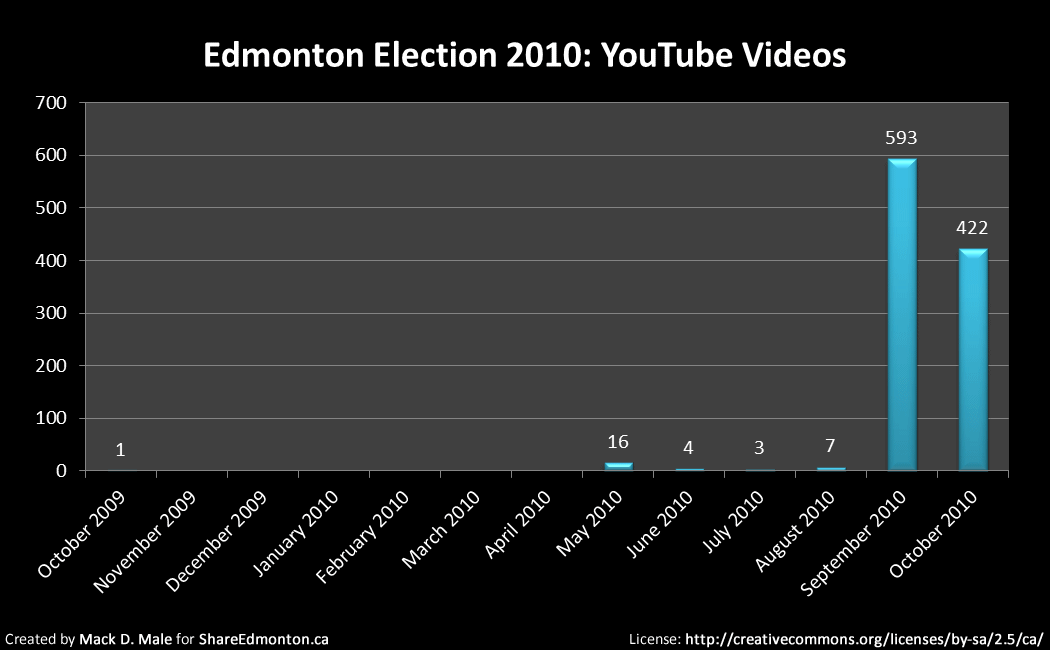
That might help to explain why just 12 of the candidates have YouTube pages. In total, they have uploaded 76 videos this election season, which in total have been viewed over 10,000 times (about 134 times each, on average).

In total, I have aggregated 1046 videos related to the election at ShareEdmonton (so far). You can see all videos, videos by ward, or videos by candidate. For example:

Here are some statistics on the aggregated videos:

  • Every video has been viewed at least once. In total, those 1046 videos have been viewed more than 26,000 times.
  • The average number of views per video is 25.
  • Daniel Dromarsky’s video on the Downtown Arena is the most viewed.
  • There are 104 videos with comments (9.9%).
  • The average number of comments on those videos is just under 2.
  • Daniel Dromarsky’s video on the City Centre Airport has the most comments.
  • There are 142 videos with ratings (13.6%).
  • The average rating on those videos is 4.2. There are 108 videos with an average rating of 5.

The vast majority of those videos have been uploaded within the last month or so.

That lonely video off to the left is from Ward 1 candidate Andrew Knack, who definitely started early.

There have been two key producers of election-related video: CTVnewsEdmonton and edpublicschools. Of the 1046 videos, those two users have uploaded 916. As a result, most candidates have some kind of video online, and a number of them have simply embedded CTV’s or Edmonton Public Schools’ videos on their own websites.

There are lots of other places to find election video (and audio):

And hey, what’s a post about video without an actual video! Here is one from the edmontonian on the basics of the municipal election:

You can watch part two here.

The final mayoral forum takes place tonight at Eastglen School, and election day is Monday! On election night, only CTV is planning to have live coverage on television, but there will be lots of online coverage. ShareEdmonton will be updating live with results, I’m sure #yegvote will be busy on Twitter, and the edmontonian will be broadcasting live.

Make sure you vote!

Double props to the Edmonton Journal

As you probably know, I don’t shy away from criticizing the Edmonton Journal (or other local media). Though I don’t always succeed, I do try to be constructive, because I think there’s incredible opportunity facing The Journal. Two such opportunities: data-driven journalism, and real-time reporting.

Props to Brent Wittmeier & Lucas Timmons

Neither Brent nor Lucas have been with The Journal for very long, and maybe that’s why they were able to succeed with the unclaimed balances story. Brent was voluntold to write about the Bank of Canada’s unclaimed balances, which he did by teaming up with data journalist Lucas to create a searchable online database for Edmonton. They put together a three-part story, but it didn’t stop there:

We also got quite the response. Dozens of phone calls and emails poured in, and I began working on a follow-up story. And then two. And now, three. Some of these other stories are even better than the original… There should be an extensive piece either later this week or next weekend.

Start with some data, and more often than not a story will emerge. Brent noted: “In truth, they ended up being far more interesting stories than I thought.”

Props to Paula Simons & David Staples

I’m glad to see that Paula and David (with some help from other colleagues such as Todd Babiak) have started a new blog focused on local affairs, called The Edmonton Commons. They used it very effectively on nomination day to share stories about the candidates and the official start of the election. They’ve also got the #yegvote hashtag embedded on the page. Though they have cross-posted some columns, I’m hopeful that their use of the blog as way to forego the print deadline will expand.

Here is Paula’s first post, and here is David’s first post. I like what David had to say:

The sharpening of ideas, the accumulation of good information and the discarding of bad information is at the core of strong decision making. It’s what we hope to do here at this forum. In the past, there were more barriers in regards to entering into the great conversation of civil society, even for a newspaper writer…the conversation was largely one-way. The Internet gives us a new tool that enables that conversation to flourish.

Time will tell how successful the two are with the blog (will they still be writing as often in three months as they do now) but I think they’re off to a great start.