Recap: DemoCampEdmonton12

Tonight we held our twelfth DemoCamp in Edmonton. We changed up the venue this time but decided to stay on the University of Alberta campus, so instead of the familiar ETLC we found ourselves at the Telus Centre. To me the vibe in the room felt different, like there was less energy, and it actually seemed like there were less people because it was a bigger room. It’s amazing how the layout of the room can have such an impact.

We had four short demos tonight, from some of the winners of the Apps4Edmonton competition:

  • Eugene showed us Statistics Edmonton, which lets you easily look at demographics and other information on a map.
  • Ben showed us Alertzy, which can send you a text or email notification when it is time for garbage pickup where you live!
  • Mitch showed us Diner Inspect, which lets you look at health inspects for restaurants in your neighbourhood.
  • Chris showed us YEG Live, which aggregates music events in Edmonton and does e-ticketing as well.

DemoCamp Edmonton 12DemoCamp Edmonton 12

We also had five regular demos:

  • Chad Smith from Hybrid Forge kicked things off by demoing TRACpac for iPhone, an iPhone application that lets users search the combined catalogue of more than 150 libraries. He also demoed an iPad app that offers the same functionality but with a different interface. The apps looked great, and I love that they use a variety of 3rd party APIs to pull in data.
  • Jas Panesar showed us an app he had built for clients to deal with managing warranties. We didn’t get to see too much of it, but it seemed to have some solid workflow behind it. And certainly as a customer, making my interactions with warranties better is a good thing.
  • Next up was David Nedohin and Kieron Quigley from Statusfirm. They demoed Core Catalyst, a CMS tool targeted at government, enterprise, and other large organizations. It’s actually the platform that is powering the City of Edmonton’s election webcasts.
  • Fourth tonight was Joel Adria and Yuri Delanghe, university students who built Bearbook which is a Facebook app that makes it easy for students to share their timetables with other students, and to find common breaks. Joel said they were inspired by Bearscat and currently have 3700 students using the app (half of which have uploaded their schedules).
  • Last but not least was Trystan Kosmynka and Colin Humber. They showed TestFlight, a beta testing management platform for developers targeting the iOS platform. It fills a big gap that Apple developers face, and does it without iTunes, cables, or jailbreaking.

You can see all the presenters on Twitter here.

Overall, I’d say my favorite demo was probably Bearbook (though I also really liked the TRACpac app that Chad showed). I think a lot of other people in the room enjoyed Bearbook as well, feeling that Joel and Yuri brought some of the old-school-DemoCamp back. And I love that Joel was more than happy to respond to questions about new features with “we wanted to keep it simple.”

I think the most popular demo was without a doubt TestFlight. I’m not an iOS developer, but a lot of people in the room were, and they seemed to be salivating at the solution that Trystan and Colin showed. I also love that they tackled a real problem, and solved a major pain point. TestFlight isn’t just cool tech, it will actually have a really positive impact on the lives of iOS app developers and their testers.

We definitely had some issues tonight. Internet connectivity was a problem, due in part to us being on the U of A campus I think. We need to get that figured out. A lot of our demos tonight used iPhones or iPads, so we made use of the camera display. It worked well enough but the constant switching of video cables did get somewhat annoying.

The after-party tonight was awesome! The entire top floor of Original Joes was packed. I’m sure some people skipped or couldn’t make the demos and just came for beer, which is fine! It was a good time.

DemoCamp Edmonton 12

There were a few announcements tonight:

  • The next BarCamp is tentatively scheduled for October 23.
  • The next Launch Party is tentatively scheduled for November 17.
  • There are a bunch of other tech events coming up! I’ve got them listed at ShareEdmonton.

Stay tuned to Startup Edmonton for updates. You can see a few more photos from the evening here.

Thanks to everyone who came out tonight. See you at DemoCampEdmonton13!

Double props to the Edmonton Journal

As you probably know, I don’t shy away from criticizing the Edmonton Journal (or other local media). Though I don’t always succeed, I do try to be constructive, because I think there’s incredible opportunity facing The Journal. Two such opportunities: data-driven journalism, and real-time reporting.

Props to Brent Wittmeier & Lucas Timmons

Neither Brent nor Lucas have been with The Journal for very long, and maybe that’s why they were able to succeed with the unclaimed balances story. Brent was voluntold to write about the Bank of Canada’s unclaimed balances, which he did by teaming up with data journalist Lucas to create a searchable online database for Edmonton. They put together a three-part story, but it didn’t stop there:

We also got quite the response. Dozens of phone calls and emails poured in, and I began working on a follow-up story. And then two. And now, three. Some of these other stories are even better than the original… There should be an extensive piece either later this week or next weekend.

Start with some data, and more often than not a story will emerge. Brent noted: “In truth, they ended up being far more interesting stories than I thought.”

Props to Paula Simons & David Staples

I’m glad to see that Paula and David (with some help from other colleagues such as Todd Babiak) have started a new blog focused on local affairs, called The Edmonton Commons. They used it very effectively on nomination day to share stories about the candidates and the official start of the election. They’ve also got the #yegvote hashtag embedded on the page. Though they have cross-posted some columns, I’m hopeful that their use of the blog as way to forego the print deadline will expand.

Here is Paula’s first post, and here is David’s first post. I like what David had to say:

The sharpening of ideas, the accumulation of good information and the discarding of bad information is at the core of strong decision making. It’s what we hope to do here at this forum. In the past, there were more barriers in regards to entering into the great conversation of civil society, even for a newspaper writer…the conversation was largely one-way. The Internet gives us a new tool that enables that conversation to flourish.

Time will tell how successful the two are with the blog (will they still be writing as often in three months as they do now) but I think they’re off to a great start.

Recap: Startup Weekend Edmonton

This past weekend was the first Startup Weekend in Canada, held right here in Edmonton! About 30 local developers, designers, and idea people got together at Enterprise Square for the event, organized by Startup Edmonton. As I mentioned last week, Startup Weekend’s mission is to teach entrepreneurship in a fun, interactive way. It’s also a great way to see first-hand the talent that exists in the local tech community.

The weekend got started on Friday evening with the pitches. Anyone with an idea for an application or product was invited to write it down on a flip chart. After all the ideas were collected, each one was given 60 seconds to make an elevator pitch, trying to attract people to the team. When that was done, everyone spread out and slowly but surely teams formed. In the end, six teams came together for the weekend.


The teams starting to form on Friday evening

For all of Saturday and most of Sunday the teams were hard at work on their ideas. There is no required deliverable at the end of Startup Weekend, but each team was working as quickly as possible to get as much done as they could in time for a demo. Startup Weekend forces teams to focus on bringing an idea to life quickly, which is an important skill to have. Ideas are a dime a dozen, but being able to execute on them is much more difficult. Starting with just the seed of an idea and less than two days later having something workable to show to others is incredibly valuable. Another great thing about Startup Weekend is that it provides an opportunity for individuals to work together, even if they had never met before. It’s amazing what can happen when two or more creative people get talking.

As the teams put the final touches on their prototypes on Sunday evening, members of the local tech community started to arrive. The final part of Startup Weekend was the demo, giving teams a chance to show off what they had worked on for the last two days.

Here’s what was built at Startup Weekend Edmonton:

  • HomeCricket, an iPhone application that utilizes Open Data from the City of Edmonton to help you find a house. It shows you assessment information, as well as the nearest police stations, schools, parks, and more.
  • Life Radar, a to-do application for the iPad that uses a points system to motivate you to get things done. Neat app, especially when you consider that no one on the team had ever built an iPad app before!
  • RightPath, a web-based Q & A style app that connects high school students with mentors from the business world. Students ask questions about careers, mentors answer.
  • PaxImperium, a social real-time strategy game for Facebook. With no developers on the team, they focused on a detailed product pitch instead, complete with financial projections.
  • GameGigs, a web-based app that connects game developers, designers, and players. It uses the Twitter API for authentication, which made for an interesting (and challenging) demo!
  • Green Planet, a Facebook-based app (with an iPhone app too) that builds awareness around environmental sustainability. As you complete real-life missions (like replacing light bulbs in your house with energy efficient ones) your virtual planet benefits.

I’m really amazed at what was created in such a short amount of time! The apps were all polished and well-thought out, and while there were some bugs in the demos as expected, every team completed enough to clearly convey their idea. Many of the ideas changed quite a bit from the original pitch on Friday, and it would be interesting to see how they’d change even more if the teams continued working on them. With the Apps4Edmonton competition now underway, I suspect some of the teams may do just that.

There are loose plans for another Startup Weekend in Edmonton, tentatively scheduled for the fall. Stay tuned to Startup Edmonton (and on Twitter) for updates. You can see the rest of my photos from Startup Weekend here.

Congratulations to the Startup Edmonton team and to all the participants for a very fun and successful weekend!

City of Edmonton launches Apps4Edmonton Competition

On Wednesday the City of Edmonton officially launched its Apps4Edmonton competition, which challenges residents to submit ideas for apps and developers to actually build them. There is more than $50,000 in prizes available, and everyone has a chance to win an Apple iPad. Here’s what the competition is all about:

Every Edmontonian can be an active participant in reshaping our city. Together with community partners the City of Edmonton is proud to launch Apps4Edmonton – a contest which encourages residents to develop applications that will benefit Edmontonians.

Using data sets from the Edmonton Open Data Catalogue, we’re challenging you to develop an app for either a smart phone, mobile device, or PC web browser. Mash up a map, create a visualization, or analyze data in a new way, the choice is yours.

To support the competition, the City has also released an update to the Data Catalogue. There are now 25 datasets available, including Ward boundaries and a list of City facilities. Even more datasets should be available soon, and if there’s something specific you’d like to have, request it from opendata@edmonton.ca.

If you have an idea for an app, submit it here. It can be anything, so be creative! Even if your idea isn’t possible or a developer doesn’t want to take it on, it might serve as inspiration for other apps, so don’t be shy. If you’re building or have already built an app, submit it here. You have until August 27 to do so. The FAQ has some good info, and be sure to familiarize yourself with the rules too.

Applications will be judged on four criteria: Accessibility, Usability, Creativity, and the number of community votes received (voting runs online from August 27 to September 10). In addition to three overall prizes (Gold, Silver, Bronze) there are six categories:

  • The Way We Live
  • The Way We Grow
  • The Way We Green
  • The Way We Move
  • The Way We Plan
  • The Way We Prosper

I’m very happy to see that IT has aligned itself with Transforming Edmonton for this competition! I am hopeful that Apps4Edmonton can help introduce more Edmontonians to those important documents that help guide us toward becoming a more innovative, inclusive, and creative city.

To learn more about Apps4Edmonton, visit the contest site. There should be lots of chatter about the competition at Startup Weekend too, and tonight at the Emerging Business Leaders’ Patio Party.

I can’t wait to see what everyone comes up with!

Startup Weekend comes to Edmonton

This weekend Edmonton will host an event called Startup Weekend (on ShareEdmonton), which brings together developers, designers, marketers, inventors, investors, and anyone else interested in startups to see what they can build in just 54 hours. Will the next big thing emerge out of Edmonton? Will the community create something small that positively impacts the lives of Edmontonians? Maybe both!

Startup Weekend has happened in dozens of cities around the world. Their goal is to hold 60 events this year, and 100 in 2011. Here’s some background:

Startup Weekend is a non-profit organization based out of Seattle, WA USA. Startup Weekend is a small team of three along with community leaders around the world. Startup Weekend’s primary mission is to be the most valuable and influential organization in startup communities around the world. Startup Weekend doesn’t have to teach entrepreneurship in a boring classroom setting, we model it in a fun, interactive, and results driven way. As a result, we have become one of the leading catalysts for startup creation, co-founder dating, and entrepreneurship education in startup ecosystems around the world.

You can download a one-pager on Startup Edmonton in PDF here.

The way the event works will be somewhat familiar to anyone who has attended a *camp. It starts with the pitch – ideas for new startup ventures. The favorites are selected, and teams of 4 to 10 people are formed to tackle each one. The rest of the weekend is spent trying to build a prototype, demo, or maybe even a finished product!

The Edmonton event, organized by Startup Edmonton, is taking place at Enterprise Square downtown. The weekend kicks off on Friday evening at 6pm, with introductions and idea pitches. Then the real work begins! Here’s what attendees get out of the event:

Startup Weekend provides an unprecedented level of networking, team building, learning, and life changes for its attendees and their communities. Don’t forget that there will be 6-7 meals and drinks provided. There is a reason that most attendees come back for every event – it’s just plain fun and provides amazing opportunities you can’t get anywhere else. Sometimes a company emerges, sometimes one doesn’t, but every time people leave with more experience, insight, knowledge, friends, and resources than they came with.

Startup Weekend should be a lot of fun! Tickets are $99, which includes meals and beverages for the weekend (there are a few available at half price if you hurry). You can follow @StartupEdmonton on Twitter for updates, as well as the #SWEdmonton hashtag. See you there!

Click here to register for Startup Weekend Edmonton!

Edmonton Journal launches 2D barcodes with ScanLife

Yesterday the Edmonton Journal launched 2D barcodes throughout the newspaper, enabling readers with mobile devices to scan the codes for access to related information. They chose ScanLife to provide the technology, the same company that Metro Canada chose back in September. Here’s what The Journal had to say about the barcodes, known as EZcodes:

Want to vent? Send a letter to the editor? Tweet at one of our writers? Find a map to that great new restaurant? Just scan the code and that information stays with you and your phone to take wherever you want. The standing codes attached to our regular columnists and bloggers stay under the history button in the ScanLife application on your phone, so you can read their latest columns and blogs even when you don’t have the paper with you.

Mobile barcodes are another technology that Canada (and North America really) is behind on relative to the rest of the world. In that respect, I guess you could say that Metro and The Journal are adopters of the technology. ScanLife isn’t the only player, another popular choice (at least in North America) is Microsoft Tag, which uses high capacity color barcodes rather than the black-and-white EZcodes.

To get started with the codes that The Journal is using, simply visit http://2dscan.com on your smartphone to download the free scanning software. Then whenever you see the 2D barcode, just scan it! There are more detailed instructions here.

Edmonton Journal ScanLife Launch

The Journal hosted a party last night at Earls Tin Palace to celebrate the launch. The patio was packed with people wearing nametags with EZcodes on them. Bistro columnist Liane Faulder was the host, appropriate as her section was the first to launch with the new codes. Here’s a video of Liane, Edmonton Journal publisher John J. McDonald III, and Caritas Hospital Foundation President John Boucher (the first advertising partner for the codes) talking about the launch of 2D codes in the paper:

It was a fun party! I learned that Sandra Marocco planted the seed for the idea after a trip to New York. She noticed the tags being used outside Saks on Fifth Avenue, and decided to explore them further. After she found that Esquire magazine was using them, she realized they might provide value to the Edmonton Journal. The rest, as they say, is history.

Edmonton Journal ScanLife LaunchEdmonton Journal ScanLife Launch

You can see a few more photos from the party here. You can also see some photos and a video at The Journal.

Thoughts on 2D barcodes in the Edmonton Journal

I have mixed emotions about the 2D barcodes now found inside the Edmonton Journal. I think it’s great that they are continuing to experiment, trying new things, and I hope we see additional innovations coming from The Journal in the near future. Having said that, I wonder if too much emphasis is being placed on the barcodes by management. More than a few times last night I heard “this is just the beginning” or as was printed yesterday, “the possibilities for connection are endless.” I have three main issues with the barcodes:

  1. Putting the barcodes inside the newspaper reinforces the importance of the physical product. It emphasizes the “paper” part of “newspaper” rather than the “news” part. It’s short-term thinking, not long-term thinking. I think The Journal is very much facing the innovator’s dilemma, and even though the smart people that work under management know what needs to be done, they hit roadblocks at every turn. Here’s a rough analogy for you: The Journal is like a long-time smoker, addicted to paper. Connecting the physical paper to the digital world with barcodes is like a smoker using a nicotine patch, even though we know cold turkey is the most effective way to quit.
  2. Speaking of reinforcing the paper, the barcodes give you more information than the actual website does. That’s just completely unacceptable. Take yesterday’s Bistro article on sliders. The EZcodes provide access to “a list of Edmonton restaurants with sliders on the menu…a tasty recipe from local foodie Shauna Faragini… and where to get slider buns and pre-made sliders”. The online story? Completely devoid of links. There are so many things wrong with this picture that I don’t know where to start. Writers need to do some extra work to create the codes, but I would much rather see that extra work be put into links on the website (and I’m positive that doing so would provide greater value to The Journal).
  3. Less of an issue but still important is that the EZcodes are somewhat generic. Columnists get a code, and some special features like the Bistro get a code, but individual stories do not get their own codes. This is partly a technology issue, but mainly a cost issue. I think that makes the EZcodes a little less useful (an option to “tweet this story” after scanning a code simply isn’t possible, for example).

Again though, I want to reiterate that this is a positive step for the Edmonton Journal from the perspective of trying something new, and working to provide more value to readers (and advertisers). Congrats to the entire Edmonton Journal team for making it happen!

I also want to commend The Journal on the way they did the launch. They had videos prepared online demonstrating the technology, and every article I read asked for reader feedback and suggested a variety of ways to provide it. I really do believe that they want to know how to shape their use of the technology based on reader feedback. The party was a nice touch as well. Most interesting to me though, was the use of the @EJ_Cares account on Twitter. It has been actively monitoring and engaging in discussion about the 2D barcodes and the ScanLife application. The online community are most likely going to be the early adopters of the barcodes, so it’s smart to engage with them right away – well done to the @EJ_Cares team!

I hope Journal readers find the barcodes useful, and I look forward to many more interesting ideas in the future!

UPDATE: Here is Jeff’s take on the party and the barcodes.

UPDATE2: Turns out the information is on the website, just on a different story page (this is another issue with The Journal’s online stuff). I think the link text could have been more clear than “Slider tips and toppings” but the point is the information was online – my mistake!

Edmonton-based startup Edistorm continues to grow

edistorm One of the things we need to do more of in Edmonton (especially in the tech sector) is celebrate our successes (storytelling). Reg and I talk all the time, but not always about our respective projects. Recently though, I had the opportunity to ask Reg about Edistorm, his web-based, collaborative brainstorming solution. He first previewed it to the local community at DemoCampEdmonton4 back in October 2008, and has been steadily improving it ever since, demoing again at Launch Party in March. Reg said the feedback he received and introductions that he made at Launch Party were particularly useful. I asked him how the service has been doing since then.
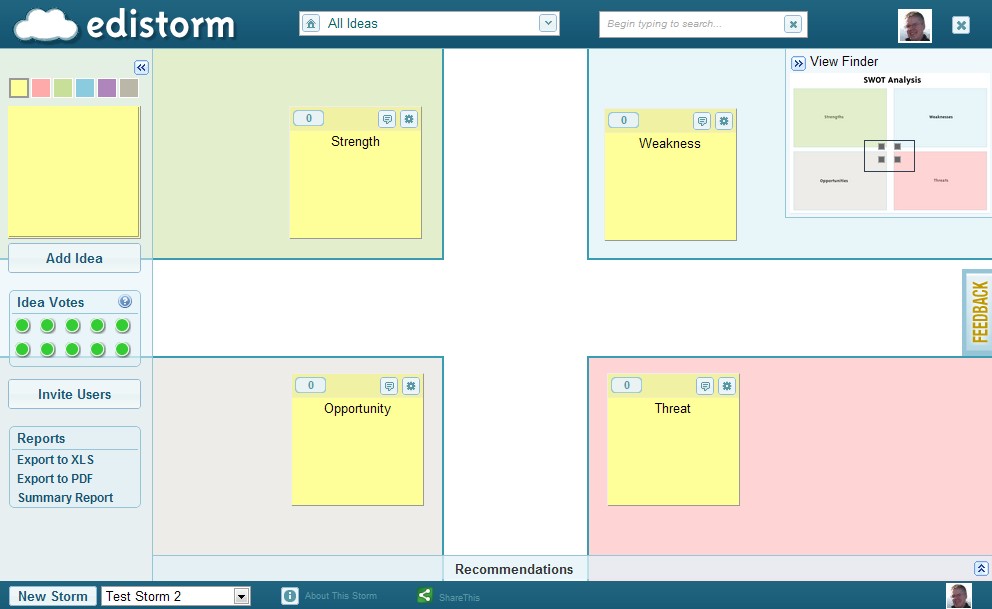
Edistorm has been getting a lot of traction lately, largely from customers outside of Edmonton. In the last 30 days alone, Edistorm has had visitors from 103 countries and has signed up over 1000 new users. There are registered users from over 60 countries now (one of the great things about Edistorm is that it doesn’t contain a lot of text that needs to be translated…the short intro video on the website is enough for people in any language to get the idea and start using it).

For those of you new to the service:

Edistorm takes the metaphor of sticky notes on a boardroom wall and brings it online allowing anyone, anywhere to brainstorm with only a web browser.

After you login and create a storm, you’re presented with a nice blank canvas. You can add ideas (on sticky notes, natch) both manually and from “idea bots” that brainstorm with you, then you can organize and vote on them. If you invite others to join your storm, they can add ideas to the canvas and vote in real-time as well.

I asked Reg what was new with Edistorm. Turns out there’s a number of things the team has added recently:

  • You can now get daily email summaries to see which ideas have been added or commented on in your storms.
  • One of the coolest new features is templates, which help your organize your ideas on the storm canvas. When creating a storm, you can choose from SWOT analysis, pros vs. cons, domain names, and more. The team is open to ideas for more templates too!
  • Sharing storms is even easier – you can simply provide a key now, instead of having to invite via email.
  • A new iPhone app will be available in the app store within the next two weeks!

Brainstorming is something everyone does, and Edistorm makes it easy to brainstorm online with others. Reg sounds pretty excited about the growth he’s achieved so far (with very little marketing) and about where the service is headed feature-wise. Best of all, it sounds like some bigger organizations are starting to take notice. I think it’s great that another local startup is doing well, and I know Edistorm will continue to grow!

If you haven’t tried Edistorm yet, you can sign up for a free account here. Be sure to follow @edistorm on Twitter too!

Recap: Tech·Ed North America 2010 Day 4

Yesterday was the final day of TechEd North America 2010 and the start of a max exodus of geeks out of New Orleans (they’re hard to miss wearing the official TechEd backpacks or other clothing emblazoned with tech company logos). I’m sure some people skipped the final day, but it still seemed pretty full. As you can see in this video I recorded mid-afternoon, many people were still attending the final sessions:

After a leisurely morning, John and I attended Mark Russinovich’s session on Pushing the Limits of Windows. Mark is one of just a handful Technical Fellows at Microsoft, and probably knows more about how Windows works internally than anyone else. As expected, Mark packed one of the larger auditoriums at the convention centre. He didn’t strike me as a natural-born presenter, but I still very much enjoyed his talk (and learned quite a lot). As John remarked on the way out, “my brain hurts.”

Tech·Ed North America 2010

I couldn’t resist attending the Coding4Fun session in the afternoon, titled Learn Windows Phone 7 Development by Creating a Robotic T-Shirt Cannon. Daniel Fernandez and Clint Rutkas walked us through how they built a Windows Phone 7 app to control the robot (affectionately named Betty) that debuted at Mix back in March. Along the way, they shot out a few dozen t-shirts and weren’t afraid to show off the robot’s capabilities! Here is a video I recorded of the robot in action:

Tech·Ed North America 2010

It was a fun way to get some exposure to Windows Phone 7 development. If you’ve never checked out Coding4Fun before, you really should! You can find the source code for the app they built here.

The final session I attended at TechEd was Programming AppFabric: Moving Microsoft .NET to the Cloud, presented by Pluralsight’s Aaron Skonnard and Keith Brown. Despite progressing a little slowly at times, I thought the talk was fantastic. In particular, the way Aaron started it was memorable. He fired up a console app running on his laptop and asked everyone with Internet-connected devices in the audience to hit a public URL. Immediately requests started appearing on the screen, prompting the very distinctive “how did he do that” murmurs among everyone in the room (turns out it is the magic of the AppFabric Service Bus).

TechEd officially finished with a large party in the evening at Mardi Gras World. Buses took thousands of geeks to and from the event, which featured a number of live bands, magicians, jugglers, palm readers, and an Xbox gaming room, among other things. It was fun to just walk around the party, taking in the sights and sounds.

Mardis Gras World

Mardis Gras World

I learned quite a lot at TechEd, and have a pretty long list of things I want to look into further! It was a fun week.

You can see more of my TechEd photos here, and also at the TechEd group on Flickr.

Recap: Tech·Ed North America 2010 Day 3

Maybe it was because I was wearing shorts, but the convention centre seemed especially cold yesterday (and today). Still really hot outside for TechEd attendees however, with temperatures hovering around the 30 degrees C mark. The day seemed to go fairly smoothly, with the exception of lunch (there was a session that went through most of the lunch break, and they ran out of food, which meant incredibly long lineups right at the end).

Tech·Ed North America 2010Tech·Ed North America 2010

The first session I went to yesterday was Windows Server AppFabric Caching: What It Is and When You Should Use It. I’m a fan of Memcached, and have been using it for a number of years now, so I really wanted to see how AppFabric compares (the codename for this was Velocity, which I wrote about here). I’d say that overall they are quite similar, though if you’re a .NET developer using AppFabric can give you some quick wins. One example is that with just a couple of lines in the Web.config, you can use AppFabric to store Session information, perfect for a web farm scenario. Another thing I like is that AppFabric Caching is managed through PowerShell. Here are some resources:

Tech·Ed North America 2010

After lunch I attended one of the bigger sessions, Overview of the Microsoft ADO.NET Entity Framework 4, hosted by Julie Lerman and Chris Sells. I really enjoyed it, first and foremost because it consisted mainly of demos, and secondly because Julie and Chris were really entertaining and worked well together. Here again, I have been using an open source solution – SubSonic. I remember reading about EF really early on, but didn’t spend too much time on it because of all the criticism it received. If nothing else, the session yesterday made me want to look at EF again – it has really come a long way. I was impressed.

Another session I attended was Building RESTful Applications with the Open Data Protocol. Although labeled a 300-level session, it was very introductory, and didn’t contain anything I hadn’t already seen. It was great to see so many people in the session though – clearly there’s some interest.

I also took some time yesterday to explore the Exhibition Hall a bit more, stopping by the Spoon booth to talk with them. They have some really interesting virtualization and application streaming technology. I recorded a short video and wrote more at Techvibes.

Tech·Ed North America 2010

There are lots of social events during TechEd, but last night in particular seemed like a busy night. John and I checked out the Springboard party at the House of Blues (where we saw some of the Hawks-Flyers game) as well as the Pluralsight mixer. Good times!

You can see more of my TechEd photos here, and also at the TechEd group on Flickr.

Recap: Tech·Ed North America 2010 Day 2

Full day of sessions at TechEd yesterday, though I did take some time in the morning to catch up on blogging, as I am doing today. Probably the most talked about topic at TechEd so far has been the breakfast! People are simply not happy with bagels, muffins, and scones. Either the breakfast or these mascots that everyone has been stopping to get a photo with:

The main feature of the day was the Business Intelligence keynote with Ted Kummert, Microsoft Senior Vice President, Business Platform Division. I missed it, so I’ll watch it online, which you can do here. You can also read a transcript here.

The first session I went to was Prototyping Rich Microsoft Silverlight 4 Applications with Microsoft Expression Blend + SketchFlow. It was really interesting to see how you could use SketchFlow to draw out some screens from your application, and then start to add behaviours and other improvements. We also saw the new feature that enables you to publish a SketchFlow document to SharePoint, making it easy to share a prototype/mockup with colleagues. For more information:

Another session I checked out was Intro to Workflow (WF) Services & Windows Server AppFabric. I’m getting increasingly interested in AppFabric. It seems like a no-brainer to use it if you’re on the Microsoft platform already. I probably should have brushed up on some WF before attending the session, but it was still useful to see how WCF, WF, and AppFabric work together. For more information:

My favorite session of the day was the final one, Open Data for the Open Web, presented by Douglas Purdy and Jonathan Carter. This session had two things going for it: open data, one of my favorite topics, and the hilarious tag team of Douglas and Jonathan. They were really quite entertaining, but still managed to do a great job of explaining what OData is, and what the vision is. And, bonus, the City of Edmonton logo was on screen briefly! Some resources from this session:

The Internet at TechEd was pretty reliable yesterday, which meant that everyone on Twitter was able to find out that it was raining outside:

Some other sights:

Tech·Ed North America 2010
Microsoft Tag spotted at TechEd!

Tech·Ed North America 2010
Developers don’t actually talk like that…

Tech·Ed North America 2010
Top Secret! mPad!

You can see more of my TechEd photos here, and also at the TechEd group on Flickr.