Edmontonians magazine calls it quits, the edmontonian celebrates 1 year

After 21 years of publishing, Edmontonians magazine is calling it quits. Citing declining advertising revenues, publisher Sharon MacLean announced today via email that the June edition of the magazine will be its last.

“The news business is caught in the cyclone of change, fueled by the tremendous growth in popularity of access to news and information on the Internet. Both readership and revenues have declined significantly; major dailies have closed their doors, as have a number of magazines.”

Edmontonians had started to cultivate an online presence, amassing over 4400 followers on Twitter, but the publication remained firmly rooted in print. Perhaps anticipating a question about where the industry is going, Sharon wrote “there is much hope for the future of publishing – we simply ran out of time to bridge the transition.”

I can’t say that I was a fan of Edmontonians, but I know many people in the city really liked the publication. So far no announcement has been made on the website, so I’m not sure what will happen to the content available there. There’s also no word on what Sharon will be up to next.

The decision to cease publishing Edmontonians magazine comes at the same time that local website the edmontonian is celebrating its first year. And what a year it was! Jeff reports:

75,000+ people have checked us out. We’ve averaged 3 posts per day. We’ve got more than 2 comments per post. In the last year we’ve posted more than 780 times. We’ve also shown off more than 1,500 photos of Edmonton. We had 40+ contributors who wrote, took photos, shot video, gave us prizes, and did lots of other great stuff, all helping to tell Edmonton stories.

Of course, if you read Jeff’s actual post, you’ll see that the above stats are mixed in with his trademark writing style. Free from the constraints of print, Jeff and his partner-in-crime Sally have been able to produce content the way they want to, when they want to. That has resulted in a publication that I and many others enjoy going back to (or subscribing to) each and every day.

The similarity of their names notwithstanding, I think these publications are a great representation of two completely different worlds. The advertising-supported physical print model is increasingly under fire from the more flexible online digital media model. Will the edmontonian be around for 21 years like Edmontonians was? Almost certainly not, at least not in its current form (who knows what kind of technology we’ll have when 2031 rolls around). But for right now, its pretty clear that the edmontonian is the more sustainable model.

Congrats to Edmontonians on 21 years of telling Edmonton stories! Congrats to the edmontonian on a fantastic first year!

Edmonton-based startup Edistorm continues to grow

edistorm One of the things we need to do more of in Edmonton (especially in the tech sector) is celebrate our successes (storytelling). Reg and I talk all the time, but not always about our respective projects. Recently though, I had the opportunity to ask Reg about Edistorm, his web-based, collaborative brainstorming solution. He first previewed it to the local community at DemoCampEdmonton4 back in October 2008, and has been steadily improving it ever since, demoing again at Launch Party in March. Reg said the feedback he received and introductions that he made at Launch Party were particularly useful. I asked him how the service has been doing since then.
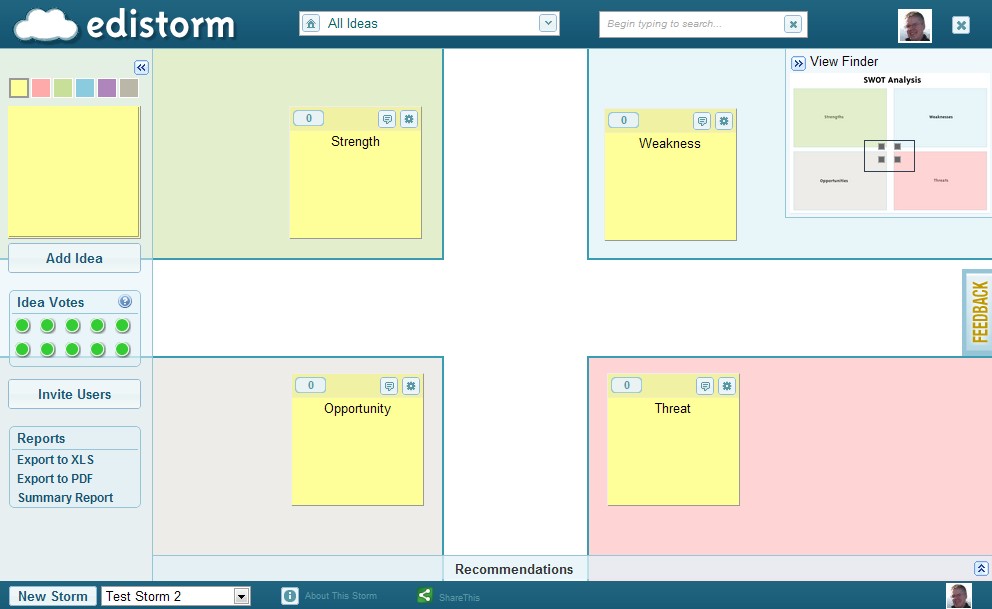
Edistorm has been getting a lot of traction lately, largely from customers outside of Edmonton. In the last 30 days alone, Edistorm has had visitors from 103 countries and has signed up over 1000 new users. There are registered users from over 60 countries now (one of the great things about Edistorm is that it doesn’t contain a lot of text that needs to be translated…the short intro video on the website is enough for people in any language to get the idea and start using it).

For those of you new to the service:

Edistorm takes the metaphor of sticky notes on a boardroom wall and brings it online allowing anyone, anywhere to brainstorm with only a web browser.

After you login and create a storm, you’re presented with a nice blank canvas. You can add ideas (on sticky notes, natch) both manually and from “idea bots” that brainstorm with you, then you can organize and vote on them. If you invite others to join your storm, they can add ideas to the canvas and vote in real-time as well.

I asked Reg what was new with Edistorm. Turns out there’s a number of things the team has added recently:

  • You can now get daily email summaries to see which ideas have been added or commented on in your storms.
  • One of the coolest new features is templates, which help your organize your ideas on the storm canvas. When creating a storm, you can choose from SWOT analysis, pros vs. cons, domain names, and more. The team is open to ideas for more templates too!
  • Sharing storms is even easier – you can simply provide a key now, instead of having to invite via email.
  • A new iPhone app will be available in the app store within the next two weeks!

Brainstorming is something everyone does, and Edistorm makes it easy to brainstorm online with others. Reg sounds pretty excited about the growth he’s achieved so far (with very little marketing) and about where the service is headed feature-wise. Best of all, it sounds like some bigger organizations are starting to take notice. I think it’s great that another local startup is doing well, and I know Edistorm will continue to grow!

If you haven’t tried Edistorm yet, you can sign up for a free account here. Be sure to follow @edistorm on Twitter too!

OpenID Connect

I’ve been doing some work with OpenID and OAuth lately, making use of the excellent DotNetOpenAuth library. I am pretty much a beginner when it comes to these technologies, but I have been able to get up-to-speed fairly quickly. I was a big fan of Facebook Connect, and I quite like the new Graph API too (which uses OAuth 2.0). Though it was easy to develop against, I think the biggest benefit of Facebook Connect was the excellent end user experience. It was consistent and simple.

In contrast, OpenID is a little more cumbersome, and a lot less consistent. The discussion on how to make it easier and sexier has been going on for a while now. It seems like some significant progress will be made this week when OpenID Connect is discussed at the Internet Identity Workshop. What is OpenID Connect?

We’ve heard loud and clear that sites looking to adopt OpenID want more than just a unique URL; social sites need basic things like your name, photo, and email address.

We have also heard that people want OpenID to be simple. I’ve heard story after story from developers implementing OpenID 2.0 who don’t understand why it is so complex and inevitably forgot to do something. Because it’s built on top of OAuth 2.0, the whole spec is fairly short and technology easy to understand. Building on OAuth provides amazing side benefits such as potentially being the first version of OpenID to work natively with desktop applications and even on mobile phones.

Chris Messina has some additional thoughts on the proposal here:

After OpenID 2.0, OpenID Connect is the next significant reconceptualization of the technology that aims to meet the needs of a changing environment — one that is defined by the flow of data rather than by its suppression. It is in this context that I believe OpenID Connect can help usher forth the next evolution in digital identity technologies, building on the simplicity of OAuth 2.0 and the decentralized architecture of OpenID.

It sounds very exciting – I hope OpenID Connect becomes a reality!

How much traffic do the Edmonton Journal and iNews880 get from Twitter?

Depending on who you talk to, Twitter is either killing news media or saving it. A recent analysis by Hitwise found that less than 0.2% of people who use Twitter wind up going to news and media sites (thanks to Karen for the link). Their analysis looks at Twitter as a whole though, and I’m not sure how well it accounts for local news sites. I believe very strongly that social media has the greatest impact at the local level (more on this in a future post). Given that, I have long wondered how Twitter has impacted local news media here in Edmonton. Last night, I finally did some analysis. I decided to explore how much traffic the Edmonton Journal and iNews880, Edmonton’s two top tweeting media outlets, received from Twitter last year.

@EdmontonJournal

First up, the Edmonton Journal. They’ve been tweeting news articles since at least January 2009, so I had lots of data to play with. They used tweetburner to shorten links until September when they switched to bit.ly. Using the APIs available from those services, I added up all the click stats for all the links posted by The Journal. Here’s what I found:

Lots of variation, as you can see. Some of that is down to the use of two services, some of it is because of the number of Twitter users. There are probably dozens of other factors too.

For the period January 30 through December 31:

  • A total of 153,968 clicks were recorded on 4737 links.
  • That’s an average of 33 clicks per link, and an average of 15 links per day.
  • According to the stats on the bit.ly links, 95.4% of clicks come from the Edmonton Journal’s hash*.
  • The link with the most clicks (700) was this one, on May 26. It doesn’t work, because annoyingly The Journal doesn’t display old articles for some reason, but it appears it was about Edmonton’s Poet Laureate Roland Pemberton.
  • The day with the most clicks, September 14, doesn’t appear to be special…just lots of clicks that day for some reason (any ideas?).

@iNews880

Next up, iNews880, one of the first local media organizations to join Twitter. They used tinyurl.com until July, when Twitter switched the default to bit.ly, so unfortunately I only have data for the latter half of the year:

For the period July 14 through December 31:

  • A total of 90,500 clicks were recorded on 3811 links.
  • That’s an average of 24 clicks per link, and an average of 22 links per day.
  • According to the stats on the bit.ly links, 93.8% of clicks come from iNews880’s hash*.
  • The link with the most clicks (1933) was this one, on August 2 (that’s the huge spike in the graph above). The link goes to the report on the Big Valley Jamboree stage collapse, and it was popular because it included before and after photos.

Edmonton Journal vs. iNews880

I wanted to do a quick comparison, so I chose the period September 17 through December 31, because both sites used bit.ly for links during that time. Here’s what it looks like:

During that time:

  • The Edmonton Journal posted 2369 links (23 per day) and iNews880 posted 2261 links (22 per day).
  • A total of 79,519 clicks were recorded on Edmonton Journal links (an average of 751 per day or 34 per link).
  • A total of 53,815 clicks were recorded on iNews880 links (an average of 508 per day or 24 per link).

Thoughts

That’s a lot of clicks! Clearly Twitter and other social networking sites (where most shortlinks are posted) are having an impact. But how much? According to the latest report by the Newspaper Audience Databank (NADbank), weekly online readership at EdmontonJournal.com increased by 35% last year to 115,900 from 85,800 in 2008. That’s an increase of 30,100 readers per week. According to the click stats above, The Journal received 3208 clicks per week in 2009. So what does that mean?

Roughly 10.7% of the Edmonton Journal’s online readership increase in 2009 came as a result of posting links to Twitter.

And if I had to guess, I’d say my analysis probably underestimates things. Apparently the NADbank data is based on surveys, so I’m not sure how accurate it is, but it’s probably within acceptable margins of error. I’m also not sure what exactly a “reader” is – a page view, a visit, etc.

Caveats

I’ve tried to be as accurate as possible, but I can’t make any guarantees!

  • All the click stats are current as of last night.
  • I’m suggesting that all the clicks come via Twitter, when that’s probably not entirely true. Links get passed around, displayed on websites, etc. But the shortlinks do originate at Twitter.
  • It’s possible that The Journal or iNews880 posted a link to somewhere other than their own sites, but uncommon. I did remove one link from the iNews880 dataset, because it pointed to an Environment Canada site (it was obvious, lots of total clicks as others have linked there too). For the rest, I’m making the assumption that the links point to the news sites.
  • I don’t know how reliable the stats from bit.ly and tweetburner are. I suspect they are quite a bit different than server logs or Google Analytics metrics.
  • I would assume that both services tweaked the way stats are calculated throughout the year, so 15 clicks on a bit.ly link in May is probably different than 15 clicks on a bit.ly link in December.

* – When you shorten a link using bit.ly, you get a unique hash. If I shorten the same link, I get a different hash. The stats are recorded and made available individually and in aggregate, however.

Edmonton Sun violates the EPS Crime Map Terms of Use

Back in July, the Edmonton Police Service launched its Neighbourhood Crime Mapping site. Like most people I was quite enthusiastic about the site, until I read the terms of use and realized how restrictive they were. Basically you can look at the numbers, but you can’t do anything with them (such as publish them on a blog). The Crime Mapping site is not open data. I emailed back and forth with the EPS, and was told that they wouldn’t be changing the terms of use. And, they haven’t.

That didn’t stop the Edmonton Sun, however. They apparently ignored the terms of use altogether, and published an article on December 20th summarizing a number of statistics from the website:

Some of Edmonton’s roughest neighbourhoods faced markedly fewer crimes in 2009, according to police statistics.

The statistics came through a new crime mapping system launched by Edmonton police last summer.

I had asked for permission to do something similar and was turned down. After reading the Sun article, I emailed the EPS to find out if the terms of use had been changed (despite the text on the website staying the same). Here’s what Acting S/Sgt. John Warden wrote back:

The Edmonton Sun did not have the EPS’ permission to use the information from the Crime Mapping website and the EPS is dealing directly with the Edmonton Sun in relation to this.

I emailed back a couple of follow-up questions, but have not yet received a response. The Edmonton Sun article is still active on the website, so I’m not exactly sure what “dealing directly with the Edmonton Sun” means.

I’m annoyed by this, obviously. Was it an honest mistake? Maybe. Is it a case of a large media organization getting off the hook? Maybe. Will it happen again? Probably. No one reads the fine print, we all know that.

I don’t think the current terms of use is appropriate, and I strongly urge the Edmonton Police Service to change it.

Recent media links & thoughts

I read a lot about new media, journalism, publishing, news, etc. I always try to think about the things I read from both a global and a local perspective. Here are some thoughts on the things I’ve read recently.

From Jeff Jarvis:

I’m not so sure journalism is storytelling anymore.

Jeff points out that saying “journalism = storytelling” is limiting. Journalism is about more than the story, it’s a process. I agree completely. Data, algorithms, aggregators – all are aspects of journalism. They always have been, of course, but their importance/visibility has been heightened lately, thanks to new tools and technologies.

From paidContent.org:

Time Warner’s CNN is taking a stake in hyperlocal aggregator Outside.in—the latest example of a big media organization making a play in the hyperlocal space.

Smart move, just like MSNBC’s purchase of EveryBlock. And the news today that Google is in talks to buy Yelp. The dollars are starting to flow toward local/hyperlocal news companies. You know how the saying goes: follow the money.

From TechCrunch:

So what really scares me? It’s the rise of cheap, disposable content on a mass scale, force fed to us by the portals and search engines.

From ReadWriteWeb:

In my view both writers and readers of content will need to work harder to get quality content. Right now ‘quantity’ still rules on the Web, ‘quality’ is hard to find.

Lots of others have already discussed the “content farm” issue that made the rounds in the blogosphere last week. My view on it is pretty simple: readers need to become more active. There’s so much information so easily available that you can’t afford to passively consume the news. You have to seek out sources and recommendations. Certainly we’ll get better tools (aggregators, filters, search engines) but I think readers need to make more of an effort. See also: Content farms v. curating farmers.

From Clay Shirky:

…one of the things up for grabs in the current news environment is the nature of authority. In particular, I noted that people trust new classes of aggregators and filters, whether Google or Twitter or Wikipedia (in its ‘breaking news’ mode.)

I called this tendency algorithmic authority.

Fascinating. I think there’s incredible opportunity, both globally and locally, to take advantage of this. Who do you trust for your news? Is it the same people/organizations that you trusted five years ago?

From Unlikely Words:

Ken Auletta from the New Yorker wrote a book about Google, “Googled: The End of the World as We Know It” and before he published it, he cut the last chapter of 25 media maxims.

Now you can read them online. A few of my favorites:

  • Passion Wins
  • Adapt or Die
  • Digital is Different
  • Don’t Ignore the Human Factor

And finally, one of my favorite new tools: Times Skimmer. We need more innovation like that at the local level!

I love Opera 10

As long-time readers will know, my web browser of choice is Opera. I’ve been using it as my primary browser since at least version 9.0, which came out over three years ago. On September 1st, the latest version was released:

In a world of ordinary Web browsers, Opera 10 stands out from the crowd with innovative new features wrapped in an elegant, fresh interface. Opera 10 is absolutely free, comes in 43 languages, and works on Windows, Mac and Linux platforms.

Opera 10 really does look fantastic, and has a decent list of new features. Interestingly enough, I haven’t found the most touted feature, Turbo, all that useful. I suppose I haven’t really used it on a slow connection however, and that’s what it is designed for.

Here are my favorite things about the new release:

  • Speed. Opera now loads Facebook and Google Reader as fast as, if not faster than, Chrome. I used to leave Chrome open for those apps, but not since Opera 10.
  • The big, beautiful new icon, as seen above.
  • The updated interface. It’s slick, and I love the little circle notification when a tab has been updated. Visual tabs are also pretty neat. I also enjoy that I can get rid of the File menu.
  • Spell checking built-in. Yes I know other browsers have this.
  • Customizable speed dial! You can now increase the number of buttons on your speed dial.
  • Built-in auto-updates. This is long overdue for Opera, and works quite well (I was using the betas and release candidates which got auto-updated).

Favorites I mentioned about versions 9.5 and 9.1 are still relevant too!

If you haven’t tried Opera, I encourage you to do so. It’s a fantastic browser! Others seem to think so too – Opera 10 was downloaded 10 million times during the first week of release. Pretty impressive.

EPS responds to my query about the Crime Mapping terms of use

Last week I posted about the new Crime Mapping site launched by the Edmonton Police Service (EPS). One of my criticisms of the site was the very restrictive terms of use or disclaimer that you must agree to before you can use the site. In particular:

While it is acceptable to pass the website link on to others in your community, you will not share the information found on the website with others other than with members of the Edmonton Police Service or other law enforcement agencies; and

You will only use this website and the information in it so you can inform yourself of, and participate in, this community policing initiative;

This is problematic because it effectively means that you can’t do anything with the data that EPS has now made available. You can look at it using their site, but you can’t then blog about that data, or add it to a PowerPoint presentation.

I emailed a request for clarification and received a response from Amit Sansanwal, Criminal Statistics Coordinator at EPS. I asked for and was granted permission (by their legal department) to publish his response:

The EPS views the Neighbourhood Crime Mapping website as a valuable addition to our community policing initiative.

The EPS, however, is of the view that this tool can only be effective and achieve its community policing objectives if people seeking the information visit the Neighbourhood Crime Mapping website directly themselves.

By visiting the website, hopeful participants in this EPS community policing initiative can learn about what kind of information is available to them (e.g. crime prevention and partnership programs) and how it fits within this program.

We appreciate your interest in this program and hope that you tell others about the existence of the Neighbourhood Crime Mapping website.

In a later email, Amit pointed out that the current preferred way to get EPS statistics is through Statistics Canada.

The crux of their position, if I understand it correctly, is that they don’t want people looking for crime statistics to come across an inaccurate or malicious source. That seems reasonable. The problem is that such a position assumes people are actively seeking the information. By opening up access to the data and allowing others to make use of it, they can potentially reach far more Edmontonians, not to mention the benefits that could come from mashups or other data visualizations. Furthermore, it seems as though they just want to force people to use the Crime Mapping site so that they can promote additional programs to users.

The Crime Mapping site is fun to look at, but I would argue its utility is restricted by the current terms of use. Unfortunately, it doesn’t look like that’ll be changing any time soon.

Edmonton Police Service (EPS) Crime Mapping tool now online

Back in June we learned that the Edmonton Police Service was planning to launch a new website that would enable citizens to find crime statistics for their neighbourhoods. This afternoon, the EPS Crime Mapping tool went online, and it does just that. You can search for stats on eight types of crimes in any neighbourhood across any time period since 2007. From the press release:

The new crime mapping tool will provide members and citizens with a better understanding of what is going on the neighbourhoods they work and live in.

I’ve been playing with the site today, and I like it. There are pros and cons, however.

How It Works

The first step is to agree to the disclaimer – more on that in a minute. Next, you pick the crimes you want statistics for. The eight types include assault, break and enter, homicide, robbery, sexual assaults, theft from vehicle, theft of vehicle, and theft over $5000. Third, you pick the neighbourhood – there are 357 listed in the system. Finally, you select the time period. There are some quick selections such as yesterday or the last 30 days, or you can enter any two dates. Click “Show Crimes” and your neighbourhood appears on the map, covered in colored dots to represent the reported crimes. Here’s what Oliver looks like for the last 30 days with all crime types selected:

There’s also a “View Statistics” tab above the map that will show you a table for the last three years broken down by month, with a graph below that.

The Good

There are some really good things about this site. First and foremost, the data is excellent. I’m glad that they included everything up-front, instead of doing a test release or something to start. Second, it’s built using Google Maps. This is a big win for EPS – it’s a stable technology that Google is continually making better, and I would guess that most Edmontonians are familiar with it. Third, it’s fast. Almost as soon as you click the button, your stats appear.

The Bad

There are two things about the site that I don’t like. First is the disclaimer – it’s too restrictive. These two points in particular are problematic:

While it is acceptable to pass the website link on to others in your community, you will not share the information found on the website with others other than with members of the Edmonton Police Service or other law enforcement agencies; and

You will only use this website and the information in it so you can inform yourself of, and participate in, this community policing initiative;

That effectively means you can’t do anything with the data. This is in direct contrast with what the press release would lead you to believe:

Providing our citizens with the real picture of neighbourhood crime is the first step in engaging them to do something about it. Members of the public will be better equipped with knowledge to work collaboratively with the EPS to reduce and prevent crime.

What’s the point of making the data available if you can’t do anything with it? Why can’t I blog about the crime stats in a particular neighbourhood? Or mash the crime stats up with some other data? I challenge the notion that simply being able to see the dots on a map equips me to do something about crime in my neighbourhood.

I’ve emailed the feedback address listed on the site asking about this, but I haven’t yet received a response.

The second bad thing about the site is that while it does make data available, it does so in an opaque and closed way. If Edmonton is going to become an open city (with respect to data), sites like the crime mapping tool need to provide information for multiple audiences. One is the average citizen who is happy to click around on the map. Another increasingly important audience is the creative professional who wants to do something with the data, and needs it in a machine-readable format such as a CSV or XML file.

The Undocumented API

The first thing I did after testing the site with my neighbourhood was poke around for clues about where the data comes from. It didn’t take long to realize that there’s a JSON web service behind the application. You can access it here. It’s probably not meant for public consumption, but it’s there and it works. I was able to throw some code together in about 30 minutes to get data out of the service. While it would still be good to have static data files available, the API largely negates the con I mentioned above. As it is unofficial however, who knows if it will remain active and working, so enjoy it while you can.

Final Thoughts

Overall I think the Crime Mapping tool is excellent. We need more applications and services like this, though with less restrictive terms/licensing and easier-to-access data. Kudos to EPS for building this, and let’s hope they improve it.

UPDATE: There are more details in this article. For instance, the tool apparently cost $20,000 to build, and is automatically updated each morning.

The future of local news gathering in action

On Saturday morning Sharon and I walked to the City Market Downtown, as we often do on the weekends. Along the way, near 107th Street and 102nd Avenue, we came upon a parade of firefighters. I immediately took out my camera to snap some photos, and also used my BlackBerry to post one to Twitter via TwitPic. We followed them up the street until they turned toward Jasper Avenue, taking a few more pictures. They were a somber group, so we assumed it was a memorial march of some kind, but we didn’t know the details.

Firefighters remember Station Captain Al HarrisFirefighters remember Station Captain Al Harris

For the next couple hours, I sent BlackBerry messages back and forth with Brittney at iNews880. She had seen my TwitPic, and wanted to write a story about the march. I always tell her she can use my photos, but she asks anyway which is nice. Brittney and her team figured out what the march was for, wrote the story, and posted it with my TwitPic. When I got home, I uploaded the rest of my photos and they added them to the story.

That’s the future of news gathering in action.

Now I realize that iNews880 and some other media organizations regularly use photos from contributors but I think what’s significant here is that the story started with the photo. Would they have written about it had I not posted a TwitPic? Maybe, maybe not. In this case they saw the photo, tracked down what it was about, and were able to produce a story.

Here’s a quote you might have heard:

In journalism, there has always been a tension between getting it first and getting it right. – Ellen Goodman

In this case, I got it first and iNews880 got it right. Note that doesn’t mean that I got it wrong and iNews880 was way behind. We simply worked together to make the story happen. This is the kind of news gathering that can scale. So many of us walk around with mobile Internet devices, always ready to post a message or a photo.

What comes next? Aggregation, of course.