Idea Zone Edmonton

Idea Zone is the City of Edmonton’s new system for open innovation. It’s one of their first attempts at leveraging a crowdsourcing model, and it represents a shift in the way the City tackles large problems. Perhaps more importantly, I think Idea Zone is another small step toward becoming an Open City.

I was first introduced to the system a few months ago, but at that time it wasn’t ready for a test drive. The first people outside the City to see it in action were the ICLEI World Congress 2009 attendees last week. You’ll notice that Idea Zone is currently described as an opportunity to “connect with your colleagues who share your interest in local sustainability.” The plan was to have ICLEI attendees seed the system with ideas before opening the doors to citizens. Unfortunately, only about 30 users signed up, far less than the goal of 100. There are currently 34 users signed up on the site, and a total of 34 ideas have been submitted.

Idea Zone is very similar to Dell’s IdeaStorm or My Starbucks Idea – you create an account, submit your own ideas, and vote and collaborate on others’ ideas. Submitting an idea is straightforward – you choose a category (current categories include “Climate” and “Energy”, for example), enter a title and summary, and optionally attach files that further define the idea. Other users can then vote on your idea, leave comments, and make additions. You can also make a collaboration request to other users, essentially inviting them to help you flesh out the idea. Anyone can choose to “Champion” an idea, which means they become responsible for seeing it through to completion. Finally, the City can issue “Challenges” which are like requests-for-ideas.

The specific software the City of Edmonton is using is called Idealink Open, by Quebec-based BrainBank Inc. There are actually a few instances running. Idea Zone is the simplified, public instance meant for citizens. There are also a couple of internal instances for use by City of Edmonton employees. The internal instances feature a more involved and detailed workflow, designed to carry ideas through to implementation.

The most interesting thing about Idea Zone to me isn’t the software itself, but the opportunities the system will enable. In the long term, Idea Zone could dramatically impact the way City employees collaborate to solve problems. Sounds very pie-in-the-sky, I know, but I have proof. Check this out:

That’s a photo of what is almost certainly the first Microsoft Surface shipped to Alberta. The City of Edmonton is working with local consulting firm Quercus Solutions to explore how the Surface can be used with Idea Zone for collaboration. The Surface is certainly a more inviting and natural interface than the web browser! Thanks to Quercus for the above photo.

I hope the City’s willingness to experiment with new and innovative technologies like Idea Zone and Surface is a sign of things to come. Feel free to sign up for an Idea Zone account and let me know what you think. I’ll be keeping an eye on the system to see how it evolves. It definitely has potential!
Airport Passenger Statistics for Edmonton & Calgary

Earlier this evening I was a guest on The Lesley Primeau Show on 630 CHED. Along with Brittney, we talked about Twitter. That went pretty much as expected – Lesley doesn’t hate social media, but she doesn’t get it either.

While waiting for the show to get started, we were talking about the Edmonton City Centre Airport (ECCA). I’m in favor of closing “the muni” while Lesley very clearly favors the status quo, or perhaps even restoring scheduled service to ECCA. She feels that Edmonton needs an airport downtown to become a great city – I think we need density in the centre, not an airport.

Things got slightly heated when Lesley said that the only growth the Edmonton International Airport (EIA) has seen was from the consolidation back in 1995. She also said that EIA will never rival the Calgary International Airport, and that growth there has been far stronger. I challenged her on both of these assertions (and have heard others make them recently). Lesley said I needed to do my homework, that I was wrong.

So I did my homework. I wasn’t wrong.

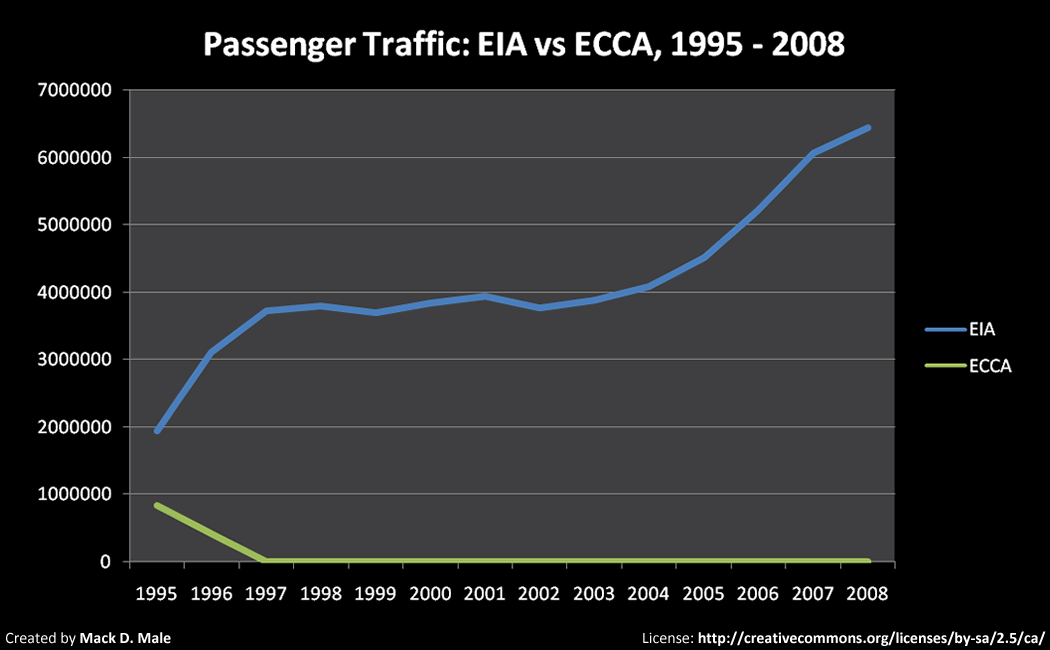
Let’s start with the first myth – that EIA’s growth has only come at the expense of ECCA. Here are the annual passenger numbers for each airport from 1995 to 2008 (I’m going with scheduled passenger numbers, which is why ECCA is 0 after 1996):

Here they are in table format:

YEAR EIA ECCA
1995 1943797 835612
1996 3104322 417002
1997 3720623 0
1998 3791574 0
1999 3700016 0
2000 3843321 0
2001 3940416 0
2002 3773800 0
2003 3882497 0
2004 4081565 0
2005 4511451 0
2006 5213992 0
2007 6065117 0
2008 6437334 0

What can learn from those numbers? The key years are 1995-97, obviously (the plebiscite vote took place on October 16, 1995). Passenger traffic at EIA, which had been stagnant since the early 1980s at about 2 million passengers per year, increased by more than the amount that passenger traffic at ECCA decreased. Passenger traffic at ECCA decreased by 835,612 from 1995 to 1997, while passenger traffic at EIA increased by 1,776,826.

Clearly there was something besides consolidation that caused traffic at EIA to increase. Growth at EIA leveled off from 1998 until 2002, but you’ll recall that was a difficult time for the airline industry – Edmonton was not alone.

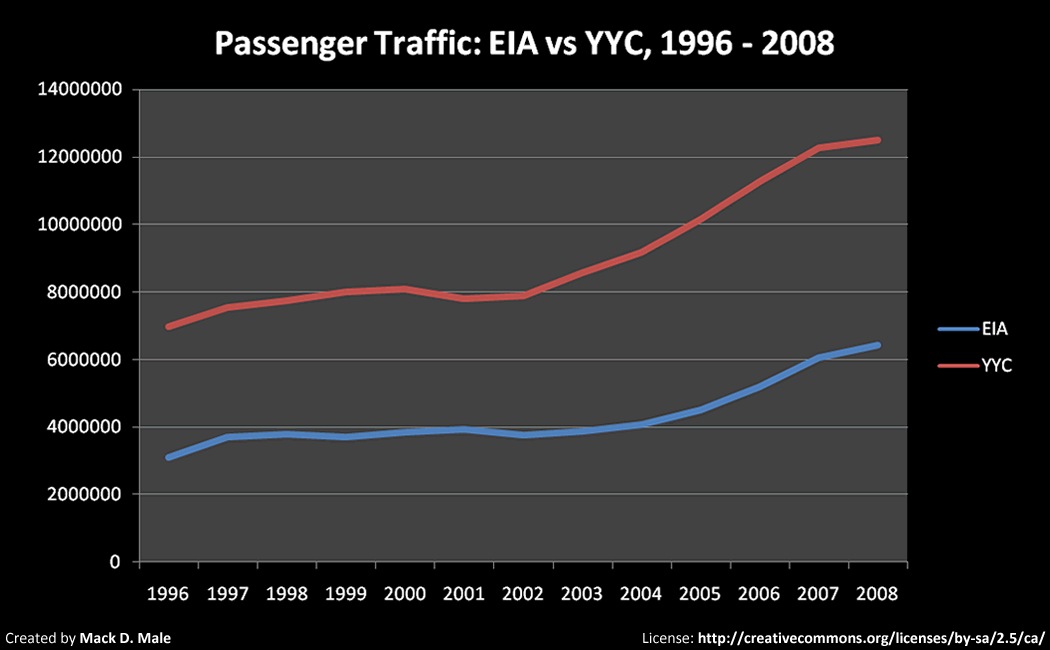
Now let’s look at the second myth – that Edmonton will always be second to Calgary. Here are the annual passenger numbers for EIA and YYC from 1996 to 2008:

Here they are in table format:

YEAR EIA YYC
1996 3104322 6967571
1997 3720623 7547156
1998 3791574 7731034
1999 3700016 8010883
2000 3843321 8090426
2001 3940416 7794519
2002 3773800 7884194
2003 3882497 8576541
2004 4081565 9174039
2005 4511451 10148718
2006 5213992 11279080
2007 6065117 12265754
2008 6437334 12507111

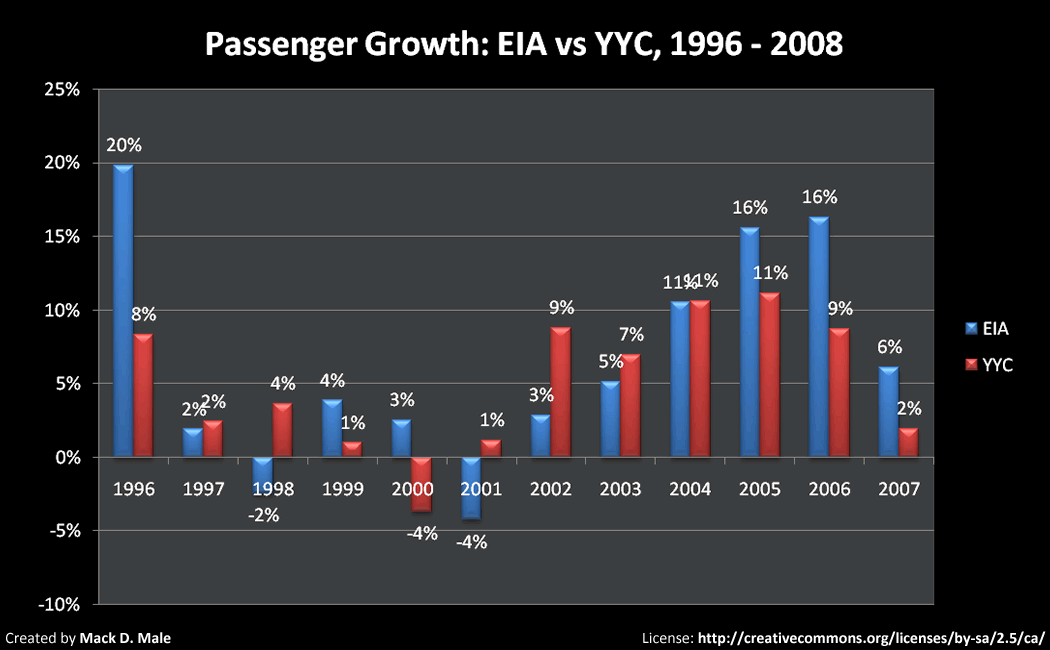
Calgary is definitely busier than Edmonton – nearly twice as busy. Edmonton is in a better position today relative to Calgary than it was in 1996, however. It’s a little difficult to tell from the graph/table above, but Edmonton’s growth overall since 1996 is actually stronger than Calgary’s. Here are the annual percentage increases:

In total, passenger traffic at EIA has increased 107% since 1996, whereas passenger traffic at YYC has increased 80% since 1996.

Is that enough to suggest that Edmonton can emerge from the shadow of Calgary, at least when it comes to their respective airports? Maybe, maybe not. But the data clearly shows that YYC isn’t light years beyond EIA as some would like to suggest.

As an aside, while doing my research I found statistics for EIA for three more years: 394000 in 1962, 755000 in 1973, and 1100000 in 1974.

The public hearing on the City Centre Airport continues tomorrow at City Hall. You can see my resources post here.

Sources: EIA Website, EIA Passenger Statistics, YYC Website, Calgary Airport Statistics, numerous EIA press releases, Wikipedia, Tourism Calgary.

Edmonton City Centre Airport Debate: Resources

We’re down to the final stages of the City Centre Airport review process. If you haven’t taken the time to educate yourself on the issue, the time is now.

Here are the reports that were released last week:

  • Airport Legal Review and Analysis (Attachment 1 in this PDF)
  • Airport Lands Net Revenue Review (Attachment 3 in this PDF)
  • The Airport Lands Impact Assessment Final Report (PDF)
  • The Medevac Transport Report (PDF)
  • The Historical Impact Assessment Report (PDF)
  • The Economic Impact Analysis (PDF)
  • The Public Involvement Plan Results (PDF)

The Alberta Enterprise Group (AEG) posted a response to the reports here.

The big report is the Airport Lands Impact Assessment, at 299 pages. Here’s a Wordle of that report:

Here are some highlights from the various report conclusions:

  • “The planning of ambulance services is dependent on many local factors such as availability of resources, both financial and personnel; regional density of populations; road condition and geographic variations; and so forth. Clinically, outcomes for trauma and medical patients are mainly impacted by the services available rather than by type of transport.”
  • “The City Centre Airport ranks with the Rossdale site and the provincial government precinct as among the three most significant historical locations in the City of Edmonton. As such everything possible should be done to acknowledge that fact through commemorative and interpretive initiatives.”
  • “Redevelopment of the ECCA, as defined in the Demonstration Plan, would result in the equivalent of a net tax saving to the City of Edmonton. The value of redeveloping the ECCA Lands is, in aggregate, a net benefit to the City of Edmonton’s financial position.”
  • “Based on the review completed, the redevelopment of the ECCA Lands into a new residential and employment based neighbourhood represents a significant opportunity for the City to achieve established long term visions regarding sustainable development and a more compact urban form. The redevelopment of the ECCA Lands could allow for the development of a new urban community with transit as its centrepiece.”

There will be a public hearing on Wednesday (and Thursday/Friday if necessary):

What: Public Hearing on the City Centre Airport (Agenda in Word)
When: Wednesday, June 24, 2009 from 9:30am to 5:30pm
Where: City Hall
Request to Speak: Fill out this form to speak.

The next step is for any recommendations to be reviewed by Council on July 10, 2009. Don’t forget that you can watch or listen to Council and Committee meetings live online.

The City’s portal for the City Centre Airport Review contains a bunch of additional information and links, so be sure to check it out. There’s also some info at the Public Involvement site.

[geo_mashup_map height=”250″ width=”500″ zoom=”13″ add_overview_control=”false” add_map_type_control=”false”]

Here are some social media resources:

Some other stuff to read:

Lorne Gunter wrote a great article in Sunday’s Edmonton Journal: Muni is not ‘my’ airport. For some predictions on Council’s vote, check out Scott McKeen’s piece from yesterday’s Journal. He’s betting that Council will vote to close the airport. Also – you’ve got to look at this photo of Councillor Tony Caterina on the tarmac of the City Centre Airport. And finally, you might find my post (from May) about the ECCA debate on Twitter interesting.

For the latest news, check out #ecca on Twitter Search.

As you’ve perhaps figured out by now, I’m in favor of closing the City Centre Airport. I don’t feel that keeping the status quo is compatible with making Edmonton a more sustainable, vibrant city, and moving passenger service back to the muni isn’t possible. There is an opportunity to redevelop the lands however, and I think the City should act on that now before the opportunity passes us by.

Let’s close the City Centre Airport and move on.

UPDATE: Edmonton Airports has compiled a number of briefing notes related to the airport for presentation at the public hearings. (PDF)

Recap: EdmontonTweetup5

Tonight was our fifth “official” tweetup, hosted by iNews880! About 35 people or so descended on the Corus studios for free hamburgers and hotdogs. Our first tweetup was technically a family-friendly one (at Three Bananas) but there weren’t many locals on Twitter back then – today was a great opportunity to bring the kids, and many people did! It seemed like a long time since our last tweetup, so it was good to see everyone again.

We got the opportunity to tour the building, led by @britl, @Korinda, @NixonK, and @TheSpinDoctor. Kinda neat to see the behind-the-scenes. The cafeteria was decorated with lots of iNews880 banners, and even more little blue Twitter birds! There were dozens! Very festive. And of course, there was food and drinks. That’s really all you need to make a group of people happy 🙂

EdmontonTweetup5IMG_8742

Here are a few select tweets from tonight:

I had a good time at the tweetup and I think everyone else did too. Thanks to iNews880 for hosting us and to @britl and her team for organizing! Can’t wait until the next one! Stay tuned to the wiki for updates.

EdmontonTweetup5EdmontonTweetup5

You can see the rest of my photos here.

Edmonton Stories – The First Month

Back on May 14th the City of Edmonton launched its Edmonton Stories website which aims to gather real stories from real Edmontonians for use in marketing. The City did a good job of getting the site started with around 60 pre-sourced stories, giving it some momentum out of the gate. I wrote at the time that while I thought the idea was good, it wasn’t without challenges. I mentioned three: quantity of content, regularity of content, and quality of content.

Were they able to feed off that momentum to overcome those challenges throughout the first month? Let’s find out.

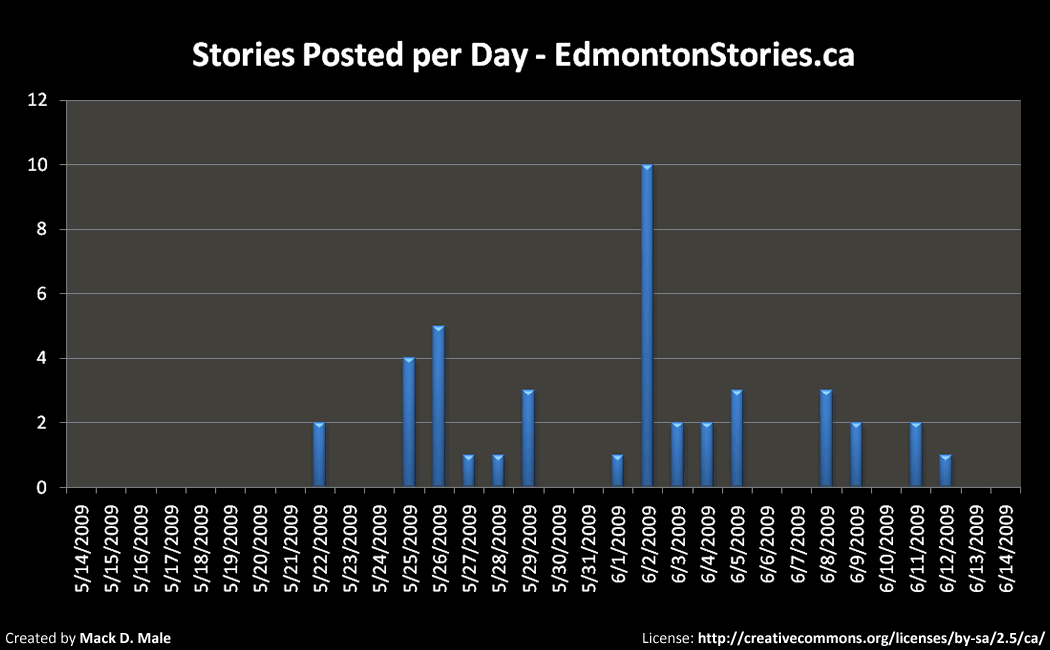
It took about a week after launch for the first story to appear – Sheila Edmonds’ story about adventures in Edmonton was posted on May 22nd. Stories have appeared somewhat regularly since then.

Here are the stats for the period May 14th through June 14th (word counts use the Microsoft Word algorithm):

Total # of stories posted: 42 (6 by staff)
Total # of words: 16328
Average # of words per story:  389
Total # of stories with video: 4
Total # of stories with photos: 12

The longest story was Marie Drake’s My First Time on the Mindbender at 1034 words, while the shortest was Lucien Levesque’s Festival for Kids in St. Albert at 59 words (plus a video).

Here a couple Twitter-related stats, since I have them:

# of tweets mentioning #yegstories: 106
# of tweets mentioning edmontonstories: 163

Here’s a Wordle of the first month’s stories:

As expected, words like “city” and “people” are quite common. After all, it’s the people that make Edmonton great, right? I’m happy to see “bus” is larger than “car” 🙂

Edmonton Stories has been quite active online in the first month or so. They’ve amassed 247 followers on Twitter (posting more than 200 tweets), and 72 fans on Facebook. More interesting than that, at least in my opinion, is that they’ve been commenting on blogs. Here’s one example on Sharon’s blog. I think that’s smart, as long as they are making comments that add value (otherwise the strategy could backfire).

So, the verdict:

  • Quantity: I think 42 stories posted in the first month is fantastic!
  • Regularity: Not bad, but there’s definitely room for improvement here. At least one story per day would be ideal.
  • Quality: This is subjective, but I’d say the quality is pretty good. The average length of stories is about right. Most user submitted stories have been in the Living category however, which means the Working category seems a little less genuine. I’d also prefer that each story had a one or two line bio about the author.

Overall I’d say Edmonton Stories had a good first month – kudos! I hope they can keep it up in the months ahead.

I’ll (finally) be submitting my story this week!

Notes for 6/21/2009

Happy Father’s Day! Here are my weekly notes:

Edmonton Notes for 6/20/2009

Here are my weekly Edmonton notes:

#yeg – Year in Review

It’s hard to believe that just a single year has gone by since the first tweet with the #yeg hashtag. It has become such a core part of the Edmonton Twitter community that it’s difficult to imagine what microblogging would be like without it!
If I remember correctly, I found about the #yyc hashtag while I was in Calgary for BarCampCalgary2 on June 14th, 2008. I learned from @wintr that a few Calgarians had started using the hashtag to tweet about things related to their city. I thought it might be a good idea to do something similar here in Edmonton. This is what I wrote:

#Edmonton Twitterers…our neighbours to the south have started using the hashtag #yyc to self organize…cool idea we should borrow? #yeg

The rest, as they say, is history.

A few highlights from the past year:

  • #yeg was mentioned on CTV when Carrie Doll did a story on Twitter at the beginning of March.
  • #yeg trended to #5 on Twitter Search on March 24th as Edmontonians were tweeting about the fire on Rice Howard Way.
  • No less than ten related hashtags have been actively used, such as #yegtransit and #yegfood.

I recall at some point a discussion about how to pronounce #yeg. I think most say “y-egg” though some say “y-e-g”.

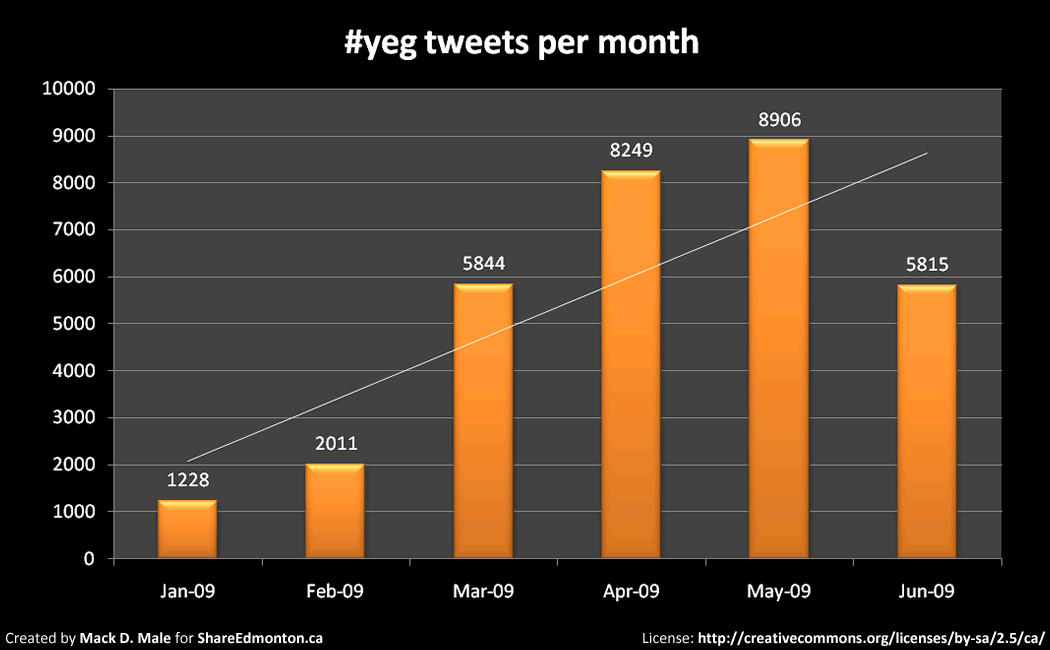
Unfortunately, I don’t have a lot of stats for the hashtag before January 2009. My best guess is that 1488 tweets were posted containing the #yeg hashtag from November 20th to December 31st. For this calendar year however, I have good numbers. The stats below differ from my monthly stats posts in two ways: they are global, so include tweets posted by non-locals, and they do not contain related tags such as #yegfood.

A total of 32053 tweets have been posted in 2009 (as of noon today) containing the #yeg hashtag. Here’s that number broken down by month:

On average, 188 tweets are posted each day containing the #yeg hashtag.

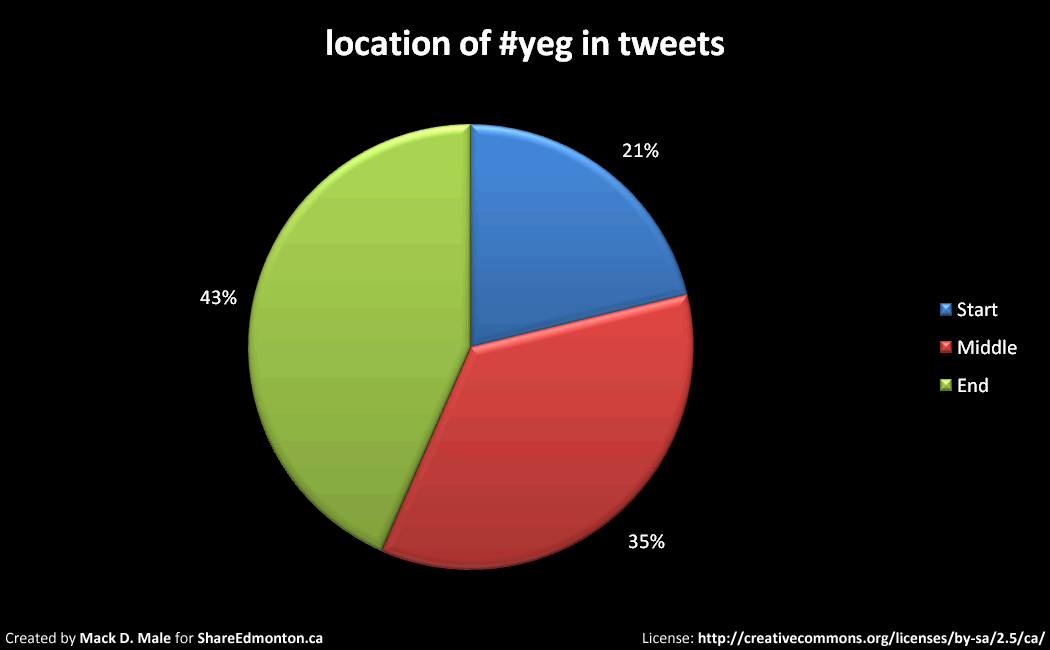
One thing I’ve always wondered is where the hashtag is most often placed inside each tweet. Here’s the breakdown:

I think it’s great that the #yeg hashtag has become so established in the Edmonton Twitter community, and I look forward to its continued evolution. Thanks everyone for making #yeg so great!

Homeward Trust in 2008

Homeward Trust hosted a reception last night to celebrate its new location on the 6th floor at 10242 105th Street, and to share its 2008 Annual Report. The past year has been described as “a landmark year”, the first under the banner of “Homeward Trust” (it used to be known as the Edmonton Housing Trust Fund). They’ve done some great work, and I think 2009 is shaping up to be an even better year for the organization!

The new office space is fantastic. It’s designed in such a way that you can walk around the entire floor in a giant square. They’ve broken the space up into sections, each with a specific focus. Numerous drink and food tables were setup throughout the office for the reception, and everyone was encouraged to explore. The office has some great views of downtown Edmonton!

View from the new Homeward Trust officesHomeward Trust Reception

The program started at 5:30pm with some entertainment, followed by a few speeches and award presentations. Mayor Stephen Mandel and MLA for Edmonton-Ellerslie Naresh Bhardwaj both gave remarks. Among the other VIPs in attendance were Councillor Ben Henderson, MLA for Edmonton-Calder Doug Elniski, MLA for Edmonton-Centre Laurie Blakeman, and City Manager Al Mauer.

Homeward Trust Reception

The annual report for 2008 isn’t online yet, but I suspect it’ll be posted soon. Here are some highlights:

  • In 2008, 133 Edmonton families were homeless. 25% more Edmonton children were without a home than in 2006.
  • 59% of Edmonton’s homeless suffer from mental illness.
  • 3079 people were identified as homeless in 2008, an increase of 18% from 2006. More than 200 volunteers and 180 agencies worked on the count.
  • More than 1500 people attended Homeless Connect in October.
  • Homeward Trust allocated nearly $20 million for capital and support services in 2008.

Additionally, five Homeward Trust funded projects opened in 2008:

  1. Habitat for Humanity Norwood ($520,000)
  2. Our House Addictions Recovery Centre ($2,800,000)
  3. John Howard Society The Loft ($580,500)
  4. Catholic Social Services Rotary Centre ($1,526,548)
  5. Women Building Futures Training Centre Reno ($903,000)

I thought Jon Hall, Chair of Homeward Trust Edmonton, said it best: “What our annual report can’t show is the difference we’ve made in people’s lives.”

Kudos to Susan McGee, Executive Director of Homeward Trust Edmonton, and her team for a great event and a fantastic year! You can see the rest of my photos here. For information on volunteering with Homeward Trust, click here.

Peter Newman in Edmonton discussing Resilient Cities

Author Peter Newman, in town this week for ICLEI World Congress 2009, gave a free talk tonight at the Shaw Conference Centre on some of the central ideas of the book he recently co-authored, Resilient Cities: Responding to the Crash, Climate Change, and Peak Oil. Presented by Edmonton on the Edge, the talk was hopeful in tone – a nice way to end ICLEI.

Here’s the handbill description:

A new approach to urban development needs to be forged that can, at the same time, enable cities to respond to the deep challenge of decarbonising cities and can use the transition to accelerate the development of what the UN calls the Global Green New Deal. Some hopeful directions will be outlined based on cities from around the world, including cities from down under.

Peter Newman in Edmonton

Peter is from Perth, Australia and he started by saying that Perth and Edmonton are similar in a number of ways (population, land distribution, etc). He next touched on Peak Oil (which Peter says happened in 2008) and the global recession. Peter positioned the Crash as an opportunity (his approach reminded me a lot of Ray Kurzweil). Peter showed a slide with five major economic downturns from the last 300 years or so, and pointed out the technological advances that were made after each. The rate of advance became faster over time, so that today we have exponential progress (this is essentially Kurzweil’s Law of Accelerating Returns).

My favorite part of the talk took the bulk of the remaining time – examples, complete with pictures, of cities around the world that have become Smart and Sustainable (together, the two characteristics of cities of the future, according to Peter). A couple of examples:

  • Phoenix, one of the worst cities in the world in terms of transportation by transit, recently replaced two lanes of traffic running through the centre of the city with light rail transit. Peter said if Phoenix can do it, anyone can!
  • Perth has completed significant rail developments in the last 15 years, with some lines going as far as 80km away from the core. During that time, ridership increased from 7 million passengers/year to 90 million/year. Amazing.

Peter introduced a number of acronyms during his talk:

  • IT: Information Technology
  • ET: Environmental Technology
  • TOD: Transit Oriented Development
  • POD: Pedestrian Oriented Development
  • GOD: Green Oriented Development

Naturally, IT and ET go together and TOD, POD, and GOD go together. You can’t have one without the others!

Peter Newman in Edmonton

Peter made reference to the concept of “place based cities” a few times, but unfortunately didn’t elaborate. The general idea is that you can make the local economy more viable by creating a stronger sense of place. Something about it really resonates with me.

The talk was followed by a reception, featuring music by Melissa Majeau. A number of other organizations helped Edmonton on the Edge make tonight’s talk possible, including the City-Region Studies Centre, University of Alberta Faculty of Extension, Edmonton Design Committee, ISL Engineering and Land Services, The City of Edmonton, and M.A.D.E. in Edmonton. Great event!