Edmonton Notes for 5/9/2009

Here are my weekly Edmonton notes:

Edmonton’s State of the City Report 2008-2009

The City of Edmonton recently released it’s State of the City report for April 2008 – March 2009. It includes a summary of “civic programs and services delivered to meet the goals of City Council, representing the priorities of all Edmontonians.” Also included is a message from Mayor Mandel, information on the City Vision, the City’s Strategic Plan, and more.

Here’s a Wordle of the report with the words “Edmonton” and “city” removed:

You can see a larger version here, and a version with those two words included here.

State of the City Report 2008-2009

Questionmark Open House in Edmonton!

It might be hard to tell, but Twittering isn’t actually my day job! As some of you know, I’m a software developer for a company called Questionmark. Though the company is based in London, UK, we have a growing team here in Edmonton. We recently moved into a new office downtown, and we’d like to invite you to come check it out and get to know us a little better:
Date: Friday, May 15, 2009
Time: 4:00pm
Location: #806, 10080 Jasper Avenue (map)
Cost: Free

Feel free to stop by anytime after 4pm! We’ll have food, wine, beer, etc. If you’re planning to come, please RSVP by emailing me at mack.male@questionmark.com.

Also taking place that evening is the #twilightYEG Guest Bartender Friday, in support of the Royal LePage Shelter Foundation. It’s happening at Lux, which is right across the street from us, so join us for a drink at the office and then head over to Lux to support a worthy cause!

If you’re a local software developer, definitely stop by and say hello – we’re hiring!

Job Description for Software Developer & Open House Invite

Hope to see you on the 15th!

State of the Calgary Twittersphere – April 2009

Welcome to the second State of the Calgary Twittersphere, my look at the intersection of Twitter and Calgary. You can see last month’s stats here.

The source of the data this month remains the same – Twitter Search. If a user has his or her location set to Calgary, Airdrie, Okotoks, Cochrane, Strathmore, or matching lat/long coordinates, they are considered a Calgarian. If a tweet is “about Calgary” it contains either the word Calgary, the #yyc hashtag, or both.

As you’ll see in a couple of the graphs below, Twitter Search was down for just over 3 hours on April 19th (from about 8:48 PM until 11:51 PM MST), so tweets posted during that period of time were not counted.

For April 2009:

# of local users: 5651 (an increase of 52% over March)

To clarify, that means there were 5651 users who posted at least one tweet in April 2009 with their location set to something that makes them a Calgarian as described above. This number should be treated as a minimum – there are probably many more Calgary users without their location set or that were not captured for some other reason.

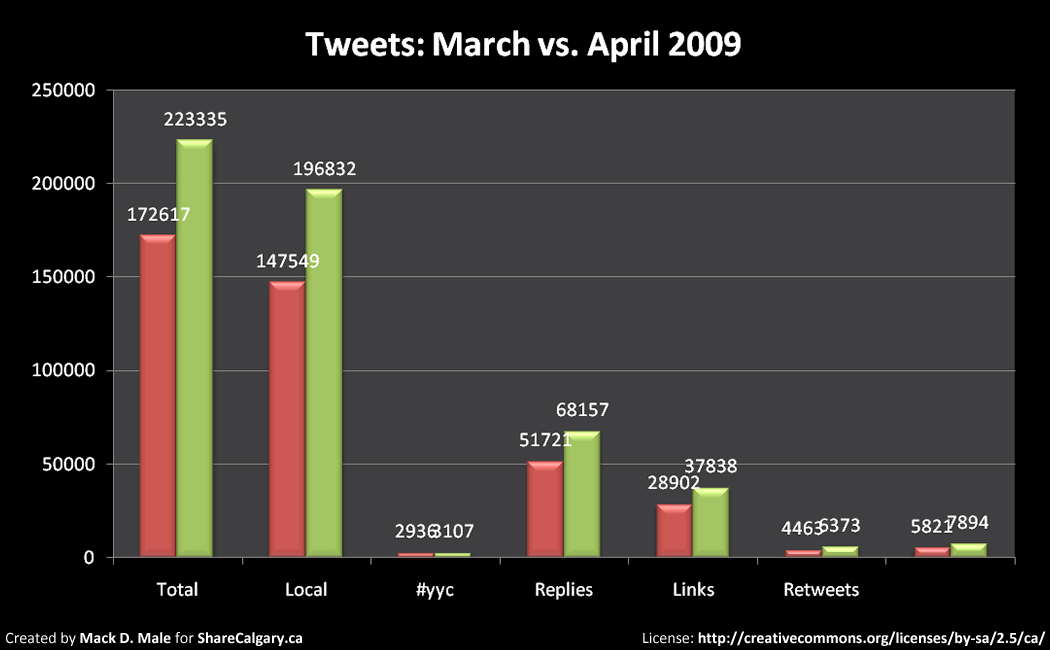
# of tweets by local users: 196832
# of tweets by local users containing #yyc: 3107 (1.6%)
# of tweets by local users that were replies: 68157 (34.6%)
# of tweets by local users containing links: 37838 (19.2%)
# of tweets by local users that were retweets: 6373 (3.2%)
# of tweets by local users that were twooshes: 7894 (4.0%)

This graph shows these numbers visually:

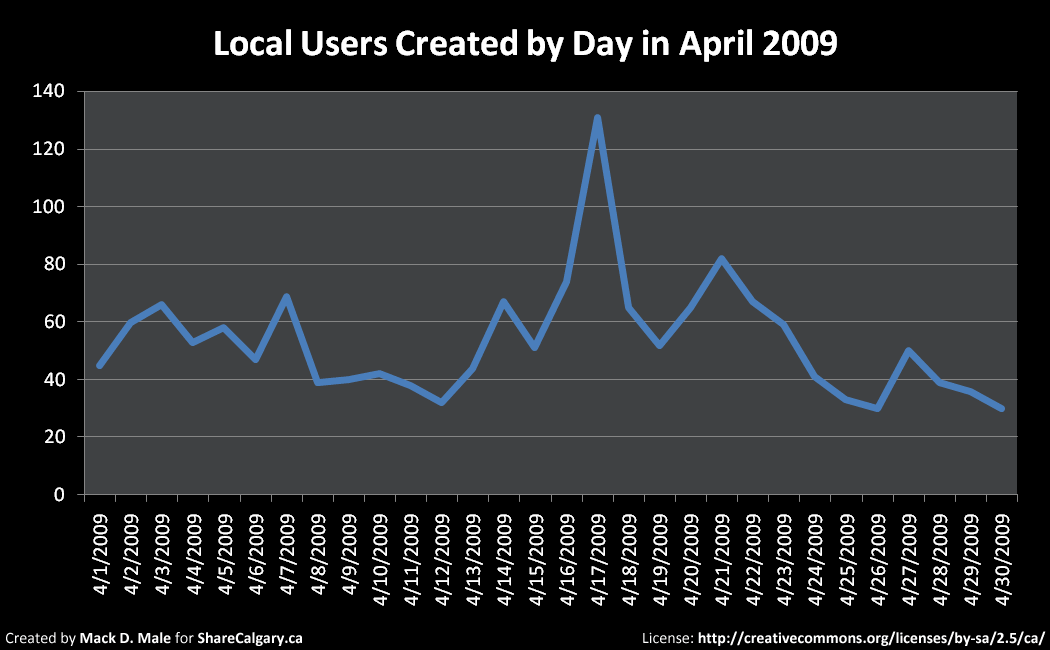
Here are the number of local users created per day in April, using the best available data from Twitter (the spike is about the time Oprah joined):

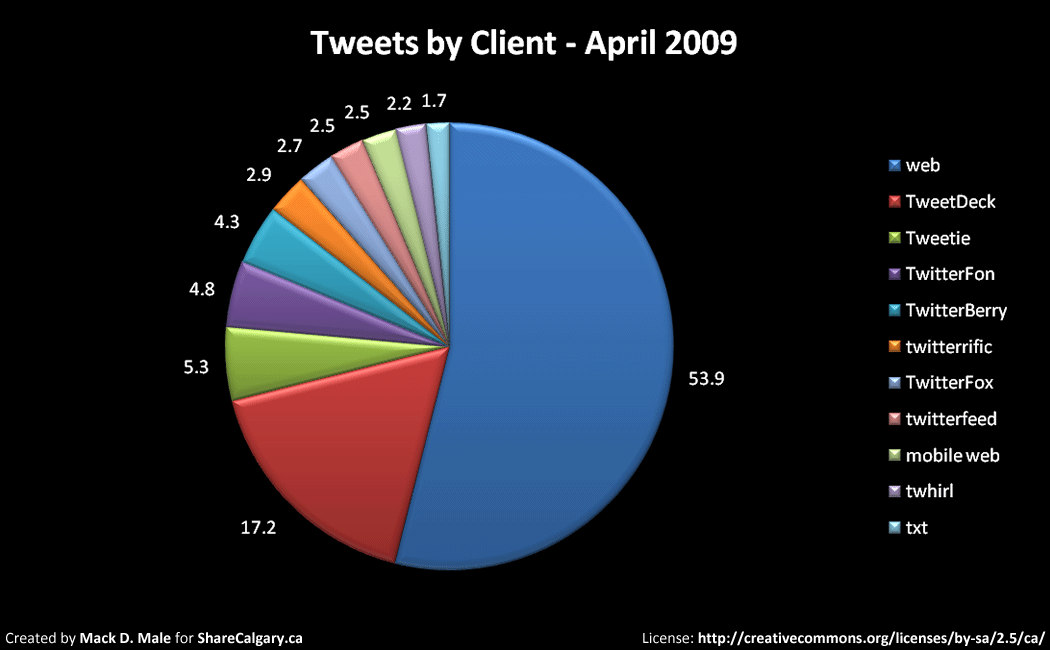
Here are the top clients used by local users for posting updates (remember that web includes all unidentified API calls too):

Some other interesting stats for the month:

  • The ten most active local users (most tweets first): strategicsense, codsta, Somecitygirl, izzynobre, C_DIG, aNorthernSoul, mrrocknroll, opiatedsherpa, wikkiwild1, caninez
  • About 51% of all local tweets were posted between 9 AM and 5 PM.
  • Local users posted roughly 4.6 tweets per minute in April, compared with 3.3 per minute in March.
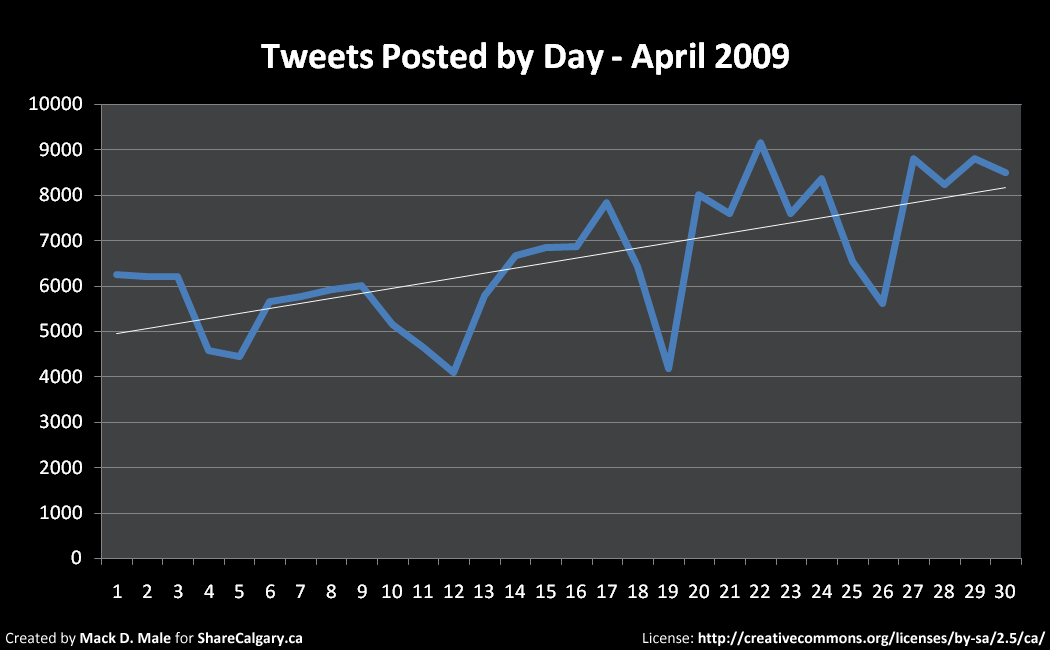
  • The day with the most local tweets posted was April 22nd at 9163. On average, 6561 local tweets were posted each day (compared to 4760 in March).
  • Of the 68157 replies posted by local users this month, 17250 or 25% were to other local users.
  • A total of 893 local users posted 50 times or more this month. In comparison, 926 local users posted just once this month.

I’m not including the top ten users by # of followers this month because I haven’t been able to update it yet, and I suspect it hasn’t changed much anyway. Instead, here are the ten “most replied to” local users for April 2009: C_DIG, caninez, Somecitygirl, darylcognito, ReaFaceToFace, djkelly, amacisaac, Wendy, CdnCowgirl, jonincalgary. This stat obviously skews toward the chatty, but it’s interesting nonetheless.

If you have any comments or feedback let me know so that I can improve these statistics in future months. You can see the April 2009 stats for Edmonton here. I should have a Calgary vs. Edmonton stats post up sometime next week.

State of the Edmonton Twittersphere – April 2009

Welcome to the fourth State of the Edmonton Twittersphere, my look at the intersection of Twitter and Edmonton. You can see last month’s stats here.
The source of the data this month remains the same – Twitter Search. If a user has his or her location set to Edmonton, St. Albert, Sherwood Park, Leduc, Nisku, Stony Plain, Fort Saskatchewan, Beaumont, Spruce Grove, or matching lat/long coordinates, they are considered an Edmontonian. If a tweet is “about Edmonton” it contains either the word Edmonton, the #yeg hashtag, or both.

As you’ll see in a couple of the graphs below, Twitter Search was down for just over 3 hours on April 19th (from about 8:48 PM until 11:51 PM MST), so tweets posted during that period of time were not counted.

For April 2009:

# of local users: 4489 (an increase of 31% over March)

To clarify, that means there were 4489 users who posted at least one tweet in April 2009 with their location set to something that makes them an Edmontonian as described above. This number should be treated as a minimum – there are probably many more Edmonton users without their location set.

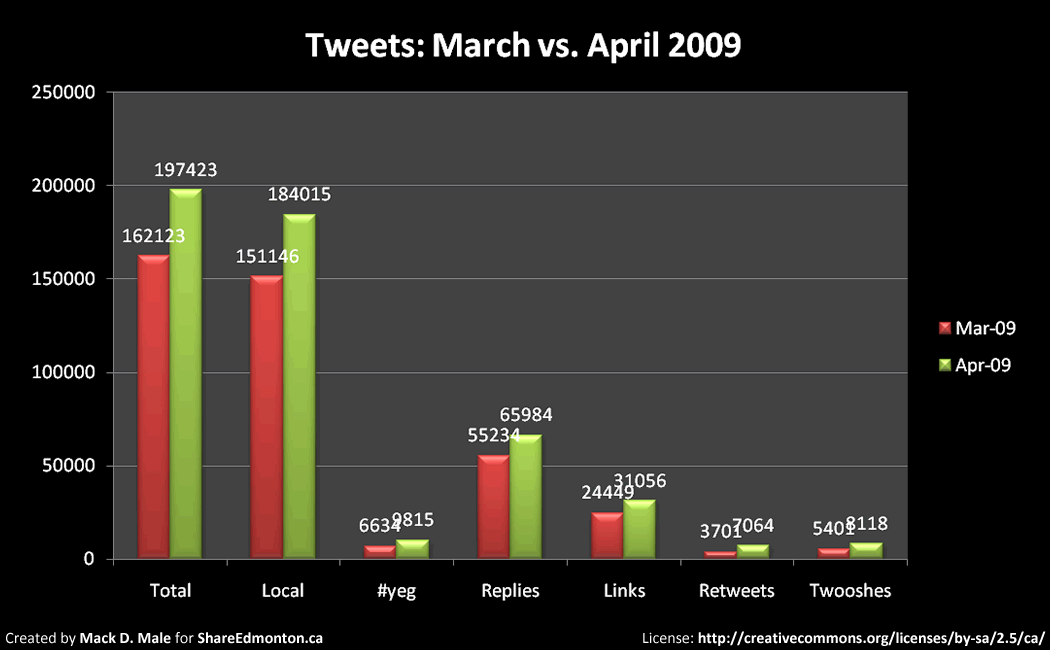
# of tweets by local users: 184015
# of tweets by local users containing #yeg: 9815 (5.3%)
# of tweets by local users that were replies: 65984 (35.9%)
# of tweets by local users containing links: 31056 (16.9%)
# of tweets by local users that were retweets: 7064 (3.8%)
# of tweets by local users that were twooshes: 8118 (4.4%)

To clarify the # of tweets containing #yeg – that number actually includes all the local hashtags that start with #yeg, so it includes #yegfood, #yegtraffic, etc. This is consistent with the stats for previous months, though it made less of an impact before. I’ll try to break out the stats by tag next month.

Here are the numbers above in graphic form:

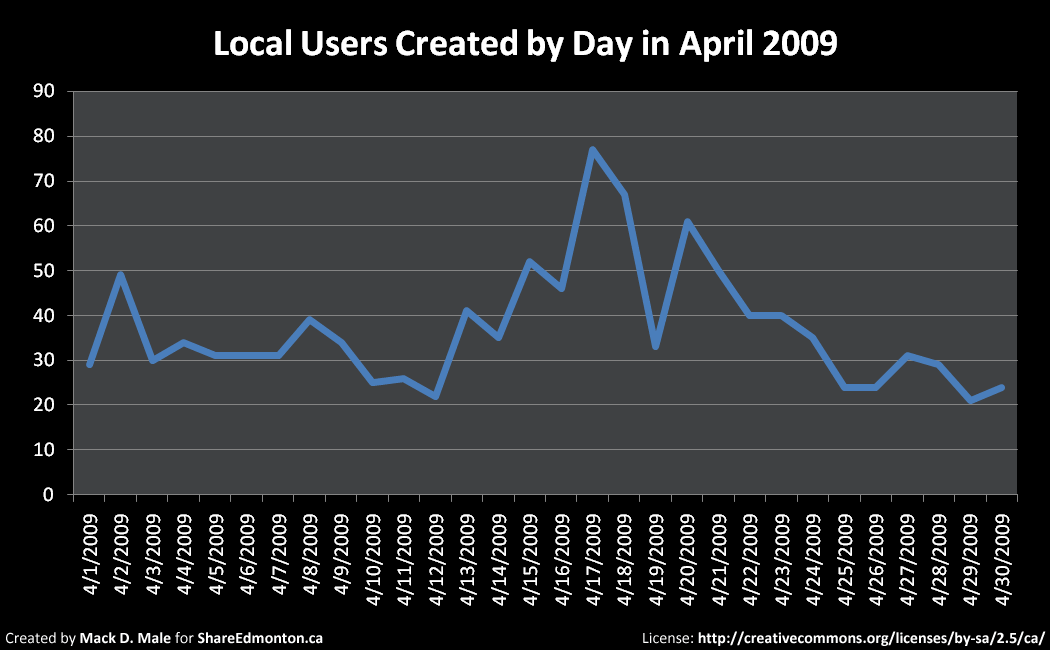
Here are the number of local users created per day in April, using the best available data from Twitter:

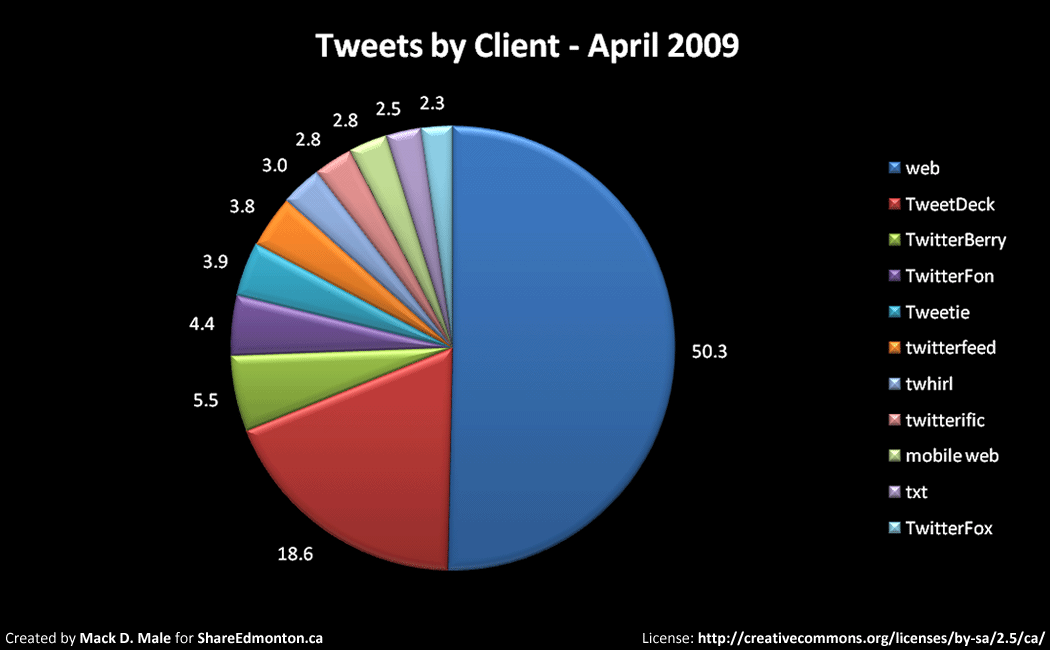
Here are the top clients used by local users for posting updates (remember that web includes all unidentified API calls too):

Some other interesting stats for the month:

  • The ten most active local users (most tweets first): AndyGroenink, DebraWard, akomuzikera, TrinaMLee, Edmontonsun, fcedmonton, Etown_Jenn, britl, bingofuel, wickedmickey
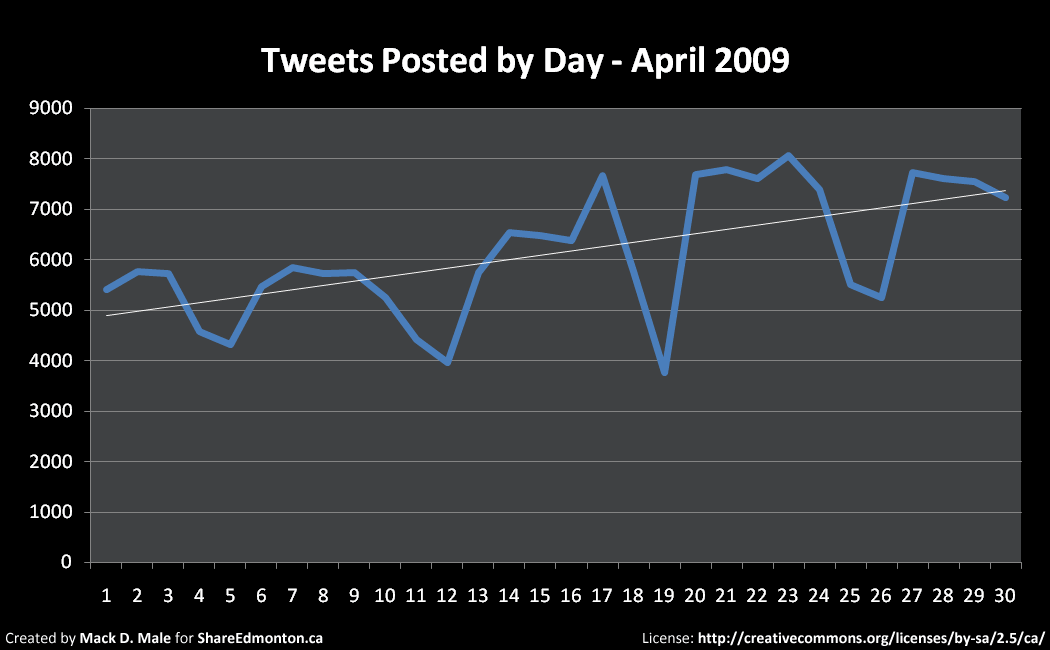
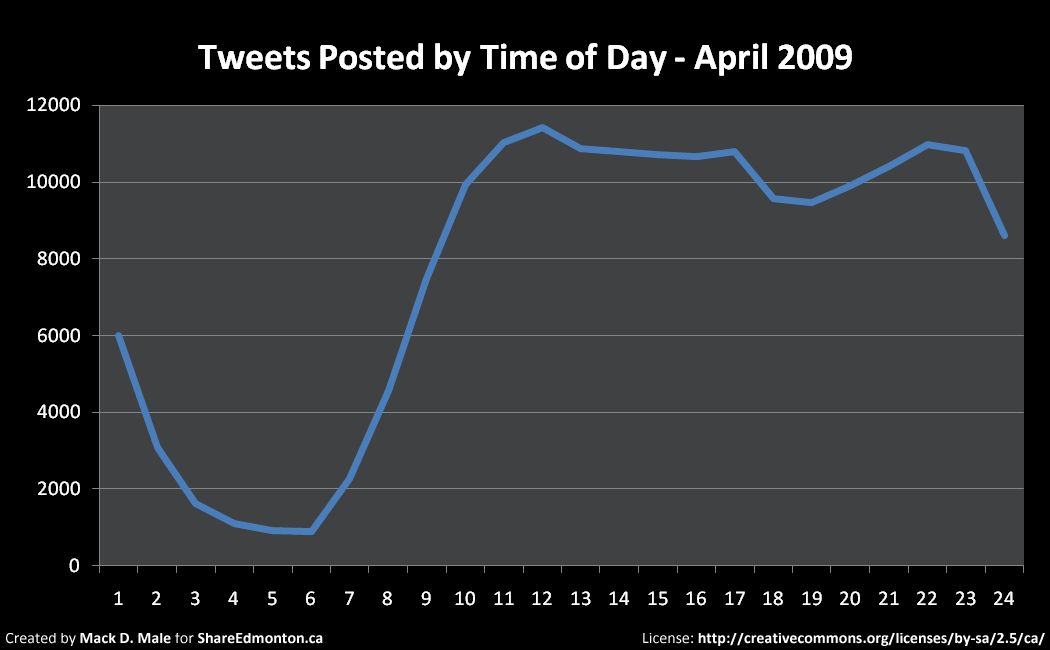
  • About 52% of all local tweets were posted between 9 AM and 5 PM.
  • Local users posted roughly 4.3 tweets per minute in April, compared with 3.4 per minute in March.
  • The day with the most local tweets posted was April 23rd at 8069. On average, 6134 local tweets were posted each day (compared to 4876 in March).
  • Of the 65984 replies posted by local users this month, 24916 or 38% were to other local users.
  • A total of 808 local users posted 50 times or more this month. In comparison, 796 local users posted just once this month.

I’m not including the top ten users by # of followers this month because I haven’t been able to update it yet, and I suspect it hasn’t changed much anyway. Also, I hope to have a dynamic list available soon.

Instead, I have a new top ten as suggested by the Social Web Meetup gang (thanks to @britl for letting me know). Here are the ten “most replied to” local users for April 2009: britl, bingofuel, chrislabossiere, citizenfish, Sirthinks, JodieGiese, frostedbetty, angelzilla, mastermaq, Out_Inc. This stat obviously skews toward the chatty, but it’s interesting nonetheless.

Tomorrow, I should be posting the stats for Calgary. Stay tuned!

UPDATE: Here are the Calgary stats for April 2009.

DemoCampEdmonton7

Are you ready for another DemoCamp? Our next event here in Edmonton is coming up fast, on May 13th! Join us at the University of Alberta to see what local tech entrepreneurs are up to. As usual, we’ll head over to RATT after the demos for Edmonton’s best networking opportunity for tech professionals. If you’re new to DemoCamp, check out my recap of our last event. Here are the details for #7:

Date: Wednesday, May 13, 2009
Time: 6:30pm (and drinks/networking afterward)
Location: E1 017, ETLC, University of Alberta (map)
Cost: Free

The rules for DemoCamp are simple: ten minutes to demo real, working software, followed by a few minutes for questions. No slides allowed.

This time we’ve got a fantastic new sign up page for both attendees and anyone interested in demoing at this event or in the future. No more wiki craziness – just enter your name and click Register!

Help us spread the word – check out the BarCamp Edmonton blog and our Facebook group. Be sure to tag your tweets, posts, photos, and other content with democampyeg.

Hope to see you there!

Notes for 5/3/2009

Here are my weekly notes:

  • Kim & Shane moved out this weekend. My apartment now looks pretty empty! I also realized how much kitchen stuff Kim had. Needless to say I did quite a bit of shopping and cleaning over the last two days.
  • The cookie-cutter tech article (this one is about bit.ly): find a service that bloggers have written about recently, explain what it does in layman’s terms, throw out some statistics about growth, describe the business model or lack of one, cite either Google or Microsoft as companies that could destroy the service. Oh, and capitalize its name, even if the service itself never does.
  • General Electric has apparently come up with a digital storage technology breakthrough that will allow standard-sized discs to hold the equivalent of 100 DVDs.
  • This is kinda cool: The TV magic behind Hockey Night in Canada.
  • Derek is right – taking photos doesn’t, and shouldn’t, make you a terrorist. He wrote about some very odd security ads in SkyTrain stations.
  • Here’s something I could get behind: Reboot the university.
  • Sharon and I went to see Ghosts of Girlfriends Past yesterday. It wasn’t bad, pretty much as expected. We were both surprised at how little Jennifer Garner was in the movie, however.
  • I’ll be in Calgary on Tuesday covering the Web Strategy Summit.

Edmonton Notes for 5/2/2009

Here are my weekly Edmonton notes:

Jasper Avenue New Visions

Tonight I stopped by the first of two open houses for the Jasper Avenue New Visions initiative. Part of the Capital City Downtown Plan, the project aims to develop a vision to re-establish Jasper Avenue as the main street of Edmonton. I have worked on Jasper Avenue for over five years now, and while there have been some changes in that time, they haven’t been significant (though lately this has been changing). I was curious to see what the future might hold.

The consultants on the project are Toronto-based Urban Strategies, led by former Edmontonian Mark Reid. Other firms involved include Phillips Farevaag Smallenberg of Vancouver, and Edmonton-based ISL Engineering & Land Services, Armin A. Preiksaitis & Associates and HIP Architects.

Jasper Avenue New VisionsJasper Avenue New Visions

The open house took place in the main floor atrium of Enterprise Square. Along one wall was satellite imagery of the areas being considered by the project, and next to that were a bunch of flip chart sheets with lists of challenges and aspirations created by the team throughout the day. There was a projector and a bunch of seats setup, and not far from that was the 3D styrofoam model of Edmonton’s downtown. The remaining walls and separators were plastered with drawings, maps, and other designs.

Mark gave a brief presentation to the dozen or so in attendance, and then led everyone around the room to talk about some of the posters and drawings, finishing with the 3D model. Here are some observations from the event (and about the plan):

  • The project focuses on Jasper Avenue from 97th street to 111th street.
  • The heart of the project is the Central LRT Station, which is being planned for rehabilitation in 2013.
  • There’s a combination of infill development, large development areas, and open spaces in the concepts.
  • Edmonton’s estimated population for 2041 is 1,158,872. The goal is to attract 6% of the growth or 24,000 people to downtown. That translates into roughly 75 twenty storey apartment buildings.
  • Jasper Avenue is wide enough to support seven lanes of traffic. In comparison to other downtowns, the amount of pedestrian space on Jasper Avenue is incredibly small.
  • In fact, almost every feature of Jasper Avenue is geared toward vehicle traffic. Any redevelopment needs to shift the focus to pedestrian traffic. Think back to the Stanley Cup run of 2006, and this becomes crystal clear. I took video of both Whyte Avenue and Jasper Avenue – Whyte was full of people, Jasper was full of vehicles.
  • Height restrictions due to the City Centre Airport are a challenge, but not as big as you might think. The strictest height limitations are west of 109th street. However, Mark did admit that the airport is one of the main reasons our skyline lacks a recognizable, tall structure.

The timeline for the project is as follows:

  • Phase 1: Concepts – November 2008 to May 2009
  • Phase 2: Finalizing the Urban Design Concept – May 2009 to June 2009
  • Phase 3: Preparing the Public Realm Concept – June 2009 to September 2009
  • Phase 4: Preparing the Preliminary Design Drawings – September 2009 to November 2009

One of the more interesting displays was a timeline describing Jasper Avenue from the early 1900s up to now. It started as the commercial district for the city, centered between 96th and 99th streets. By the 1930s, Jasper Avenue had become a prestigious business address. Through the 1960s, higher scale development started, a number of historic buildings were demolished, and vehicles were more prominent. Suburbanization through the 1980s led to the decline of Jasper Avenue, and the launch of initiatives to help revitalize the street. Today, we’re starting to see renewal though continued outward growth poses major competition.

What will it be like in 2020?

You can see the rest of my photos from tonight here. The second open house is tomorrow from 2pm to 4pm in the main floor atrium of Enterprise Square (10230 Jasper Avenue).

Newspapers, cities, and the local web

Edmonton SkylineThe concept of “local” has never been more important – that’s something I firmly believe. Though I found the book somewhat wordy, Who’s Your City by Richard Florida presents this idea very effectively:

Globalization is not flattening the world; on the contrary, the world is spiky. Place is becoming more relevant to the global economy and our individual lives.

It’s definitely worth a read. So much of our lives is defined by place – by the people and things around us. I think this is especially true when you live in a city.

Cities are interesting because they encompass a range of place sizes. A specific block, neighborhood, area, quadrant, etc. right up to the entire city and greater metropolitan area. Some people identify most with a neighborhood or area, others with the entire city. Often their affiliation depends on the current situation (perhaps a neighborhood when it comes to family issues and the city when it comes to business). Consequently, the information individuals are interested in varies.

Newspapers try to cater to this range of interest. Here in Edmonton, the Examiner publishes stories for different regions of the city. On the opposite end of the spectrum, the Edmonton Journal attempts to cover the entire city. Then there are all of the other publications in between. And some news simply isn’t covered by any publication.

There are many problems with this. A newspaper can’t get too specific, because advertisers won’t want to buy ad space if only a few dozen people are going to see their ad. As newspapers move toward a larger audience to attract better ad revenue, they inevitably end up with more general content. And of course, newspapers are not real-time.

Put simply, newspapers are not very good at representing places. For this reason, I find it incredibly bizarre that a number of recent articles focus on place as the reason why newspapers will not go away. For example, here’s an excerpt from a National Post story on Monday:

Newspapers retain their market relevance partly because flipping through a newspaper is one of the quickest and easiest ways to answer the question, "What’s new and might be of interest to people who live where I live?"

The printed version of the newspaper is connected with a physical geography at a specific point in time that few, if any, online resources can be.

How can any of that be true? We know that to truly find out “what’s new and might be of interest to people who live where I live”, we’d have to flip through a number of newspapers. And even then we’d be missing stuff. The second point is absolutely wrong also – there are many online resources that are intimately connected with a place and time. For instance, EveryBlock. Such online services are probably more connected with a specific place and time because they go down to the street level and often deal with real-time information.

Here’s another excerpt, from a Todd Babiak column in yesterday’s Edmonton Journal:

For its residents, a city must be more than a house, a car and a job. It’s a narrative, a living history, myths and conflicts, and for as long as Canada has been a country the newspaper is where the city has been inscribed.

If it is true that the city newspaper is dying, the city is dying with it.

Just because something has always been a certain way, doesn’t mean it’ll remain that way forever. Innovation is largely about challenging the status quo. Thus, the fact that newspapers are failing to innovate shouldn’t be a surprise. To suggest that cities are dying as a result is simply ridiculous, however.

I’m not falling for the myth that cities depend on newspapers. It’s true that a newspaper plays an important role in documenting the evolution of a city, but it’s not the only institution that does so. A newspaper is also not the only way to get information to citizens. Increasingly, citizens can get information directly.

I think we’re at the beginning of the “local” era on the web. As more and more people carry mobile devices that are location-aware, this trend will accelerate. Increasingly, online services will help answer the question, “what’s new and might be of interest to people who live where I live?” Eventually they’ll also provide context and background in a way that simply isn’t possible in the offline world.

Newspapers can play an important role in this local era. However, just as cities do not need newspapers to survive and flourish, neither will the local web.