Notes for 3/14/2010

Here are my weekly notes:

Edmonton Notes for 3/13/2010

Here are my weekly Edmonton notes:

GalaGuru 2010 & Edmonton Twestival

Guru Digital Arts College, a digital media school located in downtown Edmonton, is hosting an event on March 25 at Latitude 53 called GalaGuru to celebrate the co-mingling of the creative arts and technology. This is the second year they’ve held the event, which features local food, interactive exhibits, and Edmonton’s own The Be Arthurs!

Also on March 25, is Twestival Global 2010. Hundreds of cities around the world, including Edmonton, will be hosting local events to create awareness for the important cause of education. All funds raised will go to Concern Worldwide, an organization that provides education for the world’s poorest children. Founded in 1968, Concern’s current education programs reach over 700,000 people in 25 countries. Twestival is also a fun way to meet other local Twitter users face-to-face!

So we’ve got a local educational institution hosting a big party on the same day that Twitter users are rallying around education. Sounds like a great match! That’s why were joining forces:

WHO: You and all your friends!
WHAT: GalaGuru 2010 & Edmonton Twestival (on ShareEdmonton)
WHEN: March 25, 2010 at 6 PM
WHERE: Latitude 53 – 10248 106 Street
WHY: To celebrate creative arts, technology, and education!

If you’re planning to attend, please RSVP and if you’re on Twitter, add your name to the wiki. You can donate to Concern online (use the widget on the right here), or bring your donation with you to the event. Hope to see you there!

Edmonton City Centre Airport Lands Master Plan Principles

A report went to City Council today outlining the vision and principles for development of the City Centre Airport lands.

The ECCA lands will be home to 30,000 Edmontonians living, working and learning in a sustainable community that uses 100% renewable energy, is carbon neutral, significantly reduces its ecological footprint, and empowers residents to pursue a range of sustainable lifestyle choices.

You can download the report here. A few of the highlights for me:

  • The challenge is to be experimental, not to wait for the perfect solution to arrive.
  • Common goal is defined by: design excellence, empowering people, reducing consumption, offering lifestyle options, innovating, measuring achievements.
  • Examples mentioned: Vastra Hamnen (Western Front), Malmo, and Hammarby Sjostad, Stockholm, both in Sweden, and One Planet Communities.
  • The goal is to achieve LEED Gold certification for all buildings, and to encourage LEED Platinum.
  • Under transportation: LRT is a focus, of course, but also “designs to discourage high speed traffic”, “bike paths and multi-use trails to provide fully connected routes”.
  • Technology is identified as a key component of the Master Plan: “A key to success in adapting new technologies will be the engagement of three major local players: EPCOR, the University of Alberta and NAIT.”
  • Our climate is highlighted: “It must be recognized that Edmonton has severe winter conditions, which bring their own challenges, but these need not stand in the way of achieving sustainable development.”

The report also highlights the historical significance of the lands, and states that the Master Plan must embody that through preservation, naming, interpretation, and designation:

  • Identify opportunities to re-use hangars as recreation facilities or other community facilities (e.g. farmers market).
  • Explore the idea of a “mall of museums” that would acknowledge the historical significance of structures such as Hangars 8 and 11 that are all on the Inventory of Historic Resources in Edmonton.
  • Acknowledge the history of the site through naming opportunities for thoroughfares, places and buildings that are associated with the past.

The Master Plan process will be guided by a new steering committee, and is broken into the Request for Qualifications (RFQ) and Request for Proposals (RFP) phases. In the RFP stage, the City is looking for 3-5 proposals. Selection would be made by “an independent jury of distinguished professionals.” Excluding formal approvals by Council, the entire process is expected to take a year.

I think the report is a great first step, but there’s still a long way to go. In the background section, there are lots of specific targets, such as the One Planet principles that include “100% of power coming from renewable energy”, “98% reduction in solid landfill waste”, “82% reduction in CO2”, and “20% of materials manufactured on site”. The section that outlines the Master Plan is largely devoid of such targets, however. I found only a couple:

  • At least 20% of the housing units built must be affordable housing.
  • Achieve an overall density of 25 units per acre minimum.

To get an idea of what 25 units per acre looks like, check out this PDF (4 MB).

Council will be discussing the report today. You can watch or listen live online here.

Why I went to Reboot Alberta 2.0

I live in Edmonton, Alberta. I’m proud to call myself a Canadian.

I don’t consider myself a progressive. To be honest, I’m not even sure I know what that label means.

I enjoy the mountains.

I reject partisan politics. If you look through the archives here, you’ll see that I have voted for every major party in Canada at one time or another, for various reasons.

I yearn for a leader. Even if that leader belongs to a party.

I like learning. I know more about politics (and life) now than I did a year ago. Time marches forward.

I love meeting new people and reconnecting with existing friends and acquaintances. You never know what will come of a relationship.

I care about the future, and I try to approach it optimistically.

I believe I can help to create the kind of the world I want to live in. The kind of world I’d be happy to leave behind.


For a few hours at the end of February, I was in the mountains, meeting new friends and reconnecting with others, discussing the future of Alberta, and learning a great deal from some very smart people.

It’s true that my expectations going into Reboot Alberta 2.0 were pretty high, but in retrospect, I think they were misplaced anyway. I was expecting outcomes of some kind, deliverables even, but instead was presented with the opportunity to think. The chance to slow down for a day, to really consider things. To listen.

Maybe if I had gone to the first Reboot Alberta I’d feel differently. I completely understand why those who did might have felt like they were rehashing the same thing again.

I agree that action is important and necessary. But so are conversations. I don’t know where Reboot Alberta will go from here, but I’m grateful for the opportunity to take part.

You can see my photos from the event here.

Reboot Alberta 2.0Reboot Alberta 2.0

Recommended reading:

Edmonton Tweets during the Men’s Gold Medal Hockey Game

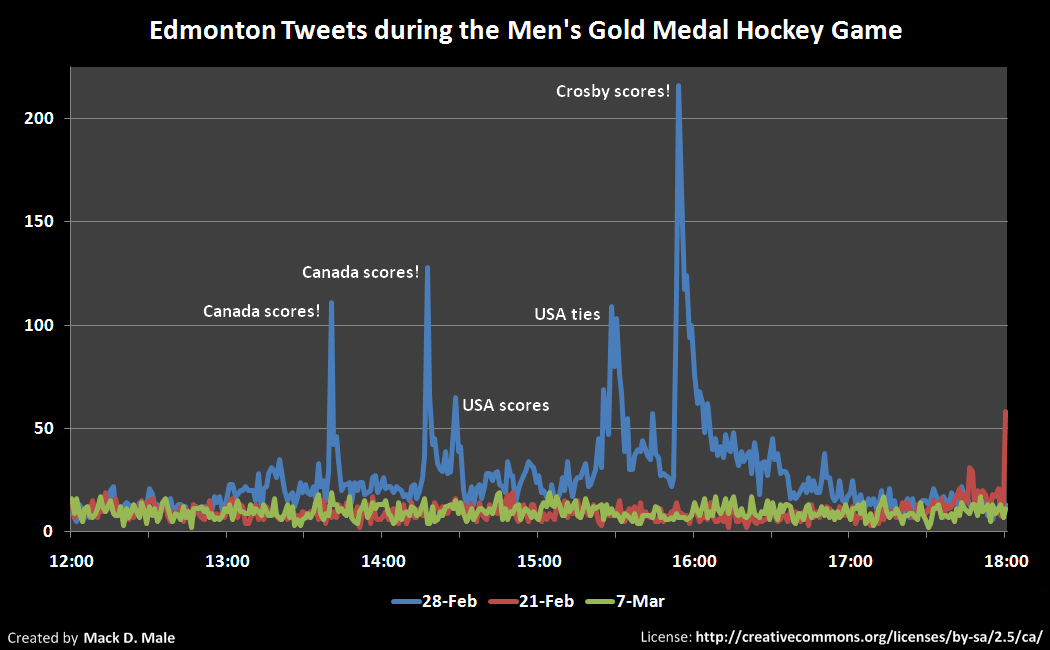
I’m sure you’ve seen by now the chart that EPCOR released showing water consumption in Edmonton during the men’s gold medal hockey game on February 28th. It’s pretty amazing how closely the data matches the end of the periods! I’m sure the game had an impact on many other parts of our lives as well. For instance, tweeting!

Here’s how much Edmontonians were tweeting during the game:

I’ve also stuck February 21 and March 7 in there, so you can see the difference from normal. We posted 27 tweets per minute from noon until 6pm on game day. That’s about three times more than normal!

Here’s what we were tweeting about:

No surprise there! I’ll have more Twitter stats up soon.

Recap: Open City Workshop

Saturday’s Open City Workshop at the Art Gallery of Alberta was a fantastic event! Excellent turnout, great discussions, and lots of enthusiasm for the open data/open government movement here in Edmonton. We started the day with some opening remarks from Councillor Don Iveson, CIO Chris Moore, and FusedLogic’s Walter Schwabe. I really liked Don’s key values: transparency, empowerment, and collaboration.

Open City WorkshopOpen City Workshop

Next up was the panel, featuring David Eaves, Nick Charney, Mark Kuznicki, and Alayne Sinclair. They talked about what open government meant to them, took an odd detour into voting, and took some questions from the audience as well. Here are a few of the key things that stood out for me:

  • The idea of government as a platform is not new!
  • It’s about empowering citizens to make the city their own, enabling them to go after their passions.
  • Engagement is often a sign that you need to do something differently, not necessarily that you’re doing something right.
  • Civil servants are citizens too!
  • Open government is part of a broader cultural shift, and citizens have a responsibility to become participants.

I really enjoyed the panel – it was the highlight of the day for me. It was great to finally meet David, Nick, and Mark in person too.

After some forced networking and a break for lunch, the unconference part of the day got underway. We broke into smaller groups to discuss things like the role of journalism and storytelling in open data, the digital divide, thinking beyond technology solutions, and timelines/deliverables.

Open City WorkshopOpen City Workshop

Open City WorkshopOpen City Workshop

I attended the role of journalism and storytelling first, and we seemed to reach the consensus that storytelling is vital for open data/open government to succeed. We need everyone to tell stories, so that we achieve a diverse range of views. We also felt that journalism has a role to play in bridging the gap that exists between those who “get it” and those who don’t. The second session I attended was on engaging residents not familiar with technology. We ended up talking a lot about deliberative dialogue, and I was left with a lot to think about – how will access to open data affect the way a citizen looks at the world? We’re naturally selective, does open data change anything in that regard? For some thoughts on the other two sessions, check out Stella’s recap.

Open City WorkshopOpen City Workshop

Another really great aspect of the day was that it was streamed live online by FusedLogic in both English and French. There were dozens of people participating virtually, from Edmonton and around the world! I understand that they even held their own breakout discussion in the afternoon! Kudos to the FusedLogic team for taking on such a big task, and making it work so well.

At the end of the day, Chris Moore took the stage once again to make a few announcements:

  • An RFP has gone out for the design and implementation of the next generation of productivity technologies at the City of Edmonton.
  • The City of Edmonton is partnering on open311.org, to bring open standards for 311.
  • On April 19, the City of Edmonton is planning to launch an iPhone app called CityWatch, developed by local company Touchmetric.
  • The City of Edmonton is calling for the creation of a “Code for Canada” organization, modeled after Code for America.
  • There will be an Apps4Edmonton app contest in the near future, with the prizes and winners to be showcased at GTEC2010 in October.

Exciting stuff! Congrats to Chris and his team for putting on a great event.

Stay tuned to the #openyeg and #yegdata hashtags on Twitter for updates, as well as the City of Edmonton’s open city page. You can see the rest of my photos here, and you can see the City’s photoset here. You can see a list of the attendees on Twitter here.

I’ll leave you with this TED video of Tim Berners-Lee talking about open data:

Bring on the data!

Notes for 3/7/2010

Feeling very behind at the moment. Here are my weekly notes:

Edmonton Notes for 3/6/2010

Here are my weekly Edmonton notes:

Open City Workshop & Participation Inequality

The City of Edmonton is hosting a workshop tomorrow at the Art Gallery of Alberta called Building Community through Open Information (on ShareEdmonton). It’s a follow-up to the open data workshop that happened last year and the conversations that have taken place since, but is focused on connecting stakeholders, increasing a shared understanding of Government 2.0, and planning the way forward. Devin wrote some great thoughts on the workshop here.

I’m really looking forward to seeing a diverse local crowd, representing a variety of agencies and interests. I’m also looking forward to meeting special guests David Eaves, Mark Kuznicki, and Nicholas Charney in person. All three are key players in Canada’s open government space.

And while I’m hopeful that we’ll see some new data released tomorrow, I’m mindful that data is not the focus. The three objectives listed on the event details page are about establishing Edmonton as a leader, and then lots of talk. I think the way you establish yourself as a leader is by actually doing things, but I’ll keep an open mind tomorrow 🙂

One thing I do want to talk about at the workshop is the divide that a number of people have picked up on. It’s great that Edmonton and other places are making progress on opening up data, but how does that impact the average citizen? There’s definitely a perception that only techies understand and can use open data. I don’t think that gives the average citizen enough credit, but I’m willing to concede that open data is not as accessible today as it needs to be. There’s lots of room for improvement.

Having said that, I think it’s important to keep participation inequality in mind:

All large-scale, multi-user communities and online social networks that rely on users to contribute content or build services share one property: most users don’t participate very much. Often, they simply lurk in the background.

If we think of open data (and open government) as a large community, then we should absolutely expect that a small subset of that community will be responsible for most of the activity. In the context of the 90-9-1 rule, 90% of the community won’t participate (they just observe or read), 9% will occasionally participate, and 1% will participate a lot.

Here’s one way to visualize the open community:

I’m sure there are other ways to break it down, but this makes the most sense to me at the moment.

  1. Goverati: these are government employees, folks from related agencies, non-profits, etc.
  2. Creative Professionals: these are people such as myself, developers, designers, etc.
  3. Business: for-profit organizations.
  4. Citizens: ultimately, the beneficiaries of all this open government stuff!

Of course, this picture is somewhat misleading, because all goverati, creative professionals, and business folks are also citizens, but let’s set that aside for now. I think the goverati and some creative professionals fall into the 1% category, the rest of the creative professionals and business fall into the 9% category, and citizens account for the 90% category.

The 90-9-1 pattern can be seen in action all over the web, perhaps most notably on Wikipedia. A tiny percentage of Wikipedia’s user base is responsible for the vast majority of all content produced. I think we can do better with open data/open government, however. Through applications, interactive visualizations, and the other interesting things that the goverati, creative professionals, and businesses build, I think more and more citizens will move from the 90% category to the 9% category.

I guess the point I’m trying to make is that considering how the average citizen benefits from open data is important, but we shouldn’t let that hold us back from making progress at this point. We need to empower businesses and creative professionals to build things that the average citizen will ultimately benefit from. As we do that, there’s an opportunity to educate citizens if they want to be educated!

There’s only a few hours left to register for the event. Hope to see you there!