Notes for 10/11/2010

Happy Thanksgiving to everyone in Canada! Here are my weekly notes:

ThanksgivingThanksgiving

Edmonton Notes for 10/9/2010

Here are my weekly notes:

City Market Final DayCity Market Final Day

City Market Final Day
Today was the final day for the City Market on 104 Street, at least for this season. The market will be back at Olde Time Fair on the Square, as well as for a few winter dates in Churchill Square.

Edmonton
It’s definitely fall in Edmonton.

Edmonton Election 2010: Inner City Issues at The Learning Centre

It’s pretty clear that technology is playing a big role in this year’s election. Lots of candidates now have websites and a presence on social networking sites, and there are an increasing number of places you can look online for more information. We’re fortunate in Edmonton to have lots of opportunities to meet candidates in person too, such as at City or community organized forums, many of which are either streamed online or live-tweeted by those in attendance.

But what about Edmontonians that don’t have regular access to the web? Or Edmontonians whose reading skills are in need of improvement? Some people simply don’t feel comfortable attending a forum or talking to candidates in person, so how can they have a voice in this election? I was happy to discover that The Learning Centre (I am a board member) was making an effort to help people in the inner city get involved.

The Learning Centre

Daniel Johnson, a sessional instructor in the Faculty of Native Studies at the University of Alberta, has been a volunteer at The Learning Centre since being introduced to it through the Humanities 101 program. Recently, he decided to try to get people that use The Learning Centre and Boyle Street Community Services (BSCS) thinking about the election. For the last few weeks, Daniel and other volunteers have been running an informal session called “Inner City Issues” in the Boyle Street drop-in. The goal was to get people talking about the issues they care about. Daniel would write down their questions and thoughts on the whiteboard, and then he’d ask other people what they thought. As you can see below, they’ve come up with not only questions, but also lots of ideas.

As the election draws near, the focus of the session will shift toward helping people be prepared to vote, ensuring they know where to go, what identification is required, etc. And everyone will continue to have the opportunity to voice their concerns.

The Learning Centre

Daniel also organized two candidate forums, held at The Learning Centre on September 30 and October 7. Mayoral candidate Daryl Bonar was joined by Ward 6 candidates Brian Kaptiza and Jane Batty at the first forum, and Mayor Stephen Mandel was on hand for yesterday’s forum. I wasn’t able to attend the first forum, but Daniel told me that there was a great turnout, with lots of questions and animated discussion.

I was able to check out yesterday’s forum, however. Mandel arrived late but stayed for quite a while to answer more than two dozen questions. There were about 25 people in attendance, a little less than at the first forum. There were a range of issues brought up, but homelessness and housing issues (bed bugs, basement suites, etc) dominated the discussion. Other issues that came up were policing, transit (not enough passes or tickets in the Donate-A-Ride program), helping those with mental illness, the amount of garbage downtown, school closures, safe injection sites, and the downtown arena. The airport and EXPO were mentioned once or twice, but were definitely not the focus!

I thought Mandel did a good job of answering questions for the most part, though he did get a little defensive on occasion. Most people in the room wanted to see more action on helping the homeless, though a few did explicitly thank Mandel for the work the city has been doing under his watch. What impressed me most was that people didn’t just have questions, they had ideas for possible solutions too. Things like using recently closed schools for transition housing, or offering a free downtown bus route. One person even suggested that Mayor Mandel go homeless for a night, to see what it’s really like. He replied: “I’ll think about it!”

I think it’s great that Mandel, Bonar, Kapitza, and Batty took the time to meet with people in the inner city. It’s a group that is often overlooked, even as we tout the statistics of the Housing First program and other service agencies. Kudos to Daniel and his fellow volunteers for making it happen!

The weekly inner city issues session will continue to run next Thursday at 1pm at the BSCS drop-in centre, and on October 18, there will be buses available throughout the day to bring people from BSCS to the polling station.

Recap: Edmonton Next Gen’s Candi{date} :: north of the river

Edmonton Next Gen held its second Candi{date} forum this evening, this time for candidates in Wards 1 through 7. Organized in conjunction with interVivos and the MacEwan Students’ Association, the event provided young people the opportunity to sit down with candidates for 20-minute mini-dates. The first Candi{date} event was poorly attended, but tonight’s event was much more lively. Most of the candidates were in attendance and their tables generally seemed busy throughout the evening.

I decided to focus on Ward 6 candidates, since that is the ward I live in. I managed to sit down with each of them, except for Jane Batty. Here are my thoughts on the candidates I talked to:

  • I started with Thomas Roberts. He seemed unprepared, both in terms of his campaign (he had some excuse about not having materials) and in terms of his knowledge. Thomas brought up the airport, as an example of the current city council not listening to citizens. He cited business as the core reason to keep it open, but could not express why and I don’t think he really knows anything about the airport. He thought all the businesses had already moved away from the ECCA. He also thought Port Alberta was called “Port Edmonton” and that it involved the ECCA. We talked about transit as well, and he expressed his belief that the U-Pass is too expensive and should be opt in. He couldn’t tell us how much the U-Pass costs, and he did not have a strategy for making the program viable if it were opt-in. I asked him why he wanted to run for council, and he said the airport was a big issue, and there was another one…that he read in the paper not long ago…that he couldn’t remember. Frankly, I couldn’t wait for our time to be up.
  • My next stop was with James Johnson, one of the younger candidates running for office. He seemed relaxed and did a good job of answering questions, even if he lacked enthusiasm. I asked him where he sees Edmonton in twenty years, and he said “with the same boundaries we have now.” He seems to understand that a more compact urban form could help our city run more efficiently, but unfortunately, his policies don’t align with that vision. He supports the ECCA, again claiming we’ll lose business without it. I asked him what he’d do to ensure we attract new business when it closes, and he didn’t have a strategy. James has concerns with the Stony Plain LRT and referred to transit in general as a “social service”. He did acknowledge that having everyone drive is not the solution. We also touched on EXPO, something James is opposed to due to cost. I thought James was a pretty personable guy, but I disagree with his ideas about how to move Edmonton forward, and I got the impression that he’d have a lot of learning to do.
  • My third stop was at Lee Permann’s table. He was very friendly, and actually, I’d say my conversation with him was the most enjoyable of the evening. I had to start by asking him about his lawn signs, which have councillor spelled “councelor”. He blamed it on the printer, but didn’t have a reason for why he didn’t print new signs. He had a sense of humor about it though, suggesting it might get people to notice him. He lives in Westmount, and talked a lot about increasing the number of people living in the ward. He thinks downtown (I’m assuming he means Downtown and surrounding neighbourhoods together) could support another 100,000 people in the next 20 years. I’m not sure that is realistic, but I do like that he views downtown revitalization as a function of the number of people living there. He also talked about the need for infrastructure. I asked him why he wanted to run for council and he said that he felt the current council was too closely aligned with big business, but did not elaborate. Lee seems like a good guy, but I don’t think city council is for him.
  • Next up for me was Brian Kapitza. He clearly knows a thing or two about how the city works, and seems to have spent some time learning about other places in the world too. Almost as soon as we sat down he launched into his two core issues: neighbourhood renewal & empowerment, and curbing urban sprawl through property tax reform. I think his idea for property tax reform (basically you pay based on the services your land can use, rather than the value of the land) makes a lot of sense but would be difficult to get consensus on. Likewise I think his plan to give community leagues the power to veto planning and development issues in their neighbourhoods would be difficult to implement. I guess someone needs to start these discussions, but I wonder what else he’d do if elected. I really felt as though I was being lectured to when Brian talked, but I am happy to see a candidate with some experience, a vision for Edmonton’s future, and some concrete strategies to start working toward that vision.
  • My last stop was at Cris Basualdo’s table. We spent our time talking about Cris’ two major issues: creating a vibrant downtown (she includes the surrounding neighbourhoods) with more residents, and dealing with community safety. It’s a little odd to talk about how unsafe the ward is in one breath and then to start talking about bringing in more families in the next, but that’s how it went. Like Lee Permann, Cris thinks the key to creating a vibrant downtown is to get more people living there. I think she exaggerates the crime problems facing ward six, and did not share any specifics on how she’d go about improving the situation. Cris wants to take a firm stance against undesirable activities such as needle use, but did not indicate where users would go (no mention of safe injection sites, etc). I thought Cris was really friendly, and she certainly has passion for what she believes, but I don’t think she’s ready for city council.

Candi{date}

I tweeted earlier that the evening was both eye opening and depressing. The speed-dating format is a fantastic way to meet the candidates, and to find out more about them. It’s also a format that prevents candidates from hiding behind platform points or big issues. You can fairly quickly figure out which candidates know that they’re talking about, which candidates would likely be team players, and which candidates have a vision for Edmonton beyond fixing potholes. The depressing part is that I left most tables underwhelmed and unimpressed.

I’ve mentioned the learning curve a few times. I think it takes guts to throw your hat into the ring to run for office, but I also feel you should be prepared for it, and I want a councillor that can hit the ground running. Obviously there’s a learning curve for anyone new to council, but there is a whole ton of knowledge about how the city works that you can learn before getting into office. That doesn’t mean no new ideas, it just means being prepared to do the job well. I think we’ve got some momentum as a city, and I’d like to see us capitalize on that.

Candi{date}Candi{date}

I thought NextGen did a great job with Candi{date} and I’d love to see them do it again. I can only imagine that candidates would want to do more of these events as well. Daryl Bonar told me about his experience at the first Candi{date} and said it was a great way to meet lots of people in a short amount of time, far more than you’re likely to have a meaningful conversation with door-knocking. It would be great to see similar events for school board candidates as well.

Thanks NextGen (and partners) for a unique way to meet my candidates! You can see a few more photos from the evening here.

TechDays 2010: Edmonton

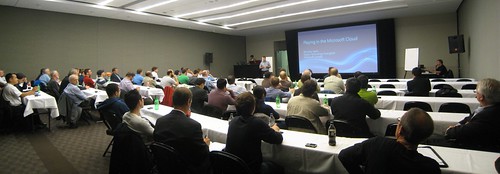
This year Microsoft finally brought TechDays, its Canadian technical training conference, to Edmonton. Some of us had been asking Microsoft to add our city to the cross-Canada tour for a while, and when enough people spoke up, they listened. And it paid off too. Initially Microsoft was expecting 250-300 people to register for the Edmonton event, but we blew that out of the water! Nearly 500 people registered! And judging by the large crowds, I’d say that most of those people attended too (it’s probably quite uncommon pay the registration fee and then not attend).

There is always criticism of the sessions offered at TechDays, but I think they had a decent mix this time around. Lots of introductory stuff I suppose, but that seemed to match the makeup of the audience. The addition of the Local Flavours track was a good start toward including some more diverse content as well. I was the track host for the “Optimizing the Development Process” track, and I did two presentations of my own.

TechDays 2010

My first presentation was Top 10 Mistakes in Unit Testing, adapted from a similar talk that was done at TechEd. The goal of the session was really to get people thinking about the little things that can help them be more successful with unit testing. I included three demos: a simple MS Test demo, a more involved demo using Ninject and Moq, and finally a demo showing JavaScript unit testing. Here are some resources for the session:

For my second presentation, I teamed up with Devin Serink to present A More Programmable World with OData. We talked about open data in general, about the work the City of Edmonton is doing, and then showed how easy it is to create and consume OData services. We spiced things up by using some PHP and Google Charts in the demos! Here are some resources for the session:

I thought both talks went well, and I hope people found them useful!

TechDays 2010

Given the success of the inaugural TechDays in Edmonton, I’m sure they’ll be back again next year. You can follow along as TechDays continues to travel across the country using #techdays_ca on Twitter.

Joey wrote about Day 1 here, and you can see the rest of my photos here.

Recap: CloudCamp Edmonton

Tonight was the first-ever CloudCamp here in Edmonton, an unconference focused on cloud computing. Held at the Shaw Conference Centre, kind of in conjunction with Microsoft’s Tech Days (happening tomorrow and Wednesday), around 60 people attended. Here’s the brief overview:

CloudCamp is an unconference where early adopters of Cloud Computing technologies exchange ideas. With the rapid change occurring in the industry, we need a place where we can meet to share our experiences, challenges and solutions. At CloudCamp, you are encouraged to share your thoughts in several open discussions, as we strive for the advancement of Cloud Computing. End users, IT professionals and vendors are all encouraged to participate.

The format was similar to other unconference events. Moderated by Larry Carvalho, we started with six lightning talks:

  • Barnaby Jeans went first and gave an overview of Microsoft’s cloud computing strategy and offerings.
  • Associate Professor Paul Lu from the University of Alberta was up next and talked about the university’s proposed adoption of Gmail, its experimentation with Google’s Fusion Tables, and its research work on virtualized RAM.
  • Third was Rob Bissett from 6fusion. He talked more about infrastructure-as-a-service as well as the need for consistent price-per-compute units across the industry.
  • Li-Yan Yuan, a Professor at the University of Alberta, talked about LogicSQL, which is basically a grid architecture for a DBMS.
  • Fifth was Sean Ouimet, who dared to be different and used a flipchart instead of slides to talk about how to design your applications for the cloud so that they scale.
  • Last but not least was Timothy Dalby, winner of Make Web Not War, who discussed his application Find-A-Home.

CloudCamp Edmonton

After the lightning talks, Larry asked everyone in the audience to raise their hands if they thought they were an expert in cloud computing. The four guys that raised their hands become the panelists on the “unpanel” (and it was guys…I think there was maybe one woman in the whole audience). Everyone in the audience then had the opportunity to ask questions, which the panel fielded. Larry took notes, and the questions eventually formed the basis for the breakout sessions.

Some of the topics that came up included: geography (where is your data located), multi-tenancy, cost, building a cloud application, and startup opportunities. We ended up breaking into just two separate groups though, one more focused on the business side and one focused more on the technical side.

I decided to join the business group, and for an hour or so we had a really great (not to mention really broad) discussion about the impacts of cloud computing. I had to leave before the two groups came together again, but that was to be the final part of CloudCamp.

One of the more basic questions that arose throughout the evening was the difference between the various “as-a-service” offerings:

  1. Software-as-a-Service
  2. Platform-as-a-Service
  3. Infrastructure-as-a-Service

I think the Wikipedia articles do a good job of explaining each one, so I won’t expand on that here. I tend to think of it like this: SaaS is something like hosted Exchange, PaaS is something like Azure (which hosted Exchange runs on), and IaaS is something like Amazon S3 (which could host the Azure data).

It was great to see so many people interested in discussing cloud computing! You can see a few more photos from the evening here.

Notes for 10/3/2010

Here are my weekly notes:

Edmonton Legislature Grounds During Fall
Fall is definitely here, though we had some warm weather this weekend. This photo was taken yesterday by Oscar D.

Heritage, Innovation & the Livable City: A Heritage of Local Food

The final session at the Edmonton Heritage Council’s symposium was on the heritage of local food. I thought it was a great idea to include a topic like food, something we don’t always associate with heritage, though obviously it makes sense to do so. The session was moderated by Liane Faulder, and panelists included Kathryn Chase Merrett, Jessie Radies, and Patricia Myers.

How might the history of local food production and marketing in Edmonton relate to people’s contemporary interest in local food? This session will discuss how this history connects to current concerns and developments on sustainable food systems.

Here are my notes:

  • In addition to moderating, Liane was also a panelist. She started by sharing some recent local food stories. She talked about three local producers: Donna & Bohdan Borody (The Jam Lady), May Ellen & Andreas Grueneberg (Greens, Eggs & Ham), and Gordon Visser (Norbest Farms). She also mentioned the Culina family of restaurants.
  • Liane noted the recent desire that many people have to reconnect with their food producers. She also talked about the importance and popularity of farmers’ markets, saying “the farmers market is the new church”.
  • Kathryn, who has literally written the book on the history of the Edmonton City Market, talked a lot about her view that food is a big part of what makes a city livable.
  • It might be hard to visualize but from 1900 until 1965, market square was where the current Stanley Milner library sits.
  • She said the market has not always been seen as a positive thing in Edmonton, at least not by those in power. Old city councils viewed it negatively, and tried a number of times to displace it. Nothing has ever really worked though, because citizens and food producers have always loved the market.
  • Kathryn also touched on foods which used to be plentiful in Edmonton, such as strawberries. She read a passage from an 1894 Edmonton Bulletin article that described the “crimson trail” left behind as you walked, because there were so many strawberries.
  • To Kathryn, a livable city is one that can feed all of its people, but which also takes the time to enjoy and to share.
  • Jessie recounted her experiences of growing up on the farm, describing the various skills she learned, such as canning. It was a great story.
  • She also talked about her recent work with Original Fare and Live Local. She said that both the local and global food systems are necessary, and must be strong.
  • Patricia collects antique cookbooks and shared some of the reasons behind her hobby.
  • She said she doesn’t care so much about having particular editions, but she loves acquiring different books to see what she can learn from them.
  • Patricia said she views the cookbook as a repository of women’s history. Typically cookbooks are dismissed as historical works, and Patricia is trying to change that.
  • She said you can learn about the technology and cultural norms through the cookbooks. For example, she said books that contain lots of sandwich filling recipes were likely from a time when picnics, fundraisers, and other activities were quite common.

I was really intrigued by Patricia’s idea that you can trace technology through the cookbooks. It made me wonder what else is out there that we don’t typically think of as being important heritage pieces.

Heritage, Innovation & the Livable City: Edmonton’s (Lost) Spaces, Places, & Neighbourhoods

This session sounded interesting and I was hoping it would provide me a neat list of places to check out. That didn’t happen, unfortunately, but I still learned quite a few things. The panelists included: Tyler Dixon, intern architect with ziola newstudio architects; David Holdsworth, one of the two heritage planners at the City of Edmonton; and Ken Tingley, Edmonton’s first historian laureate.

Edmonton could be described as a city in the habit of remaking itself. As a result, historic spaces, places and events are obscured, lost or ignored. Panelists will discuss this heritage of “remaking” and what has been ignored, overlooked or misunderstood and how it might be reclaimed.

Here are my notes:

  • Ken started by showing pictures of early Edmonton and describing the disappearance of First Nations people from the urban setting.
  • He described an effort in 1911 to eliminate First Nations as an attraction from western exhibitions, something Edmonton complied with the following year.
  • Ken also talked about some of racial incidents from our past, such as when local hotel and restaurants banded together to get rid of non-white labour.
  • David spent most of his time talking about heritage areas. The City of Edmonton has just three official heritage areas: Westmount, 104 Street, and Whyte Avenue.
  • Heritage areas must have regulations and guidelines for development, must allow new or alternative uses, and must have community support.
  • David described the Edmonton trend of breaking from the past – tearing down the old to make way for the new.
  • He showed one slide with photos of what looked like the same house, except that each photo was from a different city, all around the world. David say that both now and 100 years ago, there’s not much architecture unique to Edmonton.
  • Much of his discussion centered around “theming” and whether that is a good thing or not. Think of the warehouse buildings on 104 Street for instance, and how the new Icon towers were built to mimic that design.
  • David said he never asks for duplication, but wants to prevent building another “anywhere place”.
  • The Edmonton Design Committee will be considering the 81 Avenue area as another potential heritage area (most of the buildings there have false facades).
  • Tyler talked about aging and the stories that aging buildings can tell.
  • He also touched on urban sprawl, saying Edmonton is filled with holes (parking lots), and that the boom-bust cycle has nudged us toward certain building materials and styles.
  • Tyler was much less enthusiastic about the theming David talked about, saying he fears it leads to “just-add-water” instant heritage.
  • Ken had said during his talk that Edmonton is caught between progress and nostalgia. Tyler picked up on that, and said that both can be beautiful.

I thought David’s introduction to heritage areas was really good, and that’s a topic I’ll likely try to follow-up on. Another thing that was discussed that I didn’t mention in my notes was the importance of intangible heritage. After all, out of sight, out of mind.

Edmonton Notes for 10/2/2010

Here are my weekly Edmonton notes:

Edmonton Heritage Council
The first ever Edmonton Heritage Council symposium was held this weekend at the Sutton Place Hotel.