Heritage, Innovation & the Livable City: A Northern City

There were three concurrent panel sessions this morning, which means we had to choose. I ended up going to the one called A Northern City. The panelists included: Rod Macleod, retired professor of History & Classics at the University of Alberta; Mark Nuttall, professor and Henry Marshall Tory Chair in the Department of Anthropology at the University of Alberta; and Heather Zwicker, associate professor of English at the University of Alberta.

Tagged as the “Gateway to the North”, Edmonton has also been described as “a northern city of art and ideas”. Yet its northernness is often overlooked in understanding the city and region, as well as its connection to the “south” and other northern places.

As someone who grew up primarily in Inuvik, NT, this panel caught my eye. I was quite familiar with the idea of Edmonton as “a northern gateway to the south” – something the panelists talked about. Here are my notes:

  • Rod started by highlighting the two things that we think about as a northern city. The first, climate, gets a lot of attention. The second, isolation, is something we think about far less. Rod says to draw a 500km circle around northern cities. With the exception of Edmonton and Moscow, you’ll find lots of other places in those circles.
  • Despite the creation of the rival city of Strathcona, the construction of the railroad from Calgary had surprisingly little effect on our northern orientation, according to Rod.
  • He talked at length about our history as a transportation hub more than a trading post, noting that the air freight industry was practically invented here. He talked about the arrival of the airplane, and how it replicated the region’s previous economy: bringing furs south, taking supplies north.
  • Something to look up: the Aerosmith map of 1832, which has great detail north of Edmonton but not much south.
  • Rod suggested that while “facing north” has made us culturally self-sufficient, being a part of the northern frontier has ingrained in Edmonton a reluctance to plan and build for the long-term.
  • Mark picked up here, nothing that although there are lots of places further north than us on the globe, northernness actually has very little to do with latitude.
  • He noted that in Canada, the term “north” has often been synonymous with “marginalized”. That’s not the case in other places. He also observed that as places develop, “north” seems to move further north. When a Walmart arrives in Whitehorse, is still the north?
  • Mark finished by discussing the Arctic Council and how the north is becoming centre stage, thanks to climate change and other global issues. Canada assumes the chair of the council in three years, which provides an opportunity for Edmonton.
  • Heather discussed the literature surrounding Edmonton as a northern city, starting with Alice Major’s Contemplating the City, and Erin Knight’s Bribing the Boundary God.
  • She said the river plays a key role in most of the literature, either positively or negatively – is the river an obstacle, or a way in and out of the city?
  • I thought the notion of Edmonton as “the cosmopolitan north” was quite interesting. Heather said the notion of “cosmopolitan” is up for grabs, saying that “Brooklyn is the new Manhattan”.

Another interesting concept came up in the questions. Mark had said that before moving to Edmonton, he had never lived away from the sea. And while Edmonton doesn’t have a traditional port, we are something of a “port city” thanks to Fort McMurray and other northern communities. I immediately thought of the Port Alberta initiative as well.

What I took away from the session is that being a northern city is much more a mindset than anything else. There are physical elements of course, but it’s the intangible part of being in “the north” that has probably had the biggest impact on Edmonton’s development.

Heritage, Innovation & the Livable City: The Future of History in Edmonton

The keynote address this morning at the Edmonton Heritage Council’s first symposium was delivered, fittingly, by Edmonton’s first Historian Laureate, Ken Tingley. Titled The Future of History in Edmonton, Ken’s talk introduced a number of the topics that would be discussed throughout the symposium. It was immediately followed by “20 questions” from Linda Goyette, a sort of response that really got people thinking!

Ken talked quite a bit about the “old timer’s” and the impact they have had on the preservation of Edmonton’s history. He pointed out that although their early efforts to preserve our local history were valuable, they were often done for self-congratulatory or other selfish reasons. Linda picked up on this, asking: “Who gets to tell Edmonton’s stories? Which are excluded and which are preserved?”

Perhaps not surprisingly, Ken pointed out that history in Edmonton has always been linked to the idea of progress and to the march of civilization onward. This has had a number of impacts, not all of them positive, and Ken mentioned the way people native to the area were treated when settlers arrived as one specific example. Linda touched on this as well, and said the Rossdale lands should be the site of the proposed civic museum, an idea that garnered lots of applause.

At one point, Ken mentioned the idea that instead of “gateway to the north” we should be known as “Gibraltar of the north”. A quick search reveals that Luxembourg has already claimed that title! Linda had a quite a number of memorable comments herself, such as the idea that we should start protecting modern buildings for the future now, just as we sometimes defend our built heritage (she made it clear that we often don’t do enough).

Technology wasn’t really mentioned in the opening sessions, except for Linda asking why the complete Fort Edmonton history still hasn’t been digitized. If we’re going to be more innovative about how we preserve and share our history, I think technology is going to be key.

Ken closed his remarks with a bit of a challenge, stating that the presentation of our local history is getting more sophisticated, and could be just as innovative as other parts of urban culture. Linda’s final question complemented that idea quite nicely: “How can we work together?” Though she was referring mainly to the heritage workers in the room, I think that question applies to Edmontonians more broadly as well.

Heritage, Innovation & the Livable City: Spying on E-Town

Tonight was the kickoff of the Edmonton Heritage Council’s first ever community symposium, called Heritage, Innovation & the Livable City (on ShareEdmonton). I came across the event online a few weeks ago, and thought it would be really interesting and likely very educational. Here is the EHC’s introduction to the symposium:

“Heritage”, “innovation” and “livability” are terms not often used in relation to each other. To many people, interest in heritage seems contrary to the spirit of innovation and has little currency in the pace of urban life.

This inaugural symposium brings together community members, heritage organizations and engaging speakers to explore how Edmonton’s unique heritage has shaped—and is shaping— the city and region.

Linda Goyette was our keynote speaker this evening. She delivered a very spirited talk entitled Spying on E-Town. Linda took us on a journey across Edmonton, pointing out well-known features like the High Level Bridge as well as lesser known ones, such as the many statues around the city that help to tell the story of Edmonton. Along the way she highlighted and paid tribute to the many archivists, historians, and other heritage workers, some of whom were in the room, that ensure Edmonton’s history is not forgotten.

I wrote down a few notes from Linda’s talk to follow up on:

  • There are 23 distinct museums in Edmonton, but no civic museum.
  • A book that caught my eye, because of the subtitle as well as the publication date (2009) – Aboriginal Edmonton: A Statistics Story.
  • Ian Mulder, an artist responsible for many murals throughout the city. He has apparently just relocated to Toronto, unfortunately.
  • The City of Edmonton Archives recently hired someone dedicated to the digital side of things. Anyone have any further details?
  • Christian Nelson’s 3D models of Edmonton buildings are really neat and take advantage of modern technology, but they too are a form of digital preservation.

Tomorrow starts with a keynote address from Ken Tingley, Edmonton’s first historian laureate. I’m looking forward to it!

Timeraiser returns to Edmonton with a WestJet giveaway!

Last year, Timeraiser came to Edmonton for the first time. It was a great opportunity for people to connect with both local organizations looking for volunteers and with local artists. The event was a big success too: 4145 total hours were pledged by 180 people and $12,000 was invested in the careers of emerging artists, surpassing the goals the organizers had set. You can see my photos from the event here.

Timeraiser is like a mix between a silent art action and a volunteer fair. Here’s an overview of how it works:

This year, Timeraiser Edmonton is taking place on October 16 (on ShareEdmonton), and there are 20 agencies participating. You can get your tickets here, which include the Special Live Performance of Amy van Keeken’s Rock & Roll Sing-a-Long.

WHO: Everyone!
WHAT: 2nd Edmonton Timeraiser
WHEN: Saturday, October 16, 2010 at 7:00 PM
WHERE: TransAlta Arts Barns, 10330 84 Avenue (map)
WHY: To raise 4000 community hours for local organizations!
Click here to register!

The Timeraiser crew was in Edmonton a couple weeks ago, purchasing the art from local artists, and talking to over 100 local shops & restaurants about the upcoming event. It’s going to be a great night!

Win two tickets to anywhere WestJet flies!

One of the exciting things about Timeraiser this year is that WestJet has signed on to be the national presenting partner, and they have been running a social media contest in each city, giving away two airline tickets worth over $4000. I was asked to help give them away in Edmonton!

To enter the contest, leave a comment below answering this question:

What are you doing to help make Edmonton a better place?

You have until noon on October 13 to make your entry. After that, I’ll assist the Timeraiser organizers in picking the best comments and ultimately the winner. I’ll announce the winner here on October 14. You can see the full contest rules and regulations here.

Mark your calendars for October 16 and don’t miss the second Edmonton Timeraiser! You can learn more about Timeraiser on their blog and Facebook, and you can follow along using #timeraiser on Twitter.

UPDATE: Congrats to Christina for her comment on getting informed about Edmonton and contributing positively to our city!

Recap: DemoCampEdmonton12

Tonight we held our twelfth DemoCamp in Edmonton. We changed up the venue this time but decided to stay on the University of Alberta campus, so instead of the familiar ETLC we found ourselves at the Telus Centre. To me the vibe in the room felt different, like there was less energy, and it actually seemed like there were less people because it was a bigger room. It’s amazing how the layout of the room can have such an impact.

We had four short demos tonight, from some of the winners of the Apps4Edmonton competition:

  • Eugene showed us Statistics Edmonton, which lets you easily look at demographics and other information on a map.
  • Ben showed us Alertzy, which can send you a text or email notification when it is time for garbage pickup where you live!
  • Mitch showed us Diner Inspect, which lets you look at health inspects for restaurants in your neighbourhood.
  • Chris showed us YEG Live, which aggregates music events in Edmonton and does e-ticketing as well.

DemoCamp Edmonton 12DemoCamp Edmonton 12

We also had five regular demos:

  • Chad Smith from Hybrid Forge kicked things off by demoing TRACpac for iPhone, an iPhone application that lets users search the combined catalogue of more than 150 libraries. He also demoed an iPad app that offers the same functionality but with a different interface. The apps looked great, and I love that they use a variety of 3rd party APIs to pull in data.
  • Jas Panesar showed us an app he had built for clients to deal with managing warranties. We didn’t get to see too much of it, but it seemed to have some solid workflow behind it. And certainly as a customer, making my interactions with warranties better is a good thing.
  • Next up was David Nedohin and Kieron Quigley from Statusfirm. They demoed Core Catalyst, a CMS tool targeted at government, enterprise, and other large organizations. It’s actually the platform that is powering the City of Edmonton’s election webcasts.
  • Fourth tonight was Joel Adria and Yuri Delanghe, university students who built Bearbook which is a Facebook app that makes it easy for students to share their timetables with other students, and to find common breaks. Joel said they were inspired by Bearscat and currently have 3700 students using the app (half of which have uploaded their schedules).
  • Last but not least was Trystan Kosmynka and Colin Humber. They showed TestFlight, a beta testing management platform for developers targeting the iOS platform. It fills a big gap that Apple developers face, and does it without iTunes, cables, or jailbreaking.

You can see all the presenters on Twitter here.

Overall, I’d say my favorite demo was probably Bearbook (though I also really liked the TRACpac app that Chad showed). I think a lot of other people in the room enjoyed Bearbook as well, feeling that Joel and Yuri brought some of the old-school-DemoCamp back. And I love that Joel was more than happy to respond to questions about new features with “we wanted to keep it simple.”

I think the most popular demo was without a doubt TestFlight. I’m not an iOS developer, but a lot of people in the room were, and they seemed to be salivating at the solution that Trystan and Colin showed. I also love that they tackled a real problem, and solved a major pain point. TestFlight isn’t just cool tech, it will actually have a really positive impact on the lives of iOS app developers and their testers.

We definitely had some issues tonight. Internet connectivity was a problem, due in part to us being on the U of A campus I think. We need to get that figured out. A lot of our demos tonight used iPhones or iPads, so we made use of the camera display. It worked well enough but the constant switching of video cables did get somewhat annoying.

The after-party tonight was awesome! The entire top floor of Original Joes was packed. I’m sure some people skipped or couldn’t make the demos and just came for beer, which is fine! It was a good time.

DemoCamp Edmonton 12

There were a few announcements tonight:

  • The next BarCamp is tentatively scheduled for October 23.
  • The next Launch Party is tentatively scheduled for November 17.
  • There are a bunch of other tech events coming up! I’ve got them listed at ShareEdmonton.

Stay tuned to Startup Edmonton for updates. You can see a few more photos from the evening here.

Thanks to everyone who came out tonight. See you at DemoCampEdmonton13!

Notes for 9/27/2010

Here are my weekly notes:

Downtown Edmonton Sunrise
There was a pretty awesome sunrise in Edmonton on Sunday morning!

Sylvan Star CheeseBles Wold
Sharon and I spent all day Sunday on the Slow Food Edmonton Dairy Farm Tour! We visited Sylvan Star Cheese and Bles Wold Yogurt. You can see all of our photos here.

Edmonton Notes for 9/25/2010

Here are my weekly Edmonton notes:

City Market
The new 4th Street Promenade brand was officially unveiled at the City Market today.

Edmonton Corn Maze
It was a great day today for the Edmonton Corn Maze!

Pecha Kucha Night: Edmonton #8

Last night was Edmonton’s eighth Pecha Kucha Night, the first public event to be held at the University of Alberta’s brand new Centennial Centre for Interdisciplinary Science. The lecture theatre we were in was massive, but the crowd was equally as large. Edmonton loves Pecha Kucha!

In order of appearance, here were the presenters at PKN8:

  1. Dr. Indira Samarasekera, President and Vice Chancellor of the University of Alberta
  2. Robert Rogers, Herbalist
  3. Carol Neuman, Board Member, LitFest: Edmonton’s Nonfiction Festival
  4. Dustin Bajer, Teacher & Permaculture Designer
  5. Ben Gardner, Intern Architect
  6. Nadir Bellahmer, Designer, and Michael Rivest, Intern Architect, M.A.D.E
  7. Leslee Greenaway, Edmonton-based Realtor, Save A Village
  8. Marcelo Figueira, Civil Engineer and Land Use Planner
  9. Anita Gregoire, Developer of Urban Food Production
  10. Isha Datar, Researcher

Pecha Kucha Night 8Pecha Kucha Night 8

For the most part, I thought all of the presentations were good. All of the presenters seemed as though they had practiced at least once, and no one really let nerves get the better of them. In contrast with PKN7, where the presenters could barely see the audience, last night’s presenters could probably see everyone, and I imagine that would have been quite daunting in such an imposing room.

I think my favorite talk of the evening was Dustin’s talk on permaculture. He started with a sort of introduction to the topic, before sharing the project he has been working on at Jasper Place School. Though he spoke pretty fast, he was loud, clear, and made permaculture sound very interesting. I really like the idea that “resiliency is the measure of connections.”

I also thought Carol’s talk was very good. She was very successful at promoting LitFest without actually talking about the event! That was in contrast to Nadir and Michael. Although they were entertaining, there wasn’t a lot of substance in their talk, and I don’t even think it was a very good introduction to M.A.D.E.

In talking with others after the event, Isha’s presentation seemed to be a favorite (she also spoke at PKN5). Anita’s talk on community supported agriculture was informative, and Robert took what seemed at first to be a very dry topic and ended up giving a talk with the most memorable quote of the night: “It tastes like chocolate, and it gives you sweet, sweet dreams.” Leslee’s presentation was very well done, but seemed out of place with the rest of the talks. I thought the topics that Ben and Marcelo chose were interesting, especially Ben’s on some new buildings in Edmonton, but perhaps could have been presented differently.

I also have to mention Indira’s talk. She’s a really great speaker, but I would say that her presentation last night probably wasn’t my favorite. She also went over time and bolted from the room as soon as she was done, but I realize she’s a busy lady.

Pecha Kucha Night 8Pecha Kucha Night 8

Some other thoughts on the evening:

  • Our hosts were Ryan Stark and Brian Murray, and once again they did a pretty good job of keeping the evening flowing. They also ditched cue cards in favor of iPads!
  • There wasn’t a theme last night, but “food” kind of emerged as the theme.
  • Edmonton was big on Twitter last night! #pkn8 trended in Canada (as did #yegvote). It seems that more and more people are using Twitter to enhance the Pecha Kucha experience.
  • Though it was cool to be the first ones in the new venue, it really didn’t work as well as it could have. The space outside the lecture room was tight and narrow, which made it difficult to move. Inside, the room had odd lighting and the occasional sound issue. And the event started a half hour late, due to technical difficulties.
  • There were free cookies! And a free photo booth (use password “Nextgen780” once the photos are uploaded).
  • The wonderful graphics for the event were done by Sarah Krzyzek. I understand she painted them on canvas and then scanned them in, which sounds like an incredible amount of work!

Edmonton Next Gen is planning the next Pecha Kucha Night in Edmonton for March 2011. Thanks to them for a great event, to all of the volunteers for making it happen! Stay tuned to @EdmNextGen on Twitter for updates.

You can see a few more photos from last night here.

Double props to the Edmonton Journal

As you probably know, I don’t shy away from criticizing the Edmonton Journal (or other local media). Though I don’t always succeed, I do try to be constructive, because I think there’s incredible opportunity facing The Journal. Two such opportunities: data-driven journalism, and real-time reporting.

Props to Brent Wittmeier & Lucas Timmons

Neither Brent nor Lucas have been with The Journal for very long, and maybe that’s why they were able to succeed with the unclaimed balances story. Brent was voluntold to write about the Bank of Canada’s unclaimed balances, which he did by teaming up with data journalist Lucas to create a searchable online database for Edmonton. They put together a three-part story, but it didn’t stop there:

We also got quite the response. Dozens of phone calls and emails poured in, and I began working on a follow-up story. And then two. And now, three. Some of these other stories are even better than the original… There should be an extensive piece either later this week or next weekend.

Start with some data, and more often than not a story will emerge. Brent noted: “In truth, they ended up being far more interesting stories than I thought.”

Props to Paula Simons & David Staples

I’m glad to see that Paula and David (with some help from other colleagues such as Todd Babiak) have started a new blog focused on local affairs, called The Edmonton Commons. They used it very effectively on nomination day to share stories about the candidates and the official start of the election. They’ve also got the #yegvote hashtag embedded on the page. Though they have cross-posted some columns, I’m hopeful that their use of the blog as way to forego the print deadline will expand.

Here is Paula’s first post, and here is David’s first post. I like what David had to say:

The sharpening of ideas, the accumulation of good information and the discarding of bad information is at the core of strong decision making. It’s what we hope to do here at this forum. In the past, there were more barriers in regards to entering into the great conversation of civil society, even for a newspaper writer…the conversation was largely one-way. The Internet gives us a new tool that enables that conversation to flourish.

Time will tell how successful the two are with the blog (will they still be writing as often in three months as they do now) but I think they’re off to a great start.

Edmonton Election 2010: Nomination Day Statistics

Yesterday was nomination day, the day that all candidates in the upcoming municipal election needed to file their paperwork and pay their fees. Dave was at City Hall and has a nice overview of how things went.

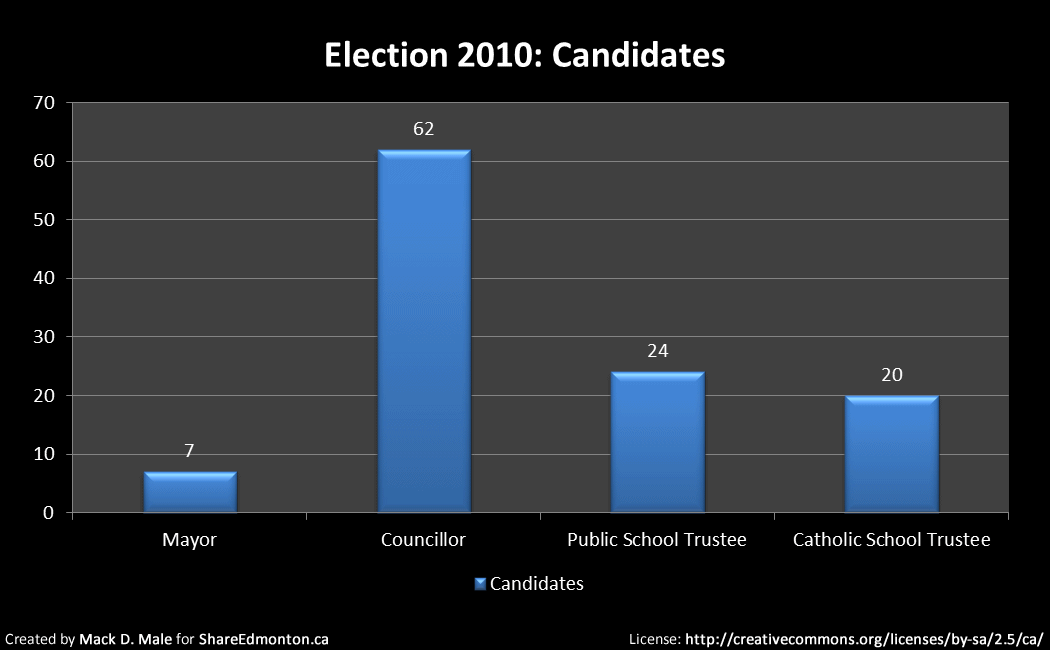
Now that we know who’s running (though some may still drop out) let’s look at some stats. In total, there are 113 candidates vying for the role of mayor, councillor, public school trustee, or catholic school trustee. Here’s a breakdown of the various candidates:

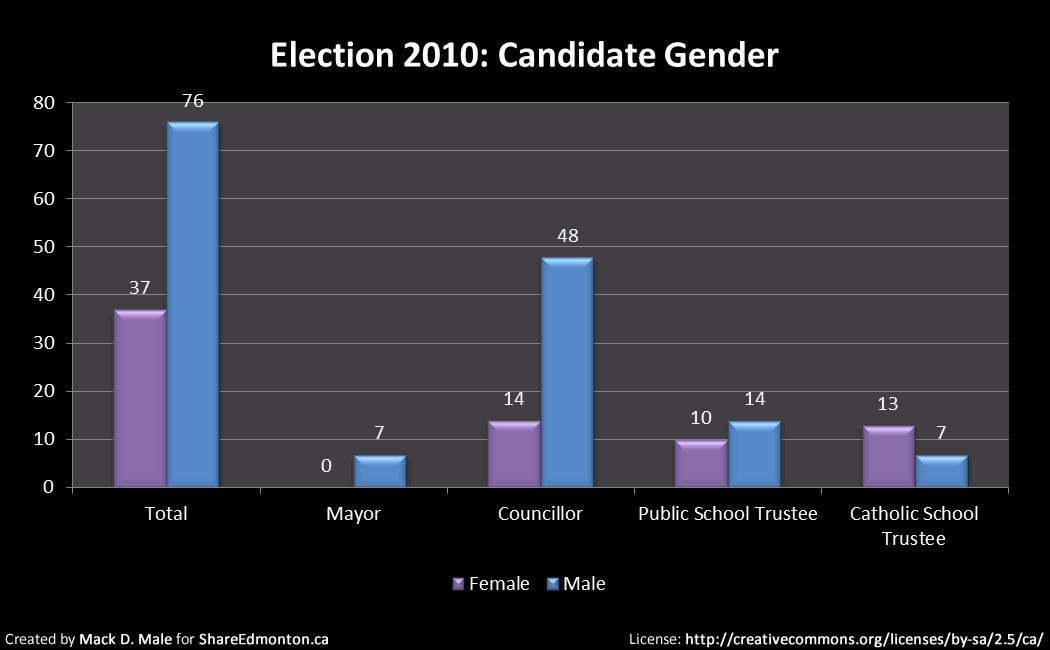
I wondered about gender, since that is often a hot issue in politics. Here’s the gender breakdown for the candidates:

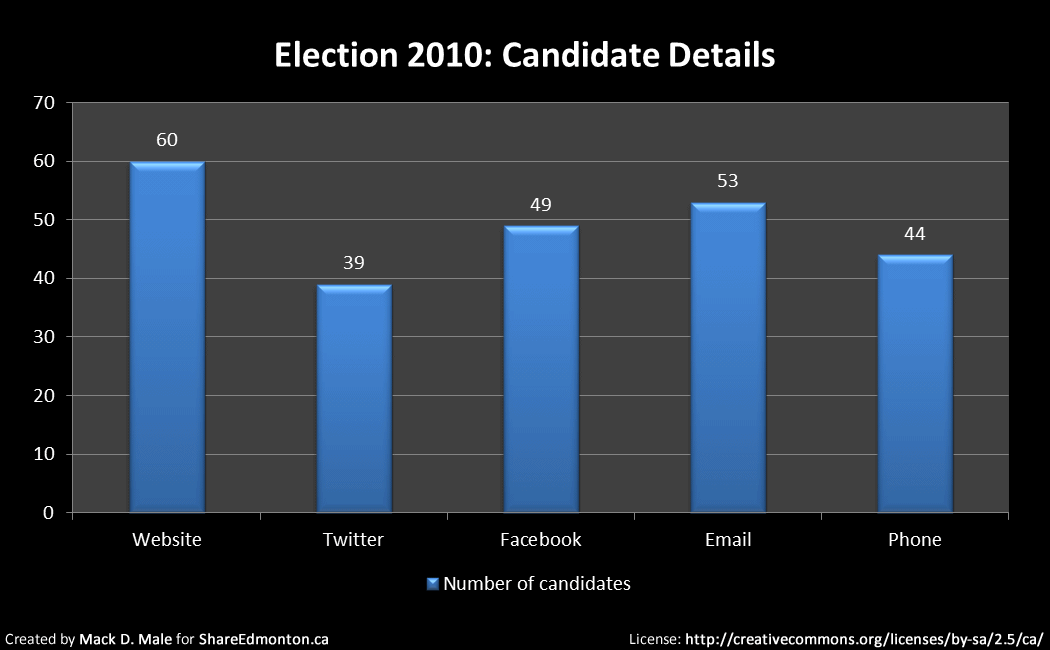
The web is going to play a very important role in this election. It’s the first place people turn to when they want to know more – they search. How many of the candidates could be found online as of last night? And which details did they make available?

As you can see, candidates have some work to do.

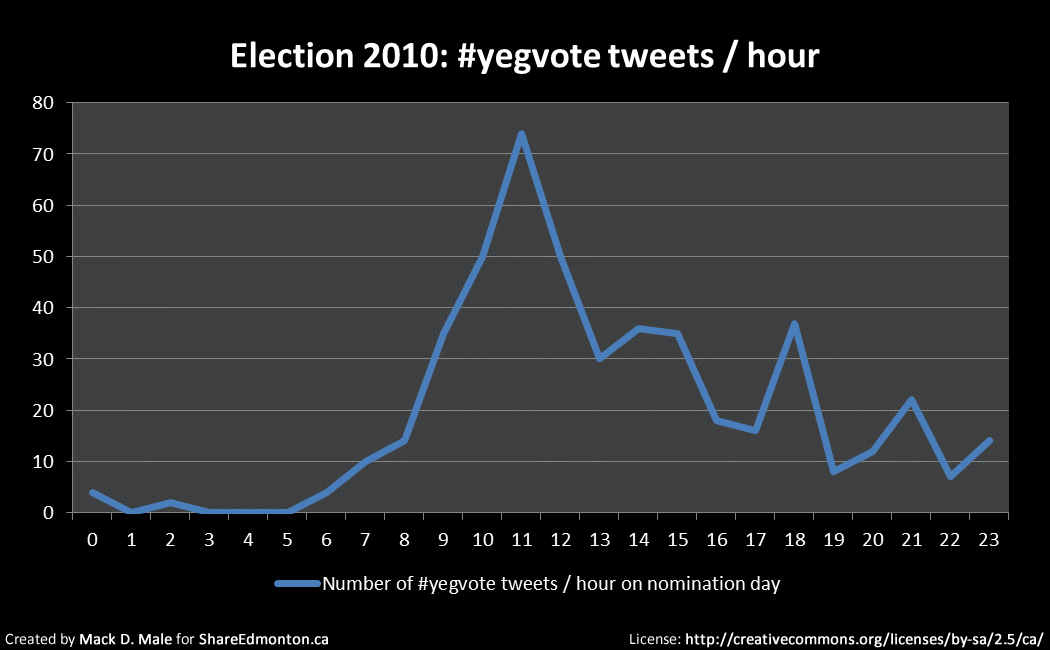
Quite a few people, myself included, followed along yesterday on Twitter. Kudos to Dave and John for live-tweeting and posting lots of photos! Here’s what yesterday’s #yegvote activity looked like:

Candidates could file their paperwork between 9am and noon, which explains the big spike in the morning.

I hope Edmontonians take the time to learn about their candidates, and to voice their concerns and thoughts on the issues facing our city. I have updated ShareEdmonton to (hopefully) help make that easier. Here’s what’s new at the Election 2010 site:

I’d love your feedback on how I can improve the Election 2010 site at ShareEdmonton. And if you find additional candidate information that I’m missing, let me know. I’ve got a few planned improvements on the way, so stay tuned!