
About two months ago at the Youth Summit on Sustainable Transportation I had the opportunity to tour Edmonton Transit’s Centennial Garage, located at Ellerslie Road and 156 Street. The name commemorates Edmonton Transit’s 100th anniversary of service. The facility, which officially opened on April 10, 2010, primarily serves neighbourhoods in the west and southwest parts of Edmonton.

The garage has space to store and maintain at least 250 buses, but is also home to administration offices as well as dispatch and support. More than 250 fleet services and bus operations staff work at the facility (that includes 200 operators).


The building is massive, encompassing 7.1 acres (or 313,000 square feet, approximately five football fields). The budget for the garage was $99 million, $89.3 million of which came from the Municipal Sustainability Initiative (MSI). It was designed and built to LEED Silver standards, with features such as a solar wall for heating. Croy D. Yee Architect Ltd, Morrison Hershfield Limited, Earthscape Consultants, and Clark Builders were involved in the design and construction of the building.

Some of the building materials used include 31 miles of electrical conduit, 1325 imperial tons of steel (structural steel was made up of 90% recycled content), 11,800 cubic metres of concrete (27.5% was reycled content), 3300 sprinkler heads, and 81 miles of in slab heating pipe.
The Centennial Garage is the first garage in Edmonton designed to handle ETS’ 13 articulated buses, with a special hoist that can lift the 20-metre, three-axled vehicles.

The storage part of the garage was fairly empty when we visted, as most buses were out on the road. It as neat to see the buses that were present parked nose to tail in long lines.


The high pressure wash system is what gets the buses nice and clean on the way into the garage. Apparently they had to turn the pressure down from the original setting, because it was causing the decals and advertising on the buses to come right off! In addition to being powerful, the system was specifically designed to cut down on water use by more than half.

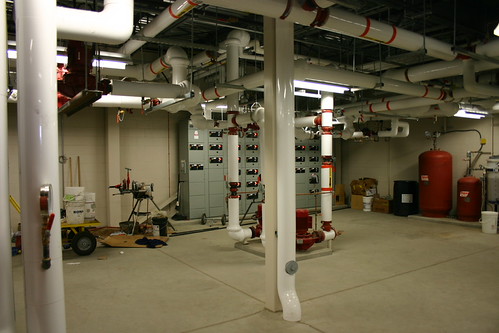
There are state-of-the-art systems in the building for monitoring carbon monoxide levels and maintaining comfortable heat and humidity. Energy modeling results indicate that the Centennial Garage is 33% more energy efficient than a typical building of its size and type.

The ride out to the garage seemed to take forever (it’s really far south west) but it was definitely worth it to get a closer look at one of the facilities that keeps ETS running smoothly!

You can see more photos from the tour here.
 MasterMaq's Blog