Recap: DemoCamp Edmonton 23

democampEdmonton’s 23rd DemoCamp took place last night at the Telus Centre on the University of Alberta campus. DemoCamp is “an event that brings together developers, creatives, entrepreneurs and investors to share what they’ve been working on and to find others in the community interested in similar topics.” You can read my recap of our last DemoCamp here. Despite the cooler weather, we had a strong turnout for both the first half (demos) and second half (beer) of the event.

We had five demos. In order of appearance:

  • Shawn and Zeshan kicked things off with a demo of SelfieText. “If SnapChat and Instagram had a baby, this app would be it,” they told us. The app lets you take a photo and send it to contacts, but the unique thing is that the photo “self destructs” after 12 seconds. They’ve decided to go with the closed network approach, and though you can take a photo of anything, they found the app was popular among people taking selfies.
  • Next up was Nathan, Forrest, Ben, and Donald who showed us Project Quest, a fun project management app that they built for Rails Rumble 2013. The idea is that instead of creating and working on tickets, you instead create and complete quests. Each quest also gets added to a game map. They had different types of quests too, representing by a unicorn or a yak that needs to be shaved. It looked like a really fun project to create!
  • Our third demo came from Nick and Andre who showed us PinShape. Described as a cross between Pinterest and the App Store, PinShape is a community for 3D printing. Designers can use the site to share and even sell their 3D models, while the public can use it to download, buy, and print the objects that others have designed. It definitely seems like 3D printing will be rapidly moving from commercial/industrial applications to consumer ones soon, so the project seems well-timed.
  • Our fourth and quickest demo of the evening came from students Grant and Motiejus who showed us SilentZone. The app runs on Android phones and allows you to have your phone switch to vibrate or silent mode automatically based on your location. There are other apps that provide similar functionality, but SilentZone is focused on having a simple user interface. They have plans to add more features though the app already seems highly useful.
  • Our final demo came from Blaine who showed us DryRun. It’s a web-based tool that helps you forecast your cash flow and create different financial scenarios with a few clicks. The interface looks great and very simple-to-use. Blaine has plans to integrate it with financial services like FreshBooks, though he feels already that you can get a lot of mileage out of the app. There are tools for sharing and exporting your scenarios and projections too.

I think the crowd-pleaser was probably Project Quest, just because it was such a fun way to look at a fairly boring problem (issue/project management). Though the team had lots of ideas for new features and other things to add, there’s no word on whether they’ll pursue it further. I would say that DryRun was probably the demo that I can see being most successful. It’s polished and highly functional, and it solves a problem nicely that a lot of people have (sure you can use spreadsheets, but the possibilities with DryRun are appealing). Of course, the SilentZone guys sort of stole the show with their Q&A. It was the right mix of humor, indifference, and seriousness.

Great job to all the demoers!

Here are the upcoming events and other announcements that were highlighted at DemoCamp:

Keep an eye on the Startup Edmonton Meetup group for more upcoming tech events.

See you at DemoCamp Edmonton 24!

Ten Years of Blogging

I have now been writing at this address in some form or another for over ten years1. Sometimes it feels like just yesterday that I started tinkering with blog engines. Other times it feels like I’ve been a blogger forever!

I like to say that I blog first for myself and second for everyone else, and that’s still true. Ten years doesn’t sound like a lot of time, but it’s fascinating to read the crazy things that 20-year-old-me wrote. I really have changed quite a lot in that time! That said, it certainly is nice to have readers. Not only do you keep me motivated (and correct me when I get things wrong) you have also taught me an awful lot over the years. I have met so many people and learned so many things that I just don’t think I would have without this blog. I really appreciate all of the relationships and opportunities that writing here has afforded me!

Surface Pro & HTC Windows Phone 8X

Technology and the web have also changed quite dramatically in the time I have been writing here. There are lots of reasons that my posts have gotten longer over the years, but one big factor was Twitter. Before Twitter launched, I would occasionally write really short “status” entries here, like this one. Increasingly I have been producing content elsewhere, whether it is Tumblr, YouTube, or Instagram. Still, this blog has remained the glue that ties it all together.

I have mentioned this before, but it was around 2008 that my blog started to focus very heavily on local topics. It was September 2008 that I launched my Edmonton Notes series2, which is now one of the most popular features on the blog. If you’re looking through the archives, don’t be surprised if you find the first five years of this blog to be much more random than it is now!

Whether you’ve been reading for years or are new, thank you. Here’s to another ten years!

New Design

You may notice that I refreshed the look of the blog this week. I’ve been meaning to do so for a while now, and the anniversary was as good an excuse as any! My blog is now a fully responsive site, which should make for a better reading experience on your mobile devices. There’s a bit more room for content, and I’ve made the text bigger by default.

Curious to see what this blog looked like in the past? Thanks to the Wayback Machine, you can:

I’ll continue tweaking it, so please let me know if you have any feedback.


  1. I generally treat November 6, 2003 as the start of my blog because that’s the oldest post I was able to save when I moved to WordPress in 2008. I actually started blogging prior to that, but unfortunately all of those posts were lost. 

  2. Five years of Edmonton Notes, can you believe that?! My blog has been Edmonton-focused for about half of its existence. 

Wireless Internet throughout Edmonton with Shaw Go WiFi

I’ve been thinking a lot about wi-fi again lately. I say again because it’s a topic I have written about on this blog for over eight years! Here’s what I wrote in September 2005:

What’s my mantra? Wireless Everywhere! I look forward to the day when wireless is like oxygen; everywhere you go, it’s there.

I was pretty dedicated to the cause. On a business trip in about 2004, my colleague and I were staying in a hotel that didn’t have Internet access in the rooms, though it did have access in the business centre. So we went to Staples, bought a wireless router, and hooked it up. We carefully hid it behind one of the enormous computer towers, and after we checked out we returned it. For the few days we were there, we had wireless Internet access! (After that trip, we started bringing a wireless router with us when traveling.)

A couple of years later, I was intrigued by a device that might alert me to the existence of wi-fi (no longer needed thanks to smartphones). In 2008 one of my first experiences with Edmonton’s NextGen was a result of their focus group on wi-fi. Also that year, the City of Edmonton launched a wi-fi pilot called Wireless Edmonton, the Edmonton Public Library launched free wi-fi, and I got involved in the Free WiFi Project.

Of course, technology has changed dramatically over the years. Mesh networking was initially pretty popular and was used in a number of cities, but you don’t hear too much about it now. Longer-range standards like WiMax never really materialized. And perhaps most importantly, nearly everyone now has a smartphone equipped with mobile data access.

Still, I find the idea of blanket wi-fi coverage intriguing. We all know how ridiculously expensive mobile data is in Canada. And wi-fi is generally faster (though LTE is quick too). I never had much hope that an ISP would make wireless access easier – what incentive did they have? I always figured that the City would have to make it happen, but the reality is we very nearly have blanket wi-fi coverage right now. And it’s because of Shaw.

Shaw Go Wifi

I know this is going to seem like a big advertisement, but I can assure you it’s not. I haven’t received anything special. I am a Shaw customer, and I pay thousands of dollars a year for TV and Internet, just like many of you. I’m a happy customer though, and I like the Go WiFi service so much I wanted to write about it.

It was in September 2011 that Shaw announced plans to build out a wi-fi network (PDF). They had been looking to enter the wireless (cell phone) industry, but decided it was too expensive and risky.

We believe that a more prudent approach for us is to provide a managed Wi-Fi network that will allow our customers to extend their Shaw services beyond the home. This will achieve our objectives without risking well over $1 billion in capital expenditures on a traditional wireless network build.

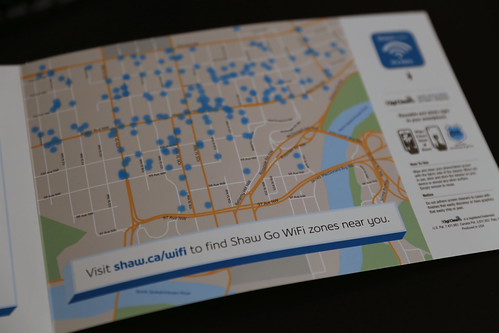
Shaw launched its first hotspots in the spring of 2012 and has been expanding the network ever since. Today there are thousands of locations throughout western Canada, especially in large urban centres. I find I’m regularly connected to ShawOpen without even realizing it! You can find a location near you here, or you can download one of the mobile apps to find nearby hotspots.

Here’s a quick video from Shaw explaining how to use the service:

Entering your username and password each time is rather annoying, but fortunately you can avoid that. Simply login to the Shaw Customer Centre, and go to the Shaw Go WiFi page. There you can enter up to ten devices (depending on your plan) that should automatically connect (by MAC address). It works perfectly!

Shaw Go Wifi

If you think the network is great now, just wait. In May 2013, City Council approved an agreement with Shaw to expand the Go WiFi service to public areas like LRT stations. They’re even going to be adding hotspots nearly 900 streetlights! The expansion is slated to take place over the next two years and will result in about 1500 new access points and coverage at all public facilities. The City estimated that expanding their own network would cost up to $15 million, so partnering with a telecom provider would be a much more cost-effective approach. The City isn’t directly investing in the project, but is contributing staff time to the tune of about $540,000.

The best part is that you don’t need to be a Shaw customer to take advantage of the new service. Anyone can get access to 500 MB of data each month after you complete a free sign-on (on a Shaw & City of Edmonton co-branded page).

It seems like I’ll finally have wireless everywhere, at least in Edmonton. Thanks Shaw!

Building a globally competitive & innovative Edmonton Region

With our new mayor now officially in office, it’s time to learn some new vocabulary. Forget “world class”, “creative”, and “Capital Region”; start getting used to “globally competitive”, “innovative”, and “Edmonton Region”. All three featured prominently in Mayor Iveson’s swearing in address on Tuesday afternoon. The new words may not seem important on the surface, but I think they signal a shift in the way Iveson will lead Edmonton over the next four years.

City Council Swearing In 2013

When I interviewed EEDC CEO Brad Ferguson just over a year ago he was still settling into his new role but had already started using some consistent language in meetings and interviews. “We need to change to a culture of competitiveness,” Brad told me. “We need to have a hunger to compete.” He sees that culture of competitiveness as the best way to combat our biggest threat: complacency.

If his speech is any indication, Mayor Iveson is going to get along just fine with Brad. Iveson used the phrase “globally competitive” six times. You could probably have substituted the phase “world class” into each of those sentences, but that phrase carries baggage. Even Mayor Mandel generally stayed away from it (until he got upset about the arena, that is). But for all the distaste that many of us have with “world class” there hasn’t been a strong alternative. It would seem that “globally competitive” could be just that.

I like the approach that “globally competitive” suggests. Instead of just attaining a certain status and then potentially becoming complacent, you need to keep working hard to remain competitive. Maybe it’s a stretch, but I think it also opens the door to greater collaboration with Calgary. We absolutely can be globally competitive together, but can we both be world class? Here’s what Iveson said about the relationship with Calgary:

We have a lot of work ahead of us with the provincial government on a big city charter that must recognize our special challenges, and that ensures we have the tools and resources we need to realize our full potential as globally competitive Alberta cities.

So “world class” is out, “globally competitive” is in.

One of Mayor Mandel’s favorite words was “creative”. He used it a lot in speeches and in response to questions. He was always talking about finding “creative solutions” to problems. There’s nothing wrong with the word creative, but Mayor Iveson seems to prefer the word “innovative”. He used it a lot during the election, and in his speech on Tuesday he used it at least half a dozen times.

Iveson likes to mention Startup Edmonton and TEC Edmonton when he talks about innovation, and he frequently highlights the role that post-secondary institutions play as well. Maybe a creative solution could save us some money, but Iveson seems to suggest that an innovative one could make us money. Here’s what he said in the innovation section of his speech:

As problem solvers, we can do our business cleaner, greener, cheaper, faster and safer – and sell those solutions to the world. This is how we will ensure that Edmonton will compete globally, and endure long into the future, no matter the price of oil.

So “creative” is out, “innovative” is in.

Mayoral Forum #3

Paula Simons wrote about the shift from “Capital Region” to “Edmonton Region” yesterday:

“I do not live in the capital region. You don’t either. There is no such place. It’s a bureaucratic invention, a mythical, mealy mouthed way of describing the cities, towns, villages and counties that surround Edmonton.”

She goes on to make some excellent points about the “weasel-word label” and includes some great quotes from both Mayor Iveson and St. Albert Mayor Nolan Crouse (“Atta boy!” he said in response to Iveson marketing Edmonton). I particularly like that Iveson understands the importance of using Edmonton when we talk about our city. That was one of the key points I tried to make at PKN7. “Capital Region” could be anywhere, but “Edmonton Region” is specific (yes I know there are two other much smaller towns named Edmonton). That’s another reason that Make Something Edmonton is compelling as a brand for our city.

The other interesting news this week related to the Capital Region Board (CRB) is new legislation introduced by the Province. The Modernizing Regional Governance Act would give the Province the ability to create “regional growth boards” much like the CRB itself. If the new legislation is adopted, it’ll make the CRB an official body under the Municipal Government Act. It would be great if we could rename the organization alongside those changes, something Mayor Iveson has indicated he’d like to pursue.

So “Capital Region” is out, “Edmonton Region” is in.

Wordsmithing, you say? I can see how one might reach that conclusion. But Mayor Iveson doesn’t choose his words lightly; he’s purposeful about what he says. I think he’s saying the right things, and that’s an important first step toward making change happen.

You can listen to this post here:

Avenue Edmonton’s Top 40 Under 40 for 2013

With the unveiling tonight of Avenue Edmonton’s fifth annual Top 40 Under 40, there have now been 200 amazing, young Edmontonians recognized. The latest group was honored this evening at the Royal Alberta Museum.

Every year, Avenue magazine recognizes Capital Region’s most exceptional young community leaders. The Top 40 Under 40 list honours individuals under the age of 40 who are excelling in their careers, giving back to the community and raising the profile of Edmonton.

Both Minister of Culture Heather Klimchuk and Mayor Don Iveson (who was recognized in 2009) brought greetings to the event. “This is a city that loves to defy expectations,” the mayor said. “There are many leaders in this room. There might even be a mayor among you!”

Here’s the Top 40 for 2013 and where you can find them online (in alphabetical order):

Congratulations to all the winners! There are some names there that have me saying “finally” and others who I’m happy to be introduced to. I look forward to learning more about this new group of Top 40 alumni.

For those of you who care about such things, the average of this year’s list is 34.3 and there are 24 males and 16 females.

The cover of the new issue features Aaryn Flynn. You can read more about all of the individuals above at Avenue Edmonton. There’s lots more to see on Twitter using the #top40yeg hashtag too.

Want to see who made the list in past years? Check out my posts from 2009, 2010, 2011, and 2012.

Recap: Pecha Kucha Night Edmonton #17

Edmonton’s seventeenth Pecha Kucha Night was held on Saturday evening at the Winspear Centre downtown. With nearly 1000 people in attendance, it was one of our city’s biggest PKNs yet. I kept thinking back to the first-ever PKN in Edmonton, which took place in the lobby of the Winspear Centre back in 2008 – it’s pretty incredible how much has changed over the last five years!

In a break from past PKNs, this Designing Downtown edition featured speakers from across the country. The theme? New ways to think about designing and developing our city cores. Here’s what Designing Downtown is all about:

Designing Downtown is a movement to transform downtowns founded by Progress Unlimited, MADE, and Edmonton’s NextGen. Designing Downtown is a vehicle for inter-city exchange for partnerships that seek to enrich and advance the conversations and actions we take to shape downtowns as spaces for everyone. Designing Downtown is an experiment and exchange; an opportunity to create dialogue that celebrates & critiques; and a space to be a fixture in and designer of the urban experience.

designing downtown

In order of appearance, these were the presenters at PKN17:

  1. Johanna Hurme, Occupy
  2. Sophie Mankowski, Architectural Translations: From Memory to Music
  3. Janice Abbott, Atira Women’s Resource Society
  4. Dalton Higgins, Hip Hop World
  5. Curtis Olson, Designing a Creative City
  6. Micheline Clouard, Place & Identity
  7. Simon Taylor, Harsh Optimism
  8. Kamala Todd, Indigenize Our Urban Eyes
  9. Waye Mason, Urban Halifax Rebounding

We were also treated to a live podcast recording of 99% Invisible with host and creator Roman Mars. He opened the show with a segment on how buildings tell stories, and he closed with a piece on city flags.

Pecha Kucha Night 17

For the most part I really enjoyed the presentations, partially because they were a return to “classic” PKN with a slant toward architecture and design. That said, I did find it someone disappointing that a few of the presenters relied on paper notes. Fumbling around with paper on stage is just awkward, but more importantly, it prevents the speaker’s passion from coming across. These are all talened, experienced individuals who know a lot about their topics – paper shouldn’t be needed for six minutes and forty seconds.

Johanna was up first and she talked about fighting the ambivalence of design. “There is power in the collective,” she told us. I found Sophie’s presentation a little difficult to follow, but ultimately she was talking about creating bridges between artists and architects. Her project, Portrait Sonore, is a collection of sound walks that guide you through cities, “revealing their architecture and their history in a lively and poetic manner.” Janice used her time to tell us about the innovative housing project Atira built in Vancouver’s downtown eastside using shipping containers. Last up before the intermission was Dalton, who provided us with the most upbeat and random presentation of the evening. While his energy was infectious, his message was a little less clear.

First up after the intermission was Curtis, who talked to us about some of the interesting projects he has undertaken in Saskatoon. He finished with an overturned car used as a garden, something the crowd seemed to really enjoy! Micheline spoke about some of her work in Montreal, and how it connects humans with nature. Simon talked about the school he worked on way up north in Cambridge Bay. It has become the central gathering place for the town, so he told us that “downtown can happen anywhere” (I disagree – there’s more to “downtown” than just being the central gathering place). Kamala spoke passionately about recognizing the indigenous narratives of our urban settings, using Vancouver as the focal point. The final presenter of the evening was Waye from Halifax, who shared some of the exciting changes that have been happening that city.

Pecha Kucha Night 17

I love hearing about interesting uses for things like shipping containers, so I really enjoyed Janice’s talk. Having grown up in Inuvik in the Northwest Territories, I was naturally drawn to Simon’s talk on the school in Cambridge Bay. I think Curtis had one of the strongest presentations, with great visuals and a tight narrative.

Though Roman’s two segments did not fit with the PKN format, I thought they were a great addition to the evening. His style is just so inviting! There were a lot of folks on Twitter who said they were immediately subscribing to the podcast as a result. His closing segment focused on city flags. Roman is a fan of Chicago’s flag, and he walked us through some of the do’s and don’ts of flag design. Keep it simple, avoid words or seals, etc. In case you were wondering, this is Edmonton’s flag. There was quite a bit of laughter when he put the slide up because it breaks most of the don’ts! Roman also earned loud cheers and applause for calling Canada’s flag the best one out there.

Instead of having speakers from Edmonton in the lineup, two videos featuring a number of Edmontonians passionate about downtown were shown. Here’s the first vignette:

Here’s the second vignette:

In contrast with the last PKN, I very much felt like a member of the target audience for PKN17. There were a lot of familiar faces in the large crowd, which suggests the organizers did a great job of reaching out to previous attendees to get them to return. Equally, I kept running into people who had never been to Pecha Kucha before, so it’s great to see that the series continues to reach new communities.

In addition to the presentations, there were also some great activities in the lobby. Guests could take part in a collaborative mural, check out the LEGO display, get their photo taken in WinterCity’s winter patio, and much more.

Pecha Kucha Night 17

Prior to the main event, Makescape took place in Centennial Plaza behind the Stanley Milner Library. Featuring food trucks, a live stream of the presentations, and Bench Talks, it was a neat complement to PKN. I missed the bench talks unfortunately, but I love the concept!

Kudos to Lisa Baroldi, the driving force behind PKN17 and Designing Downtown, on a fantastic event! I know it takes a big team of volunteers and the support of many sponsors to pull off an event like PKN, but you also need strong leadership. Well done to all involved!

You can see a few more photos from the evening here. Keep an eye on @EdmNextGen for details on upcoming events!

Edmonton’s Food Council is now real

The inaugural meeting of the Edmonton Food Council took place on Monday night at the Commonwealth Recreation Centre. I’m very excited to have the opportunity to work with fourteen passionate and dedicated Edmontonians to move this initiative forward!

Edmonton Food Council
Photo courtesy of the City of Edmonton

In November 2012, City Council approved fresh, Edmonton’s Food and Urban Agriculture Strategy. It called for an Edmonton Food Council to be established, a process which began in earnest in May of this year. By early June, 57 citizens submitted their applications to the City, a great show of interest. Interviews with 22 of them took place in mid-July, and finally on July 26 the City announced the names of the 15 citizens selected to serve on the inaugural Food Council. Here they are:

Some folks I know fairly well, others I look forward to getting to know over the months ahead. There’s a really great mix of perspectives and backgrounds, and I think we’re going to have some fascinating conversations as a result.

Edmonton Food Council
Photo courtesy of the City of Edmonton

Mayor Mandel kicked the meeting off with some introductory remarks, and made it clear that we should feel empowered as a group to decide how best to contribute to the implementation of fresh. He put a nice spin on the Food Council’s elevator pitch:

As a committee of the City’s administration, the Edmonton Food Council’s primary role is to advise on matters of food and urban agriculture and to take an active role in supporting the implementation of fresh. Other core jobs may include providing advice, undertaking research and evaluation, coordination, engagement and education.

For the rest of the evening, facilitator Beth Sanders led us through a helpful process to tease out desires and perspectives. It was great to hear from everyone and to realize by the end of the night that we had already come to some consensus on how we’ll interact as a team. I can’t say it any better than the newsletter that went out today:

What became clear is that there is no shortage of energy with this group. When discussing when monthly meetings should be held, the group quickly came to consensus that monthly meetings would not be enough to maintain momentum. They wanted to meet sooner than later. No doubt that the commitment and enthusiasm of this group will have a lasting effect on Edmonton’s food and urban agriculture landscape.

Energy is a great word – there was lots of it on Monday night! We’re all eager to get to work, and we want to actually get things done. Being nomination day, I couldn’t help but think of the phrase that so many candidates had remarked to me after filing their paperwork – “now it’s real!”

Edmonton Food Council
Photo courtesy of the City of Edmonton

Edmonton Food Council meetings will be open to the public, and there will very likely be opportunities to get involved. You can get all the information on the City’s website, and I’d also encourage you to subscribe to the Food In The City newsletter.

Recap: DemoCamp Edmonton 22

Edmonton’s 22nd DemoCamp took place tonight at the Telus Centre on the University of Alberta campus. DemoCamp is “an event that brings together developers, creatives, entrepreneurs and investors to share what they’ve been working on and to find others in the community interested in similar topics.” You can read my recap of our last DemoCamp here. While it was still a good turnout, the crowd did seem smaller tonight than it has recently. Maybe the frost warning scared everyone back into their homes!

We had six demos tonight. In order of appearance:

  • Our first demo came from 9-year-old Ella, the youngest person to demo here in Edmonton! She was a participant in CodeCamp over the summer that Startup Edmonton hosted with Junior Achievement. Ella learned how to create a game using Scratch, a creative learning community from MIT. Ella’s game, pacman 2, is pretty cool and not as easy as it looks! Ella said she wants to be a programmer one day, and with more time she’d add more levels to her game and would make it more challenging. Great work Ella!

DemoCamp Edmonton 22

  • The second demo was SAM, which stands for Social Asset Management. James walked us through the app’s features. SAM helps media professionals curate and manage content, which they can then use in their storytelling. So I could search for and save a bunch of tweets, then using a WordPress plugin, I could insert them into a blog post. It looks pretty feature-rich already, though SAM is still in beta.
  • Next up was Galen who showed us a couple of the digital storytelling projects he’s working on. One was an app that lets you pin stories atop a map. The other was Novorapid, an interactive short film being produced by the National Film Board. Directed by Tyler Enfield, the film “uses dynamic split screens to allow the viewer to experience the film from multiple perspectives.” It looked like a really cool approach.
  • The fourth demo was Spatialtree from Ajay and James. The basic idea is that you can create a cluster of online profiles that Spatialtree will then analyze and generate reports for. So you could see who’s getting the most interactions, or how you compare to the competition. The tool has a pretty nice interface, though I’m a little unclear on practical applications for this aside from social media marketing.
  • Grant was up next to show us a game he and his team are building called Bardbarian. The protagonist, Brad, has grown tired of life as a barbarian and uses a makeshift axe-lute to “shred lute and collect loot”. It looks pretty fun, and the development team have been blogging as they progress. Here’s some preview footage:
  • The final demo tonight was Meerkat, a social network analysis application developed at AICML. Matt showed us how the tool can be used to visualize Twitter data, and to answer questions about that data such as who is most influential but not necessarily most popular. The team behind it have something pretty powerful, and are looking for interesting use cases for it. Financial analysis sounds like it has been a successful early sector to use the tool.

It was funny that so many of the demos tonight featured Twitter, leading Cam to joke that “Twitter is a thing” and “you should buy some stock!” (Twitter recently announced it is planning an IPO.) Given that I have been known to dabble in Twitter analytics and digital storytelling, I found tonight’s lineup pretty compelling! It’s hard to top an energetic, young programmer like Ella, especially when she kicks off the show with a great demo, so I’m going to pick hers as my favorite tonight. I could certainly see myself using SAM though, so I’ll be keeping an eye on that one! Well done to all the demoers.

There were a few announcements tonight:

  • Startup Edmonton’s Preflight Pre-Accelerator Program returns in October. The deadline to apply is September 20.
  • The 4th Launch Party is slated to take place on November 21. Have something to launch? Get in touch with Startup Edmonton.
  • The Software Engineering Capstone Design program at the U of A is looking for project suggestions! Get in touch with professor Scott Dick if you have one.

Here are some of the upcoming tech events you might consider checking out:

Keep an eye on the Startup Edmonton Meetup group for more upcoming tech events.

See you at DemoCamp Edmonton 23!

Make Something Edmonton moves forward with 8 recommendations

Today the Mayor’s Task Force on Image and Reputation submitted its final report to Executive Committee. The task force is better known by its adopted name, Make Something Edmonton. In summarizing the work that has been done thus far and recommending next steps, the report draws the task force to a close and marks the start of Make Something Edmonton as a more official thing. Exactly what that thing is however, must still be determined.

Here are the recommendations outlined in the report (which you can download here):

  1. Adopt Edmonton’s Brand
  2. Open the Make Something Edmonton Office
  3. Preserve and Maintain the Citizen-Driven Focus
  4. Recognize and Reward Excellence: The Builders Prize
  5. Promote a “Make Something” Culture
  6. Appoint a Make Something Edmonton “Champion”
  7. Implement an Image and Reputation Strategy
  8. Create and Activate Ambassador & Mentor Networks

Some of these recommendations are obvious while others are a little more interesting.

The first recommendation would see “Make Something Edmonton” become Edmonton’s “brand platform”, the foundation for an image and reputation strategy. This doesn’t necessarily mean that “Make Something Edmonton” replaces “City of Champions” as some have suggested, but it does assert that the story behind MSE is our brand.

The second recommendation calls for the creation of an organization similar in structure to the Edmonton Arts Council, perhaps operating under the umbrella of EEDC. The purpose of the office would be “to develop the words, the tools, and the expertise” to help existing organizations and Edmontonians in general to launch new businesses, promote events and initiatives, and attract others to our city. It would guide the brand. The third recommendation is obvious and somewhat related, calling for an advisory council with representatives from a broad range of sectors.

The fourth recommendation is to create The Builders Prize, an annual cash prize to recognize MSE projects. “$30,000 will be awarded to one outstanding and completed Make Something Edmonton project. The recipient of the $30,000 prize will then award four $5,000 Catalyst Prizes to other Make Something Edmonton projects in progress.” I love the twist there – the grand prize winner must award the smaller prizes.

The fifth recommendation is again fairly obvious, and also probably the most difficult to action. Some suggestions include offering a MSE award as part of the Awards of Excellence, and embedding “What are you making? How can we help?” on City of Edmonton business cards.

I’m perhaps most excited to see the sixth recommendation, which calls for a “champion” to operate out of the City Manager’s office. This person’s job would be something like an ombudsperson for MSE. They would help navigate City of Edmonton bylaws and rules, and would work to streamline things for future makers. City Manager Simon Farbrother has endorsed this idea.

The seventh recommendation is really for the organization created out of recommendation #2 and its to implement a strategy and communications plan. As a result of this you should see the brand story and image appear throughout communications from all of Edmonton’s prominent organizations, businesses and institutions.

The final recommendation is really something the task force has already been doing. The idea is to create “an informal training program” to go out and tell the MSE story to anyone who will listen. An addition would be the mentor network, made up of people who have already made and built things in Edmonton, to help new makers get their own ideas off the ground.

The report concludes with:

This is only the beginning of Make Something Edmonton. The first phase of our work was to discover the Edmonton Story and to activate it with early adopters. Now we begin to actively find – to use marketing parlance – the “early majority.”

It also promised a new website and advertising campaign to launch this fall.

I feel like the report and recommendations address many of the concerns I raised in my post from July. Executive Committee this morning decided to request that a funding package be put forward as part of the budget in order to move these recommendations forward. I think this is an initiative that deserves ongoing support from the City of Edmonton, even if it ultimately lives with EEDC or elsewhere, and I am optimistic that Council feels the same way.

Kudos to everyone involved with Make Something Edmonton on progressing to this point!

E-Town celebrates entrepreneurship in Edmonton

e-townNext week a new festival takes place in our city called E-Town. Billed as  “an intensive two-day festival of ideas for entrepreneurial-minded people who get excited by innovation, change and disrupting common thought,” the event is being organized by EEDC and takes place at the Shaw Conference Centre next Thursday and Friday.

“E-Town is built on an existing regional strength—a tenacious entrepreneurial spirit. The festival features not only a reflection on past learnings and stories, but a launching ground for ideas, change, self-growth and relationships. Attendees won’t be disappointed to meet and join the people in their city who didn’t just talk about their business ideas or leave them on a cocktail napkin. They put their ideas into action to get them where they are today.”

Tickets for the event are $299, but the impressive lineup of speakers should make that easy to stomach. You’ll get to hear from musician David Usher, astronaut Chris Hadfield, former WestJet president and CEO Sean Durfy, former Apple chief evangelist Guy Kawasaki, bitly’s chief scientist Hilary Mason, and founder of The Webby Awards Tiffany Shlain. On top of that is a series of panels and breakout sessions, and a concert featuring the Barenaked Ladies.

I asked EEDC CEO Brad Ferguson for some additional details on how the event came about and what attendees should expect. “We wanted to go bold,” he told me. “It speaks to brand development and confidence in Edmonton.” Brad explained that the idea was to bring the entrepreneurial community together, to celebrate entrepreneurship in Edmonton. “EEDC has the ability to assemble, to germinate the idea,” Brad said. They brought a group of local organizations focused on entrepreneurship together and said, “let’s go do something.” Co-hosting with EEDC are the Entrepreneurs’ Organization, Startup Edmonton, Alberta Women Entrepreneurs, TEC Edmonton, Junior Achievement, JCI Edmonton, Capital Ideas, Alberta Enterprise & Advanced Education, Alberta Enterprise Group, the Edmonton Chamber of Commerce, Make Something Edmonton, and the Edmonton Executives Association.

It was important to the organizers for the event to be about more than just business. They wanted a mix of arts, creativity, business, entertainment, and education. “We are aligned by mindset rather than industry,” Brad told me. He cited C2MTL, LeWeb, and InnoTown as events that are similar in spirit to what E-Town hopes to become. 

Commander Chris Hadfield will kick things off with a keynote on Thursday at 5:15pm. The Food Truck Fest (featuring Bully, Drift, Eva Sweet, La Poutine, Smokehouse BBQ, The Crooked Fork, The Food Fighter, and Yellowbird Café) and Barenaked Ladies concert will follow. The remainder of the keynotes and sessions take place during the day Friday, with local musician Martin Kerr closing the show at 6pm that evening. Check out the full schedule here.

One of the interesting things E-Town is doing differently is sponsorship. They’re really trying to get the speakers engaged and participating in the event instead of just plastering their logo all over it. Sponsors can choose to take part in the Emerging Questions Panel and then get interactive in what are called “exploration sessions”. Think whiteboards and interactive panels rather than talking heads. Sponsors on board include ATB Financial, the City of Edmonton, Parlee McLaws LLP, PWC, and Rogers.

While EEDC is supporting the festival for the first year, the goal is to have it both grow and become sustainable in future years. “We want to break even this year, and build the brand,” Brad said. In future years, additional days and locations could be added, making the event even more of a festival. More than 1000 attendees are expected to take part in the inaugural event, most of whom would likely be locals. That’ll change in future years as well.

I asked Brad why people should attend E-Town, and he responded with a question that has driven much of the event’s planning: “What do you feel the least prepared for?” The conference is an opportunity to explore what’s changing, and to get inspired by what’s possible. Don’t stay comfortable with the status quo, is the message. Brad also promised some surprises for attendees once they get inside (think of the impressive stage from this year’s Economic Impact Luncheon, amped up). “We want to show off what we can do with digital!”

As for EEDC, Brad says E-Town is an opportunity to “take economic development in a new direction.” They’re striving to provide value for money but also to make a statement. “We want to get people talking about it.”

Be sure to check out the E-Town news page for lots of additional information and updates. You can also follow @etownfest on Twitter and Facebook. And if you’d like to attend, get your tickets here.