Mover is making cloud storage solutions in Edmonton

moverCan you build a successful, scalable technology company in Edmonton? Local startup Mover thinks so, and yesterday they received validation of that goal in the form of $1 million in seed financing from an impressive list of American and Canadian investors.

“Absolutely” was Mover CEO Eric Warnke‘s response when I asked if he thought he could find the necessary talent and other resources to grow the company here in Edmonton. The tech landscape is a lot different today than it was five or six years ago when Eric was at Nexopia, the hot local startup at the time. “Realistically we’d have to double salaries if we relocated to the valley,” he told me. Not that Mover isn’t paying a fair wage, it’s just that the cost of living there is much higher and the competition for talent is much fiercer. “A lot of people ask us if we’re going to move, but there are good incentives to stay here.” The footer of Mover’s website carries the message “proudly made in Edmonton.”

Mover is barely a year old, but it certainly doesn’t lack history. Walk around the office on the second floor of the revitalized Mercer Warehouse building and little reminders of the past consistently pop-up. A Free Wi-Fi magnet on a metal divider, a Firenest coffee tumbler on top of the fridge, a Mesh Canada brochure hanging on one of the beautiful wooden beams. Even the Launch Party sign front-and-centre as you walk across the creaky floors offers insight into how the growing local tech scene made it possible for Mover to go from idea to reality.

Mover Office

In 2004, Eric was employee number four at Nexopia and wore a number of hats there over the years, everything from customer service to ad management. A few years later, while working full-time at the social networking site and also going to school, Eric found time to start and run an Internet café on Whyte Avenue. It was the Internet café that sparked an interest in wireless networks and led to the creation of the Free Wi-Fi Project. Through that initiative Eric met Mark Fossen, a former partner at ThinkTel Communications. The two decided to join forces and launched Mesh Canada in 2009. They sold it to a Calgary company last year.

In January 2012, Eric & Mark decided to participate in Startup Edmonton’s Startup Hackathon. They built a utility called Backup Box that helped users move files from one place to another (such as an FTP server to Dropbox), and eventually showed it off at DemoCamp in March. A few months later, they were part of GrowLab‘s spring 2012 cohort in Vancouver. Renamed as Mover, they refined the product and when they got back to Edmonton, realized they needed to grow. That’s when Ben Zittlau joined as a partner and the VP of Technology. He had previously worked on Firenest, a web-based tool for non-profits, and for a short time worked at Yardstick Software too.

In the space of a year the team has grown from four to ten. They’ve mostly hired people they know, and that was a deliberate decision. “Slowly but surely we’re putting Nexopia back together,” Eric half-joked. He stressed how important it is to hire strong people. “They had a lot of great people working at Nexopia.” Mover plans to stay in the Mercer Warehouse as long as possible, and already have their eye on some additional space on the second floor. “It’s walkable for almost everyone on the team,” Eric said. “There are great amenities here, and being downtown and close to Startup Edmonton is really great.”

Mover Office

I asked Eric to describe the culture at Mover. “Pretty awesome” was his response. The fridge is stocked with groceries in addition to beer, so that everyone on the team can have a healthy lunch at the office if they choose to (today the team had a craving for Oodle Noodle). The company is flexible on working hours and vacation, and employees get ownership options. Eric cited Box, Dropbox, and Singly as companies he admires with Jobber and Granify as local examples. “One day we’ll be the example others mention,” he added.

Mover has a strong technical team. Greg Bell, Graham Batty, and Sean Healy are all former Nexopia employees. Derek Dowling was a programmer for The Gateway. Jacob Straszynski worked at Mediashaker. Eric thinks they’ll add a few more technology folks, but where the new funding will really help Mover is with marketing and business development. Aside from Eric and Mark, there’s just marketing intern Aidan McColl at the moment.

Mover Office

Mover has quickly become a leader in the growing world of cloud storage migration and backup. With support for about a dozen popular services like Dropbox, Google Drive, and SkyDrive, Mover is carving out a unique middleware position for itself in a rapidly growing market. Steve Jobs famously said Dropbox was just a feature, not a product, but today the company has more than 100 million users who collectively save more than 1 billion files each and every day. And they’re just one of many options available to consumers and enterprises. Back in 2010 a series of Microsoft commercials featured the refrain “to the cloud!” Today more than ever, that’s exactly what’s happening, and Mover is hoping to play a key role in the space.

The plan was always to raise money. But like many technology startups, Mover was probably too ambitious last year in trying to build an impressive technical solution to a problem that not enough people have yet. The lesson was to focus on the areas in which they already had traction, Eric told me. “We’ve got this really interesting thing here, and we need some money to figure that out so that we can get to the next stage.” That approach, combined with a realization that it’s okay to say “I don’t know” to certain questions, led to the new investment.

Mover currently thinks about two primary categories of customers. There are individuals who are mostly self-service but have a wide range of needs. Then there’s enterprises, with lots of users and fairly well-defined problems. Both offer lots of opportunities and are expected grow significantly in the years ahead. Balancing the feature set between them is one of the challenges Mover will face. “We’ve got a fantastic backend,” Eric said, “but we need to make some improvements to the user experience.”

The team is well aware there is lots of work to be done. Every Friday afternoon they meet in the “conference room” for a retrospective led by Ben. Each person has the opportunity to share something positive from the past week as well as something that needs to be improved. The admin dashboard they’ve built is displayed on a large television and allows the team to monitor performance, identify potential bugs, and highlight areas of improvement.

Mover Office

Eric and Mark took part today and used the opportunity to talk about the new investment, thanking everyone for their hard work. “It was a team effort,” Eric said. “Each of you have played an important role in getting us to this point.” Mark added some thoughts about what the investment means for the company, and there were smiles all around. But that was the extent of the celebration. Minutes later they were back to discussing some workloads that had been flagged on the display. The message was clear: the investment helps a great deal, but it’s not the endgame. Mover has lofty goals and there’s a lot of work to be done to achieve them.

The Make Something Edmonton Rope

What’s a rope? "A rope is a linear collection of plies, yarns or strands which are twisted or braided together in order to combine them into a larger and stronger form," according to Wikipedia. I like to think of Make Something Edmonton (MSE) as a rope. As such, it’s made up of a number of different strands that had to come together. There are three strands that I want to highlight.

strand

The first started with a wall.

In the spring of 2011 while still working at the Edmonton Journal, Todd Babiak wrote a series of stories on what he called "interventions". It began with the blank, unattractive wall that he saw every day when looking out the window. Todd wanted to do something about it, so he wrote about it. And he encouraged readers to email him with their suggestions.

A few months later at the downtown-focused Pecha Kucha 10, Todd spoke about the interventions project. He stole the show that night with a hilarious, entertaining, and thought-provoking presentation. Todd called Edmonton "a magpie town" and shared with us a lesson he learned through the interventions process: "I should have asked people to do something, then email me."

Six months later, Todd had a new startup called Story Engine, and he found himself pitching the City of Edmonton. "I had worked on the City Vision for 2040, and I had noticed — in community halls all over the city — that citizens were obsessed with the Edmonton story," he later wrote. Todd wanted to help tell that story. He was persuaded to start a blog, appropriately called magpietown, and he used it to explore the ideas that would form the groundwork for Make Something Edmonton.

The second strand is a long one. If you follow it back far enough, you might find yourself at Edmonton’s beginning.

Like most cities, we aspire to be recognized and loved on the world stage. We want our city’s image to be positive and well-received. Branding is a part of forming that image, and over the years there have been numerous attempts at identifying or creating our brand. We’ve always had this inferiority complex, and many Edmontonians have tried to do something about it. Most recently, the City of Edmonton embarked on a project called Edmonton Stories. By most accounts it was a disappointment, masked only by the repositioning of the project as a tool for recruiting rather than as a tool for emboldening Edmonton’s image.

Last year, the issue once again came up at City Council. One of the outcomes of The Way We Propser was a desire by those involved to better define and communicate our city identity. So in July 2012, Council decided to strike a task force. It got off to a rocky start due to significant differences in approach, but by the fall everything was in place.

That’s when Brad Ferguson, the new CEO of EEDC, spoke up about the issue. "On a scale of one to 10, we’re a one and a half. I’m not going to sugar-coat it," he told Council. All of a sudden, the new task force on image and branding became even more important.

The third and final strand I want to highlight is probably pretty boring to most people, but it’s highly intriguing to a City-watcher like myself.

Since 2006, the "big C" City (the City of Edmonton) has been undergoing a significant transformation. A new City Manager, a new approach to visioning and planning, and a progressive Council working cohesively to move things forward all contributed to a very different mood around City Hall.

One of the side effects of that transformation, in my opinion, has been an expansion in the kinds of things the City is willing to take on. Whereas in the past certain things may have been ignored because they were not seen as central to the City’s mandate (such as establishing a Food Council), today there’s almost an expectation that the City tackle such endeavours. On the whole this has probably been a good thing for citizens.

I think the City has gone back-and-forth on who should own the image and branding piece. Should it be Communications? Should it be a new City-led office? Should it be a partner, most logically EEDC? If the expansion trend continues, I would not be surprised to see some within the City push for MSE to remain a City-led initiative.

These and other strands all came together to form Make Something Edmonton. How exactly the strands came together, I don’t know for sure. But I like to imagine that the committee was sitting around trying to figure out how to get from being 1.5 out of 10 to something better, and Todd said, "I have an idea!" He pitched Make Something Edmonton and everyone declared, "our work here is done!" That’s probably unfair to everyone who put some significant volunteer time into the project, and I don’t mean to belittle that effort. But I also think it’s probably not far from the truth.

The initiative, or movement, or experiment – take your pick – officially launched in March of this year with a splashy party attended by the same people who always show up at these sorts of things. It was a good start, and the launch party was energizing and created a certain amount of momentum. There have been a number of really successful projects added to the website, and the Twitter hashtag remains as popular as ever. It’s a great way to showcase the many exciting things happening in Edmonton.

There is, however, a certain amount of spin surrounding Make Something Edmonton. It was evident at the launch party, and has become somewhat more evident in recent weeks.

Is MSE a grassroots movement, by the people for the people? The funding and committee structure behind it would suggest otherwise. There’s a big MSE committee, and a number of smaller sub-committees, all made up of the same 300 or so people who get involved in most things. Furthermore, that committee is expected to submit a report back to Council. It is, after all, just an expanded form of the task force that Council struck.

Is MSE a new approach to city branding, because traditional branding doesn’t work? The process would seem to suggest otherwise. The City hired a firm to design the MSE logo and identity, and another firm to build the website. There was Brand Camp a few weeks ago, but the only element of it that didn’t resemble a traditional branding exercise was that it was called Brand Camp. It was a bunch of people in room talking with no clear idea about what the outcome should be. Pretty typical consultation piece for a branding exercise if you ask me.

Does MSE tap into a fundamental truth about Edmonton? I feel it does, but many others dispute this point. "Can’t I make things in Winnipeg?" they ask. "Maker is too exclusive," others will say. If MSE isn’t resonating with the smaller group of the same 3000 people that are already hyper-engaged, how can we ever hope to get to 30,000? Or to 300,000?

Since March there have been a number of smaller MSE-related events (like Brand Camp), but the big success has undoubtedly been the creation of the website and its listing of hundreds of projects. I think "maker" is absolutely the right word, because otherwise we’ll end up with the lowest common denominator and that’ll get us exactly nowhere. It needs to be aspirational. Seeing all of the projects on the website and thinking about all of the people behind them gets me incredibly excited about our city.

But as great as that website and all of those projects are, thinking about them inevitably leads to the question that I’ve been hearing people ask more and more: what’s next?

The City of Edmonton has funded MSE so far (by way of the task force on image and reputation) which means they not only feel a sense of ownership, but need to be careful about how they spend the money. It also means that MSE is going up against everything else the City does for resources. And practically it means there will need to be a report that goes back to Council.

Another thing is that while our current Mayor and City Council support the initiative, they’re gone in October. There’s no guarantee that the next Council will be as supportive. So you can almost certainly expect the report to come out before then.

Beyond that, I’m not sure anyone knows what’s next. Maybe there’s not even a correct answer. Let’s phrase the question differently: what are we going to do with this rope?

Are we going to have a tug-of-war to see who hangs on the tightest? Are we going to give up and let it collapse into a pile on the ground? Or are we going to keep using it to climb ahead?

I hope we can use it to keep climbing ahead, but to do so we’ll need to know what outcome we’re moving toward.

Here are some suggestions on how we can establish that:

  • Let’s figure out where Make Something Edmonton will live. Right now I think it should be EEDC, because if it remains City-led there’s too great a risk that politics and/or bureaucracy will cause it to fail (or at least to hold it back). (And if we’re going to give it to EEDC, let’s ask them to drop something that doesn’t align as closely with their vision and strategic plan as a consequence.)
  • Let’s recognize that there’s a difference between the organization that funds & supports Make Something Edmonton, and the people who lead it. EEDC can provide meeting space, coffee, and administrative support, but it doesn’t need to be EEDC staff setting the direction.
  • Let’s identify the gaps between the successful projects and the ones that haven’t gotten off the ground. That’ll help us seed opportunities and remove barriers for makers, hopefully resulting in even more great projects for our city.
  • Let’s clearly define our desired outcomes. We want the language, tools, and confidence to be able to talk about Edmonton. From there, we want the City of Edmonton, EEDC, the University of Alberta, Northlands, and everyone else to make use of that toolkit.

Thoughts?

Edmonton’s Pedway: Wayfinding

This is the third part in a series of posts looking at the past, present, and future of Edmonton’s pedway network.

Have you ever gotten lost in the pedway? You wouldn’t be the first to do so.

In the late 1970s, the City began to think about how to make the pedway more usable, and navigational information (known today as wayfinding) was to play a big part of that. The Pedway Concept Plan of 1976 called for “a standardized information guide applied throughout the system, including directional signs, maps, route directories, and general information signs” and “identification for individual commercial frontages.”

In March 1989, the City published the Downtown Pedway Network Review which highlighted the need for improved signage. “There is a need to develop and implement a directional and information signage program for the pedway network,” it said. “The 1987 pedway user survey revealed that users generally were unaware of the extent of the pedway network beyond a few specific areas.” As is often the case with the City, there was already a project underway to improve the signage when the report came out.

Pedway Documents

In 1987 the City of Edmonton entered into an agreement with Lance Wyman Ltd. for “consulting services in the area of the design of public signage and information systems.” Wyman has had extensive experience in designing branding and wayfinding systems, having worked on the Washington D.C. Metro maps, the Mexico City Metro icons and wayfinding, wayfinding for Midtown Detroit, and branding & wayfinding for Pennsylvania Station in New York City, among many other projects.

Edmonton’s pedway wasn’t the only project Wyman undertook in Alberta. He also designed the branding and wayfinding for Calgary’s +15 network. Here’s what he wrote about it in 2004:

“Symbols can participate with the environment in many ways and can enhance and make a wayfinding system work better. A symbol can be a reminder of history and a functional directional guide at the same time. The Calgary +15 Pedestrian skywalk symbol (bridges and walkways are 15 feet above grade) combines references to the city history and culture (local native Blackfoot star constellation circles, traditional white rodeo hat symbol) to establish a symbol that participates in all aspects of the wayfinding system. Circle patterns are also used to indicate the walking path on +15 maps, and are inlaid into the floors in contrasting materials to indicate the actual walkways. The consistent use of the circle patterns become familiar +15 wayfinding information and is a reference to Calgary history.”

In Edmonton, Wyman’s work was to proceed in three phases. The first would be Preliminary Design, during which data would be collected and Wyman would become familiar with the system. A concept for the pedway system logo, typography, and symbols would also be produced in the first phase. The second phase would be focused on detailed design, resulting in a manual and cost estimates for each element. The third phase would be a demonstration project. The total value of the contract, signed in December 1987, was $117,950.00. Only the first phase at $27,725.00 was funded at first; the other two phases were to proceed subject to funding approval from City Council. The work was to be completed by the fall of 1988.

Wyman eventually produced the City of Edmonton Pedway Signing & Graphics Manual (pictured above), which outlined the pedway network logo, iconography, and other design details. “The Helvetica system of typography was chosen for the Pedway to be compatible with the LRT signing system, which also uses the Helvetica system,” it reads.

pedway levels

Something that may not be immediately apparent is that the pedway logo itself comes in three versions, one for each level of the system. As Wyman puts it, “pedway logos inform pedestrians which of three walkway levels they are on; Subway, Street, or Skywalk.”

Another unique aspect of the design are the directional elements. “The signs give orientation using compass directions that incorporate familiar city landmarks; the North Star to the North, the refineries to the East, the river to the South, the view of the Rockies to the West.”

pedway directions

The manual includes design details on a wide array of different signs, including:

  • Flag Sign (sticks out from building)
  • Wall Sign (flat on building)
  • Elevator Button Sign
  • Pedestal Map
  • Wall Map
  • Waymarker Sign (mounted at baseboard level)
  • Stencil Sign (for paint applications)
  • Overhead Sign
  • Street Name Sign
  • LRT Sign (on the illuminated signs)
  • Entrance Decal (interestingly has different times for entrance hours)

The project was a relative success, and today the signage that Wyman designed can be seen throughout the network. In 1989, the Downtown Pedway Network Review recommended that the designs and signs “be incorporated into the existing portions of the Pedway Network and used in all future pedways.” Furthermore, it recommended that all development agreements should “require installation of this standardized signage system within the pedway link and throughout adjacent developments to ensure ease of access by pedway users.”

Edmonton Pedway Signs

Over the years the signage rolled out, but it very quickly became out-of-date. As new buildings and connections appeared, they did not always follow the same format and some lacked signs altogether. There were long stretches of time during which the pedway map was not updated. Even today, the link to the Downtown Pedway Map on the City of Edmonton’s website takes you nowhere. Today’s system reflects a lack of ownership over the wayfinding aspects of the pedway, resulting in a mess of different signs and maps.

Twenty years after they first tackled the problem, Council decided to do something about wayfinding in the pedway. On November 18, 2009, Executive Committee directed Administration to work with the Downtown Business Association on addressing issues with the pedway, including “signage, way-finding, and new directions, including connections to outside streets.” An ad hoc pedway committee was formed shortly thereafter, and they identified “a system of standardized signage” as a key opportunity. The committee felt that a database should be created containing all of the relevant details about the pedway, so that it could serve as the basis for a web-based map to help people navigate the system.

Edmonton Pedway Signs

The Downtown Pedway Committee was officially established in September 2010 with a mandate to “examine and address the challenges and opportunities” related to the pedway. The committee met six times throughout 2011 and focused their efforts on updating the existing pedway maps, a task they finally completed in March 2012 (you can download it in PDF here). Next they turned their attention to wayfinding.

“The major focus of the Committee has been the creation of an integrated way-finding signage system for the pedway network. A way-finding system performs the essential function of directing, informing and supporting movements that allow public spaces and buildings to function. Such a system is key to ensuring that people can access and use pedways and the transit system efficiently, conveniently and safely. A comprehensive way-finding system involves not only clear directional signage to smooth pedestrian flows, but also includes open spaces beyond the pedway network which extend throughout the downtown, resulting in a more open, uncluttered environment. A comprehensive way-finding system also includes connecting street level activity with the existing multi-level pedway system.”

The Pedway Committee made it clear that they felt improvements to the wayfinding system were necessary, especially given all of the other projects taking place in the downtown area:

“The Pedway Committee feels the time is right to start planning for an integrated way finding signage system for the pedway and throughout the downtown. The downtown is well-positioned to take advantage of this initiative.”

In November 2012 the Pedway Committee made a presentation about the business case for a wayfinding system. They identified “at least 78 different signage types” throughout the pedway network, including 13 in the library parkade alone!

Edmonton Pedway Signs

They proposed a project with three phases to remedy the situaton. The first would be to do initial scoping and conceptual and detailed design. The second phase would focus on a pilot project, with the final phase including final design and rollout of the system beyond the pilot project area. Executive Committee was generally unimpressed with the presentation, and seemed shocked at the cost. The report estimated the cost of implementing such a project at $2 million, a figure based on similar projects that were recently implemented in Calgary and Toronto.

The source of that funding? The report recommended that the project be aligned with the “Green and Walkable Streets” project proposed as part of the downtown CRL. Unfortunately, when Council approved the list of catalyst projects that would be funded under the CRL on May 8, 2013, they broke Green and Walkable Streets into two. The first part, around the arena, was in the “recommended for initial funding” category. The second and much larger part, which includes any potential wayfinding project, was placed in the “to proceed on revenues actually realized” category. In other words, any improvements to the wayfinding system used throughout the pedway are for now dependent on the arena going ahead and the CRL being successful. Improvements may never happen.

So we’re stuck with the same old pedway signage and out-of-date information that has plagued downtown for the past twenty years. We’re stuck with PDF maps instead of mobile apps and other technological advances. And the situation could get even worse with the new arena, Royal Alberta Museum, and numerous other projects being constructed downtown with pedway connections.

It’s important to remember that wayfinding is about more than just signs. “An effective wayfinding system can be a visual ambassador, a means of saying ‘Welcome, let me help you find your way around and enjoy yourself’,” Lance Wyman wrote in 2004. “Wayfinding offers the designer an opportunity to reference the history, culture, and essence of place in an immediate way that will be seen and used on a daily basis.”

Edmonton’s Pedway: The Growth Years

This is the second part in a series of posts looking at the past, present, and future of Edmonton’s pedway network.

The pedway system we know today was largely built in the 1980s. According to the Edmonton Journal in 1990, projects with an estimated value of $679 million were completed between 1983 and 1989 downtown, including $20 million on Jasper Avenue, Rice Howard Way, and the pedway system.

One of the biggest projects was the extension of the LRT line, with construction on Bay and Corona stations beginning in 1980. Subterranean downtown Edmonton must have seemed like paradise in those days, because the LRT construction had an extremely large impact on downtown. Jasper Avenue was under construction for years, and that harmed businesses as much if not more than West Edmonton Mall (which first opened in 1981).

LRT Construction 1980s
Downtown construction, photo by ETS

It wasn’t just the LRT being built though. Of the roughly 40 buildings downtown connected to the pedway, half were built between 1974 and 1984. More buildings were constructed in Edmonton during the 70s than any other decade. It’s no surprise then that the pedway grew significantly during the latter part of this period and in the years immediately following it (as pedway construction tended to lag building construction).

Following the completion of Edmonton Centre in 1974, a series of office towers followed. TD Tower opened in 1976, with the Sutton Place Hotel (Four Seasons Hotel) and 101 Street Tower (Oxford Tower) following in 1978. All three had connections to the pedway built. The Citadel Theatre and Sun Life Place also opened in 1978, and the Stanley Milner Library, constructed in 1967, was first added to the pedway network that year. Canadian Western Bank Place, HSBC Place, and the Standard Life Building all opened in 1980. ATCO Centre and Enbridge Place opened in 1981, followed by Bell Tower and Scotia Place in 1982. Manulife Place and the Shaw Conference Centre opened in 1983. Canada Place capped off a busy period of construction in 1986.

Pedway connections were often added years after a building was first completed. Scotia Place was connected via an above-ground bridge in 1990 when Commerce Place (Olympia & York) opened (though it already had an below-ground connection). The Royal Bank Building, built in 1965, didn’t get a pedway connection until April 1993, one month after an above-ground pedway was built connecting Manulife Place and Edmonton City Centre (Eaton’s Centre). Construction of these connections did not always go smoothly. The bridge connecting City Centre and Manulife was delayed for a variety of reasons, but one was that the hallway from City Centre did not line up with existing “knock-out” panels that Manulife Place had for future pedway construction. That meant blasting through a wall that was not designed to be opened. Still, the bridge came in at a relatively inexpensive $200,000 (the typical above-ground bridge could cost up to $500,000 at the time).

Downtown Pedway c. 1980
Existing & Approved pedway connections, ~1980

Downtown wasn’t the only place pedway-like connections were being built. A $64 million renovation of the Alberta Legislature grounds took place from 1978 to 1982, and one of the key features was an extensive underground pedway system. In the spring of 1985, the Business Building opened on the University of Alberta campus with an above-ground connection to Tory and HUB Mall. It would eventually be connected to the larger system in August 1992 when the University LRT Station opened featuring a below-ground connection to the Dental-Pharmacy Centre and above-ground bridge to HUB Mall.

Though connections continue to be added today, many Edmontonians considered the pedway “complete” in 1990 after two key projects. The first was the extension of the LRT to Grandin Station in 1989, finally linking the downtown pedway network with the Legislature pedway network. The second was much more controversial.

The pedway linking Edmonton Centre and Churchill LRT Station was often called “the final link” in the pedway network. When the City first put the project out for tender, no bid came in at the budgeted amount of $4.9 million. The lowest bid was 14% higher, bringing the cost to $6.2 million. The original design called for a glass wall and an amphitheatre under Churchill Square, in addition to the removal of 16 elm trees. Council requested that the design be tweaked and re-tendered. That delayed the project, but the plan worked. The pedway we know today was designed by MB Engineering Ltd. and constructed by Chandros Construction Ltd., right on the original $4.9 million budget.

Edmonton Centre contributed $600,000 of the budget, and insisted on the skylights and planter boxes. Jim Charuk, Edmonton VP of Oxford Development Group, said at the time that anything less would have become a “people sewer.” The pedway connection first opened for Christmas shoppers on December 14, 1990. It closed during January 1991 so that finishing touches could be put on the project. The pedway officially opened to the public on February 18, 1991.

With the addition of City Hall in 1992, the Winspear Centre in 1997, and the Art Gallery of Alberta in 2010, the downtown pedway network has continued to grow. But today’s network was largely built in the 80s, and it shows.

Edmonton’s Pedway: The Beginning

This is the first part in a series of posts looking at the past, present, and future of Edmonton’s pedway network.

For nearly 40 years Edmonton’s pedway system has been a fixture downtown. The maze of pedestrian walkways built above streets, through parkades, and under buildings has hosted parades, buskers, and even a pop-up restaurant over the years. It has kept office workers from having to step into the rain or snow, and it has served as an emergency shelter for our city’s most vulnerable during cold spells. Thousands of Edmontonians use the system each and every day, and while not universally loved, most Edmontonians can’t imagine our downtown without it.

Elevated walkways and other pedestrian-oriented urban planning concepts were becoming increasingly common in the 1960s in North America. Cities such as Chicago had started a pedway network as early as 1951. In Canada, Toronto led the way with PATH in 1959, followed just three years later by Underground City in Montreal. Eventually the idea moved west, and both Edmonton and Calgary started exploring the concept of a pedestrian circulation network in the late 1960s.

City Council paved the way for the pedway in Edmonton by approving the following recommendation on April 8, 1968:

“Council accepts the principle of a Downtown Pedestrian Circulation System as a guide to the future planning of pedestrian circulation in this area.”

Increasing concern about pedestrian safety played a key role in the recommendation, though it would be six years before the plan to separate pedestrians from vehicles became real. A working paper on the Downtown Pedestrian Circulation System published in 1980 offered this explanation: “Unlike streets, pedways cannot be laid out, constructed, and await development to occur around them.” The pedway has never had a master plan because no one owns it. Passages cannot be built until there are developments to connect, which makes the pedway a cooperative effort between a variety of developers, including the City.

Edmonton Centre opened in early 1974, and with it came Edmonton’s first pedway connections. It was the city’s first full-block development, and it featured both above-grade and below-grade pedways. The first above-grade pedway connected Edmonton Centre with the 14-level parkade across 102A Avenue. Connections were later added to Eaton’s (now City Centre West) and the Four Seasons Hotel (now Sutton Place).

Brand new Edmonton Centre 1974
Pictured top-left is Edmonton’s first above-ground pedway, photo of microfilm by Darrell

Over the summer of 1974, Council approved the City of Edmonton Transportation Plan Part 1. The document proposed “an enclosed walkway system” for the downtown and was an important step in the development of the pedway network.

That same year construction began on the LRT. Council had first endorsed the concept of a rapid rail transit system in 1968, and through a series of reports and debates the decision to go underground was made. That presented the challenge of ensuring smooth access from the street to the trains. To tackle it, the City approved a series of development agreements with nearby properties, and started building “climate-controlled linkages” which quickly became known as pedways.

In July of 1977, Council adopted the Pedway Concept Plan with the following motion:

“That the policy guidelines contained in the Pedway Concept Plan be adopted for future planning, design, security, maintenance, financing, operation, and implementation of a pedway network for Downtown Edmonton.”

According to the plan, the City had made “substantial investments to encourage construction of the pedway system” throughout the 1970s. However it also signaled that as acceptance of pedways increased and the network was built out, the City would no longer contribute financially. The pedway would have to evolve without the direct backing of the City.

The LRT began regular service on April 22, 1978, with Central and Churchill Stations all but guaranteeing the pedway would play a key role in moving people throughout Edmonton’s downtown for years to come.

Machete Something Edmonton

Well, that escalated quickly1.


GIF created by Jay Runham

This morning at the ONEdmonton Leaders Forum at the Shaw Conference Centre, Mayor Mandel took to the stage to share his thoughts on the impact of post-secondary cuts on Edmonton’s economy. But he also used the opportunity to once again call into question the decision to dismantle Capital Health and form AHS, and to express his distaste with a recent National Post column. Here’s what Chris Selley wrote in the Full Pundit column on Monday:

The Calgary Herald’s editorialists could not be more proud of how those affected by terrible flooding over the weekend in Calgary and other communities conducted themselves. “It all adds up to one giant, collective effort, a well-oiled machine that slipped seamlessly into action with no hitches,” they write. “There was no major crime, there was no rioting. That sort of thing has happened elsewhere because disasters can bring out the worst in people. But that’s not southern Alberta’s way and never has been.” Edmonton, for example, would be a smoking hole in the ground at this point, infested with twitchy-eyed, machete-wielding savages.

As you can imagine, it was that last line that set Mandel off. Here’s a video from the Edmonton Sun with comments the Mayor made later in the day. You’ve got to admire his passion for Edmonton and his boldness in making those remarks! Many have pointed out that the column was satirical, and that the comment was directed at the Calgary Herald, not Edmonton. Mayor Mandel said he found nothing satirical about it, and instead found it “demeaning” and “disgusting”. One of the problems seems to be the difference between the online version and the print version. Brittney was first to share the news this morning, with a photo of the print edition:

The Sun mentioned to Mayor Mandel that the story was getting quite a bit of traction on Twitter. “It should gain a lot of traction,” he responded. “It shows a total disdain for our City, and I think citizens should respond to it.”

And respond they did.

Marty Chan got the party started in true Edmonton-form by making a clever hashtag:

#machetesomethingyeg has been trending all afternoon as dozens of tweets have been posted using it. Some are serious, but most are funny and trying to make light of the situation.

Of course, the humor is what has attracted most people to the hashtag, both online and offline:

It’s easy to dismiss this as merely some Friday-before-the-long-weekend-fun, or to look at the uproar over the National Post’s column as proof that Edmontonians are insecure and overly sensitive. But I think there are some important undercurrents here.

First, it should be noted there’s a sensitivity around media coverage of Edmonton and knives. Two years ago, our city was in the national news because of our alarming homicide rate. Knives factored into that narrative, though much of the coverage was outlandish and sensational. Still, that did long-term harm to our city’s reputation and brand.

Even if the comments in the National Post were meant as a joke, portraying Edmontonians as machete-wielding savages only perpetuates the myth that Edmonton is unsafe. It’s not funny, because it’s not true.

Second, I think this whole episode speaks to the connection Mayor Mandel has with Edmonton. He brings something up, and Edmontonians respond. We’ve seen it in recent weeks after his comments on the post-secondary cuts, and we’re seeing it again right now. It’s clear that Mandel loves this city, and the fact that he’s not shy about it is inspirational. Edmontonians are willing to back him up when he calls the National Post out.

Third and most important, I think this is further proof of the new energy that many Edmontonians have been talking about lately. We’ve always been proud of our city, but we haven’t always been willing to say that. Maybe because we lacked the right words, or maybe because we were simply afraid. But no more.

Things are different now. Gone are the days of us letting someone else tell our story. And gone too are the days of us staying quiet when something needs to be said. Welcome to the new Edmonton.

If you haven’t already done so, check out the hilarious #MacheteSomethingYEG hashtag on Twitter.

UPDATE: The National Post stands by the column: Surely, Edmontonians can take a joke

UPDATE2: You can now get your very own Machete Something Edmonton t-shirt! $1 of each sold will go to Alberta flood relief efforts.

Construction hoarding in Edmonton’s downtown is a disaster

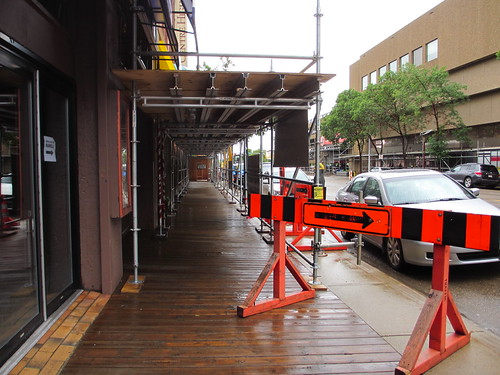
There’s a lot of construction taking place downtown, and that can mean closures, detours, and delays. For the most part, I’m willing to live with some short-term pain because I know it’ll bring long-term gain. But if you think construction downtown is bad now, brace yourself. It’s going to get much worse with the Valley LRT line, the arena, the new RAM, new condo and office towers, and much more. The City needs to do more to ensure it all goes as smoothly as possible.

One big issue that we should be able to do something about is hoarding (the temporary fencing you see around construction sites). At the moment, construction hoarding downtown is a disaster.

Here’s what 101 Street looks like thanks to the demolition of the Kelly Ramsey building:

Kelly Ramsey Construction

Here’s what it looks like on Rice Howard Way:

Kelly Ramsey Construction

They’ve taken the sidewalk and one lane on either side. It has been like this for weeks now.

Over on 104 Street, here’s what the Fox Tower construction looks like:

Fox Tower Construction

As you can see they’ve taken not only the sidewalk but one lane of traffic too. Yet on the alley side, they don’t appear to have needed any extra space:

Fox Tower Construction

I would have praised the Ultima Tower construction, as they have kept the sidewalk open complete with a bus stop, but their temporary closure (from May 24 to June 29) is just as bad as the others:

Ultima Tower Construction

You can’t actually see that the sidewalk is closed until you get near the site, so you know what happens right? People walk on the street, right in traffic:

Ultima Tower Construction

Hardly safe! Hopefully they’ll be back to normal next week, with the sidewalk and bus stop open.

All of these examples share some common problems. First and foremost, pedestrian access has been disrupted, and in some cases, vehicular access too. Secondly, signage is either non-existent or very poor. All have been in place for weeks or even months, with no indication about whether or not they are temporary or permanent until the projects are done. And of course, all are quite unattractive.

The Downtown Edmonton Community League (DECL) has already raised concerns with the City regarding the Fox Tower construction. They were initially concerned about the loss of trees, but when it became clear that the sidewalk would be closed with no clear timetable for it to reopen, they brought those concerns to the table as well. Thus far the response has been lukewarm at best. I understand that Graham Construction has not indicated a willingness to change anything. Worse, the City’s response was that the development would bring hundreds of new residents to the street, as if that made up for the impact on the hundreds of residents who already live here. We must do better!

Aren’t there rules?

As great as the Capital City Downtown Plan is, it lacks any real guidelines for construction hoarding. Here’s what it says:

Ensure that construction hoarding in the Downtown features a minimum functional clearance of 2.15 metres continuous linear electrical illumination and public art if in place for over 1 year, to provide a safe, clean and professional appearance.

We missed an opportunity to really strengthen the requirements through that document. There’s also the Procedures for On-Street Construction Safety document, but it mentions hoarding just once, and only as a way to “ensure that there is no danger to pedestrians from above.” Finally, there’s a section of the City’s website devoted to Design & Construction Standards, but those documents do not mention hoarding either.

If you search long enough, you’ll eventually come across Bylaw 15894, the Safety Codes Permit Bylaw. Part 1, Section 13 requires that any hoarding placed on a highway (street, lane, road, alley, etc., including sidewalks and any other land between the property lines adjacent) requires a permit. Section 14 outlines the hoarding regulations. Section 15 basically states that there must be a walkway for pedestrians approved by the City Manager. Part 7 outlines hoarding permit fees.

So in theory, the construction projects mentioned above needed to obtain a hoarding permit from the City, and must pay ongoing fees for as long as the hoarding is in place. I say in theory because, if you read the regulations, it’s clear they are not being met. So who knows if the City actually polices this kind of thing. Maybe they just approve each application without too much consideration. And though the Alberta Building Code isn’t mentioned, presumably the construction site hoarding requirements from subsection 8.2.1 also apply. But the bottom line is the City can approve whatever they like.

What happens elsewhere?

Compare all of that to Calgary, which has produced the Practical Guide for Construction Sites. It has an entire section on construction hoarding, which includes this passage:

As pedestrian flow is vital to downtown and neighbourhood vibrancy and operations, The City of Calgary Roads hoarding policies, fees and fines are intended to improve pedestrian mobility, provide effective hoarding solutions and visually enhance construction sites in Calgary. Where required, hoarding provisions must be maintained at all times for the safe passage of pedestrians in and around construction sites. In an effort to add to Calgary’s visual appeal, The City is encouraging an Enhanced Screening Initiative for hoarding applications and offers incentives for this option.

The document goes on to outline requirements for fencing and sidewalk maintenance, citing appropriate sections of the Alberta Building Code. It very clearly states that developers must “keep sidewalks adjacent to construction sites clear of obstructions” and also that they must “maintain publicly accessible and safe sidewalks.” Straightforward and to the point. On top of that, they’re offering a discount on the fees! If developers take part in the Community Boardworx Project, intended to add visual interest and public art to construction sites, they’ll receive a 25% reduction in hoarding fees!

My experience in places like Toronto and Vancouver has always been pretty positive. Oh there’s lots of scaffolding, but at least pedestrian access was maintained. It’s not all rosy though. Here’s an article from January talking about construction site nightmares in Toronto:

The current building boom has created a checkerboard of downtown curb lane and sidewalk closures. Some three dozen construction sites, mostly condo towers, are ringed with hoarding that extends over the sidewalk and curb lane, many on major streets including Yonge and Adelaide.

Politicians there have made some great suggestions as a result. Requiring developers to file construction staging plans upfront, charging higher fees the longer the closure goes on, and putting construction trailers on top of hoarding (as they do in New York) are all possibilities. There’s a lot we could learn from other cities.

Let’s be good neighbours

Downtown, like every other neighbourhood, is shared. By residents, employees, students, and yes, construction sites. When construction sites pop up in the neighbourhood, I’d like to see greater thought given to how that site will be a “good neighbour”. We’ve all got to get along. Construction hoarding, as the interface and barrier between the site and users of the sidewalk and street, is very important. At the moment, most downtown construction sites are not being very neighbourly. I’d like to see that change, and I think it must change if we’re going to make it through the next few years of construction mayhem.

#yeg turns five

#yegToday marks the fifth anniversary of the #yeg hashtag on Twitter (here’s #yeg tweet number one). Can you believe it has been five years since Twitter started to take hold here in Edmonton? I can’t. I’m also continually surprised at the impact our humble hashtag has had on this city. Here’s something I wrote back in 2009 about the start of the #yeg hashtag.

It started out simply but has exploded in use since, and not just online. Now it is common to see the tag offline, even in the names of companies like YEG Live. I’m always surprised when newcomers to Twitter discover and start using the hashtag, but I’m even more surprised when I see it out in the offline world! What is it about those three letters?

YEG didn’t start with Twitter, of course. Most Edmontonians would associate YEG with Edmonton because of our international airport, constructed around 1960. According to Tom Hinderks and Richard Skermer, YEG would likely have been assigned to us roughly a year before the airport received its operating certificate, so that would have been 1959. That means those three letters have been associated with Edmonton for more than 50 years! But it wasn’t until Twitter came along that Edmontonians really started to embrace YEG as a sort of identity for the city. It was probably a wise decision for the Edmonton International Airport to focus on EIA as its brand rather than YEG, because there’s a risk it would have gotten lost amongst the chatter.

Use of the hashtag on Twitter has grown fairly steadily over the years. Today it might not even be the hashtag that you follow most, it might instead be one of the 430+ related tags that have become popular such as #yegfood or #yegtraffic. There were nearly 1 million tweets posted by Edmontonians last year that included the #yeg hashtag or one of the related tags, and that’s up from less than 140,000 in 2009.

How do you pronounce it? I did an informal survey on Twitter in December 2011, and that was one of the questions I asked. About 61% say yegg (rhymes with egg), the rest spell it out as in why-e-gee. Around the same time I asked Chris Martyniuk, co-founder of YEG Live, how he pronounces it. “Originally we were adamant about spelling it out,” he told me. “But we gave in about a year ago, because everyone said ‘yegg live’.” However you choose to say it aloud, online those three letters have become synonymous with Edmonton.

People from other cities often comment on how connected and tight-knit the online community in Edmonton seems to be, and I think the #yeg hashtag is really at the heart of that. We’ve used it to make new friends, to share the news, to raise money for important charitable causes, and for thousands of other interesting and important reasons. The world of social media is very different today than it was in 2008, with a variety of new services like Pinterest and Instagram, but the #yeg hashtag remains as a way to bind it all together.

I had no idea that Twitter would become as popular as it has in Edmonton, nor that the #yeg hashtag would take hold and play such a significant role in creating a sense of community here. Thank you to everyone who has used #yeg to make this a richer, more interesting city to call home.

Here’s to the next five years of #yeg!

AccelerateAB 2013: The Next Billion Users with Mozilla CEO Gary Kovacs

In less than a month, Alberta’s tech entrepreneurs and investors will descend upon Calgary for AccelerateAB. Now in its third year, AccelerateAB is an initiative of the A100 focused on “connecting, educating and showcasing the incredible tech companies that proudly call Alberta home.” It’s not just locals you can expect to see there, but also mentors and investors from around the country and across the continent.

This event is a true melting pot that brings together Alberta’s seasoned veterans, young punks, quality mentors, whip-smart investors and keen students, all with the goal of building Alberta’s tech ecosystem. With speakers, mentors and investors jetting in from Silicon Valley and all across Canada, this isn’t just a great tech event for Alberta, it’s a great tech event. Period.

Here’s a promo video for the event:

This year’s opening keynote features Mozilla CEO Gary Kovacs who will be speaking about The Next Billion Users:

The next billion users: the global opportunity of wireless. As mobile technology spreads throughout the developing world, everything we know about mobile communication, commerce and information is about to change.

I had the opportunity to talk with Gary back in April about his keynote.

Born in Toronto, Gary completed his BComm and MBA at the University of Calgary’s Haskayne School of Business throughout the 90s. Though now located in California, he does make it back to Calgary a couple of times a year. Given that AccelerateAB is taking place during the Stampede, Gary said he was looking forward to returning with his family. Beyond that, he relishes the opportunity to connect with Alberta-based entrepreneurs. “I want to bring my mistakes and lessons back to people who are working hard in Alberta,” he said. “It’s an opportunity to speak one-to-many, not just one-to-one.”

Gary has talked about the next billion users before. He spoke at the Mobile World Congress in Barcelona back in February, and I encourage you to check out his blog post about the topic. “It took 22 years for the first billion users to come online, and everything changed,” Gary started. “The next two billion will come online over the next five years.” It’s that dramatic pace that has Gary most excited. “If we thought we were moving fast before, we can’t even understand this change.”

The interesting thing about the next billion users is that they aren’t tied down. “They won’t be constrained by any existing process,” Gary said. “They can start something new.” Sending money using a phone might be a shift in habit for someone from Canada used to visiting a bank, but for the next billion that will be just the way you do things. I mentioned that students in Africa often receive test scores via text message, whereas I had to wait for a piece of paper when I was in high school. Being free of the context of paper is part of what makes the coming shift so exciting to Gary. “To anyone who has never had a test score delivered via a sheet of paper, they don’t even have that in mind.”

Something that Gary has focused a lot of energy on during his time at Mozilla is privacy. “It’s a concern mostly because there’s no transparency,” he told me, which in the context of the recent NSA and PRISM news is quite accurate. The challenge around privacy in bringing the next billion users online is to enable them to have control. “Tools are being developed, and there will be ways for them to have a much better privacy experience from the start,” Gary said.

gary kovacs
Gary Kovacs at Mobile World Congress

Another topic we discussed was the open web. “It must be open and available for all to participate,” he said. “The next two billion people can’t be forced to go online in a way that advantages one commercial organization over another.” Gary mentioned the history we’ve been through with AOL, and noted that in the world of mobile today we’re forced to essentially choose one of two centrally planned economies. “One or two organizations cannot possibly keep up with the millions of requests of human innovation,” he said.

Lastly, I wanted to ask Gary what advice he’d give to startups. “Big organizations innovate at the centre of the bell curve,” he said. “Startups are magically placed to innovate at the edges.” For Gary, the next two billion people coming online is an incredible opportunity for startups. “Look beyond the boundaries of where you live,” he advised. Startups are able to have an impact in areas that simply cannot be contemplated by larger organizations. “Also think in terms of systems,” he added. “We should no longer think of mobile as a device or an app, that wave of innovation has occurred; the next wave is when anything is connected.”

Very exciting times ahead indeed! This is just a small snapshot of the things you’ll hear discussed at AccelerateAB in Calgary next month. The conference takes place on July 11, and tickets are just $30. You’ve got until July 2 to register, so get on it! You can check out the schedule here.

The other thing happening in conjunction with AccelerateAB is Alberta Tech Week. All week long there will be interesting tech events taking place, and you can submit your own if you’d like to get involved. It’s going to be a great week to connect with tech entrepreneurs from across the province!

Recap: Pecha Kucha Night Edmonton #16

pkn16Edmonton’s sixteenth Pecha Kucha Night was held tonight at the Citadel Theatre downtown. I did my first Pecha Kucha talk at PKN7 back in 2010 which was held in the same venue, so it was nice to be back without the nervous feeling that you get before presenting! The vast majority of the not-sold-out crowd were newcomers who had never been to Pecha Kucha before, judging by the show of hands at the start.

In case you’re not familiar with Pecha Kucha, here’s what it’s all about:

PKN features presentations on local ideas, projects and musings in the 20 slides at 20 seconds per slide format made popular by worldwide by Klein Dytham Architecture. More than 150 presentations have been given at Edmonton Pecha Kucha Nights to date on wide-ranging topics, from lighting up Edmonton’s bridges to in vitro meat and everything in between.

In order of appearance, these were the presenters at PKN16:

  1. Emerson Csorba, Make Something for Single Mothers
  2. Myles Curry, Grasscycling & Community Based Social Marketing
  3. Mark Connolly, Downtown Story
  4. Dan Jacob, The Future of Civic Engagement
  5. Andrew Whistance-Smith, What’s In a Smile?
  6. Alistair Henning & Gary Garrison, McCauley Then and Now
  7. Anna McRobbie, Open Space Technology & Unconferences
  8. Mara Erickson, Conservation Caravan: Going Beyond the BBQ
  9. Matthew Stepanic, Mythic Power
  10. Kuen Tang, The Ha Ling Project

I thought all of the presenters tonight did a great job. Everyone spoke clearly and for the most part confidently. There was a pretty good variety in terms of content too, with everything from climbing a mountain to teeth.

Pecha Kucha Night 16

Emerson kicked things off talking about SMART – Single Mothers Achieving Results Together. It’s an organization he is launching with his mother, focused on providing a space for single moms to learn from, collaborate with, and support one another. Next up was Myles from the City of Edmonton who told us all about grasscycling. During the summer, about 40% of all waste collected in Edmonton is grass. If everyone grasscycled, the emissions saved would be equivalent to taking 4,329 cars off the road. Mark from CBC used his time to talk about their new interactive web project called Downtown Story. They’ve got a collection of data and stories and invite you to take part. Dan was fourth and he talked about Urban Pulse, a new online platform for civic engagement that he’s building with Sean Healy. I liked the way he introduced it, with a story about Sean’s desire to better communicate with the City. Last up before the intermission was Andrew, who did a very entertaining talk on teeth. He connected the golden ratio and explained what we notice when looking at someone’s teeth.

Pecha Kucha Night 16

After the break, Alistair and Gary kicked things off with a talk on an upcoming book about McCauley. I’m such a sucker for local history, so I quite enjoyed hearing about some of the stories. Anna was up next to tell us about open spaces, unconferences, and Mosaic Minds. If you’ve ever been to an unconference you’ll know they don’t have an agenda, the law of two feet rules, etc. Mara was perhaps the strongest speaker of the evening, and she told us about Operation Grassland Community to the south. She encouraged everyone to ask not just where their beef comes from, but what it took to get it there. The penultimate talk was by Matthew, and I think it might have been the most powerful of the evening. He shared his story with us with a nice mix of heartfelt and funny moments. He told us that “every story has mythic power.” Our final presenter was Kuen, who shared the story of how along with the help of her co-workers she became the first quadriplegic to climb the Ha Ling mountain. It too was at times funny and at times serious, and inspirational throughout.

I think my favorite talk was Andrew’s. It was unexpected, educational, and entertaining. More than any of the others, it got people chit-chatting!

Tonight I came to the realization that I’m no longer the target audience for Pecha Kucha (and probably haven’t been for a while, honestly). I wish it could be all ideas and less promotions and launches, but I don’t think the majority feel that way. Judging by the amount of applause tonight, I think most people in attendance really enjoyed hearing about the various projects. After all, why shouldn’t it be a venue for nextgeners to learn more about what others are doing? There’s no rule that says you can’t talk about your own stuff at Pecha Kucha. I guess I just like the notion of a platform to throw out a controversial idea to get people talking, where the only benefit to the presenter is the conversation. But maybe that’s not the role of Pecha Kucha in Edmonton.

Pecha Kucha Night 16

Even though we’re halfway into the month already, Mayor Mandel was on hand tonight to proclaim June as NextGen Month. He had some really kind things to say about Edmonton’s NextGen, and said he felt confident that no matter what happens in October, nextgeners will speak their minds.

The next Pecha Kucha Night in Edmonton is actually going to be a pan-Canadian event featuring twelve speakers from across the country. The theme is downtown, and the event will take place on October 5. With an anticipated audience of 1,700, it’s going to be a big deal!  You can learn more at Designing Downtown.

Stay tuned to @EdmNextGen on Twitter for other upcoming events and have a look back at the #yegpkn hashtag for thoughts on this evening’s presentations.