It’s the season of detours downtown!

Summer means lots of construction here in Edmonton, so we shouldn’t be surprised by detours and road closures. More than $122.9 million is being invested in special projects, road paving, and other growth infrastructure projects this year! While walking around downtown today, I took some photos of a number of the projects underway.

On the east side of the 105 Street hill there’s a new sidewalk! It’s much wider, which is great for pedestrians. Looks like they are still doing some work on the west side.

New sidewalk on 105 Street

Between Jasper Avenue and 102 Avenue there is pavement renewal work being done on 106 Street:

Construction on 106 Street

There’s a lot of activity near the Legislature grounds, as the Federal Building and Centennial Plaza construction continues.

Centennial Plaza Construction

Work also continues on Capital Boulevard (108 Street). If you look closely here, you can see the street widen near the construction signs.

Capital Boulevard Construction

There’s also rehabilitation work happening on the north end of Capital Boulevard:

Capital Boulevard Construction

The most visible construction downtown is definitely the Central Station LRT Rehabilitation and Jasper Avenue Streetscaping. Basically avoid Jasper Avenue from 100 Street to 102 Street if at all possible.

Jasper Avenue Construction

They have now started removing the surface near 102 Street:

Jasper Avenue Construction

This section near 100 Street looks like it’ll be next. It has been pretty interesting to see how they do this work over the last couple weeks. It looks like the use a giant saw to slice the road (the thin straight lines in the photo below) then they’ll use the larger machinery to dig it up.

Jasper Avenue Construction

I didn’t make it up there today, but there is of course the North LRT to NAIT construction taking place along 105 Avenue and 105 Street (among other places). Here’s a great panorama from Hugh Lee:

LRT Expansion Expanded

One of the projects you’ll encounter as you enter downtown is the Grierson Hill Bridge & MacDonald Drive Pedestrian Underpass Rehabilitation. The City has been updating that page with photos.

For an overview of all current major road projects in the city, click here. Or, check out the more detailed construction schedule at Construction On Your Streets.

Downtown Edmonton’s Super Saturday

If you’re in Edmonton this Saturday, downtown is without a doubt the place to be. Some of us have been calling it “Super Saturday” because there are just so many things happening all day long!

Here’s a list of some of the activities you should check out:

TEDxEdmonton: Activating Ideas Citadel Theatre 8:30am – 5:30pm  
DECL Pancake Breakfast 4th Street Promenade 8:30am – 11:00am
City Market 4th Street Promenade 9:00am – 3:00pm
Edmonton Pride Parade 102 Avenue, from 107 Street to 99 Street 12:00pm – 2:00pm
Sprouts New Play Festival for Kids Stanley Milner Library 1:00pm – 5:00pm
Bikeology’s Heritage Bike Ride Ezio Faraone Park 3:00pm – 5:00pm
Al Fresco Block Party 4th Street Promenade Noon – 11:00pm
What the Truck?! 4th Street Promenade 5:00pm – 11:00pm
Mercer Warehouse Street Superparty 4th Street Promenade 7:00pm – 11:00pm
Al Fresco After Party Halo Lounge 9:00pm – 2:30am

Tickets are still available for TEDxEdmonton, so get yours here. You can read my recap of last year’s event here, that should give you a sense of what to expect. DECL’s Pancake Breakfast is a toonie breakfast, so bring your coins! For the City Market, the tasting area of Al Fresco, and for What the Truck?! you’ll need cash, so come prepared.

And since this post is about downtown, here’s an amazing panorama from Hugh Lee (78 images stitched together, taken from the top of the Crowne Plaza Hotel):

Downtown from the Crowne

Saturday is going to be an amazing day. Let’s hope the weather cooperates, but even if it doesn’t, bring an umbrella and enjoy!

Pecha Kucha Night: Edmonton #13

Edmonton’s thirteenth and first outdoor Pecha Kucha Night was held last night at the Heritage Amphitheatre in Hawrelak Park. With more than 800 tickets sold in advance, there was a big crowd in attendance (both people and fearless squirrels), though the venue could have held even more people. As a result, tickets were available at the door for the first time in a long time! One of my favorite things about Pecha Kucha is that the venue changes each time. Organizers have flirted with the idea of being outside before, and after last night I think it’s safe to say that it can work. Fortunately the weather held out – aside from a little wind, it was a lovely evening!

In order of appearance, these were the presenters at PKN13:

  1. Sarah Jackson, Coffee Boss, Entrepreneur
  2. Michael Cenkner, Inventor, Educator, Artist
  3. Vanessa Higgins, Watershed Specialist
  4. David Faber & Lewis Cardinal, Community Leaders
  5. Adam Henley, Student
  6. Ken Bautista, Entrepreneur
  7. Pieter de Vos, Community Development Practitioner
  8. Nadine Riopel, The Savvy Do Gooder
  9. Amy Beaith & Mike Johnson, Fruit Rescuers
  10. Omar Mouallem, Associate Editor, Avenue Edmonton

I thought everyone did a great job delivering their talks last night. There were more notes-in-hand than at previous PKNs, but no one stumbled as a result. I wonder if the larger outdoor vendor was more intimidating than the smaller enclosed spaces or less? As always, our hosts asked for a show of hands to see how many people had never been to PKN before. I think the majority of the audience were first-timers!

Pecha Kucha Night Edmonton #13

Sarah kicked things off with a talk that I would best describe as a lecture on the perils of engaging online at the expense of face-to-face communication. She encouraged people to lay down their devices and meet people for coffee. It’s a good message, but I don’t think the two are mutually exclusive. I would say I’m fairly active online, but I also meet people for coffee all the time. Seriously, ask the folks at Credo, they’ll tell you! Michael’s talk explored monoculture and permaculture, among other things. I thought his idea that monoculture is often characterized by straight lines was really interesting. I thought Vanessa was one of the best speakers of the evening, even if I didn’t really connect with the content of her talk. Her delivery was spot-on, and even with the technical difficulties of the screen behind her, she powered forward without hesitation. As Brittney said, Vanessa deserves huge props for getting up in front a crowd to talk about her depression.

After a quick break, David and Lewis told us about the Spirit of Edmonton, an initiative to reclaim and connect our city’s spirit, art, culture, and history. I had not heard about this before, so it was great to learn a little about what is being planned. Lewis told us that Edmonton’s “pehonan” is the Rossdale Flats, where our city was born eight to ten thousand years ago. Adam’s talk on our healthcare system was one of the most intriguing of the night. He talked about the changes being precipitated by technology, and touched on some of the things that could be possible if only we could move past paper and steel vaults (think big data analysis). After another quick break, Ken shared with us some thoughts on TEDx and what the program has achieved and is capable of. It’s amazing how many events have been organized all around the world! Oh and Ken, I love that you included the falcon picture. Pieter was up next and he talked about some of the work he has done in places like Vancouver and Haiti with photography. In addition to telling stories about his travels, Pieter has taught others in the places he has visited how to use photography to tell their own stories.

Pecha Kucha Night Edmonton #13

Nadine was up next to talk about the charitable sector. As promised, it was very different than her last PKN talk. In fact, I think it was my favorite presentation of the whole evening, because Nadine put forward an idea that inspired conversation. She challenged us to think differently about the charitable sector – why do we always ask charities about their costs and whether they are keeping them low but never if they are achieving their outcomes? Why is it okay to get rich mining for diamonds or drilling for oil, but not saving lives? Nadine said that we treat the charitable sector as if we want it to cut costs. Instead, we should treat it as if we want it to do good!

Amy and Mike told us about Operation Fruit Rescue Edmonton (OFRE) and the work they are doing to rescue fruit and build community. It’s pretty amazing what the group has been able to achieve in just a few short years, and I’m sure the best is yet to come. You can learn more about what they do and where the fruit goes here. The final presentation of the evening was Omar’s hilarious talk on cats. He was the perfect choice for a closer, because he made everyone laugh but also expertly snuck in some serious points about cats as well! He started with LOLCats and the idea that cats are more popular now than ever before. Unfortunately, because most people don’t pay anything for their cats, they are also among the most abused and least looked after pets. There was one moment in particular when everyone in the crowd looked at each other in disbelief – Omar told us about the Canadian Avalanche Rescue Cat Association. Yes, search and rescue cats save lives. I can’t remember ever experiencing such a full-on “are you serious?!” moment at Pecha Kucha, so nice job Omar!

I have to say that while I enjoyed myself and loved the venue, I didn’t exactly walk away from PKN13 feeling inspired nor particularly challenged. I guess that’s okay – people can share whatever they like – but I prefer the presentations that really do lead to interesting conversations and discussions.

Pecha Kucha Night Edmonton #13

Before the show got started, Mayor Mandel joined a few NextGeners on stage to proclaim June as Next Gen Month in our city. He remarked to me afterward that he is really impressed by how much the community has accomplished! There’s a lot of great stuff happening throughout the month, so check out Edmonton Next Gen for updates.

Pecha Kucha Night Edmonton #13 Pecha Kucha Night Edmonton #13

Our hosts for the evening were Thomas Scott and John Loveseth, and I thought they both did an excellent job. The giant LED screen on stage was provided by Allstar Show Industries, and despite a few technical difficulties at the beginning, it worked really well. DJ Justin Foosh from All Out DJs provided the musical ambiance, while Molly’s Eats and The Act served hungry attendees all evening long. It was great to have the food trucks on site! Sharon and I took the free PKN Shuttle Bus from the University to Hawrelak Park – thanks NextGen for arranging that! One other sponsor note – everyone in attendance received a gift card from Famoso Neapolitan Pizza for a free pizza before June 30!

Stay tuned to @EdmNextGen on Twitter and check out the website for updates on PKN and other events. See you at PKN14 in the fall!

You can see a few more photos from the evening here, and you can read about past Pecha Kucha Nights in Edmonton here.

Your Guide to Summer Festivals & Events in Edmonton!

For the 2016 edition, click here!

For the last couple of years I have posted a list of all the summer festivals happening here in Edmonton. It’s a lot of work to pull together, but I think the list is quite handy so I have done it once again. Powered by ShareEdmonton, here is a list of the festivals, parades, and a few other notable events you can look forward to over the next few months. Click on the title of a festival to visit its website, click on the ShareEdmonton logo to see the event listing there, and click on the calendar icon to open up an iCal for the festival’s dates.

Edmonton International Athletics Festival May 25 – June 25
Vocal Arts Festival May 25 – July 1
International Children’s Festival May 29 – June 2
Dreamspeakers Film Festival May 30 – June 2
Bikeology Festival June 1-30
Oliver Community Festival June 2
Bonnie Fest June 2
Heart of the City Festival June 2-3
Highlands Street Festival June 3
Rubaboo Arts Festival June 6-17
Nextfest June 7-17
Edmonton Pride Festival June 8-17
Edmonton Pride Parade June 9
Creative Age Festival June 8-10
Open Sky Music Festival June 8-10
Al Fresco June 9
What the Truck?! June 9
Improvaganza June 13-23
The Works Art & Design Festival June 21 – July 3
Summer Solstice Festival June 22-24
Edmonton International Jazz Festival June 22 – July 1
Philippine Arts Festival June 23
Freewill Shakespeare Festival June 26 – July 22
Historic Festival & Doors Open Edmonton July 3-8
Edmonton Triathlon Festival July 6-8
Edmonton International Street Performers Festival July 6-15
Choralies Festival July 8-15
Race Week Edmonton July
Edmonton Indy July 20-22
A Taste of Edmonton July 19-28
Capital EX Parade July 19
Capital EX July 20-29
Interstellar Rodeo July 27-29
Servus Heritage Festival August 4-6
Edmonton Folk Music Festival August 9-12
Animethon August 10-12
Edmonton International Fringe Theatre Festival August 16-26
Rock Music Festival August 17-18
Edmonton Dragon Boat Festival August 17-19
Edmonton Latin Festival August 18-19
Edmonton Blues Festival August 24-26
Symphony Under the Sky Aug. 31 – Sept. 3
Kaleido Family Arts Festival September 7-9

You can see a listing of all the festivals here, and a calendar view here. You can also add all of the festivals to your calendar with this iCal feed.

If you know of a festival that I have missed, please let me know and I’ll add it. There are some festivals that have happened in previous years such as Rock the Square and Cariwest that will likely happen again, but they don’t have websites with information to confirm that. I’m sure there will also be events that get announced closer to the date (such as additional What the Truck?! events throughout the summer).

Be sure to check out ShareEdmonton for even more upcoming events – there are hundreds of additional listings such as Edmonton Eskimo games, farmers markets, and many more.

Happy summer!

The Past, Present, and Future of Food Truck Bylaws & Guidelines in Edmonton

Well it was bound to happen sooner or later – Edmonton has joined the long list of cities that have had disputes between restaurants and food trucks. As you’ve probably heard, Grandma Lee’s in Petroleum Plaza has complained about Drift, one of our city’s most popular food trucks. It’s an attractive media story as we head into summer and that has contributed to the issue becoming a bigger deal than is necessary. On the plus side, the situation has highlighted the need for a review of the Street Vending Program.

Truck Stop in Old Strathcona

I have been learning about and researching the bylaws and guidelines and how everything works for quite a while now, and this seems like a good opportunity to share what I know!

Why are food trucks allowed in Edmonton?

The Traffic Safety Act (TSA) sets out the basic rules for streets in our province. Among other things, the act outlines how the Alberta Transportation Safety Board should work, the rules for operator’s licenses and vehicle registrations, speed limits and other rules of the road, and the powers of municipalities with respect to streets. Specifically, section 13(1) states that municipalities can pass bylaws that govern the use of highways under its direction, provided they are not inconsistent with the TSA. Here in Edmonton that is bylaw 5590 (Traffic Bylaw, PDF) and in Calgary, that is 26M96 (Traffic Bylaw) and 20M88 (Street Bylaw).

A useful way to think about it is this: All streets in Alberta are governed by the basic rules set forward by the province. In cities like Edmonton and Calgary, bylaws enable each municipality to manage its own streets, building on top of those basic province-wide rules.

In Calgary, the Street Bylaw states in section 5(a) that you cannot sell things on streets. Section 5(b) outlines some exceptions to this, including pushcarts and ice cream trucks, but does not specifically mention food trucks. In Edmonton, section 67 is far less specific, and simply states that you must have a permit in order to sell goods and services. It also grants authority to the City Manager to basically bring the bylaws to life through policies, procedures, guidelines, and enforcement.

That’s why Edmonton has been allowed to have food trucks – our Traffic Bylaw enables permits for selling goods and services on city streets, and it does not specify any restrictions as to what those goods and/or services might be. As long as you have a valid permit, you’re good to go. In Calgary, you’d need to get a letter from the Director of Roads unless you fall under one of the allowed exceptions. Obviously that’s not a very scalable solution, hence the pilot that is underway in Calgary.

How does the City of Edmonton manage food trucks?

Nearly thirty years ago the Street Vending Program was created. According to a City report from 2005, it “was initiated by City Council to aid in the revitalization and enrichment of the downtown core.” Parks & Recreation was originally responsible for the program, though it has also called Community Services home. Currently responsibility falls to Sustainable Development.

The program today consists of the coordinator, the application forms, and the guidelines. You can download the latest package here. If you look at the package, you’ll find that the Street Vending Program deals with all kinds of vendors, not just food trucks. Hotdog carts, ice cream trucks, and any other vendor wanting to sell things on city streets must have four things: a business license (specifically a Travelling or Temporary Food Sales license), a health permit, a minimum of $2 million general liability insurance, and a vending permit. In order to get a vending permit, you need to talk to the Street Vending Coordinator and you need to follow the guidelines. There are slightly different guidelines for sidewalk vendors as opposed to street vendors, and altogether different guidelines for ice cream trucks.

Until very recently, the coordinator was a seasonal position, which means that throughout most of the winter there was no staff person at the City working on street vending. That meant that there was limited time to make improvements to the guidelines or changes to the program, which is part of the reason why they have remained largely the same for years.

What are the guidelines for food trucks in Edmonton?

There are a number of guidelines that apply to all kinds of vendors. For example, vendors are only allowed to operate from 7am until 11pm. Permits apply to a single location only – if you want multiple locations, you need to have multiple permits. Vendors must adhere to a code of conduct and “conduct themselves in a professional manner”. Vending units must not be left unattended, vendors cannot sell illegal or counterfeit products, etc.

In addition to the general street vending guidelines, there are roughly fifteen bullet points under the section for street vendors. Most of these are fairly straightforward, including things like “all existing parking restrictions apply” and “overhead canopies or vertically operating doors must not obstruct or hinder safe pedestrian traffic”. I encourage you to read the document for yourself as it isn’t very long. I’ll highlight the two points that deal with disputes between existing businesses and vendors:

  • Permission will not be granted to Vendors where a conflict with an existing business is evident.
  • Where a conflict arises with an existing business, the Sustainable Development Department reserves the right to relocate the contentious Vendor.

Nowhere else in the guidelines does the topic of conflicts come up. There is no section on how such complaints are handled, nor is there any information on how to appeal a complaint. Under the current guidelines, if you’re a vendor that someone has complained about, you’re automatically labeled “contentious” and there’s not much you can do about it. There are no rules to fall back on, and there is no process to follow to try to resolve the issue.

When was the Street Vending Program last reviewed and updated?

While minor modifications have been made over the years, mostly with respect to title and department name changes but also fees, the current street vending guidelines are largely the same as they were in 2005 (the oldest copy I was able to find). And according to a report from that year, the “program has not had an Administrative or City Council initiated review”. In other words, they haven’t been formally reviewed since they were created!

That report came about because then-Councillor Michael Phair received a complaint about street vending and “especially concerning vendors that sell food” so he made an inquiry to Administration. They brought a report back to the Community Services Committee on September 1, which outlined how the program operates. The committee voted to have Administration bring back a second report comparing the program with “best practices in cities such as Toronto, Montreal, and Vancouver.” That report came back on November 4 and outlined some of the things other cities do with respect to street vending. Here are the two key points from that report:

“Community Services Department surveyed service providers directly and asked a series of questions via telephone with counterparts from Montreal, Ottawa, Toronto, New York, Winnipeg, Regina, Calgary, Vancouver, Victoria and Seattle.”

“After looking at the street vending practices for ten municipalities, it is concluded that Edmonton’s program equals or exceeds that of the other municipalities.”

As a result no further action was taken, and the program has continued the same way ever since.

Why should the guidelines be reviewed and updated now?

Put simply, a lot has changed in the last thirty years since the Street Vending Program was created! Especially in the last five years, interest in food trucks has exploded across North America and expectations about how such businesses operate has changed very quickly. In 2005, the program had about 40 vendors in total. This year, there are 55 vendors (that number includes food trucks, ice cream trucks, carts, and all other sidewalk vendors). That’s not a large jump, but we are seeing new food trucks joining the fray and I expect that trend will continue.

More important than the quantity of vendors is the type of vendor. Back in 2005, we didn’t really have curbside food trucks like Drift. Now we do, and we should expect more! I think there are significant differences between a sidewalk vendor and a food truck, yet the guidelines for the most part don’t reflect that. Whereas it might make sense to restrict a sidewalk vendor’s permit to a single location, the whole point of a food truck is that it is mobile and can move around.

The food trucks of today are serving a completely different kind of product than mobile carts have in the past, and that has an impact on the program too. Sandwiches from Drift are certainly competition for brick-and-mortar restaurants, so it’s no surprise that some disputes will arise. The current street vending program does not outline any process for dealing with such disputes.

The opportunity to realize Council’s original vision for the Street Vending Program – “to aid in the revitalization and enrichment of the downtown core” – has never been stronger than it is today. If we want food trucks to be viable and sustainable into the future, we need to update the program.

What changes should be made?

This is a topic that will need further discussion, but we could do a lot worse than to look to Calgary for guidance. Because their pilot program is so new, they have been able to capture many of the key points that differentiate food trucks from other vendors and those are reflected in the program’s guidelines.

Note that we don’t need to change our bylaws, just the Street Vending Program. Changing the bylaws is a much more difficult process that would require approval by City Council. Changing the Street Vending Program can be much simpler. Remember it’s the bylaws that make food trucks possible but it’s the Street Vending Program that outlines how food trucks are managed and should operate.

Here are some ideas for positive changes to Edmonton’s Street Vending Program:

  • Grant food trucks a permit that applies to multiple locations or a large area, rather than requiring one permit per location. In Calgary they have the concept of “roll zones” and “no-roll zones” which outline where the trucks can and cannot go.
  • Bring the cost of the permit in line with other cities. In Calgary, food trucks pay a flat fee of $700 per year that is not dependent on actual street usage.
  • Make it easier for trucks to serve in the evening. This could be accomplished by establishing some sort of evening roaming rules, by extending the valid operating times past 11pm, or both. In Calgary, food trucks may operate until 3am.
  • Get rid of the restriction that only one truck may operate on a street at a time. We know that food trucks are often more successful when there are many together than when they are going solo, as long as they are complementary, and we know that food truck operators all talk and already team up from time to time!
  • Clearly outline where food trucks are allow to operate. Calgary’s guidelines clearly state that food trucks cannot operate within 25 metres of any restaurant during its operational hours. (Note: Drift is a lot further from Grandma Lee’s than 25 metres!)
  • Outline a process for dealing with complaints. Food trucks need to have some certainty about their business, and if the processes by which they may be asked to move is completely opaque, it’s hard to have that certainty.
  • Revamp the evaluation process for issuing permits. The current “process” is highly subjective and often relies upon the food truck’s relationship with the street vending coordinator. That leads to inconsistent treatment of food trucks, and in some cases, inconsistent fees.
  • Create a proper website. For the longest time, all the Street Vending page said was to call the coordinator and it gave a phone number. At least now it links to the application package, but we could obviously do so much more.

The good news is that discussions regarding these changes have already been taking place, and I anticipate we’ll make significant progress this year. I think if we can make some of these changes a reality, we’ll have a much stronger vending program into the future.

It’s also worth mentioning that perhaps Sustainable Development is not the right home for the Street Vending Program. Sustainable Development is responsible for business licenses, property management, and economic development strategies, among other things, but food trucks in particular need more than that. They also deal with Transportation, Transit, and other departments. I would recommend folding the Street Vending Program into the Civic Events Office, which already coordinates with the various City departments on a regular basis.

If we’re willing to put even more effort in, I think there are significant opportunities to once again have Edmonton’s street vending program be the standard by which other cities are measured. Here’s just one example. Food trucks are different lengths and so are parking stalls. Why not release a dataset of all the parking stalls in Edmonton, or at least those in food-truck-friendly neighbourhoods that includes the location, length, price and other information? It would then be relatively easy for a food truck to scan for potential locations at which to park. We’ve already got the open data catalogue and the parking meter data exists somewhere, so with a bit of effort we could make something like this a reality.

What’s next for Drift and Grandma Lee’s?

As you might have heard, Drift was granted an extension at their current 108 Street location until Friday. They are supposed to file an appeal by then, whatever that means. There is nothing in the guidelines that outlines how exactly Drift is supposed to respond to the situation. Furthermore, the advantage is clearly with Grandma Lee’s – the City can basically tell Drift that they have to move and there’s nothing they can do about it.

I would rather see businesses like Grandma Lee’s choose to compete rather than complain. With a brick-and-mortar location, a restaurant should be able to offer an experience that no food truck can match. Furthermore, we know from our experience with What the Truck?! that having food trucks in an area often draws more people to surrounding businesses, not less. Unfortunately, as Colby Cosh astutely identified last week, Grandma Lee’s has chosen rent-seeking over delivering a better experience, and that means everybody loses.

Drift Sandwich Mob

I hope Drift is not forced to move, but if they are, then I hope it ultimately results in improved guidelines that clearly stipulate how such disputes will be handled in the future. If we want to make it easier for new food trucks to open up in Edmonton – and I think we do – then we need to make the rules clear and consistent.

What’s next for food trucks in Edmonton?

I think Edmonton’s existing food trucks will become even more successful over time as they build up a larger and larger client base and as the food truck movement really takes hold here in Edmonton. We’ll also see new food trucks launch and enjoy success, such as The Act which entered service on Monday. More food trucks means more pedestrian activity and vibrancy on the streets and that ultimately will make Edmonton a better city in which to live. Unless we somehow take a massive step backward, I don’t see any other outcome for food trucks in Edmonton!

By reviewing and updating the Street Vending Program, we can create an environment for food trucks that better reflects the realities of today, and more importantly, better positions us for success in the future. It’ll take some work, but I think it’ll be worth it!

Edmonton’s City Market Downtown needs community representation

This is a long post, so here’s the summary: the City Market Downtown has called a Special Meeting to change the organization’s bylaws so that vendors have complete control over the affairs of the market, whereas previously a healthy mix of vendor and community representation has been required. I believe this is an unfortunate and reactive turn of events that will prevent the City Market from growing and achieving success in the future. The City Market is successful presently because of the partnership that exists between vendors, consumers, residents, businesses, and the City of Edmonton, and I would like to see that partnership remain and become even stronger. I’m sharing this in the hopes that more Edmontonians will look at the City Market not just as a great place to shop at on Saturday, but also as an integral part of our downtown and of the city we all want Edmonton to be.

In a little over a week the City Market Downtown will return to 104 Street for the summer season. Even though it has been nearby throughout the winter at City Hall, I’m positive that May 19 will feel more like a return than simply a shift in location. The outdoor market is an altogether different and special experience, one that thousands of Edmontonians enjoy every weekend from May through October!

For more than one hundred years, the City Market has played an important and unique role in our city. In the early days, the existence of the market reflected Edmonton’s aspirations to be a place of importance. In recent years, the market has helped to revitalize our downtown. It’s most important role however, has been as a mechanism for connecting urban Edmontonians with their rural neighbours. As Kathryn Chase Merret wrote in her book, A History of the Edmonton City Market, 1900-2000, “the years during which the Edmonton City Market flourished were years when it embodied a popularly held and powerful civic idea, the interdependence of country and city.”

City Market Downtown

When the City Market moved to 104 Street in 2004, the idea of connecting country and city became embedded in the bylaws of the Edmonton Downtown Farmers’ Market Association. Among other things, the bylaws outline the composition of the board: five to ten members, including at least two members representing vendors, one member representing residents, and one member representing the business community. That composition is significant because it puts vendors and the community on equal terms, fifty-fifty. For the organization to work with such a structure, there must be a partnership between both sides. I firmly believe that partnership is what has enabled the City Market to flourish over the last seven years. And that is why I was alarmed to receive a notice about an upcoming Special Meeting to amend the bylaws in such a way that vendors would have complete control over the market.

Over the last week I have spent a significant amount of time and energy trying to get a better understanding of the situation. I wanted to know more about the history and the people involved, and I wanted to figure out if my initial alarm regarding the changes was warranted. I have talked to both current and past board members, I have talked to residents and businesses on 104 Street, and I have talked to both current and past City Councillors. What follows simply cannot represent every viewpoint on the matter, but know that I have done my best to gather as many perspectives as possible. Unfortunately both Dieter Kuhlmann and Dan Young, the current and past chairs of the City Market board respectively, declined to comment.

Proposed Bylaw Changes

On April 27 a “Notice of Special Meeting” was mailed to all members of the Edmonton Downtown Farmers’ Market Association. The notice indicated that a Special Meeting would take place on Monday, May 14, 2012 starting at 7:30pm at the Sutton Place Hotel to vote on a Special Resolution to amend the current bylaws. A copy of the amended bylaws was included, but the current bylaws were not, making it difficult to compare. In addition to a number of smaller changes, there are three big and important changes proposed.

  1. The categories of membership under the current bylaws are: Regular Member, Associate Member, Honoured Life Member. Regular Members are further categorized as Vendor Members and Community Members, but both have full and equal voting rights. Under the proposed bylaws, the categories of membership are: Voting Member, Non-Voting Member, and Honoured Life Member. Importantly, only vendors would be allowed to be Voting Members.
  2. As mentioned above, the current bylaws state that the Board of Directors must comprise five to ten members, including at least two Regular Members representing vendors, one Regular Member representing residents of downtown Edmonton, and one Regular Member representing the business community of downtown Edmonton. Under the proposed bylaws, the Board of Directors would be comprised of five to nine individuals, including a minimum of five Voting Members (ie. vendors), and if additional board members are elected, one Non-Voting Member who would represent residents and one Non-Voting Member who would represent the business community. If a full slate were to be elected, the eighth and ninth members would also be Voting Members.
  3. Under the current bylaws, each Director serves a two year term and may serve no more than three consecutive terms. Under the proposed bylaws, there is no limit to the number of terms a Director may serve.

To summarize, the changes remove the requirement to have resident and business representatives on the board, they remove the right of non-vendors to vote, they require that vendors always have a majority on the board, and they remove the term limits for board members.

I think it is important to point out that inadequate notice has been given for this Special Meeting. According to Service Alberta:

The by-laws must say that in the future the by-laws can only be changed by a special resolution of the members. Special resolution is defined in Section 1(d) of the Societies Act. The definition cannot be changed.

If you look at that section of the Societies Act, you’ll find that for such a resolution to be valid, “not less than 21 days’ notice specifying the intention to propose the resolution has been duly given.” In this case, just 17 days notice has been given.

Why did this come forward?

Practically speaking, someone brought a petition forward signed by twenty-five members of the association, as required by section 9.03 of the bylaws. I have been told that the petition was not a board initiative, and although no one was willing to name names it has become clear to me that there is one individual in particular who has taken it upon himself to drive this forward.

For some time now, there have been complaints from the businesses on the street about the logistics of the market. The businesses feel that the configuration of the market on the south end of the street unnecessarily hides their storefronts, blocks the sidewalks, and makes it difficult for consumers to shop. The market has typically responded with concern about the impact any changes would have on the logistics of setting up and tearing down the market. In my opinion, both sides have handled the situation poorly. The market seems to have taken the perspective that it is the greatest thing to ever happen to the street, and the businesses don’t seem to realize that perhaps they could do more to attract some of the 15,000+ people who walk by on a Saturday. Discussions have been ongoing and with Councillor Batty acting as a mediator between the two sides in recent weeks, a small amount of progress was finally made a few days ago when both sides agreed to trial a reconfiguration of the south end of the market. I think this ongoing negative situation has contributed to the desire by some vendors to remove any business representation from the market.

Another contributing factor appears to be last year’s vote on whether or not to pursue the Mercer Warehouse as a year-round venue for the market. The motion was defeated overwhelmingly, 69-3. Sharon and I abstained from that vote because we felt it was inappropriate to vote on something that could have such a significant impact on a vendor’s financial situation (each would have had to contribute thousands of dollars). In hindsight, it seems that a number of community representatives pushed quite hard for the building and that may have contributed to some vendors feeling threatened and ultimately led to the decisive vote.

Most significantly, it seems that personality conflicts have played a major role in this turn of events. Arnold Renschler was recruited to the board as a community member and was elected in January this year, but stepped down just a couple of months later after attempting unsuccessfully to bring vendors and businesses on the street together to discuss their differences. He quickly found that others on the board were not supportive of his initiative. “We need people to volunteer and while I am willing to give my time, the organization has to be open, transparent, fair, and democratic,” he told me. Arnold felt that the organization was one he did not want to be associated with, a message I have heard from a number of other individuals as well.

Why does this matter?

In my conversations over the last week, people overwhelmingly feel that the proposed changes would take the market in a negative direction. “A healthy balance between vendors and non-vendors is what has made the market successful,” is what former board member Jennifer Fisk told me. That healthy balance is precisely why the original board members wrote the bylaws the way they did. They recognized that the City Market is unique specifically because of its location. Instead of occupying a building that it owns and operates, the City Market calls 104 Street home just on Saturdays and just during the summer months. You might say that they are a guest of the street for that time, and that being a guest comes with certain expectations. “Downtown has many stakeholders, all of which need to be willing to hold dialogue with each other and discuss the issues in a rational, open-minded manner,” Chris Buyze, President of the Downtown Edmonton Community League, told me. “It’s about maintaining balance and a willingness to work with others.”

Without question, many vendors have a much larger stake in the market than residents or local businesses do. For many vendors, the market is their livelihood, and they’ve almost certainly put more blood, sweat, and tears into participating in the market than someone who simply lives on the street. However, because of that greater investment vendors are more likely to act in their own self-interest than in the best interests of the market. Having outside representation can help to provide a broader perspective. “I believe it should be a vendor led board, but that doesn’t mean that you have to exclude the other parties,” Arnold told me. There are few organizations that are as political as farmers’ markets are, and often that’s because of turf wars and other petty differences.

From a logistical point-of-view, having a balance of vendors and non-vendors is vitally important. Vendors are busy and many live outside the city, so they cannot be expected to keep up-to-date with what is happening on the street. That’s one area in which residents and businesses can be extremely valuable contributors. For example, they can both provide input to the board about changes to the street and can attend meetings in the city such as the ones that Transportation is scheduling to discuss future LRT construction.

Most people I talked to also feel that it is difficult to compare the City Market to other markets. Each market is different and what might work for one won’t necessarily work for another. For example, the St. Albert Market is completely run by the Chamber of Commerce and it has grown to become possibly the most successful single-day market in the province. In contrast, the Old Strathcona Farmers’ Market is vendor-run and yet it too is extremely successful. The context in which the City Market operates is completely different, and I think a strong case can be made for a healthy mix of vendor and community representation.

The City Market does not operate in a vacuum. It needs the support of the community it parachutes in and out of for twenty-two weeks over the summer. “I do think that this market in particular works best when the community and the market are integrated,” former City Councillor Michael Phair told me. “It would be very valuable to have voting representation on the board from someone that has a connection to those living or working on the street.”

Why does the City Market matter?

There are lots of farmers’ markets in the Edmonton area, and new ones seem to be popping up all the time. But there aren’t any other markets like the City Market. Being located in the heart of downtown is a huge advantage that no other market has. The City Market is the only farmers’ market accessible via LRT, for instance, and that draws thousands of people into the core every week. When the LRT was extended to Century Park, there was a noticeable jump in attendance at the City Market.

According to Alberta Agriculture, the average person spent $35 per visit to a farmers’ market in 2004. By 2008, that number had jumped to $45. “The average customer to the City Market spends $68 each week,” former board member and 104 Street resident Jon Hall explained to me. “The market supports millions of dollars of commerce each year.” And he pointed out that the weekly average spend does not include parking, coffee, or other things that people might buy while they are in the area.

We throw the R-word (revitalization) around a lot these days, but there’s no question that the City Market has played and continues to play an important role in the turnaround of downtown. That’s especially exciting because it was not very long ago that the market itself was in need of a turnaround! There seems to be a interesting mix of fortunes for downtown and the City Market. For example, one of the key reasons that Sharon and I moved downtown was because of the City Market.

Future of the City Market

While the City Market still has a number of years on its lease with the City for 104 Street, there is no guarantee that it will remain there. Starting next year, the market will likely face significant logistical challenges at its present location due to the construction of the proposed third and fourth Icon towers in the parking lot on the northwest corner of 102 Avenue and 104 Street, as well as the eventual construction of the Downtown LRT Connector (which runs down 102 Avenue). There are alternatives that don’t require the market to move off the street, however. Michael Phair suggested that both the alley behind Sobeys and 104 Street south across Jasper Avenue could be viable locations for the market to expand or move into. “As you go south, you have quite a bit of space,” he said. “I think it would be relatively easy to manage the crossing at Jasper Avenue.” He points out that thousands of people cross Gateway Boulevard every Saturday from the parking lot to the Old Strathcona market, so why can’t they cross Jasper Avenue, which has even less traffic?

If the City Market cannot remain on 104 Street because a new location is truly better for the market, then that’s a valid reason to move. But if the market decides to move because it cannot or will not get along with the 104 Street community, that’s a different situation altogether. And I fear that without representation from the downtown community that has been home to the market for over one hundred years, there’s a real chance that the market may consider moving outside the downtown core. That would be a significant blow to the momentum that downtown now has, and I think would ultimately have a negative impact on the market itself.

Conclusion

The City Market on 104 Street is successful today because of the partnership that exists between vendors, consumers, residents and businesses on the street, and the City of Edmonton. Without the significant investments made by the City over the last two decades, 104 Street simply would not have been able to develop into one of Edmonton’s premier streets. The residents, businesses, and City Market together all bring the foundation provided by the City to life and positively contribute to the vibrancy and attractiveness of the street.

I believe that partnership is worth fighting for, and as such I view the proposed bylaw changes with great concern. I do not believe that the changes have been suggested with the best interests of the City Market at heart, and I think it is clear that they have been brought forward without adequate notice in an effort to avoid healthy discussion of the matter. I feel that strong vendor and community representation is a necessity for the City Market to continue to thrive, and I think that any attempt to cut either side out of the equation is shortsighted and harmful.

The City Market is not simply a place to buy food and crafts on the weekend. Rather, it connects Edmonton’s urban and rural communities and contributes significantly to the ongoing revitalization of our downtown. The City Market is one of the few remaining connections we have to our city’s earliest days, and I hope it continues to successfully play a role in the lives of Edmontonians for years to come.

City Market Downtown

How You Can Help

Tell others that you care about the City Market and its role in the city. Contact the City Market and buy a $10 membership. Go to the meeting on Monday night and express your concerns. Write to your City Councillor. Tweet your thoughts. Whatever you do, please don’t take the City Market for granted!

UPDATE (May 12): As per the comment below from City Market board chair Dieter Kuhlmann, the meeting has been postponed until mid-June. Here’s the notice that was sent to members:

The Special Meeting that was called for May 14, 2012 has been cancelled. Notice of a Special Meeting for the week of June 11, 2012 will be issued and mailed out next week in order to provide members with the required 21 days notice of the Special Resolution that will be the topic of the Special Meeting.

While this is a welcome change that will allow for more discussion, it doesn’t mean the issue is done just yet.

Where you’ll find me over the next week!

Tonight is the first Truck Stop of the year and our first event in Old Strathcona! We’re actually holding a Truck Stop every Thursday night this month at McIntyre Park (8303 104 Street, aka Gazebo Park). The lineup and menu will change each week, so there’s definitely a reason to attend more than one! Here are the details for tonight’s event.

To keep up-to-date on What the Truck?! and Truck Stop events, check out our website, like us on Facebook, and follow us on Twitter! We’ll be posting each week’s lineup and menu details as we get closer to the date.

On Saturday at the Fantasyland Hotel you’ll find iMedia 2012: Edmonton’s Social Media Conference. Vancouver’s Darren Barefoot and Rebecca Bollwitt are both in town to deliver keynotes. At lunch time I’m on the iMedia-lite Panel along with Kathleen Smith, Kendall Barber, and Ryan Jespersen. We’ll be talking about personal branding on the web – should be fun!

Later that afternoon I’ll be back downtown to participate in the Edmonton Public Library’s Downtown Stories event. The idea is to celebrate “the diverse stories of people who live downtown.” I’ll be sharing some thoughts on the changing face of downtown. Other speakers include Poet Laureate Anna Marie Sewell and EPL’s Writer in Residence Jocelyn Brown.

In addition to Truck Stop next Thursday, you don’t want to miss the Grand Opening Party for Startup Edmonton’s new space in the Mercer Warehouse! There will be drinks, DJs, and tours all evening long, so stop in and check it out. I can’t wait to see the space full of people.

On Friday, May 11 you’ll want to join me at the Art Gallery of Alberta to celebrate Guru’s tenth birthday at Gala Guru TEN. They’ve accomplished so much in that time! “We hang out on the corner of technology and the arts. If you like freaky mashups of technology and music/dance/theatre/visual media, this is the event for you.”

So that’s a few of the events I’ll be at over the next week or so. For more upcoming events, check out ShareEdmonton!

2012 Alberta Election: Social Media Highlights

I don’t think there’s any doubt that social media played a significant role in this year’s provincial election. From witty tweets to conversation-shifting blog posts and everything in between, there’s no shortage of social media highlights to look back on. In an effort to capture how social media impacted the election, I have been tracking some of the most popular and memorable blog posts, photos, tweets, videos, and links.

Very early on, Danielle Smith’s campaign bus was the talk of Twitter for its unfortunate wheel placement. It attracted so much attention that even Jay Leno joked about it! The Wildrose quickly fixed the bus, sharing a new photo on Facebook that was liked nearly 800 times with more than 220 comments.

danielle-smith-bus-628

Social media proved to be an effective tool for the mainstream media to share their stuff throughout the election. For example, CBC’s Vote Compass was shared more than 5300 times on Facebook and more than 870 times on Twitter. Over 115,000 responses were completed.

On March 30, PC staffer Amanda Wilkie (@wikwikkie) posted a tweet questioning Danielle Smith’s lack of children. There was an immediate backlash which forced Wilkie to apologize and delete the tweet. Smith released a statement explaining that she and her husband had tried to have kids with the aid of fertility treatments, and Alison Redford released a statement announcing that Wilkie had resigned. The two leaders spoke on the phone and vowed to move on.

Smith’s tweet was retweeted more than 100 times.

On April Fools Day, the Wildrose issued a news release saying that if elected, the party would pursue a merger with Saskatchewan to form a new province known as Saskberta. It was shared on Facebook more than 2100 times and on Twitter more than 360 times. The Wildrose tweet itself was retweeted more than 140 times:

Candidates first felt the power of blogs on April 2, when Kathleen Smith (@KikkiPlanet) posted her widely-read piece entitled Pruned Bush: Confessions of a Wilted Rose. An impassioned and well-written post, it racked up more than 1400 likes on Facebook, more than 330 tweets, and 136 comments. More than that, it brought “Conscience Rights” into the spotlight.

Kathleen’s post even attracted an angry response from a Wildrose supporter. Paula Simons has a good recap of the whole story, so check it out.

Just two days later, Dave Cournoyer (@davecournoyer) posted an even more popular blog post. His entry titled thorny candidates could be the wildrose party’s biggest liability attracted more than 4700 likes on Facebook, more than 600 tweets, and 150 comments. Though we didn’t know it at the time, Dave’s post would be cited countless times over the next few weeks as Wildrose candidates made gaffe after gaffe. Even his follow-up post on April 16 attracted more than 600 likes, more than 70 tweets, and 75 comments.

The next day on April 5, Dave Cournoyer noticed that a Twitter account named @PremierDanielle had been created and was being followed by @ElectDanielle, Smith’s official account. While it only came to light during the election, it was actually created back on October 12, 2010.

I didn’t think there’d be many audio clips to note during the election, but on April 7 the Alberta Party launched its official campaign song, composed by JUNO winners Cindy Church and Sylvia Tyson. The page was shared on Facebook more than 100 times and on Twitter more than 40 times. The song itself, hosted on SoundCloud, has been played more than 3500 times.

It didn’t take long after Danielle Smith announced a $300 dividend for all Albertans for Sean Healy to launch Dani Dollars, a website that let users pledge their cash “to Wildrose Relief”. It was shared more than 280 times on Facebook, more than 130 times on Twitter, and attracted more than 170 pledges for a grand total of $51,600.

The leaders debate took place on April 12, and while it ended up being fairly boring (aside from Raj Sherman’s unintentionally comedic outbursts) there were a couple of highlights. One was Alberta Party leader Glenn Taylor’s live blog, which was followed by more than 1700 people. It was shared more than 480 times on Facebook and more than 300 times on Twitter.

The debate also resulted in one of the most memorable tweets of the election, retweeted more than 340 times:

https://twitter.com/omar_aok/status/190617702690340864

Edmonton Journal videographer Ryan Jackson posted a really unique video on April 13. By stitching together four different videos, Jackson made it appear as if you were sitting in a coffee shop with four of the party leaders. The video was shared more than 140 times on Facebook and more than 50 times on Twitter.

On April 14, a new Twitter account known as @Adamwyork posted a tweet about Wildrose candidate Allan Hunsperger. It linked to an old blog post that Hunsperger had written that contained the shocking statement that gays and lesbians would “suffer the rest of eternity in the lake of fire, hell.” You can see a screen capture of the post here. It wasn’t until April 26 that the person behind the tweet was identified. Turns out it was Blake Robert, better known online as @BRinYEG. Paula Simons’ post about the outing has already been shared more than 275 times on Facebook and more than 144 times on Twitter.

Though the original tweet was only retweeted 13 times, the impact it had on the election cannot be overstated.

On April 16, the domain name INeverThoughtIdVotePC.com was registered. A couple of days later, the website launched featuring a short video that asked Albertans to vote strategically against the Wildrose. The website has been shared on Facebook more than 3700 times and the video itself has been seen more than 88,000 times.

On April 17, Vicky Frederick posted a Wildrose-edition of the “Downfall / Hitler Reacts” video meme. The video, titled Inside the Wildrose War Room, has been seen nearly 12,000 times.

It was a busy day on April 17. That was also the day that Wildrose candidate Ron Leech made controversial statements about having an advantage as a Caucasian. The Journal captured a copy of the radio interview here. The tweet from CTV Edmonton breaking the news was retweeted more than 250 times:

That same day, the Wildrose posted its “Momentum” ad on YouTube. With more than 112,000 views, it’s the most popular election-related video.

On April 20, Paula Simons wrote a blog post titled The Price of Free Speech. She discussed Danielle Smith’s stubborn refusal to reprimand candidates like Hunsperger and Leech. The post was shared on Facebook more than 1500 times and on Twitter more than 180 times.

In the final weekend of the campaign, photos of this graffiti wall here in Edmonton started circulating on Facebook, Twitter, and elsewhere online:

I don’t know how many times it was shared, but I saw it all over the place.

After all of the negativity of the election, I was quite happy to see Ryan Jackson’s next election video on April 23. A “whimsical parody video”, it featured the “strange new species” popping up on lawns across Alberta known was the election sign.

He posted a behind-the-scenes on the video just yesterday.

As the polls opened on April 23, many people tweeted that they had voted while others encouraged Albertans to get out and vote. With more than 200 retweets, Kathleen Smith’s call-to-action was probably the most visible of the day:

On election night itself there were many memorable tweets, but Todd Babiak’s post about how the public opinion polls were so wrong was one of the most retweeted with 195 retweets:

As far as I can tell, the most retweeted tweet of the entire election came at 9:27pm on election night, after it became clear that the Wildrose would form the official opposition. Calgary’s Nick Heer posted this tweet:

It has been retweeted more than 650 times!

Final Thoughts

It’s hard to imagine what the election would have looked like without social media! Through tweets, photos, videos, blog posts, and more, Albertans had no shortage of ways to share their thoughts on the candidates and the campaigns. And because of the nature of social media, those thoughts often spread extremely quickly and were frequently picked up by the mainstream media. Whether you’re a Twitter or Facebook user yourself or not, there’s no question that social media helped make the 2012 provincial election one of the most exciting in Alberta’s history.

Did you have a social media highlight that I missed? Let me know in the comments! For more on the role that Twitter played during the election, be sure to check out AlbertaTweets. Looking for election results and statistics? Check out my #abvote Results Dashboard!

Recap: TEC VenturePrize 2012

tec ventureprizeLast night was the tenth annual TEC VenturePrize awards celebration and to mark the milestone, an evening dinner format was selected instead of the usual luncheon. Hundreds of people packed Hall D at the Shaw Conference Centre to see some of Alberta’s most inspiring entrepreneurs battle it out in three different categories: student, fast growth, and for the first time ever, nano. Over $300,000 in prizes was handed out this year! For those of you who are new to the competition here’s a brief description:

A program of TEC Edmonton, TEC VenturePrize is an Alberta-wide program providing training, professional support and financial incentives to help people build or enhance a viable business. Now celebrating its 10th year, TEC VenturePrize is open to individuals such as aspiring entrepreneurs and faculty and students of post-secondary institutions, or new companies entering the marketplace.

Mayor Mandel kicked things off by welcoming everyone to the event and bringing greetings on behalf of the City. He was followed by the University of Alberta’s Lorne Babiuk and EEDC’s Ron Gilbertson who shared introductory remarks as presenting partners. As he has done for the last few years, Ryan Jespersen emceed the event. Ryan encouraged everyone to participate using the #VenturePrize hashtag on Twitter, and participate they did! It was great to see all of the positive comments about the companies competing. Throughout the evening there were videos featuring participants from the last ten years talking about their experiences with VenturePrize and the impact it had on them as entrepreneurs and on their companies.

TEC VenturePrize 2012

Being the tenth year, time was reserved in the program to honor the organizations and individuals that have been a part of the competition since the beginning. The Edmonton Journal, Field Law, FMC Law, novaNAIT, PWC, and the TSX Venture Exchange have all been sponsors since 2002. Volunteers who have contributed their time and expertise since the start include Colin Christensen, Brian Goheen, Ted Heidrick, Van Konrad, Gord Meeberg, Dennis Pommen, Lloyd Steier, Sam Soliman, and Ted Yoo.

Just like last year, representatives from each of the finalists in the student category participated in a sit-down interview on stage with Ryan. It was a neat way to learn a bit more about each of the companies! The three finalists were:

Founded by 27-year-old Calgary surgical resident Dr. Breanne Everett, Orpyx is behind two highly innovative planar sensory replacement systems, the SurroSense Rx and the SurroGait Rx, that use pressure sensor-embedded shoe insoles to determine force exerted over the bottom of the feet, and wirelessly transmit collected information to a back pad, mobile device or wristwatch worn by the user. Employing the phenomenon of neuroplasticity – the potential of the human brain to rewire itself – the patient is able to interpret the sensory stimulus felt on the back as that from the feet, and positively adjust their gait, balance, mobility and overall health as a result.

Enercal is building CALTrack – intelligent data software for the oil & gas industry. CALTrack provides easy-to-use, intelligent tools to manage critical calibration processes, allowing companies to meet increasing regulation and measurement quality requirements. Enercal was a finalist in Calgary’s STIC competition.

CitizenBridge is a not-for-profit civic engagement organization creating an online platform that will directly connect Canadians and government by facilitating conversations between citizens and their representatives. Capitalizing on the movement of Gov 2.0 in Canada, CitizenBridge’s purpose is to create a much more accessible, transparent and engaging government by using technology to connect constituents with their elected representatives in an effort to strength the overall well-being of our communities.

TEC VenturePrize 2012

There were two finalists in the nanoVenturePrize category, and we got to hear a short pitch from each of them in addition to a video. I think the addition of a nano category is great and will help to cement Edmonton’s role as a key research and development centre for nanotechnology. The products the finalists have created sound really impressive (and way over my head):

Aquila Diagnostics uses the Domino nanotechnology platform developed at the University of Alberta to provide on-site, easy-to-use genetic testing that can quickly test for infectious diseases and pathogens in livestock. The mobile diagnostic platform is portable, low-cost, fast and easy to use.

Parvus Therapeutics’ breakthrough nanomedicines may hold the cure for difficult-to-treat autoimmune diseases like type 1 diabetes, multiple sclerosis and inflammatory bowel disease. Parvus’ new Navacim medicines are nanoparticles coated with immune system proteins that can target specific autoimmune conditions.

There have been a lot of really unique and successful competitors in the fast growth category over the last ten years, so I’m sure the two finalists were feeling the pressure. Neither showed it up on stage though, delivering great elevator pitches before we got to see their videos.

As a combat trauma surgeon, ITC founder and CEO Dr. Dennis Filips was a firsthand witness to bleeding as a leading cause of battlefield deaths. Now a civilian surgeon and entrepreneur, he is committed to inventing point of injury solutions. ITC’s first product, the ITClamp, is a hand-held device that stops bleeding and saves live by instantly sealing a wound until surgical repair.

Pedpad solves a pervasive challenge faced by consumers in the footwear industry: finding shoes that fit. The process of trying on different sizes across different brands and returning online purchases that don’t fit is frustrating for customers and retailers alike. Pedpad solves this problem with a multi-axis, digital shoe-sizing platform. By stepping on the Pedpad device in-store, consumers can immediately determine their shoe size for a given brand. Through a personal Pedpad account, consumers can access their measurements online, obtain precise sizing recommendations across brands, and shop online with confidence.

The keynote speaker for the event was the Honourable A. Anne McLellan, who spoke about the spirit of innovation in Alberta. After attending a bunch of big events in the last week or two where speakers have not been shy about celebrating the positive economic outlook for Edmonton and the province, it was refreshing to hear Anne McLellan take a more measured approach. She said that we can and must do better in this province, that while energy is our traditional industry, it won’t always be enough. “Complacency is the biggest threat facing Alberta,” she told us. Her remarks covered a lot of ground, including the role that government should play in economic development. “Government should pick the races we’re in, not the winning horses,” she said. I wasn’t sure at first if McLellan was the right fit for a VenturePrize keynote, but I’m glad the organizers picked her!

TEC VenturePrize 2012

While I enjoyed the longer dinner format for the special 10th anniversary, I do think the program was a bit too long. It was well after 9pm by the time we got to the winners! The first award was the Screeners’ Award of Merit, presented by the Alberta Business Family Institute’s Shauna Feth. The award, which recognizes a business plan submission that shows excellent promise, went to Raw-Bitz.

Stephen Lougheed from Alberta Innovates Technology Futures presented the award to the winner of the student category, Orpyx Medical Technologies.

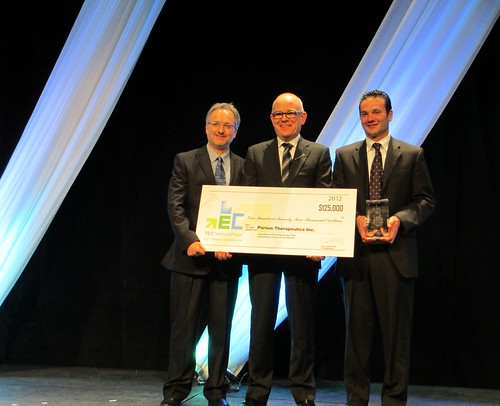
Dan Djukich from Alberta Innovates Technology Futures presented the inaugural nanoVenturePrize award, which went to Parvus Therapeutics.

TEC VenturePrize 2012

The two finalists in the fast growth category could not have been more different. I think Pedpad is on to something interesting, though as Sharon remarked to me when I told her about the company, you really have to try shoes on to see how they fit, because materials and other factors all play a role. Still, companies and products that mix the physical and online worlds are intriguing to me. As for ITC, I still can’t quite believe that their product doesn’t already exist. It looks and operates just like a hair clamp, and doesn’t look very complicated to my untrained eye (though I’m sure there’s more to it). But it obviously works and works well, so I hope it catches on!

TEC Edmonton CEO Chris Lumb had the honor of presenting the award to the winner of the fast growth category: Innovative Trauma Care.

Congratulations to all of the participants, finalists, and winners! Thanks also to TEC Edmonton for saving me a spot at the media table – much appreciated! You can see more photos from the evening here.

Building a Results Dashboard for the 2012 Alberta Election

Like many Albertans, I have spent a significant amount of time over the last month paying attention to the election! Reading about the candidates, following all the drama, and spending lots of time with the #abvote hashtag on Twitter. As the candidates were making one final push over the weekend before the election, I decided to build a results dashboard. I like a good challenge and enjoyed building it, but it was especially rewarding to see that it proved to be quite popular too! In this post I’ll tell you a little about how and why I built the website, and what I learned from it.

abvote results

If you haven’t checked out the dashboard, you can see it here. I’ve added a bunch of stuff since election night, which I’ll explain below.

The Idea

By late Friday afternoon, my thoughts had drifted to election day itself. I started to think about how exciting it would be to see the results come in – I love election nights! I knew there would be television coverage and that the media would have some web coverage as well, but I also felt that I could build something unique and valuable. If only I had the data! So I looked around, and found the Elections Alberta results site. At that time, the results page was full of test data. I immediately saved a copy to my computer, and saved a few of the electoral division pages too. That proved to be a wise decision, because a few hours later the site went offline!

elections alberta

Before I took a crack at scraping the website, I wanted to know if there was a data feed of some kind available. I blindly emailed the general Elections Alberta address, and to my surprise, received a response shortly thereafter! Unfortunately there was no data feed available, so I set about writing a scraper. Within a couple of hours, I was correctly scraping the main results page as well as all of the electoral division pages. Now that I had the data, I felt pretty confident that I could build a dashboard over the weekend. I didn’t get back to the project until Sunday morning, so that meant I had to prioritize what I was going to build. It took about six hours, but my I finished my initial version late that evening.

The Design

This was not my first election results dashboard. If you’ve been reading my blog for a while, you’ll recall that I built a dashboard for the municipal election here in Edmonton back in 2010. I learned a lot from that experience, and I remember it being a lot more rushed and difficult than this dashboard! Among other lessons, it was clear that design and colors matter, and that mobile devices are important (even then lots of people were asking for mobile support). I also knew that forcing users to refresh the page is less than ideal – it’s not a very delightful experience, and it puts unnecessary strain on the server. I also disliked the limited real estate that I had to work with (the current ShareEdmonton page width is fixed…but I’m working on a new version that is fluid).

So, I wanted a mobile-friendly, fluid-width, Ajax-enabled, attractive looking design. I immediately decided to use Twitter Bootstrap. I have used it a few times now, and I absolutely love it. I can’t thank the folks at Twitter enough for making such an excellent framework available for free! It gave me everything I needed to get going from a UI perspective. In particular it features responsive design, which makes it possible for the pages to scale from the desktop down to mobile devices without much work. For the backend, I used ASP.NET MVC 3. I use it for everything, so I know it well.

For performance reasons, it definitely made sense to cache the data. I decided on a fairly straightforward approach: I’d scrape the data from Elections Alberta and would store it using Memcached for two minutes. That meant that every two minutes, a request would take slightly longer because it had to download the data again, but this seemed reasonable (and as it turned out, the Elections Alberta site was incredibly quick). I also designed the pages to poll for new data every 30 seconds, which prevented users from having to reload the page manually.

The Cloud

When I built the ShareEdmonton dashboard a couple years ago, it was hosted on one of my servers. That worked fine, but it did slow down under load and I didn’t have much ability to scale up or out without a lot of additional cost, time, and effort. I really wanted to avoid that situation this time, so I decided to host the dashboard using Windows Azure. I’m in the process of migrating ShareEdmonton to Azure, so I already had an account and was pretty familiar with how it worked. Deploying to Azure is so easy – I simply had to add a deployment project in Visual Studio, and then I could deploy new versions in just a couple of clicks.

Windows Azure supports a range of instance types – basically you get to choose how big and powerful you want your server to be. I started with “Extra Small”, the least powerful and therefore least expensive type. As the polls were about to close at 8pm, I scaled up to “Small”, which meant redeploying the app (which took about 8 minutes, but happened completely behind-the-scenes). About half an hour later, I had to add capacity because the site was starting to get quite sluggish. This time I scaled out, by adding a second instance. All I had to do was change a configuration setting in the Azure management console, and the service took care of everything. Within a few minutes, I had two load-balanced “Small” instances. The performance boost was immediately noticeable. About an hour later, I added a third instance, and kept the system running that way until about 1am. I scaled it back down in stages, and now have it running as a single “Extra Small” instance again.

Two Key Decisions

I think the two most important decisions I made were:

  1. Using Twitter Bootstrap
  2. Using Windows Azure

The decision first meant that the website looked good and worked across browsers, screen resolutions, and devices. I got all of that engineering effort and testing for free, which meant I could focus on building an election results dashboard rather than building a website. I didn’t have to figure out how to lay things out on the screen, or how to style tables. The second decision was perhaps even more important. By using Windows Azure, I could deploy new versions of the dashboard in minutes, plus I could scale up and out simply by changing a few settings. That meant I could quickly respond when the site came under load. The other big advantage of using Azure was the cost – running the site on election night cost me just $1.54. Incredible!

Some Statistics

The dashboard served around 60,000 page views on election night alone, which is pretty good for a website launched just hours before the main event. Keep in mind that because the data on the site automatically updated, users didn’t have to refresh the page which kept that statistic lower than it would otherwise have been. The visit duration metric is another way to see that – 20% of all visitors spent at least 10 minutes on the site. I actually would have guessed a higher percentage than that, but perhaps the high mobile usage was the reason.

The top screen resolution for visitors was 320×480, not a desktop resolution! Roughly 36% of all visits that night were made on mobile devices (which includes tablets). The iPhone was the most popular device, followed by the iPad. Clearly using a framework like Twitter Bootstrap with responsive design was a good decision.

The other statistic worth sharing is that the vast majority of visitors (about 73%) found the site by way of social networks, and two in particular. Facebook accounted for 78% of all those visits, while Twitter accounted for 20%.

Recent Improvements

Since Monday I have made numerous improvements to the dashboard. Here’s a brief overview of the new features:

  • All the data is now stored locally, which means I’m no longer reliant on Elections Alberta. They have made numerous updates over the last two days, and I have updated the site’s local data store accordingly.
  • I updated the voter turnout chart and added regional voter turnout to the front page. I also added a table of the five closest races.
  • District pages now show voter turnout and the list of polls is now sortable.
  • There’s a new Districts Grid, which lets you see lots of information about all the districts in a single, sortable view. For example, you can quickly see which district had the best voter turnout, which were the closest races, and which had the most candidates.
  • There’s also a Candidates page, which lets you see information about all of the candidates in a single, sortable view.
  • Last night I also added a Maps page, which has interactive maps for the province, as well as zoomed-in maps for Calgary and Edmonton. Click on any region for details and a link to the district page.

What’s Next?

I plan to keep the dashboard up as it is now, though at some point I’ll probably transition it from being a dynamic website to a static one (far cheaper to host over the long-run). If you have any suggestions on things to add or improve, let me know! I hope the site will serve as a valuable reference tool going forward.

Thanks for reading, and thanks to everyone who sent positive comments about the dashboard my way. It’s great to hear that so many people found it useful on election night!