State of the Edmonton Twittersphere – June 2010

Welcome to the sixth State of the Edmonton Twittersphere of 2010, my look at the intersection of Twitter and Edmonton, AB. You can see last month’s stats here.

For information on the data, definitions, and other background, click here.

For June 2010:

# of local users: 8178 (an increase of 127 from May)
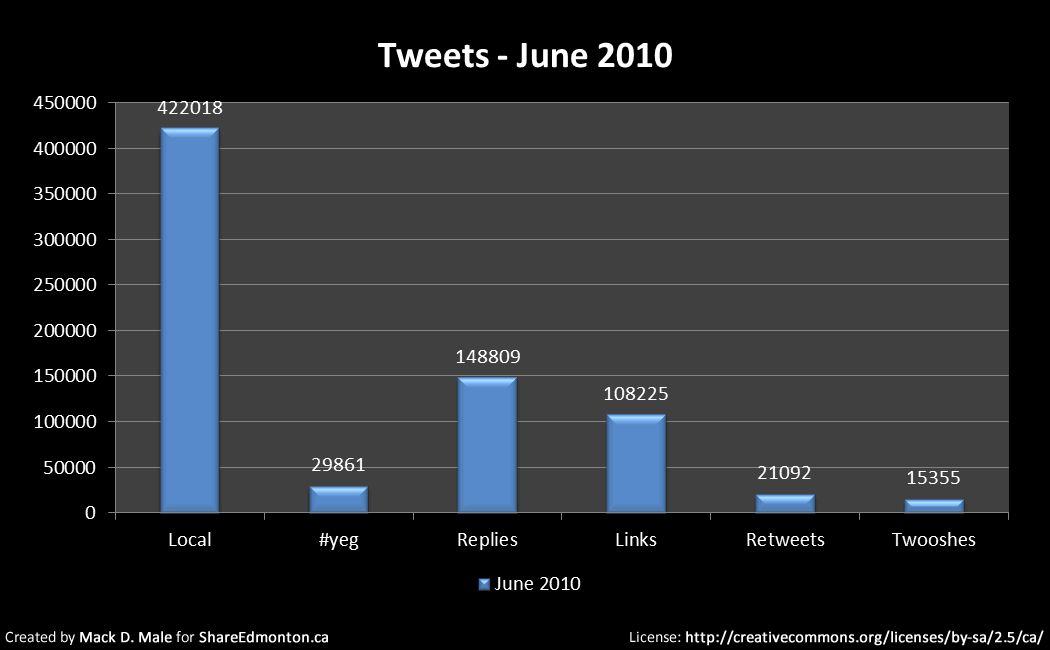
# of tweets by local users: 422018
# of tweets by local users containing #yeg: 29861 (7.1%)
# of tweets by local users that were replies: 148809 (35.2%)
# of tweets by local users containing links: 108225 (25.6%)
# of tweets by local users that were retweets: 21092 (5.0%)
# of tweets by local users that were twooshes: 15355 (3.6%)

Here are the numbers above in graphic form:
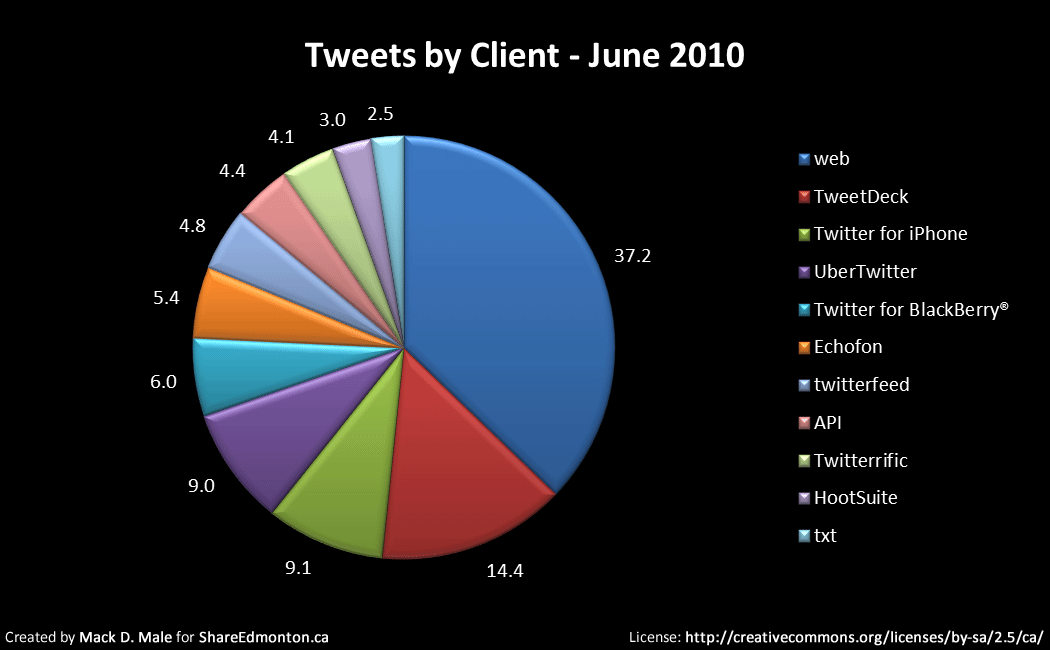
Here are the top clients used by local users for posting updates – UberTwitter has been overtaken!
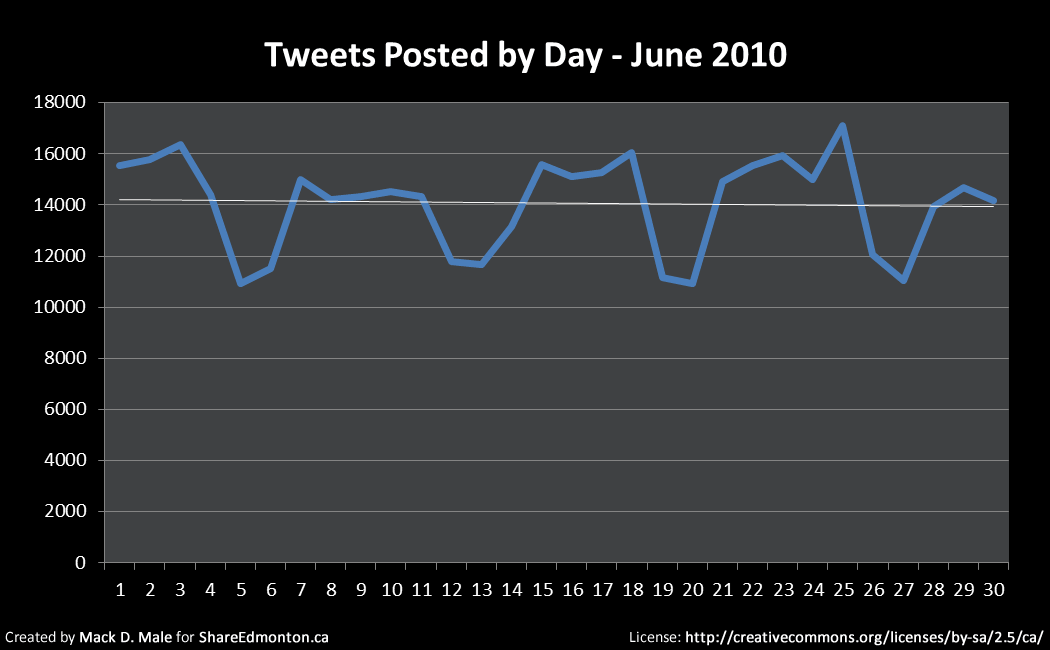
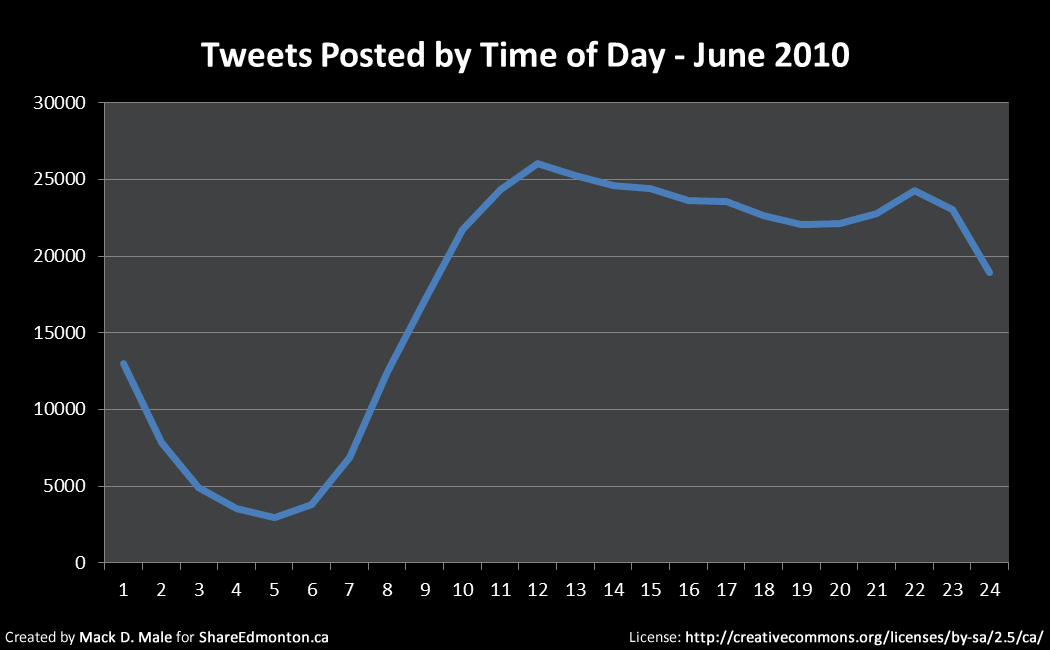
Some other interesting stats for the month:

  • Just over 51% of all local tweets were posted between 9 AM and 5 PM.
  • Local users posted roughly 9.8 tweets per minute in June (compared to 9.6 tweets per minute in May).
  • The day with the most local tweets posted was June 25 at 17106. On average, 14068 local tweets were posted each day (compared to 13894 in May).
  • Of the 148809 replies posted by local users this month, 56284 or 37.8% were to other local users.
  • A total of 1631 users posted 50 times or more in June. In comparison, 1229 users posted just once.
 

Here are the top ten most active local users (not including bots):

  1. rootnl2k
  2. DWsBITCH
  3. fraygulrock
  4. Lekordable
  5. SGT_ZamboniGuy
  6. gcouros
  7. frostedbetty
  8. Hori_canada
  9. trinamlee
  10. angelzilla

Here are the top ten most active local users using #yeg (not including bots):

  1. edmontonjournal
  2. iNews880
  3. ctvedmonton
  4. DebraWard
  5. livingsanctuary
  6. cbcedmonton
  7. capitalfm
  8. mastermaq
  9. joshclassen
  10. bingofuel

Here are the top ten most replied to local users:

  1. britl
  2. angelzilla
  3. ZoomJer
  4. frostedbetty
  5. mspixieriot
  6. SaySandra
  7. LauraSem
  8. bingofuel
  9. fraygulrock
  10. GuitarKat

Here are the top ten most retweeted local users (by other local users):

  1. edmontonjournal
  2. bentrem
  3. ctvedmonton
  4. mastermaq
  5. dantencer
  6. cbcedmonton
  7. CityofEdmonton
  8. bingofuel
  9. joshclassen
  10. iNews880

Final Thoughts

First off, my apologies to those of you who have been waiting for a stats update! I’ll be getting caught up over the next week or two.

There was a slight increase in the number of users in June, and a slight decrease in the number of tweets posted. I think that decrease is due to two things: one less day than in May, and the large amount of downtime that Twitter experienced in June (it was their worst month since August 2009). I’ll have more on this in a future post, but June 20 was the second anniversary of the #yeg hashtag!

Edmonton City Centre Airport Design Competition Finalists

Today Simon Farbrother, City Manager, and Phil Sande, City Centre Airport Executive Director, announced the five finalists in the City Centre Airport Lands Design Competition. These finalists will now work until the end of the year on their plans to redevelop the 216-hectare site into a sustainable, transit-oriented community.

City Centre Airport Design Competition Finalists

From the press release:

“We had an overwhelming response to our request for qualifications,” says Phil Sande, Executive Director, City Centre Airport redevelopment project, City of Edmonton. “We’ve received 33 submissions with a wealth of experience in innovative sustainable design, urban design and redevelopment, engineering and architectural design.”

The five winning firms are (in alphabetical order):

  1. BNIM, Kansas City, USA
  2. Foster & Partners, London, UK
  3. KCAP, Rotterdam, Netherlands
  4. Perkins + Will, Vancouver, Canada
  5. Sweco International AB, Stockholm, Sweden

The contents of their submissions is confidential, so all we got to see were the covers of the proposals. The City also suggested the following visuals: BNIM, Foster & Partners, KCAP, Perkins + Will, Sweco International AB.

Local firms involved in the proposals include Williams Engineering, Bunt & Associates, Cohos Evamy, and Calder Bateman.

City Centre Airport Design Competition Finalists

Their submissions were based upon the Master Plan Principles that City Council approved earlier this year. The review committee included: Simon Farbrother, City Manager; Gord Jackson, Acting Manager of the Policy and Planning Branch; Rick Daviss, Manager of Corporate Properties Branch; Peter Hackett, Exec. Professor School of Business, VP Research and a Fellow of the National Institute for Nanotechnology at the University of Alberta; Chris Henderson, CEO of Delphi Group, Canada’s leading strategic consulting firm in the environment and clean energy sectors; and Todd Latham, President of Actual Media Inc. which produces ReNew Canada, the infrastructure and renewal magazine. James McKellar, Associate Dean, External Relations Academic Director, Program in Real Estate and Infrastructure, Schulich School of Business, York University ensured the review process was transparent and fair.

Some additional notes from the press conference:

  • The first phase of the build out could be completed by 2024.
  • Preliminary results of the environmental evaluation show three small sites with limited contamination potential. The findings thus far were described as “very positive”. More information will be available in about 3 weeks.
  • Each firm will receive an honorarium of $50,000 to participate.
  • Phil said that consideration of Edmonton as a Winter City was important, and was something the finalists both embraced and have experience with.

Edmontonians will get to review all five submissions at the end of the year. The review committee will then be joined by Lars Franne, Retired Project Manager, Hammarby Sjöstad Sustainable Redevelopment, Stockholm, Sweden, and potentially others, and will make a recommendation to City Council, who ultimately has the final decision.

It’s great to see this project moving forward!

UPDATE: Here are the biographies of the five finalists (in PDF), provided by the City.

Edmonton’s Omni Technology Solutions brings CRM integration to the world

Last year, local software company Omni Technology Solutions celebrated its 10th birthday. They’ve had some incredible success during that time, and are well-positioned for future growth. With a focus on customer relationship management integration solutions, they’re probably not a company that you’ve heard of, unless you happen to be a customer. While almost all the leading CRMs are headquartered in Silicon Valley, it’s interesting to know that the number one CRM integration platform is developed here in Edmonton! That’s why I reached out to Trevor Poapst, Omni’s Director of Global Marketing, to learn more.

Their core offering, Riva, overcomes the limitations of Outlook CRM plug-ins that need to be installed, configured and managed on each user’s desktop, laptop and mobile device. Instead, Riva gets installed once on a server and transparently syncs CRM address book, calendar, sales and support data to all Microsoft Exchange and Novell GroupWise email clients. Riva is compatible with the very popular Salesforce, SugarCRM, Microsoft Dynamics CRM, Oracle CRM, SageCRM, Saleslogix and several other leading CRM systems. What’s unique about Riva is that the synchronization all happens server-side, so there are no Outlook plug-ins required.

The company’s second product is called eControl, and it satisfies the need for a simpler, web-based alternative to the native management tools for Microsoft Active Directory, Exchange, Novell GroupWise, eDirectory, SAP and other systems. Though eControl has been designed to be simple enough for non-technical users to use, it is still very powerful, and features full auditing, enhancing compliance with SOX and other regulations. Omni’s customers have used eControl to manage anywhere from 500 to 50,000 user accounts, and a typical deployment takes less than 3 hours.

You’ll notice that both solutions work with Novell’s products, which is really where Omni got started. They’re one of the top three GroupWise developers in the world, and have benefited greatly from participating in the Novell ecosystem. Being focused on Novell hasn’t been without challenges, however. The first was the size of the market. There are far fewer Novell customers than Microsoft customers. In the last year or two however, Omni has successfully expanded into the Microsoft marketplace, and is working hard to continue to grow in that area.

The second challenge is one that Omni continues to deal with. Though the company has always been based here in Edmonton, very few of its customers have been in Canada because GroupWise has traditionally had a stronger following elsewhere. Winning global sales hasn’t been easy. In addition to working with partners, Omni has started to open offices abroad. Offices in Chile and Munich opened late last year, and the company recently closed its first major eControl deal in Chile as a result.

Though reaching the global market is challenging as an Alberta-based company, Trevor wouldn’t have it any other way. The company has received lots of support from the provincial government, and has benefited from having access to a highly trained workforce and relatively low business costs. Trevor also mentioned that Alberta is a great place to raise a family, in part because you don’t have to commute several hours every day. In fact, Omni’s CEO and CTO both bike to work year-round, even in the snow!

Omni just launched version 3.5 of eControl (education customers can save 70% until August 31), as well as its new Riva website. The company is planning its second annual eControl conference in Santiago, Chile. Omni is poised for growth and is looking to expand its partner network, especially now that it can tap into the large Microsoft and CRM partner communities.

It was great talking to Trevor (who is actually working from Mexico this year), and learning more about a successful Edmonton-based software company making significant inroads into the global CRM and identity management markets. I think it’s a fantastic example of the success that companies based here can have, and I wish Omni all the best as they continue to grow. You can follow Omni on Facebook and on Twitter.

Would you trust a citizen plumber to work on your toilet?

That’s one of the questions, referring to citizen journalism, that Edmonton Journal columnist Dan Barnes asked last week in this all-over-the-place piece. Was it rhetorical? Maybe, but I’ll bite anyway.

I know you’re not supposed to answer a question with a question, but I wonder what Dan meant by citizen plumber? Did he mean someone whose experience with plumbing is limited to some fancy new tool, or did he mean someone who simply lacks the license but has all of the necessary interest, skills, experience, and knowledge of a plumber-minus-the-citizen? My point is that its easy to misuse the label “citizen journalist” and to paint with too broad a brush.

It’s also really difficult to define. I wonder how Dan defines it? Maybe he thinks I’m a citizen journalist because my platform is this blog. But what about “mainstream journalists” who have blogs – aren’t they also citizen journalists then? If we can’t define it with the tools or platform, maybe we can define it with the kinds of content the citizen journalist produces. But there again, what’s the distinction between someone who rewrites a press release for a newspaper and someone who does an interview for a blog post? Is the only distinction the employer?

Why do we need that label anyway? What would happen if we dropped the term “citizen” and just called them journalists? Both tell stories, after all.

Dan Barnes and I would be on the same level, that’s what would happen. And my guess is that Dan wouldn’t be able to deal with that.

It’s worth mentioning that Dan’s argument is not new or unique. Though at least one other “mainstream journalist” has used the term “citizen plumber” before, the straw man is most often made with a “citizen neurosurgeon” or a “citizen dentist”. As always, Techdirt does a nice job of dealing with that:

Most people seem to recognize the basic difference between reporting on something and cutting into someone’s brain. And, many people also recognize that most reporters themselves are often not experts in the field they’re reporting on — and what participatory journalism and the internet enable is the ability for actual experts on the topic to take part in the discussion and reporting as well.

I don’t think it’s that difficult to recognize the differences between a plumber and a journalist, either. There are only so many ways to fix a leaky pipe, but a myriad of ways to interpret and write about something, for instance.

The reality is that journalism is not a constant, it’s not static or unchanging. Like most things worth caring about, journalism is constantly evolving, and whether Dan likes it or not, journalists who don’t work for the mainstream media are here to stay.

I can understand why we’d be hesitant to call the first guy I described above a plumber, but it’s pretty clear that the second one is a plumber. If we call them both just plumbers, do we risk cheapening the term? If we call them both “citizen plumbers”, do we risk preventing the second guy from making an impact?

What if the new tool that plumber #1 uses turns out to be a plunger, or Drano, all of a sudden enabling millions of people to deal with simple plumbing problems on their own, and thereby freeing up the non-citizen plumbers to focus on more difficult problems? That’s the real risk, in my opinion, with putting too much weight behind a label. We risk overlooking the significant contributions that both can make to plumbing overall.

Still not convinced Dan? Maybe you’ll enjoy this story (from way back in 2006!):

Witness the power of the humble tools of citizens’ media. A citizen dentist used them to become a journalist. He used them to give the world a unique and human perspective on a story where too much is unreported. He gained an appreciative and supportive audience around the world. He helped give birth to a new medium. And journalism is all the better for it.

Give a citizen dentist a blog and he’ll change the world? Maybe not, but he might just impact journalism for the better.

Photo Tour of Apron 2 at the Edmonton International Airport

Last week I had the opportunity (with a few other local bloggers) to tour the General Aviation Services at the Edmonton International Airport (EIA). As with the ECCA tour, Traci Bednard, VP of Communications at Edmonton Airports, was our guide. We ran into some challenges getting a vehicle to take us to Apron 2, but we eventually made it. Here’s what we saw.

EIA General Aviation Tour

This is what most people think of when they think about EIA. The number of passengers has grown significantly since scheduled service was consolidated at EIA in 1996. EIA now handles roughly 6 million passengers each year, and is in the midst of major expansion, known as Expansion 2012.

EIA General Aviation Tour

Apron 2, on the north side of the airport near by runway 02/20, is where a significant amount of general aviation (GA) activity takes place. Approximately 380,000 landed seats are served through Apron 2 each year. Edmonton Airports has committed just under $20 million for GA facilities & support at EIA this year.

EIA General Aviation Tour

There are currently two Fixed Base Operators (FBO) at Apron 2 – Executive Flight Centre and Shell Aerocentre (Shell also operates at ECCA). FBOs provide a variety of services, such as aircraft maintenance, fueling, passenger services, cargo services, etc. They operate hangars, passenger lounges, executive lounges, and customer parking. Shuttle services are available to/from the main terminal, enabling passengers to connect with scheduled service.

EIA General Aviation Tour

We got to see one of the Executive Flight Centre’s facilities. The VIP lounge pictured above serves the Edmonton Oilers, Edmonton Eskimos, and many others. One of the most recent VIPs to use it was Kevin Costner. Oilers players are provided with valet service, so they can drive up and get on the plane (and when they return, their vehicles are ready to go). The Executive Flight Centre will honor almost any request, including catering, ground transportation, etc. The Executive Flight Centre also provides ample hangar space, and can even accommodate a Global Express.

EIA General Aviation Tour

A number of GA charter companies operate at Apron 2, including Alta Flights, Flight Tech Aviation, North Cariboo Air, and Sunwest Aviation. Other users include the military, and private operators such as Cathton Aviation.

EIA General Aviation Tour

EIA is the primary airport serving the north. At EIA, 70% of northern departures are scheduled service, 18% are non-scheduled, and 12% provide oil sands related crew changes. As many as 1200 CNRL Horizon workers per day pass through Apron 2. Other northern projects that rely on EIA include the Mackenzie Gas Project, Diavik Diamond Mines, and Athabasca Oil Sands.

EIA General Aviation Tour

EIA could easily accommodate the GA activity that currently takes place at ECCA. There are many large hangars sitting empty, such as the old Spar hangar, pictured above. It offers 120,000 square feet of hangar space, with an additional 35,000 square feet of office space attached. Thanks to recent investments that Edmonton Airports has made at Apron 2, there is also plenty of space available for customers who want something different to custom-build.

Thanks to Traci and Edmonton Airports for the tour. You can see the rest of my photos here.

Photo Tour of the Edmonton City Centre Airport

This week I had the opportunity (with a few other local bloggers) to tour the Edmonton City Centre Airport (ECCA). Traci Bednard, VP of Communications at Edmonton Airports, took the time to guide us around the facility, providing information relevant to the ongoing debate and answering as many of our questions as she could. Here’s what we saw.

Edmonton City Centre Airport

ECCA, built in 1929, encompasses approximately 144 acres of land just north of the City Centre. It has two runways (12/30 and 16/34) placed in an intersecting “V” configuration. The airport supports general aviation activities. Approximately 41% of all flights originate and terminate at ECCA without landing at another airport.

Edmonton City Centre Airport

Edmonton Airports has invested over $13 million in ECCA since scheduled service was consolidated at EIA in 1996. A further $35 million of capital investment will be required over the next 10 years. Though ECCA generates a small amount of operating income annually, it cannot fully cover its capital requirements.

Edmonton City Centre Airport

Edmonton’s Zoning Bylaw 12800 describes the Airport Protection Overlay (APO), which restricts the height of structures within the overlay area to 815.34 m above sea level. The maximum height of a building varies depending on the base elevation. At 146 m tall, Manulife Place is very close to the maximum, as is the soon-to-be-completed EPCOR Tower at a height of 149 m.

Edmonton City Centre Airport

Roughly 27% of all aircraft movements at ECCA are northern flights. In 2008, there were 133,000 landed seats from the north to ECCA, versus 778,000 from the north to EIA. The top 25 users at ECCA make up 75% of all aircraft movements, and of these users, 18 also commonly use EIA.

Edmonton City Centre Airport

Roughly 4000 air ambulance flights occur at ECCA each year (about 5% of total movements). Less than 10% of those (approximately 350) are time sensitive. Air ambulance, while important, is just one leg of a patient’s overall journey. Patients must be stabilized on the scene and taken to an airport via ground ambulance, loaded on a fixed wing air ambulance, flown to Edmonton, and then loaded onto another ground ambulance to be taken to a hospital.

Edmonton City Centre Airport

STARS Air Ambulance is one of the more well-known users of ECCA. Its helicopter fleet transports time sensitive/trauma patients directly to hospital, most often to the University of Alberta hospital. STARS, Alberta Health Services, Alberta Health & Wellness, and Edmonton Airports have discussed the concept of an integrated air ambulance facility at EIA, which could create efficiencies and ultimately improve patient care.

Edmonton City Centre Airport

With the phased closure of ECCA set to begin next week, Edmonton Airports has been working with tenants (such as the Government of Alberta) to help prepare for the closure of runway 16/34. That includes ensuring that all tenants have access to runway 12/30, and exploring options for moving to either EIA or Villeneuve.

Edmonton City Centre Airport

The City of Edmonton has launched an international competition seeking firms interested in redeveloping the ECCA lands. A total of 33 responses to the request for potential bidders were received. The City is working to short list the group to 5 by August 6. That group will have until the end of the year to develop their proposals.

Thanks to Traci and Edmonton Airports for the tour. You can see the rest of my photos here. You can read fellow blogger John Winslow’s post here. Stay tuned to #ecca on Twitter for updates on this ongoing issue. You get more information about ECCA from Edmonton Airports.

Free Wireless Internet Lands at the Edmonton International Airport

Since 2004, the Edmonton International Airport has offered wireless Internet access, for a fee. As at many other airports, it was operated by Boingo. Unless you were already a Boingo subscriber, it just wasn’t worth it to get connected for an hour or two, and many people griped (myself included) about the lack of free wi-fi at the airport, especially as other airports increasingly offered it. Starting today, passengers have one less thing to complain about: EIA now offers free wi-fi access throughout the entire airport!

I wanted to learn more about the service and how it came to be, so I sat down with Reagan Winchester, EIA’s Director of IT, to find out. He was quite excited about the free wi-fi, even though it was a challenging project to implement. We started with some background.

It turns out that there wasn’t any broadband Internet access at EIA until Reagan’s team brought in two very large connections from Shaw and Telus. Once those were in place, EIA built a mini DSL network, and started selling access to its tenants in order to recoup the costs (one of its customers was, of course, Boingo). That worked, but everyone still managed their own hardware and services. Over time, it became clear that the many separate networks that existed at EIA (security, flight information, etc) would be better served if they were integrated, running off the same infrastructure, without each tenant having to worry about hardware and maintenance. So EIA started building out a Campus Area Network. Importantly, wi-fi was a key component of the network. With that infrastructure in place, the primary technical hurdle to offering free Internet access went away.

Another hurdle was convincing management that EIA should be offering something for free that previously they had been charging for. Under the deal with Boingo (which expired in June 2009), EIA made only a little bit of money. Boingo installed the access points and managed everything, so they kept most of the revenue. Now with its own wireless access in place, EIA had a few options: offer its own paid wireless, offer ad supported wireless, or offer completely free wireless. One of the tools they used to make that decision was the Airport Service Quality survey results. If you look at ASQ scores, Canadian airports with free wi-fi (like Vancouver) are in the top ten in North America with an average score of 3.61/4, whereas airports with paid wi-fi are in the 20-30 range with an average score of 3.06/4. Of all the different categories that airports are scored on, EIA performed worst compared to others in wi-fi category. So that made it clear that by offering free wi-fi, EIA could improve its ASQ score quite a bit. Further investigation revealed that airports with ad supported wi-fi scored 3.59/4, so the ability to have a little bit of cost recovery and still improve ASQ scores meant that in the end, EIA decided to go with ad supported wi-fi.

The new wireless network itself is managed by EIA, with the gateway and public facing stuff being provided by Boldstreet (the same company that Starbucks and Second Cup use at their locations). Boingo has at least 36 Cisco Aironet access points at EIA, but they’re old and only support 802.11b, so they’re pretty slow (they’ll remain accessible until August 31, 2010). EIA is using Meru access points (with Foundry hardware on the wired side), which support 802.11 a/b/g/n, and there are 31 deployed throughout the airport currently. That’s just a fraction of the more than 300 that they plan to install! The idea is to have VOIP-level wireless, which means three overlapping access points, with five bars everywhere. I tried connecting in the tower (which doesn’t have any access points currently) and I got four bars, so I was quite impressed!

To connect to the free wi-fi, look for the EIA_FREE_WIFI network. On devices like laptops, you’ll get presented with a splash screen that you need to login to. You can either choose anonymous access for 15 minutes (after which you go back to the splash screen and can choose it again), login with Facebook, login with your carrier account (Bell, Telus, Rogers, etc), or you can get a password sent to you via SMS. The authentication helps ensure that the network is not abused. On devices like cell phones that support voice over wi-fi, the authentication step can be skipped. There is no content or port filtering once you’re connected.

I’m really happy that EIA now offers free wireless Internet access. It’s such a positive thing for Edmontonians who are waiting to fly out, and for visitors to our city whose first impression is the airport. To celebrate, EIA is encouraging people to become fans on Facebook. If you do it before August 13, you’ll be entered to win a $1000 travel voucher, a 32 GB iPod, or free parking.

Congrats to EIA on making free wi-fi a reality!

Windows 7 on the Toshiba Portege M200 Tablet PC

Two years ago I decided to upgrade my tablet PC to Windows Vista, a process that I detailed here. I don’t use my tablet very much, but I do like to get the pen out from time to time to do some scribbling. The improvements in Windows Vista made the tablet much more usable, and though it wasn’t without problems, I wouldn’t have gone back to Windows XP. Slowly but surely I’ve replaced or upgraded the rest of my computers to Windows 7, and I love it. It’s a great operating system that just works. I decided to see if Seven could breathe new life into my tablet too.

Windows 7 on Toshiba Portege M200

The first hurdle was the same as last time – the lack of a DVD drive in the tablet. Fortunately it was much easier to deal with this time! I took the installation DVD and put it on a USB key, something that appears to be quite common given all the tutorials available online. Here’s the TechNet guide and here’s a useful guide from Ars Technica.

The install proceeded normally, and as quickly as I had come to expect from Windows 7. All was going well until the first boot up after installation, when the machine froze. I restarted it, but the same thing happened. I decided to try to boot into safe mode, which didn’t work because the machine had not yet been setup. I searched around online and found many people talking about removing unnecessary hardware. The only extra thing I had was the D-Link Wireless card I had added (you can see it sticking out in the picture). I removed it, restarted, and everything worked fine! Success!

After all the Windows updates were finished, I installed a couple more things. First was the Toshiba Value Added Package for Windows 7 (click on Downloads), which is meant for the M400 but works fine on the M200. Second was the NVIDIA ForceWare driver. The 96.85 version worked reliably for me, enabling Aero without transparency. After that it was pretty much good to go!

I ran the Windows Experience test, which resulted in an overall drop from what I had under Vista:

Oddly enough, the gaming graphics score went up slightly! A score of 1.0 is a far cry from the 5.9 my desktop computer gets (and that’s just because of the hard drive score, everything else is 6.9 or higher), but considering how old the tablet is, I guess I can’t complain.

Under Windows Vista, everything worked as it did in Windows XP except for the external display. I haven’t tried that under Windows 7 yet, but a few other things no longer work, such as the buttons on the side of the screen, and more importantly, screen rotation. I’ve looked into a few threads where some people have successfully made it work, but I haven’t tried any of their solutions just yet. I’m not sure I want to mess with the video drivers too much now that I have something stable. I never take my tablet with me anymore anyway (I have a netbook for that), it’s strictly a home PC, so I’m not too worried about it.

There are some nice improvements to the tablet functionality in Windows 7, and combined with how much better the OS is than Vista in general, I’m happy with the upgrade! I’m not sure how much life the hardware has left though – I suspect Windows 7 will be the last OS it runs, but you never know.

Edmonton’s future leaders

Today in the Edmonton Sun, Marty Forbes asked where Edmonton’s future leaders are. I found the article via the edmontonian, and was happy to see that Jeff mentioned a few people in response. Here are the key excerpts from Marty’s article:

The one thing that vaults a city from good to great is its people, and over the past few months several great Edmontonians have served notice that they are retiring from their high-profile gigs here in town.

All are moving on soon and I wonder "who is going to fill their shoes?"

The part that scares me is that I’m not seeing a huge list of young dynamic people stepping in to fill many of the big jobs and needs in the community.

Now I’m sure the next generation of leaders are out there somewhere. I’d love to hear from you if you know such a dynamo so that we could start recognizing these folks in the media.

We need dreamers, builders, rule breakers, risk takers and leaders to take this city up yet another notch towards greatness. The mantle is officially being tossed.

I want to first point out that you don’t need to hold a “high-profile gig” to be a leader. Maybe that’s why Marty hasn’t heard of any upcoming leaders. The next generation generally doesn’t care for suits, invitation only events, old boys clubs, or any of the traditional places you’d find “leaders”. There are plenty of places to find them, however. Here’s a small list to get Marty and everyone else like him started:

I really don’t think the next generation of leaders is hard to find. There are lots of them, getting things done and working hard to make our city a better place in which to live. Here’s a list of the first 75 I could think of (in alphabetical order):

Alex Abboud, Trevor Anderson, Justin Archer, Jerry Aulenbach, Ken Bautista, Myron Belej, Tamison Bencz-Knight, Mark Bennett, Chris Bolivar, Nathan Box, Michael Brechtel, Will Buchkowsky, Brandy Burdeniuk, Marc Carnes, Stephani Carter, Ashley Casovan, Christine Causing, Reg Cheramy, Josh Classen, Dave Cournoyer, Xanthe Couture, Matthew Dance, Jas Darrah, Mark Donovan, Michael Donovan, Janaya Ellis, Cindy Fulton, Bretta Gerecke, Tad Hargrave, Elisse Heine, Chris Henderson, Scott Hennig, Alistair Henning, Christel Hyshka, Elaine Hyshka, Don Iveson, Todd Janes, Michael Janz, Sam Jenkins, Ryan Jespersen, Shafraaz Kaba, Alistair King, Duncan Kinney, Chris LaBossiere, Brittney LeBlanc, Cam Linke, Raffaella Loro, Shauna McConechy, Jess McMullin, Roberto Moreno, James Murgatroyd, Christian Nelson, Monique Nutter, Gregg Oldring, Jason Openo, Roland Pemberton, Darryl Plunkie, Jessie Radies, Adam Rozenhart, Zohreh Saher, Jeff Samsonow, Mari Sasano, Jordan Schroder, Amy Shostak, Gene Smith, Tamara Stecyk, Kevin Swan, Asia Szkudlarek, Daniel Tse, Zoe Todd, Brendan Van Alstine, Cary Williams, Marlon Wilson, Sharon Yeo, Mike Zouhri

They’re all passionate about different things, but together, they’re having a big impact on our city. And this is just a small list! I do my best to keep up on who’s doing what in Edmonton, but there are so many other communities that I have no connection with that are full of emerging leaders. There’s definitely no shortage of next generation leaders in Edmonton.

So Marty, I hope that gets you started. I look forward to you “recognizing these folks in the media”. And maybe next time you’ll match the effort they put in by doing more than simply asking your audience to do the work for you.

It’s impossible to make a list like this 100% complete – sorry if I missed you – so add your favorite up-and-coming leaders in the comments below (something that the Edmonton Sun article is sorely lacking). Thanks!

The Way We Green Workshops

The Way We Green WorkshopA few weeks ago I was invited to check out a workshop for stakeholders of The Way We Green, part of the public consultation process for the project. It took place on a Thursday evening in a conference room on the top floor of the Holiday Inn Express downtown (great view). I arrived roughly halfway through the session, and found two tables of about ten people deep in discussion.

The workshop I attended was the last of four in the second phase. In the four workshops of phase one, which took place during the first week of June, participants identified what sustainability means for Edmonton and what key environmental challenges we face. In the second phase, participants discussed the policy options for eight broad categories: energy, water supply, food, ambient air, biodiversity, water quality, extreme weather, and waste management.

The table I sat with was just finishing up a discussion on energy when I arrived. Each participant had a sheet of paper with three or four sections to drive the conversation. There was also a moderator and a designated note-taker. Very shortly after I sat down, the group started talking about food. Everyone around the table had the opportunity to talk about why they thought protecting Edmonton’s local food system is important. They also completed the exercises on the sheet, which asked for a proposed goal, for their thoughts on what the City of Edmonton has done thus far, for a recommendation that the City of Edmonton should do more, less, or retain the status quo, and to identify any barriers to achieving the goal. Everyone in the group agreed that we need to do more to protect and strengthen Edmonton’s local food system (which I agree with), and highlighted public awareness as a major barrier (which I disagree with).

The Way We Green Workshop

I’m really interested in how the City’s public consultations work (and how they might be changing), so it was a great opportunity to see one aspect first hand. Even with all of the technology available to us, there remains a place for face-to-face discussions. I felt there could have been more discussion between participants at the workshop I attended, however, instead of just answering the questions provided. Another thing I noticed was that while there was diversity in the ages of the participants, there wasn’t much ethnic diversity. It’s important that immigrants and newcomers have a say in the strategic direction we take as a city (something that City staff acknowledged is a challenge when I mentioned it after the workshop).

More workshops are being scheduled for September, including some that will be open to the public. Forums and other information sessions are also scheduled to take place, after which the draft plan will be written and presented to City Council (sometime before February 2011). You can learn more about the project timeline here. You might also want to read the EcoVision Annual Report, which was published last month.

You can read my recap of last month’s expert panel here. Don’t forget you have until August 20th to complete the online survey. Stay tuned to TheWayWeGreen.ca for updates!