Homeless Connect Edmonton 3

Edmonton’s third Homeless Connect was held yesterday at the Shaw Conference Centre (I wrote about HCE2 here). Over 1100 people attended to receive free services from more than 60 local agencies. Guests could make long distance phone calls, get haircuts, see a dentist, find a winter jacket, and much more all for free. New this time around was supervised child care, increased Aboriginal services, and free photographs! Everyone was served a hot lunch and received a gender-appropriate “goodie bag” too.

“It was a great day. The amount of people and services that come together to support our neighbors is exceptional,” says Joanne Currie, Homeless Connect co-chair and Community Investment Specialist with the United Way. “It’s vital that people dealing with homelessness access these services, and it’s wonderful that they can find these easily, on one day and under one roof.”

There were more than 300 volunteers on hand for the day. Some of us were there all day, while others took either the morning or afternoon shift. Everything seemed much better organized this time around, and there was far less confusion among volunteers about where to be and what to do. It’s great to see that the organizers have acted on feedback from previous events to improve things.

Homeless Connect 3

I’m continually amazed at how many volunteers come out for the event. I’m also pleasantly surprised that so many of them are young! I have no idea what the average age of a Homeward Trust volunteer is, but I suspect its lower than the average for most service organizations. It’s great to see young people taking an active role in helping the less fortunate and improving our community.

I worked at registration this time, which I really enjoyed. The line was quite long throughout the morning but definitely slowed down around 1:30pm. As guests arrived, I introduced myself and shook their hand. I then asked them if they wanted to fill out a quick one-page survey (no one that came to my table declined). Usually I’d just ask the questions and fill it out for them. They survey was pretty straightforward but could definitely be streamlined. After the survey guests received a wristband and goodie bag and were on their way!

Once again I was reminded that the primary role of a volunteer at Homeless Connect is to be friendly and to listen, to ensure that all guests have a positive experience. A smile and a few minutes to chat really can make a big difference!

Homeless Connect 3Homeless Connect 3

I saw some familiar faces at the event (such as Mayor Mandel helping to serve lunch), and met some new people too, such as Lynn (DandelionV on Twitter).

“I’m very impressed with this event. It’s wonderfully organized,” says first time volunteer Lynn Turnbull. “It’s so wonderful seeing each guest being treated with respect and dignity. I thoroughly enjoyed my day.”

Alex also volunteered and wrote about his experience here. You can also check out articles in The Journal and The Sun.

Another great event in the books! I’ll definitely be helping out at the next one. Stay tuned to Homeless Connect Edmonton on Twitter for updates. You can see the rest of my photos here.

Pecha Kucha Night: Edmonton #5

Edmonton’s fifth Pecha Kucha Night took place tonight at the Myer Horowitz Theatre at the University of Alberta (you can read about PKNs here). The theme this evening was “Old School” – presenters were meant to take a look back and then push forward in the areas of design, science, art, and sustainability. They had a large audience to present to! The entire lower section of the theatre was full, and there were quite a few people seated above as well. Great turnout for the event, though I don’t believe it sold out.

Tonight’s presenters were (in order of appearance):

  1. Yuri Wuensch, Senior Advisor, Corporate Communications, and Michael Malone, Corporate Communications Coordinator, Edmonton Airports
  2. Dawn Doell, Green Communities Guide Project Coordinator
  3. Jeffrey Klassen, Designer
  4. Michael Janz, Edmonton Federation of Community Leagues (EFCL)
  5. Christian Nelson, P.Eng, Co-chair, dEdmonton, Canada’s Halloween Festival
  6. Isha Datar, Researcher
  7. David Cournoyer and Diane Begin, ChangeCamp Edmonton
  8. Shafraaz Kaba, Architect and Josh Kjenner, Engineer, Manasc Isaac
  9. Nadine Riopel, Campaign Manager, United Way of the Alberta Capital Region
  10. Aaron Pedersen, Photographer, 3tenphoto
  11. Tad Hargrave, Co-Founder of e-sage.ca and Marketing Consultant for Hippies

Pecha Kucha Night 5 EdmontonPecha Kucha Night 5 Edmonton

Yuri and Michael did a fine job of getting things underway, leading us through some of the Edmonton International Airport’s history. That was the old school part – the new school part was Expansion 2012, EIA’s ambitious expansion program. Dawn highlighted some examples of the Green Communities Guide in action. My favorite old school-new school reference from her presentation was wildlife crossings on highways: old school is to put up a sign, new school is to build a green wildlife overpass. Next up was Jeffrey, who focused on virtual environments for learning. What I found interesting was the notion of virtual worlds as “old school”, as they are stepping stones to other technologies such as augmented reality. Michael gave a great overview of EFCL, touching on some of its storied history (the old school part) and identifying the challenges ahead in reaching a younger demographic (the new school part). Fun fact: the first community league hall in Edmonton was built in King Edward Park in 1923. Last up before the break was Christian, who pretty much stole the show with his talk about modeling Edmonton in 3D inside Google Earth. He has created models for around 200 local buildings, including some that no longer exist (old school) and some that are yet to be built (new school).

Pecha Kucha Night 5 Edmonton

First up after the break was Isha who talked about in vitro meat production. Raise cows for meat? That’s so old school. Isha explored growing meat in the lab, and she had the science to back it up. The audience gasped more than once! Next was Dave and Diane talking about ChangeCamp. They highlighted some of the old school ways that citizens have gotten involved in government, and brought us up to present day where new school tools like the Internet make events like ChangeCamp necessary. Shafraaz and Josh then talked about the old school land use policies the city has, notably related to parking, and highlighted the need for some new school thinking in order to achieve goals such as increasing density. Next was Nadine, who talked about how service agencies have improved over time, bringing us to new school things like Homeless Connect. Despite having his slides all out of order, Aaron did a fantastic job of exploring the iconic image. Old school images are iconic, new school ones not so much! And finally, Tad shared his thoughts on the trend back toward supporting local businesses.

I thought all the presenters did a pretty good job tonight. I wasn’t as interested in Dawn’s or Jeffrey’s, but others in the crowd seemed to be. My least favorite was probably Nadine’s though. Yes most of the talks are self-promotional in nature, but hers really seemed like a commercial for the United Way (and their campaign is on now). Worse than that, her presentation made it seem like the United Way is the only agency making a difference. She didn’t mention a single partner agency, even when citing Homeless Connect, though there are dozens of them who work hard to improve the lives of so many.

I think my favorite presentation was Christian’s. He’s a great speaker, and I’m a sucker for cool technology applied to Edmonton. It’s amazing that he’s created so many 3D models of local architecture. His work is a really great resource for all of us. I also really loved Isha’s presentation, because I think it embodied what Pecha Kucha is all about – an interesting, thought-provoking idea introduced in six minutes and forty seconds. She left me wanting to learn more and wanting to talk to others about it!

A couple of other highlights:

  • I really liked Tad’s “triple bottom line” – people, profit, planet.
  • Aaron had the best line of the evening: “Here is Ernest Hemingway. If you don’t know who that is, get a library card.”
  • I learned a new word: Xeriscaping.
  • Josh hit all the major points on parking minimums/maximums, but had to concede at the end of his presentation that City Council recently took a step in the right direction.

Pecha Kucha Night 5 EdmontonPecha Kucha Night 5 Edmonton

The door prizes tonight were pretty amazing – some expensive theatre tickets, lots of Transcend Coffee, and a $1400 bag (seriously). Councillors Iveson and Henderson helped with the prize draws, and Councillors Batty and Leibovici were also in attendance. Even David Swann was spotted in the crowd! Pecha Kucha was definitely the place to be tonight.

Kudos to Edmonton Next Gen on another great event! They’re already working on Pecha Kucha Night 6. If you want to be the first to find out about it, sign up for the Next Gen newsletter. You can see the rest of my photos from the evening here.

Timeraiser comes to Edmonton

Timeraiser is a unique event that supports both artists and non-profit organizations. You can think of it as a volunteer fair with a twist. Here’s the back story:

Timeraiser was conceptualized in 2002 in response to a group of friends wondering how it could be easier to find meaningful, relevant volunteer opportunities. Now, 7 years and 10 Timeraisers later, it is amazing that this grass-roots initiative has flourished into a well-known, annual event that operates in 6 cities across Canada.

It’s a great opportunity to learn more about local non-profit agencies and the volunteer opportunities they have available. What’s the twist? The event is also a silent art auction! To bid on art, you pledge volunteer hours instead of money. It’s an interesting way to get people involved in their local community. You can learn more about how Timeraiser works here.

Edmonton’s first Timeraiser is taking place on October 17th. Here are the details:

WHO: Everyone!
WHAT: 1st Edmonton Timeraiser
WHEN: Saturday, October 17, 2009 at 7:00 PM
WHERE: TransAlta Arts Barns, 10330 84 Avenue (map)
WHY: To raise 4000 community hours for local organizations!
Click here to register!

I got in touch with organizers Theresa Wetzel and Amanda Grainger to find out more. I wondered how Edmonton’s event came to be. Here’s what they said:

“The Edmonton Timeraiser came about from interest that was generated from the success we have had with the Calgary Timeraiser over the past four years. Our corporate partners, volunteers, and agencies were encouraging us to expand the program to Edmonton because they knew it would be a perfect fit for the city. So we started out by approaching the United Way Alberta Capital Region, Volunteer Edmonton, and Enbridge to see if we could rally their support to help bring the program to Edmonton. Instantly they were interested in getting on board and the Edmonton Timeraiser got off the ground without a hitch.”

The goal of the event is to provide people who aren’t already involved with volunteering a fun and easy place to start. Before individuals can bid on art, they first spend some time matching their skills to an agency’s needs. There are 22 agencies currently signed up to take part, and attendees are encouraged to shortlist the agencies they’d like to connect with ahead of time. Given that Edmonton has a fairly strong culture of volunteerism already, I asked Theresa how she saw that impacting the event. She said that Edmonton’s Timeraiser had the highest number of agencies that submitted applications and that “Edmontonians seem very engaged civic minded people who have a passion for art and volunteering”.

In addition to supporting local non-profits, Timeraiser supports local artists by purchasing artwork at fair market value. There will be 22 works of art up for auction. “We are happy to report we invested over $12,000 in the careers of Edmonton artists and in total since 2004 we have raised $300,000 in the careers of Canadian artists.” You can see some of the artwork here.

Organizers are hoping for about 200 participants pledging hours, with the goal of raising 4000 volunteer hours in total (the minimum pledge is 20 hours). Tickets for the event are on sale now for just $20.

Don’t miss this great event! Follow along and chat about it on Twitter using #timeraiser.

Edmonton City Centre Airport closure delayed

Back in July, City Council voted in favor of phased closure for the City Centre Airport. The first runway (16-34) was scheduled to be closed by April 30, 2010, but today Council voted to delay that until October 2010 so that the Rexall Edmonton Indy can be held next year (only Councillor Batty voted against the decision). You know, the race that cost taxpayers $5.3 million last year (figures for the 2009 race haven’t yet been released). I guess this means the design competition will also be delayed.

Just last week a report suggested that air traffic may be closed for four weeks to accommodate the Indy. The only other alternative that was presented was to spend the money on a new track, a decision that probably wouldn’t have gone over very well with anyone.

The current contract with the Indy Racing League expires after the 2010 race, but City Manager Al Maurer says that discussions about a longer term agreement are underway. If the 2009 figures don’t show a big improvement from 2008, it’ll be hard for City Council to justify a renewal.

I think City Council missed an important opportunity today to reinforce their decision to close the City Centre Airport. Additionally, they’re in danger of setting a bad precedent of delays. What happens the next time Tom Hendricks or someone else goes to Council to ask for more time?

I hope this is the first and last delay in the closure process. We’re watching you City Council.

UPDATE: The Journal reports that the delay would be until July 31, 2010 not October 2010.

UPDATE2: The text of the motion is as follows:

That the City of Edmonton cooperate with Edmonton Regional Airports Authority to ensure that any closure of Runway 16-34 would not take effect until after the 2010 Edmonton Indy and Alberta Aviation Museum’s Airfest 2010.

You can download the minutes in Word here.

Recap: artsScene Edmonton boardLink

Tonight was the first ever boardLink event in Edmonton, hosted by artsScene Edmonton with partners Emerging Business Leaders, InterVivos, and JCI Edmonton and held in the Shoctor Lobby at The Citadel. I wasn’t sure if I wanted to attend, but I’m glad I did. Here’s what it was all about:

boardLink is a national program that was created by Business for the Arts in 2002. Since its start, boardLink has connected hundreds of young professionals with volunteer opportunities in various arts and culture communities throughout Canada with boardLink Online and boardLink Live events.

You can think of it like speed dating for local arts organizations and potential volunteers. The organizations on hand tonight included: The Citadel Theatre, Edmonton Opera Association, Mile Zero Dance, Edmonton Jazz Festival Society, The Works International Visual Arts Society, The Art Gallery of Alberta, LitFest: Edmonton International Literary Festival, Fringe Theatre Adventures, Latitude 53, and Alberta Foundation for the Arts. There were roughly 50 potential volunteers in attendance.

artsScene Edmonton boardLinkartsScene Edmonton boardLink

At the beginning of the event, everyone was given five small post-it notes to paste on the agenda BarCamp-style, indicating which organization they wanted to check out in each rotation. The rotations themselves were 15 minutes each, so you had to be quick meeting an arts organization and introducing yourself. It wasn’t one-on-one, instead each arts organization had at least two volunteers and there were three or more potential volunteers in each group.

I did three rotations: Fringe Theatre Adventures, The Art Gallery of Alberta, and Latitude 53. The three could not have been more different! No one really knew what to do (so I guess it really was like speed dating in that way) but Sam and Thomas from FTA did a good job of giving an overview of the organization and the opportunities available. Unfortunately we didn’t have much time to chat. In stark contrast to them, Allan and Priscilla from the AGA relied on us to prompt them with questions. It was a little awkward, but they were definitely excited about their new building. Finally, Todd and Vieri were very casual, funny, and off-topic. I enjoyed chatting with all of them.

It became clear to me as the evening unfolded that there’s a big disconnect between young people such as myself, and the arts organizations that were in attendance. We don’t know how to communicate with one another.

It was even evident during the opening remarks – EBL, InterVivos, and JCI were all well-spoken and informal human-sounding, talking about the great things they wanted to accomplish together. Penny from The Citadel congratulated everyone for coming and showing an interest, and ended by announcing a two-for-one offer for attendees. It just seemed tacky and out of place.

artsScene Edmonton boardLinkartsScene Edmonton boardLink

I’d say the event was a successful one, but it’s the follow-up that will truly determine the outcome. Everyone filled out a “volunteer profile” that will be circulated to the arts organizations so they will contact individuals who might be a good fit. More importantly, I hope artsScene puts on additional boardLink events in the future so that we can work on that communication disconnect!

Be sure to check out the artsScene Edmonton blog and Twitter for updates. You can see the rest of my photos from tonight here.

How open data could help the City of Edmonton save at least $197,500 on 311-related expenses

While researching 311 for my previous post, I consulted the 2009-11 Capital Budget (PDF). The Capital Budget pays for both maintaining existing infrastructure and undertaking new projects (in contrast, the Operating Budget is a one-year budget for services and programs – you can find both here). In it, I discovered a Corporate Services (read: IT) project called “e-Business”, described as follows (on page 382 if you want to look it up):

The purpose of this funding is to put 311 statistics on our websites. First for internal staff then to public. The objective is to present 311 statistics in a manner similar to the what New York City does. Their 311 activity is presented by neighborhood or ward, in text form in a table as well as on a map. This project is being presented as a phase in of sophistication. This enhancement can be implemented based on what can be funded.

I went to check out New York’s site for 311 statistics, and it is indeed quite useful. If you type in an address and select a borough, you get a wide assortment of statistics, presented in tabular form or on a map. The bad news is that most of the tables and maps are in PDF form. The good news is that you can export all the data to CSV, which means you can map it yourself! Very cool.

The project description continues:

The e-Business program is driven by three primary factors. Our citizens are demonstrating increased use of the Internet and the City’s Web site, our population is growing, resulting in a projected need for increased services, and citizens and other stakeholders are demanding new and more extensive self-service access to government.

If you’re not thinking of open data and ChangeCamp by now, you should be! Here are some justifications for the project as outlined in the Capital Budget:

  • Program Managers would use this as an additional tool for monitoring service activity.
  • Residents and potential residents could find out what the issues are in specific neighbourhoods.
  • The Mayor and City Council could quickly determine what the major issues are, without having to make a request.
  • The project will help make the City more transparent to its public.

Sounds great to me!

So what’s the problem? Cost.

The justification section of the project description says: “At the City of Edmonton, e-Business is about business first – providing the services our citizens need and want at a justifiable cost.”

I wouldn’t call these costs justified, I’d call them outrageous:

Phase 1 Table display of 311 Statistics reports $27,000
Phase 2 Option to display of reported statistics by business area $27,000
Phase 3 Option to display of reported statistics by neighborhood $37,000
Phase 4 Option to display reported statistics on a map $133,500
Phase 5 Include statistics that are stored in other applications $974,000
  TOTAL: $1,198,500

This is why we need a policy on open data, so that projects like this one don’t get funded, wasting taxpayer dollars.

The first item consists of automating the conversion of reports generated by the 311 system to web content, presumably HTML. I think $27,000 sounds justified for that task. It’s potentially quite difficult and error-prone, depending on what the reports look like, what format they are in, etc. The rest of the items are ridiculously overpriced, however.

What the City should do instead

Spend the $27,000 to automate the conversion of the reports to CSV format. Then make those CSV files available for free to the public. I promise you the City would get the next three phases for free. If I had the data I’d gladly do it, and I’m sure there are others who would too. On top of that, the community is more likely to use standard/open tools and technologies (such as Google Maps) rather than proprietary, awkward ones (such as the City’s SVG maps). We’d probably get it done faster too. The City can then put money to more useful things, such as an open 311 API similar to what Washington, D.C. has.

I think Phase 5, which would include data from POSSE, CLASS, and other internal systems, is too big and broad currently (hence the very large cost). It could be approached in the same way though – spend a little bit of money to make the data available in an open format, and give it to the community to do the rest.

I should point out that the above total ($1,198,500) has no approved funding. Rather, it is the amount the project would cost if City Council approved the entire thing. They could choose to approve only one phase, a couple phases, or none. The reason I put $197,500 in the title is that only the first four phases seem reasonable to me given the information available, and I think the first one is a justified cost as-is.

If the City of Edmonton could save nearly $200,000 on this one project alone by embracing open data (not to mention the indirect benefits that will come along with that cost-savings), imagine what the benefits of embracing open data across the board would be!

Edmonton’s 311: six month status report

As you’ve probably heard by now, the City’s 311 service is not performing as well as expected. The Sun first reported the story last week, and the Journal followed up with an article yesterday. They key point mentioned in both is that wait times to connect to an operator are far longer than originally anticipated. As a result, an interactive voice response system is being considered for next year. I can’t imagine that will make callers any happier, even if it does make their calls slightly faster.

I personally think they should put more resources into 311 online. How many citizens even realize that they get online access to a lot of the information and services that 311 provides? The best way to reduce call times is to increase self-service options and quality so that citizens can bypass the phone altogether.

Fortunately, there are new self-service features being developed for release in October. The City will still need to communicate their existence effectively, however.

Background

The CRTC approved the use of the 311 phone number for municipal services back in November 2004, and Calgary became the first city to launch 311 on May 8, 2005. Here in Edmonton, City Council approved the service at its May 9, 2006 meeting. Edmonton became the first city in North America to use SAP’s CRM application to deliver 311.

The 311 service officially launched on December 16, 2008. Implementation was approved at a cost not to exceed $10 million (and it is on track to come in about $1.5 million under budget). Half of that amount came from an internal loan, which is to be repaid from operating savings (the other half came from a special dividend in 2005).

Six Months In

The report that went to the Executive Committee this week isn’t incredibly long at 7 pages, but it does have lots of information. Here are some graphics to help make it easier to understand the first six months of 311 operation in Edmonton.

Call lengths are one of the reasons everyone is complaining:

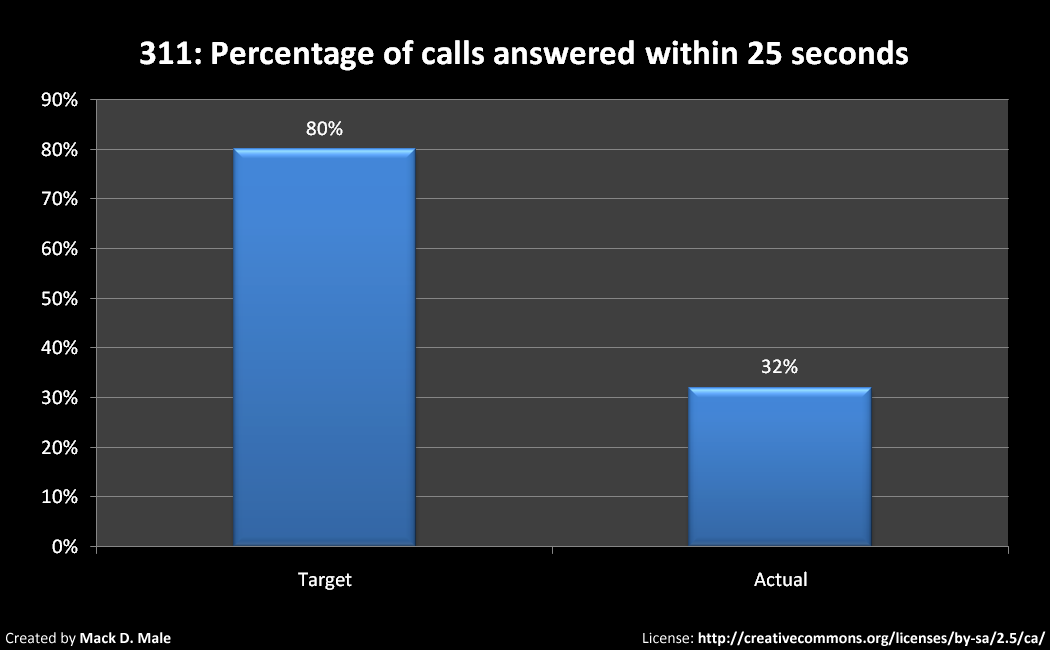
Wait times to get through to an operator are another concern:

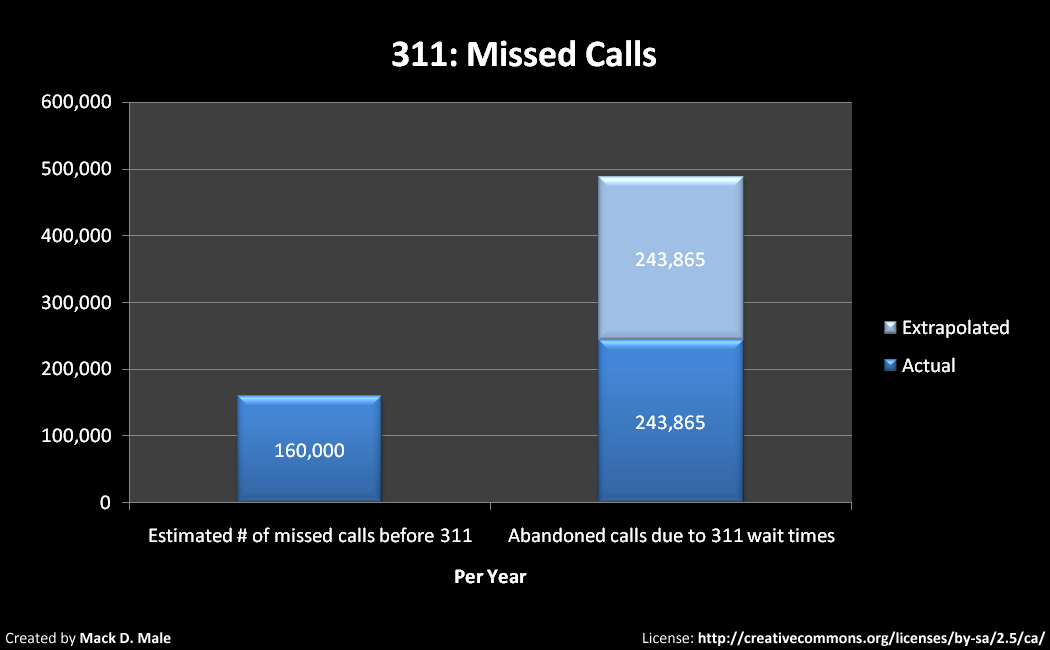
The 311 system was supposed to help the City capture the estimated 160,000 missed calls each year, but so far it is on track to make things much worse:

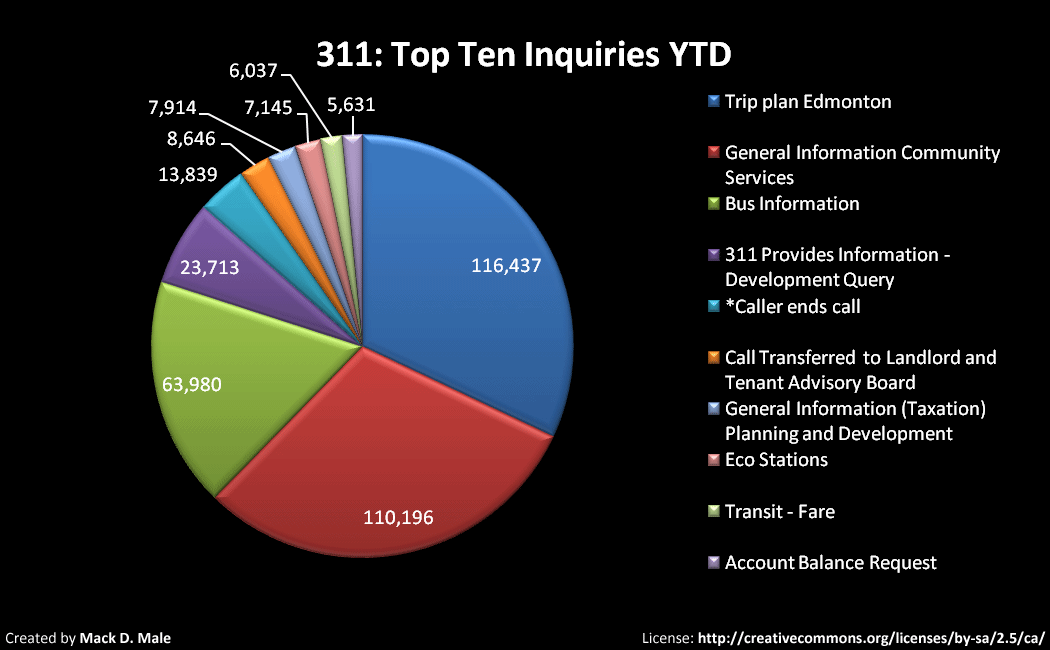
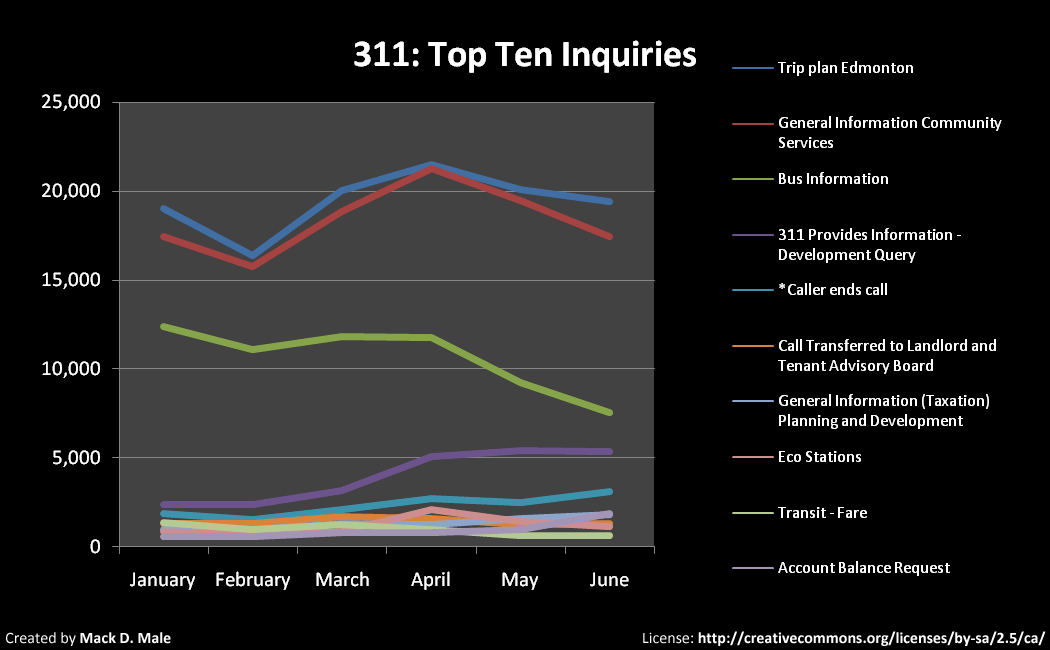
The report contains information about the top ten services:

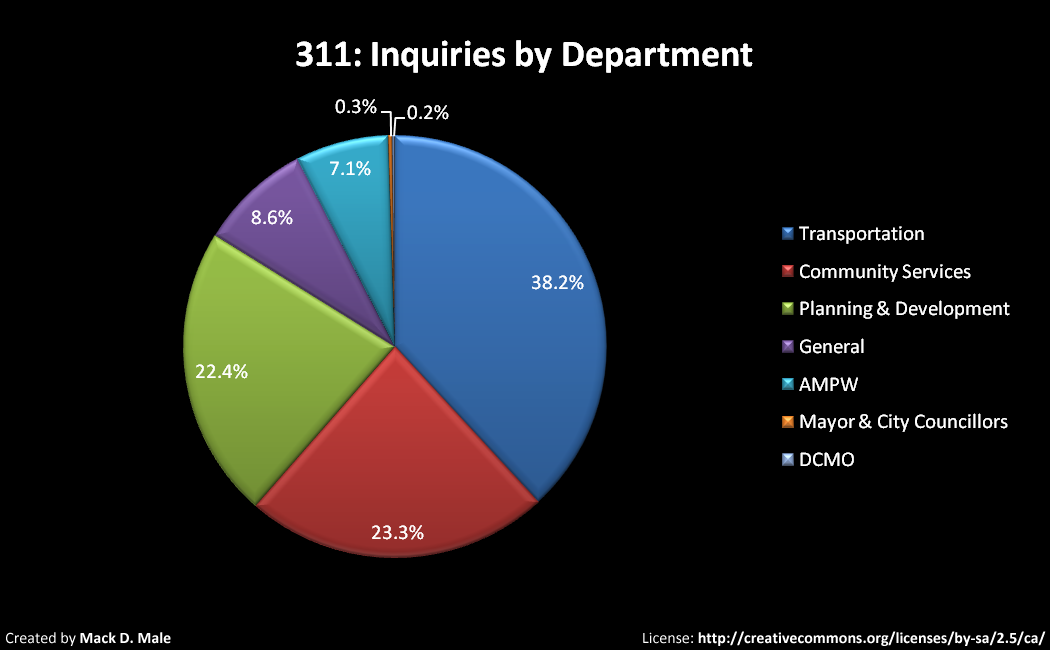
Transit inquiries make up a significant portion of all 311 calls, followed by Community Services inquiries. There’s a clear opportunity for transit to do more to reduce the number of calls going through 311. I find it odd that trip planning is such a common request actually, given that there’s a separate number for that (BusLink) not to mention the online trip planner and Google Maps.

Here’s the breakdown by department:

There are a few more graphs (without data values unfortunately) in the report, so take a look at those too. They show that the number of calls answered within 25 seconds is on the rise, and that the time it takes to get through to someone is declining.

Does this report suggest that 311 is “a disaster”? I don’t think so. All it shows is that there is work to do, and it sounds like the 311 team is on the case. Hopefully the departments they serve are as well.

How far beyond the city does Edmonton Stories reach?

The winners of the Edmonton Stories contest were announced by Mayor Stephen Mandel on Tuesday at City Hall during the lunch hour. About 50 people attended the public event, not including the large number of City employees who were present. Nearly all of the City Councillors were on hand as well, a strong show of support for the project. Congratulations to all of the contest winners and runners up!

Edmonton Stories Contest Announcement

Mayor Mandel’s speech started by highlighting some of the traffic statistics for EdmontonStories.ca. Here are some of the key numbers:

  • 242 stories have been posted, 44 of which include videos
  • 453 comments have been posted on 78 stories
  • Users in 2159 cities from 131 countries have visited the site
  • Total Visits: 113,979
  • Total Unique Visits: 87,049
  • Local Visits: 60,497
  • Total Page Views: 348,750

Those are pretty good numbers, though they are unverified. I think the “local visits” stat is interesting – over half of all visitors to the site have come from Edmonton. That makes sense at this stage, as Edmontonians are visiting to submit and vote on stories. Over time though, I would hope for that percentage to drop.

I’d love to see more stats on the non-local visits. For instance, I’d like to know the bounce rate for non-local visits. How many non-local visitors come to the website and then promptly leave? Referral statistics would be interesting to know as well – how did they get to the website?

As Edmonton Stories moves into its second phase, recruitment and visitor attraction, non-local visits will become increasingly important. There are a solid number of stories up on the site now, but if they aren’t shared with the rest of the world, how successful can the campaign be?

The City has repeatedly stressed that Edmonton Stories is unique because it focuses on social media and online marketing as opposed to traditional marketing. Most of the social media marketing I have seen thus far has been directed at Edmontonians though, not the rest of the world. I don’t think they’re doing enough to spread the word beyond Edmonton.

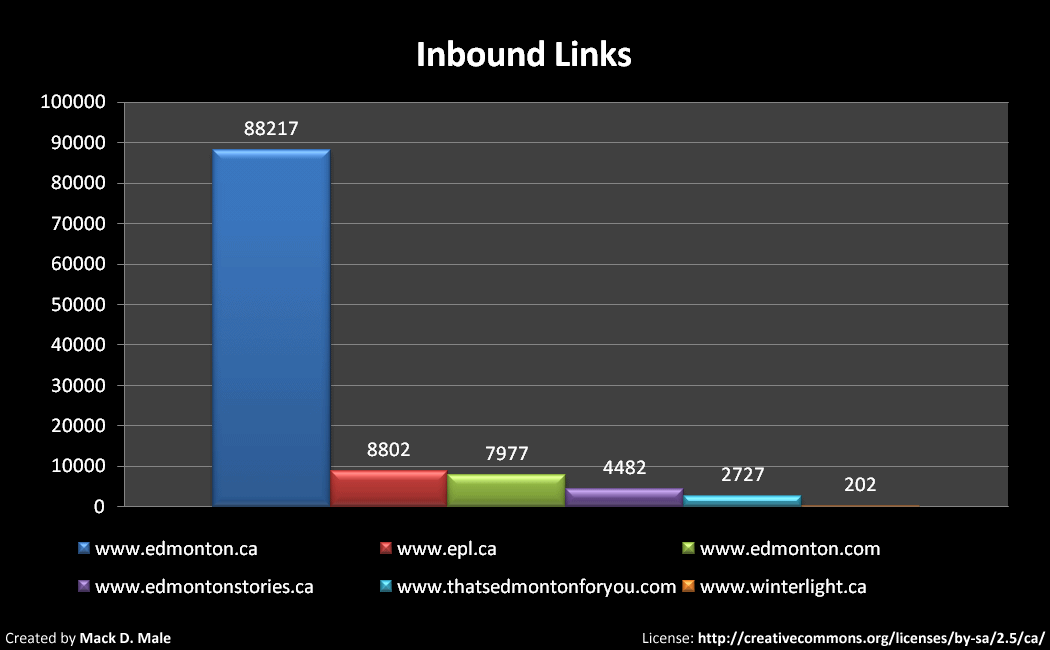
For a website marketed almost entirely online, I’d expect it to have a decent number of other web pages linking to it. I tallied the number of inbound links for some Edmonton websites, using Yahoo! Site Explorer:

Obviously the City of Edmonton site has the most inbound links, no surprise there. What jumped out at me about this graph is the number of inbound links for That’s Edmonton For You. Despite launching a month later than EdmontonStories.ca, and without a large budget to promote it, that site managed to accumulate over half the number of inbound links that EdmontonStories.ca has. I would anticipate that a majority of the inbound links for That’s Edmonton For You would be from other local sites, which doesn’t bode well for how far beyond the city EdmontonStories.ca is reaching.

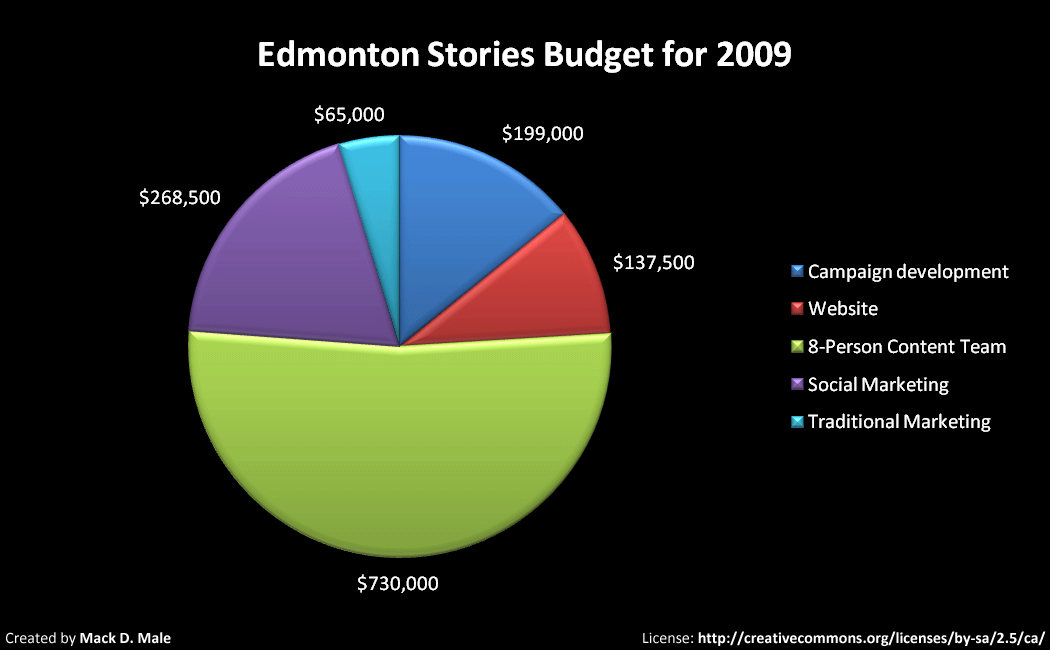
The budget for promoting EdmontonStories.ca isn’t insignificant either, when you consider that it’s being spent on social media and online marketing, not traditional marketing:

The total budget for 2009 is $1.4 million dollars. City Council approved $1 million, and EEDC kicked in another $400,000. According to The Journal, project staff expect to ask for another $1 million in 2010. Should they get it? I’m leaning toward no.

I wonder how much of that $268,500 earmarked for social media marketing has been spent. Based on the number of inbound links above, I’d hope very little, but given that there are only three months left in 2009, I’m not so sure. If there’s a lot to spend still, I expect to see Edmonton Stories everywhere online for the next few months.

I think Edmonton Stories is a great concept, and I’m glad to see that Edmontonians are contributing stories. The project was created to help market the city elsewhere though, and I don’t think it is accomplishing that yet.

Open Data in Edmonton? Follow Vancouver’s lead

Last week Vancouver launched an open data portal, providing one-stop-shopping for open data provided by the city. David Eaves called the launch “a major milestone for Vancouver” and explained:

The Data Portal represents an opportunity for citizens, especially citizen coders, to help create a City that Thinks Like the Web: a city that enables citizens to create and access collective knowledge and information to create new services, suggest new ideas, and identify critical bugs in the infrastructure and services, among other a million other possibilities.

He was also quick to point out that getting access to the data is just the beginning. Citizens have to use it, or risk losing it. The next day he launched VanTrash, an application to make garbage collection sexier. Use it or lose it indeed!

I think it’s interesting that he started with garbage collection, because I too identified that as an area that could use some innovation. A couple months ago, I spent about an hour on the phone with a manger in the Waste Management department at the City of Edmonton, trying to get access to the data behind the garbage collection schedules. Currently you can enter your address here to download your collection schedule in PDF. But if you want to find the schedule for a different part of the city, you’re out of luck. And even if you manually tried enough addresses to find all the zones and collection schedules, they’d be in PDF, which means you can’t easily add them to a calendar.

By the end of the call, I think he finally understood what I was after, and he said he’d have to get back to me. He never did, unfortunately. I can only hope that my request had an impact and that it will eventually help to open the data floodgates in Edmonton.

Open Data doesn’t have to be difficult!

Take a look at the data available at Vancouver’s data portal. Most of the data there is simple and exists elsewhere, in a less “creative friendly” format. A good example is the list of libraries. You can download the data in CSV, XLS, or KML formats, but it really just comes from the Vancouver Public Library website. The CSV contains the library name, it’s latitude, longitude, and address. Simple stuff, but potentially really useful if combined with other data sets.

Here’s an example in Edmonton. Let’s say I want to know how the crime rate of neighbourhoods with libraries compares to those without. What data would I need for that?

  • A list of libraries, with their locations (see below)
  • A list of neighbourhoods, with their boundaries
  • Crime statistics by neighbourhood
  • Census data for neighbourhoods to find comparable ones without libraries

Could you find this today? Yes, but it’s definitely not easy! The EPL website lists the libraries with addresses, so you’d need to figure out the lat/long on your own. The City of Edmonton website lists the neighbourhoods, but you’d need to figure out the boundaries on your own. The EPS website provides reported crimes by neighbourhood. And finally, the City of Edmonton provides census data for neighbourhoods in PDF.

If I could get all the above data in CSV format, it would have taken a matter of minutes to find the answer (I should point out that not all of that data exists at Vancouver’s portal either). Instead, I had to do a lot more work. The very rough result (because I compared with a random sample of similarly populated neighbourhoods) is that neighbourhoods with libraries were 1.5 times more likely to have crime than neighbourhoods without libraries in 2008. Though if you don’t count Downtown, then the crime rate is about the same for neighbourhoods with libraries and those without.

Maybe you’re thinking “what a useless example” and that’s fine – it is one of just hundreds or thousands of possible uses for that data! Just imagine what would be created if software developers and other creatives in Edmonton had access to the data.

Libraries Data

All this talk of open data, why not give you some? I’ve created a CSV of the Edmonton Public Library locations in the exact same format as the Vancouver Public Library data (minus eplGO in the Cameron Library). Enjoy!

Download the Edmonton Public Library location data in CSV

Onward in Edmonton

I’ve heard rumblings that the City of Edmonton will be doing some stuff in the open data space in the next couple of months, but I’m not holding my breath. There haven’t been enough conversations taking place. I’m hopeful that the right people are envious of the progress that has been made in Vancouver, however. I sure am!

Randall Stout on the new Art Gallery of Alberta

On Saturday afternoon, Randall Stout gave a talk at the Winspear Centre on the new Art Gallery of Alberta. As the lead architect on the renovation of the AGA, he could talk about the project like no one else. He started with some of his influences and favorite examples of architecture, and then moved on to the philosophy behind the design for the new AGA. He touched on the technology used throughout the design process, and the materials used for the building’s construction. He finished with some never-before-seen renderings and photographs of the new AGA.

As Sharon noted, one couldn’t help but come away from the talk feeling excited about the new Art Gallery. I was already looking forward to the new building for it’s unique and controversial design (both positive things in a city mostly full of plain buildings) and hearing Stout’s thoughts only furthered my appreciation for the design.

Randall Stout Architects, Inc. was named the winner of the Edmonton Art Gallery’s New Vision architectural competition on October 13th, 2005. Here’s what Stout had to say at the time:

“It is an honour to be chosen from among such distinguished colleagues,” said Randall Stout once he had been given the news. “I look forward with great excitement to crafting architecture that serves the Gallery’s New Vision of programming for the people of Edmonton and all of Alberta.”

The distinguished colleagues he mentioned included Alsop & Partners (London, UK) and Quadrangle (Toronto), Arthur Erickson/Nick Milkovich (Vancouver), Dub Architects (Edmonton), and Zaha Hadid (London, UK).

Though Randall Stout has been on the job for about four years, the project actually started nearly twelve years ago. That’s when the wheels were set in motion for the renovation of what was known at the time as the Edmonton Art Gallery. I think once we see the completed building we’ll look back and say it was worth the wait.

The most distinctive feature, the sweeping stainless steel wave, is known as “Borealis”. It is meant to reflect our city’s unique geography – the river valley cutting through box-filled urban spaces. While it will appear as one piece as you walk into the building, it is actually separate to ensure that cold outside temperatures stay outside.

Stout talked a little about designing for such a northern climate. He mentioned that the building was designed with winter in mind, and showed a rendering of the building on a very snowy day. He didn’t give specifics however, and said to wait for some nice weather-related surprises when the building opens. He also shared his admiration for local construction workers who braved the cold weather to keep the project on track.

Though the new AGA will indeed be linked to the pedway system and to Churchill LRT station when finished, it will not include a redesigned LRT entrance. Stout said that he went above and beyond the requirements of the competition by including the feature in his initial designs, but scrapped it due to lack of funding. He’s hopeful that the City might resurrect the feature in the future (and I am too).

Art Gallery of Alberta

Other interesting features of the new building include “the grand staircase”, the third floor terrace, a new restaurant/cafe, and a color-changing exterior. You can learn more about the building features here.

The new $88 million Art Gallery of Alberta will open to the public on January 31, 2010, roughly 1500 days after Randall Stout won the competition. To tide you over until then, the Art Gallery of Alberta is hosting an exhibit called Building a Vision, which features “the progression of the building from initial conceptual sketches and diagrams to pictures, models, and photographs captured throughout construction.” Don’t miss it!