Idea: Proud Edmonton Tech Company badge

Edmonton SkylineThings have definitely improved in the last couple of years, but Edmonton still has a reputation as something of a dead zone for innovation. Or perhaps more accurately, we don’t really have a reputation – we’re not on the radar in most cases. It’s not true of course, there are plenty of interesting and innovative projects, companies, and people in Edmonton. The challenge is making others aware of them.

There are a variety of ways to do that. One is through the media, both traditional and new. Such mentions tend to be fleeting, however. Another way is through events such as DemoCamp, though those typically benefit only the locals. These are important, and we should keep doing them, but we need something else as well.

As I thought more about the problem, it occurred to me that we could learn something from other industries. There are two organizations in particular that do a good job of boosting local companies – Original Fare and Keep Edmonton Original. You can find their logos at independent restaurants and retailers around the city, and I think seeing them reinforces the notion that we have more than just big box stores and chains. What if we had something similar for technology companies?

For tech companies, the web is important. It’s often the first point of interaction. As such, it’s always been a pet peeve of mine that so many local tech companies seem afraid to mention on their website that they are based in Edmonton:

I’m not trying to suggest that any of these companies have intentionally left Edmonton out, but I do think there is room for improvement.

So here’s the idea: what if every local tech company put a badge on their website that says “Proud Edmonton Tech Company”? What kind of an impact would that have? I think it would definitely help with awareness.

For most companies, placing the badge on the front page probably doesn’t make sense. Nexopia, for instance, has a very large external audience that probably doesn’t care that the company is located in Edmonton. Others will simply want the front page to look a certain way. Nearly every company has an about page however, and it’s on that page that I think such a badge would be featured (and maybe on the contact page too). Where would the badge link to? I’m not sure. I’m not even sure it has to link anywhere.

What do you think?

Edmonton Police Service (EPS) Crime Mapping tool now online

Back in June we learned that the Edmonton Police Service was planning to launch a new website that would enable citizens to find crime statistics for their neighbourhoods. This afternoon, the EPS Crime Mapping tool went online, and it does just that. You can search for stats on eight types of crimes in any neighbourhood across any time period since 2007. From the press release:

The new crime mapping tool will provide members and citizens with a better understanding of what is going on the neighbourhoods they work and live in.

I’ve been playing with the site today, and I like it. There are pros and cons, however.

How It Works

The first step is to agree to the disclaimer – more on that in a minute. Next, you pick the crimes you want statistics for. The eight types include assault, break and enter, homicide, robbery, sexual assaults, theft from vehicle, theft of vehicle, and theft over $5000. Third, you pick the neighbourhood – there are 357 listed in the system. Finally, you select the time period. There are some quick selections such as yesterday or the last 30 days, or you can enter any two dates. Click “Show Crimes” and your neighbourhood appears on the map, covered in colored dots to represent the reported crimes. Here’s what Oliver looks like for the last 30 days with all crime types selected:

There’s also a “View Statistics” tab above the map that will show you a table for the last three years broken down by month, with a graph below that.

The Good

There are some really good things about this site. First and foremost, the data is excellent. I’m glad that they included everything up-front, instead of doing a test release or something to start. Second, it’s built using Google Maps. This is a big win for EPS – it’s a stable technology that Google is continually making better, and I would guess that most Edmontonians are familiar with it. Third, it’s fast. Almost as soon as you click the button, your stats appear.

The Bad

There are two things about the site that I don’t like. First is the disclaimer – it’s too restrictive. These two points in particular are problematic:

While it is acceptable to pass the website link on to others in your community, you will not share the information found on the website with others other than with members of the Edmonton Police Service or other law enforcement agencies; and

You will only use this website and the information in it so you can inform yourself of, and participate in, this community policing initiative;

That effectively means you can’t do anything with the data. This is in direct contrast with what the press release would lead you to believe:

Providing our citizens with the real picture of neighbourhood crime is the first step in engaging them to do something about it. Members of the public will be better equipped with knowledge to work collaboratively with the EPS to reduce and prevent crime.

What’s the point of making the data available if you can’t do anything with it? Why can’t I blog about the crime stats in a particular neighbourhood? Or mash the crime stats up with some other data? I challenge the notion that simply being able to see the dots on a map equips me to do something about crime in my neighbourhood.

I’ve emailed the feedback address listed on the site asking about this, but I haven’t yet received a response.

The second bad thing about the site is that while it does make data available, it does so in an opaque and closed way. If Edmonton is going to become an open city (with respect to data), sites like the crime mapping tool need to provide information for multiple audiences. One is the average citizen who is happy to click around on the map. Another increasingly important audience is the creative professional who wants to do something with the data, and needs it in a machine-readable format such as a CSV or XML file.

The Undocumented API

The first thing I did after testing the site with my neighbourhood was poke around for clues about where the data comes from. It didn’t take long to realize that there’s a JSON web service behind the application. You can access it here. It’s probably not meant for public consumption, but it’s there and it works. I was able to throw some code together in about 30 minutes to get data out of the service. While it would still be good to have static data files available, the API largely negates the con I mentioned above. As it is unofficial however, who knows if it will remain active and working, so enjoy it while you can.

Final Thoughts

Overall I think the Crime Mapping tool is excellent. We need more applications and services like this, though with less restrictive terms/licensing and easier-to-access data. Kudos to EPS for building this, and let’s hope they improve it.

UPDATE: There are more details in this article. For instance, the tool apparently cost $20,000 to build, and is automatically updated each morning.

State of the Calgary Twittersphere – June 2009

Welcome to the fourth State of the Calgary Twittersphere, my look at the intersection of Twitter and Calgary. You can see last month’s stats here.

The source of the data this month remains the same – Twitter Search. If a user has his or her location set to Calgary, Airdrie, Okotoks, Cochrane, Strathmore, or matching lat/long coordinates, they are considered a Calgarian. If a tweet is “about Calgary” it contains either the word Calgary, the #yyc hashtag, or both.

For June 2009:

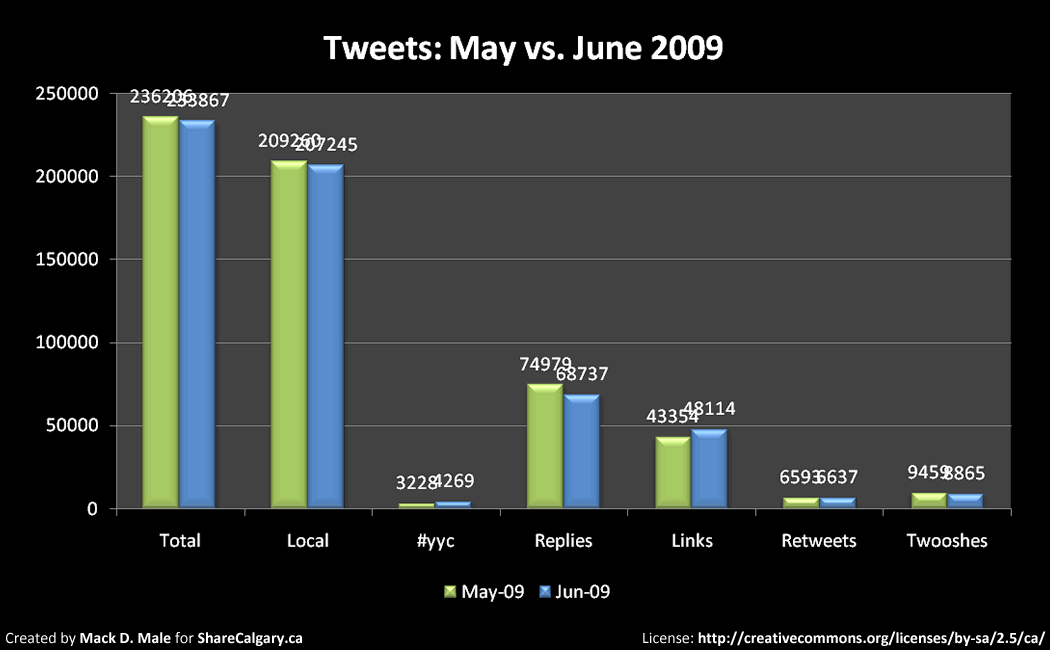
# of local users: 5646 (a decrease of 215 from May)

To clarify, that means there were 5646 users who posted at least one tweet in June 2009 with their location set to something that makes them a Calgarian as described above. This number should be treated as a minimum – there are probably many more Calgary users without their location set or that were not captured for some other reason. See additional analysis below.

# of tweets by local users: 207245
# of tweets by local users containing #yyc: 4269 (2.1%)
# of tweets by local users that were replies: 68737 (33.2%)
# of tweets by local users containing links: 48114 (23.2%)
# of tweets by local users that were retweets: 6637 (3.2%)
# of tweets by local users that were twooshes: 8865 (4.3%)

Here are the numbers above in graphic form:

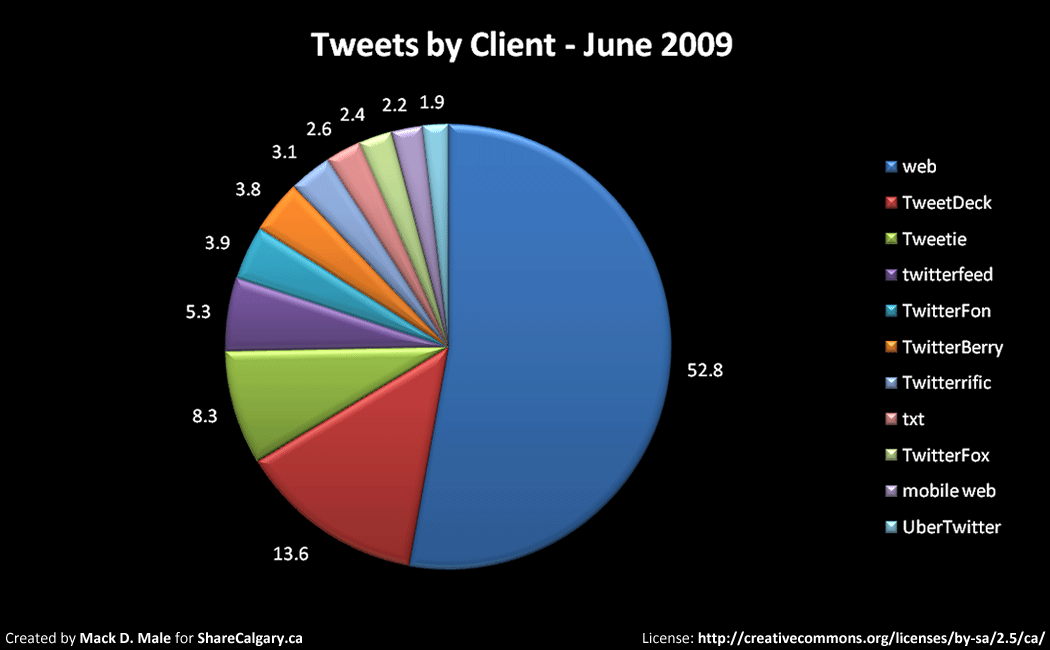
Here are the top clients used by local users for posting updates (remember that web includes all unidentified API calls too). A notable new entry is UberTwitter:

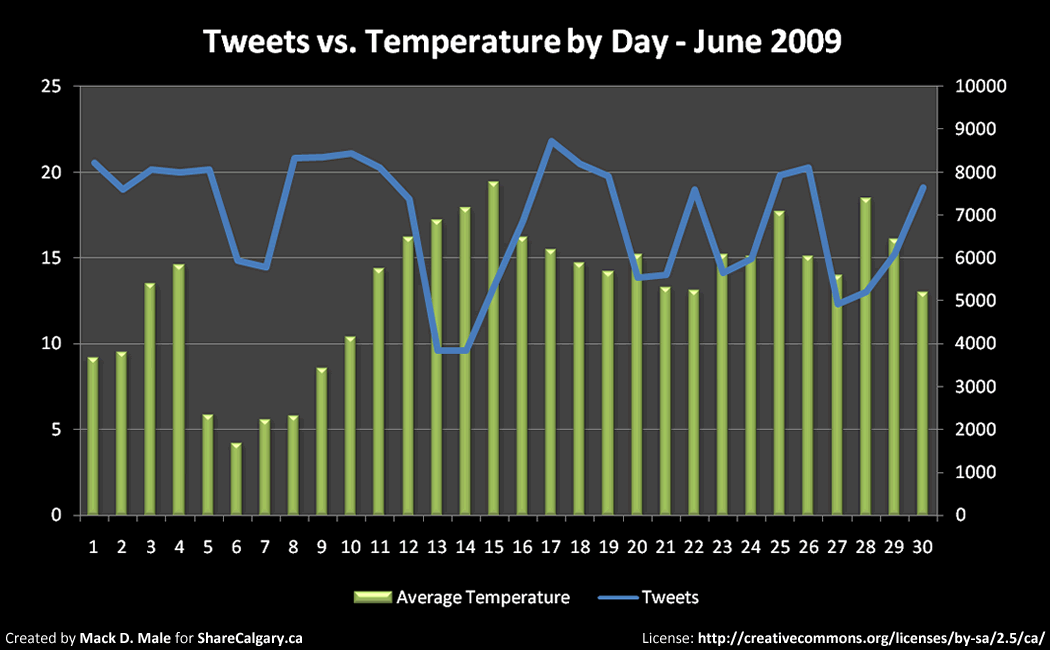
Since I’ve been playing with some temperature data from Environment Canada lately, I decided to plot the average temperature against the number of tweets for each day in June:

Do people tweet more when it’s colder outside? I’m not sure the graph really tells us. What’s clear however is that people tweet less on the weekends!

Some other interesting stats for the month:

Finally, here are the top ten users in Calgary by followers (most followers first): douglasi, OksanaIrwin, ahhhgolf, twitty7x, strategicsense, CrazyMechanic, broatch, nolanmatthias, ThankASoldier, tessaru

Analysis

Like the Edmonton stats for this month, the Calgary stats don’t look that impressive. Some people have abandoned Twitter, it’s the summer, and as was pointed out in the comments on the Edmonton post, the Iran Election probably impacted my stats as some users changed their location to Tehran.

There are some encouraging signs, however. The increase in tagged tweets this month surprised me – maybe #yyc will try to catch up to #yeg! Also, since I started recording the stats for Calgary back in March, I have identified just over 11,000 local users. The number above, 5646, is how many of them were active in June.

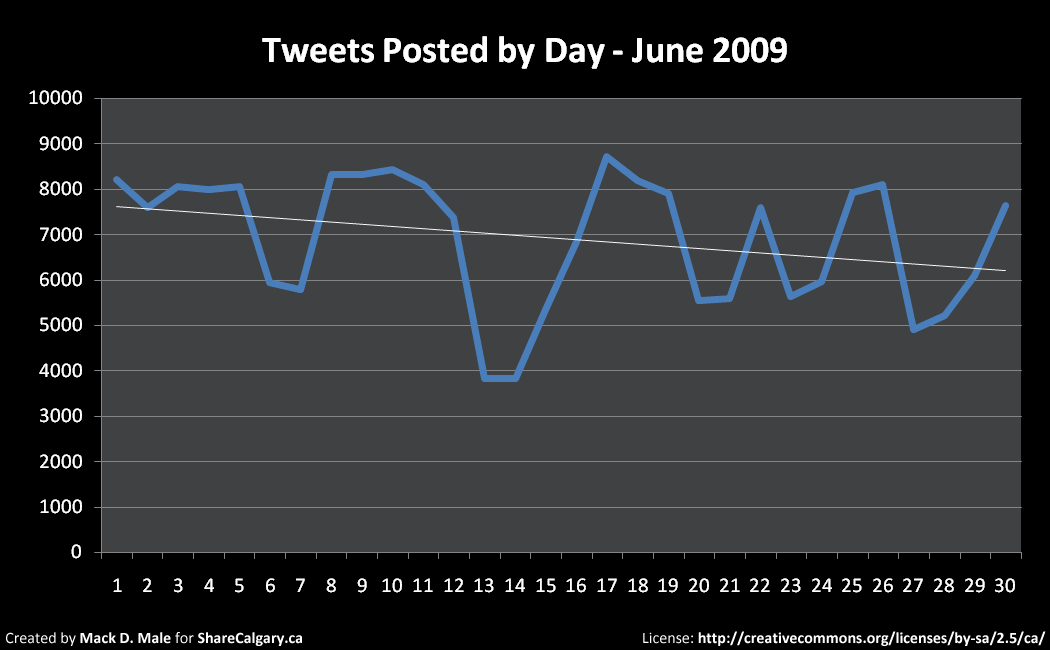
I didn’t monitor things as closely in June as I do normally, so there’s a chance I might not have captured all of the data. In particular, I’m not sure if June 13th/14th was really that low or if there was a data import error of some kind. Either way, I think the data above represents the overall trends accurately.

I’ll be making some changes to hopefully boost the accuracy of the numbers in July.

State of the Edmonton Twittersphere – June 2009

Welcome to the sixth State of the Edmonton Twittersphere, my look at the intersection of Twitter and Edmonton. You can see last month’s stats here.
The source of the data this month remains the same – Twitter Search. If a user has his or her location set to Edmonton, St. Albert, Sherwood Park, Leduc, Nisku, Stony Plain, Fort Saskatchewan, Beaumont, Spruce Grove, or matching lat/long coordinates, they are considered an Edmontonian. If a tweet is “about Edmonton” it contains either the word Edmonton, the #yeg hashtag, or both.

For June 2009:

# of local users: 3642 (a decrease of 871 from May)

To clarify, that means there were 3642 users who posted at least one tweet in June 2009 with their location set to something that makes them an Edmontonian as described above. This number should be treated as a minimum – there are probably many more Edmonton users without their location set. See additional analysis below.

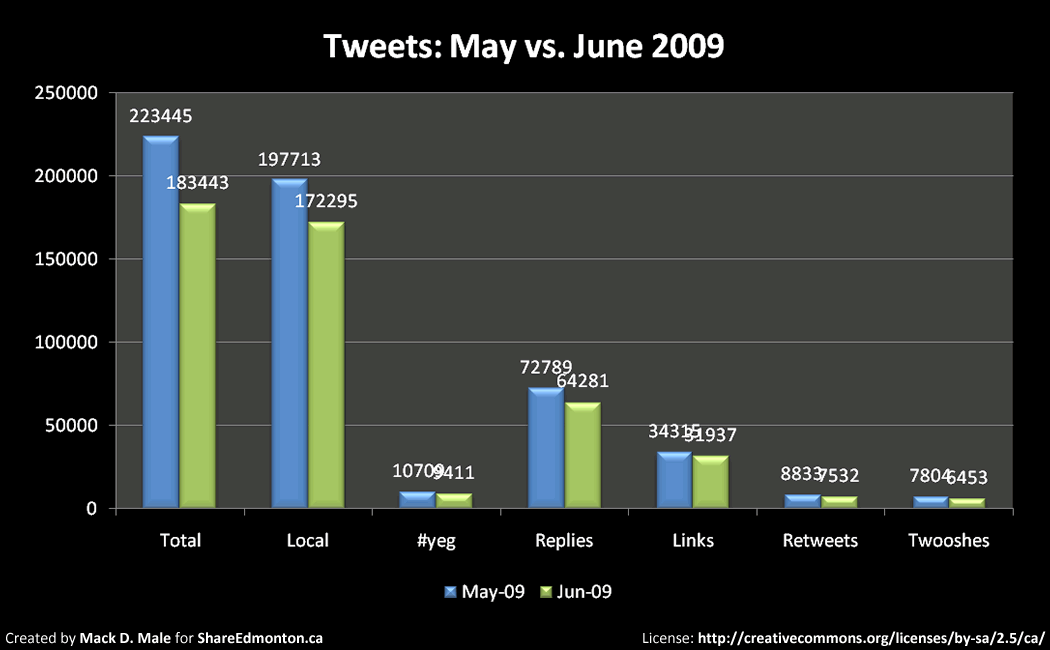
# of tweets by local users: 172295
# of tweets by local users containing #yeg: 9411 (5.5%)
# of tweets by local users that were replies: 64281 (37.3%)
# of tweets by local users containing links: 31937 (18.5%)
# of tweets by local users that were retweets: 7532 (4.4%)
# of tweets by local users that were twooshes: 6453 (3.7%)

Once again, the number of tweets containing #yeg actually includes all local hashtags, such as #yegtransit or #yegfood (though most often they are used together anyway).

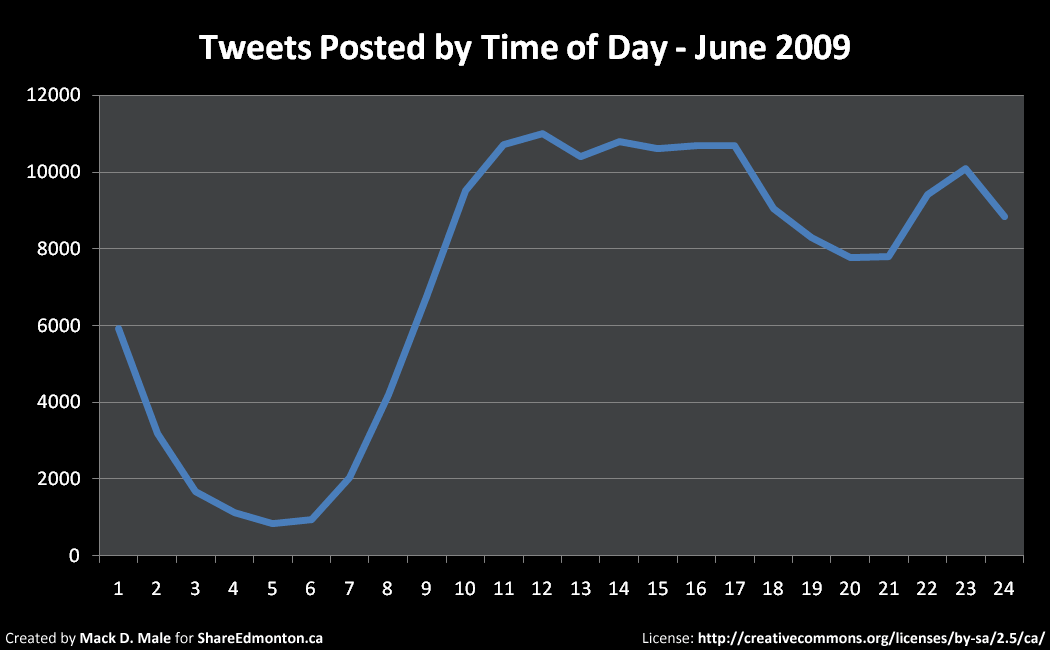
Here are the numbers above in graphic form:

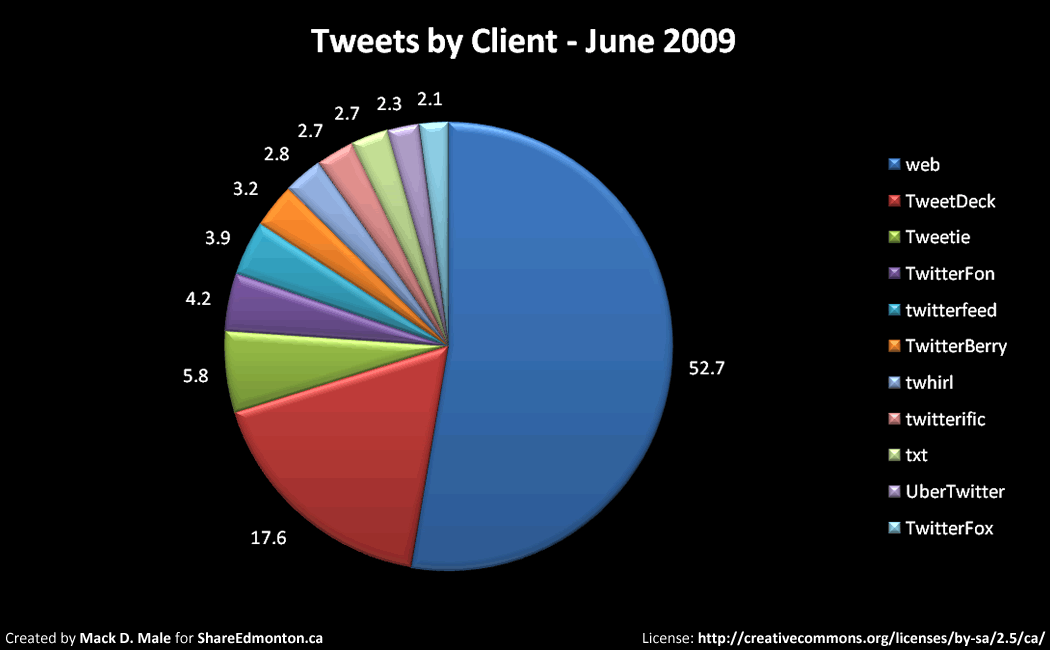
Here are the top clients used by local users for posting updates (remember that web includes all unidentified API calls too, though they are changing that). A notable new entry this month is UberTwitter:

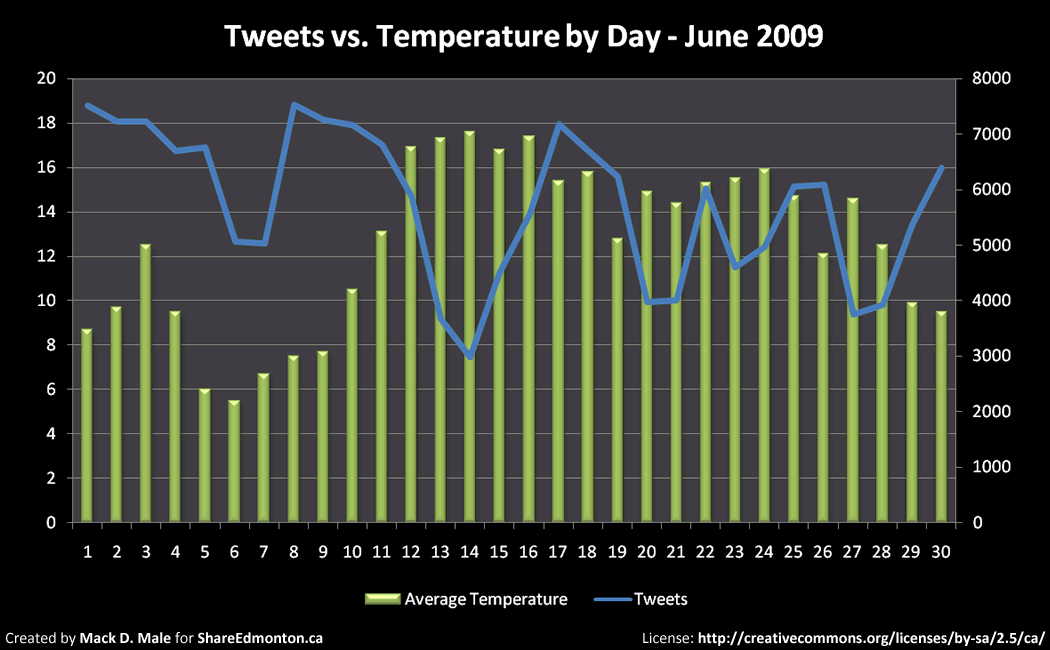
I’ve been playing with some temperature data from Environment Canada lately, and it occurred to me that I could visualize it against my Twitter data. Here is the number of tweets posted and the average temperature for each day in June:

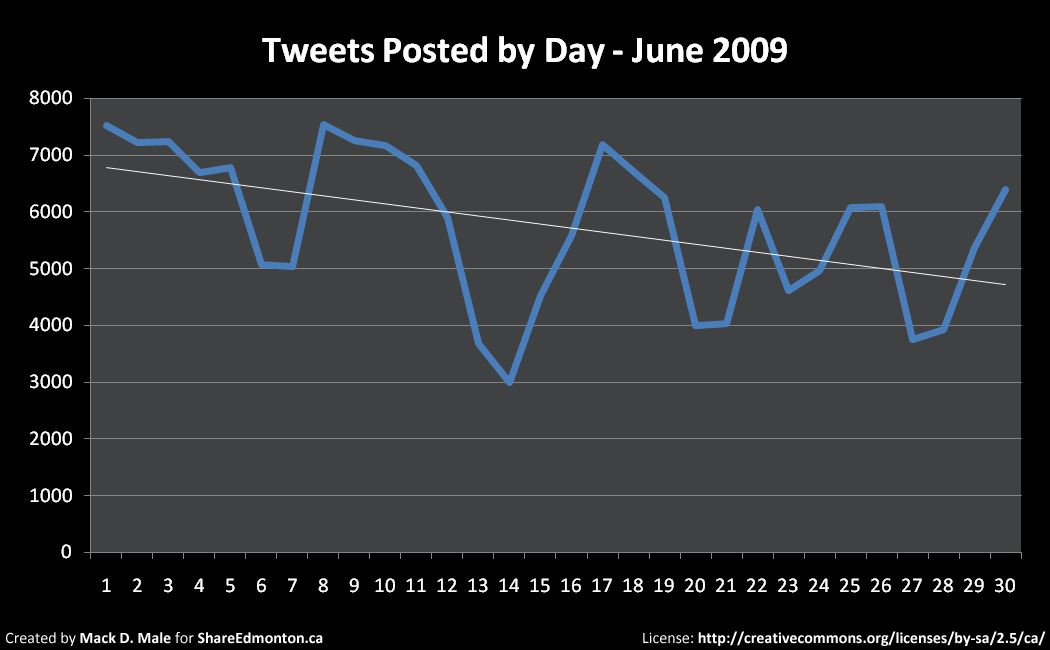
Do people post more when it’s warmer or when it’s colder? The only thing I can be sure of is that there are always less tweets posted on the weekend. Beyond that, there seemed to be more tweets posted at the beginning of the month when temperatures were cooler, but obviously this is in no way scientific!

Some other interesting stats for the month:

Finally, here are the top ten users in Edmonton by followers (most followers first): Pat_Lorna, revtrev, LesM, subunit1, garrymullen, mastermaq, redneckmommy, NHL_Oilers, karlkovacs, dan_cote. It would take a lot more time to generate, but a top ten list ranked by local followers would probably look much different.

Analysis

This month’s stats don’t look very good! The numbers haven’t been this low since March. There are definitely users who have abandoned Twitter, but I think the time of year probably has an effect as well. Presumably people are outside enjoying the weather, tweeting less often! A preliminary look at the numbers for July suggests to expect more of the same for next month’s stats.

The good news is that since January, I have identified nearly 9000 local users. The number above, 3642, is how many of them were active in June.

I didn’t monitor things as closely in June as I do normally, so there’s a chance I might not have captured all of the data. In particular, I’m not sure if June 14th was really that low or if there was a data import error of some kind. Either way, I think the data above represents the overall trends accurately.

I should have the stats for Calgary up by Thursday. Stay tuned!

UPDATE: The Calgary stats for June are here.

UXCamp Edmonton – July 18th

Edmonton’s first UXCamp is being held on Saturday! Organized by Cam Linke of BarCamp fame, Jess McMullin from nForm, and Marc Brisbourne, an instructor with MacEwan’s Design Studies program, UXCamp is a free, one-day event taking place at MacEwan downtown. Here’s what it’s all about:

UXCamp is for people who want to learn and share about user experience, design, usability, information architecture, user interfaces, service design, and anything and everything else about creating better products and better experiences.

Edmonton joins a growing list of cities that have hosted UXCamp, DesignCamp, or InteractionCamp events. Like BarCamp, the schedule is open – anyone can sign up to present in a 20 minute time slot. You can read more about what they’re expecting for presentations and how the day will progress here.

Here are the details for UXCamp Edmonton:

Date: Saturday, July 18, 2009
Time: 9am – 5pm
Location: 9-202, Robbins Health Learning Centre (104th Ave, 109th Street – map)
Cost: Free

The event is limited to 100 people by the venue, so make sure you register now. If you’re interested in sponsoring, click here. Should be a great event!

Social Media and the City Centre Airport Debate

Where there’s smoke, there’s fire.

On Thursday morning Jeff Samsonow and I chatted about the City Centre Airport for a few minutes on CBC Radio. During the interview I was asked if I thought social media played a role in the debate. I answered, “absolutely”.

Also on Thursday, Graham Hicks mentioned the “rise of youth” in his column, observing that “the younger demographic flexed its muscle” and that “the "social media" was solidly anti-airport”. He specifically mentioned myself, Jordan Schroder, Dave Cournoyer, and Michael Janz.

Scott McKeen got things rolling on Friday with his column in the Edmonton Journal, stating that “a new reality emerged along with a new establishment.” He too mentioned age:

Blogger Mack Male used Twitter to go live from council chambers during the final debate. In one Twitter post, he wrote: "There is a silver-haired guy in the audience shaking his head during Don Iveson’s remarks."

Global Edmonton’s Linda Nguyen interviewed me Friday for a piece that aired during the evening news (click on “silent majority” because their video system sucks). Councillors Iveson and Krushell were also interviewed for the story, and cited the use of social media by young people as a trend to keep an eye on.

On Saturday, Todd Babiak’s column in the Edmonton Journal took the story to another level. He interviewed both myself and Jordan Schroder, and said:

It must have been devastating for the city’s most powerful men and women to watch a group of virtually connected–but politically unconnected–young people creating and controlling public debate with speed, elegance and respect.

Is it just coincidence that so many stories on the same topic appeared over the last few days? Were they all just trying to avoid another negative comment from Cal Nihols and his side? Maybe, but I think there’s more to it than that.

Social Media Lessons

Social media definitely played a large role in the City Centre Airport debate, on both sides. As I mentioned in my post introducing NotMyAirport.ca, AEG made use of social media for its campaign too, though the local media seems to have glossed over this fact. David MacLean was active on Twitter, and actually was the first to use the #ecca hashtag that has become so popular. You may know that I didn’t create the Not My Airport group on Facebook, Jordan Schroder did. I just looked for the largest pro-closure group and linked to it – Jordan then renamed it and made me an admin. David told me a similar thing happened with their side’s Facebook group. David and I both took part in the web debate hosted by FusedLogic, and we both encouraged others to email their councillors.

All of which begs the question, if both sides had such similar stories, why were the pro-closure side’s social media efforts so much more effective? The fact that, at least in my opinion, we had a stronger case notwithstanding, I believe the following reasons are key:

  1. Blogging

    Blogs are still the stars of social media. The pro-closure side made use of blogs quite extensively. Myself, Dave, Michael, Adam, Adam, and Jeff all blogged about the issue numerous times, and I’m sure there were others too. A blog has many benefits, but three in particular played a role here: a place to expand on thoughts and to lay out facts, a good ranking in search engines, a place for others to leave comments and have a conversation. The pro-Muni side didn’t have any blogs, and they missed out accordingly.

  2. Consistency

    Perhaps the most important thing you can do when you have a blog is to post regularly. I did that, as did others. We were also consistent with other tools. We kept the Twitter stream updated, and we regularly sent messages to our Facebook group and posted on the wall. The debate seemed more alive because we were consistent with our communications.

  3. Using the right tool for the job

    Blogs are great for sharing a relatively large amount of information. Twitter is great for short, real-time bits of info. Here’s an example: I listened to the live stream for the public hearings, and Twittered about it in real-time. The pro-Muni side was nowhere to be found. Similarly, I live tweeted the final decision, because that’s what Twitter is good at. The pro-Muni side again was silent. Even the web debate is a good example – I suggested it because I knew it would give us time to explore the issues and a chance for others to converse online.

  4. No distractions

    You might call it grassroots or simply having no money, but the pro-closure social media efforts were not affected by other “distractions”. The billboards, lawn signs, etc. all have an impact – in this case, they made the pro-Muni side seem like it had some money, and that took away from the authenticity of their social media efforts.

Over the weekend, Adam and Dave wrote about Babiak’s story. Both suggested that there’s more to the story than just young people using social media. I agree with them. If age played any role, it’s that young people are more comfortable with social media tools and thus used them more effectively. That’s a bit of a generalization, however. There were young and old people on both sides of the debate.

Final Thoughts

There’s no doubt in my mind that the City Centre Airport debate and the role social media played in that debate will have a lasting impact on politics in Edmonton. Having said that, it’s important to realize that change doesn’t often happen overnight. Just as it will take years for the airport itself to give way to something new, political decisions will continue to be made the way they always have been, at least for the foreseeable future.

The difference now, I hope, is that social media has been legitimized in the eyes of our local political system and should see greater use in the future.

I think that’s something to be proud of.

Collaboration & Community: Edmonton New Technology Society (ENTS)

Nearly a year ago while in Vancouver I took some time to check out WorkSpace, a shared workspace located in the historic Gastown neighbourhood. I had been reading about the concept for quite a while and after seeing one in action, I knew that I’d get use out of a collaborative workspace (they’re also known as hackerspaces or innovation commons). The ability to have an office without having an office, and to meet and network with other local creatives is just so appealing. I’ve been wishing for one here in Edmonton ever since.

Now, it looks like I’m going to get my wish!

The Edmonton New Technology Society, or ENTS, is a new non-profit organization that is working to bring a collaborative workspace to our city. They’ve come together incredibly quickly over the last couple of months, and while they don’t officially have a space yet, they’re incredibly close. I’ve been quite impressed with the progress they’ve made in such a short amount of time.

The society has seven directors currently: Stephen Olesen (President), Rob Davy (Vice-President), Eric Warnke, Graham Batty, Matt Mercer, Jeff O’Toole, and Don Egliniski. Roughly 55 people have joined the society so far, paying a nominal $20 membership fee. As Graham told me, “this project will be nothing without people engaged and interested,” so that’s been a big focus for the group. They’ve made use of both social media and face-to-face gatherings to spur interest. Stephen says that “Twitter has certainly been one of the largest driving factors in informing people and getting to know the majority of members.” Early discussions used the hashtag #yegspace, but they’ve since switched to #ents. You can follow ENTS on Twitter here.

ENTS held its first AGM on June 7th, and has hosted a number of informal gatherings since. Rob and a few of the other directors presented ENTS at BarCamp last month, and Wings Nights have been popular. The most recent took place on Tuesday at the Elephant & Castle downtown which about 30 people attended.

ENTS Wings NightFree beer! London Pride

Another focus has been finding a space. It is on this task that the group’s commitment to allowing the members to drive things is most evident. They polled their members and quickly found that office space wouldn’t be enough – members wanted a “dirty” place to work too, so that they could experiment with hardware, robotics, etc. The space they’ve found fits both needs perfectly. Located at 10575 114th street, it is already nicely separated. Here’s the office space:

And here’s the dirty space:

You can see more photos of the space here. They’ve done a few tours already, so a number of the members have already seen it. If all goes well, ENTS should be moving in by the end of the month (and will need help with that so feel free to volunteer).

Both Eric and Stephen agreed that financing the project has been one of the biggest challenges. In addition to collecting membership fees, ENTS has been actively seeking projects and partners to help raise money. They found a powerful ally in the City of Edmonton IT branch recently:

The City of Edmonton is looking to have ENTS host some exciting events within the Edmonton technical community. The City of Edmonton is committed to supporting us in our core goals of social collaboration and innovation within Edmonton, and we’re very glad to have the support of the city in our endeavours.

I’d say that’s more proof that the City’s IT branch is transforming for the better. I’m excited to see what ENTS can accomplish with the events, and I’ve offered to help where I can.

Finally, I asked the directors what they hoped to accomplish with ENTS. I like what Eric had to say:

We’re all about collaboration, it’s in our mission. We want to foster the tech community in Edmonton and give people the opportunity to learn something new while teaching others what they already know. We’re about making Edmonton a better place through technology.

If you’d like to join ENTS, fill out the membership application online. For the latest news and updates, check out their blog and Twitter feed. They’ve also got forums and a wiki.

Congratulations to ENTS on everything they’ve been able to accomplish thus far! I’m really looking forward to seeing the society grow and evolve, and to being able to use the space of course.

Recap: Next Gen Community Challenge

Last night the Edmonton Federation of Community Leagues (EFCL) and Edmonton Next Gen co-hosted an event called the Community Challenge at Orange Hall in Old Strathcona. The goal of the event was to bring together interested members of the next generation (roughly 18-40 years old) to share ideas on how to improve and better work with community leagues.

Upon arriving, attendees were given a name tag and were asked to place a dot on the map to show where they live. Additionally, everyone had a polaroid taken that was pinned up on the giant map of community leagues in Edmonton. As you can see, most people were from the core:

Next Gen / EFCL Community Challenge

The program kicked off at 7:30pm with some introductions from EFCL and Edmonton Next Gen representatives. The first activity of the evening was for each table to discuss two primary questions:

  • What can community leagues to do better engage the next generation?
  • What kinds of projects would you like to work on with your community league?

Every single group mentioned “Twitter” and “Facebook” among the answers to the first question. Other ways of getting young people engaged included ensuring website information is accurate and up-to-date, aligning community league benefits with the demographic, and making information available at more locations in the community. Projects included community gardens, car sharing programs, community health plans, block parties, and many more.

The second activity was to work as a group to get the ball rolling for one project. It seemed less effective than the first activity, but I liked the intent. Afterward many people stayed to mingle and consume the large amount of leftover food and wine!

Next Gen / EFCL Community ChallengeNext Gen / EFCL Community Challenge

Back in April I wrote about EFCL’s push to adopt social media as part of a larger strategy to attract a younger demographic. I think the Community Challenge event was a smart way to make progress on that. Social media is a powerful thing, but nothing beats face-to-face conversations in a room of passionate, enthusiastic people.

I asked Michael Janz, EFCL’s Marketing Director and co-host for the evening (along with Next Gen’s Angela Hobson), what he thought about the event. He told me he was “thrilled with the turnout” and that he thought “many people were inspired to participate further in their communities.” Michael said the results of the “collective brainstorming” will be typed up and posted to the EFCL site soon.

If you couldn’t make it out last night, don’t worry: you can still get involved. You can head over to the EFCL website to purchase a community league membership, or you can volunteer for your community league. Be sure to check out EFCL on Facebook and Twitter, and Edmonton Next Gen on Facebook and Twitter. You might also want to sign up for the Edmonton Next Gen weekly newsletter. Finally, keep an eye out for a similar event in August.

Edmonton City Centre Airport Decision: Phased Closure

City Council voted today to implement a phased closure of the City Centre Airport. The motion put forward by Councillor Gibbons described two phases and passed by a vote of 10-3. I’m happy with the decision that was made today, and I commend Council for taking a courageous step toward ensuring the City’s Vision and Strategic Plan are realized.

Here is the vote breakdown for adopting the motion (which you can download here):

Councillor Karen Leibovici (Ward 1) Yes
Councillor Linda Sloan (Ward 1) No
Councillor Ron Hayter (Ward 2) No
Councillor Kim Krushell (Ward 2) Yes
Councillor Ed Gibbons (Ward 3) Yes
Councillor Tony Caterina (Ward 3) No
Councillor Jane Batty (Ward 4) Yes
Councillor Ben Henderson (Ward 4) Yes
Councillor Bryan Anderson (Ward 5) Yes
Councillor Don Iveson (Ward 5) Yes
Councillor Amarjeet Sohi (Ward 6) Yes
Councillor Dave Thiele (Ward 6) Yes
Mayor Stephen Mandel Yes

Council started discussing the issue at 1:30pm, and didn’t wrap up until nearly 6pm. There were at least four rounds of questioning, driven largely by Councillors Caterina and Sloan who were vehemently opposed to the motion. After the questioning finally ended, Councillor Caterina put forward a motion to refer the issue to Administration which was soundly defeated.

Three amendments were made to the original motion. Councillor Iveson’s two amendments were “friendly”. Councillor Krushell’s amendment stated that after scheduled service licenses expire at ECCA in June of 2012, that they not be renewed. All three amendments were approved, and as soon as the final motion is online I’ll link to it which you can download here (PDF).

It became clear as Councillors gave their final remarks that the motion was going to pass. I thought Councillors Henderson, Iveson, and Krushell made excellent comments about why this decision needed to be made, speaking in particular about the future. Councillor Leibovici mentioned the role of social networking in this debate (more on that in a future post). Mayor Mandel used his time to make it clear that “this is a closure motion.” Councillor Gibbons used his time to get a dig in at Councillor Caterina, saying “if you can’t win, don’t bring it forward.”

After the vote passed, a motion from Councillor Sloan was brought forward that called into question the legality of Councillor Gibbons’ motion (the City’s legal counsel gave the OK hours earlier). It also requested that quarterly updates be provided to Council on legal issues related to the City Centre Airport. The motion was split – the first part was defeated, the second part (quarterly updates) passed.

What happens next?

The following will happen immediately:

  • Runway 16-34 will be closed. General aviation business activities will be adjusted to accommodate a one-runway airport. Medivac service will be maintained.
  • As a result, a GPS landing system will likely be added to runway 12-30.
  • The parcel of lands adjacent to runway 16-34 that can be surrendered to the City once the runway is closed will be identified.
  • Negotiations will begin with NAIT and the Province of Alberta to allow for NAIT expansion.
  • The City of Edmonton will create a development office and will work to set out long-term visioning plans for the ECCA lands in their entirety. The plan will be presented to Council by November 2009.
  • Plans for realignment of the NAIT LRT line based on the closure of 16-34 will be provided to Council no later than September 2009.
  • The downtown plan will be adjusted to take into consideration the immediate removal of the overlay height restrictions.
  • The City of Edmonton will develop a communications strategy to inform the public about the impact of this decision.
  • The City Manager will negotiate with Edmonton Regional Airport Authority (ERAA) to make mutually acceptable lease amendments.

The following will happen sometime in the future:

  • ERAA will work with Alberta Health Services on a long-term system design to facilitate Medivac operations at the Edmonton International Airport or other regional airports.
  • The final closure date will be determined by City Council with input from ERAA when the lands are required to support the long-term land development plan.
  • After the final closure date is set, environmental remediation will take place.

What does this mean?

Council decided today to close the City Centre Airport. They stopped short of attaching dates however, which makes the motion much weaker than it could have been (during my live-tweeting I called it “gutless”). Both Mayor Mandel and Councillor Henderson addressed this in their final remarks, stating that Council’s intentions should not be misinterpreted – the intention is to close the airport.

I fear the lack of a timeline will open the door for this to be discussed again in the future, however. At what point are the lands “required to support the long-term land development plan”? Who decides that and brings it forward, especially if the City is to be the developer of those lands? I do believe that the direction is clear, that the airport is to be closed, but the lack of a final closure date makes me uncomfortable.

It’s important to realize that we’re a long way from seeing the airport completely closed. New communities are not developed overnight, and especially not world-class, transit-oriented ones. The City needs to take the time to come up with a solid, exciting plan that Edmontonians readily support.

Final Thoughts

I think Council made a bold statement today. By voting to close the City Centre Airport, Council made it clear that they’re willing to do what it takes to ensure Edmonton’s future is bright. I think today’s decision was an important step in the push to create a more vibrant, sustainable, innovative, and livable Edmonton.

The City Centre Airport will be closed, and that’s good for Edmonton.

UPDATE (7/9/2009): You can download the final version of the motion here (PDF).

Council’s Q & A on the City Centre Airport

I know I’ve been writing a lot about ECCA lately, but with the Council meeting taking place tomorrow afternoon, it’s crunch time. I think the most likely outcome is that Council will vote for a staged closure of the airport (shutting one runway down initially, with the rest to follow at a later date). The only other outcome that I think has a chance is that Council will somehow delay the process, likely by asking for additional information.

During the public hearings last week, Council asked a number of questions (75 to be exact). This afternoon, the answers were published online (you can download the Word doc here). It’s worth reading the entire thing (50 pages, which includes the ECCA 2007 Annual Report) but I thought I’d highlight a few here.

On height restrictions:

Examples of major past projects that were reduced in height or could have developed higher were it not for the Airport Protection Overlay (APO) height limitations include the EPCOR Tower (101 Street/105 Avenue), the AMA Building (109 Street/118 Avenue, the Royal Alexandra Hospital Expansion, two residential towers in Railtown, and Aurora Developments (105 Avenue/101 Street).

On medivac (there’s not as much in the answers as you might think):

Many stakeholders noted that the medevac system needs improvement, whether or not there are changes to ECCA. They also noted with all ambulances (ground, fixed wing and rotary wing) potentially being managed by Alberta Health Services, an opportunity exists for improvement of patient care.

On a third party managing the airport:

The Board of Directors of Edmonton Airports approved a resolution on June 20, 2009 that “For as long as the Edmonton City Centre Airport lands are used as an airport, Edmonton Airport is committed to manage the Edmonton City Centre Airport as an airport in accordance with the lease to the expiry of the lease term.” Therefore, the option of having the ECCA separately managed is not available for consideration.

On competition for development throughout the City:

Armin Preiksitis & Associates estimates that the current major development sites underway or expected in the City will contribute almost 35,000 multi-family units. If no other developments come on-line, those units will be completely absorbed in 2019, and there will be 2,453 multi family units needed each year thereafter. That is the equivalent of over 8 30-story condo towers and 650 townhouses per year. As part of the City’s multi family dwelling supply, the ECCA lands would reduce the rate of absorption at competing properties and lengthening the development timing.

On the timeline for closure:

It needs to be recognized that potential redevelopment of the ECCA lands is a mid-term to long-term proposition. If you refer to the report (Report 2009DCM032, Attachment 2, pages 10 of 299 and) it is assumed that the earliest redevelopment on the ECCA lands would begin in 2016 – seven years from now. Colliers International, based upon market conditions and competing developments, estimates a 23-28 year build out period.

On the creation of economic activity:

To say that Airports Create Jobs, leaves you with the wrong impression, that if you develop an airport, you will create economic activity. This is only true to the extent that the demand for these services already exists. If you took the statement that aviation creates jobs at face value, you would consider building another airport in Edmonton as a measure for generating economic growth. This of course is not something anyone would actively promote.

On how much the City will have to pay to maintain ECCA:

Like most general aviation airports, the City Centre Airport cannot fully pay for its capital costs. Those costs are subsidized by the users of EIA. Also, the ten year capital requirements of the airport approximate $35M and one of the more significant items is storm water improvements. It is expected that the city’s contribution towards the completion of that component is up to $10M.

One of my favorite sections rips apart the Ascend report put forward by AEG (question 31). Definitely worth a look.

I’ll be tweeting live from the City Council meeting tomorrow afternoon (July 8th) at 1pm. You can follow along with the #ecca hashtag. I hope they make the right decision.