5 Days for the Homeless 2009 in Edmonton

I think homelessness is a very important issue, and like many others I’d love to see it come to an end. It’s crazy that there are more than 3000 people without a permanent place to sleep in Edmonton. Fortunately, the issue has received a lot of attention lately. On January 29th, the Edmonton Committee to End Homelessness released its 10-year plan (which called for nearly $1 billion in funding). On February 4th, City Council unanimously endorsed the plan and established the Edmonton Homeless Commission (pdf). Yesterday, the Alberta Secretariat for Action on Homelessness released its own 10-year plan to end homelessness in Alberta, at a cost of $3.3 billion.

It doesn’t take a report and billions of dollars to make a difference, however. That’s why I was particularly interested to chat with Tim Hankinson, a business student at the University of Alberta spearheading this year’s 5 Days for the Homeless event. Here’s their mission:

“To raise awareness of the issue of homelessness, monetary donations for local charities around the country, and help change the image of business students.”

The concept behind the campaign is simple. Participants are homeless for five days (March 15th to 20th). They receive only food and drinks received through direct donations, have only a pillow and a sleeping bag (plus a cell phone for emergencies/media, and a camera to document the experience), have no access to showers, and must sleep outside.

Five Days started in 2005 at the University of Alberta’s School of Business. After a very successful first year, the event began to grow. There are now 16 schools participating across the country!

Tim explained to me that money is raised through donations on the website, not pledges. The donations in each city go toward a local charity. Here in Edmonton, all money raised will be donated to the Youth Emergency Shelter Society. The goal for this year is to raise $30,000 locally, and over $100,000 nationally.

Equally important is raising awareness. Tim said the biggest impact the campaign has is on making their fellow students and others in the community aware of the problem. To that end, they’ve made an effort this year to make use of social media to spread the word. Like most of the participating cities, Edmonton has a Facebook group and a Twitter account. Participants have also been making use of the #5days hashtag.

The total amount raised for Edmonton is currently $3349, while the national total sits at $51,120.12. National Bank Financial is matching student donations up to a maximum of $10,000. Other local sponsors include Time Line Construction and Xerox, both of which will be spending some time outside with the participants. I’m planning to do so also – you can see their schedule here.

I think 5 Days is a fantastic initiative. It’s a great example of how a handful of people can make a big difference. Well done to all participants and supporters!

Will Speaker Ken Kowalski come to ChangeCamp?

I’m not sure how much overlap there is between the readers of my blog and the readers of Dave Cournoyer’s blog, but I wanted to highlight a post that Dave made on Wednesday. He wrote a letter to Ken Kowalski, current Speaker of the Legislative Assembly of Alberta. Here’s a small excerpt:

I would urge you to revisit your initial reaction to the use of online communications from the floor of the Assembly. I agree that Members should respect the institution and proud traditions of the Legislature, but it is important to understand the limitless potential that these technologies now play in connecting elected Members to citizens outside the Dome.

I think Dave’s letter is very well-written, not to mention incredibly important. Banning the use of Twitter and other online communications tools from the floor of the Assembly is shortsighted, to say the least. I suspect that Speaker Kowalski, like so many others, is just afraid of social media because he doesn’t understand it.

This is the kind of issue I hope we can address with ChangeCamp Edmonton. We need to help politicians like Speaker Kowalski get over their fear of social media. We need to help educate them about its power. And we need to make it clear that we want social media to play an important part in our democracy.

I look forward to the discussion, should Speaker Kowalski be willing to participate.

Blog posts have staying power

Fascinating post over at TechCrunch today by Brian Solis. He talks about the declining authority of blogs and attributes the loss to the “statusphere” – essentially micromedia services like Twitter and FriendFeed. This is the key passage:

Links from blogs are no longer the only measurable game in town. Potentially valuable linkbacks are increasingly shared in micro communities and social networks such as Twitter, Facebook, and FriendFeed and they are detouring attention and time away from formal blog responses.

Ignoring the fact that he talks about Technorati a lot (I never use it anymore), I think Brian makes a good point. Even just looking at my own activities, I definitely respond less to other blog posts using my own blog than I used to. Instead, I tweet about them. Actually, I would say Twitter is affecting my social bookmarking activities too! I save things in Delicious far less frequently now, choosing instead to tweet them.

What does this mean for bloggers? Mainly that it’s more difficult to track the discussion about a blog post. Brian mentions a number of services in his post that you can use, but they’re not yet what I would call foolproof. They are getting better though.

This trend toward micro-responses doesn’t make blogs any less important, however. Probably the opposite, actually. I could tweet all day about a topic, but my tweets would be largely lost the next day. Blog posts have staying power. That’s probably why I still get more traffic from Google than from Twitter.

Anyway, give Brian’s post a read.

Twitter 101

On Saturday at IDEAfest, I gave a short presentation on Twitter. I wasn’t sure who would be in the audience, so I decided to do some very introductory slides. Some of the content was based on a post I wrote back in November – suggestions for getting started with Twitter. I’d still recommend looking at that post as it has more detail than the presentation on some points.

Here are the slides for my “Twitter 101” talk:

You can download the presentation in PDF here.

If you have any feedback, let me know! Thanks to everyone who came out to my talk.

Planning ChangeCamp Edmonton

Tonight we held our first planning meeting for ChangeCamp Edmonton. Though it went a lot longer than I expected, it was definitely productive. Lots of great ideas and discussion. ChangeCamp is an event in the spirit of BarCamp or DemoCamp, but focused on government and citizenship. The central focus is to “re-imagine government and citizenship in the age of participation.”

Here’s how the idea is described at changecamp.ca:

ChangeCamp is an event format, an open community and a set of tools and ideas designed to give citizens and governments the ability to work collaboratively in new ways to make change and to better address real-world challenges in our communities.

We didn’t form any really solid plans tonight about what the Edmonton version of ChangeCamp will look like, but did set some goals and came up with a list of things we need to consider. We’ll meet again in a few weeks to progress things further. In the meantime, check out the wiki for our meeting notes and to get involved.

ChangeCampEdmontonChangeCampEdmonton

Here’s who attended (yes we’re all on Twitter!): @fusedlogic, @Imparo, @ChrisLaBossiere, @JillLaBossiere, @jdarrah, @davecournoyer, @mastermaq, @paulney, @eadnams, @dibegin.

A bunch of us will be at IDEAfest tomorrow at the University of Alberta, so if you drop by ask about ChangeCamp and let us know what you think!

Social Media: What Edmonton Transit (ETS) could learn from TransLink

I think the South Coast BC Transportation Authority, or TransLink, is one of the most web-savvy transit organizations in Canada. Through blog posts, videos, meetups, and more, TransLink is doing a great job of fostering a community of people interested in transit. I think Edmonton Transit (ETS) could learn a lot from them!

The Buzzer blog

The Buzzer is a free publication found on all TransLink vehicles (our equivalent is In Transit) and The Buzzer blog is its companion. The blog is described as a “frank, fun, and ongoing conversation about TransLink and its work.” Every time I read it, I find myself wishing that ETS had something similar! Here’s what I love about the blog:

  • It is updated regularly – almost a post per day!
  • They have comments enabled – and they participate in them!
  • They post about a variety of topics, not just announcements and service updates
  • There are clearly defined Participation Guidelines

Most importantly, the blog is written with a human voice. It’s interesting and easy to read.

What ETS could learn: The easiest, most effective way to get involved is to start a friendly, regularly updated blog. It forms the foundation of TransLink’s social media efforts, and could perform the same role for ETS. This should be priority #1!

TransLinkInfo on YouTube

Video is time-consuming both to produce and to consume, so while it shouldn’t be the primary form of communication there are times when video is handy. TransLink gets this. They primarily post short updates and announcements on their YouTube channel. Videos range from about 30 seconds to 5 minutes. I think it could be a good vehicle for “behind-the-scenes” kinds of stories as well.

What ETS could learn: Pick the right tool for the job. There’s more to the web than just text, so venture into other forms of media too!

TransLink on Twitter

There are a few TransLink accounts on Twitter: @thebuzzer, @KenHardie, @2010Transit, and @TransLink. I think the 2010 account will get more interesting as the Olympics near, and The Buzzer account could probably be used for more than just broadcasting, but they are on Twitter and are evaluating how to use it better (they recently polled the community to see if they wanted Twitter service alerts). It’s pretty cool that Ken Hardie, Director of Communications at TransLink, is an active user.

What ETS could learn: Twitter is growing incredibly quickly and is becoming an increasingly important platform for news and connections. TransLink is guessing (I think correctly) that Twitter will be a key communications tool for the 2010 Olympics, and they’re getting prepared now. ETS would be wise to make use of Twitter on a regular basis, and especially during Edmonton’s major events.

I Love Transit Week & The Buzzer Meetup

TransLink celebrated I Love Transit Week on its blog from February 23rd to 27th. I like their introduction to the event:

Why? Because while there are things we don’t like about transit, I know there are many things that we do like about the system. And there just hasn’t been an official opportunity to celebrate what we like – until now!

That could definitely apply to something similar here in Edmonton. We always hear people complain, but there are lots of things to like as well. TransLink did a good job of keeping the blog updated with I Love Transit Week content.

The other cool thing they did that week, was the meetup. They hosted the gathering at a local cafe, and brought transit-related swag to give away. Face-to-face conversations are always best, so the meetup was a great (and obvious) idea.

What ETS could learn: The annual Community Conference is a formal, one-way conversation – ETS speaking to a select few. Meetups are more informal, and are two-way. They allow the community to put human faces to the organization. Plus they can be a ton of fun!

Final Thoughts

I don’t mean to suggest that TransLink is perfect, because they’re not. And to be fair, ETS acknowledges that it has a lot of work to do in the area of community engagement. Like many other organizations they are new to social media, and are going to have to learn quickly.

Conversations about the state of transit in Edmonton are happening, but ETS isn’t yet participating. The sooner they get involved, the better off they’ll be. Fortunately for ETS, they don’t have to start from scratch. Others like TransLink are already leading the way!

Mountains of data, right at your fingertips

Last week, two announcements caught my eye. The first was from Amazon.com, which announced that there is now more than 1 TB of public data available to developers through its Public Data Sets on AWS project. The second was from the New York Times, which announced its Newswire API, providing access all NYTimes articles as they are published.

This is a big deal. Never before has so much data been so readily available to anyone. The AWS data is particularly interesting. All of a sudden, any developer in the world has cost-effective access to all publicly available DNA sequences (including the entire Human Genome), an entire dump of Wikipedia, US Census data, and much more. Perhaps most importantly, the data is in machine-readable formats. It’s relatively easy for developers to tap into the data sources for cross-referencing, statistical analysis, and who knows what else.

The Newswire API is also really intriguing. It’s part of a growing set of APIs that the New York Times has made available. With the Newswire API, developers can get links and metadata for new articles the minute they are published. What will developers do with this data? Again, who knows. Imagination is the only limitation now that everyone can have immediate access.

Both of these projects remove barriers and will help foster invention, innovation, and discovery. I hope they are part of a larger trend, where simple access to data becomes the norm. Google’s mission might be to organize the world’s information and make it universally accessible and useful, but it’s projects like these that are making that vision a reality. I can’t wait to see what comes next!

Edmonton Media Organizations on Twitter

Given the recent interest in Twitter from the local media, I thought it would be a good idea to take a look at which of the organizations are on Twitter and how they use it. Back in November I wrote about local news organizations and their use of social media. At that time, only the Edmonton Journal and iNews880 were on Twitter.

Things have definitely changed!

Here are the local news organizations (and their representatives) I know about on Twitter (numbers retrieved on 3/3/2009 at 12:30 AM):

Which media organizations are missing? Lots:

  • Edmonton Sun
  • CityTV Edmonton – though there are @axfergie, @meagankelly, and @KMPhotographer
  • Edmonton Examiner
  • Vue Weekly – I setup a placeholder account: @vueweekly
  • SEE Magazine
  • Avenue Edmonton
  • 24 Hours
  • 630 CHED – there is a placeholder account, @630CHED, but their efforts are focused on the iNews880 account
  • CKUA – though there is @kevinckua
  • Most other radio stations: Team 1260, 91.7 The Bounce, 96.3 Capital FM (added above), EZ Rock 104.9, CISN Country 103.9, 100.3 The Bear, Magic 99, etc.
  • Edmontonians Magazine
  • Venture Publishing magazines (maybe) – though there is @VentureMags, @RachelatVenture and @RuthatVenture

From this we can identify a few trends:

  • Most accounts were only recently created, and there are still lots of organizations not yet on Twitter.
  • Most of the active accounts are updated automatically using twitterfeed.
  • Most organizations have an “official” account that is treated like a bot, and employees have the more personal, interactive accounts.
  • Most accounts don’t follow back. The one notable exception is @iNews880.

I’m not sure how long I’ll wait before revisiting this list, but I’m pretty sure the number of local media organizations using Twitter will continue to increase. There’s definitely some concern in the community that by simply broadcasting, the local media aren’t using Twitter as effectively as they could be. I still think there’s value in having them on Twitter though.

UPDATE (3/5/2009): Very quickly others are joining! Here’s 91.7 The Bounce: @917thebounce, @onair1980, @carlykincaid

State of the Edmonton Twittersphere – February 2009

Welcome to the second State of the Edmonton Twittersphere, my look at the intersection of Twitter and Edmonton. You can see last month’s stats here.
The source of this data remains the same. Using Twitter Search I collected anything posted by Edmontonians, or about Edmonton. If a user has his or her location set to Edmonton, St. Albert, Sherwood Park, Leduc, Nisku, Stony Plain, or matching lat/long coordinates, they are considered an Edmontonian. If a tweet is “about Edmonton” it contains either the word Edmonton, the #yeg hashtag, or both.

There was confusion about which numbers were local or general in last month’s post, so I’ve focused in on local numbers this time. For February 2009:

# of local users: 1314 (an increase of 54% over January)

To clarify, that means there were 1314 users who posted at least one tweet in February 2009 with their location set to something that makes them an Edmontonian as described above.

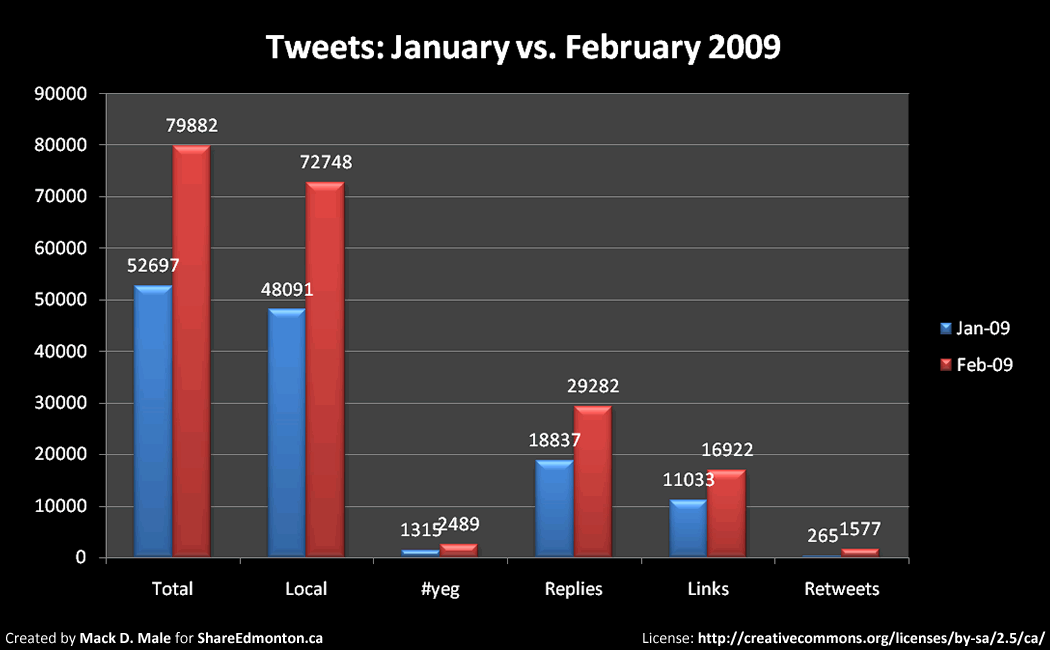
# of tweets by local users: 72748
# of tweets by local users containing #yeg: 2489 2231
# of tweets by local users that were replies: 29282 28212
# of tweets by local users containing links: 16922 13318
# of tweets by local users that were retweets: 1577 1468

This graph shows the (incorrect) above numbers compared to the same numbers from last month:

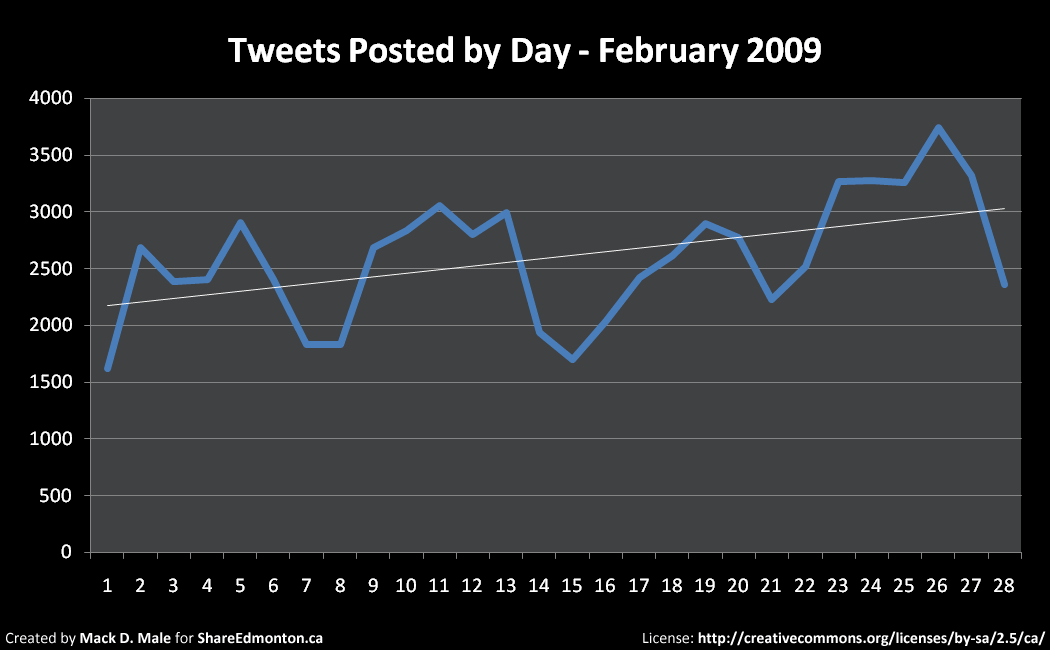
Of the 463 additional local users I identified in February, only 320 were new accounts created during the month. The other 143 users had existing accounts and either didn’t post in January, or only changed their location to something matching a local user in February. This graph shows the new user creation by day:

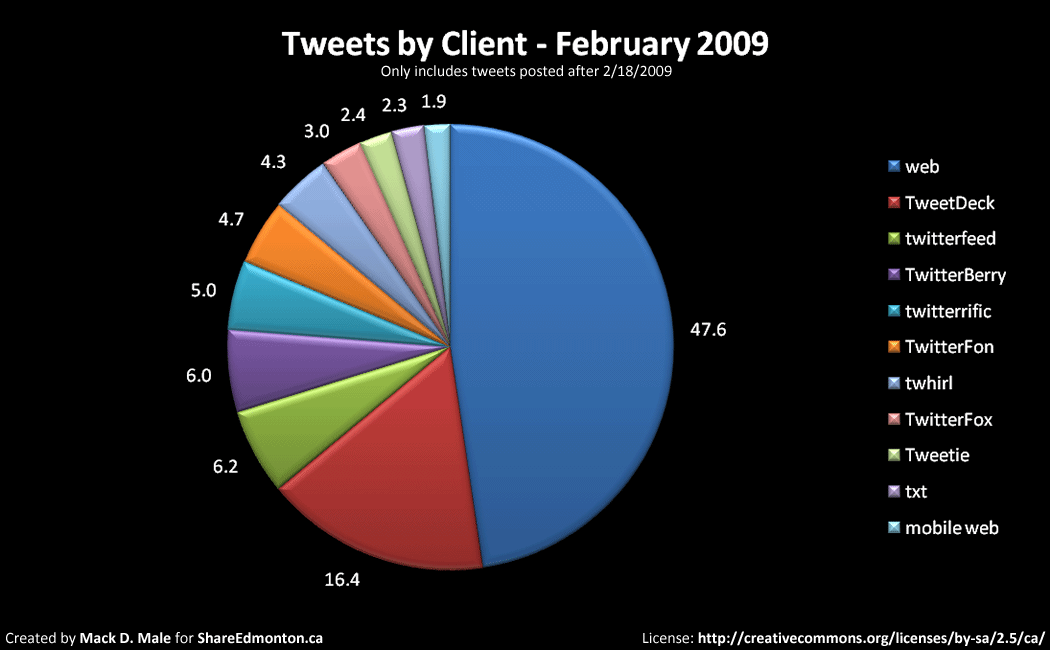
On the 18th, Twitter added a new property to the results returned by Twitter Search – the source. That means I was able to identify the clients that local users use most when posting updates. The top five are: web, TweetDeck, twitterfeed, TwitterBerry, and twitterrific. Note that web source actually includes all unidentified API calls too.

Some other interesting statistics for the month:

  • The ten most active local users (most tweets first): fcedmonton, angelzilla, britl, mastermaq, justNICKI, adampatterson, Pat_Lorna, foomanizer, AndyGroenink, and JodieGiese.
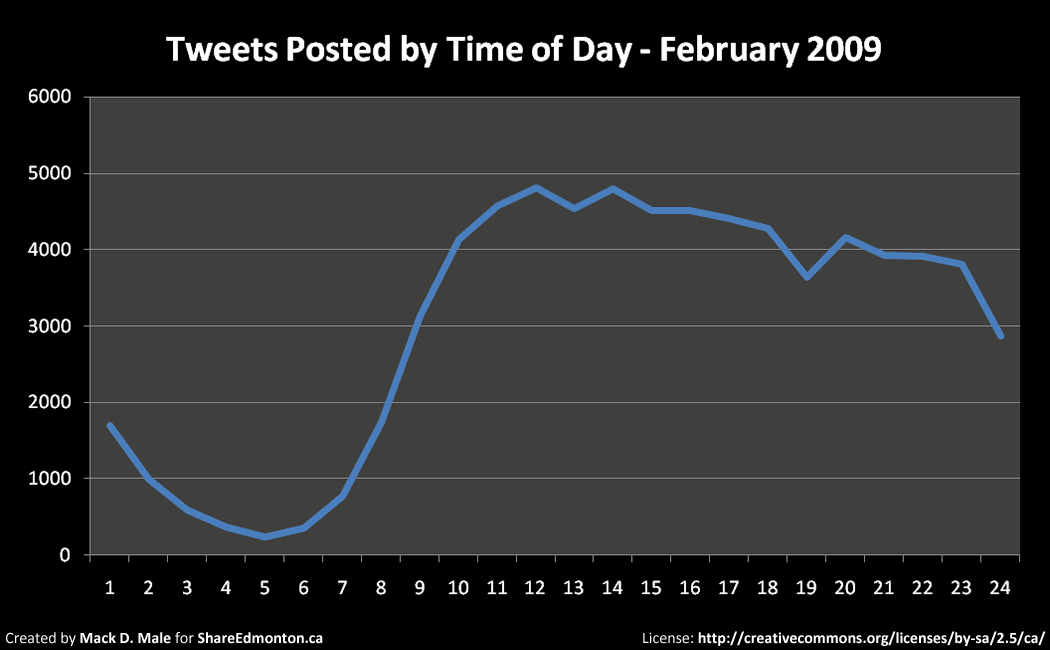
  • Just over 55% of all local tweets were posted between 9 AM and 5 PM.
  • Local users posted roughly 1.8 tweets per minute in February.
  • The day with the most local tweets posted was February 26th at 3742. On average, 2598 local tweets were posted each day. 
  • Of the 29282 replies posted by local users this month, 13141 or 45% were to other local users.
  • Just 343 local users posted 50 times or more this month. In comparison, 164 local users posted just once this month.

And finally, the top ten users in Edmonton (as of March 1st) by # of followers: Pat_Lorna, mastermaq, LesM, redneckmommy, cleversimon, melanienathan, babyrumps, saralees, jerryreeder, revtrev

I knew the number of local users would increase this month, but I had no idea by how much. With a sudden interest in Twitter in the local media, I expect the growth for March to be even larger.

I hope you enjoyed this unscientific look at the Edmonton Twittersphere! I have done my best to provide accurate numbers, but I can’t give any guarantees. If you have any suggestions or other feedback, please let me know.

UPDATE: Great suggestion from @britl – the total number of twooshes (tweets that are exactly 140 chars) posted by local users in February 2009: 2233

Where’s the Edmonton version of Illuminate Yaletown?

While in Vancouver last weekend, Megan and I went to check out an event called Illuminate Yaletown. Sponsored by the Yaletown Business Improvement Association, the event featured light-as-art installations spread throughout the heritage district. From the website:

Featuring light installations designed and developed by artists and architects, pyrotechnics, fire dancing, cutting edge music, interactive activities and a display of illuminated ice sculptures, Illuminate Yaletown shows off Vancouver’s hippest community in a whole new light!

We were impressed by what we saw! We started with the fire dancing and illuminated ice sculptures, and then made our way to the BMW Mini dealership that had been filled with lights. We saw another display where a video camera on the ground was projected up onto the side of a building. Down a little further were some illuminated windows with silhouettes moving about inside. There were lots of people walking around, taking in the sights!

Illuminate Yaletown

Illuminate Yaletown was developed to “brighten up a gloomy winter evening” and is the only outdoor event taking place in Vancouver at this time of year. Sound familiar? I immediately thought of Winter Light. This event sounds exactly like the kind of thing you’d expect to be a part of Edmonton’s new winter festival. But it’s not.

The closest thing is Illuminations, taking place on March 21st in Churchill Square. It too will have fire and projected light. The big difference is that it takes place only in Churchill Square. What I really liked about Illuminate Yaletown is that it got people walking around, so they could check out the buildings, shops, and restaurants in the area. It was a great combination of interesting art and community exploration and discovery.

I’m hopeful that next year’s Winter Light festival will include something similar.

You can see the rest of my photos from Illuminate Yaletown here.