Maybe we should have just had a food strategy

When it comes to the Food & Agriculture Strategy, there’s perhaps no organization more deserving of credit for getting us to where we are today than the Greater Edmonton Alliance (GEA). They worked hard during the development of the MDP to ensure that the importance of local food and agricultural land was recognized, and those efforts ultimately led to the creation of the strategy that is now in draft form. But GEA is also largely responsible for tying the development of that strategy to the land in the northeast, which has resulted in a document that fails to adequately address the importance of food to our city.

City Market 2012

Instead of a strategy to transform Edmonton into a world leading food city, the Food & Agriculture Strategy is viewed by most as simply one of the final remaining hurdles to the continuation of urban sprawl that has plagued our city for decades. Whereas the WinterCity Strategy was created to “highlight Edmonton as a leading winter city,” the Food & Agriculture Strategy was created to allow the development of ASPs to move forward.

The Advisory Committee, created to “offer guidance and experience in exploring the development” of the strategy, was doomed to fail from the beginning. Because the land issue was not resolved, it was made up of fifteen members representing very diverse interests, rather than fifteen members all focused on food. It’s no surprise that farmers and developers could not see eye-to-eye on what should happen with the land in the northeast and that the issue dominated discussions.

Think about all of the other advisory committees and task forces that have been created over the last few years. We’ve had groups come together to talk about community safety, homelessness, winter, and dozens of other topics. The makeup of the Food & Agriculture Advisory Committee is like putting people that hate winter on the WinterCity Strategy committee, or people who love crime on the REACH committee, or people who think we should have more homelessness on the Homeless Commission.

So, how did we get here? There are lots of reasons of course, but here are a couple thoughts.

MDP Second Reading

One issue is that GEA’s leaders don’t care about food as much as they care about power. This was made abundantly clear at the ward meeting GEA held on October 9. A significant amount of time was spent discussing the power struggles that take place behind-the-scenes inside and outside City Hall. “One of the tools GEA uses in organizing is the power analysis,” GEA’s Monique Nutter told us. She said that in organizing there are two forms of power: organized money and organized people. The latter is the approach that GEA has taken, and for a while it seemed to work well. They filled City Hall with citizens, and they got the attention of their opponents as well as City Council.

But somewhere along the line, GEA lost the room. Any support they may have had from Council during the MDP deliberations has largely evaporated. Were they too aggressive in their demands, or disrespectful in their communications? Does organized money speak louder than organized people? It doesn’t matter. The fact is, Council is unhappy with GEA right now. That’s a problem for those of us who care about the same issues as GEA but are not associated with them, because I think at least some Councillors now treat GEA and others who feel strongly about food and/or agricultural land as one and the same. Which means that if GEA is being viewed negatively, so are the rest of us.

I don’t mean to suggest that GEA deserves all the blame for the turnaround in support. Certainly Councillor Loken has not done the strategy any favors by “trying to add some reality to the discussions.” He claims his efforts have made him a target on the Advisory Committee. Rather than diffusing an already tense situation, it seems Councillor Loken has actually made things worse.

Food in the City

The second issue is that as far as I can tell, GEA didn’t have any other choice. Tying the development of the land to the creation of the strategy was really the best they could accomplish at the time. There was no support from Council for a stronger stance on urban sprawl, as evidenced by policy 3.1.1.2 in the MDP which establishes that just 25% of city-wide housing unit growth be located in the downtown and mature neighbourhoods.

In an ideal world, a Food & Agriculture Strategy would have been initiated without the need to incorporate a contentious debate over land use (of course, any strategy on food would have included something about the importance of agricultural land, but in broad strokes rather than specifics). Then again in an ideal world, the true cost of sprawl would be known and factor prominently in decisions about how our city should grow. We don’t live in an ideal world.

Untitled

On Friday, City Hall will fill up with citizens eager to have their say on the Food & Agriculture Strategy. We know that Executive Committee is not looking forward to the public hearing, they’ve made that clear. They’re expecting to hear the same thing over and over, and I admit that’s not an enticing prospect. But I think that’s because they’re viewing this strategy through the lens of land, rather than the lens of food. I hope there’s a large turnout on Friday, that at least a few people talk about the importance of food to Edmonton’s future, and that Executive Committee chooses to listen to them.

Media Monday Edmonton: Update #55

It has been a few weeks since my last update, so a few of the links below are a bit older but I wanted to include them just the same. Here is my latest update on local media stuff:

You can follow Edmonton media news on Twitter using the hashtag #yegmedia. For a great overview of the global media landscape, check out Mediagazer.

So, what have I missed? What’s new and interesting in the world of Edmonton media? Let me know!

You can see past Media Monday Edmonton entries here.

Edmonton Notes for 10/21/2012

Here are my weekly Edmonton notes:

Tri-lights 293-365
Lovely shot of the Muttart Conservatory with the skyline in the background. Photo by Funtographer.

It may be controversial, but the Talus Dome at night looks pretty impressive:

Talus 1
Photo by Sean Gordon.

Here are some upcoming events:

Down the Fall Path
Down the Fall Path. Photo by RandallTT.

Translating the City’s report on the Food & Agriculture Strategy

The agenda for next week’s non-statutory public hearing on the Food & Agriculture Strategy is now available online, as is the final draft of fresh: Edmonton’s Food and Urban Agriculture Strategy. In addition to some tidying up and a “fresh” new look, the final draft includes an executive summary. Here’s an excerpt:

fresh is not an endpoint, but a starting point. With that in mind, the Strategy does not provide a detailed implementation plan, but rather sets directions for moving forward. Implementation will occur over time as the Edmonton Food Council is established, partnerships are formed, research is continued, resources are allocated and progress builds towards results.

fresh

Also included in the agenda is a nine-page report prepared by Administration with an overview of the strategy, commentary on the recommendations, and a recommendation to Executive Committee on how to proceed. Here is the recommendation:

That Executive Committee recommend to City Council:

  1. That fresh: Edmonton’s Food and Urban Agriculture Strategy, as outlined in Attachment 1 of the Sustainable Development report 2012SPE029, be endorsed in principle.
  2. That implementation of fresh (Edmonton’s Food and Urban Agriculture Strategy) be postponed pending Administration reporting to Executive Committee in the first quarter of 2013 on the options and costs.

Endorsed in principle, but with implementation delayed pending an update on options and costs. I wasn’t entirely sure why they’d structure the recommendation that way. I mean, since when does Administration implement anything without first gathering options and costs? Why couldn’t Council approve the strategy, if they think it is ready to be approved, and then direct Administration to start implementation immediately, the first step of which might be to gather more information on costs?

So I kept reading. Here are the final remarks in the report:

While Administration views the recommendations of fresh as being generally reasonable and worthy of follow up, it also sees it being prudent to postpone implementation of fresh pending the development of a better shared understanding between Council and Administration on the options and costs to implement the Strategy.

Notwithstanding advice to postpone its implementation, endorsement of fresh in principle will satisfy the requirements of Municipal Development Plan Policy 3.2.1.7 relative to enabling consideration of future Area Structure Plans and will provide City Council with the means to evaluate future Area Structure Plans for the Urban Growth Areas by way of the tool kit contained in strategic direction 9 (see Attachment 3).

Right, so allow me to translate. Administration is basically saying: “Look, we have the development industry breathing down our neck and we need to get this taken care of ASAP so that the Area Structure Plans in the Urban Growth Areas can move forward. We know the recommendation that deals with land use raises a bunch of questions, but we don’t think it is important to answer those right now. Also, we don’t want your endorsement to necessarily commit us to implementing anything, even something as straightforward as establishing a food council, so we’re just going to come back with a report on costs and go from there. Cool?”

No, not cool.

I’d encourage you to read through the documents here in more detail.

Pecha Kucha Night: Edmonton #14

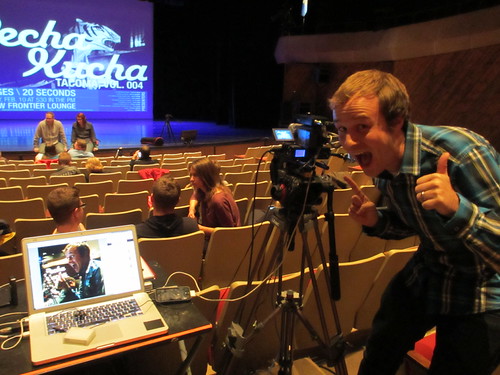
Edmonton’s fourteenth Pecha Kucha Night was held tonight at the Myer Horowitz Theatre on the University of Alberta campus. It looked like it was going to be a smaller crowd tonight, and though not quite a sell-out, the theatre did fill up just in time for the presentations! There were six women presenting tonight, the first time since PKN4 that women have outnumbered men on stage (I mention it only because many folks noticed the split tonight, and recent PKNs have indeed featured predominately male presenters).

In order of appearance, these were the presenters at PKN14:

  1. Dave Mowat, Light it Up, #yeg!
  2. Sunniva Van, Ride to Learn
  3. Pamela Colleen, The Universal Language: and No, It’s Not Love
  4. Wang Yip, Design Is…
  5. Shawn Kanungo, I Love the Spelling Bee
  6. Renee Vaugeois & Chelsea Freeborn, Imagine a Dream
  7. Jacqui Fraser, A Split Second
  8. Daniel Schneider, That John Denver is Full of S@#*
  9. David Zip, 3D Workflows for Historical Refacading
  10. Brittney Le Blanc, Bragging is Good

Alberta’s Minister of Human Services and Government House Leader Dave Hancock was slated to speak tonight but had to cancel at the last minute.

On the whole I’d say tonight’s slate of presentations was better than average. The presenters were all new to presenting at PKN, and I thought everyone did a great job! There was a good mix of newcomers in the audience, and more than a handful of people who had been to five or more PKNs. Only a few of us have been to every one though!

Pecha Kucha Night Edmonton #14

Dave kicked things off with a talk about light. Light makes people happy, he told us. He showed examples of some of our favorite cities from around the world, including New York and Paris, with their recognizable structures all beautifully lit up at night. He then showed Edmonton’s bridges at night, all very dark, and none that you would see on a postcard. He added some light to the Groat, High Level, and Low Level bridges to get us thinking about what could be. He then exited the stage on crutches that lit up! It was a really strong start to the evening.

Next up was Sunniva who shared some great stories from Ride To Learn. Very inspiring and strong images too. Pamela took us through the universal language – that would be music, not love! She seemed to have a strong dislike for heavy metal, mentioning a few times that plants forced to listen to Metallica for too long would soon die. It was a very thoughtful talk, and definitely made me think more about how the music I listen to has an impact on what I’m doing. Wang was fourth, and he talked all about the power of design. His talk was sort of the prototypical Pecha Kucha talk, and I mean that in a good way. He showed a variety of designs and encouraged everyone to think about what design means to them. The highlight slide was a design for a divorce lawyer’s business card that featured a perforation down the middle.

Pecha Kucha Night Edmonton #14

Shawn gave the final talk before the intermission, and I think it’s safe to say he brought the house down! It was smart, funny, and he delivered it with such enthusiasm and stage presence. If there were ever a “Pecha Kucha All-Stars” in Edmonton, Shawn’s would no doubt make the cut. I won’t do it justice, so just watch it:

I also totally love that he was inspired by Omar’s wonderful talk on cats from PKN13:

First up after the break was the tag team of Renee and Chelsea. They had a cellist join them on stage and they delivered their talk over the music. It was a good concept, but it really didn’t work. I also thought their talk could have done with some focus. Jacqui was up next with a very thought-provoking talk that touched on everything from why some colors are used for certain things to why the Fibonacci sequence is so powerful. Daniel had the eighth talk of the night, a cleverly crafted talk about why he loves being a country boy. It was a bit slow starting, but finished strong. I loved the hand-drawn images that illustrated most of the talk! David had the penultimate slot, and talked about historical refacading. He didn’t touch as much on the 3D workflows part as I thought he might, but he did certainly point out some intriguing architectural observations. For instance, he noted that Starbucks does a great job of making its locations look as though they have been in the neighbourhood for decades (as opposed to say a McDonald’s where each location looks the same on the outside).

Pecha Kucha Night Edmonton #14

The final talk of the night was the much anticipated presentation from Brittney. I didn’t know what to expect based on the title “Bragging is Good” but I was pleasantly surprised to see that it was a call to action for Edmontonians to speak up about the great things we have in our city. I am not a fan of the giant baseball bat on 118th Avenue, but Brittney is, and she speaks up about it (and notes that it spins!). I also like that she touched on the importance of going from “should” to actually doing something. It’s easy to say something should be done, and much more difficult to actually do it. Here is Brittney’s talk:

Like I said, everyone did a great job tonight, but my favorite has to be Shawn’s. Based on my completely unscientific read of audience reaction in the room and on Twitter, my guess is I’m not alone in feeling that way either!

Edmonton’s NextGen received a lot of complaints about the service charges that Prime Box Office charged for tickets. I was even charged $3 per ticket when purchasing at the door. NextGen was not happy about the charges either, but couldn’t do anything about it as PBO is the exclusive ticket retailer for the venue. If you want to complain, get in touch with Prime Box Office and the Myer Horowitz Theatre. This was the third PKN at the Myer Horowitz (the only repeat venue) and while the size of the audience has greatly reduced the number of potential venues, perhaps it was the last.

Our hosts tonight were Doug McLean and Karen Unger, and they did a nice job of keeping us on track while adding a dash of humor. As has become customary, the Edmonton Journal was once again livestreaming the event. Major props to Ryan Jackson for an amazing job and for getting all of the videos uploaded to YouTube before the event even ended!

Pecha Kucha Night Edmonton #14

Stay tuned to @EdmNextGen on Twitter and check out the website for updates on PKN and other events. Also note there’s a new hashtag in use: “#pkn14 is just one night, #yegpkn is forever.” See you at PKN15 in March 2013!

You can see more photos of tonight’s event here, and check out all the videos here. You can read about past Pecha Kucha Nights in Edmonton here.

The arena deal is dead, but the City of Edmonton came away the victor

After a heated discussion on the arena yesterday afternoon, City Council voted to cease all negotiations with the Katz Group and directed Administration to explore alternatives. Here are the three motions they passed:

  1. As a result of Mr. Katz’s letter and unwillingness to have an open discussion with Council and the frustration of the Interim Design Agreement, all negotiations and ongoing City work related to the October 26, 2011, framework cease immediately.
  2. That Administration provide a report, as soon as possible, to City Council to report on the completion of the cessation of negotiations and the status of the City’s current, transferable investments in a potential downtown arena project.
  3. That Administration provide a report outlining a framework for Council to explore potential avenues to achieve the long term goals of sustainable NHL Hockey in Edmonton.

That means the arena as we know it is dead, but it doesn’t mean that a new arena is completely off the table. With that third motion, Administration is empowered to explore alternatives to working with the Katz Group, which could mean the City builds a new arena by itself. Here’s the full video of Mayor Mandel and City Manager Simon Farbrother answering questions about yesterday’s meeting:

Supporters of the arena will no doubt lament the fact that we appear to be no further ahead than we were four years ago, but I don’t think that’s true. Here are some of the reasons that I think the City and Council came away the victors in this whole debacle:

  • The City owns the land. No matter what happens with the arena, that land was a great investment. And I’d much rather have the City own it than some speculator who is just going to sit on it.
  • The City owns the design of the arena. Last October, Council directed Administration to spend $30 million to get the design completed to 60%. The City can take this design to a new partner or use it as the basis for building the arena itself.
  • The City now has a head start on a CRL for downtown. I think a case could be made for a downtown CRL even without the arena. Maybe it would be scaled back, but all the work that has already been done to develop the CRL plans could be reused.
  • Council no longer look like the bad guys & gals. I’m no fan of the way that Council handled the negotiations over the last couple of years, but fortunately for them Katz handled things even more poorly!
  • It may seem as though Katz has the upper hand with the ability to move the team elsewhere, but that has always been an empty threat and remains so. The NHL still wants hockey in Edmonton, and I honestly believe that Katz wants to keep the Oilers here too. If anything has changed, it’s that the NHL would be even less likely to allow a move now that Council has done everything it can to work with the Katz Group.

I’m less confident this will actually come to pass, but I was encouraged by comments made yesterday by one of the Councillors that the “unprecedented” use of in-camera sessions should be avoided in the future. It’s clear that the private meetings did more harm than good in progressing the deal and getting Council what they wanted, and I hope that means Council will avoid in-camera sessions in the future.

The arena is getting all the attention right now, but in the grand scheme of things, there are far more important issues for Council to be dealing with. More than 150 neighbourhoods need renewal and it’s going to take billions to maintain all of that infrastructure. At the same time, Edmonton’s population and economy continue to grow much faster than the national average and that means big pressures in terms of where we put new infrastructure, how we move people efficiently throughout the city, etc. As soon as they were done with the arena issue yesterday, Council starting talking about the LRT.

Back to business.

If you care about local food & urban agriculture, tell your Councillor

In an effort to connect City Council with constituents to discuss the Food & Agriculture Strategy, the Greater Edmonton Alliance (GEA) organized two ward meetings in advance of the public hearing on October 26. The first took place on Tuesday at the Robertson Wesley United Church, and while the councillors for wards 2, 3, 4, 6, 7, and 8 were invited, only Councillor Henderson attended. GEA officials told us that Councillor Krushell had responded and that she was unable to attend, and that Councillor Loken had responded and wanted to meet privately with GEA (he confirmed to me he is waiting for GEA to confirm a meeting, GEA has told me they want a public meeting, not a private one).

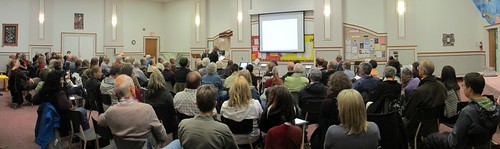
GEA Local Food Ward Meeting

The meeting was scheduled to last one hour, and GEA officials did a good job of sticking to that schedule. Unfortunately most of the hour was spent bringing everyone up-to-speed on the issue, and on GEA’s efforts thus far. We heard from Elizabeth Smythe from GEA’s Local Food Team, Debbie Hubbard, who served as GEA’s representative on the Food & Ag Strategy Advisory Committee, and Monique Nutter, Co-Chair of GEA’s Local Food Team. Monique concluded her remarks with a call-to-action for citizens and a request that Councillor Henderson respond by October 22:

Unfortunately, pressures are mounting to push decisions on this land forward quickly in a way that denies the time to explore options and, more concerning, marginalizes the voices of citizens.

We are here tonight to ask our City Councillors to work with us to ensure the Citywide Food and Agriculture Strategy provides the necessary information to enable good decisions.

Finally, we got to hear from Councillor Henderson. “I’m not the one that needs to be convinced,” he started, gesturing to the empty chairs that had been set aside for his colleagues on Council. He received a loud ovation for his attendance from the crowd.

Asked whether he felt the strategy sufficiently answered questions about what to do with the land in the northeast, Councillor Henderson responded: “I absolutely do not have enough information yet.”

In his remarks, Councillor Henderson noted that whatever support might have existed for preserving the land in the northeast back when the MDP was passed now appears to be gone. What happened? The answer might be found in a blog post by former GEA organizer Michael Walters:

The campaign to “preserve farmland” in northeast Edmonton was never an either-or endeavor. It was never about opposing development. It was about making something amazing in Northeast Edmonton.

In short, he feels the conversation has shifted from wondering where our food will come from in the future to a debate over sprawl and farmland. A debate he feels is unwinnable.

It was a strategic decision to tie the creation of the Food & Agriculture Strategy to the development of the three Urban Growth Areas. Whether that was the right strategy or not remains to be seen, but at the moment things feel far more uncertain than they did three years ago. There are some good things in the strategy and it would be a shame to see them held up or abandoned because of the land use issue in the northeast. At the same time, what other leverage do proponents of preserving the land have? The Growth Coordination Strategy has already been made much less comprehensive, and the Integrated Infrastructure Management Plan has already been approved as a “framework”, rather than as a plan of Council as originally identified.

“What happens if we delay the entire strategy?” Councillor Henderson wondered aloud at the meeting. “I’m uncertain about what happens next.”

GEA Local Food Ward Meeting

Councillor Henderson also reminded everyone in attendance that this is a regional land issue. “The essence of this is the fixation in this province with the primacy of property rights,” he said. Michael Walters notes the responsibility to deal with the issue has been floating back and forth for years:

The Capital Region Board has shown little courage in facing this question and in fact handed back the responsibility for addressing protection of farmland to the province in 2010. So for the City of Edmonton to pass this decision to the regional board cements an existing culture of timidity in dealing with this issue.

This is despite clear input to the Capital Region Board on the issue of preserving agricultural land:

In the quantitative survey, a significant majority (60 percent) of residents said agricultural lands should be preserved and protected. This support was consistent across the region.

How can we address the ongoing lack of action? How can we get City Council to pay attention? Liane Faulder says a “noisy, loud, foot-stomping and engaged” food movement is needed:

City council may well get away with doing precisely nothing of any substance to deal with the issue of urban agriculture because nobody is going to make them. There’s not a single council member who has shown any real interest in the urban food debate.

In other words, if you care about this issue, you need to get involved now!

GEA Local Food Ward Meeting

The next meeting takes place on Thursday evening at 7pm at St. Theresa’s Parish (7508 29 Avenue). Councillors Sloan and Diotte have apparently confirmed their attendance, and the councillors for wards 5, 9, 10, and 12 have been invited.

Don’t forget the non-statutory public hearing on the Food & Agriculture Strategy takes place on Friday, October 26. If you want to speak at the hearing, fill out this form.

The story of how I fell out of love with driving

When I got my current car, a 2005 Honda Civic, my Dad bought me a gas mileage book and told me to record each and every time I filled up. I have been diligently recording the date, odometer reading, number of litres, gas price per litre, and total cost of each fillup ever since. I also record notes on some fillups, such as out-of-town trips. A couple of weeks ago, inspired by Nora Young’s trip to Edmonton to discuss self-tracking, I finally decided to digitize the records. It occurred to me that this was the first bit of self-tracking I ever did. I know that I drive far less today than I did when I got the car, and I wanted to be able to visualize that. You can see the charts below, but to really understand them, I need to share a bit of history with you first.

The moment I turned 14, I was ready to get my learner’s permit. Like most guys my age I desperately wanted to drive, even if I needed to have an adult with me. I got the study guide, but didn’t spend too much time with it. As a result, when I went to write the test, I failed by one question (it was something to do with uncontrolled railway crossings if I remember correctly). I made sure to not let that happen again, and the second time I passed with no problems. I was living with my Grandma at the time, and she was great about letting me drive. Whenever we went to the grocery store or if she was dropping me off somewhere, she’d happily take the passenger seat.

I took lessons from AMA to learn how to drive a manual transmission, and took the driver’s test soon after I turned 16. With only a few minor hiccups I passed, and was free to drive on my own (fortunately I got in just before the GDL program took effect, so I had no limitations). When I was in high school, I drove a lot. I thought nothing of crossing the city to get somewhere or to drive a friend home. Gas prices were quite a bit lower at the time than they are today, but looking back it still seems incredibly wasteful how much I would drive.

When I started attending the University of Alberta, I would frequently drive. Sometimes I’d park at campus, other times I would get a ride with a friend, but most times I would park at the Stadium LRT Station and take the train the rest of the way (also handy because my office was downtown). I would sometimes take the bus, but I never made that a habit.

Shortly after I graduated in the spring of 2007, I started working at Questionmark. Our office was located near The Brick warehouse in the northwest part of the city, and I was still living with my Grandma in the southeast. That meant driving about 60 kilometers every day, and it meant driving the very busy Whitemud. I looked at taking the bus, but it would have taken about 45 minutes and required a transfer.

In May 2008, I moved into an apartment in Oliver with my sister. That cut the distance to work significantly, though I still drove every day. Roughly a year later, with our local team growing at Questionmark, we decided to move the office downtown to the Empire Building. I started taking the bus to and from work every day, because it was just a short trip (about a 15 minute ride) and I didn’t want to pay for parking.

In the summer of 2010, Sharon and I moved into our current place on 104 Street. I’m now just a short walk away from the office (Google estimates 9 minutes), which means I walk to and from work every day. As we have written before, I absolutely love it.

To recap quickly:

  • June 2005 to July 2007: I drove pretty much everywhere.
  • July 2007 to May 2008: I drove across the city to get to work every day. I regularly drove other places.
  • May 2008 to May 2009: I still drove to work every day, but the distance is much shorter.
  • May 2009 to July 2010: I took the bus to work, and drove only on evenings and weekends.
  • July 2010 to present: I walk to work, and avoid driving whenever possible.

Here’s what that behavior looks like on a graph:

distance by year

I think the four big shifts are pretty evident in that graph. Slowly but surely, I have been reducing any dependence on my car to get around.

Out of interest, here’s what that behavior cost me at the pump:

spend by year

I wish I had kept records prior to 2005, because I know the price of gas was quite a bit less when I first started driving.

What’s not captured in this data is how my attitude toward driving has changed over the years. It sounds counterintuitive, but the less time I spent behind the wheel the less I enjoyed it. I remember arguing with Sharon back in my university days about how terrible our public transit system was (she has always been a regular user). I loved driving and wanted nothing to do with the bus. Today we use the car maybe once a week, for trips to Superstore, to visit family, or to get out of town, and I regularly complain if I need to drive for pretty much any other reason. I would much rather walk or take the bus. I now find driving quite stressful! I’m sure that the shift from driving to walking has positively impacted my health. It has no doubt lowered my carbon footprint by quite a bit as well.

Also missing from the above charts are the other changes that have made my move away from the car possible. Without question, being able to use Google Maps to lookup bus routes has been hugely beneficial. Text messaging at bus stops has also made the experience of using the bus much more positive. My experience traveling in other cities has no doubt had a big impact on me as well. The are lots of things to consider.

As much as I would like to go car-free, it’s just not a very realistic option in Edmonton at the moment. I’m hopeful that will change however, and that our next car will be our last (though I recognize that other life changes may significantly affect that plan).

In an effort to better understand my behavior and potentially change it, I have been tracking my travel habits every day this year. In January, I’ll be able to show you a full year of data, including how often and how far I traveled by foot, bicycle, automobile, bus, train, plane, etc. Stay tuned!

TEDxEdmonton Education: Discussing the evolution of learning in the City of Learners

Hundreds of Edmontonians will gather at the Winspear Centre on Saturday for a special TEDxEdmonton event focused on learning.

In the spirit of ideas worth spreading, join us for a special edition of TEDxEdmonton around a conversation on how learning is evolving and impacting our schools, workplaces and industries. We’ll come together to kickstart a discussion on learning among students, educators, entrepreneurs, artists, scientists, and community leaders. How do we disrupt the status quo and replace traditional approaches to learning? How do we leave the politics of education behind to focus on impact and innovation?

TEDxEdmonton Education is open to anyone interested in the topic, and will bring a number of intriguing speakers together for what should be a very inspiring day. You’ll hear from some local folks such as Ashlyn Bernier of the Graduate Students’ Association at the University of Alberta as well as some special guests from out-of-town like Stephanie Lo, Product Manager of TED’s Education initiative. The full line-up looks amazing!

tedxedmonton education

Education is a topic I have been thinking about a lot lately, mainly from two perspectives: technology and cities. I’m unfortunately going to be out of town on Saturday, but I wanted to share a few thoughts in advance of the event.

Massively Open Online Courses

It’s shocking to me that we, more or less, teach the same way today as we have for centuries, despite incredible advances in technology. A teacher or professor in front of dozens of students in a classroom is typically the image that comes to mind when we talk about teaching and learning. Is that really the best we can do?

I was inspired recently by Daphne Koller’s TED Talk in which she discusses the emerging trend toward online education. She’s a co-founder of Coursera, which is one of the popular new platforms for MOOCs – massively open online courses. Coursera, edX, and other platforms are enabling a really interesting new way of learning. Instead of a few hundred students in a classroom, these online courses bring potentially hundreds of thousands of students together from all over the world. There’s still a professor and there are still lectures (delivered via video on-demand) and there are still readings, but there’s a lot that is different too. For starters, they’re free!

Here is Daphne’s talk:

I decided to take a course to experience first-hand what a MOOC is like. I signed up for the Introduction to Sustainability, taught by Jonathan Tomkin from the University of Illinois. There are lots of reasons that people might take this course – maybe they’re looking for academic credit, maybe they’re looking to advance their careers, or maybe like me they are just interested in the topic. I admit I haven’t been keeping up with the course as well as I should have, but already I have gotten a lot out of it. One of the most interesting things to me is the “How to Pass the Class” page, which states:

I recognize that this is no ordinary course. You may have different perspectives and different goals for this course than some of your peers or than I could have anticipated. Therefore, I want to empower you to customize this course to meet your needs. To this end, I have designed multiple “badges” you can earn through participation in this course.

Here’s a look at those badges:

coursera pass the course

This is great! If you want to take the “traditional” approach, you can simply do all the quizzes. But there are other options now. I like the idea of doing a project, because it provides an opportunity to really apply what you’ve learned. Most interesting of all are the forum badges – you can pass the class simply by interacting with your peers. I say simply but that’s probably not the right word because I think there’s an incredible amount of learning that can happen through that interaction. Some students have even formed in-the-flesh study groups in their cities!

I don’t know if MOOCs are the future of learning, but so far I like what I see.

City of Learners

As you may know, Edmonton has been declared a City of Learners. Through the Edmonton Learning Initiative, the City is trying to make lifelong learning a core value of our community. The initiative has adopted UNESCO’s four pillars of education:

  1. Leaning to know – understanding how we learn
  2. Learning to do – emphasis on the knowledge component of tasks
  3. Learning to live together – educate to avoid conflict or peacefully resolve it
  4. Learning to be – the complete development of the mind body, intelligence and sensitivity

These are quite broad of course, but so is learning!

Thinking about the education system more specifically, we can see from the 2012 Municipal Census that roughly 24% of Edmontonians were identified as students. Here’s the breakdown by level:

edmonton students

Edmonton has long been recognized as a leader in public education, and Edmonton Public Schools has been singled out as a model district. It’s encouraging to see achievement results that show the continued success of EPSB’s approach. I’m also a big fan of initiatives like City Hall School, which provides Grade 1-9 students with the opportunity to learn more about how the city works. It has been a big success, so perhaps we should consider expanding it to other levels? Fieldston’s City Semester in New York sounds like the kind of course I could only have dreamed about in high school.

The University of Alberta has a publicly stated goal to become one of the top 20 universities in the world by 2020, and while that sounds audacious it also seems attainable. Edmonton is fortunate to have a number of great post-secondary institutions, and we should not take that for granted. Here’s just one post on why universities matter so much:

Universities appear to function as an important social leveler. Nations with larger numbers of great universities have lower income inequality (with a negative correlation of -.475 between the two). And universities are part of the mix of institutions that lead to higher levels of happiness and well-being across societies.

There are all kinds of reasons that having strong educational institutions here in Edmonton will make our community stronger, but is education also something we could be exporting to other places? This post by Avnish on Alberta’s labour shortage proposes a really interesting idea:

In an era where governments are scaling back funding to post-secondary education, India presents itself as a lucrative opportunity. Alberta’s colleges and universities can make up funding shortfalls by expanding into India, with its large market, significant growth potential, and cheaper start-up and operating costs.

The argument is that we could tap into India’s labour pool with this approach.

One of the biggest reasons to think about education in relation to cities is the economy. Edmonton enjoys one of the lowest unemployment rates in the country, hence the labour shortage referenced above. We need trained, skilled workers not only to fill the jobs we currently have available, but to create new ones too. We’re in a resource-based economy, but attracting and inventing new industries will be important for our long-term viability. It can be tempting to equate the “creative class” with education, but Richard Florida cautions against that:

The creative class is not just a proxy measure for college graduates. Roughly three-quarters of college grads in America work in creative class jobs, but four in ten members of the creative class—16.6 million workers—do not have college degrees.

They may never have been college students, but they’re absolutely learners.

There are just so many aspects of education in relation to the city that could be explored! I’ll leave you with part of Council’s declaration:

As a City of Learners, we celebrate the excellence our community has already achieved in learning, and we set our sights on even greater success for individuals, institutions, industry and our city as a whole. The challenges of a complex and competitive world demand nothing less than conceiving of learning as an organizing principle in our community.

TEDxEdmonton Education

I can’t wait to hear about all of the interesting ideas and conversations that come out of TEDxEdmonton Education this weekend! Tickets are $99 and that includes a full day pass plus lunch and snacks. The official after party is Edmonton’s fourth Timeraiser, a unique art auction where you bid in volunteer hours.

Ticket Giveaway: Edmonton Comic & Entertainment Expo

Adam West. Billy Dee Williams. Charisma Carpenter. These are just a few of the special guests you’ll find later this month at Edmonton’s premier pop culture show, the Edmonton Comic & Entertainment Expo. This new event grew out of a partnership between the Edmonton Toy & Comic Show and the Calgary Expo:

Whether you’re a connoisseur of sci-fi, horror, gaming, fantasy, animation, toys, and comic books, or you simply have a keen interest in pop culture, then this is the show for you. The Edmonton Expo will feature vendors, exhibitors, celebrities, and artists, from every nook and cranny of the pop culture universe, not to mention the many hours of fantastic programming included with admission.

The event takes place on October 20 and 21 at, appropriately, the Edmonton Expo Centre. Check out the detailed schedule here. You can see the event on ShareEdmonton here.

Ticket prices range from $15 for a single day to $150 for a VIP pass and are on sale now at Ticketmaster. I was fortunate enough to be contacted by the show’s PR folks recently with some tickets to give away! Here’s what is up for grabs:

A family pack of Edmonton Expo tickets (2 Adult tickets and 2 Children ages 10 and under) and priority seating at the Whedonverse Panel, where Sean Maher and Charisma Carpenter will lead a discussion on what it has been like working within the Whedonverse and the benefits their careers have had working beside legendary writer, producer, and director Joss Whedon.

To enter the contest, simply leave a comment below identifying an “Edmonton superhero”. It can be a real person or a character you make up!

Entries will be accepted until 11:59pm on October 17, 2012. I will contact the randomly chosen winner by e-mail by October 18, 2012.

Good luck!