Edmonton Notes for 9/5/2009

Here are my weekly Edmonton notes:

City Centre MarketCity Centre Market

Why I’m excited for the Southeast LRT

Now that I’ve had a chance to think and talk to a few people about yesterday’s LRT route announcements, there is one aspect in particular of the Southeast LRT route that I am quite excited about.

Can this:

Pic of the Day #965 by Kenneth Hynek

Go with these?

Fall Photowalk in EdmontonMuttart - May 12 024 - by A.N.U.J

I think the answer is a big yes (minus the high-floor, underground, elaborate stations…low-floor FTW).

If you look closely at the recommended route for the Southeast LRT corridor, you’ll notice that it goes from downtown through Louise McKinney Riverfront Park and across the river to the Muttart Conservatory (where there should be a stop).

Did you catch that? The LRT will go through the crown jewel of Edmonton, the river valley!

A low-floor, urban style LRT route from downtown through the river valley opens the door to all kinds of possibilities. Most obviously, it makes the river valley accessible to all – no more talk of building an incredibly expensive funicular. More significantly, it creates the potential for some development along the river valley. Think riverfront restaurants, pubs, and other attractions. Don’t get me wrong, I don’t want to turn our river valley into an outdoor West Edmonton Mall or anything like that, but I do think that we often fail to make the most of what is perhaps our best asset. I think an LRT stop at the Muttart Conservatory could spur a number of interesting ideas and concepts.

Now to be clear, this isn’t guaranteed to happen. They could still switch the stations or even potentially the route. And I don’t know how they plan to get from downtown down to the river. There are a lot of unknowns. Still, I think the potential for this is incredible. That’s why I’m excited about the Southeast LRT route, and why I think you should be too!

Photo credits: A.N.U.J, mastermaq, Kenneth Hynek

West & Southeast Edmonton LRT Route Recommendations

This afternoon Edmonton Transit announced its recommended routes for West and Southeast LRT lines. The routes “work towards the Transportation Master Plan’s vision to expand LRT service to all sectors of the City of Edmonton by 2040.” Back in June, City Council approved the LRT Network Plan, which identifies how the LRT system will be expanded. These two routes are part of that plan.

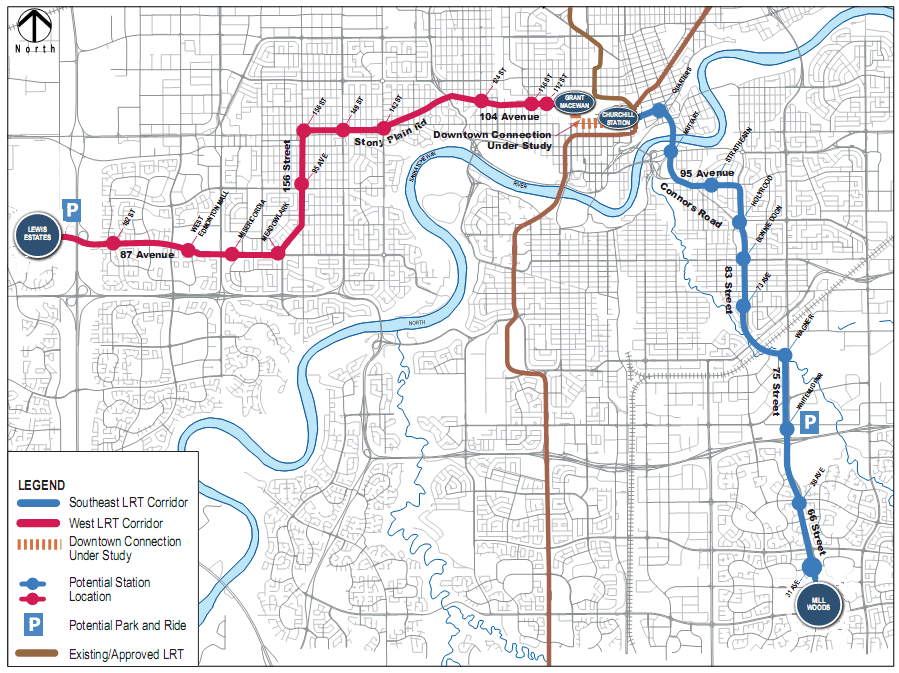
Here’s what the recommended routes look like (click for a larger image):

There was a lot of information shared during today’s briefing, which I did my best to live-tweet. Here are some of the highlights:

  • This is not the LRT you’re used to – it’s low floor technology with smaller, urban style stations.
  • Initially, there are seven stations planned for the West LRT route and six for the Southeast LRT route.
  • The two routes are actually part of a single line, which means you’ll be able to travel from Mill Woods to Lewis Estates without any transfers.
  • Travel time from either end to downtown will be 20-25 minutes. Both speed and carrying capacity is expected to be the same as the current LRT line.
  • The estimated cost for each route is between $900 million and $1.2 billion.
  • Short-to-medium term ridership for each line is expected to be 45,000 riders per day by 2040.
  • Though bus routes will almost certainly be eliminated, service hours will likely remain the same and will simply shift elsewhere (so in effect, the LRT is making the bus system more efficient).
  • The downtown connection still needs to be considered.

The routes were evaluated based on a new set of decision-making criteria established in December 2008 for LRT route planning. Initial screening looks at feasibility, community, and environment. The next stage is the specific evaluation criteria, with weights in brackets:

  • Land-use/Promoting Compact Urban Form (4)
  • Movement of People/Goods (3)
  • Feasibility/Construction (2)
  • Parks, River Valley and Ravine System (2)
  • Social Environment (2)
  • Natural Environment (2)

Southeast LRT

Recommended Route
Route Options

The Southeast LRT corridor travels north from Mill Woods Town Centre on 66 Street, continuing north on 75 Street. It then uses Wagner Road to extend either over or under the CP Rail line to 83 Street. From there, it proceeds along 83/85 Street north to 95 Avenue, then along 95 Avenue to Connors Road with the route crossing the North Saskatchewan River, either replacing the Cloverdale footbridge or adjacent to it, and east into downtown to connect to the proposed Quarters development, providing a surface (street level) connection to Churchill LRT station, ultimately connecting to Grant MacEwan College.

Major potential stations: Muttart Conservatory, Bonnie Doon Mall, Grey Nuns Hospital, Mill Woods Town Centre

Key benefit: Direct link to downtown, minimizes traffic impacts to Connors Road.
Key weakness: Neighbourhood disruption.

West LRT

Recommended Route
Route Options

The West LRT corridor goes from Lewis Estates east along 87 Avenue, then north on 156 Street. It connects to downtown via Stony Plain Road and 104 Avenue, providing a surface (street level) connection to Grant MacEwan College.

Major potential stations: MacEwan, Oliver Square, Jasper Gates, MacEwan Arts Campus, Jasper Place, Meadowlark Shopping Centre, Misericordia Hospital, West Edmonton Mall

Key benefit: Direct connection to downtown, opportunity to transform Stony Plain Road into a transit corridor for west neighbourhoods.
Key weakness: Impact on established neighbourhoods.

Discussion & Analysis

At this point, I’m simply happy to see this moving ahead. The South LRT expansion has been going well, and it’s important to keep momentum and interest. The West LRT route has definitely been the more controversial of the two, and I don’t see that changing (which likely means that the Southeast LRT route will get built first).

I talked to Councillor Kim Krushell this afternoon to get her thoughts on the recommended routes. While she too was happy to see progress, she had reservations about the West route, telling me that she didn’t necessarily agree with the weighting of the evaluation criteria. “Some estimates put the number of people working at the U of A at 50,000 and the number working downtown at 60,000. The recommended route bypasses a major employment centre.” While she’s “not against the Stony Plain route” she will be asking questions to better determine if the Stony Plain route is actually better, and admitted that “the Oliver connection is appealing.”

That got me thinking about the impact of the West LRT route on the University of Alberta. While many who work in the area may not replace their vehicles with the bus, there’s a good chance they’d use Park and Ride and take the train to work. Students on the other hand, will almost certainly use the bus if no other transit option is available. I called Students’ Union President Kory Mathewson to get his thoughts: “The biggest impact for students is access to afforable housing. The more transit connections we have to the University, the more options students have.”

I expect to see a number of community meetings and town halls related to the West LRT route over the next couple of months.

What’s next?

This is far from a done deal, and there are a bunch of upcoming events you should know about. First up are a series of public information sessions taking place on September 21 and 23 for the Southeast LRT route and September 29 and 30 for the West LRT route (full details here). This is your opportunity to learn more and to ask questions.

Next is a statutory public hearing on November 9th, followed by a report back in December 2009. Concept engineering, which includes working with individual neighbourhoods to site stations, complete environmental analysis, planning a new maintenance facility site, and further defining the downtown connection, will take place from November 2009 through December 2010. It is during the engineering phase that details like home expropriation will be determined.

Funding is in place for a Lewis Estates Transit Centre and Park and Ride facility (with over 800 parking stalls). The Transit Centre is expected to be completed in March 2010, and the Park and Ride in July 2010.

Beyond that, a lot depends on the direction and priorities set by City Council. We should get some indication of their thoughts at the Transportation Master Plan public hearing taking place on September 14.

To keep up-to-date on these and other LRT projects, visit http://www.edmonton.ca/LRTprojects.

UPDATE: Thinking about the West LRT a little further, does it matter that it doesn’t go directly to the University of Alberta? By the time it’s built, the Quesnell Bridge will be widened and express bus service from West Edmonton Mall to the U of A will likely be quite fast.

Visualizing Edmonton’s Municipal Development Plan

The Municipal Development Plan (MDP), also known as “The Way We Grow”, is the City of Edmonton’s strategic land use plan. You can think of it as the implementation of the City Vision for the next ten years (along with its sister document, the Transportation Master Plan). The next public hearing on the draft MDP takes place tomorrow (you can download the agenda in Word here).

From the Executive Summary:

By the year 2040, Edmonton will be home to more than 1 million people. To accommodate our growth and to aid Edmonton’s evolution to a more sustainable, healthy and compact city, this plan takes a holistic city building approach to managing growth and development. Success will give Edmonton a grater range of housing, living and work place choice, greater financial sustainability, an ecological system throughout the city and a fully functioning integrated transit and land use system.

Though a plan like this is probably just good to have, it’s also required by the Municipal Government Act – all municipalities in Alberta with populations greater than 3,500 are required to prepare a Municipal Development Plan.

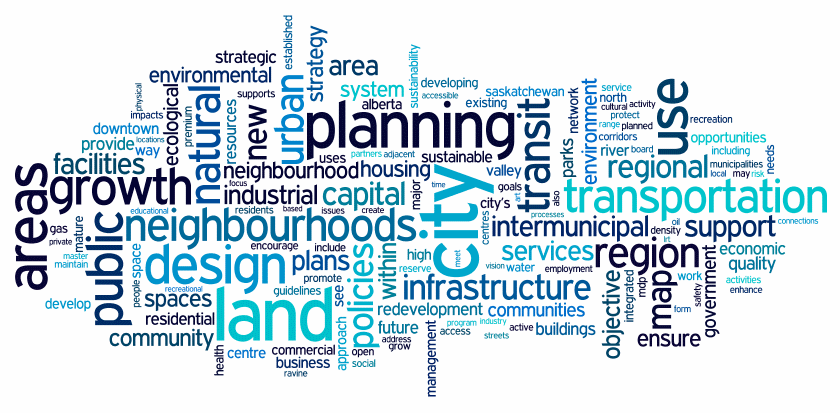
The draft MDP is a hefty document, so I like to start by trying to visualize it. Here’s a Wordle of the entire 141 page draft document (which you can download in PDF here), with common terms (such as Edmonton or Municipal Development Plan) removed:

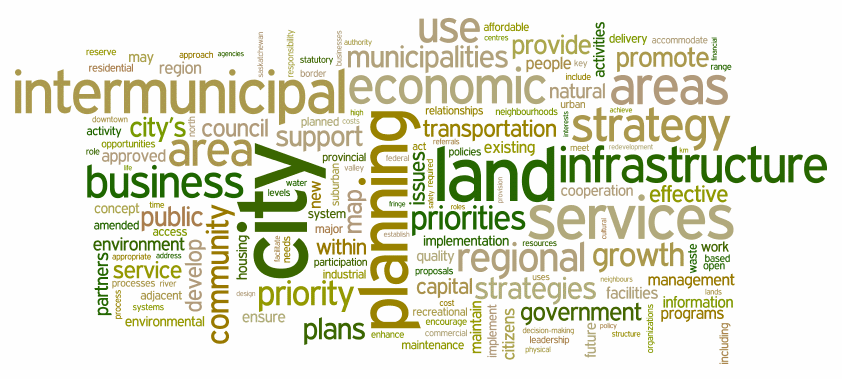
I thought it would be interesting to compare that with the current 109-page MDP (which you can download in PDF here):

Not surprisingly, they are fairly similar. The three that jump out at me are “neighbourhoods”, “transportation”, and “transit” in the draft plan – all are much smaller in the current plan. On the flip side, “business” and “services” are much larger in the current plan.

The key bullet points from the draft plan describe what the City of Edmonton is attempting to achieve:

  • Emphasizing the role urban design plays in a world class city.
  • Recognizing the need to address Edmonton’s financial sustainability by integrating land use and transportation decisions with city infrastructure and lifecycle costing.
  • Shifting from an auto-oriented transportation system to a system offering citizens more choice of transportation modes.
  • Focusing investment to transportation corridors that facilitate the movement of goods within the City and throughout the region.
  • Promoting integration of ecological networks and biodiversity in our approach to land use.

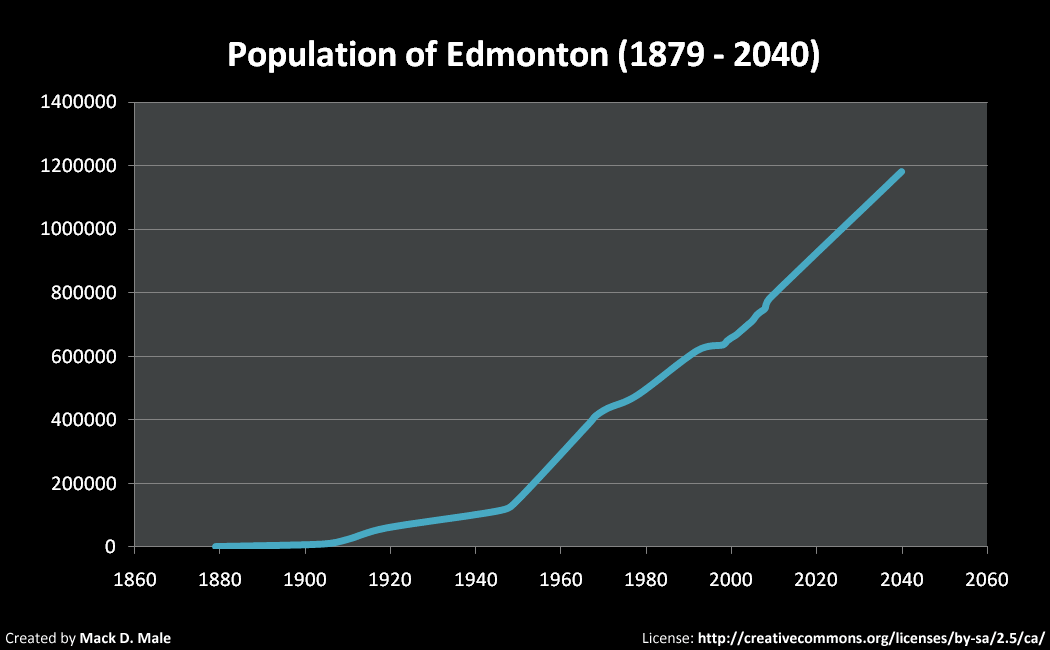
I haven’t read the entire thing, but two themes seem to be common throughout the draft MDP – population growth and financial sustainability. Edmonton’s current population of 782,439 is expected to grow by 400,000 people by 2040. Here’s what that looks like:

Looks a bit like the classic hockey stick curve! It takes a lot of infrastructure to support that many people. The City of Edmonton currently has more than $32.6 billion of City-owned infrastructure, most of which has a life cycle of 50 years. That’s a big number, so here’s a visualization to hopefully help you make sense of it:

I tried to pick items related to Edmonton in some way. It’ll be interesting to see how that number grows over time.

Proposed revisions and amendments to the draft will be considered by City Council tomorrow. The next public hearing is currently scheduled for November 12th. That gives you lots of time to scan through the document if you’re up to the challenge!

I’ll have more on the MDP over the next few weeks.

Twestival Local 2009 – September 10th in Edmonton

As I mentioned a few weeks ago, we’re holding Twestival Local here in Edmonton next week (get your tickets here). After an online vote, it was decided that the local cause we’ll be supporting is the Youth Emergency Shelter Society. I’m very excited about this, and they are too! Here’s a brief into to YESS:

In 1978, a group of concerned individuals discovered a gap in our social services system. Essentially, there were no programs in place to assist homeless children between the ages of 16 and 18. In response to this lack of service, the group activated  the Youth Emergency Shelter Society (Y.E.S.S.) in September 1981, offering services in a reclaimed fire hall building on Whyte Avenue.

In 2004, based on extensive research into the challenges and issues faced by homeless youth in our community, Y.E.S.S. conducted a major  restructuring  of  all  programs. We  are  now  serving  youth  at risk more efficiently and effectively than ever!

And a little on why they need our help:

YESS relies on fundraising for more than 50% of our budget each year. We face the ongoing challenge of raising more money to provide services to Edmonton’s growing population of troubled teens. You are a critical part of our ability to continue to develop our programs.

For more, check out their Summer 2009 “Eye on Youth” newsletter in PDF.

Very soon, YESS is opening a new facility called the Armoury Youth Centre. They responded to the City’s RFP for the Connaught Armoury space just north of Whyte Avenue and were chosen as the organization whose proposed program would have the greatest positive impact on the community.

A couple weeks after Twestival, you can check out the new Armoury Youth Centre for yourself! Here are the details:

September 26 & 27

Pancake Breakfast from 8am to 10:30am
Tours from 9am to 4:30pm
Afternoon BBQ!

10310 85 Avenue
Edmonton, AB

You can download the grand opening invite in PDF here.

Twestival Local takes place on Thursday. Here are the details:

WHAT: Twestival Local 2009
WHEN: Thursday, September 10, 2009 at 6:00pm
WHERE: Original Joe’s Varsity Row, 8404 109 Street, Edmonton, AB (map)
WHY: To support the Youth Emergency Shelter Society

We’re asking for a minimum donation of $20, but feel free to donate more! You can get tickets online here. Please spread the word!

See you there!

Notes for 8/30/2009

Summer is nearly gone! At least we’re getting some warm weather to finish it off. Here are my weekly notes:

Edmonton Corn Maze 2009Edmonton Corn Maze 2009

Edmonton Notes for 8/29/2009

Here are my weekly Edmonton notes:

Taking Edmonton’s Technology Community to the Next Level

I’m always thinking about the technology community in Edmonton. Some very positive things have happened in recent years, and I want to see that trend continue and even accelerate. To take our tech community to the next level however, we’re going to need everyone to bring their unique strengths and abilities to the table. Community organizers, researchers, investors, public policy makers, educational institutions, small and large enterprises, and most importantly, entrepreneurs, all have a role to play.

For a while now I’ve felt that something is holding us back, something that we can change. That’s what this post is about.

Leveraging Technical Expertise Locally

There were two interesting items at the top of the City of Edmonton Executive Committee meeting yesterday. The first was the TEC Edmonton 2008 Annual Report (PDF). The second was a report entitled Leveraging Technical Expertise Locally (Word).

I read the second report with great interest. It is based on a consultation with TEC Edmonton, Edmonton Economic Development Corporation (EEDC), and City Administration and is in response to the following motion from the May 6, 2009 Executive Committee meeting:

That Administration consult with TEC Edmonton, Edmonton Economic Development Corporation, and the general technical community on opportunities to facilitate and better capitalize on incorporating work and research done via the City’s purchasing, standards and business practices, and report back to Executive Committee.

The report is relatively short at just two and a half pages, so I encourage you to read it for yourself. Here’s my summary:

  • One of the four principles of the City of Edmonton Strategic Plan is innovation, loosely defined as “exploration in the adoption of new techniques, technologies, products and ways of operating in order to improve results and lead progressive change.”
  • With that in mind, EEDC, TEC Edmonton, and City Administration want to challenge the status quo with a pilot project that connects them with one another and the “general technical community”.
  • The pilot project would provide benefits to local technology firms (such as opportunities to use the City as a reference customer) and to City Administration (including exposure and access to technologies that previously had not been realized).
  • The pilot project would leverage concepts similar to “the University of Alberta Idea-Fest or local technology Demo Camps” and would consist of two sessions.

It’s nice to see DemoCamp and IDEAfest both get mentioned. Kudos to Cam Linke, Michael Janz, and everyone else who makes those and other events successful.

The above points seem logical enough and if that’s all I had read, I’d happily support the recommended pilot project (which sounds like a couple of events). Unfortunately I kept reading, and as the saying goes, the devil is in the details.

First, the scope of the pilot project is defined as:

  • Small entrepreneurial organizations
  • Prototype the approach – keep it simple
  • TEC Edmonton would identify potential attendees and review with Administration
  • Products must be usable and available for testing

If by “small entrepreneurial organizations” they mean “startups” then I think the first point is spot on. There are so many local startups that could use a leg up with the City. The second point makes sense also – simplicity and iteration are key. The fourth point is similar to the rules of DemoCamp – we’d like to see action rather than talk. I’ll come back to the third point.

Next, the two sessions are defined as follows:

The first session, held in Q3 of 2009, would focus on the City of Edmonton identifying business problems and communication of priorities to TEC Edmonton associated companies.

A second session would be held approximately four weeks later with TEC Edmonton members presenting possible solutions to opportunities identified.

Can you spot the pattern? It continues in the report’s final remarks:

This pilot also supports the concept of the knowledge economy and leverages the capability of local educational institutions.

It focuses on retaining and accelerating the success of high-impact innovation-based start up companies in the Edmonton area by strengthening the partnership between TEC Edmonton and the City of Edmonton. This in turn promotes the development of an entrepreneurial culture and the infrastructure to nurture and sustain scientific and technology-based enterprises.

What started out as a promising attempt by the City to leverage and work with the wonderful technology community we have here in Edmonton quickly became all about TEC Edmonton. According to the recommendation, TEC Edmonton would be responsible for picking the attendees and for driving the dialogue.

This is bad for two reasons:

  1. TEC Edmonton does not represent the whole of the technology community in Edmonton.
  2. TEC Edmonton has a very poor track record when it comes to “promoting the development of an entrepreneurial culture” in Edmonton.

TEC Edmonton Background

Formed in 2000 and ratified in 2006, TEC Edmonton is a joint venture between the University of Alberta and EEDC. It’s mandate is to “help navigate the commercialization process – transitioning science solutions into business opportunities” in the greater Edmonton region. A few highlights from the annual report I mentioned above:

  • TEC Edmonton received 98 reports of inventions in 2008. A total of 77 patent applications were filed and 48 patents were granted. A total of 23 technologies were licensed.
  • TEC Source provided free business advice to 70 entrepreneurs in 2008.
  • A total of 160 entrepreneurs participated in TEC VenturePrize in 2008.
  • The TEC Centre is home to 22 tenants.

TEC Edmonton represents the Information and Communications Technology, Physical Sciences, Life Sciences and Agri-Value industry sectors. There’s absolutely a need for an organization to facilitate the commercialization of research coming out of the University of Alberta. TEC Edmonton needs to continue that work – they’re good at it and they’ve proven they can get results.

The Problem With TEC Edmonton

TEC Edmonton automatically gets a seat at the technology table in Edmonton, whether it deserves one or not. The City of Edmonton and EEDC cannot pursue their objectives in the technology space without involving TEC Edmonton, which is a problem because TEC Edmonton isn’t interested in much of what it would take for those organizations to achieve their objectives.

Startups have little to no interaction with TEC Edmonton and are very rarely impacted by TEC Edmonton programs. Software-based startups are even further removed from TEC Edmonton’s activities. The organization is completely geared toward monetizing expensive high tech research from the University of Alberta, not helping local startups.

  • Patents are meaningless in the world of software, but are at the heart of nearly every deal that TEC Edmonton does. The very first question mentioned on the TEC Source page is: “Do you have intellectual property or a business plan?”
  • The TEC Centre is an incubation facility for TEC Edmonton companies, not technology companies in general. You can’t just drop in.
  • Alberta Deal Generator doesn’t help startup companies prepare for investment, it helps later stage companies. And the private sector does a better job of that anyway.

Quite simply, TEC Edmonton has been ignoring software startups for nearly a decade now. Why does this matter? If we want to move beyond our current energy-based economy to nurture and capitalize on the incredibly smart and talented people we have in Edmonton and Alberta, we need to start paying more attention to software. That’s where innovation is happening and value is being created.

What We Really Need

We don’t need two events to talk about business and communication problems for TEC Edmonton associated companies, nor do we need an organization filtering communication between the City and the technology community. What we really need is for TEC Edmonton or an organization like it to help software startups by doing the things the community can’t.

Easy exchange of knowledge and ideas is something the community has proven it can do well with events like DemoCamp and BarCamp. The ability to get started without a lot of initial investment is another thing the community is addressing through initiatives such as ENTS (you can read more about ENTS here).

Something the community can’t do is provide smart seed funding. I’m talking about YCombinator and TechStars. Tiny amounts of money to get entrepreneurs going, with ongoing mentorship and other networking opportunities. These programs likely aren’t going to make anyone rich, but that’s not the point anyway. The point is to invest in people, to encourage entrepreneurship. TEC Edmonton could do this right away if they really wanted to by scrapping Alberta Deal Generator and taking a fraction of the money spent on that program and putting it into a local YCombinator. I’ve heard about some members of the community working towards this, but I think it would be a great opportunity for TEC Edmonton.

Final Thoughts

If we want to take the technology community in Edmonton to the next level, we need the City of Edmonton and EEDC to recognize that as it currently exists, TEC Edmonton is holding the community back, not helping it move forward. TEC Edmonton certainly has a role to play, but it’s not the catch-all they’ve been given. We need to focus more attention and energy on software startups, an area that TEC Edmonton has historically ignored.

Unfortunately I wasn’t able to attend or listen to the meeting yesterday, so I’m not sure what the Executive Committee did with the report. I’m hopeful that the right people will read this however, so that we can start down the path to positive change.

Finally, I’d like to thank everyone who provided me with context and thoughts on this topic over the last few months – you know who you are.

DemoCampEdmonton8

Unfortunately the leaves have already started changing colors on some of the trees and the mornings are getting progressively cooler. The good news about fall? It means that DemoCamp is back! Join us at the University of Alberta in two weeks to see what local tech entrepreneurs are up to. As usual, we’ll head over to RATT after the demos for Edmonton’s best networking opportunity for tech professionals. Here are the details for #8:

Date: Wednesday, September 9, 2009
Time: 6:30pm (and drinks/networking afterward)
Location: E1 017, ETLC, University of Alberta (map)
Cost: Free sign up

The rules for DemoCamp are simple: ten minutes to demo real, working software, followed by a few minutes for questions. No slides allowed. You can learn more here. Our last DemoCamp took place on May 13th – you can read my recap here.

If you’re planning to come out, sign up here!

Help us spread the word – check out the BarCamp Edmonton blog and our Facebook group. Be sure to tag your tweets, posts, photos, and other content with democampyeg.

Hope to see you there!

Edmonton & Winnipeg Fringe Festivals break records in 2009

The final numbers for the 28th Edmonton International Fringe Theatre Festival were released yesterday: a record-breaking 92,279 tickets were sold over 11 days. Less than a month ago, the Winnipeg Fringe Theatre Festival announced that it had sold 81,565 tickets over 12 days, a new record at the time for fringe festivals in North America. Edmonton held the previous record – 77,700 tickets in 2006.

Clearly, this year has been a good one for North America’s two largest fringe festivals. Being the stats junkie that I am, I decided to look up the ticket sales for Edmonton and Winnipeg in recent years. I was able to find solid numbers for 2002 onward:

These numbers come from newspaper articles as well as press releases from the festivals themselves. There are a few minor discrepancies depending on which source you look at. For example, this year’s numbers for Winnipeg are inconsistent – the official site says 81,353 but all the media articles say 81,565. I went with the number I saw most often.

In tabular form:

Year Edmonton Winnipeg
2009 92279 81565
2008 77204 72722
2007 74693 71921
2006 77700 69320
2005 70700 66315
2004 60442 68470
2003 68000 67002
2002 68925 62801

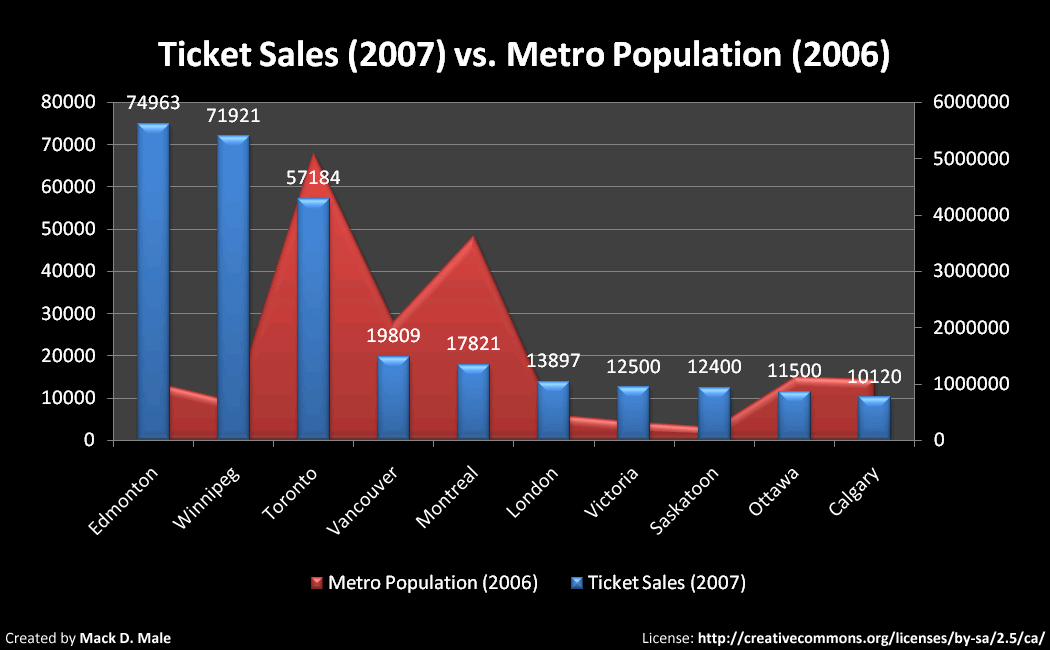
I’m sure there’s a spreadsheet of ticket sales for all of the Canadian fringe festivals somewhere, but I haven’t been able to track it down (looking at you CAFF). I wanted to see how Edmonton and Winnipeg compared with other cities in Canada. It didn’t take long to find the numbers for 2007, which while slightly out of date, give you an idea of the relative size of each festival:

The red area is the metro population for each city, to show how big each festival is relative to the overall population. Edmonton and Winnipeg are clearly in a class of their own!

I look forward to the fringe each year, and I’m obviously not the only one. Here’s to hoping the friendly competition between Edmonton and Winnipeg continues to benefit both cities for years to come!