The future of local news gathering in action

On Saturday morning Sharon and I walked to the City Market Downtown, as we often do on the weekends. Along the way, near 107th Street and 102nd Avenue, we came upon a parade of firefighters. I immediately took out my camera to snap some photos, and also used my BlackBerry to post one to Twitter via TwitPic. We followed them up the street until they turned toward Jasper Avenue, taking a few more pictures. They were a somber group, so we assumed it was a memorial march of some kind, but we didn’t know the details.

Firefighters remember Station Captain Al HarrisFirefighters remember Station Captain Al Harris

For the next couple hours, I sent BlackBerry messages back and forth with Brittney at iNews880. She had seen my TwitPic, and wanted to write a story about the march. I always tell her she can use my photos, but she asks anyway which is nice. Brittney and her team figured out what the march was for, wrote the story, and posted it with my TwitPic. When I got home, I uploaded the rest of my photos and they added them to the story.

That’s the future of news gathering in action.

Now I realize that iNews880 and some other media organizations regularly use photos from contributors but I think what’s significant here is that the story started with the photo. Would they have written about it had I not posted a TwitPic? Maybe, maybe not. In this case they saw the photo, tracked down what it was about, and were able to produce a story.

Here’s a quote you might have heard:

In journalism, there has always been a tension between getting it first and getting it right. – Ellen Goodman

In this case, I got it first and iNews880 got it right. Note that doesn’t mean that I got it wrong and iNews880 was way behind. We simply worked together to make the story happen. This is the kind of news gathering that can scale. So many of us walk around with mobile Internet devices, always ready to post a message or a photo.

What comes next? Aggregation, of course.

Why the proposed City Centre Airport compromise won’t work

Tonight was I on Alberta Primetime with David MacLean from AEG to discuss the compromise that was proposed recently by the Alberta Aviation Museum in the debate about what to do with the City Centre Airport. The compromise would see one of the two runways closed, to make room for some redevelopment. We didn’t have a lot of time to get into the issue, but we agreed on one thing: a compromise isn’t going to work. City Council needs to make a decision.

There are two runways at the City Centre Airport. There’s 16/34, which has the ILS (instrument landing system), prevents NAIT from expanding, and has the largest impact on the Outer Surface restricting building heights over downtown. The second runway is 12/30, which is slightly longer than 16/34 but lacks the important ILS. The runways are placed in an intersecting “V” configuration.

It’s true that if Council decides to shut the City Centre Airport down, it won’t happen overnight. It’s also true that it’ll take time for any development to be completed. Those two facts aren’t enough to make the proposed compromise work, however:

  • It’s not clear which runway would be shutdown. Clearly 16/34 would make more sense from a development perspective, and a financial one too as it requires about $7 million of investment (part of the $35 million in total required for ECCA over the next ten years).
  • That would largely be dependent on moving the ILS to 12/30, something which may not be possible. Actually, it may not even be desirable given how old the system is – it almost certainly needs to be replaced.
  • Shutting down 12/30 instead doesn’t make a lot of sense either, because height restrictions would still be impacted and NAIT expansion would still be blocked.

I’m told that Edmonton Airports has promised to provide Councillors with a feasibility study on the compromise in time for next week’s Council meeting. It doesn’t really matter though.

The truth is that such a compromise is just an easy way out for Council. If they don’t decide once and for all to shut it down or keep it open, we’ll just keep having this same debate every few years. Or even worse, we’ll end up with some development right next to a crippled airport. Nobody will benefit from either of those scenarios.

City Council must take a bold step to do what’s right for the future of Edmonton. Encourage your City Councillors to vote in favor of closing the City Centre Airport.

Transforming the City of Edmonton IT Branch

On Friday the City of Edmonton’s IT branch held its first ever IT Vendor Open House. The event was a big success, with dozens of local technology professionals stopping by throughout the day. Attendees had the opportunity to learn more about how the IT branch does business, and about some of the initiatives and projects that are coming down the pipe. The event also gave the IT branch a chance to share some of the work they’ve done recently to transform internally.

Chris Moore, the City’s Chief Information Officer, delivered two keynotes during the day, called “IT New Directions”. Chris isn’t your typical CIO – he doesn’t have a desk in his office, he avoids PowerPoint whenever possible, and he is always one step ahead of everyone else. For example, it wasn’t possible for anyone to run Macintosh computers at the City until recently. While everyone has been focusing on making that a reality (a few Councillors switched over earlier this year), Chris is looking at what’s next: bring your own technology. Chris imagines an environment in which employees can run whatever they like.

Edmonton CIO Chris Moore

He touched on a few main points:

  • There are around 1100 different applications and systems at the City. Only 132 of them are Access or Excel. That means there’s an incredible amount of overhead required for management and support, not to mention data in 1100 different places.
  • Throughout the spring, the IT branch held mini town halls, with about ten employees in each (there are 300 employees total).
  • Out of those discussions and other meetings, a new Agile Service Delivery Model emerged.

One of the few slides Chris showed during his keynote was a list of highlights from the past sixty years:

  • 1954: Univac 120 – First in Western Canada
  • 1960: IBM 1401 – First in Canada
  • 1966: IBM 360 – One of the first in Canada
  • 1978: Early adopter of GIS
  • 1980: City recruits IT staff from the U.K.
  • 1985: Sale of COINS to Orange County, CA
  • 1991: gov.edmonton.ab.ca, “early Internet adopter”
  • 1996: POSSE – Award winning system
  • 1999: One of the first cities to move to Enterprise GIS
  • 2009: First city in North America to use SAP CRM for 311

The slide was titled “Western Canada’s Municipal Information Technology Leader”. That’s perhaps a bit of a stretch for the last few years, but it’s certainly the goal for the future. Chris and his team want to get back to being the innovators.

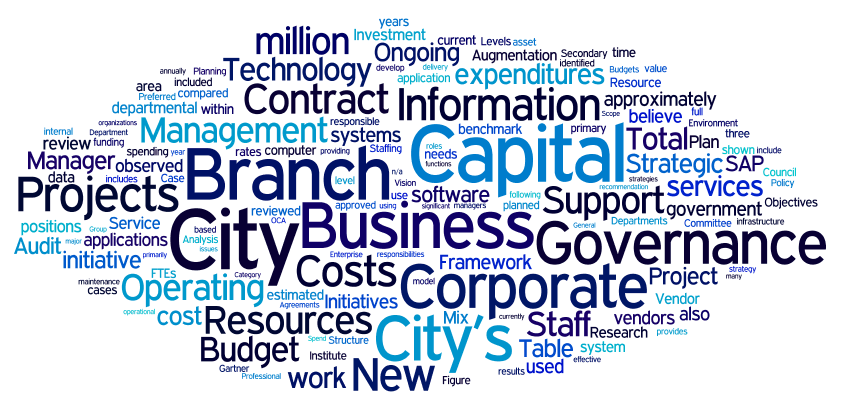
On June 18th, the Information Technology Corporate Audit Report for 2008 was released and it talks a lot about the drivers behind the transformation that Chris touched on in his keynote. Here’s a Wordle of the report:

Among other things, there were two clear conclusions from the report (which you can download here in Word format):

  • That Corporate IT resources can be used in a more cost effective and efficient manner.
  • That the IT Governance Framework is not effective in prioritizing and allocating operating and capital resources for information technology.

In reality, there isn’t much of a Governance Framework at the moment, but the IT branch is already working to change that. They’ve created something they call COKESFORIT, or the “ten ways of being”:

  1. Collaborative
  2. Open
  3. Knowledgeable
  4. Empowered
  5. Supportive
  6. Flexible
  7. Organized
  8. Responsible
  9. Innovative
  10. Trusting

The idea is that everything the IT branch does should align with these concepts.

During ICLEI a couple weeks ago, visual facilitator Roy Blumenthal worked with the IT branch, and captured eighteen impressive visual notes. As a fan of open data, I like this one:

I’m excited about the changes taking place at the IT branch. I think the organization is heading down the right path: to become more efficient and more transparent. If you’ve got ideas or feedback, now seems like the right time to get in touch with them!

The Story Behind NotMyAirport.ca

The discussion about what to do with the City Centre Airport has largely been monopolized by the pro-Muni crowd. A majority of the speakers at last week’s public hearings were either in favor of the status quo or of expanding scheduled service at ECCA. I suppose that shouldn’t be a surprise – supporters of the City Centre Airport have the most to lose in this debate. It makes sense that they would put time and money into making their positions known.

Increasingly, civic debate is happening digitally. To their credit, the Alberta Enterprise Group recognized this and very early on in the process launched SaveOurAirport.ca (they’ve also been quite active on Twitter and Facebook, and there’s this site also). The site acts both as a hub for pro-Muni information and as a place to point to online if you support AEG’s stance on the airport (or simply wish to talk about it).

Unfortunately, there isn’t a similar website supporting the closure of the City Centre Airport. There are many articles, blog posts, forum messages, and tweets, but nothing that ties them together.

Today, that changes.

I’ve just launched NotMyAirport.ca. I have two primary goals with the site. First, I want to ensure that facts and arguments in favor of closing the City Centre Airport can easily be found and shared. Second, I hope to encourage as many Edmontonians as possible to contact City Council to urge them to vote in favor of closure.

I’m not sure how much of an impact the site will have, especially considering we’re just a week away from a potential Council decision on the matter. That said, it didn’t take very long to create (as you can tell by the simple design) and I’m continually amazed at how quickly people can mobilize via the Internet. If you have feedback/suggestions for the site, let me know.

This doesn’t level the playing field, of course, but it’s something – anyone out there want to pay for some billboards?

Please contact your City Councillors to let them know what you think about the City Centre Airport. Feel free to use or reference the information posted at NotMyAirport.ca. Finally, consider using the links, buttons, posters and other resources posted at the site to help spread the word to others.

Closing the City Centre Airport is a unique opportunity to improve our city in ways consistent with the City of Edmonton’s Strategic Plan. We must not let this opportunity go to waste.

Mayor Mandel and Councillors, the City Centre Airport is Not My Airport. Please close it.

Letter to City Council regarding the City Centre Airport

Here’s my letter to Council:

Dear Mayor Mandel and Councillors:

I listened to the public hearings on the City Centre Airport Lands last week with great interest. You heard from a large number of Edmontonians and received a great deal of information related to the airport. Unfortunately, the only thing that everyone could agree upon was that the status quo at the City Centre Airport is untenable. Which leaves two options: expand scheduled service, or close the airport.

Except that expanding scheduled service is not a viable option. There is no evidence to support the notion that Edmonton as a whole would benefit from faux-competition between the City Centre Airport and the Edmonton International Airport. In fact, expanding scheduled service would almost certainly be detrimental to both airports, and therefore to the city.

The only rational, responsible decision is to close the airport.

The arguments you have heard against this decision are flawed. Medevac patients would not be affected by closure as time critical patients could be accommodated at other facilities. Few would be inconvenienced by travel delays – the Villeneuve Airport is just ten minutes further from Downtown Edmonton than the Springbank Airport is from Downtown Calgary. Most of the economic activity facilitated by the airport would not disappear, but would instead shift. There is absolutely no factual basis for the assertion that closing the City Centre Airport would negatively affect Edmonton’s economy, let alone affect it more than the loss of one of our major sports teams.

Closing the City Centre Airport is an incredible opportunity. Removing the height restrictions of the Outer Surface will help to re-invigorate our downtown. Expansion of the existing NAIT campus will remove the need for that institution to build elsewhere, helping to curb urban sprawl. Intensification of the airport lands is wholly consistent with the City of Edmonton’s Strategic Plan and vision for the future. Importantly, this can be accomplished while celebrating the historical significance of Blatchford Field. Our city has a rare chance to build a transit-oriented community on the airport lands that is integrated, livable, innovative, and sustainable.

I urge you to vote in favour of closing the City Centre Airport.

Thank you.

Contact your City Councillors to let them know what you think about the City Centre Airport.

Notes for 6/28/2009

Here are my weekly notes:

Edmonton Notes for 6/27/2009

Here are my weekly Edmonton notes:

These ashtrays have been on Whyte Avenue for a while, but they just started appearing downtown this week:

Ashtrays Downtown

Idea Zone Edmonton

Idea Zone is the City of Edmonton’s new system for open innovation. It’s one of their first attempts at leveraging a crowdsourcing model, and it represents a shift in the way the City tackles large problems. Perhaps more importantly, I think Idea Zone is another small step toward becoming an Open City.

I was first introduced to the system a few months ago, but at that time it wasn’t ready for a test drive. The first people outside the City to see it in action were the ICLEI World Congress 2009 attendees last week. You’ll notice that Idea Zone is currently described as an opportunity to “connect with your colleagues who share your interest in local sustainability.” The plan was to have ICLEI attendees seed the system with ideas before opening the doors to citizens. Unfortunately, only about 30 users signed up, far less than the goal of 100. There are currently 34 users signed up on the site, and a total of 34 ideas have been submitted.

Idea Zone is very similar to Dell’s IdeaStorm or My Starbucks Idea – you create an account, submit your own ideas, and vote and collaborate on others’ ideas. Submitting an idea is straightforward – you choose a category (current categories include “Climate” and “Energy”, for example), enter a title and summary, and optionally attach files that further define the idea. Other users can then vote on your idea, leave comments, and make additions. You can also make a collaboration request to other users, essentially inviting them to help you flesh out the idea. Anyone can choose to “Champion” an idea, which means they become responsible for seeing it through to completion. Finally, the City can issue “Challenges” which are like requests-for-ideas.

The specific software the City of Edmonton is using is called Idealink Open, by Quebec-based BrainBank Inc. There are actually a few instances running. Idea Zone is the simplified, public instance meant for citizens. There are also a couple of internal instances for use by City of Edmonton employees. The internal instances feature a more involved and detailed workflow, designed to carry ideas through to implementation.

The most interesting thing about Idea Zone to me isn’t the software itself, but the opportunities the system will enable. In the long term, Idea Zone could dramatically impact the way City employees collaborate to solve problems. Sounds very pie-in-the-sky, I know, but I have proof. Check this out:

That’s a photo of what is almost certainly the first Microsoft Surface shipped to Alberta. The City of Edmonton is working with local consulting firm Quercus Solutions to explore how the Surface can be used with Idea Zone for collaboration. The Surface is certainly a more inviting and natural interface than the web browser! Thanks to Quercus for the above photo.

I hope the City’s willingness to experiment with new and innovative technologies like Idea Zone and Surface is a sign of things to come. Feel free to sign up for an Idea Zone account and let me know what you think. I’ll be keeping an eye on the system to see how it evolves. It definitely has potential!

Airport Passenger Statistics for Edmonton & Calgary

Earlier this evening I was a guest on The Lesley Primeau Show on 630 CHED. Along with Brittney, we talked about Twitter. That went pretty much as expected – Lesley doesn’t hate social media, but she doesn’t get it either.

While waiting for the show to get started, we were talking about the Edmonton City Centre Airport (ECCA). I’m in favor of closing “the muni” while Lesley very clearly favors the status quo, or perhaps even restoring scheduled service to ECCA. She feels that Edmonton needs an airport downtown to become a great city – I think we need density in the centre, not an airport.

Things got slightly heated when Lesley said that the only growth the Edmonton International Airport (EIA) has seen was from the consolidation back in 1995. She also said that EIA will never rival the Calgary International Airport, and that growth there has been far stronger. I challenged her on both of these assertions (and have heard others make them recently). Lesley said I needed to do my homework, that I was wrong.

So I did my homework. I wasn’t wrong.

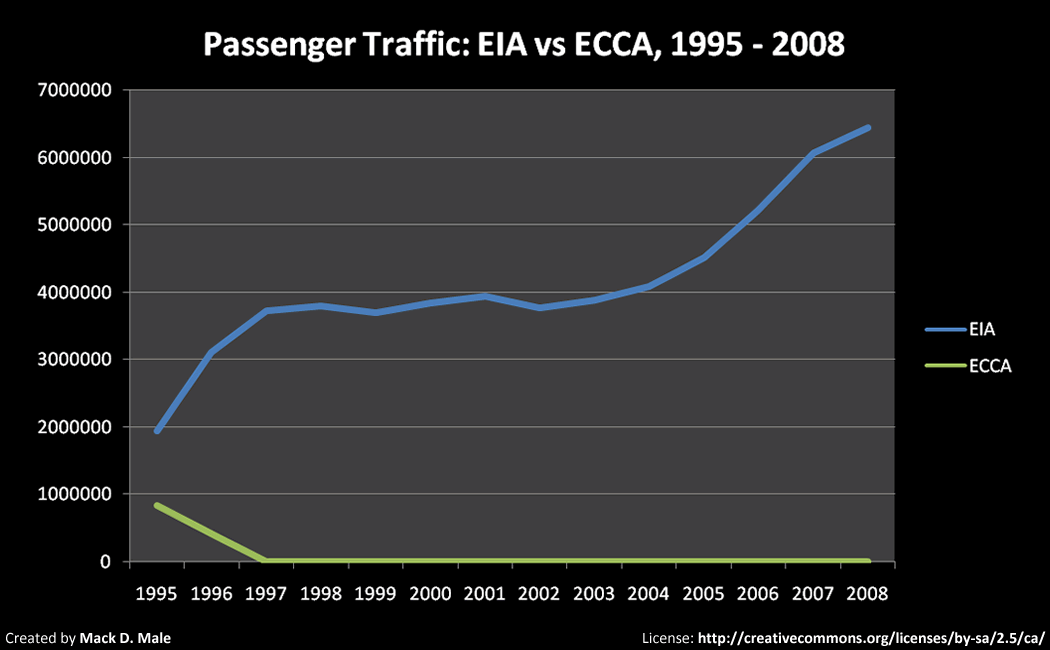
Let’s start with the first myth – that EIA’s growth has only come at the expense of ECCA. Here are the annual passenger numbers for each airport from 1995 to 2008 (I’m going with scheduled passenger numbers, which is why ECCA is 0 after 1996):

Here they are in table format:

YEAR EIA ECCA
1995 1943797 835612
1996 3104322 417002
1997 3720623 0
1998 3791574 0
1999 3700016 0
2000 3843321 0
2001 3940416 0
2002 3773800 0
2003 3882497 0
2004 4081565 0
2005 4511451 0
2006 5213992 0
2007 6065117 0
2008 6437334 0

What can learn from those numbers? The key years are 1995-97, obviously (the plebiscite vote took place on October 16, 1995). Passenger traffic at EIA, which had been stagnant since the early 1980s at about 2 million passengers per year, increased by more than the amount that passenger traffic at ECCA decreased. Passenger traffic at ECCA decreased by 835,612 from 1995 to 1997, while passenger traffic at EIA increased by 1,776,826.

Clearly there was something besides consolidation that caused traffic at EIA to increase. Growth at EIA leveled off from 1998 until 2002, but you’ll recall that was a difficult time for the airline industry – Edmonton was not alone.

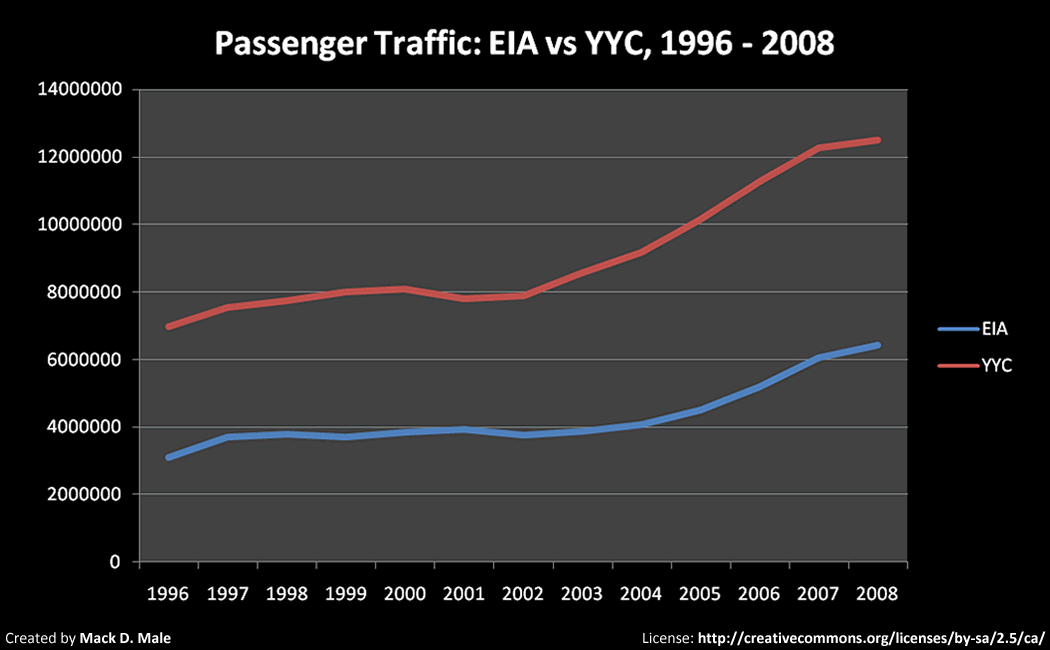
Now let’s look at the second myth – that Edmonton will always be second to Calgary. Here are the annual passenger numbers for EIA and YYC from 1996 to 2008:

Here they are in table format:

YEAR EIA YYC
1996 3104322 6967571
1997 3720623 7547156
1998 3791574 7731034
1999 3700016 8010883
2000 3843321 8090426
2001 3940416 7794519
2002 3773800 7884194
2003 3882497 8576541
2004 4081565 9174039
2005 4511451 10148718
2006 5213992 11279080
2007 6065117 12265754
2008 6437334 12507111

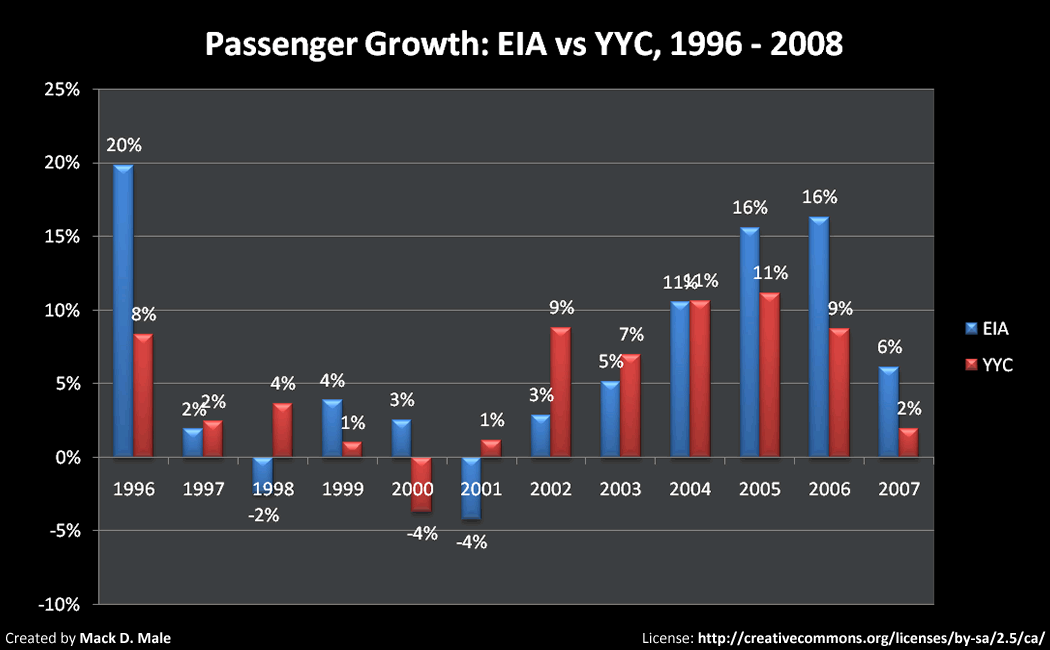
Calgary is definitely busier than Edmonton – nearly twice as busy. Edmonton is in a better position today relative to Calgary than it was in 1996, however. It’s a little difficult to tell from the graph/table above, but Edmonton’s growth overall since 1996 is actually stronger than Calgary’s. Here are the annual percentage increases:

In total, passenger traffic at EIA has increased 107% since 1996, whereas passenger traffic at YYC has increased 80% since 1996.

Is that enough to suggest that Edmonton can emerge from the shadow of Calgary, at least when it comes to their respective airports? Maybe, maybe not. But the data clearly shows that YYC isn’t light years beyond EIA as some would like to suggest.

As an aside, while doing my research I found statistics for EIA for three more years: 394000 in 1962, 755000 in 1973, and 1100000 in 1974.

The public hearing on the City Centre Airport continues tomorrow at City Hall. You can see my resources post here.

Sources: EIA Website, EIA Passenger Statistics, YYC Website, Calgary Airport Statistics, numerous EIA press releases, Wikipedia, Tourism Calgary.

Edmonton City Centre Airport Debate: Resources

We’re down to the final stages of the City Centre Airport review process. If you haven’t taken the time to educate yourself on the issue, the time is now.

Here are the reports that were released last week:

  • Airport Legal Review and Analysis (Attachment 1 in this PDF)
  • Airport Lands Net Revenue Review (Attachment 3 in this PDF)
  • The Airport Lands Impact Assessment Final Report (PDF)
  • The Medevac Transport Report (PDF)
  • The Historical Impact Assessment Report (PDF)
  • The Economic Impact Analysis (PDF)
  • The Public Involvement Plan Results (PDF)

The Alberta Enterprise Group (AEG) posted a response to the reports here.

The big report is the Airport Lands Impact Assessment, at 299 pages. Here’s a Wordle of that report:

Here are some highlights from the various report conclusions:

  • “The planning of ambulance services is dependent on many local factors such as availability of resources, both financial and personnel; regional density of populations; road condition and geographic variations; and so forth. Clinically, outcomes for trauma and medical patients are mainly impacted by the services available rather than by type of transport.”
  • “The City Centre Airport ranks with the Rossdale site and the provincial government precinct as among the three most significant historical locations in the City of Edmonton. As such everything possible should be done to acknowledge that fact through commemorative and interpretive initiatives.”
  • “Redevelopment of the ECCA, as defined in the Demonstration Plan, would result in the equivalent of a net tax saving to the City of Edmonton. The value of redeveloping the ECCA Lands is, in aggregate, a net benefit to the City of Edmonton’s financial position.”
  • “Based on the review completed, the redevelopment of the ECCA Lands into a new residential and employment based neighbourhood represents a significant opportunity for the City to achieve established long term visions regarding sustainable development and a more compact urban form. The redevelopment of the ECCA Lands could allow for the development of a new urban community with transit as its centrepiece.”

There will be a public hearing on Wednesday (and Thursday/Friday if necessary):

What: Public Hearing on the City Centre Airport (Agenda in Word)
When: Wednesday, June 24, 2009 from 9:30am to 5:30pm
Where: City Hall
Request to Speak: Fill out this form to speak.

The next step is for any recommendations to be reviewed by Council on July 10, 2009. Don’t forget that you can watch or listen to Council and Committee meetings live online.

The City’s portal for the City Centre Airport Review contains a bunch of additional information and links, so be sure to check it out. There’s also some info at the Public Involvement site.

[geo_mashup_map height=”250″ width=”500″ zoom=”13″ add_overview_control=”false” add_map_type_control=”false”]

Here are some social media resources:

Some other stuff to read:

Lorne Gunter wrote a great article in Sunday’s Edmonton Journal: Muni is not ‘my’ airport. For some predictions on Council’s vote, check out Scott McKeen’s piece from yesterday’s Journal. He’s betting that Council will vote to close the airport. Also – you’ve got to look at this photo of Councillor Tony Caterina on the tarmac of the City Centre Airport. And finally, you might find my post (from May) about the ECCA debate on Twitter interesting.

For the latest news, check out #ecca on Twitter Search.

As you’ve perhaps figured out by now, I’m in favor of closing the City Centre Airport. I don’t feel that keeping the status quo is compatible with making Edmonton a more sustainable, vibrant city, and moving passenger service back to the muni isn’t possible. There is an opportunity to redevelop the lands however, and I think the City should act on that now before the opportunity passes us by.

Let’s close the City Centre Airport and move on.

UPDATE: Edmonton Airports has compiled a number of briefing notes related to the airport for presentation at the public hearings. (PDF)