OneNote + OneDrive = Awesome

Without good tools to keep me organized, I’d be totally scatterbrained and lost. Well, good tools and an understanding partner who helps me keep on top of things! I have tried a bunch of different tools over the years, but two in particular have become absolutely critical: OneNote and OneDrive. This isn’t a sponsored post, I just want to share two tools that have really made a difference for me. Maybe they’ll have a positive impact on your life too!

OneNote

OneNote has developed into an amazing tool since it was launched over ten years ago. I originally used it locally on my computer to keep track of typed notes. I also had a Tablet PC, so I would use it for handwriting too. OneNote supports more advanced features also, like audio or video notes, photo notes, smart tags, document scanning, screen clippings, and much more.

Here’s an overview of the new OneNote:

I use OneNote many times a day, across most of my devices. I track my computer activity with RescueTime, so I know with certainty that OneNote is consistently in the top five applications by usage. It works on my desktop, my laptop, my Surface, and my phone. I run Windows everywhere, but even if your devices are a bit more varied, OneNote can work for you. There are apps for Android, iPad, and iPhone too. There’s even a web app.

At the moment I have two high level notebooks – one for personal stuff and one for work stuff. When I’m doing research for a blog post, I store everything in OneNote. I’ll even write some of my drafts there. I keep recipes, lists, and ideas in my personal notebook. My work notebook is filled mainly with meeting notes, often captured in ink using my Surface Pro, but I also use it for UI reviews, to keep track of technologies I’m exploring, and a variety of other things.

One of the greatest things about OneNote is the search. The ability to organize notes into sections is handy, and if you use tags you can quickly find any note that has a specific tag. But most of the time I just search. The best part is that OneNote will even search my handwritten notes, without any conversion to text. It’s surprisingly accurate, and it’s this feature that I typically demo to people when I’m showing them OneNote on my Surface. Support for this was added years ago and it still never fails to amaze.

OneDrive

OneDrive is the new name for SkyDrive, which first launched in 2007. It’s kind of like DropBox in that it is a place in the cloud to store your files. You get 7 GB of storage space for free, and it’s pretty easy and expensive to boost that amount.

Here’s an overview of the new OneDrive:

Again, OneDrive works across all of my devices, and again, there are apps for Windows, Mac, Android, iPad, and iPhone. There’s even an Xbox app, which comes in handy when you want to show some photos (which are stored automatically on OneDrive as I take them with my phone).

I put all kinds of stuff in my OneDrive (I’ve got over 47 GB of storage total, 20 GB of which comes from my Office 365 subscription). Everything I scan using my Doxie goes into OneDrive. Documents, presentations, audio recordings, graphics, mind maps, blog post drafts in MarkDown, – you name it, I store it in OneDrive.

Using OneDrive I don’t worry as much about backups (though I still use Backblaze and a few other approaches to do regular backups). Using OneDrive means I rarely have use for USB sticks, because my files are always in sync, across all my devices. OneDrive has completely changed the way I think about file storage, for the better.

The one and only feature I desperately want for OneDrive is co-owned folders, to bring DropBox-like folder sharing to the platform (you can share and collaborate on documents now, but I want to have an entire folder that is kept in sync across multiple OneDrive accounts). The good news is that the co-owner feature is apparently coming very soon.

OneNote & OneDrive are better together

The magic happens when you store your OneNote notebooks on OneDrive. All of the new Microsoft Office apps support logging in with a Microsoft Account, so it makes it super easy to do. I think this approach is probably the default for the phone and tablet apps too.

With OneNote on OneDrive, it doesn’t matter what device I’m using, because my notebooks are kept up-to-date with changes. The sync is completely automatic and fast. So fast actually, that it fits into a 6 second Vine:

I rely on this each and every day, so I’m glad I have never run into a sync problem. I can take some notes at home, walk over to the office, and pick up right where I left off on a completely different computer. I regularly take notes on my phone when I’m at an event, and when I get back to a computer to start blogging about it, I don’t need to worry about where my notes are. They’re always there, ready for me.

These two tools have made a big difference in my life. If you want to give OneDrive a spin, use this referral link and we’ll both get an extra 0.5 GB of storage space for free. If you want to try OneNote, you can download it for free here.

Province to Edmonton’s City Council: “You’ll like the 2014 budget…just kidding!”

Things were looking up for LRT expansion in Edmonton. As recently as a few weeks ago, Mayor Iveson sounded optimistic that the Province was going to provide money for LRT. Other members of City Council had also received positive indications from the Province. But talk is cheap, and the Province didn’t follow through with today’s budget, as Mayor Iveson made clear:

“Not in a position to celebrate anything today at this point. Little bit of disappointment that yesterday’s message and really the message our Council has been consistent about since last year hasn’t quite gotten through yet.”

The Province unveiled its 2014 Budget this afternoon, saying it “delivers the core services Albertans expect, makes strategic investments in innovation to improve the lives of Albertans today and into the future, and strengthens new and existing infrastructure to address the demands of our growing province and economy.” Unfortunately, LRT was not deemed a priority as evidenced by the complete lack of commitment to funding its ongoing expansion in Edmonton and Calgary.

The original GreenTRIP fund of $2 billion, created by the Stelmach government in 2008, has not been increased. MSI funding increased slightly, but not nearly enough to fund the LRT expansion to Mill Woods. Besides, as Mayor Iveson again pointed out today, Edmonton has a need for LRT funding on top of all the things that MSI funding is used for in other municipalities – building libraries, recreation centres, etc. The lack of increase in GreenTRIP funding was especially disappointing to the mayor:

“My interpretation of long-term commitment to GreenTRIP isn’t just saying we’re going to roll out all the money we announced serveral years ago by 2019 and announce this year’s money like its new when its actually money that we’re putting into the NAIT line today because its money that was announced previously.”

He clarified yet again what a long-term commitment would look like:

“For me, a long-term commitment to transit would be an open-ended or ten year commitment to sustained levels of funding for rapid transit expansion in our province.”

The reaction from local leaders was disappointment, as expected. “There’s no new commitment to transit here,” Mayor Iveson said.

//platform.twitter.com/widgets.js

//platform.twitter.com/widgets.js

//platform.twitter.com/widgets.js

//platform.twitter.com/widgets.js

There are two key risks the City faces by not receiving funding for LRT expansion from the Province. The first risk is that we miss yet another construction season, which could add around $65 million to the total cost of the project. The City has a deadline of April 30 to try to get all of the necessary funding in place. If that date isn’t met, then the completion of the Southeast LRT expansion by 2019 is in jeopardy.

The second risk is that the federal funding Edmonton has applied for under the P3 Canada program could be at risk if construction doesn’t begin by the end of 2015. “There is a timeline on the P3 grant,” Mayor Iveson said. “If we were to lose another year, then we would potentially begin to lose some of the federal funding, and then we’d really lose momentum.”

Mayor Don Iveson

But the biggest issue here is that the Province made noise about a long-term commitment to LRT, and simply hasn’t delivered. Mayor Iveson expressed his frustration with this:

“Frankly I received a lot of mixed messages from the Province over the last six to eight weeks, that we’d be happy, that we should manage our expectations, that we’d be satisfied, that we’re asking for too much, and often from the same people, so that is a frustration.”

Still he tried to remain optimistic, adding, “that just tells me that things are fluid still.”

You can listen to Mayor Iveson’s full remarks here:

If there wasn’t already a trust issue between City Council and the Province, there most certainly is now. Conversations can only be considered productive if they actually lead to an outcome that all sides are happy with. If the Province wasn’t prepared to make a commitment now, they should have made that clear to the mayor and the rest of Council.

Asked what he thought about his first provincial budget experience since taking office, Mayor Iveson sighed audibly. “That’s what I think,” he said. Ever the optimist, he said he remained dedicated to working with the Province to find a positive outcome for the city. “I think they’ve figured out in the last 24 hours that we really mean it, this is really important to us.”

You can read more about the Province’s Budget 2014 here.

Recap: Mayor Iveson’s 2014 State of the City Address

Mayor Don Iveson delivered his first State of the City address today in front of an absolutely packed crowd at the Shaw Conference Centre. Hosted by the Edmonton Chamber of Commerce, the State of the City luncheon attracted more than 2200 people including Councillors, MLAs, MPs, as well as business and community leaders, all eager to hear what our new mayor would say. Would he make a statement like Mayor Mandel did (by declaring “no more crap”) in his first address? Would he dump on the Province like Mayor Mandel did (lamenting the treatment of post secondary education in Edmonton) in his last address? Or would he set a completely different tone?

State of the City 2014

Though Mayor Iveson’s speech today may have lacked a lightning rod comment like the infamous “no more crap”, it had its moments. Looking right at Premier Redford, our mayor called for the Province to come to the table on funding for LRT expansion:

“Madam Premier, never has the opportunity and timing to fully build out Edmonton’s LRT network been more worthy of your government’s leadership, commitment and support. Show that you understand the needs of this city in the same way that my Council does. Show Alberta’s capital city that we are worth investing in.”

It was a powerful moment, and the audience erupted into applause after he delivered the words. Without question that part of the speech is what we’ll be talking about years from now.

Mayor Iveson opened and closed his speech recognizing the important role that indigenous peoples have played in Edmonton’s history, and the important role they’ll play in our future.

“Ladies and gentleman, a new, more confident Edmonton has emerged – building upon our rich heritage, leveraging our advantages, and – most importantly – unafraid to challenge ourselves to do even better.”

He noted that Edmonton will host the Truth and Reconciliation Commission of Canada’s national event later this month. “Without recognizing our shared history and learning from it, we have no hope of making change,” he said.

Though he touched on topics like public engagement, roadway maintenance, and the City Centre Airport, Mayor Iveson focused the bulk of his time on ending poverty, the global competitiveness of the region, LRT expansion, and the big city charter.

State of the City 2014

On poverty, Mayor Iveson looks set to keep an election promise, announcing that next week Council will consider his proposal to elevate the existing Poverty Elimination Committee (of which I have been a proud member) to a task force. “Simply managing poverty is not working,” he told the crowd. He called upon everyone in attendance to think about what they could do to “unleash the next generation of entrepreneurs from unlikely circumstances.” Mayor Iveson also recognized the importance of aligning with the Province’s commitment to eliminating child poverty in Alberta.

“Poverty is complex. Its causes are multi-facted, interlinked and anything but straightforward. Many are afraid to tackle it. But I am not.”

Using language that should by now seem familiar, Mayor Iveson next turned his attention to the Edmonton region. “If we want to continue to outperform other city regions in Canada, then we must work together much more effectively – and there can be no delay,” he said. Amalgamation isn’t on the horizon but he recognized that business leaders are frustrated. “For the region to achieve results, we must work together much more effectively on economic development,” he said. Again, the mayor issued a challenge, calling on his fellow mayors to consider the role they play:

“What will you do differently…how will you think differently…are you ready to look ahead and ensure that our region’s ability to compete globally for our mutual long-term benefit is always at the forefront of our deliberations?”

He briefly discussed annexation, saying that “boundary changes are a natural part of these discussions.” Mayor Iveson said that “Edmonton’s future growth must be balanced with a healthy mix of residential and employment areas.”

State of the City 2014

Though his pointed comments to Premier Reford were the most memorable part of Mayor Iveson’s remarks on LRT, he had much more to say. “To remove all doubt,” he told the audience firmly, “this Council unanimously declared LRT expansion as its priority for new infrastructure investment, beginning with the long-awaited Valley Line from Mill Woods to downtown.”

Most of City Council has been saying optimistic things about the Province providing funding for LRT, and Monday’s throne speech certainly sounded like a step in the right direction. We won’t know for sure until tomorrow if anything has changed however, when the budget is released.

The final major topic that Mayor Iveson addressed was the Big City Charter. “Big cities fuel a large part of the province’s economic dynamism,” he said. Citing work underway with the City of Calgary that has led to a closely aligned vision for such a charter, the mayor expressed his hope that discussions with the Province will be productive.

“We have reached the point where Alberta’s big cities have outgrown the one-size-fits-all Municipal Government Act and our collective efforts are better spent focused on a big city charter. What is needed is a real partnership between Alberta’s big cities and the provincial government.”

Unfortunately, I think Mayor Iveson again missed an opportunity to talk about what a big city charter might look like. I certainly applaud the ongoing effort to negotiate a better deal for big cities, but it would be much easier to ask the hundreds of Edmontonians in the room for support if they could understand and talk about it. The big city charter still seems nebulous.

State of the City 2014

Mayor Iveson spoke today with the same confidence and measured delivery that attracted Edmontonians to him during last fall’s election. Will it go down as his most memorable speech? Likely not. But I think he said the right things, in public, to the right people. Most of the folks in the room were already Iveson supporters, so winning them over wasn’t the goal. Instead, he delivered a clear message about what’s important to Edmonton and offered insight into how we should tackle key issues.

“My responsibility, and my Council colleague’s responsibility, is to steer us, focused on an ascendant Edmonton. Great cities emerge when conditions are ripe for unprecedented cooperation, creativity and disruptive change. The cities that embrace this will thrive while cities that are content with today will lag and whither. I will not stand for that in Edmonton. And, given what we hear from Edmontonians every day, neither will you.”

You can read the full text of Mayor Iveson’s remarks here in PDF. You can read my recap of last year’s State of the City here.

Does high speed rail have a future in Alberta?

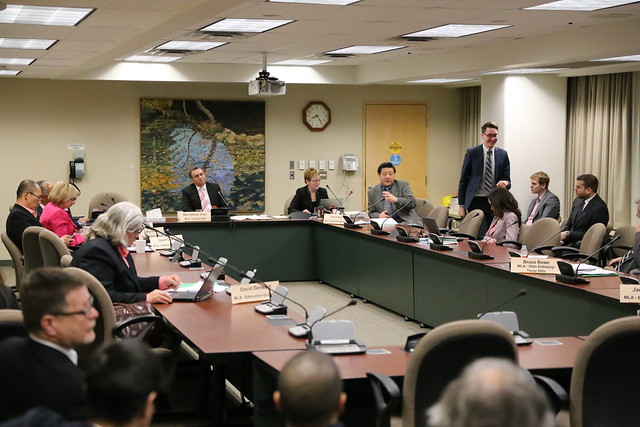
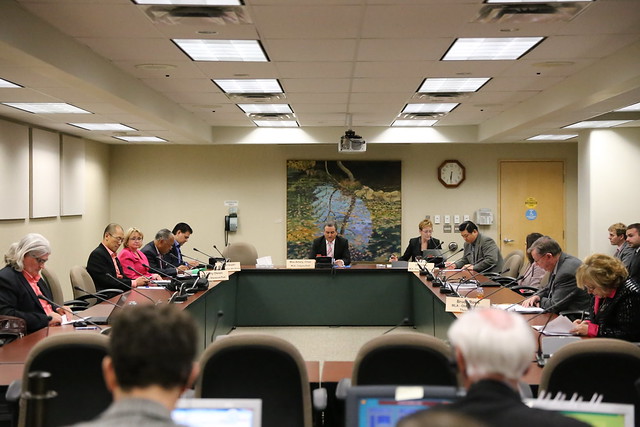
Last week I attended a public meeting on high speed rail in Alberta (which I typically abbreviate ABHSR). The issue is being considered by the Standing Committee on Alberta’s Economic Future, an all-party committee consisting of 18 MLAs. As part of the process, the committee has now heard from the public in Calgary, Red Deer, and Edmonton, and is encouraging additional written submissions by March 31. I hope at least a few Albertans take them up on that, because their “public” meeting was poorly publicized and required going past three security checkpoints.

Alberta High Speed Rail Public Meeting

Here’s the stimulus provided by the committee on the idea:

  • It could offer service between Edmonton and Calgary (including a stop in Red Deer) with a trip time of one to two hours at speeds of 200-500 km/h.
  • One-way ticket prices have been estimated at between $66 and $142.
  • Capital costs have been estimated at $2.5 to five billion, but could be significantly higher.
  • A route would be chosen and land would be acquired along the route for tracks and stations.
  • Overpasses or underpasses would likely have to be built to accommodate many of the road crossings or, alternatively, bridges above any roads the track would cross could be constructed.

Clearly the idea is intriguing. A hundred bucks to get to Calgary in less time than it would take to drive? Sign me up! Driving is stressful, I could read or do some work on the train, there are lots of positives, for sure. But is Alberta ready? Is this an investment we’re prepared to make now?

There were some interesting viewpoints put forward at the meeting. Some felt the time is right, and that a project like this could allow us to harness the talents of all the smart, creative, and innovative people we have throughout the province. Others expressed concern that our population isn’t big enough to warrant such a project. And still others argued that automated, driverless cars are coming and will make the entire idea irrelevant (as exciting as the work Google and others are doing in this area is, there are significant hurdles still to overcome, so I’m not holding my breath).

Technically, the project sounds feasible. A few speakers talked about Maglev technology that has been deployed in a number of other places, notably in Asia. One speaker, Deryck Webb, said Maglev combined with vacuum tubes was the way to go (what he described sounded very similar to Elon Musk’s Hyperloop). I think the key issues are financial and political, not technical.

Alberta High Speed Rail Public Meeting

The issue last came up in 2009, when a report was issued assessing the potential for service between Calgary and Edmonton. At the time I wrote:

“I personally think if the province is going to be spending money on transit, it should be on city and regional transit. Both Edmonton and Calgary could use the assistance to improve their respective transit systems…”

I still feel that way today. If we’re going to spend a few billion dollars, let’s spend it on LRT first.

This is the message our local leaders are sending to the Province. One of the written submissions the committee has received thus far was from the Edmonton International Airport. President and CEO Tom Ruth wrote the following:

“Given the lack of local networked options in the Edmonton Region, we agree with the position of the City of Edmonton and the Edmonton Economic Development Corporation (EEDC) that the priority should be to ensure there are fully developed networks in advance of HSR; including Light Rapid Transit (LRT) service fully developed within the Edmonton Region, with connectivity to EIA. Until these intra-regional options are fully built out, the utility of HSR is severely limited.”

Maybe high speed rail is in Alberta’s future, but I hope it’s after we have developed the LRT networks in Calgary and Edmonton.

You can see the full transcript of last week’s public meeting here (or in PDF here). You might also be interested in the Reddit thread on the issue. If you’d like to submit something to the committee, send it to economicfuture.committee@assembly.ab.ca. The deadline is March 31, and all submissions and the identities of their authors will be made public.

Media Monday Edmonton: Update #102

Here’s my latest update on local media stuff:

You can follow Edmonton media news on Twitter using the hashtag #yegmedia. For a great overview of the global media landscape, check out Mediagazer.

So, what have I missed? What’s new and interesting in the world of Edmonton media? Let me know!

You can see past Media Monday Edmonton entries here.

Edmonton Notes for 3/2/2014

Here are my weekly Edmonton notes:

Headlines

Precious Treasure
Cool shot titled ‘Precious Treasure’ by Dave Sutherland

Upcoming Events

Edmonton Light
Edmonton Light by Jeff Wallace

A vision for the future of transportation in Alberta

The Province is currently working on a new long-term transportation strategy for Alberta. Over the last two months, public discussions have been held throughout Alberta and in the spring, an online survey will be released.

“This Strategy – which will focus on all forms of transportation, connections and ways to move people and products – provide an overarching vision for Alberta’s transportation system over the next 50 years. It will also help guide government decisions on transportation investments, policies and programs.”

That’s a big challenge. But it’s exciting to consider!

Since I missed the meeting here in Edmonton, I took a look at the feedback form. It includes a number of questions that aim to capture what the public thinks about the strategy. One of the first deals with the proposed vision for the Transportation Strategy for Alberta:

“A world-class transportation system that is safe, sustainable and innovative, and that supports Alberta’s economy and quality of life.”

I suppose there’s nothing wrong with that, but it just seems rather bland, doesn’t it? It’s very expected. And phrases like “world-class” are just meaningless. The proposed vision is also incredibly similar to others. For instance, here is Transport Canada’s vision:

“A transportation system in Canada that is recognized worldwide as safe and secure, efficient and environmentally responsible.”

Needless to say, I’m not a fan of the proposed vision. It doesn’t tell me anything about what transportation in Alberta will look like in the future, especially as you could credibly argue that it reflects the current state of Alberta’s transportation system.

welcome to alberta
Welcome to Alberta by Magalie

What could it be instead? Well let’s consider the context.

The shift from rural to urban has been dramatic in Alberta. According to the 2011 federal census, more than 56% of Albertans now live in population centres larger than 100,000 people in size, and 83% live in urban areas of any size (compared to 81% nationally). We’re an urban province now more than ever. The economic power of cities cannot be ignored.

We know that vehicles are dangerous. According to the World Health Organization, “road traffic injuries are the eighth leading cause of death globally, and the leading cause of death for young people aged 15-29.” Here in Alberta, traffic fatalities have declined significantly from 2007 through 2011, but there are still too many of them. We also know that vehicles have a negative impact on the environment. They contribute to global warming, they contribute to smog, and they take up an incredible amount of land that could otherwise be used more productively.

There are lots of other factors to consider, but I think these are the two most important. Reducing our dependence on vehicles and recognizing the importance of cities should be central any vision of the future of transportation in our province. Unsurprisingly, the two biggest cities in Alberta have already recognized this.

Our neighbours to the south have the Calgary Transportation Plan, which says:

The decisions made today about where and what to build will affect Calgarians for 100 years or more – just as decisions made in the past affect us today. Going forward, the transportation system must perform a wide variety of roles and consider the context of surrounding land uses, be they natural or manufactured. It must provide more choice for Calgarians – realistic choices that are convenient, affordable and attractive. These choices include walking, cycling, transit, high occupancy vehicles (HOV or carpooling) and single-occupant vehicles (SOV).

Here in Edmonton, we have the Transportation Master Plan, The Way We Move. It is even more aggressive:

We are building a 21st century city, shaping an Edmonton that will meet the needs of our diverse and growing urban and regional population. Growing environmental concerns, acknowledgment of the ongoing investment needed to maintain our transportation infrastructure and the rapid growth of our city demand a shift in transportation priority setting. It is a shift from single passenger vehicle use to more public transit; from building outward to a compact urban form. From an auto oriented view of transportation to a more holistic view of an interconnected, multi-modal transportation system where citizens can walk, bike, bus and train efficiently and conveniently to their desired location.

I recognize that Calgary and Edmonton have a completely different context and set of challenges than the rest of the province does, but I think their transportation strategies are informative. Let me also say that I don’t think creating a vision statement is easy. I know a lot of hard work, thought, and difficult discussions are needed to come up with them. That said, I’ll take a stab at it.

Here’s my attempt at crafting a stronger vision for the future of transportation in Alberta:

An innovative and sustainable transportation system that emphasizes high occupancy vehicles and strengthens the global competitiveness of Alberta’s urban areas.

What do you think?

Want to solve the space problem for the arts in Edmonton? Stop shaving that yak!

In software development there’s an expression we use to avoid scope creep. “Don’t shave that yak!” we’ll say. It’s shorthand for staying focused and working on solving the problem at hand, not other problems that we might notice along the way. As far as I know the phrase comes from a Ren & Stimpy episode and was coined by Carlin Vieri, a Ph.D. at MIT back in the 90s.

“Yak shaving is what you are doing when you’re doing some stupid, fiddly little task that bears no obvious relationship to what you’re supposed to be working on, but yet a chain of twelve causal relations links what you’re doing to the original meta-task.”

I quite like Seth Godin’s example of yak shaving. This GIF illustrates it well too:

yak shaving

I was chatting with someone in the arts community recently about the Edmonton Downtown Academic & Cultural Centre project, and I remarked, “I just don’t know how we got from ‘arts organizations need space’ to ‘a $1 billion project is the answer’.” But thinking about it later, I realized that I know exactly how we got there. We’re shaving the yak.

It was back in November 2011 that the Mayor’s Arts Visioning Committee released its recommendations for how we could “lift Edmonton to international recognition as a city of the arts by the year 2040.” They followed a public engagement process, learned about the challenges facing the arts in Edmonton, and developed recommendations to try to address them.

One of the challenges identified was space:

“Edmonton artists and arts advocates described a critical need for additional creation, rehearsal, exhibit and performance space. Developing or designating new arts space is paramount to the vision in this report.”

It’s worth noting that this wasn’t a new challenge – The Art of Living identified it in 2008 too. As a result, many of the recommendations dealt with space. The third recommendation was titled “Downtown Arts District and Performance Centre” and was relatively simple:

“The City of Edmonton endorse, in principle, a landmark performing arts centre (PAC) downtown, and designate land for such a development in the city core.”

The report goes on to detail the need and provides background and context. I understand from my conversations with those in the arts community that there is a real need for more space, especially smaller, black-box space that is multi-purpose.

So that’s the problem we’re meant to be solving: a lack of performance and rehearsal space. How did we start shaving the yak? I think it went something like this:

City Council put up $100,000 for the newly created Edmonton Performing Arts Centre Foundation to develop a business case. In developing the business case, the foundation connected with the University of Alberta which expressed a desire to link its music and art & design programs with the downtown arts community. There’s not enough money for all of that, so the vision needed to be made broader. The “revitalize downtown!” mantra evidently worked for others, so the group decides to go after that as part of the vision. To compete with the other big, fancy space known as the arena, a big, fancy space known as the Galleria was designed. In order to pay for that, a commercial office tower was added to the plan, along with a new campus for the University of Alberta. But those projects were deemed unrealistic unless there was a connection to the new Royal Alberta Museum and the LRT.

Before you know it, the group has taken arts out of its name completely, and we’re talking about a $40 million dollar pedway.

Weren’t we supposed to be finding new space for the arts? Stop shaving that yak!

Media Monday Edmonton: Update #101

Here’s my latest update on local media stuff:

Ellie!
We met Ellie in July at the Avenue Goes to the Dogs event!

  • I can’t remember where I saw this link, but I’m looking forward to reading the Verification Handbook: A definitive guide to verifying digital content for emergency content.
  • Have you noticed the new paging that the Journal has added to its website? It looks like this:

paging

  • How annoying! First of all, it’s rare that an article is long enough to warrant that functionality (there’s usually only a paragraph or two on the second page). But worse than that, when I click either “2” or “View as one page”, it jumps back to the top of the screen (I’m using IE11). I have no idea why they introduced this. It doesn’t even do a page load, so it can’t be for page views.
  • While I am complaining about the Journal, I think the ads have gotten worse. I want the ads to be there so that they can make some money, but they’re so intrusive and they slow the page so much that I’m tempted to use an ad-blocker just to make the site usable. This is what the front page looked like for me tonight:

edmonton journal

You can follow Edmonton media news on Twitter using the hashtag #yegmedia. For a great overview of the global media landscape, check out Mediagazer.

So, what have I missed? What’s new and interesting in the world of Edmonton media? Let me know!

You can see past Media Monday Edmonton entries here.

Edmonton Notes for 2/23/2014

The Sochi 2014 Winter Olympic Games wrapped up today, and like most of you I was up by 5am to watch the Canadian men’s hockey team defeat Sweden 3-0 to take the gold medal. In case you missed it, ATB Financial lit up its new building downtown every time Canada scored:

Canada finished 3rd in the medal standings with 10 gold and 25 medals total, one less than our haul in Vancouver four years ago. Edmonton-born athletes did well too. Now attention turns to the Paralympic games, with the opening ceremonies taking place on March 7.

And if you’re like me, you’re now counting down to World Cup 2014 – just 108 days to go!

Here are my weekly Edmonton notes:

Headlines

Upcoming Events

Parka Patio Party
Sharon getting a drink from the vodka ice luge at Latitude 53’s Parka Patio Party on Saturday night. More photos here.