International Open Data Day in Edmonton

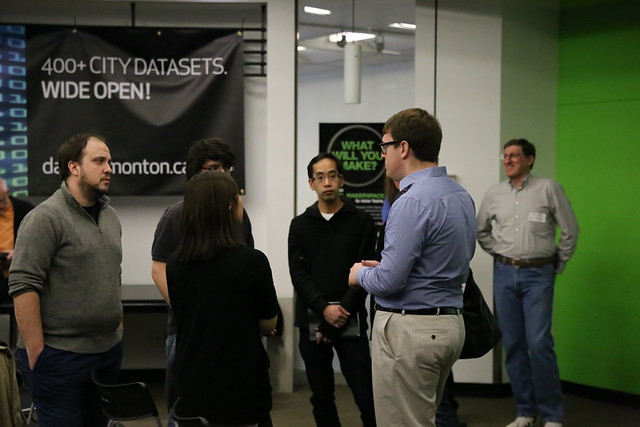
Today is Open Data Day around the world, and here in Edmonton we celebrated with a hackathon at the Edmonton Public Library’s new Makerspace. A few dozen people came out to learn more about open data, to hear ideas from others, and to start exploring and building.

International Open Data Day Hackathon

The day started off with “speed data-ing”, where anyone who wanted to could pitch an idea to the room. Once the pitches were done, there were a lot of great conversations taking place as everyone figured out how they wanted to spend their time for the rest of the day. Teams slowly self-assembled, and then everyone got to work.

International Open Data Day Hackathon

At the end of the day, teams had the opportunity to show off the progress they had made throughout the day. One team worked on visualizing open datasets so that they could be more easily accessed and used by educators. Another team looked at visualizing how many dogs there are and which breeds are most popular in different areas of the city. The winning idea was a visualization of tree data in Edmonton. Hackathons are typically longer than just a few hours, so it was impressive to see what everyone was able to come up with given the time constraints!
International Open Data Day Hackathon

There has never been a better time to be an open data developer in Edmonton. The City of Edmonton’s open data catalogue now contains more than 400 datasets, and the Citizen Dashboard that sits atop the catalogue recently won a national public-sector leadership award. The Government of Alberta’s open data catalogue also has more than 400 datasets now, and it only launched last May. The Government of Canada recently expanded and updated its large open data catalogue. And just this week, Strathcona County launched its own data catalogue featuring more than 60 datasets.

International Open Data Day Hackathon

Many other cities around the world hosted hackathons today too. Here’s what Open Data Day is about:

Open Data Day is a gathering of citizens in cities around the world to write applications, liberate data, create visualizations and publish analyses using open public data to show support for and encourage the adoption open data policies by the world’s local, regional and national governments.

Open Data has come a long way over the last few years. It has been adopted by governments around the world both large and small, and even organizations like the G8 have adopted an Open Data Charter. Countless apps and services have been developed to take advantage of all that information, and I think the best is yet to come. If you’re looking for an open data primer, check out the Government of Canada’s Open Data 101 or check out the Apps Gallery.

Thanks to the City and EPL for hosting a fun and creative day at the Makerspace! You can see more photos from the day here.

The lights are on at Edmonton’s Outdoor Neon Sign Museum

Dozens of Edmontonians braved the cold tonight to join Mayor Iveson, Councillor McKeen, Councillor Knack, and Downtown Business Association Executive Director Jim Taylor for the official launch of the Edmonton Neon Sign Museum on 4th Street Promenade. After probably a bit too much talking, the signs were introduced and the lights came on one-by-one.

Neon Sign Museum

Here’s an overview of the museum:

The primary purpose of this project is to develop an outdoor historic neon sign museum in downtown Edmonton to celebrate the history of neon signage in the city, and to create an engaging outdoor space for cultural tourism as part of the bustling 104th Street Promenade. This unique museum fosters activity and walking traffic in the surrounding area, acting as a light-based form of urban beautification for downtown Edmonton.

The project has been years in the making. Work began in 2008 and the museum has been consistently championed by city planner David Holdsworth, who originated the idea.

The City of Edmonton Heritage Planning has been collecting the historic neon signs at The City of Edmonton Archives over the past few years, salvaging them from both demolished buildings and from buildings where new businesses moved in and removed the signs. The City has collected twelve signs that represent some of the early signage styles and iconic signage forms in Edmonton. The Museum will continue to grow as additional signs – a goal of 30 total – are added in the coming years. Each of the current signs has an accompanying plaque with text panels that tell the stories of the signs, and by doing so the signs speak to the history of Edmonton.

For more on the history of the project, check out Omar’s piece.

Neon Sign Museum

The museum currently features signs from Mike’s News Stand, Canadian National Railway freight-telegrams, Northern Alberta Railway, XL Furniture, W.W. Arcade, Cliff’s Auto Parts, an unidentified drugstore, and Canadian Furniture. Signs still to come are from the Princess Theatre, Pantages Theatre, the Georgia Baths, and a second sign from the W.W. Arcade.

Neon Sign Museum

Sponsors of the museum include the City of Edmonton and the Alberta Sign Association, and community partners include TELUS, the Downtown Business Association, and The Places.

You can see more photos here. Stay tuned for much better photos from the local Flickr group as well!

Recap: DemoCamp Edmonton 24

democampEdmonton’s 24th DemoCamp took place tonight at the Telus Centre on the University of Alberta campus. DemoCamp is “an event that brings together developers, creatives, entrepreneurs and investors to share what they’ve been working on and to find others in the community interested in similar topics.” You can read my recap of our last DemoCamp here. There was a pretty good turnout tonight, and lots of new faces in the crowd.

We had seven demos tonight, three of which were projects created at the recent 24 hour Computer Engineering Club Hackathon. In order of appearance:

  • Gregg and Stephen showed us Industry Mailout‘s new email editor. The existing editor hasn’t really been changed since 2004, so a fresh approach was long overdue. The new editor looks very slick, and in addition to being easier to use with a live preview, it’s more advanced too. Users can easily include tweets and other elements in their templates. It also supports Liquid.
  • Ross and Andrew were up next to show us their project from the hackathon called Stall. It’s a mobile app that lets you play mini games simply by scanning a QR code that has been placed somewhere. So imagine getting into an elevator, scanning the QR code, and playing a quick game. They also implemented a high score feature, so you could try to top the leaderboard in that elevator. Cool stuff!
  • Our third demo was from Michael who showed us Renturly. It’s an app that helps to match buyers and sellers in off-market, NPN (non-performing note), and REO (real estate owned) real estate. I must admit I don’t understand the business, but I gathered that this isn’t a tool you’ll use to buy your next house. It’s for people looking to buy and sell apartment buildings, hotels, and golf courses. I’m not really sure where the name comes in or why the logo is a bird, but it sounds like Renturly already has a number of paying customers.
  • Next up was Indragie and Ali who showed us their Smartwatch Light Bulb Controller, which took first place at the hackathon. Their solution enabled a Pebble smartwatch to control the color and state of a wifi-connected lightbulb (they used LIFX). It was neat to see such a visual demo that just worked! Currently it requires a server and a phone, and it requires everything to be on the same wifi network, but in theory they could make it run from the cloud.
  • Our fifth demo was from Myst.io. Logan and his team showed off the cross-platform API using Visual Studio! Myst makes it easy for developers to add features to their games like cloud saving, multiplayer, and achievements. It sounds like their API is fairly complete, though they are still working on the deployment and management.
  • Sixth was Ranek who showed us his hackathon project called URSA. As he himself admitted, it solves a problem that students try to solve every couple of years – a better way to search and select from the University of Alberta’s course catalogue. His solution did look pretty slick, and there are lots of potential improvements he could make. Interestingly it doesn’t simply scrape data, but actually gets the bulk of it from an LDAP server the university makes available. Progress!
  • The final demo of the evening was from Kris, Damien, and their team, who showed us GameSys. They work in the online gaming (as in casino) space, and showed us some nifty tech that can help to detect fraud, collusion, and other “abhorrent” behavior in online poker. We basically saw a Virgin-branded poker game being played, followed by a peek at the admin interface they would use on the backend to detect foul play.

Here are some video highlights from the event:

All of tonight’s demos were relatively quick – I don’t think anyone used their full seven minutes actually! I am really happy to see what Industry Mailout is up to as their service is used by so many local organizations (I feel like I interact with it daily due to all the email newsletters I get). I loved seeing all of the cool projects that students were able to create in just 24 hours, it’s really impressive. Even if their solutions don’t have a commercial future, it’s great to see such creativity.

Great job to all the demoers!

Here are the upcoming events and other announcements that were highlighted at DemoCamp:

  • Startup Edmonton is hosting an open house each Friday afternoon. It’s a great opportunity to check out the space and to find out what it is like to be a member.
  • The next Go Meetup is on Monday night. There are also meetups for Ruby, Python, and many other technologies so check them out! One of the newest is an AWS Meetup, the first meeting of which will be during lunch on March 20.
  • There’s an interesting lunch event coming up next Wednesday called Lunchalytics. Taking place at Startup Edmonton, the event’s theme is Predictive Analytics in the Public Sector.
  • TEDxEdmonton is coming back this summer with the theme of “uncertainty”. They’ve recently changed the date to June 14 to watch for future details in the weeks ahead.

Keep an eye on the Startup Edmonton Meetup group for more upcoming tech events.

See you at DemoCamp Edmonton 25!

DemoCamp Edmonton 24 is on Thursday!

Looking to connect with local entrepreneurs, investors, and other creative Edmontonians? Look no further than the next DemoCamp, taking place at the U of A on Thursday.

DemoCamp is an event that brings together developers, creatives, entrepreneurs and investors to share what they’ve been working on and to find others in the community interested in similar topics. For presenters, it’s a great way to get feedback on what you’re building from peers and the community, all in an informal setting. Started back in 2008, DemoCamp Edmonton has steadily grown into one of the largest in the country, with 200-300 people attending each event.

If you’ve never been to a DemoCamp, I think you’ll enjoy the format. The reason it is called DemoCamp is because you have to actually demo something!

The rules for DemoCamp are simple: 7 minutes to demo real, working products, followed by a few minutes for questions, and no slides allowed.

Following the demos, a large group usually heads to a local pub for drinks. It’s a great opportunity to ask the demoers about their stuff and to meet some new people.

BarCamp coming soon!
Photo of Edmonton’s first DemoCamp in March 2008

You don’t need to be a programmer to appreciate DemoCamp. The demos are approachable and don’t usually dwell on any technical details. There are plenty of people in the room who are not developers, so you won’t be in the minority if code scares you! Come and get inspired by what others have applied their talents to.

Here are the details for Thursday’s event:

WHEN: Thursday, February 20, 2014 at 6:45pm
WHERE: TELUS Centre 150, University of Alberta

The demos this time will include:

Here’s a teaser on CTV Edmonton!

Don’t miss it! You can RSVP on Meetup here. If you can’t make it, follow along on Twitter using the #democampyeg hashtag.

If you’d like to read about previous DemoCamps, you can see my recaps here. Here’s my recap of DemoCamp Edmonton 23, which took place in November. Thinking you might want to demo in the future? You can apply here.

See you Thursday!

Media Monday Edmonton: Twitter Statistics

Though numbers are only one part of the story of how local media are using tools like Twitter, I find them interesting nonetheless. I have posted Facebook statistics for the local media a couple times, but never Twitter! In this post, I have taken a snapshot of the local media’s Twitter stats.

The following numbers were all gathered today using Twitter Counter and are sorted by followers.

Organization Followers Following Tweets
Edmonton Journal 47,389 122 76,503
CTV Edmonton 43,933 658 54,336
Global Edmonton 41,037 93 22,409
CBC Edmonton 30,205 407 28,912
Edmonton Sun 20,001 4,294 41,855
SONiC 102.9 15,992 301 29,289
91.7 The Bounce 15,068 15,540 18,596
Avenue Edmonton 13,264 641 5,847
Metro Edmonton 13,125 1,196 27,204
102.3 Now! Radio 13,107 14,386 46,021
Vue Weekly 13,006 420 4,223
CISN Country 103.9 12,617 12,108 23,874
HOT 107 Edmonton 11,306 2,277 24,829
CityNews Edmonton 10,872 158 4,402
BT Edmonton 10,271 2,932 13,913
100.3 The Bear 9,531 5,376 17,506
CKUA Radio 9,049 948 6,323
iNews880 7,517 1,615 40,046
TSN 1260 7,138 746 10,768
630 CHED 6,569 424 21,509
96.3 Capital FM 6,548 571 6,115
104.9 Virgin Edmonton 6,277 306 25,396
K-97 Edmonton 6,199 3,785 11,528
Alberta Primetime 6,155 416 5,365
CJSR 88.5 FM 4,094 733 1,925
up! 99.3 FM 2,224 998 5,980
105.9 Shine FM 1,486 878 4,755
92.5 Fresh FM 1,318 542 14,085
95.7 CRUZ FM 1,292 997 11,533

You can see some other Twitter stats in my State of the Edmonton Twittersphere for 2013. Based on that data, the ten most retweeted local media accounts are:

  1. edmontonjournal
  2. ctvedmonton
  3. globaledmonton
  4. cbcedmonton
  5. metroedmonton
  6. edmontonsun
  7. 925freshfm
  8. cisncountry
  9. inews880
  10. 1049virginyeg

What do you think? Do the numbers make sense given what you know of these organizations on Twitter?

You can see past Media Monday Edmonton entries here.

Edmonton Notes for 2/16/2014

Here are my weekly Edmonton notes:

Headlines

Here’s a different way to see Edmonton: from above!

Upcoming Events

Left or Right?
Great long exposure of the skyline from Jeff Wallace

Another small step forward for Edmonton’s Southeast LRT extension

Prime Minister Stephen Harper today introduced the new Building Canada Plan, “the largest long-term infrastructure plan in Canadian history, providing stable funding for a 10-year period.” The highlight of the new plan is the $14 billion New Building Canada Fund, a potential source of funding for projects like Edmonton’s planned Southeast LRT extension.

valley line lrt

Known as the Valley Line, the Southeast to West LRT extension would run 27 km from Mill Woods to Lewis Farms. The City hopes to construct the expansion in phases, starting with a $1.8 billion leg from Mill Woods Town Centre to 102 Street downtown. The City has already committed $800 million to the project, and now needs the federal and provincial governments to contribute their share.

Despite some opposition, City Council approved the use of a public-private partnership to build the extension, enabling the City to access funding through P3 Canada. In March last year, P3 Canada awarded $250 million toward the project.

Mayor Don Iveson

Though many details about the new Building Canada Fund are still to come, Mayor Don Iveson held a press conference this afternoon to discuss how it might help the City with the LRT expansion. In the ideal case, the City would receive another $150 million for the project, taking the total federal contribution to $400 million. Mayor Iveson said:

“That shows the federal government is seriously committed to investing in transit, maybe to not the level that mayors across the country would like, but it’s an opening to further discussion about the importance of national investment in transit infrastructure.”

Though he praised the efforts of the federal government, he also shared his thoughts on what he’d like to see in the future:

“Long-term, I would like to see a dedicated federal investment in rapid transit, over and above these baseline Building Canada commitments.”

Here’s the audio from Mayor Iveson’s press conference today:

If the City were to receive the funding it hopes to from Building Canada, that would bring the funding gap down to $365 million (the City has $235 million left over from Stelmach’s fund for green transit that mostly went to the North LRT to NAIT). The Government of Alberta needs to come to the table, and Mayor Iveson sounded optimistic that could happen:

“We’ll keep on talking to ministers and MLAs and we’ve been having a lot of those conversations lately and they’re very receptive. They’re working within their own constraints, and their own competing priorities, but I believe they’re trying to find a way.”

I’m much less optimistic. Both Calgary and Edmonton have made it clear that rapid transit is their top priority, but Premier Alison Redford’s government has consistently avoided making any commitments. Sooner or later, the province is going to have to either come to the table on LRT funding, or as David Staples wrote last month, “we need to elect a government that can make it happen.”

If the funding were secured by the spring, construction on the Southeast LRT could begin as early as 2016 with the extension opening by 2020.

Green light given for Rogers Place, Edmonton’s new downtown arena

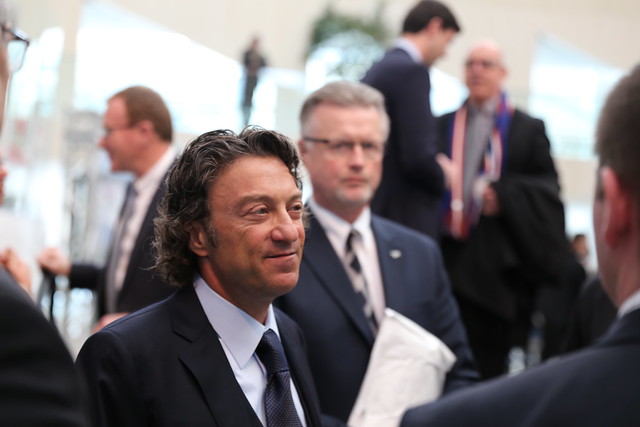
Construction on Rogers Place, the future home of the Edmonton Oilers, will begin in March now that the $480 million guaranteed maximum price has been met. The announcement was made at a press conference today at City Hall that featured a rare public appearance by Daryl Katz.

Downtown Arena Press Conference

The new downtown arena will seat 18,641 for hockey games, and is being described as “the most technologically enabled sport facility in all of North America” (details on what that means are still to come, I presume). The arena is part of a $606.5 million package that includes a community rink, LRT connection, pedway, and the Winter Garden.

The stage today was backed with hockey boards while a face-off circle emblazoned with the Oilers logo sat in front. Giant renderings of the new building flanked each side. Mayor Don Iveson, City Manager Simon Farbrother, Daryl Katz, and Ian O’Donnell from the Downtown Community League (DECL) were the speakers.

Downtown Arena Press Conference

I have to say the press conference seemed a bit over the top for what was announced. It was very unlikely that the guaranteed maximum price wouldn’t be met, and even if it hadn’t been met, that would have been little more than a speed bump. Council would have voted, and construction would have gone ahead one way or another.

Very little that was announced today was new (would it have killed them to talk about the building, even just a little?). Most of the speeches consisted of the various parties involved thanking one another, and extolling how great the new arena will be for Edmonton. And we heard the same old arguments once again. City Manager Simon Farbrother said:

“With this announcement, we are able to announce two very significant goals for this city. The first one this does is helps us on that continued journey of building a great downtown. The second one it does is it supports NHL hockey in Edmonton for the very foreseeable future.”

Nevermind that downtown has been on the upswing for years and that the threat of losing the Oilers was misleading at best.

But those arguments are over and done with – today was about the future, as Daryl Katz said. I suppose his attendance was meant to suggest a sense of finality, but I’m not sure that came across. He certainly didn’t look like he wanted to be there. Sure, he expressed his relief at getting to this point and his thanks to all involved, but he looked and sounded to be going through the motions more than anything else.

Downtown Arena Press Conference

Why was DECL invited to participate? Maybe it was just to play the role of “downtown supporter” in the story. I hope it wasn’t to represent the members of the public that were apparently involved in the decision, because just two or three people on the board were involved. As someone who both lives and works downtown, I don’t feel that DECL represented me in the process (this is a great example of how community leagues are setup to promote “tick the box” public engagement).

But I guess that was the point of today’s event – the process is done, the arena will be built. I’m happy that we’ve reached this point and I do think the arena will have a positive impact on downtown. I have great respect for everyone who has gotten involved, whether it was to support to the project or whether it was to ask hard questions. There are still questions remaining too. Will the remaining government funding be confirmed? What will happen to Rexall Place?

One thing that’s clear is that the arena won’t succeed on its own. It needs a district surrounding it. In his remarks today, Daryl Katz made mention of that development, saying that we can expect to learn more this spring. I have heard the project described as a series of dominoes, with the new City tower following the arena, and more still to fall. I sure hope that’s the case.

Downtown Arena Press Conference

There were a couple of other interesting tidbits of news shared today:

  • Katz Group Executive VP John Karvellas confirmed that the Oilers have an agreement in place to continue playing at Rexall Place until the new facility opens in time for the 2016 season.
  • MacEwan University has come to the table and will be contributing $2 million to the community rink to “increase capacity and improve functionality”.

You can see more photos of the press conference here. The Oilers have audio and video of the press conference available here. The City has made renderings of Rogers Place available here.

Media Monday Edmonton: Update #100

Today’s post is a milestone for me. I started my Media Monday Edmonton series almost exactly three years ago, with this introduction:

Like many others, I’m interested in the continual evolution of journalism and media. And given my passion for Edmonton, I’m particularly interested in that evolution at a local level. Where have we been, and where are we going? What’s next?

Today’s post is #120 in the series, and #100 of my weekly updates (the first few were called “Week in Review”). I had no idea how long my experiment would last, but here we are, still going strong. The media landscape in Edmonton continues to evolve, meaning there’s no shortage of new things to write about!

I know how disappointing it would be to read a milestone post and not see a word cloud (heh) so here you go – each of my weekly updates visualized:

media monday word cloud

I’m both surprised and happy to see that Media Monday has become so popular. Thanks for correcting my mistakes, sending in tips, and for reading week after week.

Here’s my latest update on local media stuff:

You can follow Edmonton media news on Twitter using the hashtag #yegmedia. For a great overview of the global media landscape, check out Mediagazer.

So, what have I missed? What’s new and interesting in the world of Edmonton media? Let me know!

You can see past Media Monday Edmonton entries here.

Edmonton Notes for 2/9/2014

Here are my weekly Edmonton notes:

Headlines

Waiting for Green
Beautiful shot of the historic McLeod Building by Jeff Wallace

Upcoming Events

Portal
Looks like the Flying Canoe Adventure was fun! Photo by Chris Gusen.