Media Monday Edmonton: Editorials & Endorsements

Should news organizations write editorials? Should they endorse political candidates? I think the answer to both questions is yes. Perhaps they should do it differently than newspapers have historically written editorials and endorsements, but I think both are important activities for news organizations today, and even more so for news organizations of the future.

To understand my point-of-view, I think there are three key things to consider. First, I believe the view from nowhere is harmful. Second, I believe that technology is dramatically changing the opportunities we have to seek out varied opinions and perspectives for the better. Third, I believe that news organizations need to be part of the communities they wish to inform.

The View from Nowhere is harmful

I firmly believe that the view from nowhere does more harm than good. The idea that journalists are unbiased and impartial strikes me as wrong, and the idea that keeping their biases hidden because it earns them more authority is even worse. As Jay Rosen wrote:

“In journalism, real authority starts with reporting. Knowing your stuff, mastering your beat, being right on the facts, digging under the surface of things, calling around to find out what happened, verifying what you heard. “I’m there, you’re not, let me tell you about it.” Illuminating a murky situation because you understand it better than almost anyone. Doing the work! Having a track record, a reputation for reliability is part of it, too. But that comes from doing the work.”

If you’re going to do all of that work, you’re going to form an opinion. Why not share that work? Why not share the facts and an opinion? I do not think that facts and an opinion are mutually exclusive. I would much rather read an opinion from a journalist who has invested a great deal of time and effort into understanding and forming that opinion, than a so-called impartial piece that belies the journalist’s true feelings and knowledge of the story.

Increased access to varied perspectives is a good thing

The democratization of publishing ushered forth by the web has provided us with a lot of crap, but also with more intelligent, well-researched, and thoughtful perspectives than we’ve ever had access to before. Gone are the days when reading one newspaper article would provide you with everything you could possibly know about a story. These days, that article is just the tip of the iceberg. Venture below the surface, and you’ll find a myriad of voices, perspectives, facts, and other information. It can take a bit of work to avoid getting lost in the sea of sources, but in exchange for an ounce of effort you’re rewarded with a ton of insight.

Who wants to do all that work, you ask? Increasingly you don’t have to. Searching the web today is less like finding a needle in a haystack and more like asking a question and getting an answer, and search remains a focus of major investment for the key players. New software that aggregates sources together appears almost daily, and with every new tool the algorithms get better and better. Curators are blossoming alongside both search and aggregation, offering yet another way to cut through the clutter.

I reject the notion that the explosion of perspectives makes it too easy to get trapped into the so-called echo chamber. At the end of the day, I don’t think human beings are satisfied reading only things they agree with and ignoring everything else, if for no other reason than we crave connection. As strongly as you might feel about something, keeping it to yourself is nearly impossible. Nothing compares to the experience of telling another person.

News organizations need to be part of the community

I agree 100% with Edmonton Journal editor Margo Goodhand when she wrote, “I still believe editorials can inform and challenge a community.”

The Edmonton Journal’s mission remains unchanged from the early days: “to provide relevant and reliable news and information to the Edmonton community.” In order to do that, the Journal needs to be part of the community, otherwise what credibility would it have? You can talk about a community without being part of it, but you can’t talk with a community unless you’re a member.

But how can a company be a part of the community? I think the answer is through its people. Journalists are the Edmontonians that can talk with the Edmonton community, not the organization itself. It is those journalists that will have gained knowledge and insight into something that is important to the community, such as an election.

Ignore tradition

The one line in Margo’s piece that still troubles me is this: “I would hate to be the first in the Journal’s 110-year history to abandon a venerated newspaper tradition.” (How will she lead the organization into the future of media if she is unwilling to break with tradition?) Even though I think editorials and endorsements have a place in the news, I think news organizations need to be willing to make some changes.

I don’t think unsigned editorials have a place in the future of media. Margo identifies the Journal’s editorial board in her piece, so why not identify the writer of each editorial on a regular basis? Is it solely to maintain the artificial separation between the editorial board and columnists? I would like to see editorials with a byline. The journalists who wrote the editorial will of course have sought insight from others, done some research, and perhaps even consulted the archives, but that doesn’t change the fact that they wrote it.

Likewise I don’t think political endorsements should carry the name of the news organization, but rather the name of the journalist(s) making the call. Maybe an editorial board as a whole can’t agree – why does there need to be only one endorsement, or lack thereof? ‘The decision is yours’ offered absolutely nothing of value. I would much rather have seen two or more strong, opposing opinions. That would have given me additional perspectives to consider.

To the future!

From my viewpoint in 2014, the future looks a lot more complicated and a lot more interesting than it is now. I’ll need to work harder to truly understand the world around me and my place in it, and I don’t and won’t rely on any single source of information. I’ll continue to consult sources with perspectives that match my own as well as sources that offer a different point-of-view. I’ll make up my own mind.

I think editorials and endorsements, created by journalists who know enough to have formed an opinion and who are clearly identified, are a healthy and important part of that future.

Edmonton Notes for 2/2/2014

Here are my weekly Edmonton notes:

No more bike lanes for you!

When it comes to bike lanes, enough Edmontonians have screamed “not in my backyard” that the City is now looking to delay further bike lane construction. This just after Council asked for more proof that shifting our city’s transportation modes is actually happening. Don’t hold your breath Councillors!

You know what other cities are doing? Building bike infrastructure. Chicago, Phoenix, San Francisco, Washington, D.C., and Los Angeles were among the large American cities that pushed ahead with bicycle-related initiatives in 2013.

Headlines

Child Intervention Roundtable. Jan. 29, 2014
“A child intervention roundtable held at the University of Alberta in Edmonton January 28 and 29 brought experts, policy makers and stakeholders together to discuss the best practices in reviewing all child deaths in Alberta, and striking a balance between transparency and privacy.”

Upcoming Events

Waiting for Night
Waiting for Night by Jeff Wallace

State of the Edmonton Twittersphere 2013: Top Users & Tools

In case you missed it, check out the overview post for a general look at Twitter in Edmonton in 2013. In this entry I’ll share more details on who the most active, replied to, and retweeted users of the year were. If you want to see the most followed users in Edmonton, check out Twopcharts. Taylor Hall is the first local user over 300,000 followers!

A quick reminder that the data in this post comes from a sample of roughly 13.8 million tweets posted by local users as defined in the overview post. Nearly 120,000 local users posted at least one tweet in 2013.

Here are the 25 most active local users (they tweeted more than anyone else):

  1. RPrasad619
  2. DaniParadis
  3. KikkiPlanet
  4. DavidPapp
  5. canadianglen
  6. Leask
  7. TrevorBoller
  8. YEGlifer
  9. JovanHeer
  10. abdihalimsalad
  11. MyLegacyCoach
  12. HouseofGlib
  13. ChristySpratlin
  14. bcbreakaway
  15. markyeg
  16. Moesquare
  17. edmontonjournal
  18. 1023nowradio
  19. machinegunv
  20. DJ_Orphan
  21. Gloriadantuono
  22. tommylutz
  23. eissyrC
  24. ctvedmonton
  25. candyTae

There were three easily-identifed bots that would have been in the list above:

  1. edmonton_rt
  2. EdmontonCP
  3. HOT107OD

Here are the 25 most active local users using #yeg (they tweeted using the #yeg hashtag more than anyone else):

  1. ctvedmonton
  2. GlobalEdmonton
  3. CBCEdmonton
  4. iNews880
  5. 925FreshFM
  6. mybirdietweets
  7. edmontonjournal
  8. 1049VirginYEG
  9. DerrickDodgeYeg
  10. metroedmonton
  11. RobWilliamsCTV
  12. KikkiPlanet
  13. Dave_CHED
  14. Edmontonsun
  15. Yegfit
  16. YEGFoodie
  17. vineshpratap
  18. EJ_Arts
  19. JBH8
  20. lindork
  21. lite957
  22. DishcrawlYEG
  23. Sperounes
  24. 1023nowradio
  25. YEGlifer

There were four bots that tweeted enough to be in that list above:

  1. edmonton_rt
  2. EdmCA
  3. everythingyeg
  4. yegtraffic

Here are the 25 most replied to local users (other local users had lots of conversations with these users):

  1. KikkiPlanet
  2. EdmontonOilers
  3. JasonGregor
  4. nielsonTSN1260
  5. YEGlifer
  6. Leask
  7. TrevorBoller
  8. CommonSenseSoc
  9. JenBanksYEG
  10. eissyrC
  11. Wildsau
  12. DeeMented2
  13. Kage_99
  14. britl
  15. JameyMPhoto
  16. erinklassen
  17. dantencer
  18. lindork
  19. dstaples
  20. baconhound
  21. Steeeveohh
  22. joshclassenCTV
  23. JackieDee16
  24. Arbitral
  25. edmontonjournal

Here are the 25 most retweeted non-individual local users:

  1. edmontonjournal
  2. ctvedmonton
  3. globaledmonton
  4. cityofedmonton
  5. cbcedmonton
  6. edmontonoilers
  7. yegsphere
  8. yegtraffic
  9. localgoodyeg
  10. oilersnation
  11. edmoilkings
  12. edmontonpolice
  13. yegtweetup
  14. metroedmonton
  15. whereedmonton
  16. edmontonsun
  17. ualberta
  18. 925freshfm
  19. cisncountry
  20. inews880
  21. cfl_esks
  22. 1049virginyeg
  23. northlands
  24. nait
  25. oldstrathcona

Here are the 25 most retweeted individual local users:

  1. kikkiplanet
  2. dantencer
  3. jasongregor
  4. joshclassenctv
  5. fakeoilersgm
  6. paulatics
  7. doniveson
  8. mastermaq
  9. cstpower
  10. nielsonTSN1260
  11. sunterryjones
  12. sbarsbyweather
  13. wanyegretz
  14. etownmickey
  15. ryanjespersen
  16. britl
  17. davecournoyer
  18. lindork
  19. trevorboller
  20. dstaples
  21. ebs_14
  22. robin_brownlee
  23. yeglifer
  24. staceybrotzel
  25. geneprincipe

Clearly if you tweet about the Oilers, there’s a good chance you’re going to get retweeted. I’m fascinated by the fact that a satirical account, @FakeOilersGM, is the fifth most retweeted individual. Shows you what kind of year the Oilers have had, and how engaged Edmontonians are with the Oilers.

Only the Edmonton Journal was retweeted more than 10,000 times. A total of 88 users were retweeted more than 1000 times, 1547 users were retweeted more than 100 times, and nearly 11,000 users were retweeted at least 10 times.

Tools

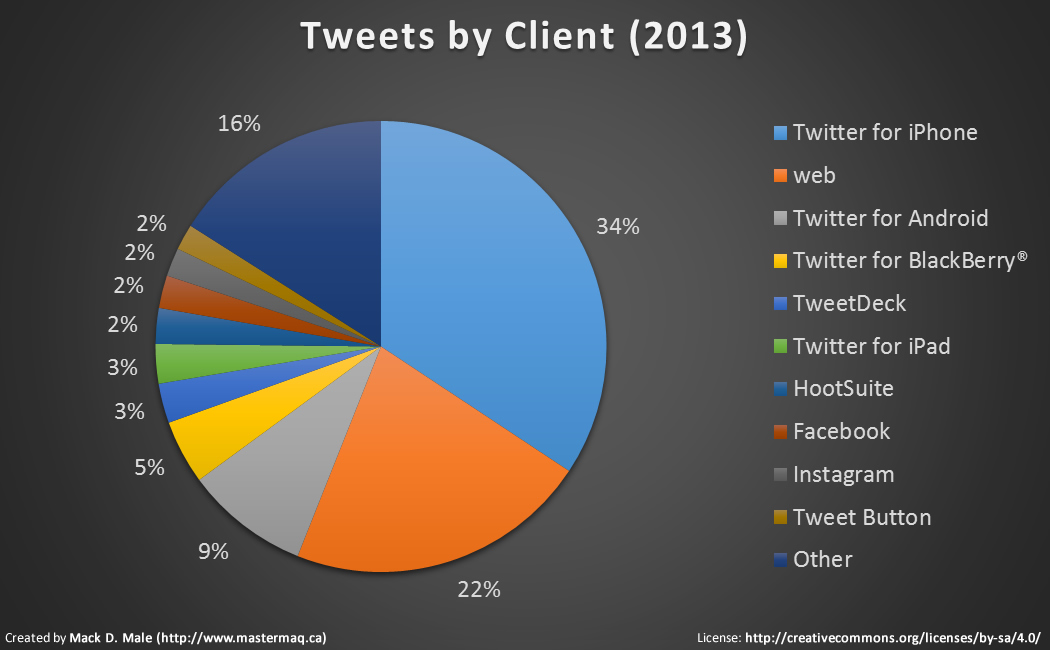
The ten most popular tools or clients used to tweet in 2013 accounted for 84% of all local tweets. The top 25 accounted for just less than 93% of all tweets. There’s definitely a long tail here though, as more than 3300 different clients were used.

  1. Twitter for iPhone
  2. web
  3. Twitter for Android
  4. Twitter for BlackBerry®
  5. TweetDeck
  6. Twitter for iPad
  7. HootSuite
  8. Facebook
  9. Instagram
  10. Tweet Button

Here’s a look at the breakdown:

Tweets by Client (2013)

No surprise to see BlackBerry fall down below Android, but I must admit I am a little surprised it remains so high on the list.

You can see the top users & tools from previous years here: 2012, 2011, 2010, 2009.

Happy Tweeting!

State of the Edmonton Twittersphere 2013: Overview

Welcome to the State of the Edmonton Twittersphere for 2013, my fifth look at the intersection of Twitter and Edmonton. You can see my previous annual recaps here: 2012, 2011, 2010, 2009.

In previous years, I have more or less treated the reports as connected to one another. I’d capture nearly every tweet posted by local users over the year, and compare the data to previous years, and you’d see the growth. This year is different. Twitter made changes to the part of its system that I use to gather the data, so instead of gathering most of the data, I instead was only able to gather a large sample.

The sample for this year’s report is about 13.8 million tweets posted by local users. Local users are defined the same way as before: if a user has his or her location set to Edmonton, St. Albert, Sherwood Park, Leduc, Nisku, Stony Plain, Fort Saskatchewan, Beaumont, Spruce Grove, or matching lat/long coordinates, they are considered an Edmontonian, and thus a “local user”.

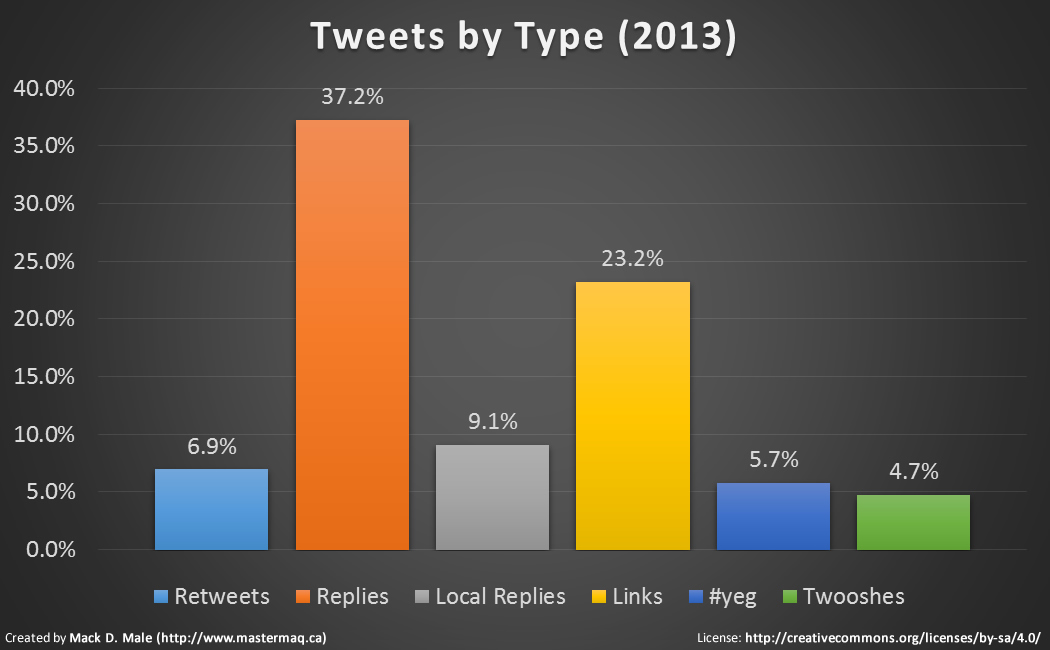
Of the 13.8 million tweets in this year’s sample:

  • Just under 800,000 or 5.7% were tagged #yeg.
  • More than 950,000 or 6.9% were retweets.
  • About 5.1 million or 37.2% were replies.
  • Roughly 1.2 million or 9.1% were replies to other local users.
  • Nearly 3.2 million or 23.2% contained links.
  • More than 640,000 or 4.7% were twooshes (exactly 140 characters).

Tweets by Type (2013)

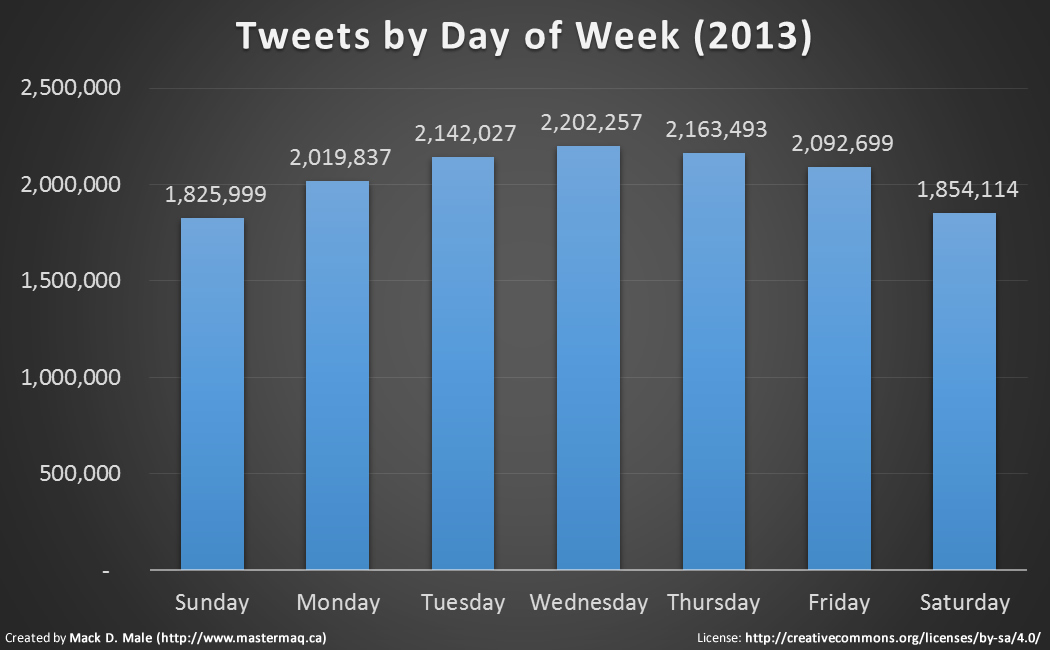
In 2013, the day of the week with most tweets posted was Wednesday, which is consistent with previous years. Sunday and Saturday saw the fewest tweets posted.

Tweets by Type (2013)

Local users used over 840,000 different hashtags in 2013. As usual, hashtags ranged in length from 1 character to 139, excluding the hash, and they were used for just about every purpose you can think of. The average hashtag length was 13 characters.

Here are the top 25 hashtags used by local users in 2013:

  1. #yeg
  2. #oilers
  3. #edmonton
  4. #yegfood
  5. #yegvote
  6. #ableg
  7. #cdnpoli
  8. #yyc
  9. #shpk
  10. #yegwx
  11. #jobs
  12. #yegcc
  13. #nhl
  14. #ff
  15. #yegtraffic
  16. #stalbert
  17. #yegdt
  18. #ualberta
  19. #yegarts
  20. #cbc
  21. #yegweather
  22. #whatshouldplaynext
  23. #teamfollowback
  24. #instantfollowback
  25. #canada

Here’s a visualization of the top 100 hashtags excluding #yeg:

Top Hashtags for 2013

It’s no surprise that #yeg was once again the most popular hashtag, by far. Twitter even declared #yeg as the second most popular trend in Canada for the year. In total, there were 4,611 different hashtags starting with #yeg used by local users in 2013.

Here are the top 25 #yeg-related hashtags:

  1. #yeg
  2. #yegfood
  3. #yegvote
  4. #yegwx
  5. #yegcc
  6. #yegtraffic
  7. #yegdt
  8. #yegarts
  9. #yegweather
  10. #yegarena
  11. #yegmusic
  12. #yegjobs
  13. #yegbike
  14. #yegre
  15. #yegevents
  16. #yegfashion
  17. #yegbiz
  18. #yegfringe
  19. #yegtheatre
  20. #yegtransit
  21. #yegfilm
  22. #yegmedia
  23. #yegpkn
  24. #yegbeer
  25. #yegsa

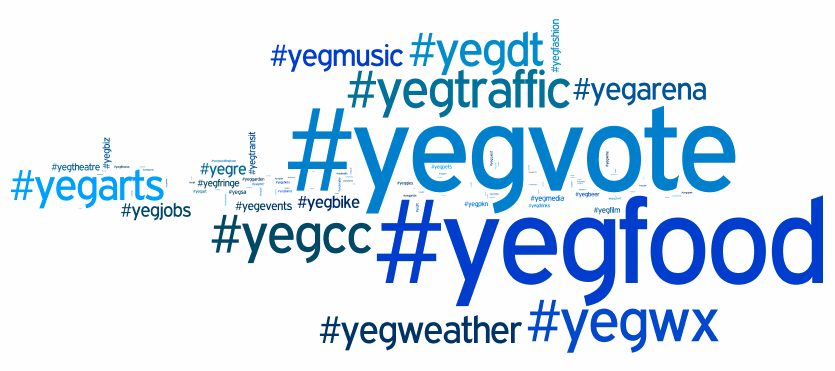
Here’s a visualization of the top 100 #yeg-related hashtags:

Top #yeg Hashtags for 2013

No surprise that #yegfood remained on top (after #yeg of course) and I suppose it shouldn’t be surprising that in an election year, #yegvote was quite popular. Interesting to me that #yegjobs is so high, but I suppose that could be due to bots or automated tweets.

I’ll have additional data to share in my next post, which will include the most active, replied to, and retweeted users of the year.

Happy Tweeting!

Media Monday Edmonton: Update #99

Here’s my latest update on local media stuff:

Press Gallery
Press Gallery at McKay Avenue School

No local interest in Pinterest

There’s a lot of talk about Facebook making a splash in the news world with an upcoming app, but they’re not the only social network with an interest in the media. Pinterest too has made an effort to court media organizations, and they said in September that “a growing number of journalists and media sites use Pinterest.” Back in March, they launched an analytics dashboard to help media orgs and others see how their content is being pinned on Pinterest. Unsurprisingly, Mashable has a lot of great stuff on Pinterest if you’d like to learn more about what they have been up to.

Some of the local media are using Pinterest, but not many (let me know if I have missed any):

As you can see, only the Edmonton Journal is really active on Pinterest. They’ve created 85 boards, featuring everything from “Cars”, “Food”, and “Weddings” to “Mint Green Fashions” and “Chalkboard Paint Inspiration”. One of the most interesting boards (from a news point-of-view) is “This Day in Journal History”, which is described as “a daily look at the past through the eyes of the Edmonton Journal.”

I guess Pinterest hasn’t caught on with local media orgs. If you’re looking to jump into Pinterest, here are five ways journalists can use the service and here are five ways journalists are using Pinterest.

You can follow Edmonton media news on Twitter using the hashtag #yegmedia. For a great overview of the global media landscape, check out Mediagazer.

So, what have I missed? What’s new and interesting in the world of Edmonton media? Let me know!

You can see past Media Monday Edmonton entries here.

Edmonton Notes for 1/26/2014

Here are my weekly Edmonton notes:

Headlines

//platform.twitter.com/widgets.js

//platform.twitter.com/widgets.js
Here’s the 2013 Year in Review video that EEDC showed at the 2014 Impact Luncheon:

Upcoming Events

UPDATE: I incorrectly stated that DemoCamp was taking place on Thursday, but it has been rescheduled for February 20.

Edmonton Chinese New Year
Lunar New Year Extravaganza at West Edmonton Mall, photo by iqremix

EEDC looks to deliver “monumental value” with new energy, identity, and purpose

When Brad Ferguson took over as President & CEO at Edmonton Economic Development Corporation (EEDC) in the summer of 2012, he knew things had to change. Even though Edmonton’s economic growth remained strong, many leaders throughout the city felt that EEDC could be doing more. Even City Council had begun to lose confidence in the organization, with Councillor Caterina going so far as to suggest that EEDC be shut down if its fortunes weren’t turned around. Brad insisted he was fired up and ready to do the work of remaking the organization.

Brad Ferguson

He wasn’t kidding. The organization today has changed dramatically from the one Brad took over. He opened his speech at last week’s 2014 Impact Luncheon with that context:

“I stood at this podium one year ago knowing a lot had to change. Our organization had lost the confidence of City Council and lost relevance with the business community.”

“I can stand here today proud of the work we’ve done and the changes we’ve made in the last twelve months.”

Over the last year EEDC has clarified its purpose and approach, revamped its brand and visual identity, brought in fresh leadership, and has started to dramatically shift the internal culture of the organization.

Edmonton Economic Development is changing the way it does business. “The culture of winning is what we’re building,” Brad said.

New Purpose & Approach

To bring greater focus to the work of the organization, EEDC has clarified its primary objective:

To ensure the Edmonton Region outperforms every major economic jurisdiction in North America consistently over the next 20 years…regardless if the price of oil is $140 or $40.

That’s a big departure from the organization’s previous (though fleeting) goal statement, which was to become one of the world’s top five mid-sized cities by 2030. It’s a shift from aspirational hyperbole to measurable outcomes, from uncertain ROI for stakeholders to an assured local impact.

In the next three years, Edmonton Economic Development needs to transition from “monumental change” to “monumental value” created for the City of Edmonton.

EEDC’s new website and its 2014-2016 Statement of Intent detail how the organization is evolving to deliver greater value and achieve its objectives. Importantly, EEDC’s strategic direction references the City of Edmonton’s plan on economic development known as The Way We Propser. Rather than duplicating effort or taking different approaches, EEDC envisions itself contributing to the City’s efforts in seven ways. “These seven roles can best be accomplished outside the City of Edmonton, and provide Edmonton Economic Development with a platform for delivering significant value to the economic growth strategy for the City of Edmonton.”

It’s remarkable how little EEDC’s structure has changed since it was formed two decades ago. The four separate organizations that came together have always remained highly visible – the Shaw Conference Centre, Edmonton Tourism, the Edmonton Research Park, and Economic Development. The new approach doesn’t completely move away from those historical silos, but it does make a start.

Edmonton Economic Development will be structured as a conglomerate of six divisions, each with their own expectation of performance and accountability.

The six divisions are:

  • Enterprise Edmonton
  • Edmonton Tourism
  • Shaw Conference Centre
  • Build Edmonton
  • Brand Edmonton
  • Corporate Services

Build Edmonton is slated to be approved and established by April, and will take over ownership of the Edmonton Research Park. Corporate Services is an internally-focused division and one of its key goals will be to earn Top Employer awards by 2015.

Brand Edmonton is perhaps the area of the new EEDC that is most in flux. Sometimes mentioned as a division and other times mentioned as a priority, Brand Edmonton will build on the work of Make Something Edmonton to provide brands, campaigns, and plans for building Edmonton’s brand locally and around the world. While the details about how Make Something Edmonton will continue are still being worked out, it’s clear that EEDC will play a significant role in it’s future (for instance, interim executive director Mary Sturgeon has already moved over to EEDC’s offices). It’s a recognition of the fact that EEDC has a key role to play in telling Edmonton’s story.

Priorities and performance measures for each division have been identified and shared publicly in the Statement of Intent, which speaks to both the competitiveness and accountability that Brad is trying to encourage throughout the organization.

Overall, the 2014-2016 period will be defined by “performance” in a way that will forever differentiate the expectation of Edmonton’s economic development organization.

Forget what you think you know about economic development organizations!

New Brand Identity

One of the most visible ways EEDC is changing is of course it’s new brand identity. EEDC last underwent a major change in 2004, when the name Edmonton Economic Development Corporation was announced on May 7. The organization had been known as Economic Development Edmonton prior to that. Then President Allan Scott said the change would “clearly emphasize what we sell: Edmonton.” The following week, EEDC moved into its current offices at the World Trade Centre (they had been at the Shaw Conference Centre before that).

Now EEDC has dropped the word “Corporation” from its public brand. Though officially (on paper) still known as Edmonton Economic Development Corporation, the public-facing brand will simply be Edmonton Economic Development. Much as Apple dropped “Computer” from its name back in 2007 to better reflect its new business strategy, the change at EEDC brings clarity to the organization’s direction. The emphasis is now clearly on economic development, rather than bureaucracy.

More visually, EEDC worked with DDB Edmonton to develop a new logo for the organization and its divisions:

“Our logo reflects Edmonton Economic Development’s vibrant new culture. It is bold, confident and energetic. Its graphic expression tells the story of big ideas transformed into tangible economic progress for Edmonton.”

Here’s the old logo compared with the new one:

EEDC Logo Before & After

Kevin Weidlich, VP of Marketing & Communications at EEDC, told me that “the old look and feel was inconsistent with the direction” that the organization was headed. When he joined in March 2013, he found himself struggling to explain to friends and family what EEDC does. “I realized that lots of energy was focused on ourselves instead of on our clients”, he told me. “Our brand architecture caused that confusion.”

Howard Poon, DDB’s Design Director, had this to say about the new look:

“What we’re doing with this identity is showcasing EEDC’s vibrant new culture, the entrepreneurial spirit. We’re telling the story of how this organization takes big ideas and transforms them into progress for Edmonton. It’s all about energy and momentum.”

The vertical grey line is viewed as the anchor, representing the organization’s established, grounded and trusted team of experts. The green and gold rays are said to be “bursting forth from the anchor” and they represent “the entrepreneurial dreams, ideas, and actions Edmonton Economic Development transforms into reality.” Green and gold are also seen as a nod to Edmonton’s heritage.

Two of EEDC’s divisions have new logos too, Enterprise Edmonton and Edmonton Tourism.

EEDC Logo Before & After

I remarked that the new logos all looked a bit abstract. The DDB design team (which included David Landreth and Adnan Huseinovic) chose that approach because they felt “it better reflects EEDC’s innovative mindset.” Howard said “a literal symbol or icon doesn’t effectively capture the organization’s personality.”

Helene Leggatt, President of DDB Edmonton, spoke positively about working on the project with EEDC. “There seemed to be a unified sense of purpose,” she told me. It can be tricky with multiple stakeholders to get consensus, but she found everyone at EEDC to be really well-aligned. The project took just 10-12 weeks, from start to finish. “They’re pushing more innovative thinking,” she said. “There’s new energy, new focus, and real fire at EEDC.”

Shaw holds the naming rights on the Shaw Conference Centre until 2016, so that logo remains untouched. Though the new EEDC website still highlights just three divisions, other material frequently mentions Build Edmonton and Brand Edmonton too. I think we can expect a logo for Build Edmonton later this year. Brand Edmonton, on the other hand, is currently envisioned as “a new suite of Edmonton Economic Development brands.”

The voice of EEDC is also evolving. The words “leadership”, “entrepreneurship”, “innovation”, and “competitiveness” permeate the language that EEDC now uses to express its mandate. The new brand guidelines say the tone of voice should be smart, inspiring, sincere, confident, and active.

As a result, the work being produced by EEDC now is less corporate and much more confident. Take the vision statement:

Edmonton, Canada’s economic and entrepreneurial powerhouse: A great northern city filled with unlimited entrepreneurship, education and energy that is a beacon toward which people who crave opportunity will come.

You’d be forgiven if the use of the word “powerhouse” surprised you. Elsewhere in the Statement of Intent you’ll find words like “unstoppable” and “scalable”. These words and phrases are used by energetic organizations like Startup Edmonton, not arms-length municipal bodies! That’s the new brand voice in action.

EEDC also launched a new website at IgniteEdmonton.com. The website doesn’t replace Edmonton.com, but it has become the corporate home of the organization. Plans are still being fleshed out, but it is likely that Edmonton.com will become consumer/tourist-focused. I asked Kevin about the choice of the word “ignite” and he said it perfectly captured the new direction of EEDC. Indeed the new brand guidelines use it to describe EEDC as “the spark that ignites success.”

New Energy

If you’re thinking that all EEDC has done is put on a fresh coat of paint, think again. From its divisional structure to its individual employees, EEDC’s internal changes have been significant.

At the 2014 Impact Luncheon Brad noted that 36% of EEDC’s employees have been with the organization less than a year, and 24% are in new roles or are doing things that didn’t previously exist, which means a full two-thirds of the organization is fresh. The organization’s makeup has changed demographically too. Just 12% of EEDC’s employees are baby boomers, while 42% are Generation X and 46% are Generation Y. They have also achieved a 52-48% male-female split.

One of the first new leaders to come on board was D’Arcy Vane, a director of Enterprise Edmonton. In early 2013, he was joined by Glen Vanstone who was previously the Director of Business Innovation at EIA. Kevin Weidlich came on as VP of Marketing & Communications, followed by Maggie Davison just a couple of weeks later as the VP of Tourism.

In April 2013 Derek Hudson joined to take on the role of Chief Operating Officer. In July 2013, Ken Chapman joined as Executive Director of Northern Initiatives. He was previously the Executive Director of the Oil Sands Developers Group, and he brings relationships and experience that EEDC has long lacked.

These are just a few of the new faces at EEDC. As noted, many existing EEDC employees have moved into new roles at the organization too. For instance, Tammy Pidner has taken on the role of Chief Evangelist.

I asked Kevin what the mood was like as a result of all the change. “Many of the new hires have brought skillsets that never existed in the company before,” he said, noting it has increased EEDC’s capacity. He cited Euna Kang, EEDC’s Creative Manager, as someone who has enabled EEDC to do more in-house than ever before.

“The level of excitement in the company now is palpable,” he told me.

Monumental Value?

When I interviewed Brad after he was just a month or so into the job, he already had a clear picture of the direction he wanted EEDC to go. “I want to fundamentally up the value of the organization to the community and to the City of Edmonton,” he said at the time.

The first step in achieving that was revamping the organization. EEDC today is focused, energized, and confident. But change is easier to bring about than increased value is (let alone monumental value). That’s the challenge facing Brad and everyone at EEDC over the next couple of years – translating all of the positive changes of 2012 and 2013 into results.

One of the things EEDC will need to do to find success is avoid distractions. While important, spearheading the work of image and branding for the city has historically been fraught with peril. Likewise, it can be easy to get drawn into the current political hot potato of the day or to start defining economic development too broadly. Focus is one of the most important things that EEDC has found over the last year, and it would be wise not to lose it.

It is often said that culture trumps strategy, but culture is much more difficult to change than strategy is to develop. New divisions, new logos, and new faces – none of these things come easily, and all are important elements of changing the organization’s culture. EEDC recognizes the challenge:

Developing the right corporate culture is a major undertaking that began in August 2012 and is developing into a strategic asset of Edmonton Economic Development that can never be measured on a balance sheet.

Getting the culture right isn’t the only hill to climb. EEDC will need to rebuild confidence in the business community and earn the trust of our new City Council. All of these things will take time and dedication because they require action. Fortunately, taking action appears to be something that the new EEDC is very good at. Brad promised changes, and he delivered.

Edmonton Economic Development’s mission is “to inspire a culture of entrepreneurship, innovation and competitiveness that forever differentiates our city.” If that wasn’t enough to make you a champion, the new energy and approach that Brad has brought to EEDC should be. The next few years are shaping up to be monumentally exciting.

Chasing the Northern Lights in Edmonton

I feel very fortunate to have grown up in Inuvik, NT where the northern lights are relatively easy to see. I remember heading to the east channel of the Mackenzie River (a short ten minute walk from where we lived) and venturing out onto the frozen ice to gaze up at the incredible dancing aurora above. Even in Yellowknife where my parents now live, you can see the northern lights relatively frequently. Here’s an incredible shot my Dad took back in September:

DSC_4892_FLR
Aurora Borealis at km 13 of the Ingraham Trail, Yellowknife, NT, by Martin Male

Take a few minutes and check out some of the other aurora he has captured. The lights just don’t look real!

Here in Edmonton the northern lights aren’t exactly uncommon, but you do need to work a little harder to see them than they do up north. Or at least I thought you did, until I discovered the AuroraWatch service a couple years ago!

Auroral forecast from AuroraWatch.ca

The award-winning AuroraWatch service was created and is operated by a team at the University of Alberta. The service monitors geomagnetic activity in the Edmonton area and can email you for free if the northern lights might be visible. At any given time, you can visit the website to see the estimated probability of witnessing the aurora borealis in the evening (their live widget is embedded to the right). There are two alert levels – yellow when the probability is above 50%, and red when the probability is above 70%.

Since it launched back in October 2007, AuroraWatch has had more than 1.2 million visitors and currently has more than 26,000 email subscribers. Since 2009, they have issued more than 175 alerts.

So how can you ensure you get a good view? Well once you’ve received your red alert, get to a better viewing location:

The best advice for viewing aurora is to look north, after dark. Just around or before midnight is an especially good time, but the northern lights can be seen in Edmonton from early evening onwards on some very active days. Inside the city, the light pollution makes dimmer auroras harder to see – so you will get a much better view if you go to a location with darker skies outside the city.

That makes sense, right? Head outside the city and you just might get an amazing photo like this one taken by local photographer Mike Isaak back in November:

Northern Lights over Elk Island
Elk Island Aurora by Mike Isaak (purchase prints here)

He posted the photo on Twitter and received more than 330 retweets and more than 280 favorites. You can see why! Mike is also a finalist in the 2014 VISTEK Emerging Photographer competition – go vote for him!

Of course, if you know when to look and how to capture it, you don’t have to go very far at all. On the same weekend in November, photographer Kevin Tuong captured this incredible shot of the northern lights over downtown:

Northern Lights over Downtown
Northern Lights over Downtown by Kevin Tuong

I didn’t think you could see them like that within the city limits, but you can! Kevin’s photo was also popular on social media, with lots of upvotes on Reddit.

The AuroraWatch site often hosts images that photographers have sent in. It sure looks like that Remembrance Day long weekend in November was a sure-thing for aurora-viewing.

AuroraWatch won the ASTech 2013 Public Awareness Award for the unique service it provides:

“We are delighted and honoured that the impact of AuroraWatch.ca in promoting space science and technology was recognized with this ASTech Award to the Aurora Watch team,” said principal researcher Ian Mann, noting that space weather can also have more damaging consequences on the satellite, GPS and power grid infrastructure we increasingly rely on in the 21st century.

According to Environment Canada, there’s an average of about 90 nights per year when the northern lights are visible in Edmonton, and the best month is probably September. The good thing about AuroraWatch is that you no longer need to guess which nights those are!

If you love gazing up at the aurora borealis as much as I do, go sign up for the AuroraWatch Alerts. You won’t be disappointed. Also check out @aurorawatch on Twitter.

Many thanks to Mike Isaak, Kevin Tuong, and Martin Male for letting me use their excellent work to help illustrate this story.

Edmonton’s International Airport is well-positioned for growth in 2014 and beyond

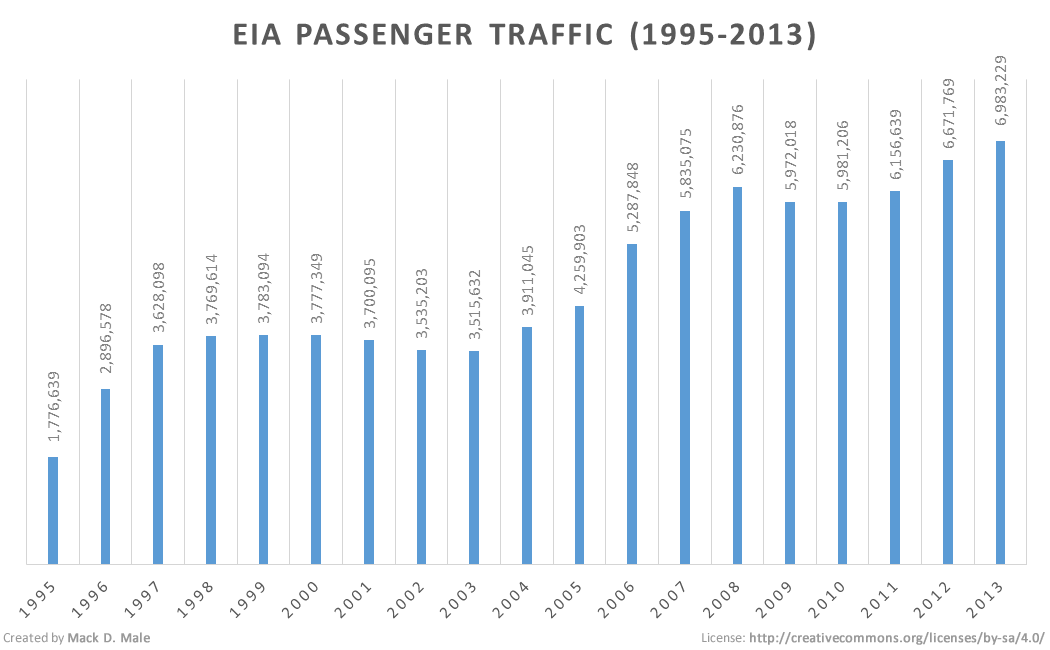
Last year was a good one for the Edmonton International Airport (EIA) with a record-breaking 6.9 million passengers served. Additionally, corporate charter flights from the private terminals increased 30%.

“These record-breaking numbers show that Edmonton International Airport completed its expansion just in time. EIA is a not-for-profit corporation that works for the benefit of our region. To foster economic growth, both air service and our airport facilities must keep pace with demand from our region,” said EIA Vice President of Passenger Market Development Traci Bednard.

There were other positives in 2013 too. Non-stop service to New York City began in May, the new NAV CANADA Air Traffic Control Tower began operations in the spring, Icelandair announced service between Edmonton and Reykjavik, and a new Dallas/Fort Worth flight was announced.

New EIA Air Traffic Control Tower

According to EIA itself, 2013 was its second straight record-breaking year, following strong increases in 2011 and 2012 (other statistics are available here). Thing is, air traffic is up around the world, and EIA wasn’t the only airport to report a record-breaking 2013; Montreal’s Trudeau Airport, the Victoria International Airport, and dozens of international airports did as well. Many others have yet to report figures. I wanted to see EIA’s growth in context, so I went to Statistics Canada to get the data.

Here’s a look at EIA’s passenger traffic growth since 1995 (using data from Statistics Canada, except for 2013, which comes from EIA directly):

eia passenger traffic

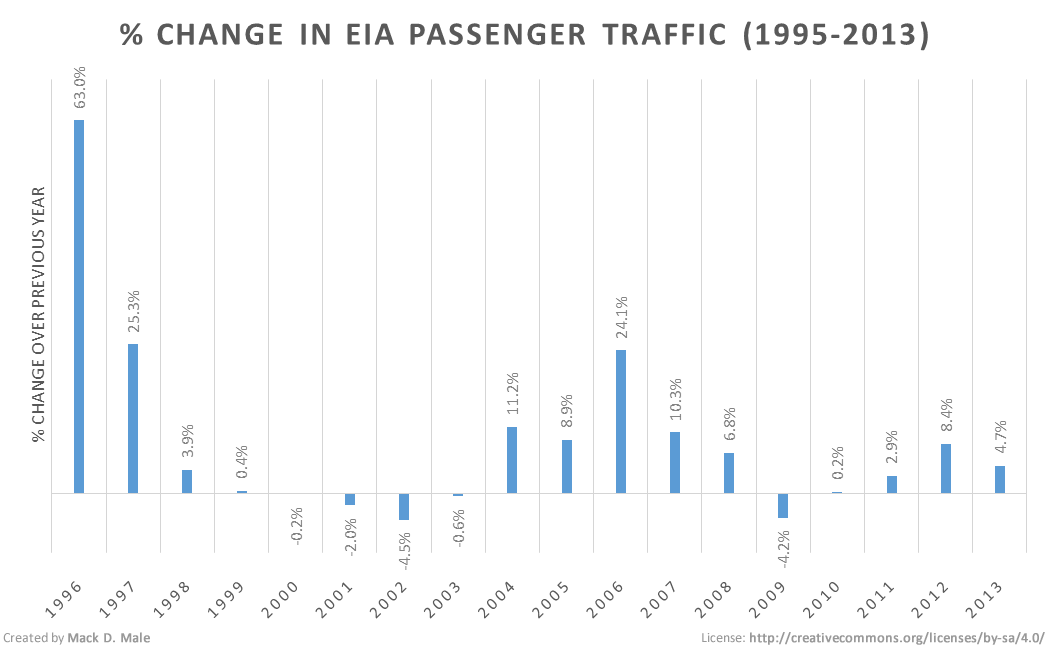
Here’s what the year-over-year change has looked like in that same period:

eia passenger traffic change

The massive spike in 1996 was of course due to the consolidation of scheduled service at EIA. In the 2001-2003 period, after 9/11, EIA experienced a slowdown in traffic just as airports everywhere did. Since then, EIA has grown significantly, from about 3 million passengers a year to nearly 7 million in 2013.

I wondered what EIA’s passenger traffic growth has looked like compared with other airports in Canada. Again using figures from Statistics Canada, here’s a look at ten Canadian airports:

airport passenger traffic

What stands out for me is that EIA broke away from the pack in the mid-2000s to become the clear #5 airport behind Toronto, Vancouver, Montreal, and Calgary. There was a slowdown in growth between 2008 and 2010, but EIA seems to have turned things around.

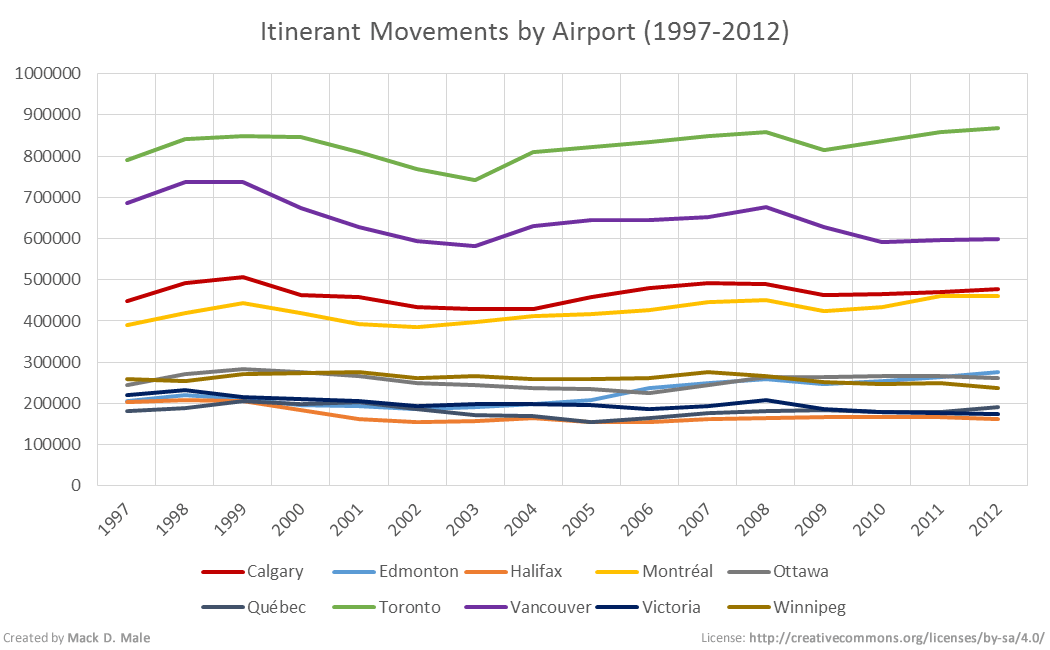
Though passengers are the metric we often think of, aircraft movements is another that is useful to track. One movement is a landing or takeoff of an aircraft and an itinerant movement is essentially a flight from one airport to another. Here’s a look at the itinerant movements for the same airports:

airport movements

Here EIA isn’t as clearly the #5 airport, though it has moved up significantly from the mid-2000s and is now approaching 300,000 itinerant movements per year.

Expansion 2012

If current trends continue, EIA should finally break the 7-million-passengers-per-year milestone in 2014, and the airport’s prospects for growth beyond that look encouraging. I certainly feel that the Expansion 2012 project has resulted in a more attractive, functional airport, and the numbers seem to support that. It’s also a similar sentiment that I often hear Edmontonians express. They’re proud of the airport now, whereas they weren’t before. Future expansion plans will not only add capacity, but will also bring a new hotel and an outlet shopping mall to EIA. And certainly Edmonton’s hot economy will continue to push usage ever higher. Altogether, it makes the outlook for EIA look very good indeed.

For more on EIA’s impressive 2013, check out the press release here.

Media Monday Edmonton: Update #98

Here’s my latest update on local media stuff:

You can follow Edmonton media news on Twitter using the hashtag #yegmedia. For a great overview of the global media landscape, check out Mediagazer.

So, what have I missed? What’s new and interesting in the world of Edmonton media? Let me know!

You can see past Media Monday Edmonton entries here.