Still Trending Down: Computing-related graduates in Alberta

If we’re serious about shifting the Alberta Advantage, I think we need to focus on technology. If we really want to be in the sweet spot of adding lots of value, participating in the economy of the future, and being globally competitive, we need smart people who can be creative and innovative in the appropriate sectors and industries. Technology is absolutely going to be at the heart of any sector or industry that will enable us to be world-class and trendsetting, there’s just no question about it.

That’s why this graph absolutely shocked me:

The data comes from the University of Alberta, but I think it is representative of the province as a whole.

The number of students graduating in the fields of Computing Science and Computer Engineering in Alberta is trending downward, with no correction in sight. How can we build the economy of the future when the picture looks like this?

Here’s a bit more detail – with the number of graduates broken out by degree/program:

I haven’t looked, but I suspect enrollment numbers would be similar (that is, I don’t think an incredible number of students register in computing-related programs and then switch out).

Bill Gates has been talking about the need for more students to take up computer science for years now. There’s more demand than supply, even when you factor in immigration. The need for us to stay competitive in this regard is well-documented. It looks like we’re falling further behind.

I don’t know what the answer is. I don’t know how we get more students interested in computer-related degrees. But I do think it is important to consider this data when we talk about the success of our provincial technology sectors, and indeed when we consider shifting the Alberta Advantage.

Economics and more with John Rose, the City of Edmonton’s Chief Economist

John Rose moved to Edmonton last May to become the City of Edmonton’s Chief Economist. It’s an important role at the City, though it is one that most people know very little about. I sat down with John last week to chat about his new job and to get his thoughts on Edmonton.

John loved geography when he was younger, and wanted to work in a field where he could apply that passion. He settled on urban planning, but while studying at the University of Toronto, switched to economics. He has been in the field ever since, working for the federal Foreign Affairs department in the 1980s in West Germany and South Korea before returning to Toronto to tackle the consulting business. He most recently worked for PricewaterhouseCoopers.

The move to Edmonton was a unique opportunity for John to combine his interests in urban planning and economics. “I’m interested in what drives the economics of municipalities forward.” He brings an outsider’s perspective to the City of Edmonton, something that initially made him wary. “I thought people would just say ‘here’s another Easterner showing up, telling us what to do’, but people have been very welcoming.”

As the City’s Chief Economist, John is responsible for publishing the reports that the City relies on for budget planning and strategy, among other things. Twice a year he publishes a long-range forecast, using a statistical model of Edmonton’s economy that looks both 3 and 10 years into the future. On a quarterly basis, he publishes City Trends, which provides current information on social, economic, demographic, land development, and transportation trends (here’s the PDF for Q3 2010, the latest to be posted to the website).

The City of Edmonton uses economic models developed by The Centre for Spatial Economics (C4SE). Somewhat surprisingly, Calgary and the Province of Alberta also use models from C4SE. The models can be complex, but John said recent technology improvements are making a difference. “In the 80s, you needed a mainframe to drive even the most simplistic models,” he told me. “Now the tech required is ubiquitous.” While acknowledging that economics is abstract – “you can’t touch the economy” – John said technology is increasingly getting rid of the mystique and mystery.

If you look at the Economic & Demographic section of the City’s website, you’ll find that most of the information is out-of-date. John explained that the transition from his predecessor is the cause, but he said to expect changes. “There’s a lot of value in the information and we want to get it out there, we want it in the public realm.” John noted there currently isn’t a way to notify people when new information is posted, but said an internal effort currently underway should change that. Getting everyone on the same page is a major push for his office this year.

John would also like to see a shift toward more regional forecasting. He works with a variety of organizations outside the City of course, including EEDC, the Chamber of Commerce, and the Finance department at the Province, but sees room for improvement. “We already do regional forecasting to a degree, because we do the CMA and extract a forecast for the City from that.” John noted that most statistics are available at the Census Metropolitan Area (CMA) level, and so it makes sense to look regionally when setting up models. “With a larger economic entity, the trends smooth out a little.” John suggested the Capital Region Board might be the logical place to host a regional forecasting effort.

Speaking of the capital region, John said that while 2011 will be a strong year for Edmonton, “most of the growth will take place outside the City of Edmonton proper.” This is partly because the City itself didn’t suffer as large a setback as a result of the recent downturn. “The manufacturing sector took a big hit in Alberta and Edmonton,” a sector largely concentrated outside the city, such as in the northeast. In a recent interview with the Edmonton Journal, John said we should see an annual growth rate of nearly 4% here in Edmonton.

He was also bullish on the province. “Alberta will be ahead of the national economy as a whole in 2011,” John told me. Again, this is due in part to the way the economic slump affected the province. “The impression is that Canada came through it very well, but the truth is the province didn’t.” In 2011, John expects Alberta to post the first or second best provincial growth rate in the country, depending on how Saskatchewan does.

Turning to individual sectors in the City, John told me that construction will show growth, but mostly due to commercial projects. The residential construction sector will be somewhat sluggish because “there’s just not a big demand for a lot of new housing.” FIRE will do well, but John cautions that increased regulation will have an impact. The retail sector will also grow more slowly this year, because people are reluctant to take on more debt and as as a result savings rates are going up. “The consumer-oriented durable component in particular” will grow slowly according to John, because as people buy fewer houses, the need for new vehicles, furniture, appliances, etc. also diminishes.

John talks about trends and forecasts all the time – he has made it part of his job to do interviews, meet people, and spread the word on Edmonton’s economy. He can rattle the numbers off with ease, and is obviously very knowledgeable. As our discussion shifted toward the city more generally, John became more thoughtful. We talked about the common refrain that Edmonton’s head office situation is dismal at best, and John pointed out that the larger question is how to “attract and retain investment, and talent.” He said we should do “exit interviews” with organizations that leave the City, to try to highlight any cross-cutting themes.

I asked John about the push to revitalize downtown, and in particular, about the City Centre Airport and the proposed arena. He called the ECCA redevelopment a “good move” by the City, because making such a large piece of land adjacent to the core largely residential will have a positive impact on our downtown. “The key to developing a vibrant downtown, is to have people living, working, being entertained, doing all those things, in the core.” He doesn’t think a blanket policy on financial incentives (such as the Railtown subsidy) to attract more residents to downtown makes sense, however. “If there’s an area that we want developed in a particular way, then the City could be come active, but otherwise there’s enough opportunity already.” John didn’t take a side on the arena, but said “it depends on how the development takes place” and said his main concern is that “we don’t want to be in a situation of two competing facilities.” He cited the Air Canada Centre in Toronto and the positive changes and increased activity it brought to the area south of Front Street. “It is very nicely integrated into the city.”

I asked John what he missed about Toronto, and he quickly replied “jazz clubs.” He said while the Yardbird Suite is great, there was more variety with regard to venues back in Toronto. John joked that by moving away from Toronto when he did, he avoided the current political drama that is taking place with new mayor Rob Ford. That led us into a discussion about transit, and LRT in particular, something John considers “the urban equivalent of an enabling technology – if you have it, you can do a lot of great things.” Projects such as the LRT expansion “are a big benefit to the local economy” in the short-term and are “vital for the City’s future,” John told me. The real value to the economy is what the LRT enables, rather than the jobs it directly creates. “If you don’t have mass transit downtown, you’re going to have a hard time developing nightlife, for instance.”

I really enjoyed talking with John (and not just because when I asked him if he was now an Oilers fan he replied, “that implies I was a Maple Leafs fan before!”). Stay tuned to his section of the City’s website for future economic updates.

Shifting the Alberta Advantage

The main thing we talked about yesterday at the ONEdmonton forum was economic development. In addition to breakouts and other discussion, we had two informative presentations that I hope to blog about over the next while. In her presentation on Diversifying Edmonton’s Economy, Tammy Fallowfield, EEDC’s Executive Director of Economic Development, touched on shifting the “Alberta Advantage”. Here’s what her slide said:

  • Remain relatively low tax
  • Not a low cost environment
  • Not a surplus of labour
  • Not a currency ‘bargain’

I think the phrase “Alberta Advantage” means different things to different people, but traditionally our low taxes, low cost of doing business, surplus of labour, and being attractive to investment, have all been considered important aspects. Here are a few notes on each.

Alberta’s low taxes remain a strength. From the Alberta Competitiveness Council’s 2010 report (PDF, 14 MB):

[Taxes and fiscal policy] represents the area of best performance for Alberta, with moderately low tax burdens for both corporations and individuals and a strong government financial position.

Of all the measures that report looks at, Alberta performs the best (unsurprisingly) in taxes and fiscal policy.

What about being a low-cost environment? From the same report:

Within Canada, business costs in Alberta (Edmonton) are lower than Ontario (Toronto), but higher than in each of the other provinces compared. This result is due to Alberta’s strong economy of recent years, which led to a much higher increase in business costs – especially labour, electricity, and facility costs – than seen in other provinces.

I haven’t yet found a good comparison of business costs with regions elsewhere in the world, so let me know if you come across something. I suspect the picture is not as rosy as it once was.

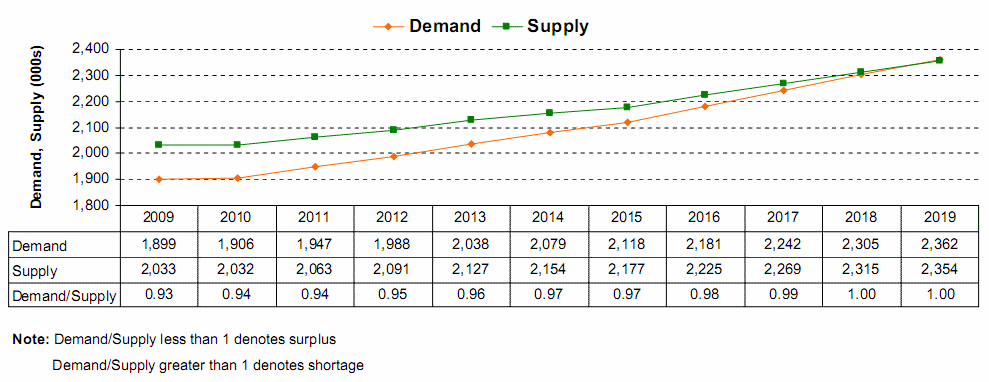
How about our labour force? All across Canada the population is aging, and that (along with our very low fertility rate) is going to lead to labour shortages. Here’s a graph from Alberta’s Occupational Demand & Supply Outlook, 2009-2019 (PDF), that shows this trend for our province:

There are many consequences as a result of this trend, not the least of which is Alberta’s challenge to attract and retain labour. Our taxes will likely also be impacted – an older population means higher costs for health care, and a slow growing labour force means a slow growing tax base.

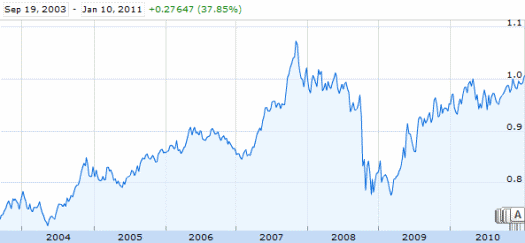
Let’s look at the Canadian dollar (compared to the US dollar).

The strength of the Canadian dollar has an impact on foreign investment, among other things. As you can see, the dollar has been quite strong in recent years (aside from the dip in late 2008/early 2009), which may not be a good thing for Alberta.

So if being low-cost, having a surplus of labour, and being a relative currency ‘bargain’ are no longer part of the Alberta Advantage, what does that mean?

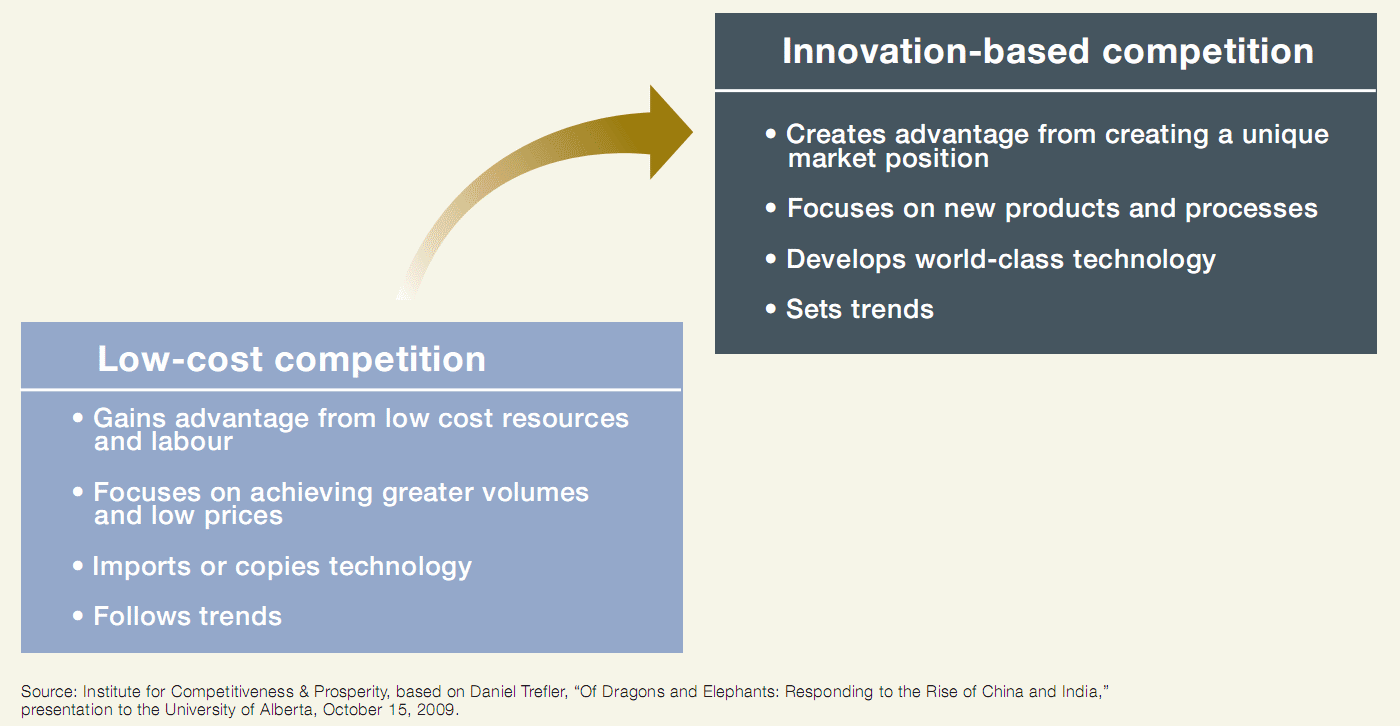
This diagram comes from the Institute for Competitiveness & Prosperity, based on a presentation that Professor Daniel Trefler of the University of Toronto gave here in Alberta on October 15, 2009. The diagram was originally used to illustrate the shift that China and India have yet to make.

On the same slide that listed the four points above, Tammy included this diagram. That’s the shift we need to make here in Alberta – from being a strong low-cost competitor, to being a strong innovation-based competitor.

How are we going to do that? By making strategic choices. Here’s (more or less) what Tammy showed next:

Tammy went on to talk about the industries that are important for us to focus on here in Edmonton, and a similar exercise would apply for Alberta. I’m not sure if what I have written above is exactly what she was trying to get across, but that’s how I interpreted it.

What do you think about shifting the Alberta Advantage?

Alberta’s Community Revitalization Levy: Rivers District, Belvedere, The Quarters

This is the second part in a three-part series on Alberta’s CRL.

Armed with a better understanding of Alberta’s CRL legislation, I turned my attention to the three active CRL projects in the province. What are the projects for? Why is a CRL appropriate for them? What can we learn from the projects that will help us when exploring the idea of using a CRL in the future? That’s some of what we’re going to look at in this post.

To quickly recap the process: there is some back-and-forth between the city and the province in establishing a CRL. First, the Lieutenant Governor must approve the regulation, which includes the CRL boundary. Second, City Council must approve the plan & bylaw for the CRL (and these can be done separately). And finally, that plan & bylaw must also be approved by the province. The three projects we’re going to look at are at different stages of that process.

Calgary’s Rivers District

The first specific CRL regulation to be passed in Alberta was for the City of Calgary Rivers District, back in 2006. The Rivers District project was the catalyst for the MGA amendment that made CRLs possible in Alberta.

 City of Calgary Rivers District Community Revitalization Levy Regulation (AR 232/2006)

The Rivers District is the furthest along of all the CRLs in Alberta – everything has been approved and the City is well into implementation. It was 2007 when everything was finally approved, so the baseline for tax assessments would have been frozen to the values on December 31, 2007.

It’s worth pointing out that the CRL is just a small part of a much larger project known as The Rivers:

The vision for a revitalized Rivers district is more than a place to live, it is a lively urban destination.

This map shows the area the project covers, and as you can see, it is quite expansive. The idea is to reclaim the waterfront, and to make the area more desirable for development. In addition to infrastructure upgrades, a new riverwalk is in the works (phase 1 is now open actually).

The CRL boundary is large, but it is a small part of the overall project. Here’s what it looks like (KML):

The boundary covers an area of roughly 1.9 square kilometers (478 acres).

One of the big advantages to using a CRL for the Rivers District is that the City of Calgary owned much of the land within the boundary. That’s important because it means the baseline assessment for those assets would be zero, and there’s lots of potential for getting some of that all-important lift.

I spent some time talking with Kathleen Young, Development Manager for The Quarters Downtown at the City of Edmonton, and found out that she actually worked on the Rivers District CRL! Her knowledge and experience on that project was one of the reasons that she came to Edmonton. You know what they say, it’s a small world.

Kathleen pointed out that the CRL boundary for the Rivers District includes some key developments, notably The Bow (here’s a photo of the building I took back in July). When finished, The Bow will become the headquarters for EnCana, and will be the tallest office building in Canada outside Toronto. Groundbreaking for the project took place in June 2007, around the same time that the Rivers District CRL was approved, which means almost all of the incremental value realized through the development of the building will be captured by the CRL.

To work on The Rivers, the City of Calgary created a wholly owned corporation called the Calgary Municipal Land Corporation (CMLC). They have some great information on the various aspects of the project if you’d like to learn more. CMLC was actually awarded a Canadian Urban Institute Brownie Award in 2008 for the CRL:

The Canadian Urban Institute’s annual Brownie Award recognizes leadership, innovation and environmental sustainability in brownfields redevelopment across Canada. CMLC won in the category of "Financing, Risk Management and Partnership" for our work in the creation of the Rivers District Community Revitalization Levy Regulation. A "made in Alberta" version of the U.S. Tax Increment Financing (TIF)— which is a widely used financing mechanism for redevelopment of brownfield sites in the United States—provides a sustainable source of funding to finance the significant infrastructure development required in the Rivers District for a 20-year period.

It sure looks like the Rivers District CRL will be a success!

Belvedere (Fort Road)

The first CRL regulation to be passed for Edmonton was for the Belvedere redevelopment project, commonly known as the Fort Road Redevelopment project. The project has been in the works since at least 2000, and has evolved quite a bit over the last decade. It was very much in the works before CRL legislation came into effect.

 City of Edmonton Belvedere Community Revitalization Levy Regulation (AR 57/2010)

The Belvedere CRL isn’t quite as far along as the Rivers District, but it is nearly there. Kathleen clarified that the borrowing bylaw (14883) has been approved, but the plan bylaw is still in the works. Armed with the $34,250,000 specified in the borrowing bylaw, the City has undertaken much of the infrastructure upgrades planned for the area.

Here’s the CRL boundary for the project (KML):

The boundary covers an area of roughly 1.3 square kilometers (324 acres).

A unique element of the Belvedere CRL is that the City owns almost all of the land within the boundary. As a result, when they sell the land all of the incremental value will be captured by the CRL, making it much less likely that the City would have to fall back on general revenue to cover the debt.

The Belvedere project is an interesting one. It is unlikely that development would have taken place in the area without the City of Edmonton stepping in to try to make the area more attractive and desirable. Through that lens, the use of a CRL makes a lot of sense. If you think back to the two basic assumptions highlighted in part one, the Belvedere CRL certainly passes the first – it’s worth the risk.

As for the second assumption – there’s a sound expectation that development will occur – that one is less certain. Especially given the challenging economy, it could be a while before anything substantial happens. Having said that, the first sale of the Station Pointe lands last year for $5.2 million is hopefully a sign of things to come (that project received $481,000 in federal funding in August). The redevelopment project is still in the early stages, and Rick Daviss at the City of Edmonton confirmed that at least a couple new conditional deals are in place, so there’s movement.

There’s more information on the Station Pointe project here – it won a Brownie Award in 2008.

You can find lots of background and other information on the Fort Road redevelopment project here.

The Quarters

The newest CRL regulation to be passed was for The Quarters Downtown, a redevelopment project here in Edmonton previously known as the Downtown East redevelopment. I wrote about The Quarters a couple weeks ago, and I’d encourage you to look at that post to get an overview of the project.

 City of Edmonton The Quarters Community Revitalization Levy Regulation (AR 173/2010)

As the newest CRL project, The Quarters has the furthest to go before it is ready for implementation. The province has approved the regulation and boundary, and Administration is now working on the plan and bylaw to present to Council. That will happen sometime in 2011, according to Kathleen. Her team wants to make sure they get it right.

Here is the CRL boundary for the project (KML):

The boundary covers an area of roughly  0.93 square kilometers (229 acres).

The Quarters is a large plan that will proceed in phases. Once completed, it is anticipated that the area will accommodate a population of nearly 20,000 people, up from less than 2500 today. The project is made up of five distinct districts, the jewel of which is known as The Armature.

An important part of any CRL plan is the way in which the City will cover the cost of the project if enough development does not occur. The default fallback is always general revenue, but Kathleen said they are looking at additional funding sources as well, such as government grants.

Kathleen told me that among other things, some of the CRL money will be used for streetscape improvements, some will be used for land acquisition to consolidate parcels for resale, and lots would be used to develop The Armature. The goal is to make that part of Edmonton a much more livable area, and the redevelopment focus is on residential assets.

As I have said before, it is an exciting project for our city! You can learn more about The Quarters Downtown here.

The project will be an interesting one to pay attention to if you’re interested in CRLs, because there are still a number of steps in the process to go.

Final Thoughts

If you’ve made it this far, you should now have a better understanding of the three active CRL projects in Alberta. You can draw your own conclusions, but a few things I wanted to highlight include:

  • All three boundaries are similarly sized
  • Infrastructure upgrades and improvements are a major part of all three projects
  • In the Rivers District and Belvedere, and to a lesser extent in The Quarters, an important consideration is the amount of City-owned land

I think it is important to look at what we already have when trying to understand how a CRL could be applied to future projects. In the next part of the series we’ll do just that, using the proposed downtown arena as our future project.

Alberta’s Community Revitalization Levy:

  1. Introduction
  2. Rivers District, Belvedere, The Quarters
  3. Proposed Downtown Edmonton Arena District

Alberta’s Community Revitalization Levy: Introduction

This is the first part in a three-part series on Alberta’s CRL.

Recently I decided to start learning more about Alberta’s Community Revitalization Levy (CRL), and I was initially struck by how little information was readily available. I searched and searched but didn’t find much. Maybe that’s because what we call the community revitalization levy here in Alberta is known as tax increment financing (TIF) elsewhere. It turns out that TIF has been available as a public financing method for more than 50 years! The State of California first used the approach in 1952, and now Arizona is the only state in the USA without some sort of TIF legislation.

Here’s how Wikipedia describes TIF:

When a development or public project is carried out, there is often an increase in the value of surrounding real estate, and perhaps new investment (new or rehabilitated buildings, for example). This increased site value and investment sometimes generates increased tax revenues. The increased tax revenues are the “tax increment.” Tax Increment Financing dedicates tax increments within a certain defined district to finance debt issued to pay for the project.

The idea is to use the “lift” generated by the increased tax revenues to pay for the debt that financed the project.

Alberta’s CRL

In Alberta, this legislation is relatively new. Bill 28 received Royal Assent on May 10, 2005 and amended the Municipal Government Act (PDF) to include Division 4 under Section 381, which enables municipalities to create a community revitalization levy bylaw (which must be approved by the Lieutenant Governor in Council).

Since that legislation came into effect, there have been three CRLs created in Alberta (as far as I can tell): Calgary’s Rivers District, the project for which Bill 28 was created, and the Belvedere (Fort Road) and Quarters redevelopment projects here in Edmonton. You can read more about all three projects in part two.

There are a few key aspects of the CRL to be aware of:

  • The CRL only applies to a very specific area (the CRL boundary).
  • The tax revenue that contributes to the CRL is split between the City and the Province.
  • The maximum amount of time a CRL can exist is 20 years, starting in the year when the bylaw is approved by the Lieutenant Governor in Council.
  • The Lieutenant Governor in Council can approve a CRL bylaw in whole or in part or with variations and subject to conditions.

And don’t be mislead by the name “levy” – the CRL is a tax as defined in the MGA. It’s a funding mechanism, nothing more.

From my read of the Municipal Government Act, there are no rules or restrictions on the type of area that a CRL can apply to. In theory a CRL works best in an area that is “blighted” but the legislation does not enforce this. This was the case in California as well, until it became clear that the legislation was being abused.

What’s the potential impact of a CRL?

I asked Rick Daviss, Manager of Corporate Properties at the City of Edmonton, to help me understand the CRL. He was very helpful and pointed me in the direction of some very useful information.

The first thing we looked was a hypothetical example of the impact of a CRL. Here’s the situation:

  • Current use: 2.0 acre parcel of land improved with a 30,500 square foot warehouse.
  • Proposed use: 2.0 acre parcel of land improved with a high rise residential condo development (proposed density of 265 units (RA9), FAR of 3.0, unit value assessed at $200/square foot).

So we’ve got an old warehouse on some land and we want to replace it with a condo. Let’s look at the assessed value:

  • Current use: $1,525,000 (this is known as the assessment baseline)
  • Proposed use: $44,431,200

Which gives us an increase in value of $42,906,200. Now let’s look at the tax assessment:

  Before After Difference
2006 Municipal Mill Rate 5.7484 5.7484
2006 Municipal Tax $8,766 $255,408 $246,642
2006 School Mill Rate 3.6182 3.6182
2006 School Levy $5,518 $5,518 $0
2006 CRL N/A $155,243 $155,243

The mill rate is used to calculate the property tax, and you can think of it as the amount of tax required divided by the amount of tax available. So if the City needs $2 billion in taxes but only $1 billion can be generated based on the assessments, the mill rate is 2. The property tax is then calculated by multiplying the assessed value by the mill rate, and dividing by 1000. So to get $8,766 in our example above, $1,525,000 is multiplied by 5.7484 and then divided by 1000.

Let’s look at the Before column first. The total tax assessment there was $14,284, and the two bottom rows are N/A because we don’t have a CRL in the before case. Both the City and School taxes are calculated the same way: assessed value multiplied by the mill rate divided by 1000. The province gets $5,518 and the City gets $8,766, all of which goes into what’s known as “general revenue”.

Now let’s look at the After column. The total tax assessment there is $416,169. The City tax is calculated the same as before, but now that we have a much higher assessed value, we end up with $246,642 in increased tax revenue. All of this will go to the CRL. The School tax is broken into two, because only the incremental tax revenue will go toward the CRL. So the $5,518 is calculated the same as in the Before case, and this goes to the province. The provincial part of the CRL is calculated as follows: the increase in assessed value ($42,906,200) multiplied by the mill rate divided by 1000. That gives us the $155,243, all of which will go the CRL.

So now you see why the CRL is such an attractive proposition: it looks like we have $401,885 in new tax that we can contribute to the CRL. And this could happen with all developments inside the CRL boundary. There are a number of caveats, however. The first is that the CRL amount will vary from year to year based on the assessment (which makes the economy and depreciation relevant) and on the school mill rate which also changes from year to year. The second is that the type of development is important – City owned properties are tax exempt, for instance. A third is that the City tax revenues as well as a portion of the School tax revenues are dedicated to the CRL, where they would otherwise have gone into general revenue.

How is a CRL created?

Rick walked me through the process of creating a CRL, and I can tell you it sure doesn’t sound like a trivial task. In the best case, Rick estimates it would take just less than two years from concept through to the start of implementation to make a CRL reality. Here’s a high-level overview of the process:

Those five steps would include, roughly:

  1. Administration conducts background research, identifies the potential boundary, comes up with preliminary revenue estimates, and prepares for and asks Council for approval to make a request to the Minister of Municipal Affairs.
  2. The Minister of Municipal Affairs considers the request and recommends an Order in Council for an establishment regulation. This step also includes some back and forth to establish the area and other parameters.
  3. The Lieutenant Governor in Council considers and approves the Order in Council for the area to be established.
  4. Administration conducts more research, holds public hearings, drafts the proposed bylaw, has it reviewed by all relevant departments as well as the province, and acquires Council approval of the bylaw.
  5. The Lieutenant Governor in Council approves the bylaw.

After all that is done, the CRL can proceed. It makes sense to plan for the Lieutenant Governor in Council’s final approval as close to the start of construction as possible, in order to get the maximum possible time under the CRL legislation.

What are the risks associated with a CRL?

As others have pointed out, a CRL is not a risk-free proposition. There are a number of issues to consider.

What if a project does not lead to an increase in property values and does not result in any new development? In this case, there would be no “lift” to pay down the debt of the project. Rick noted that a plan for this kind of scenario needs to be in place before the province will approve a CRL. It can be as simple as the City swallowing the cost of the project, as long as it can specify how it will be paid for. Another option is for a third party to backstop the plan.

Another issue is the potential shift in taxes. Will the project really result in new development – development that would not have occurred in the city otherwise – or is it merely a shift in development, from areas outside the CRL to the area inside the CRL boundary? How would you know, one way or the other?

A related issue is the decrease in general tax revenue. If the property tax inside the CRL boundary is no longer going into general revenue, what does that mean for the services the City provides? In the worst case, you can imagine the entire City being covered in various CRL projects. That would result in zero general tax revenue and thus no way for the City to pay for the services it provides to citizens. What is the impact of one or two CRL projects? That’s less clear. Same goes for the school taxes. A common concern for many people is that they don’t want their school taxes going toward the CRL instead of schools. Of course, in reality the province doesn’t come up with education programs based on the amount of school tax it receives – tax revenue does go into the Alberta School Foundation Fund, but that money is combined with whatever amount of general revenues the province deems appropriate.

Can a CRL really work?

For a CRL to work, Rick says you need to make two basic assumptions:

  1. The project the CRL would be funding is a good thing, and is worth the risk.
  2. There’s a sound expectation that development will occur as a result.

If you think the project is worth the risk, and you’re confident that development will occur as a result of taking that risk, then a CRL can be a good funding source. Rick highlighted the Belvedere (Fort Road) project as meeting this basic criteria: it’s an area that needs to be redeveloped and it’s unlikely that anything would happen without some initiative by the City, plus there’s a good chance that other development will occur now as a result of the City going in and cleaning things up.

Final Thoughts

If you’ve made it this far, you should now have a better understanding of how Alberta’s Community Revitalization Levy came to be, how it works, and what the potential impacts and pitfalls of the legislation are.

In the next part of this series, we’ll look at Alberta’s three current CRL projects in more detail.

Alberta’s Community Revitalization Levy:

  1. Introduction
  2. Rivers District, Belvedere, The Quarters
  3. Proposed Downtown Edmonton Arena District

Edmonton’s FIRE Industry: $135 billion and counting

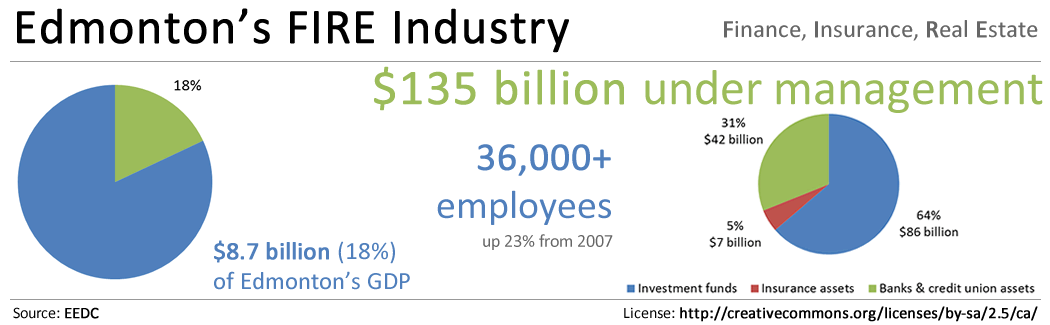
Did you know that more than $135 billion is managed right here in Edmonton? I didn’t either until I heard someone an EEDC event I was at mention it in passing. I’m sure we’ve all heard another Edmontonian gripe about our city’s lack of head offices, about how blue-collar we are, but how many people have mentioned that billion dollar stat? Not many is my guess. I decided to learn more.

The acronym FIRE stands for Finance, Insurance, and Real Estate. It’s a big industry, with more than 36,000 employees in Edmonton (roughly 5.5% of our labour force). In 2009, the FIRE industry accounted for $8.7 billion or 18% of Edmonton’s GDP. Employment in the industry has grown 23% from 2007, and GDP created from the FIRE industry has grown 40% over the last ten years (compared to 30% overall).

Those numbers come from Greg Bainbridge and Tammy Fallowfield at Edmonton Economic Development Corporation (EEDC). They were nice enough to help me gain a better understanding of the industry.

I wanted to get a sense of just how big the industry is, compared to other places. As you might expect, it’s difficult to compare Edmonton with a population of around 1 million people to Toronto, which is four or five times our size. Comparing Alberta as a whole makes more sense. That means looking at Calgary and Edmonton together, an idea that both EEDC and the Alberta Economic Development Authority (AEDA) are promoting. Greg told me that “Calgary and Edmonton are complementary financial service centres”, something that is common in other places as well (Dallas/Houston, Geneva/Zurich, Amsterdam/Rotterdam, etc). He pointed me to AEDA’s recent report entitled Building Alberta’s Financial Services Industry (PDF). Sure enough, one of the “strengths we can build upon” listed in the report is the complementary nature of Calgary and Edmonton’s financial services sectors.

The local financial services industry in Calgary has established a reputation as among the world’s best for energy financing. Edmonton’s financial services industry, meanwhile, has established strengths in banking and risk management.

The report makes the point that as a whole, Alberta’s FIRE industry is, well, on fire. From 2004 through 2009, total capital investment in Alberta totaled almost $433 billion. Here’s what the per capita investment looked like across the country in 2009 (the national average was $9,174):

Employment growth in the financial services industry in Alberta has outpaced the national average over the last ten years as well.

We’re not without challenges, of course. The AEDA report cites economic diversification as a key challenge:

Another key challenge is a shortage of skilled labour: “compared to those of other provinces with financial centres, Alberta’s labour force includes the lowest proportion of individuals with post-secondary education.”

That’s a challenge that the industry is tackling here in Edmonton. Greg described the industry as “an industry of human capital, the foundation of which is smart people”. The University of Alberta has a number of programs of course, such as the MBA program, and NAIT offers a risk management program for insurance, but beyond that there isn’t much in the way of FIRE-specific education. Many of the industry’s senior positions have been filled by drawing expertise from elsewhere, and attracting talent has been a major focus of the industry.

That’s one of the reasons that EEDC recently formed the Financial Services Working Group here in Edmonton. Greg told me that the industry has grown quite organically and independently thus far, due at least in part to the government being located here (thinking of AIMCo and ATB, for instance), but that has meant very little coordination or working together (a mission to Toronto in June 2009 focused on recruitment was one of the first tangible examples of working together). The working group, which met for the first time in October, is brainstorming ways to further the industry, and working more closely with educational partners such as NAIT to develop relevant curriculum is a key outcome of that effort.

Continuing education of the industry’s labour force is another goal. Conferences, luncheons, and other events are all being considered. Though the University of Alberta has the only Chartered Financial Analyst (CFA) partnership in Western Canada, there isn’t a strong understanding of the designation in the industry (think of it as the CA equivalent for investment professionals). There are also opportunities to share research being done at the University of Alberta more directly with the industry.

So who are some of the key players in the FIRE industry in Edmonton?

  • Canadian Western Bank – Formed as the result of a series of mergers & acquisitions, but started in 1984 as the Bank of Alberta. CWB has nearly $12 billion in assets, more than 1200 employees, and has achieved 89 90 consecutive profitable quarters.
  • ATB Financial – Founded in 1938 under William Aberhart. ATB has more than $25 billion in assets and more than 5000 employees.
  • Servus Credit Union – Formed as the result of a series of mergers, the largest of which was Capital City Savings, formed in 1987. Servus has nearly $10 billion in assets and more than 2000 employees.
  • AIMCo (Alberta Investment Management Corporation) – Created by legislation in March 2007. AIMCo manages approximately $71 billion and ranks as one of the five largest institutional investment managers in Canada.
  • Peace Hills Trust – Established in 1980. Peace Hills has nearly $500 million in assets and over 120 employees.
  • Peace Hills Insurance – Established in 1982. Peace Hills has more than $270 million in assets and more than 175 employees.
  • ATRF (Alberta Teachers’ Retirement Fund) – Has been administering a pension plan for Alberta teachers since 1939. ATRF has assets of roughly $5 billion.

These organizations and others in the FIRE industry will play an important role in the future economic growth of our city and province. As the AEDA report states:

The financial services industry is a critical enabler of economic growth, competitiveness, scalability, and productivity. It provides businesses and other industries across the economy with the necessary capital, financial support and advice to pursue opportunities and compete internationally. A robust financial services industry facilitates connections and access to international markets, and helps develop local entrepreneurship, equity, and wealth.

They might be large, but these organizations are also part of the community. ATB Financial, for instance, is a very active community member with thousands of volunteers hours and millions of dollars invested.

The future for the industry looks bright, and initiatives such as the working group should help to take the industry to the next level. Greater engagement with educational partners is important, but the industry will need to make even broader connections to truly succeed. Organizations such as the Edmonton Financial Literacy Society (of which Greg is the chair) can help in that regard. It’s also encouraging to see people like Larry Pollock, CEO of Canadian Western Bank, connect with young professionals like he did at the Emerging Business Leaders’ September meeting.

Edmonton’s FIRE industry is successful and growing, with over $135 billion under management. Remember that the next time someone tells you Edmonton is blue-collar!

The Alberta Party’s Big Listen

It’s hard to believe that nearly two months have passed since my Big Listen experience, but such is life. I meant to write something about it a long time ago, but that obviously didn’t happen! Given that the Alberta Party’s policy convention took place this past weekend, I thought now was as good a time as any to finally write something.

At the end of September, I took part in a Big Listen event. I was invited by Elaine Hyshka, VP of Communications for the Alberta Party. I’m interested in politics, obviously, and as a result I had some knowledge about the Alberta Party, but I didn’t know anything about the Big Listen process. I was told the evening would be “simply a gathering of friends to talk about their experiences, concerns and hopes related to living in Alberta.” Thankfully, that’s what it was.

The session was moderated by Michael Walters, the Alberta Party’s Provincial Organizer, and I can say with certainty that he made the evening for me. Michael is a gifted “people person”, and I thought he did a great job of facilitating our discussions. He got the Big Listen process started in March, and guided the team toward holding 100 Big Listen events reaching more than 1000 Albertans by the end of September, something they achieved.

The first activity was to break off into pairs to talk about our Alberta story. I was born here in Edmonton, but actually grew up elsewhere, primarily in Inuvik, NT. I came back for high school and university and have been here ever since. I think it’s interesting to consider why we’re here. Before I was old enough to decide for myself, I lived in Alberta because my family lived here. Now that I have the ability to go elsewhere, why do I stay? It was an intriguing way to start the event.

Next we got to the heart of the evening. We had three main discussion points. The first was to share some of the pressures we’re feeling here in Alberta. The next was to share our hopes and dreams for Alberta. And finally, we were asked to share what about Alberta we’re thankful for. All three were really enlightening and generated some great discussion. A really common pressure seemed to be the inability to share opinions about potentially controversial topics here in Alberta. Economic diversification was a common hope for the province. And most people agreed that Alberta’s future looks positive, so long  as we stay focused and take advantage of the opportunity before us.

That, in a nutshell, was the event. It was a small part of a much bigger process. Here’s how it works:

The event I attended was on the left side of that picture, and this past weekend’s policy convention was on the right side. All of the Big Listen events contributed toward draft policy that was ratified at the convention. The specific policy resolutions will be posted to the website this week, but here are some of the highlights. I thought Dave Cournoyer’s quote summed up the whole process quite nicely:

“This weekend demonstrated how Albertans with different political backgrounds, or no political experience at all, can work together to develop meaningful and positive goals,” said new Alberta Party member, David Cournoyer. “It’s not about leaning left or right, it’s about moving forward and ensuring the province achieves it’s full potential.”

You can read Dave’s closing remarks from the convention here, and he’s got some great photos from the weekend here.

It is my understanding that this process will continue, and that there will be additional Big Listen events in the future. As party President Chris LaBossiere said, “The listening isn’t done – in fact, it won’t ever be done.”

Adam Rozenhart, who was also at the Big Listen event I attended, recorded some of it for The Unknown Studio. You can listen to that here.

You can keep up with the Alberta Party on Twitter, Facebook, or their blog.

How Friday’s AMBER Alert unfolded on Twitter

On Friday afternoon, RCMP issued an AMBER Alert for 12-year-old Jacob Telford. Thankfully, he was found “in good condition” after just a few hours. For a while that evening, it seemed like every tweet in Edmonton was related to the incident. At one point during the evening, @tkoriordan said “So I’ve been away from Twitter all day. Somebody want to fill me in on what I missed?” to which @Kiri_W replied “About a billion amber alert retweets.” Curiosity got the better of me, so I looked at the data to see how the AMBER Alert unfolded on Twitter.

Here are the first four tweets that appeared:

Just heard about amber alert, young boy from #shpk, check out alert and key an eye out

1st time I have hear the emerg broadcast have a real emerg. Its ano amber alert for a little boy missing from Sherwood Park

Amber Alert in #YEG child abducted in #sherwoodpark. #Edmonton #AMBERALERT!

AMBER ALERT: 12-year-old Jacob Telford taken from Sherwood Park last night – White 2002 Ford Taurus – BC Plate: V2P4J3

Actually, Rob McAnally had one up before the main CTV Edmonton account did, but it seems that tweet has since been deleted. CTV posted the first link to a new story at 2:29 PM (that link has since been clicked over 1000 times).

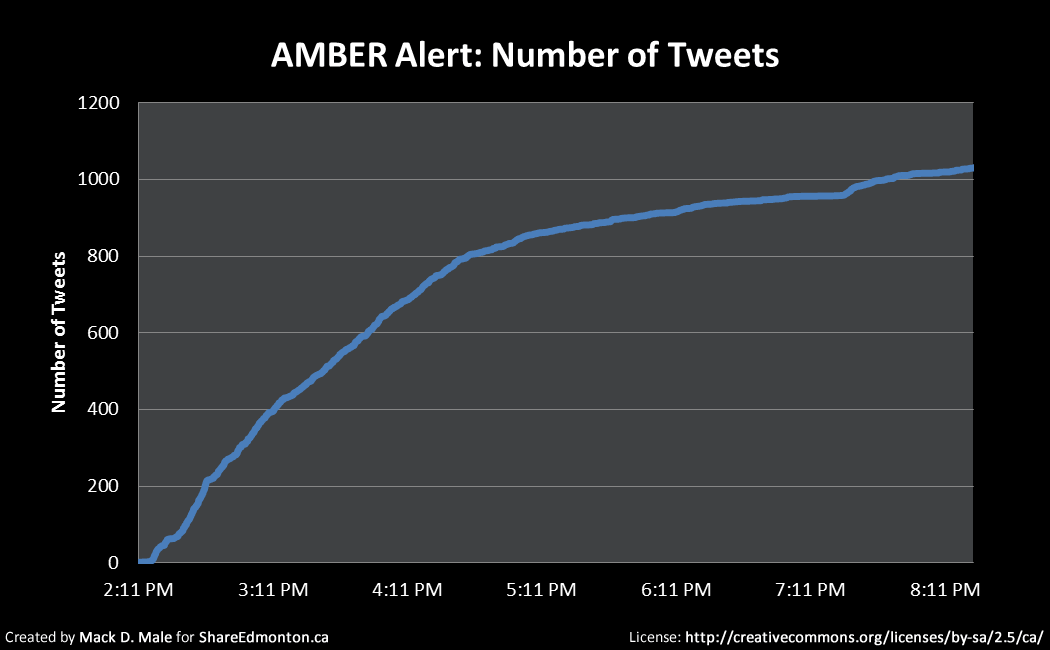
From Matthew’s first tweet at 2:11:17 PM until 7:23:43 PM when Jeremy Lye’s tweet appeared declaring that the AMBER Alert had been cancelled (the first to do so), a total of 958 tweets were posted (mentioning either the AMBER Alert or Jacob Telford). That works out to just over 3 tweets per minute (in the first hour, it was nearly 7 tweets per minute). By 5 PM the next day, the total number of related tweets had grown slightly to 1126.

Of those, 983 were retweets. Here’s what the retweets looked like:

They weren’t quite the first to tweet the start or end of the AMBER Alert (they were about six minutes behind both times), but CTV Edmonton was definitely the most visible account to do so, and that is reflected in the number of retweets they received.

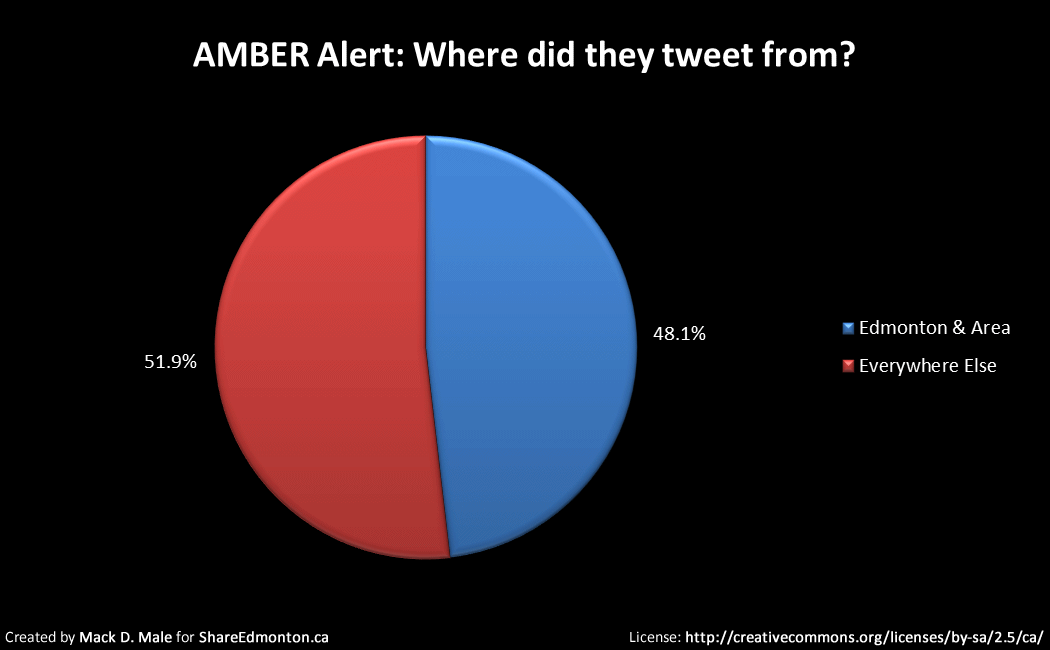
In total, 710 different Twitter users tweeted (or retweeted) about the incident. Just less than half were located in the Edmonton area, while some were as far away as Brazil, Russia, and Kuwait (based on the location in their profiles). I suppose there’s always a chance that their retweets could have helped (maybe they have followers in Canada) but I still have to wonder why someone who is so far away would tweet about something like this. Is it because it’s easy to click the retweet button? Is it because we all like to feel as though we’re helping? I’m not sure.

If you add up the number of followers those 710 users have, you get a potential reach of more than 288,000 users. That’s not accounting for overlap though, so the actual number is probably quite a bit less. And not all of those users will have been online to see the tweets. Still, there’s no question that the AMBER Alert was seen far and wide on Friday.

Here’s what I found interesting about all of this:

  • 85% of all the tweets posted about the incident appeared before we knew the boy was safe
  • 60% of all the tweets posted about the incident were simply retweets of CTV Edmonton’s tweets
  • It took less than 20 minutes for the first news story link to appear
  • After 24 hours, almost no one was tweeting about it anymore

You can learn more about the AMBER Alert Program here.

Edmonton’s Omni Technology Solutions brings CRM integration to the world

Last year, local software company Omni Technology Solutions celebrated its 10th birthday. They’ve had some incredible success during that time, and are well-positioned for future growth. With a focus on customer relationship management integration solutions, they’re probably not a company that you’ve heard of, unless you happen to be a customer. While almost all the leading CRMs are headquartered in Silicon Valley, it’s interesting to know that the number one CRM integration platform is developed here in Edmonton! That’s why I reached out to Trevor Poapst, Omni’s Director of Global Marketing, to learn more.

Their core offering, Riva, overcomes the limitations of Outlook CRM plug-ins that need to be installed, configured and managed on each user’s desktop, laptop and mobile device. Instead, Riva gets installed once on a server and transparently syncs CRM address book, calendar, sales and support data to all Microsoft Exchange and Novell GroupWise email clients. Riva is compatible with the very popular Salesforce, SugarCRM, Microsoft Dynamics CRM, Oracle CRM, SageCRM, Saleslogix and several other leading CRM systems. What’s unique about Riva is that the synchronization all happens server-side, so there are no Outlook plug-ins required.

The company’s second product is called eControl, and it satisfies the need for a simpler, web-based alternative to the native management tools for Microsoft Active Directory, Exchange, Novell GroupWise, eDirectory, SAP and other systems. Though eControl has been designed to be simple enough for non-technical users to use, it is still very powerful, and features full auditing, enhancing compliance with SOX and other regulations. Omni’s customers have used eControl to manage anywhere from 500 to 50,000 user accounts, and a typical deployment takes less than 3 hours.

You’ll notice that both solutions work with Novell’s products, which is really where Omni got started. They’re one of the top three GroupWise developers in the world, and have benefited greatly from participating in the Novell ecosystem. Being focused on Novell hasn’t been without challenges, however. The first was the size of the market. There are far fewer Novell customers than Microsoft customers. In the last year or two however, Omni has successfully expanded into the Microsoft marketplace, and is working hard to continue to grow in that area.

The second challenge is one that Omni continues to deal with. Though the company has always been based here in Edmonton, very few of its customers have been in Canada because GroupWise has traditionally had a stronger following elsewhere. Winning global sales hasn’t been easy. In addition to working with partners, Omni has started to open offices abroad. Offices in Chile and Munich opened late last year, and the company recently closed its first major eControl deal in Chile as a result.

Though reaching the global market is challenging as an Alberta-based company, Trevor wouldn’t have it any other way. The company has received lots of support from the provincial government, and has benefited from having access to a highly trained workforce and relatively low business costs. Trevor also mentioned that Alberta is a great place to raise a family, in part because you don’t have to commute several hours every day. In fact, Omni’s CEO and CTO both bike to work year-round, even in the snow!

Omni just launched version 3.5 of eControl (education customers can save 70% until August 31), as well as its new Riva website. The company is planning its second annual eControl conference in Santiago, Chile. Omni is poised for growth and is looking to expand its partner network, especially now that it can tap into the large Microsoft and CRM partner communities.

It was great talking to Trevor (who is actually working from Mexico this year), and learning more about a successful Edmonton-based software company making significant inroads into the global CRM and identity management markets. I think it’s a fantastic example of the success that companies based here can have, and I wish Omni all the best as they continue to grow. You can follow Omni on Facebook and on Twitter.