Edmonton Vaporware: The Arena District

Though the video game industry probably comes to mind first when you hear the term vaporware, it is increasingly being used to describe announcements and predictions that never come to pass in other industries too. Like construction. The construction of, for instance, big “transformative” projects that will unfold over a number of years. Sound familiar?

arena district

As you know, Edmonton’s shiny new downtown arena is being funded in part through a Community Revitalization Levy (CRL). The idea is that “projects funded by the CRL spark new developments, and property values rise on existing developments.” From the beginning, the arena was sold to Edmontonians as a catalyst for additional downtown development. It was clear that additional development would be part of the success of any deal. Here’s what the Katz Group’s Bob Black told the Journal in February 2010:

“In order for citizens of the city to have a reasonable assurance that the community revitalization levy debt will be retired by the city, then you have to have that collateral development.”

Even earlier than that, in September 2009, the Downtown Business Association’s Jim Taylor was arguing for ensuring that surrounding development took place:

“Somebody has to say that they’re building a casino or a hotel there, and you don’t get any money from the CRL unless those projects are part of it. So that funding is only available if those projects are there. It’s not, ‘We’ll do a CRL and hope that those projects are there. It’s: ‘The CRL is not available, the money is not borrowed, unless those specific developments are there too.'”

Of course, he and many other business leaders softened their stance over the years and no such requirement was ever put in place. In fact, I’d say the volume about what would be built was turned up, though details and commitments were always lacking.

In January 2011, U of A provost Carl Amrhein talked about the creation of “a university village” for student housing as part of the district. Also that month, local realtor Terry Paranych said if the arena goes ahead, he’d “build two condo towers, one 40 storeys, one 50 storeys.”

In December 2012, the Katz Group and its partner WAM Development Group stopped talking about individual projects and promised something much grander:

“If a new arena is approved, the Katz Group and partner WAM Development Group hope to push ahead this spring with $2-billion worth of nearby development, including 28 and 32-storey office towers. Plans also include two 35-storey or taller condominium highrises, a 10-storey condo building, a 26-storey luxury hotel and other commercial space along with a proposed open-air Oilers Plaza.”

Another article discussed potential tenants:

“Main anchor tenants are expected to include a VIP theatre complex, a grocery store and the headquarters of a major telecommunications company, according to a 60-page overview of the district by the Katz Group and partner WAM Development Group.”

Yet despite all the hype, there have been no commitments. It’s all just talk. Just vaporware.

In March 2011, the Journal’s Gary Lamphier made this clear:

“Not a single other developer has been willing to publicly commit hard cash toward the project. Despite recent talk from the city’s chief financial officer about proposed hotels, a casino and other projects, she hasn’t identified a single one by name. I’ve talked to roughly a dozen developers, consultants and commercial real estate brokers over the past 15 months in an attempt to flush out anyone who is willing to stand up and be counted as a participant in the arena redevelopment. I haven’t found one.”

The arena deal was finally approved, but still there have been zero commitments. And so we find ourselves in January 2014, clinging to the hope that a new tower for City of Edmonton employees will finally kickstart the development:

“Jim Taylor, executive director of the Downtown Business Association, said putting up an office tower a block from the arena would likely stimulate other development.”

Avison Young’s Cory Wosnack is even more optimistic:

“If WAM and Katz Group are successful (with the office tower proposal) — and I believe there will be an announcement within days — then the hotel deal can be announced, the retail can be announced and the domino effects begin.”

Is anyone still buying this nonsense?

Rogers Place

Perhaps the worst part about the proposed tower is that municipally-owned or leased properties do not pay property tax. Which means that all or most of the tower would not contribute to a lift in taxes within the CRL boundary. That land could have been used for a revenue-generating property instead, one that would actually help to pay down the CRL debt.

What about the Ultima Tower, you say? It was going to go ahead with or without the arena. What about the proposed, 71-story Edmontonian tower? Like the Aurora project before it, The Edmontonian has been vaporware since at least 2007, so there’s no reason to expect anything different now.

We’re being played, and the sad thing is, we’ve seen this story before.

In the world of video games, some have managed to shed their vaporware status and go on to be quite successful. Maybe that should give us hope that the arena district in Edmonton can do the same. Maybe there really is a master plan and an order in which these projects will unfold. But I’m not holding my breath.

UPDATE 2: There was some confusion about the paragraph above on taxation, as you’ll see in the comments below. I received clarification from the City. If the City of Edmonton leases space inside a building owned by a private entity, the space leased by the City is exempt from taxation. The remainder would be assessed and taxed as any other property would be.

Construction hoarding in Edmonton’s downtown is a disaster

There’s a lot of construction taking place downtown, and that can mean closures, detours, and delays. For the most part, I’m willing to live with some short-term pain because I know it’ll bring long-term gain. But if you think construction downtown is bad now, brace yourself. It’s going to get much worse with the Valley LRT line, the arena, the new RAM, new condo and office towers, and much more. The City needs to do more to ensure it all goes as smoothly as possible.

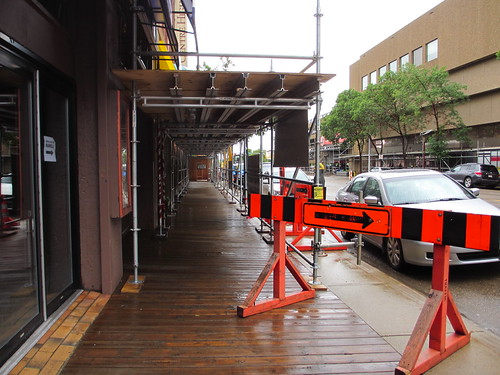
One big issue that we should be able to do something about is hoarding (the temporary fencing you see around construction sites). At the moment, construction hoarding downtown is a disaster.

Here’s what 101 Street looks like thanks to the demolition of the Kelly Ramsey building:

Kelly Ramsey Construction

Here’s what it looks like on Rice Howard Way:

Kelly Ramsey Construction

They’ve taken the sidewalk and one lane on either side. It has been like this for weeks now.

Over on 104 Street, here’s what the Fox Tower construction looks like:

Fox Tower Construction

As you can see they’ve taken not only the sidewalk but one lane of traffic too. Yet on the alley side, they don’t appear to have needed any extra space:

Fox Tower Construction

I would have praised the Ultima Tower construction, as they have kept the sidewalk open complete with a bus stop, but their temporary closure (from May 24 to June 29) is just as bad as the others:

Ultima Tower Construction

You can’t actually see that the sidewalk is closed until you get near the site, so you know what happens right? People walk on the street, right in traffic:

Ultima Tower Construction

Hardly safe! Hopefully they’ll be back to normal next week, with the sidewalk and bus stop open.

All of these examples share some common problems. First and foremost, pedestrian access has been disrupted, and in some cases, vehicular access too. Secondly, signage is either non-existent or very poor. All have been in place for weeks or even months, with no indication about whether or not they are temporary or permanent until the projects are done. And of course, all are quite unattractive.

The Downtown Edmonton Community League (DECL) has already raised concerns with the City regarding the Fox Tower construction. They were initially concerned about the loss of trees, but when it became clear that the sidewalk would be closed with no clear timetable for it to reopen, they brought those concerns to the table as well. Thus far the response has been lukewarm at best. I understand that Graham Construction has not indicated a willingness to change anything. Worse, the City’s response was that the development would bring hundreds of new residents to the street, as if that made up for the impact on the hundreds of residents who already live here. We must do better!

Aren’t there rules?

As great as the Capital City Downtown Plan is, it lacks any real guidelines for construction hoarding. Here’s what it says:

Ensure that construction hoarding in the Downtown features a minimum functional clearance of 2.15 metres continuous linear electrical illumination and public art if in place for over 1 year, to provide a safe, clean and professional appearance.

We missed an opportunity to really strengthen the requirements through that document. There’s also the Procedures for On-Street Construction Safety document, but it mentions hoarding just once, and only as a way to “ensure that there is no danger to pedestrians from above.” Finally, there’s a section of the City’s website devoted to Design & Construction Standards, but those documents do not mention hoarding either.

If you search long enough, you’ll eventually come across Bylaw 15894, the Safety Codes Permit Bylaw. Part 1, Section 13 requires that any hoarding placed on a highway (street, lane, road, alley, etc., including sidewalks and any other land between the property lines adjacent) requires a permit. Section 14 outlines the hoarding regulations. Section 15 basically states that there must be a walkway for pedestrians approved by the City Manager. Part 7 outlines hoarding permit fees.

So in theory, the construction projects mentioned above needed to obtain a hoarding permit from the City, and must pay ongoing fees for as long as the hoarding is in place. I say in theory because, if you read the regulations, it’s clear they are not being met. So who knows if the City actually polices this kind of thing. Maybe they just approve each application without too much consideration. And though the Alberta Building Code isn’t mentioned, presumably the construction site hoarding requirements from subsection 8.2.1 also apply. But the bottom line is the City can approve whatever they like.

What happens elsewhere?

Compare all of that to Calgary, which has produced the Practical Guide for Construction Sites. It has an entire section on construction hoarding, which includes this passage:

As pedestrian flow is vital to downtown and neighbourhood vibrancy and operations, The City of Calgary Roads hoarding policies, fees and fines are intended to improve pedestrian mobility, provide effective hoarding solutions and visually enhance construction sites in Calgary. Where required, hoarding provisions must be maintained at all times for the safe passage of pedestrians in and around construction sites. In an effort to add to Calgary’s visual appeal, The City is encouraging an Enhanced Screening Initiative for hoarding applications and offers incentives for this option.

The document goes on to outline requirements for fencing and sidewalk maintenance, citing appropriate sections of the Alberta Building Code. It very clearly states that developers must “keep sidewalks adjacent to construction sites clear of obstructions” and also that they must “maintain publicly accessible and safe sidewalks.” Straightforward and to the point. On top of that, they’re offering a discount on the fees! If developers take part in the Community Boardworx Project, intended to add visual interest and public art to construction sites, they’ll receive a 25% reduction in hoarding fees!

My experience in places like Toronto and Vancouver has always been pretty positive. Oh there’s lots of scaffolding, but at least pedestrian access was maintained. It’s not all rosy though. Here’s an article from January talking about construction site nightmares in Toronto:

The current building boom has created a checkerboard of downtown curb lane and sidewalk closures. Some three dozen construction sites, mostly condo towers, are ringed with hoarding that extends over the sidewalk and curb lane, many on major streets including Yonge and Adelaide.

Politicians there have made some great suggestions as a result. Requiring developers to file construction staging plans upfront, charging higher fees the longer the closure goes on, and putting construction trailers on top of hoarding (as they do in New York) are all possibilities. There’s a lot we could learn from other cities.

Let’s be good neighbours

Downtown, like every other neighbourhood, is shared. By residents, employees, students, and yes, construction sites. When construction sites pop up in the neighbourhood, I’d like to see greater thought given to how that site will be a “good neighbour”. We’ve all got to get along. Construction hoarding, as the interface and barrier between the site and users of the sidewalk and street, is very important. At the moment, most downtown construction sites are not being very neighbourly. I’d like to see that change, and I think it must change if we’re going to make it through the next few years of construction mayhem.

Edmonton’s New First Impression

About six years ago I travelled to Los Angeles for the Portable Media Expo. We had a great time at the event and got to spend a little bit of time afterward doing some sightseeing. I don’t remember much of that, to be honest, but there is one experience that has always stuck with me: my first impression upon arriving at LAX. Having never been to Los Angeles before, the picture I had in my head of the city and everything in it was modern and glamorous. I mean, it’s a famous city and is home to Hollywood, right? That picture applied to LAX itself too, especially considering its iconic airport code. The reality was much different, however. The part of the airport that we experienced seemed small, old, unattractive, and dirty. It certainly wasn’t a positive first impression.

For a long time, I think you could say the same about Edmonton’s airport. Things got a little better with the last expansion, but I still find that the first impression leaves much to be desired. You’ve probably heard the saying that “first impressions are lasting impressions” and I think that’s particularly true when you visit a new city. Even if a visitor makes it to the Art Gallery of Alberta, the river valley, or any of the other memorable attractions that Edmonton has to offer, it can be incredibly difficult to get over a negative first impression at the airport, especially considering you have to go through the facility again to leave.

That’s one of the reasons that I am particularly excited about Expansion 2012. It will change visitors’ first impressions upon arriving in Edmonton for the better.

When you fly through an airport like Heathrow in London, you rarely have to wait for your bags after arriving. That’s because it takes so long to walk from the gate to the baggage carousel – the airport is just so big! In Edmonton, you almost always arrive at the baggage carousel before your bags do. That frustrates travellers and contributes to the poor first impression. With Expansion 2012, the walk in from the gate will take longer, and that should mean less waiting around for your bags.

Expansion 2012

But don’t worry, chances are you won’t even notice that the walk takes longer. That’s due in part to the moving walkways that have been installed, but more importantly it is because of Flightpath, a digital light and sound system created by Electroland (of Los Angeles, wouldn’t you know it). The interactive installation features motion sensors that pick up movement and activate the sound and LED lights. It’s kind of hard to describe, so here it is in action:

At the end of the Interstitial Corridor is the new entrance, with Canada Customs on the main level (opening this summer) and the new International/Domestic Lounge on the second level (opening this fall). It’s big, open, bright, and inviting – everything our current entrance is not. Prominently featured is The Living Wall, a two-storey green wall that will serve double duty as an art piece and an air filtration system. Coming this summer is The Raven: Bringer of Light, a ceiling-hung stainless steel and embossed acrylic sculpture created by Michael Hayden that is 30 feet by 18 feet and weighs 3500 pounds. It sounds impressive, and I can’t wait to see it.

Expansion 2012

Airports need to be functional first and foremost, but they can’t stop there. A city’s airport plays a significant role in shaping a visitor’s opinions, and as such needs to deliver an experience that is both relaxing and memorable. Expansion 2012 no doubt makes the Edmonton International Airport more functional, but it also delivers a much improved first impression for visitors. That’s ultimately good for both EIA and for Edmonton.

You can check out a few more photos in my Expansion 2012 photoset.

Lighting up Edmonton’s new EPCOR Tower

At 6:30am this morning, EPCOR President & CEO Don Lowry officially “flipped the switch” to light the sign atop the new EPCOR Tower, the latest milestone in the construction of EPCOR’s new corporate headquarters.

EPCOR Tower Light Up

The sign is unique in Edmonton, as it is the first to feature programmable RGB lighting in lettering. Every 15 seconds or so, the color of the sign changes from left to right. Currently it cycles between blue, green, orange, and yellow. Each letter is nine feet high, which sounds large but looks relatively small compared to some other downtown signs. Of course there are actually two signs, one on the north side and one on the south side, both on the 29th floor. Here’s a video that shows the sign changing color:

Last night the purple lights at the top of the building were pulsing, but my understanding is that won’t happen normally. For more on this morning’s ceremony, check out Brittney’s excellent recap.

It was a little over three and a half years ago that EPCOR entered into a 20-year lease with Qualico:

EPCOR plans to occupy approximately 265,000 square feet on the top floors of the new 28-storey office tower, with options to scale its space requirements up or down during the term of the lease. The 20-year Lease secures enough space to meet EPCOR’s current and long-term needs.

The new building carries EPCOR’s name, but it belongs to Qualico. It is the first piece of the Station Lands project, designed by Kasian Architecture Interior Design and Planning Ltd., with construction management services provided by Ledcor Construction. It was originally known as “Station Lands Tower A”. Thanks to the spires on top it is officially the tallest building in Edmonton, edging out Manulife Place (which was completed in 1983) by just 3.4 meters (though Manulife has eleven more floors). The last office building to be constructed downtown was Commerce Place, completed in 1990. You can learn much more about EPCOR Tower in this thread.

In my opinion, one of the neatest things about the new building is that it is the first downtown office tower in Edmonton to be built during the age of ubiquitous cameras. Nearly everyone walks around with a camera now, whether it is a cell phone camera, a point-and-shoot digital camera, or a fancy DSLR. That means the construction of the new EPCOR Tower has been documented by Edmontonians themselves. Like the Icon towers before it, you don’t have to look further than Flickr to see the evolution of the EPCOR Tower.

This is an early shot of the construction, taken by cdnklc on September 9, 2008:

raft1

This photo by Dave was taken on February 5, 2009 and shows some of the early construction work:

EPCOR Tower (Future)

This photo by Darren on November 2, 2009 shows the tower starting to rise:

Epcor Tower 2009-11-02

By April 2010, the building was being covered in glass:

Epcor Tower

This photo was taken by me on August 26, 2010 not long after the building was topped out:

Epcor Tower

This shot from Spi11 taken on October 4, 2010 shows the building in context with the rest of downtown (also check out this aerial photo):

Epcor Tower (construction, aerial) h

I took this photo on April 29, 2011, the day they put the signage up on the building:

EPCOR Tower

And then of course, we have today (you can see the sign changing color):

EPCOR Tower Light Up

EPCOR will begin moving from its current offices at EPCOR Centre in about a month. They’ll occupy floors 20 through 28, while Capital Power will take floors 9 through 12. They’re not the first to move in, however. That honor went to the federal Department of Justice, which recently moved from TD Tower. EPCOR’s lease at EPCOR Centre expires at the end of the year.

What will happen to the old EPCOR Centre? That building, designed by Kenneth C. Saunders Architect Ltd. and completed in 1975, was originally known as Capital Square. It will now become the anchor piece of First&Jasper, GE Real Estate’s new downtown project, expected to be completed by early 2013. Naming rights are still available. You can read more about the project here.

I think the new EPCOR Tower is a fine way to mark EPCOR’s 120th anniversary as a company!

You can see the rest of my photos from this morning’s event here.

The problem with Capital Boulevard’s “grand view” of the Alberta Legislature building

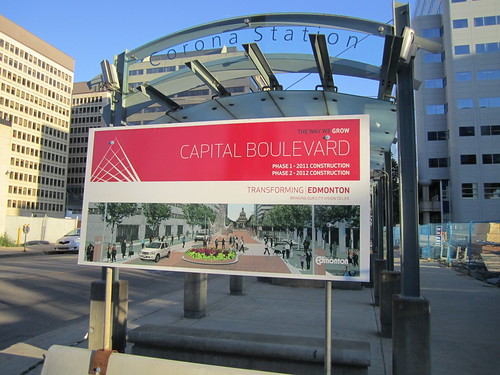
I’m excited about Capital Boulevard, the transformation of 108 Street downtown into a premiere address worthy of a capital city like Edmonton. The City of Edmonton is investing $17.6 million in the project, slated to be finished by the 100th anniversary of the Alberta Legislature building in September 2012.

When completed, Capital Boulevard will feature broad tree-lined sidewalks, enhanced street and sidewalk lighting, mid block pedestrian crossings, bike racks, and street furnishings such as benches.

The project will be completed in two phases. The first is south of Jasper Avenue to 99 Avenue, and the second is north of Jasper Avenue to 104 Avenue.

Capitol Boulevard

The redevelopment plans have drawn inspiration from signature streets and views around the world. Here are a few examples, starting with the U.S. Capitol Building in Washington, D.C.

Another is St. Peter’s Basilica in Rome.

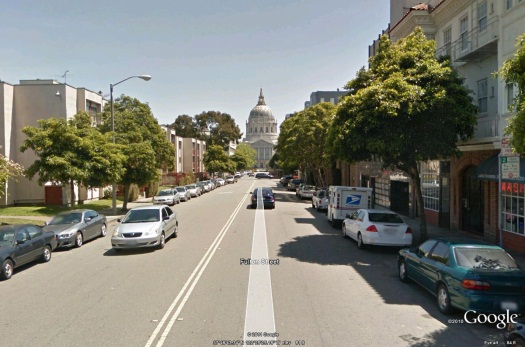
San Francisco’s City Hall is another example (opposite view here).

One of the great things about those examples is a clear line of sight down the street to the focal point. The view of the building is unobstructed. That’s something we have currently on 108 Street.

Capitol Boulevard

And losing that view is what concerns me.

The new ceremonial street will highlight the connection of the provincial legislature to the capital city and celebrate the shared history between Alberta and Edmonton. It will provide a grand view from MacEwan University to the Alberta Legislature.

A grand view perhaps, but no longer of the Legislature building! The plan is to have five sites of public art in the middle of the street between each avenue.

Here’s a rendering of what it would look like:

This rendering is off to the side, and the public art is the white mesh piece in the centre. My guess is the final art installations (which to my knowledge remain unfunded) are not going to be small, which means they’ll definitely obstruct the view of the Legislature building. Part of the problem is that the Legislature building is at an elevation of ~2160 feet and Jasper Avenue is at ~2180 feet. That’s why in my photo above, you can only see the top of the building. Put almost anything in the middle of the street and it becomes taller than the street-level view of the Legislature building.

The street is going to be called “Capital Boulevard” because of the Alberta Legislature building. So why would be obstruct the view of it?

Photo Tour: ETS Centennial Garage

About two months ago at the Youth Summit on Sustainable Transportation I had the opportunity to tour Edmonton Transit’s Centennial Garage, located at Ellerslie Road and 156 Street. The name commemorates Edmonton Transit’s 100th anniversary of service. The facility, which officially opened on April 10, 2010, primarily serves neighbourhoods in the west and southwest parts of Edmonton.

ETS Centennial Garage

The garage has space to store and maintain at least 250 buses, but is also home to administration offices as well as dispatch and support. More than 250 fleet services and bus operations staff work at the facility (that includes 200 operators).

ETS Centennial Garage ETS Centennial Garage

The building is massive, encompassing 7.1 acres (or 313,000 square feet, approximately five football fields). The budget for the garage was $99 million, $89.3 million of which came from the Municipal Sustainability Initiative (MSI). It was designed and built to LEED Silver standards, with features such as a solar wall for heating. Croy D. Yee Architect Ltd, Morrison Hershfield Limited, Earthscape Consultants, and Clark Builders were involved in the design and construction of the building.

ETS Centennial Garage

Some of the building materials used include 31 miles of electrical conduit, 1325 imperial tons of steel (structural steel was made up of 90% recycled content), 11,800 cubic metres of concrete (27.5% was reycled content), 3300 sprinkler heads, and 81 miles of in slab heating pipe.

ETS Centennial Garage

The Centennial Garage is the first garage in Edmonton designed to handle ETS’ 13 articulated buses, with a special hoist that can lift the 20-metre, three-axled vehicles.

ETS Centennial Garage

The storage part of the garage was fairly empty when we visted, as most buses were out on the road. It as neat to see the buses that were present parked nose to tail in long lines.

ETS Centennial Garage

ETS Centennial Garage

The high pressure wash system is what gets the buses nice and clean on the way into the garage. Apparently they had to turn the pressure down from the original setting, because it was causing the decals and advertising on the buses to come right off! In addition to being powerful, the system was specifically designed to cut down on water use by more than half.

ETS Centennial Garage

There are state-of-the-art systems in the building for monitoring carbon monoxide levels and maintaining comfortable heat and humidity. Energy modeling results indicate that the Centennial Garage is 33% more energy efficient than a typical building of its size and type.

ETS Centennial Garage

The ride out to the garage seemed to take forever (it’s really far south west) but it was definitely worth it to get a closer look at one of the facilities that keeps ETS running smoothly!

ETS Centennial Garage

You can see more photos from the tour here.

Roundup: The Royal Alberta Museum is moving downtown

It’s amazing how big news can just seemingly drop from the sky sometimes! Yesterday’s big announcement here in Edmonton was that the Royal Alberta Museum will be rebuilt downtown:

A new comprehensive Royal Alberta Museum will be built in downtown Edmonton starting this year, featuring twice as much gallery space, direct connections to public transit, proximity to the Arts District, and the ability to host major international exhibits and rare artifacts. The new museum will be equipped to showcase both Alberta’s history and its natural wonders, and will be free of the limitations of the current museum site.

The new museum is expected to cost $340 million and is set to open by 2015. Budget 2011 includes $180 million over the first three years of the project, which includes $30 million from the Federal government. Here’s a rough rendering of the building:

For a better look, check out this video from the Province introducing the new concept:

[googlemaps https://www.youtube.com/embed/xkbxfUSWgh0″ frameborder=”0″ width=”524″ allowfullscreen=”allowfullscreen”>

Here’s where the site is located (click here for Street View):

Lots has been written/recorded about the project already. Here are some of the things I have come across that are worth checking out.

From the Edmonton Journal:

The current museum will stay open for the next four years. Discussions are just starting on what to do with the old museum and the rest of the property in Glenora, although a portion will eventually house a new residence for the lieutenant-governor.

“Right now, I can tell you it’s not going to be condos,” Alberta Culture Minister Lindsay Blackett said. He said it’s “very unlikely” the land will be sold to private developers.

From the CBC:

Stelmach said the museum land could be the future home of the Edmonton terminal for a high-speed rail line to Calgary. Land for a Calgary station was purchased in 2007.

Paula Simons picked up on that as well at The Edmonton Commons and added:

There’s no denying the real attractions of this site. It would be accessible by LRT – especially if the city were to “activate” the dormant LRT stop, known as Future Station, that’s already roughed in under the Brownlee Building. It would be linked to the existing pedway system. It would be a block east of that proposed arena and entertainment district, assuming such a thing actually comes to be built. It would be a way to push attractive development into the Chinatown/Boyle/McCauley area. It would make the Churchill Square/City Hall precinct a true arts centre. And it would be a fabulous companion to the AGA – a tourist draw in the heart of the city core. It might also help to give impetus to develop on the Station Lands site directly to the north – and even integrate with possible plans to turn Mary Burlie Park, just to the north of the proposed RAM site, into a Chinese garden and cultural centre.

From Global Edmonton:

The decision to move to a new location was made because of size constraints at the old location, and because the construction process would have forced the museum to close for a significant amount of time while the construction was in progress. As a result, the province says the cost to build on a new location will be less than the cost of trying to redevelop the old site.

From CTV Edmonton:

This spring, a competitive bidding process will seek out a private sector consortium to design and build the new facility.

Finally, while I like the spirit of David Staples’ latest column, it’s unfortunate that most of the words are dedicated to the arena, not the RAM. Still, it is great news for downtown!

What else have you come across that is worth sharing?

Happy Anniversary to the Art Gallery of Alberta!

This weekend the Art Gallery of Alberta celebrates the one year anniversary of its new building in Churchill Square. It’s hard to believe that it was a year ago that the ribbon cutting took place and Edmontonians were clamoring to get a peek at the beautiful facility.
And what a year it has been! Here are some of the highlights of 2010:

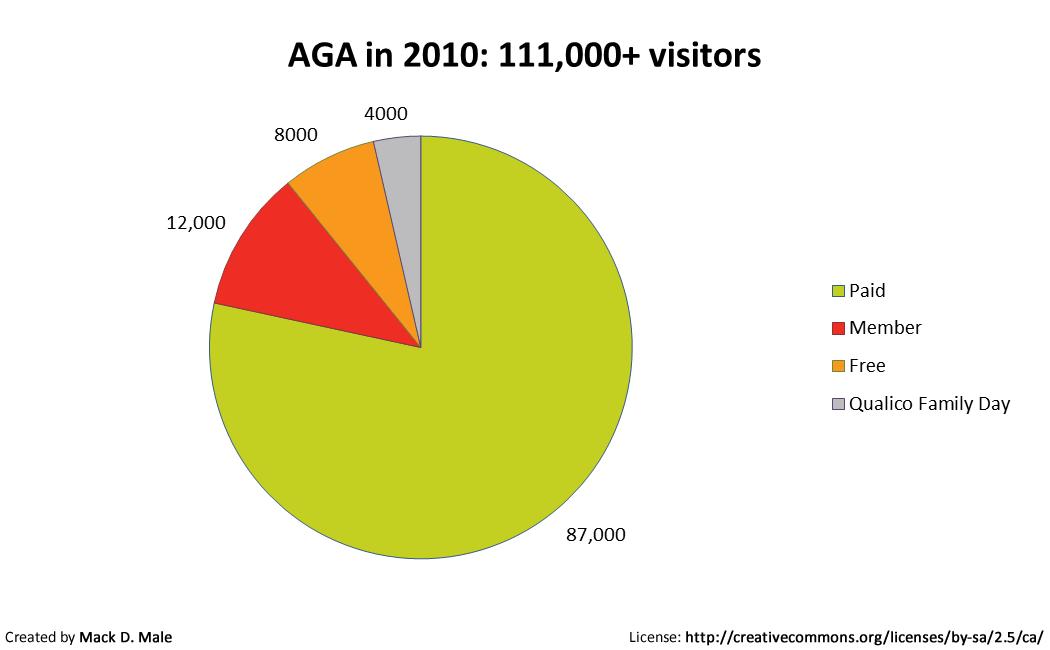
  • Attendance more than quadrupled since 2009 – more than 111,000 visitors!
  • Of that number, approximately 87,000 were paid admission, which significantly surpassed the target of 65,000.
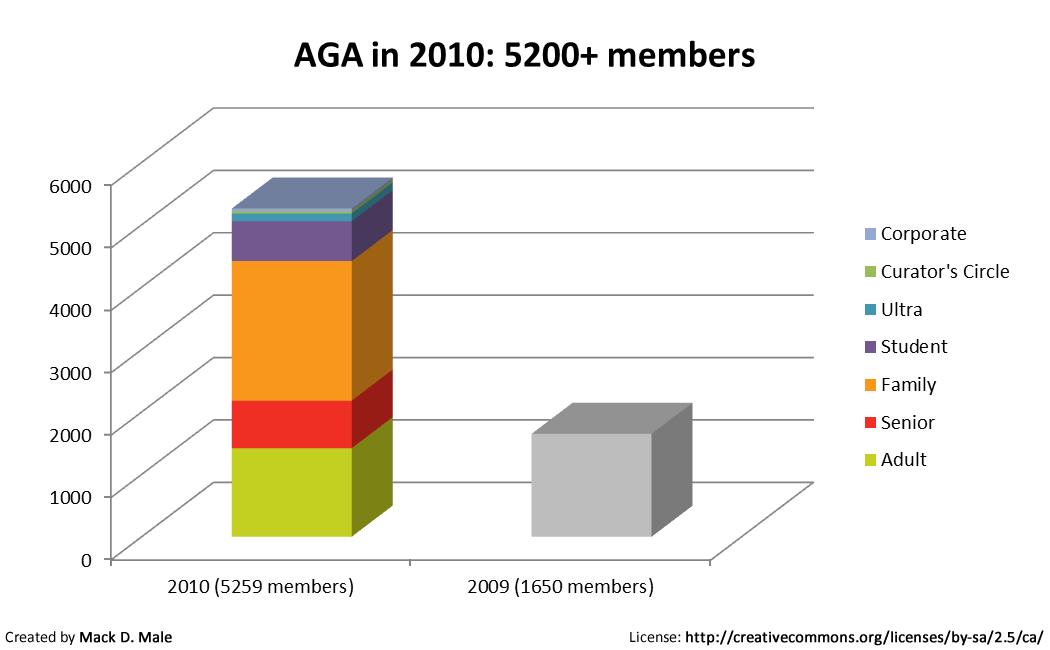
  • The number of AGA members increased from 1650 to 5300!
  • A total of 17 exhibitions were presented, 5 of which were dedicated to Alberta arists.
  • Roughly 4700 people in total attended the 395 public tours that were given. In addition, 146 private tours were given to a total of 3150 visitors.
  • School programs grew from 5000 students in 2009 to 14,500 last year.
  • A total of 367 private and corporate events, 24 wedding receptions, and 62 wedding photos sessions took place.

Here are a few graphs to help illustrate the success of 2010:

One of the highlights for me personally was the Refinery series of events. There were three in 2010, and each one was more popular than the last. Over 1700 people attended Refinery, and 800 of those were at the most recent event (it was so popular, people had to be turned away). I wrote about the second Refinery here. The 367 private and corporate events is significant as well. I attended dozens of events that took place at the AGA last year, it’s a great venue.

And who could forget the exhibitions! From Edgar Degas, Francisco Goya, and Edward Burtynsky to Warner Bros., Jonathan Kaiser, and Laura St. Pierre, we had a little bit of everything. I particularly enjoyed the Warner Bros. cartoons and Janet Cardiff & George Miller Bures’ Storm Room.

While the building was the most obvious “new” thing from 2010, let’s not forget that the AGA launched a new restaurant, logo, a new website, and established a presence in social media last year as well. All of those things helped the organization win a variety of awards:

  • Metal Construction Association Presidents Award for Overall Excellence
  • Institutional Winner: Alberta Construction Magazine 2009 Top Projects
  • 2010 Edmonton Economic Development Corporation Recognition Excellence Award
  • Best Cultural Institution 2010 by See Magazine
  • Zinc Restaurant was named one of the Best New Restaurants of 2010 by Where Magazine
  • Allan Scott was named Outstanding Volunteer Fundraiser by the Edmonton Association of Fundraising Professionals

Interview with Gilles Hébert, AGA Executive Director

The numbers for 2010 are certainly impressive. I asked Gilles to reflect on the past year. “It’s quite remarkable,” he told me. “The challenge is to maintain the momentum and continue to grow our audience.” In the first two months after the new building opened to the public, more than 30,000 people visited. “Lots of people came initially just to see the inside of the building,” Gilles said. Now he says people are coming back for the programming. “We exist because of the program, not because we have a cool building.”

Gilles said the AGA has seen the most interest in its contemporary programming, which he described as “pretty cool”. The success of the AGA’s contemporary exhibitions has driven interest nationally too. “People are looking to us for these big ambitious shows,” he told me. “They’re drawn in by the level of enthusiasm that is palpable in this community.”

Looking ahead to 2011, Gilles told me the challenge is generating buzz in places other than Edmonton. “There is no other institution like us in this province – we have a provincial mandate.” One of the ways the AGA is doing that is through social media. “We’re finding that these new forms of communication are really driving interest and allowing people to connect with what we’re doing.” He said their social media activities are actually becoming more valuable than traditional printed material and paid advertising, at least in terms of driving audience.

Gilles told me he is really looking forward to the celebration this weekend. “We are so proud to celebrate this milestone.”

Art Gallery of Alberta

Sunday Celebration

The anniversary celebration takes place on Sunday from 11am until 5pm. Here’s a brief description of what to expect:

The day includes the launch of the official AGA building book, presentations by the Citadel Theatre, Alberta Ballet and the Edmonton Opera, exhibition tours, as well as cupcakes for the first 500 visitors.

It should be a great day! You can see the event on ShareEdmonton here. And if you just can’t wait until Sunday, tonight is opening night for the Brian Jungen exhibition which features three sculptural installations.

If you’re taking photos this weekend, be sure to add them to the AGA pool on Flickr. Be sure to follow the Art Gallery of Alberta on Twitter.

You can see my photos of the AGA here. If you’d like a bit of background on the new building, check out my recap of architect Randall Stout’s talk.

Reimagine: Achieving a Sustainable Building Stock in Edmonton

A few weeks ago I attended Manasc Isaac’s Reimagine Tower Renewal Summit 4 (see my preview). John Woelfling from Dattner Architects in New York was the guest speaker, and he shared a wealth of information on the renewal of the Peter W. Rodino Federal Office Building in Newark, New Jersey.

Reimagine Tower Renewal Summit

John covered all aspects of the renewal project, from cooling & heating plant upgrades to egress improvements and façade upgrades. They were able to achieve a significant increase in the energy efficiency of the building, and it looks much nicer now too! A lot of the information was over my head, but you can download John’s presentation here if you’re interested (PDF, 10 MB).

Peter W. Rodino Federal Office BuildingPeter W. Rodino Federal Office Building

One slide in particular from John’s presentation stuck with me. To help set the context, he showed this graph:

As you can see, the vast majority of new office construction in Manhattan occurred back in the 1970s and 1980s. Why is that significant? Building codes and regulations were far less likely to consider energy efficiency at the time. An office tower built today is far more likely to be energy efficient than one built in 1970. It wasn’t until the Brundtland Report was published in 1987 that the term “sustainable development” was defined.

I have been thinking about that graph ever since, wondering if the situation here in Edmonton was similar, and trying to wrap my head around the problem of having an old and inefficient building stock. I spent some time on the website for The Way We Green, and came across this discussion paper from Klaas Rodenburg of Stantec. Titled Achieving a Sustainable Building Stock, the paper discusses the very thing I have been thinking about. Here’s a key excerpt:

Buildings are directly responsible for more than a third of all energy used and more than 50% of natural resources consumed in Canada. As a significant part of the problem, buildings also present part of the solution.

Although buildings look permanent, they are actually replaced or renewed on a perpetual basis. Municipalities can take advantage of this continual renewal cycle to significantly grow their stock of sustainable buildings by expecting higher standards for new buildings and encouraging existing building owners to engage in green renovations. Building codes are slow to change and focus on life safety, health and accessibility and not environmental performance.

The paper goes on to discuss voluntary rating systems such as LEED, and identifies strategies our city could employ to achieve a more sustainable building stock.

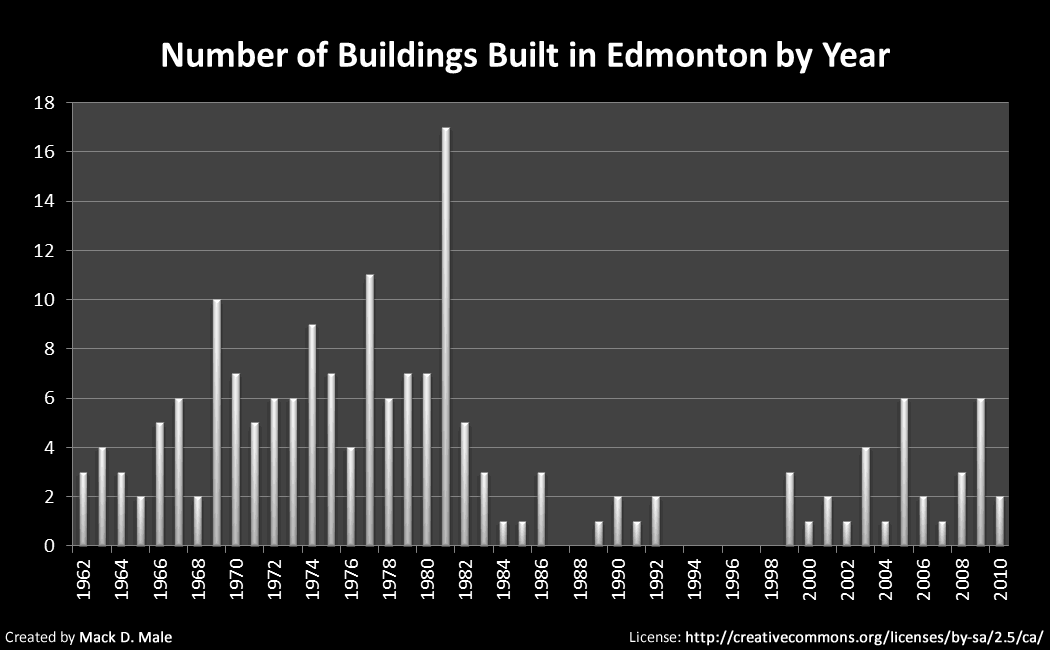
So what does our building stock look like? I turned to SkyscraperPage.com to help find the answer. They’ve got a pretty good database of Edmonton buildings – it currently contains 283 completed buildings. Of those, 183 have a “year built” associated with them. Here’s what you get with a little Excel magic:

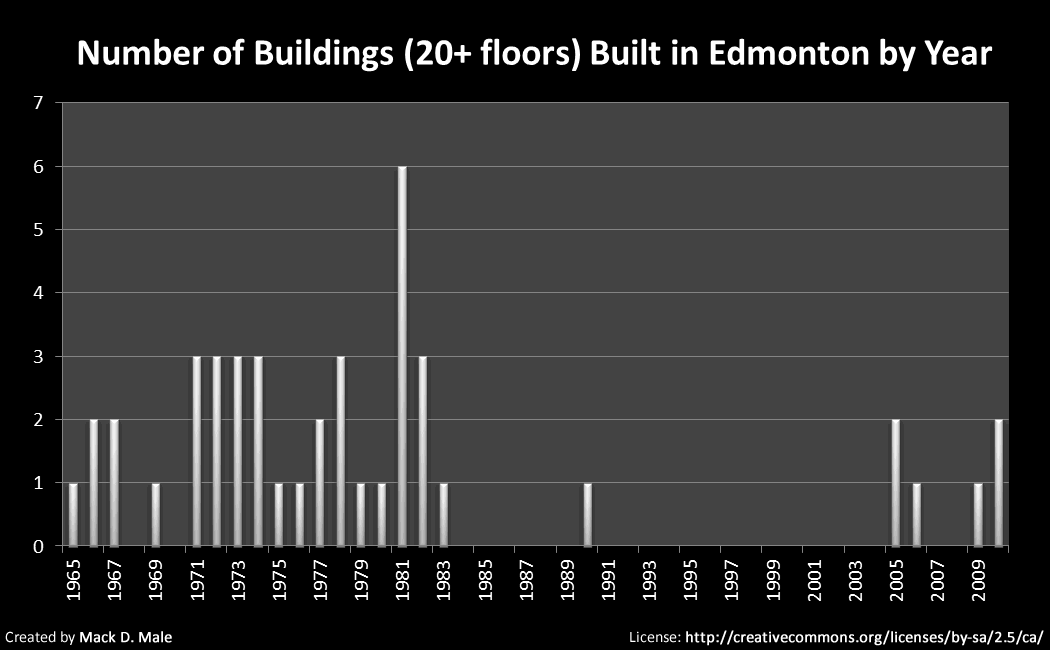
Very similar to the Manhattan chart (though the SkyscraperPage data includes both residential and office buildings). Most of Edmonton’s buildings were built prior to the mid 1980s. Here’s what it looks like when you focus just on buildings that have 20 or more floors:

Yikes! All of the buildings on the right side of that graph are residential too: One River Park, The Century, The Jasper Properties, ICON I, ICON II, and Quest.

Obviously we need to ensure that any new buildings we are constructing are energy efficient. As Rodenburg says in his discussion paper, they must “exceed existing codes and standards by a significant measure.” I think that is happening to a certain extent – being LEED certified is something we hear quite a bit about now.

The graphs above suggest that perhaps we should pay more attention to our existing building stock as well. There’s a number of strategies we could use to make our older buildings more efficient, including the increasingly popular idea of reskinning.

Reimagine Tower Renewal Summit in Edmonton

Next Tuesday, Manasc Isaac Architects are hosting a luncheon at the Fairmont Hotel Macdonald featuring John Woelfling of New York’s Dattner Architects (on ShareEdmonton). This is the latest in a series of events known as the Reimagine Tower Renewal Summit. Here’s the event description:

In this luncheon hosted by Manasc Isaac Architects, Woelfling will present on the renewal of the Peter W. Rodino Federal Office Building in Newark, New Jersey. The P3 modernization project utilizes a true re-skinning strategy, a first for North America. The smart skin increases energy efficiency, provides more effective fresh air ventilation, allows the building to be renovated while still occupied and dramatically transforms the building’s identity.

I was invited to the event and am looking forward to it. I’m not an architect (obviously) but I am interested in ways to transform Edmonton’s urban form, and this seems like a useful addition to the toolkit. Manasc suggests that “a reimagined building” (or a re-skinned building) can result in lower operating costs, reduced energy consumption, and improved day-lighting, among other things.

Some of you might remember Shafraaz Kaba’s talk at TEDxEdmonton last March, where he discussed the reimagining of the old Dell call centre building, now the Servus building. Here’s the before and after:

Servus Credit Union

Shafraaz pointed out that the benefits go deeper than just the exterior of the building. People are more productive when there is lots of natural light, etc.

One of the Pecha Kucha talks I remember most was Myron Belej’s from the very first PKN in Edmonton (slides in PDF here). He talked about Urban Color, and showed a before & after for a variety of Edmonton buildings. I remember being struck by just how much of a difference it can make when the building is not beige. Manasc Isaac’s ideas go beyond just color, of course, but I think the two are related.

Here are some more visuals from Manasc Isaac that demonstrate the re-skinning idea:

Stanley Milner Library
The Stanley Milner library downtown – it always comes up in discussions about redevelopment.

Chancery Hall
Chancery Hall

Associated Engineering
Associated Engineering building, apparently so ugly “it stops traffic in its tracks”. There’s a re-skin on the way for this building already.

If you’re interested in attending the event, you can register here. And if you’re in Calgary, they’re doing the event there too on November 10th.