One of the most important sections in The Way We Grow, Edmonton’s Municipal Development Plan, is the one that deals with the Growth Coordination Strategy. It is section 3.1 that earned the document the nickname “The Way We Sprawl” for specifying that just 25% of housing growth should happen in mature neighbourhoods. That shortcoming aside, the section is important because it aims to make land development in Edmonton more sustainable, predictable, and strategic. Section 3.1.1.6 explains the purpose of the Growth Coordination Strategy:
Develop a growth coordination strategy to address timing and phasing of new residential growth in developing and planned neighbourhoods. The strategy will relate to the City’s strategic goals, current and future public infrastructure investment, long term financial sustainability and the amount, location and pace of population and employment growth; and will establish:
- Expectations for completing developing neighbourhoods
- Expectations for initiating new Neighbourhood Structure Plans
Another important point is found in section 3.1.1.10:
The Growth Coordination Strategy will address demand for land, housing units, and housing choice at the regional, city-wide and sector level.
You might find the topic kind of dry but make no mistake, ensuring Edmonton can “manage future public obligations and growth opportunities” is of great importance to our city.

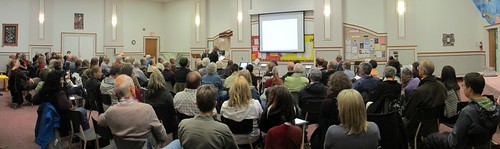
Photo by Dave Cournoyer
Despite the importance of the Growth Coordination Strategy, there are just two full-time employees at the City working on it and thus far there has been no official opportunity for public involvement. The first public draft (version 6) of the strategy (PDF) was released in May, but I understand based on conversations with City employees that that is not the same document slated to go to Council in November. A new draft is currently under development that reduces the scope of the strategy, primarily by stripping it of any objective related to infill development. A similar document focused on mature and developing areas would be left to an as yet unplanned and unfunded follow-up project. That means that Council will be considering a document that no citizen has had the opportunity to provide input on, not to mention one that does not seem to meet the requirements specified in the MDP.
No one I talked to knows (or refused to say) why the timeline for this strategy was set so aggressively. There is no doubt in my mind that powerful, well-funded behind-the-scenes lobbying has taken place. After all, without the Growth Coordination Strategy, Food & Ag Strategy, and Integrated Infrastructure Management Plan, new development in Edmonton’s urban growth areas cannot take place. Furthermore, we know from the January 26, 2011 Executive Committee meeting (see this report) that the “discussions began between Administration and Industry on the content of the Growth Coordination Strategy” as early as July 2010. I think that pressure from “Industry” partially explains why there hasn’t been any public involvement, but it doesn’t explain why the City has put so little funding into the development of this important document.
The Calgary Approach
Calgary has a number of similar documents and initiatives underway. One is called Geodemographics but the big one appears to be the Corporate Framework for Growth and Change:
The Corporate Framework for Growth and Change will guide the future sequencing of growth in Calgary to ensure investments in infrastructure and services are within the financial capacity of The City. The Corporate Framework for Growth and Change is an integral part of Calgary’s Municipal Development Plan (MDP) and growth management.
Note both the timeline and frequency of public involvement for the development of that document. It began in February 2011 and the first public involvement opportunities – a series of stakeholder meetings, plus a blog post open to public input – took place in September and October of that year. A series of stakeholder meetings and forums have been hosted throughout 2012. To be fair, Calgary took a different approach, with Council approving a set of principles early on and the rest of the project unfolding in four phases, but the fact remains that a significant amount of public involvement has taken and continues to take place.
Another thing to note about Calgary’s project – there are at least ten individuals working on it:
A team from across City Departments called the Corporate Growth Management Project (CGMP) team, has been assembled to create the Framework for Growth and Change.
Edmonton and Calgary both pay lip service to managing growth, but only Calgary seems willing to back that up with the necessary funding.
Designing New Neighbourhoods
In contrast to the Growth Coordination Strategy, the Designing New Neighbourhoods project has unfolded much more predictably with multiple opportunities for public input. The outcome of that project is a set of guidelines for Edmonton’s new neighbourhoods. Section 4.1 of the MDP directed the creation of these guidelines, but unlike the Growth Coordination Strategy, technically nothing depends on their existence.
The draft guidelines are slated to go to Council “in early 2013” and already a number of public involvement opportunities have taken place. In May, there was a series of blog posts and an IdeaScale site was created to harvest ideas from citizens. The project team also encouraged the use of Twitter to suggest ideas, a positive step for public involvement at the City!
Importantly, the project also has a Design Team that is “made up of a diverse group of about 30 people from the local development, urban design, and home building industries, as well as members of the City’s Administration, the Edmonton Federation of Community Leagues, Edmonton’s Schools Boards, and the University of Alberta’s City-Region Studies Centre.” That same post talks about the inclusion of external consultants too.
The City of Edmonton’s page on Public Involvement states:
The City of Edmonton is committed to involving the people affected by the decisions it makes. We seek diverse opinions, experiences and information so that a wide spectrum of information is available to decision makers.
Designing New Neighbourhoods seems to meet that commitment, but unfortunately, the Growth Coordination Strategy does not.
The Ongoing Abatement of Section 3.1 of the MDP
I’m very concerned that the potential impact of Section 3.1 of the MDP has been continually eroded over the last two years. In February 2011, City Council passed a motion (item 6.16) that redefined eight Neighbourhood Structure Plans from “new” to “existing” which means they are no longer subject to the completion of the Growth Coordination Strategy and other documents. Futhermore, it authorized the preparation of six other Neighbourhood Structure Plans.
Only Councillors Henderson, Iveson, and Sloan opposed the motion. In his remarks on the motion, Councillor Henderson said “I really do think this is an undermining of what we passed in the MDP” and that “our tools to deal with how we grow and when we grow in this city – we’re giving them away.”
Why did this happen? It’s not as though Edmonton is running out of places for people to live. Prior to the motion in February 2011, there were 41 Neighbourhood Structure Plans approved (between 1984 and 2010) and at various stages of development. Together, those plans have a planned capacity of 116,000 resident units yet just 19,000 units have been developed. That means 84% of the development in those areas is still outstanding. There should not be such a rush to develop new land.
Again, I think politics are at play. Our current City Council has been good to the development industry, but with a new Mayor and Council slated to take office next fall, there’s no guarantee that will continue. Better to get as much approved now as possible, if you’re in the land development industry. Unfortunately for citizens this means our city continues to sprawl, more or less free of any restrictions. Sooner or later the cost of that sprawl is going to catch up with us.




 MasterMaq's Blog