Photo Tour: Arctic Shores is coming to life at the Edmonton Valley Zoo

The Edmonton Valley Zoo is in the midst of a major transformation. One of the most talked about new features is known as Arctic Shores, set to open sometime in 2012. This week (before it snowed) I had the opportunity to tour the construction site, and was impressed by the progress!

Arctic Shores will improve the quality of life for the zoo’s seals and sea lion with a new indoor/outdoor pool. You really have to see the before and after to get a sense of how dramatic that change will be, however. Here’s what the facility currently looks like:

Valley Zoo
There are three sea lion/seal pools on the left.

Valley Zoo
The zoo’s South American Sea Lion.

Valley Zoo
The zoo’s two Harbour seals.

Valley Zoo
A new home is on the way!

The animals are well cared for, they just don’t have the most attractive or exciting space to live in. It looks and feels somewhat utilitarian, and doesn’t really allow visitors to get very close to the animals. But that’s all about to change!

Here’s a rendering that illustrates what the new facility will look like:

Polar Extremes Rendering

This is a model that was on display last May, courtesy of Sharon.

Seal habitat

And here’s another view, displayed on the fence around the construction area at the zoo.

Valley Zoo Arctic Shores Construction

And here’s what the construction status looked like as of this week. This is the road leading up to the Arctic Shores facility, inside the fenced off construction site. The zoo has around 75 acres of land, only 40% of which has been developed. The land that Arctic Shores is now on used to be home to camels and West Caucasian turs. They have been moved to a new home, which highlights one of the challenges of major construction at the zoo. It sounds like the construction team had some interesting encounters with the turs early on!

Valley Zoo Arctic Shores Construction 

The new facility is being built with sustainability in mind. It will have a green roof to minimize storm water runoff, and will also feature dark-sky-compliant exterior lighting.

Valley Zoo Arctic Shores Construction 

A big focus is water conservation. The building shown below is where filtration will happen, with the goal of achieving net zero water usage. There’s a mechanical filtration system that uses perlite (commonly seen in potting soil). That’s significant because it is safer for staff, and can simply be composted when it needs to be replaced. There’s also a biological filtration system, in the form of a saltwater marsh just behind the building.

Valley Zoo Arctic Shores Construction 

That filtration all happens via the 29 pipes buried underground. The pipes range in diameter from 4 inches to 16 inches, and altogether will ensure that all 870,000 litres of water goes through the cycle every 90 minutes. If all goes according to plan, the filtration system will mean that the pools are filled just once. In the current habitat, the water is refilled every week.

Valley Zoo Arctic Shores Construction 

This is the view from atop the back edge of the new outdoor pool. It’s pretty incredible to see the pathways and everything brought to life! The concrete you see here will be sealed and covered with a 2 inch layer of finishing concrete that looks like rock. Hopefully there are no leaks – the only way to tell is to fill it all up with water and then watch closely!

Valley Zoo Arctic Shores Construction 

The outdoor pool is connected to the indoor pool via the pathway you can see on the right below.

Valley Zoo Arctic Shores Construction 

Below you can see the viewing platform, where visitors will have a chance to get a closer look at the animals. There’s a big, curved piece of acrylic that will be added to the platform. And if you look closely, you’ll note the middle of the platform has a bunch of plywood on it. That will be turned into a viewing window as well!

Valley Zoo Arctic Shores Construction 

In the background here you can see one of the large piles of earth. In all, the construction team estimates they removed roughly 1900 end dumps (the large, 30-40 foot long dump truck trailers). The good news is that all of that earth stayed at the zoo, and will be used for refilling around the construction and other landscaping projects.

Valley Zoo Arctic Shores Construction 

In addition to the new sea lion/seal home, Arctic Shores will feature a pingo and a whale bone play structure. An arctic fox and ground squirrels will also call Arctic Shores home.

Valley Zoo Arctic Shores Construction 

The shot below is the space that will become the kitchen, where staff prepare food for the sea lion and seals. Everything will be stainless steel, with lots of work space and a viewing window into the indoor pool.

Valley Zoo Arctic Shores Construction 

In the background below, you can see the curved structure covered in black, green, and yellow tarps. That’s the acrylic piece that will encircle the viewing platform. It turns out that there are just two companies in the world that could make that component of the project, one in the United States and one in Japan. Due in part to scheduling requirements, the contract went to the company in Japan. The acrylic arrived in Edmonton late Monday night, lucky to have survived the earthquake and tsunami. You can read more about it here.

Valley Zoo Arctic Shores Construction

The final photo here is where the new zoo entrance will be. It will also serve as the entrance to The Wander, a new central trail system that will be built after Arctic Shores. Construction won’t begin on that for a while, but the zoo did get a head start this week. A total of 85 trees and shrubs will have been removed by today, in order to comply with the Migratory Birds Convention Act. All of them will be replaced.

Valley Zoo Arctic Shores Construction

As you can see, the construction of Arctic Shores has come a long way since last June. I’m really excited about the changes taking place the Valley Zoo, and will be writing more about the zoo’s ongoing transformation over the next few weeks. Thanks to Denise and Mary Lou for the tour!

You can see more photos here.

Recap: Mayor Mandel’s 2011 State of the City Address

Today I had the opportunity to attend the Edmonton Chamber of Commerce’s annual State of the City Luncheon at the Shaw Conference Centre. Hall D was absolutely packed with government, business, and community leaders – it was a really great turnout! The keynote speaker was of course Mayor Stephen Mandel, who delivered his latest State of the City Address, which you can read in PDF here (the archive of speeches is here).

2011 State of the City
Bella Rouge performed right before Mayor Mandel delivered his address.

Mayor Mandel started off talking about the “amazing arts community in Edmonton”. He talked about the importance of cultivating and investing in our arts industry, and made it clear: “Yes arts are an industry.” He talked about a new arts visioning committee that has been struck, co-chaired by Brian Webb and Diane Kipnes, to focus on raising the profile of arts in Edmonton.

He moved on to discuss working with citizens, something I have been thinking about a lot lately. He said:

And as much as I know we have more to learn in the area of citizen input, we have undertaken more citizen discussion in the last six years than at any other point in our city’s history.

I think Mayor Mandel understands that the way we’ve been doing things isn’t working. The expectations are greater, from both citizens and from the City of Edmonton employees that work so hard on their behalf. We can definitely improve when it comes to public involvement, and I think Mayor Mandel would absolutely be supportive of any such improvements.

2011 State of the City

The big news came about halfway through the address as Mayor Mandel was thanking Premier Stelmach for his support of the city. The Province has committed $497 million in new capital funding (through Green Trip) that will enable us to finish the LRT extension to NAIT.

And today, I am very privileged to say we have received assurances from the Province that money for our NAIT line – almost $500 million in new capital funding – has been secured through Green Trip. This new capital pay-on-progress money has already started to flow with $70 million advanced in 2010 through Green Trip. The balance of the province’s commitment is now confirmed which means LRT to NAIT is right on schedule.

The official Government of Alberta news release is here.

With the approval of the City’s submission for this LRT project, the province has provided $70 million from budget 2010-11 to the City of Edmonton to cover project costs already incurred. The remaining payments will be allocated to the City as progress on construction is made.

This is a big deal in my opinion, and while it did receive a pause and applause during the address, I wish a little more time had been spent on the issue. We cannot understate the impact transit will have on transforming Edmonton into the kind of city we want and need. Mayor Mandel did acknowledge the lack of support Edmonton has received from the federal government, saying that “what’s missing is full engagement of Ottawa on the big city file.” He called for citizens to speak out on the need for an urban agenda, something I can definitely get behind.

Mayor Mandel next spent a few minutes talking about the proposed downtown arena, expressing his “sincere hope that Council will take some constructive steps forward” when the issue is discussed at tomorrow’s Council meeting. “This is a project that has the potential to accelerate our efforts to bring more people, more energy and more activity to our core,” he said.

He lost me a little as he continued talking about the other opportunities we have in the downtown core, such as the Jasper Avenue revitalization and the Walterdale Bridge replacement, saying:

Within this context a broad-based CRL becomes a tool to support our efforts across our entire downtown plan – from Jasper Ave to the Quarters, to our warehouse district. So if we move forward tomorrow on the next steps towards a new arena and entertainment district we are moving forward with this entire vision.
 
I do want to frame what moving forward means. It means that we establish a baseline for a lead investment in a downtown arena project by the City of Edmonton, through a portion of any combination of CRL and a user-fee, both of which can be applied to building capital. 

Tying the future of downtown to the arena project’s CRL sounds risky to me. I’m not sure if that was the intent of his remarks, but that’s what it sounded like. It’ll be interesting to see what Council decides tomorrow (if anything).

2011 State of the City

Mayor Mandel next turned his attention to the economy, noting that efforts are underway to “reconsider the role of agrifood and urban agriculture in our region.” He also suggested that our local food economy may “become the seed of a broader economic effort.” He declared Edmonton’s economic future as “bright” but noted that we need to work hard to ensure we realize those opportunities.

He concluded by focusing on his key message, “that there is so much incredible opportunity here.” In particular, I really like his statement:

The best plans in the world, are really only this, until they are realized.

We actually have to do something about them (hence the second pillar of The Edmonton Champions Project: Connect, Do, Win). I think under Mayor Mandel’s leadership we have gotten better at this, but there’s still room for improvement.

2011 State of the City2011 State of the City

Throughout his speech, Mayor Mandel talked about the need for “a higher level of integration and collaboration.” He mentioned it a few times, almost more than “creativity” which seems to be his usual favorite word. I thought he did a good job of highlighting how working together can really make a difference, citing examples such as the Homeless Commission, REACH Edmonton, and the progress the Capital Region Board has made.

Given that there’s a federal election going on, I was particularly interested in Mayor Mandel’s comments on the relationship with the federal government, which we know has been strained at times. To start, he talked about the partnership with the Province and the success it has achieved:

It is based on understanding that municipal government, which is closest to the people is best to lead on key projects and that choosing an aligned path is better for our common citizen.

Then he made it clear – “it is also the message that our City must send to Ottawa through all parties and all MPs.”

All in all it was a great lunch and an uplifting address. My thanks to Robin Bobocel and the Edmonton Chamber for allowing me to join them for lunch today! You can see my photos from today here.

The City of Edmonton is failing at public involvement

In my opinion, the City of Edmonton needs to completely transform its public involvement practices. Over the last few years there has been the odd glimmer of hope that things are changing for the better, but I don’t think progress is actually being made. Sometimes it even feels like we’re moving backwards.

Here’s an excerpt from Mayor Mandel’s Swearing-In Address on October 26, 2010 (PDF):

Looking ahead to some of the major projects entering the consultation stage – the arena, LRT design and EXPO 2017 – it’s clear that we need to refine our consultation process and vastly improve how we communicate with our citizens.

Methods are changing, people contribute their opinions and receive information in different ways, and we are not keeping pace.

A City with a bold creative vision has to be able to communicate clearly with its citizens – we simply must do better here.

And from better process will come better solutions – ones where our citizens can witness their impacts and know that together we’ve all done the best for Edmonton.

Nothing has changed in the five months since he gave those remarks, and there’s no indication that anything is going to change.

The most recent example is the Walterdale Bridge project. There are so many issues I almost don’t even know where to begin. It’s a good illustration of some of the larger issues plaguing the public involvement process.

Oh look City of Edmonton, a dictionary!

The terminology used for public involvement is inconsistent and confusing. What’s the difference between an open house, an information session, and a community consultation? All three have been used on the Walterdale Bridge project, and I’m sure you have seen other terms used for other events. Can I always give feedback? Are some events more heavily geared toward sharing information than others? Does the name imply a certain stage of the process? There’s absolutely no way to tell based on the terminology used.

There are a bunch of other terms that are poorly defined as well. Who’s a stakeholder, for instance?

No consultation on the consultation itself?

Why doesn’t anyone ever ask how we’d like to be consulted on something? Is a bunch of private meetings with “important stakeholders” followed by an information sharing session open to the general public always the best approach? Why don’t more consultations make use of the vast array of effective technologies we have at our disposal? It wasn’t without fault, but at least the online questionnaire on the arena project was different. I think one of the simplest ways we could improve the public involvement process would be to gather feedback on how the process should work before starting it.

What’s happening?

Do you know when the public involvement process for the Walterdale Bridge started? Me neither. The first time the public became aware of the process was on November 15, three days before the first open house. Some “selected stakeholder groups” were interviewed prior to that event, but when? A couple of weeks before? Or years before as the issue popped up with each rehabilitation?

I went to the open house on November 18, and wrote about it here. At the bottom of that post, I captured the “next steps” as they were presented. There would be an interim plan in January, followed by a public information session (different from an open house apparently) in February or March, and then the final plan would go to Council in April. I added my email to the contact sheet at that event.

The update that was presented to TPW on January 25, 2011 came and went without any notice. No press release, no email. Unless you’re checking the agenda of each Council and committee meeting, there’s almost no way you’d have found out about that update. Part of the information shared at that meeting was an update on the public involvement process. The report mentioned the stakeholder interviews and the open house, then finished with this:

The balance of the Public Involvement Plan, to be undertaken in February and March, will be comprised of a series of meetings with key stakeholder groups to further discuss options and recommendations that will have been developed since the November Open House, in addition to another widely publicized public Information Session.  The purpose of this Information Session will be to communicate the content of the final report to City Council.  This Information Session will be held in late March.

So basically if you wanted to provide input but you didn’t attend the November open house, too bad. Unless of course you’re part of those secretive stakeholder groups that may or may not have taken place – no update on those was ever provided.

Finally we come to yesterday’s “widely publicized public information session”. The open house in November got a press release, this one didn’t. The only notice that went out about the event, in addition to a tweet the day of, was an email sent on March 14 to people who signed up at the November open house. That and the web page was updated, though unless you constantly check it, you’d never know that. Hardly a “widely publicized” event, if you ask me.

Actually there is one other way you could have found out about the event – at the City of Edmonton’s Public Involvement Calendar. That would be the calendar without email or text notifications, no RSS feeds, and no ability to search by keyword. None of those events show up in the much more functional Events Calendar, for some unacceptable reason.

You mean you didn’t see my tweet?

Sometimes there are comment forms, other times there are sticky notes, sometimes you participate in a group discussion with someone recording notes, and other times you fill out a survey. There are two problems. First, it’s not clear what I need to do to ensure my comments are going to be read and considered. Second, nearly all of those mechanisms for providing input require me to physically attend an event!

There are so many tools that we’re simply not making use of. It doesn’t even have to be Twitter or whatever the popular online service at the moment is. Why can’t I just send an email? Why can’t I fill out the survey online? Why can’t I just send a link to my blog post?

The very, very, very few speaking for many.

The January update boasted that the November open house was “heavily attended” at 225 participants. Just 80 comment forms were submitted, and there’s no word on how many sticky notes were written. Yesterday’s event apparently had around 150 attendees. Just 15 interviews of “stakeholder groups” were conducted.

We’re a city of nearly 800,000 people, and we’re basing the public involvement part of the decision on 80 comment forms and 15 interviews? I truly believe more people want to provide feedback, it’s just too difficult to do so at the moment.

At the November open house, the City shared a number of alignment and style options for a replacement bridge. Yesterday, they declared they had chosen the arch. There’s no opportunity to question this. It’ll go to Council without any additional public involvement.

Just going through the motions…

I want to be engaged. I want to contribute and help to make the outcome a better one for Edmonton. But all too often it feels like the City is simply going through the motions when it comes to the public involvement process. I can see why the vast majority of citizens find it hard to get engaged. Look at how much work it took to keep up-to-date on the Walterdale Bridge project!

The Walterdale Bridge Public Involvement Plan violated City policy.

Did you know the City of Edmonton actually has a policy on public involvement? Policy C513 (Word) outlines how administration should involve the public when making recommendations to Council. Let’s ignore for a minute that the policy itself absolutely needs to be improved (“…designed to involve the appropriate people at the appropriate time in the appropriate way…”). The trademarks of any City of Edmonton public involvement process are meant to be: clear purpose, consistent approach, and commitment to involve. The “commitment to involve” is pretty hard to get wrong as it is described in the policy, but the Walterdale Bridge public involvement process completely missed the boat on the first one, in my opinion, and we have to trust that the consistent approach was achieved.

Clear purpose is achieved by using the “Continuum of Public Involvement” which essentially states that you start by sharing information to raise awareness, then you consult people to test ideas and build commitment, then you share decision making with stakeholders.

  1. Sharing Information
  2. Consultation
  3. Active Participation

This was not followed with the Walterdale Bridge project. There was no information sharing or awareness building at the start, instead there were consultations with stakeholders. That’s supposed to be the third step of the continuum, not the first! Then we got the November open house, which combined steps one and two. It doesn’t seem like steps four or five, partnering with stakeholders to make a decision, ever took place.

Consistent approach is meant to be achieved using the City of Edmonton Public Involvement Roadmap:

  • Understanding the overall project
  • Defining the purpose and outcomes of public involvement
  • Clarifying the public involvement commitment
  • Public involvement process details
  • Developing the public involvement plan

Did this happen? Maybe, but it was never shared. The public doesn’t know the purpose or outcomes of the public involvement, nor did we know the process details. There was no plan available.

We simply must do better.

The Walterdale Bridge project is not unique. The same problems plague the vast majority of Edmonton’s public involvement efforts. I’ve been to so many open houses, or information sessions, or whatever you want to call them, where attendees have expressed their frustration at the lack of clarity about the process, or the fact that they feel the consultation is happening too late in the process.

In October 2009, I wrote about the proposed Centre for Public Involvement. I’m going to repeat the opening statement of the prospectus:

The timing is right for establishing the proposed Centre. In reality, the timing is probably late by ten years.

Toward the end of 2010, there was finally some movement and the Centre is now being organized. It took more than a year to get started, when we’re already so far behind.

Is this really the best we can do? I think we can do better. We simply must do better.

Taking the City of Edmonton to another level with City Manager Simon Farbrother

Last week, on the one year anniversary of his first official day as the City of Edmonton’s new City Manager, Simon Farbrother sat down with me to reflect on the past twelve months. In addition to settling into the role and continually learning about the organization, Simon is leading the City through a major cultural shift that is fundamentally changing the way it does business.

Simon Farbrother
Coffee with Simon

Simon came to the City of Edmonton from Waterloo, where he was that city’s Chief Administrative Officer. He’s not new to the capital region however, having worked at the City of Leduc from 1988 until 1997, and at the City of Spruce Grove from 1997 until 2005. I wondered if he had thought about working in “the big city” but he said that was never the game plan, though he did admit the thought crossed his mind once or twice. “I think it’s important to stretch yourself, “ Simon told me, “when opportunities come up you grab them and away you go.” That’s how he ended up in Waterloo, and in January 2010, how he found himself here in Edmonton taking over for retiring City Manager Al Maurer.

Simon said his first year has gone by really quickly, but described it as “challenging, fun, and stimulating.” Noting the number of projects the City has on the go, Simon said “Edmonton is at a very interesting point in time.” He lives in the southwest and uses the LRT quite a bit and depending on his schedule. “The south LRT has changed the way people think about transit in our city.” Though he felt Edmonton had matured politically while he was out east, Simon said that he has “always thought Edmonton’s strength was its people, and I still do.” He thinks it’s because we have a unique sense of connection here. “We’re the big city on the prairie, we’re multicultural; the people who choose to live here are really carving out their lives.”

For the first few weeks of last year, Simon spent his time getting to know people at the City while Al continued on as Manager (though Simon actually knew quite a few people already from his previous positions). On January 18th 2010, he took over and hit the ground running. “You have to get up-to-speed quickly and bring your skills to the table.” Simon told me the ladies in the Manager’s office were “tremendously helpful” and made the transition a smooth one. “When you join, naturally there’s a lot of questions about you,” he said, recalling that it wasn’t just him that had to adjust to the new role. “Fundamentally I am about building – I always have a strong belief in a person’s abilities and general willingness to do the right thing.”

Simon Farbrother
Conversation with Simon & Extended Leadership Team

One of the first things Simon did was have an open conversation with the general managers. “Leadership is about framing,” he said. Simon made it clear that the City would be moving in a new direction, and told them, “your primary role is to lead the City, not your department.” He called it a “fundamental shift” and said there has been a lot of positive engagement from the general managers on the new approach. Discussions since have focused on how the City leads, rather than on each individual project that comes up. “We also opened the door to branch managers and directors around leadership,” Simon confirmed. The City of Edmonton currently has 6 general managers and 35 branch managers, but the number is not important. “It’s about what makes sense at the time to lead.” To reinforce the shift, the Senior Management Team (SMT) was renamed to the Corporate Leadership Team (CLT). Demonstrating leadership is more important than having worked at the organization for most of your career. “We’re trying to engage people to be leaders, everyone can do that.”

Simon’s focus for 2011 is this internal cultural conversation. He shared that the City has formed a group called Transforming Edmonton and Me (TEAM) that has been challenged to explore the question, “what do we want our culture to be?” An early activity involved the creation of a word cloud, and ‘communication’ emerged as the biggest word. There’s a desire to be more transparent, and to have meaningful conversations (no more going to the meeting then having the real conversation in the hallway). “It’s about how we agree to work as an organization,” Simon said. “If you don’t see me acting in the way I say I am going to act, you have every right to tell me.”

Most of Simon’s communication has been focused internally so far (he’s going to look into updating his pagearchived here – on the public website). “Having various ways to communicate is really valuable.” To that end, Simon has published videos every few weeks for employees, focusing not on what the City got approved but on leadership within the organization. “For example, a video might talk about our approach to the budget, rather than giving details on what was approved.” The effort has given him the opportunity to meet people across the organization. “I’ve learned to cut trees, drive a bus, I’ve been in the sewers, it has been great.” He hopes the videos reinforce the notion that all employees at the City are important. He is thinking about an internal blog too, and said the intranet is a really important tool for giving context.

Simon Farbrother
Simon getting some hands-on experience felling trees in Delwood Park

Perhaps unsurprisingly, Simon was a BlackBerry user while in Waterloo. Now he’s got an iPhone and an iPad, but doesn’t consider himself to be an early adopter. “I really like the iPad in a meeting environment,” he said, because there’s less paper to carry and the device is great for graphics. “I do lots of email and text messaging,” he told me, and while he is familiar with Twitter, he has no plans to use the service. “A lot of my emails would look like tweets though!” Simon’s day consists largely of meetings, so it’s important to communicate efficiently. He uses text messaging to stay in touch with his family throughout the day.

Turning to external communication, Simon said the City “should talk about what we’re doing and what we’re trying to achieve.” It’s the philosophy that is important, not the list of projects. “We’re part of a bigger picture, we work for the full community.” Simon thinks it is important for employees to be mindful of that broader perspective too. “You can’t disconnect being a transit driver or an accountant or even a manager from being an ambassador and a representative of the City.” In other words, employees need to be accountable not just to their boss, but to all Edmontonians.

The word accountability was mentioned alongside transparency in his introductory letter last year. When I asked for his assessment of the City’s performance on those issues, Simon replied: “I think we’re getting better.” Being accountable and transparent to the public is a challenge given the size of the organization. “We’re in the A to Z business,” Simon remarked, “and we’re the only the organization that does all of our business in the public eye.” I suggested that the City could do more on the transparency side, especially as it relates to making information available and accessible. “I don’t think we consciously hoard,” he told me. “There are legitimate reasons for some information to be confidential.” He agreed that getting information into people’s hands is important though.

Simon Farbrother
Simon with Councillor Amarjeet Sohi

I asked Simon how he has found working with Mayor Mandel and the rest of City Council over the last year. Due to the nature of the position in large cities, Simon has worked more closely with Mayor Mandel, and described him as “very committed and very driven.” He said they get along well. Though he hasn’t had as many opportunities to work with the Councillors, he said “they’re all trying to build a better City, which is a positive environment to work in.”

Looking ahead to 2011, I asked if Simon had made any personal new years resolutions – he didn’t. “For me it’s about lifelong learning,” he said. “In whatever you do, you need to be relevant and adding value.” He’s excited for the year ahead, and talked about some of the big projects that have made headlines recently. “EXPO wasn’t just a three month event, it was positioning Edmonton as an important city in North America.” Similarly he thinks we need to look at the bigger picture when it comes to topics like the downtown arena or the city centre redevelopment. “We need to be strategic and aligned as a city.”

Simon said the City of Edmonton has always had aspirations, but has never embedded that into the culture. “Being aspirational has to be a fundamental part of what we do.” When it was discovered that some material was being created internally that talked about Edmonton being successful as a “tier 2 city”, Simon and his team put a stop to it. “What would a tier 1 city do? There’s nothing stopping us from being tier 1.” It’s about having vision and not being afraid to go after it. “We shouldn’t be shy about opportunities.” For Simon, it’s about taking Edmonton to another level. “We need to up our game and galvanize around being a city.”

“It’s going to be a good year.”

Chris Moore on 2010 and the year ahead for IT at the City of Edmonton

A couple of weeks ago I sat down with the City of Edmonton’s Chief Information Officer, Chris Moore, to chat about 2010 and to get his outlook on the year ahead. I first interviewed Chris back in July 2009, when we talked about the ongoing transformation of the City’s IT branch.

Open City Workshop

The IT transformation has progressed nicely, Chris told me. Recently his department ordered coffee mugs with the “ten ways of being” printed on them, something Chris resisted initially because he wanted the words to mean something. He gave a mug with the word “open” on it to City Manager Simon Farbrother as encouragement to continue the work he has been doing.

The IT transformation is ongoing, of course. The department has approval and funding to add 35 people this year, which can be an advantage because many firms are not hiring at the moment. “We want to create a place where employees want to be,” Chris said. “We need to use technology in a unique, dynamic, future way, so that they choose the City over other opportunities.” Chris is looking for the best tech people, but they also have to be a cultural fit, something that hasn’t always been a priority. The push to hire more employees should help the IT department reduce the number of contractors it has. That number currently stands at 64, but it has been as high as 99 and as low as 45, depending on the work required. “Contractors can create a knowledge void over time,” Chris told me, because they do the work but others have to support and maintain it. Furthermore, Chris wants to find a way to get employees closer to the business users. “The best place to be is embedded with the customer.”

It’s interesting that the IT department is growing given the question Chris posed near the beginning of our conversation: “Does IT, in any organization, have a future?” It’s something Chris has been thinking about both privately and out in the open on his blog. “There are a lot of folks blind to the fact that consumerization is impacting their systems.” Users are increasingly demanding more, and the technologies they use and learn about at home are making their way into the workplace as well. “Today’s consumer electronics are tomorrow’s corporate electronics,” he said. “The future of organized IT in enterprise is going to change dramatically, and I’m intrigued by that.” As a result, he is also thinking about his own position. “The role of the CIO has to change in government,” Chris told me. He said it needs to be much more strategic, but that it’s up to the people currently in the role to make that happen through their actions.

Looking back at 2010, I asked Chris about the City’s work on open data, something I’m particularly passionate about. Chris said that he was “pleased with the fact that we listened to the community” and noted that the open data initiative has benefited from three key elements: political sponsorship, administrative leadership, and community engagement. He agreed there is more work to be done, but said that “we showed up on the map in Canada” and definitely sees momentum building. Chris told me there has been “serious interest” from planning, transportation, and traffic safety, but that all the businesses at the City have questions about how to make it sustainable. “You need leadership and resources from IT to drive it forward, but you also need businesses with the data to want to play ball.” I’m hopeful that much more progress can be made in 2011 on the open data initiative.

Chris was also busy showcasing Edmonton on the world stage last year. In fact, he travelled more than any other City employee in 2010, visiting a variety of different places (PDF, page 11). He was able to speak at conferences about the work Edmonton is doing related to open government and social media (here’s a presentation he gave in Manila at FutureGov Asia), and also had the opportunity to learn from others around the world. Edmonton is now a part of the new World e-Governments Organization of Cities (WeGO) for instance. Chris was also instrumental in bringing the world to Edmonton, with events like Beyond 2010. “Lots of people asked why we were involved in that,” he recalled. “Because we can, because it is possible.” The event was another opportunity to showcase the work that IT has been doing. “A year ago we didn’t have a goal for it, but we did know we could be leading.”

I think Chris has definitely approached his role as CIO in that way as well. He has been really active on Twitter, something he is quite proud of. “I set an example for others, and articulated that you can use Twitter safely!” Recently Chris has started using Tumblr as well, and told me he’d like to spend more time blogging in 2011. “It’s a combination of what I have encountered with my work, telling the stories of what we’re doing, but also being disruptive and challenging people.” He likes the term “government futurist” as a way to describe the position he writes from.

open city workshop planning session
Chris Moore, Edmonton’s CIO, at the planning session for the upcoming Open City Workshop (March 6th, 2010) to discuss the City’s initiatives in open data and open government.

Though IT accomplished a lot in 2010, there is always more to do. In 2009 the corporate IT audit determined that governance needed to change. “I would have liked to have had more traction in 2010 with governance, but I am not disappointed.” Chris and his team had identified culture as a risk, and they have made progress on aligning IT governance with the shifting culture of the corporation as a whole. “We will absolutely crack the nut on it in 2011.” It’s one of many projects the department is working on, and Chris said to stay tuned for some exiting announcements.

This year is the 60th year of IT at the City of Edmonton (the first project was a payroll system for Edmonton Light & Power). While they didn’t celebrate ten years ago for the big five-oh, Chris assured me they are going to do something this year. With a new vision to be western Canada’s municipal IT leader and some exciting projects on the go, 2011 looks like it’ll be a great year for the City’s IT department. “Let’s return to world class,” Chris said. It won’t be easy, but Chris is looking forward to the challenge. “If you want to lead, you need continuous outcomes.”

Be sure to check out Chris’ post for additional thoughts: Technology in Government in 2011 and Beyond.

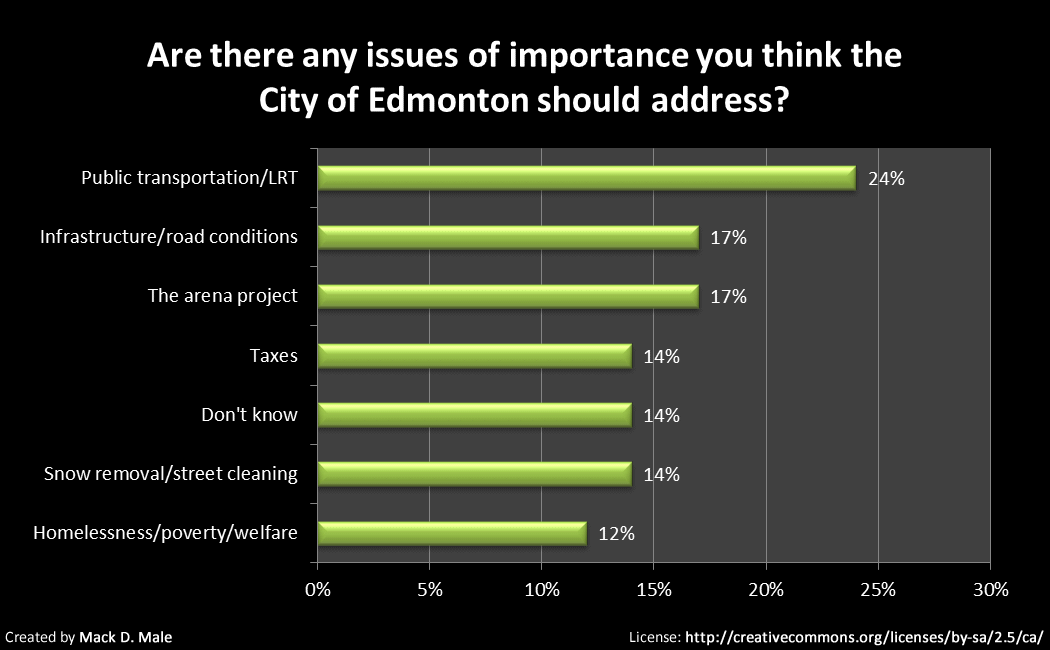
Edmontonians rank public transportation as the City’s top priority

If it were up to me, that would be the headline on the front of every newspaper and at the top of every news broadcast in Edmonton today. The result was buried in the middle of a report that goes to Council on Monday on the proposed downtown arena, but that makes it no less significant in my mind.

Edmontonians who participated in a statistically valid phone survey from December 20 to December 23 were asked what the key issues are that the City of Edmonton should address. Public transportation, and specifically LRT, came out on top.

The City is addressing this, of course, with an expansive plan to extend the LRT to all corners of the City. Shifting Edmonton’s Transportation Modes is also one of the goals in the City’s 10-year strategic plan, and public transportation is the key to achieving that. But we have to keep pushing. As the City’s Chief Economist John Rose said:

“[LRT is] the urban equivalent of an enabling technology – if you have it, you can do a lot of great things.”

Public transportation is costly – both to build and to operate. No question about that. But it’s worth it, and more importantly, Edmonton’s future success depends on it.

It’s important to remind ourselves, not to mention City Council, that improved public transportation is what Edmonton needs above all else.

Economics and more with John Rose, the City of Edmonton’s Chief Economist

John Rose moved to Edmonton last May to become the City of Edmonton’s Chief Economist. It’s an important role at the City, though it is one that most people know very little about. I sat down with John last week to chat about his new job and to get his thoughts on Edmonton.

John loved geography when he was younger, and wanted to work in a field where he could apply that passion. He settled on urban planning, but while studying at the University of Toronto, switched to economics. He has been in the field ever since, working for the federal Foreign Affairs department in the 1980s in West Germany and South Korea before returning to Toronto to tackle the consulting business. He most recently worked for PricewaterhouseCoopers.

The move to Edmonton was a unique opportunity for John to combine his interests in urban planning and economics. “I’m interested in what drives the economics of municipalities forward.” He brings an outsider’s perspective to the City of Edmonton, something that initially made him wary. “I thought people would just say ‘here’s another Easterner showing up, telling us what to do’, but people have been very welcoming.”

As the City’s Chief Economist, John is responsible for publishing the reports that the City relies on for budget planning and strategy, among other things. Twice a year he publishes a long-range forecast, using a statistical model of Edmonton’s economy that looks both 3 and 10 years into the future. On a quarterly basis, he publishes City Trends, which provides current information on social, economic, demographic, land development, and transportation trends (here’s the PDF for Q3 2010, the latest to be posted to the website).

The City of Edmonton uses economic models developed by The Centre for Spatial Economics (C4SE). Somewhat surprisingly, Calgary and the Province of Alberta also use models from C4SE. The models can be complex, but John said recent technology improvements are making a difference. “In the 80s, you needed a mainframe to drive even the most simplistic models,” he told me. “Now the tech required is ubiquitous.” While acknowledging that economics is abstract – “you can’t touch the economy” – John said technology is increasingly getting rid of the mystique and mystery.

If you look at the Economic & Demographic section of the City’s website, you’ll find that most of the information is out-of-date. John explained that the transition from his predecessor is the cause, but he said to expect changes. “There’s a lot of value in the information and we want to get it out there, we want it in the public realm.” John noted there currently isn’t a way to notify people when new information is posted, but said an internal effort currently underway should change that. Getting everyone on the same page is a major push for his office this year.

John would also like to see a shift toward more regional forecasting. He works with a variety of organizations outside the City of course, including EEDC, the Chamber of Commerce, and the Finance department at the Province, but sees room for improvement. “We already do regional forecasting to a degree, because we do the CMA and extract a forecast for the City from that.” John noted that most statistics are available at the Census Metropolitan Area (CMA) level, and so it makes sense to look regionally when setting up models. “With a larger economic entity, the trends smooth out a little.” John suggested the Capital Region Board might be the logical place to host a regional forecasting effort.

Speaking of the capital region, John said that while 2011 will be a strong year for Edmonton, “most of the growth will take place outside the City of Edmonton proper.” This is partly because the City itself didn’t suffer as large a setback as a result of the recent downturn. “The manufacturing sector took a big hit in Alberta and Edmonton,” a sector largely concentrated outside the city, such as in the northeast. In a recent interview with the Edmonton Journal, John said we should see an annual growth rate of nearly 4% here in Edmonton.

He was also bullish on the province. “Alberta will be ahead of the national economy as a whole in 2011,” John told me. Again, this is due in part to the way the economic slump affected the province. “The impression is that Canada came through it very well, but the truth is the province didn’t.” In 2011, John expects Alberta to post the first or second best provincial growth rate in the country, depending on how Saskatchewan does.

Turning to individual sectors in the City, John told me that construction will show growth, but mostly due to commercial projects. The residential construction sector will be somewhat sluggish because “there’s just not a big demand for a lot of new housing.” FIRE will do well, but John cautions that increased regulation will have an impact. The retail sector will also grow more slowly this year, because people are reluctant to take on more debt and as as a result savings rates are going up. “The consumer-oriented durable component in particular” will grow slowly according to John, because as people buy fewer houses, the need for new vehicles, furniture, appliances, etc. also diminishes.

John talks about trends and forecasts all the time – he has made it part of his job to do interviews, meet people, and spread the word on Edmonton’s economy. He can rattle the numbers off with ease, and is obviously very knowledgeable. As our discussion shifted toward the city more generally, John became more thoughtful. We talked about the common refrain that Edmonton’s head office situation is dismal at best, and John pointed out that the larger question is how to “attract and retain investment, and talent.” He said we should do “exit interviews” with organizations that leave the City, to try to highlight any cross-cutting themes.

I asked John about the push to revitalize downtown, and in particular, about the City Centre Airport and the proposed arena. He called the ECCA redevelopment a “good move” by the City, because making such a large piece of land adjacent to the core largely residential will have a positive impact on our downtown. “The key to developing a vibrant downtown, is to have people living, working, being entertained, doing all those things, in the core.” He doesn’t think a blanket policy on financial incentives (such as the Railtown subsidy) to attract more residents to downtown makes sense, however. “If there’s an area that we want developed in a particular way, then the City could be come active, but otherwise there’s enough opportunity already.” John didn’t take a side on the arena, but said “it depends on how the development takes place” and said his main concern is that “we don’t want to be in a situation of two competing facilities.” He cited the Air Canada Centre in Toronto and the positive changes and increased activity it brought to the area south of Front Street. “It is very nicely integrated into the city.”

I asked John what he missed about Toronto, and he quickly replied “jazz clubs.” He said while the Yardbird Suite is great, there was more variety with regard to venues back in Toronto. John joked that by moving away from Toronto when he did, he avoided the current political drama that is taking place with new mayor Rob Ford. That led us into a discussion about transit, and LRT in particular, something John considers “the urban equivalent of an enabling technology – if you have it, you can do a lot of great things.” Projects such as the LRT expansion “are a big benefit to the local economy” in the short-term and are “vital for the City’s future,” John told me. The real value to the economy is what the LRT enables, rather than the jobs it directly creates. “If you don’t have mass transit downtown, you’re going to have a hard time developing nightlife, for instance.”

I really enjoyed talking with John (and not just because when I asked him if he was now an Oilers fan he replied, “that implies I was a Maple Leafs fan before!”). Stay tuned to his section of the City’s website for future economic updates.

Looking back on 35 years at the City of Edmonton with Joyce Tustian

In November, Joyce Tustian celebrated her 35th year as a City of Edmonton employee. She currently holds the position of Deputy City Manager (archive), an office that was created around her in April 2008. Last month, it was announced that Joyce would be retiring at the end of January, with most of the DCMO’s responsibilities folding back into the City Manager’s office. I sat down with Joyce just before Christmas to reflect on her time at the City of Edmonton.

When Joyce started at the City of Edmonton, she planned to work for just two years. “I had a big misconception about what the City would be like.” Like most people, she figured it would be dry and very rule-bound, but actually found that the City offered tons of opportunity. “You can do many things with the same employer,” she told me. I wonder if anyone at the City has done as many things as Joyce has! When I asked her what areas of the City she had worked in, she replied “everything but transportation and buildings.” Joyce told me she has always been interested in transit, though she has never really worked with the department. She noted that transit really impacts families and is “so integral to the kind of city you want to build.”

Joyce Tustian

Joyce started her career at the City of Edmonton in 1975, working as a public information officer in the Parks & Recreation department. On her first day, thousands of Edmontonians were streaming through City Hall to pay their respects to former Mayor William Hawrelak, who had recently died of a heart attack. Over the years she worked her way into management, and in May 1995, Joyce took over as the general manager of Community & Family Services. Just a couple of years later, it was decided that Joyce would take over as general manager of the newly formed Community Services department (her main rival for the position was another longtime City employee, Maria David-Evans, who left after the restructuring). During her time in that role, Joyce was also responsible for the Emergency Response department. After a nationwide search in 2003 to find a new general manager for Corporate Services, Joyce was selected. While in that role, Joyce led the department through the “Shared Services Business Model” review. She held the position for five years, until the Deputy City Manager’s Office was formed in 2008 (two other roles were created at the same time – Chief Financial Officer, and General Manager of Capital Construction).

Joyce has had the opportunity to lead some really interesting projects at the City of Edmonton. In 1999, when she was acting general manager of the Emergency Response department, Joyce was tasked with making sure the City survived Y2K. It was her responsibility to outline the City’s plans in case things went south. “We believe that we are ready,” she assured everyone.

Another project she spearheaded was Racism Free Edmonton. As Deputy City Manager, Joyce is responsible for the implementation of the City’s Diversity and Inclusion Policy. “I take great pride in championing the Racism Free Edmonton initiative,” she declares on the website.

Perhaps the project Joyce is best known for was the merger of Community & Family Services and Parks & Recreation to create the Community Services department in 1997. It was part of then-city manager Bruce Thom’s reorganization plan that trimmed the number of City departments from thirteen to eight. When she was interviewed about leading the new department, Joyce told the Edmonton Journal, “my bottom line is I want to make it easier for citizens to access city services without having to know the city as well as I do.” Looking back on the merger, Joyce told me it was “a really rare opportunity,” to get to set things up the way you want to. She considers it a big success, noting that many other cities have since followed Edmonton’s model.

More recently, Joyce led the web renewal and was the project sponsor for the 311 initiative. Both projects “were about transparency and ease of accessibility.” When I mentioned some of the criticism that 311 has received, Joyce acknowledged that “more needs to move to 311 and then to the web” but is confident the initiative is “past the struggles.” For Joyce, 311 is the first major citizen-facing outcome of the investment the City has made in automation (ERP systems, etc).

The behind-the-scenes automation is just one part of a larger journey the City has embarked on. Joyce described it as “moving from an organizational structure that works well for us to one that works well for citizens.” The ability to have standardization, and to break down hierarchies, will help the City make it easier for citizens to access services and information. We touched on open data, and noting that automation should help make it possible, Joyce said there’s “very little that we do that shouldn’t be accessible to the public.”

Another big, related change has been the shift away from independent units and into one organization (something that increased automation has helped make possible). Joyce said Edmonton has been considered a “municipal leader in shared services.” Though the shift had already started, a major reorganization in 1987 “really paved the way.” Subsequent reorganizations have pushed the City further toward the “one organization” vision, though Joyce made it clear that the City is “still very much on the path”.

Perhaps the biggest change has been the focus on strategy (a word that many City of Edmonton employees have come to associate with Joyce). As soon as we started talking about strategy, Joyce said “if you don’t know where you’re going, any road will get you there.” I suspect she’s fond of that statement. Joyce told me her recent work on the City’s strategic vision has been one of the most rewarding things she has done. “We have always been good operationally, but now we spend lots of time and energy on strategy.” She talked about the City’s six “Way Ahead” plans, and praised the most recent City Council for having “a willingness to commit.” Joyce also said Mayor Mandel deserves credit for aligning everyone around what kind of City we want to be.

Joyce deserves a lot of credit too. One of the biggest challenges Joyce faced was during her time with the Emergency Response department. She was only supposed to work with the department for a short time, but was “never afraid to work on the fundamental issues.” And so she did. The department was losing a lot of people to retirement, and was having difficulty recruiting. Joyce recognized that the problems had been predictable, and set about implementing a plan focused on data, intelligence, and strategy. She has been able to make this work throughout her career.

Public involvement is something that the City needs to work on, Joyce told me. She recognizes that there are lots of Edmontonians with great ideas, and agreed that “we need to get better at engaging those people.” Looking at the City Centre Airport and the public hearings that took place, Joyce noted there were at least three conversations taking place, “at the mic, in the room, and outside,” but that the City hasn’t traditionally done a good job of recognizing the latter. There’s lots of room to improve.

I asked Joyce about the people she’s worked with during her time at the City. She thought about it for a minute, and realized that there have been so many people that she’s interacted with over the years. The one who had the biggest impact, however, was Cy Armstrong. “If I had any doubt about something, I’d talk to Cy.” He was city manager in the mid-1980s, actually the first city manager we had after then Mayor Laurence Decore dismantled the council-commission government. According to the book Alberta’s Local Governments: Politics and Democracy, Armstrong was for a time the most highly paid city manager in Canada, earning an annual salary of $120,000. “Much of what I am as a manager was shaped by Cy,” Joyce told me.

Joyce told me it’s an exciting time to be a civil servant (she has enjoyed being part of the iPad pilot project). “You can see the impact you have, you’re doing real work.” She described the City as an organization where you’re very close to decision makers, and obviously one that is “never dull.” Joyce also noted the strong sense of community at the City. For example, Joyce and many other employees have made it a tradition to start the day by singing carols for the five days leading up to Christmas! “Working for the City has been the making of many people – it has certainly been the making of me.”

Joyce will continue in her role until the end of the month, and though she’ll move onto other things, she’s staying here in Edmonton. “I won’t miss budget time,” she told me, but will miss “feeling connected and always having something new” come across her desk (she recalled opening the letter from Telus that said how much they’d pay for Ed Tel).

Joyce has definitely left her mark on the City of Edmonton, and I want to both thank her for her service, and wish her all the best in her future endeavors!

Looking back at the Transforming Edmonton blog’s first year

A little over a year ago, the City of Edmonton launched its official blog, called Transforming Edmonton. Though it launched as a pilot project, the blog was meant to be another vehicle for the City to “share stories about how the City is working on transforming itself.” It remains focused on the City’s Vision and Strategic Plan, with sections on Economic Diversity, Environment, Financial Sustainability, Livability, Transportation, and Urban Form. How successful has the City of Edmonton’s foray into the world of blogging been? Let’s look back at the blog’s first year.

Let me start by saying that any blog that has made it past three months and is still updated somewhat regularly can probably be described as a success! Blogging takes commitment, so I applaud the City for sticking with it. Jas Darrah, Communications Business Partner at the City of Edmonton, was nice enough to answer my questions about the blog’s first year.

Over the last year, a total of 87 entries were posted to the blog. That’s not far off from the original goal of two new posts per category per month (which would have resulted in 144 posts). Though there are approximately 40 registered authors in the system, Jas clarified that in reality up to 100 people have collaborated on the resulting posts, as Public Information Officers and subject matter experts have worked together to craft the content. Initially, a lot of effort went into recruiting City employees to contribute to the blog, but that has become less necessary according to Jas. “The desire to participate from business units across the organization grows weekly, while in the first months we were beating the bushes to get participation.”

The blog has averaged 2400 page views per month over the year, which is respectable but quite a bit less than I expected. Of course, page views are just one piece of the puzzle. There’s also RSS feed readers (that’s how I read the blog), people who read the entries on Facebook, or who see the entries on YouTube, etc. And keeping in mind the City’s goals for the blog, engagement is a better metric than traffic statistics anyway. Slowly but surely, they’re having some success in that area. The blog has received 157 comments over the year, primarily on the two most successful posts: Bob Boutilier’s Q&A post on The Way We Move, and Phil Sande’s Q&A post on the City Centre Redevelopment Project. Jas says we’ll see more of those kinds of posts in the future.

Jas told me the blog is still being classified as a pilot, because the City is still gathering information to help evaluate it. I don’t think the public perceives it as a pilot however, and it sounds like City employees are happy for the blog to continue as well. Jas said the City’s “communications teams now see this as another vehicle to offer the City business units to reach out to the community, while offering ways to experiment with multimedia.” Many posts recently have included video and photos, such as the series on the Heads Up! campaign. While it may be just another tool in the communications arsenal, Jas confirmed the blog is “one of the most cost-effective tools in our toolkit.”

I’m a big fan of the Transforming Edmonton blog, and I’ve mentioned it numerous times in social media presentations over the last year. The design is clean, and I particularly like the simple Comment & Trackback Policy, accessible on every page. Jas said he’d regard the project as a success, even though there is still a lot of work to be done.

Raffaella Loro (the blog’s primary instigator) told me before the launch last November that she saw the blog as “encouraging a cultural shift” in the way the City operates. A year later, I think that is happening. Jas noted that “our City leadership saw that any negative comments that this project may facilitate would be outweighed by the positive reputation for facilitating those comments.” City employees like the blog as a way to share information, and according to Jas, many thought the blog was only internal when it launched! He told me the City will be launching its first internal blog in January.

I’d say the Transforming Edmonton blog has had a successful first year. There’s lots of room to grow and improve, but there’s now a strong foundation in place. I look forward to seeing it evolve.

A follow-up thought: I think the blog can become an important archive of the City’s perspectives over time. In the spirit of digital archiving, here’s what the blog looked like as of December 6.

A closer look at the City of Edmonton’s Downtown Arena Questionnaire

The City’s online questionnaire for the proposed downtown arena has received quite a lot of criticism, especially online. Twitter users have not been shy about calling it “leading” and questioning its intent. And that criticism has come up in face-to-face conversations I’ve had with people at arena consultation sessions and other events as well.

At the consultation sessions, officials have made it very clear that the questionnaire is meant simply to gather feedback, and is not intended to be a statistically valid survey. It feels like a survey though, so it’s no surprise that people treat it that way.

The introduction of the questionnaire reads:

This questionnaire is one of several methods being used to gather thoughts and concerns about a proposed downtown sports and entertainment facility. The feedback received will be provided to City Council to assist in their decision-making.

And it explicitly asks that you only fill it out once, though technically there’s nothing stopping you from filling it out dozens of times. There’s also no way to ensure that only people who live in Edmonton fill out the questionnaire.

Proposed Downtown Arena Consultation

I emailed the City with some questions on the survey, and they wrote back with detailed responses.

Was the questionnaire written by City staff? Calder Bateman staff?

A team worked on the online questionnaire. It was one of the early elements developed to support public input and was meant to be a quick and convenient way people could share their thoughts. It was never intended and not designed as a statistically valid, formal survey – but a technology-based tool for use by those who might not make the open houses in person. It means we will have a richer range of input to report on.

While other elements of the open house and discussion forums have evolved based on the input and suggestions we’ve received, we didn’t feel it appropriate to adjust the online questionnaire – so it has remained consistent with what was originally posted.

How many entries have you received to-date?

As of 4:00 p.m. Nov 9 we had 17,030 directly through the online questionnaire plus another 60 from those who called 311. We’re pleased with these results. It’s likely that people are seeing the online questionnaire as an option to attendance at the open house.

Any indication of how many received entries are duplicates?

No. At this point, we haven’t done an analysis on the questionnaire submissions. We really need to wait until the entire process concludes to get the full picture. There are a number of ways people are providing input including email, sticky notes, completion of the discussion feedback forms and the questionnaires. The inputs from all areas will be consolidated into the final report.

Are there any plans for a follow-up questionnaire later in the process?

There will be other opportunities for public involvement and input throughout the process, and another questionnaire might well be an option.

Are there any plans for a statistically valid survey?

We realize the online questionnaire only reflects the opinion of the people who complete it – it is not a representative analysis of what the population of Edmonton might think. The City will be very clear when presenting the results to ensure they are not considered a statistically valid sample of opinion.

A statistically valid survey continues to be a possibility. Our focus right now is on the current suite of public involvement opportunities.

I also asked my colleague Greg Pope, Analytics & Psychometrics Manager for Questionmark, for his thoughts and feedback on the questionnaire. He suggested this best practice guide (PDF) for good survey design as a starting point. Here are some of the comments & suggestions he had:

  • The current 1-5 “definitely” likert scale is unclear (no label for 2,3,4). Greg suggested an even number of choices (1-4) so that there is no “maybe” or “unsure” category.
  • “A rule of thumb is to try and keep all the questions on the same scale with the same values, so converting all questions to statements with a 4 point agreement scale would work well.”
  • “Another rule of thumb is to phrase the questions all the same way. It is not leading or misleading to ask “I want a new downtown arena built in Edmonton.” Because you are asking whether they agree or not with the statement. “
  • If the responses were going to be analyzed in any way, Greg said he would have asked some demographic questions. As a simple questionnaire, that’s probably not as important.
  • Another suggestion Greg had was to combine the open-ended fields into one at the end, to make it quicker to complete the questionnaire. He said there’s often sorting that has to happen anyway.

Good feedback to keep in mind if a survey is created in the future. Thanks to both Greg and the City of Edmonton for helping me out with this.

I think there are two key takeaways here. First, the online questionnaire is not a survey. Second, the City of Edmonton is consistent in treating the questionnaire as just another way for people to provide input. If you think the questions are leading, don’t fill it out. There’s nothing stopping you from emailing the City with your thoughts or calling 311. And if you can, attend one of the public consultation sessions.