Rethinking Public Involvement #1

How can we get more Edmontonians involved in municipal issues? How can the City improve the way it informs and involves the public? This is the first in a series of posts on that topic.

I have been thinking extensively about Public Involvement lately (the City’s official term for public consultation, community engagement, stakeholder participation, etc). I try to keep on top of the various public involvement opportunities that are running at any given time, and have completed my share of surveys, feedback forms, and have attended many open houses and other events. It’s important to me to remain informed, but also to be able to provide input on issues that I care about. I feel a responsibility as a citizen to take some initiative and to get involved.

In the past I have been critical of the City’s public involvement efforts, and I still think there’s a lot of room for improvement. The Public Involvement Handbook (PDF) could do with an update – it was last modified in 2008. Improved consistency with vocabulary would make a huge difference – right now “open house”, “public consultation”, “information session”, and other terms are used interchangeably. A new or improved online consultation manager would also be positive – it lacks many of the features that would make public involvement easier to follow, such as iCal or email subscriptions/notifications. Those are all minor suggestions though, and I think the City needs to make more fundamental changes to really move the needle on this issue.

“What’s the purpose?”

I don’t think the answer to this should be “to inform citizens” nor do I think it should be “to gather input”. I think the purpose should really be tied to the project outcome. Are we building a bridge? Then the purpose of the public involvement is to build the best bridge possible. Informing citizens about the project and gathering input are two of the ways we’re going to achieve that.

I think this approach to defining the purpose scales up to the City level too. Why does the City conduct public involvement? To make Edmonton the best place to live, work, learn, and play.

“What’s the context?”

In my experience, this is missing from nearly every single public involvement opportunity the City conducts. Take a public involvement event focused on the Downtown LRT Connector, for instance. It will have all sorts of information about the Connector itself, and maybe even a little about the larger LRT Network Plan, but very little if anything about other projects related to or happening around the Connector. Nor will it include any history about projects that have happened in the past. There’s no context! I know that focusing the public involvement activity is important, but citizens need to be able to understand where the project fits into the grand scheme of things and why it matters.

“What have I missed?”

For most projects, public involvement activities take place over months or years. That means that citizens may be coming into them at different points and with varying levels of knowledge/experience. Despite this, I find that most public involvement activities make it difficult for citizens to get involved later in the process because there are a lot of assumptions made about what has already happened. Some work has been done recently to address this – I like the timeline graphic the Transportation folks use:

Project Lifecycle

This makes it easy to think about the status, where are we in the timeline, but it still doesn’t help a citizen who wants to get involved at the Design phase understand what has already happened and how they can best dive in. In addition to clearly identifying “where we are” there needs to be a way for citizens to quickly find out “what you missed”.

While there are many improvements that could be made to the way the City conducts its public involvement activities, I think addressing these three fundamental questions would make a big difference. I don’t think we should throw out what already exists either, because there’s a lot of solid foundational work there, but I do think we can and should work to make it better.

Should MSI funding be used for Edmonton’s downtown arena?

Even if you’re optimistic and think the Katz Group and the City can resolve their current differences, let’s not forget that the arena project is short at least $100 million. Under the current agreement, that amount is slated to come from “other orders of government” such as the province. Over the last year or so, various ministers have stated that the province will not be providing any new funding for the arena. In May, Municipal Affairs Minister Doug Griffiths said:

“The province is not going to write a separate cheque for a particular project. We provide MSI funding for every municipality in the province, which is $896 million this year. We have proposed that’s going to increase. The reason why we do so is municipalities can choose what their priorities are.”

While the downtown arena project would certainly be eligible under the Municipal Sustainability Initiative (MSI), I have long wondered if it would really make sense to use our limited funding for that purpose. How much MSI funding do we have? What have we already spent? Can we really count on an increase? These are some of the question I’ll explore below.

What is the Municipal Sustainability Initiative (MSI)?

MSI is a way for the province to provide cities, towns, and other municipalities in the province with funding for infrastructure projects. From the MSI website:

In 2007, the $11.3 billion MSI program was announced to provide predictable, sustainable funding for our province’s municipal infrastructure projects to keep our municipalities strong.

The objectives of the program are:

  • To work in partnership with municipalities to manage growth pressures;
  • To provide municipalities with sustainable funding; and
  • To support infrastructure needs.

All eligible municipalities in the province receive an amount each year that is calculated based on the following formula:

  • 48% is allocated on a per capita basis;
  • 48% is allocated based on education property tax requisitions;
  • 4% is allocated based on kilometers of local roads.

A wide range of municipal projects are eligible for MSI funding, which means that each municipality can decide where the money is best spent.

How much MSI funding will the City of Edmonton receive?

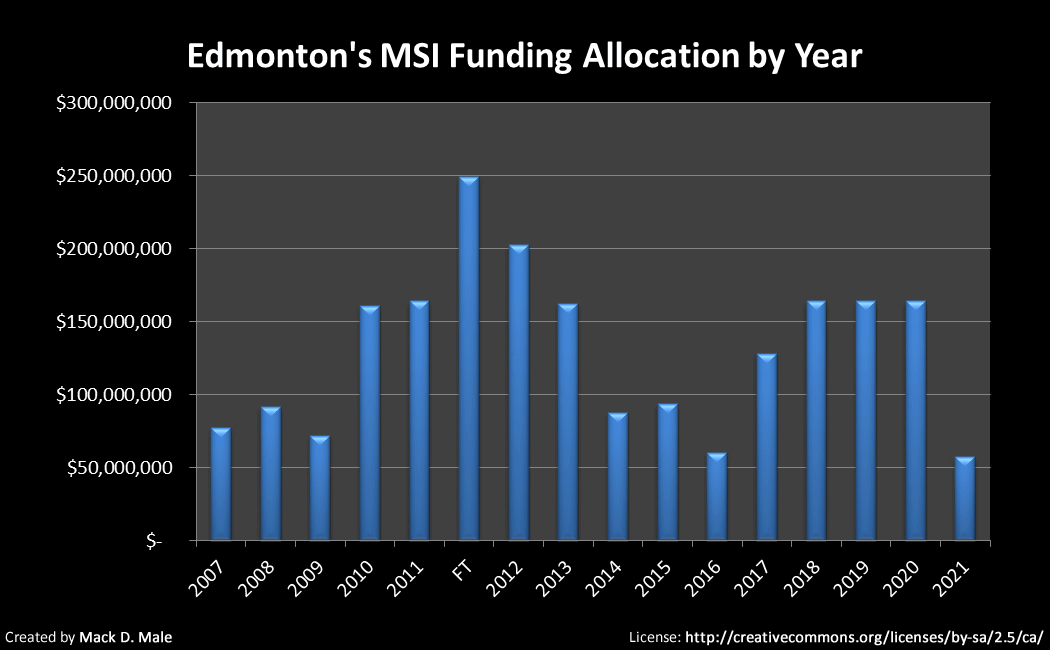
Edmonton is slated to receive a total of $2.1 billion by the end of 2021. From 2007 through 2011, we received about $567 million. In order to take advantage of favorable economic conditions, Council also decided to fast-track another $250 million or so, which means we have used roughly $850 million in MSI funding already. This chart shows the amount of funding per year (with FT designating the fast-tracked amount):

That means we have roughly $1.3 billion still to come over the next ten years. The projected amounts for 2012-2021 take into consideration repayments on the fast-tracked amount. The City’s fast-tracking strategy requires an annual repayment of $57 million, including interest for five years, reducing the amount of MSI available in 2012-2016 by $285 million.

What have we spent our funding on so far?

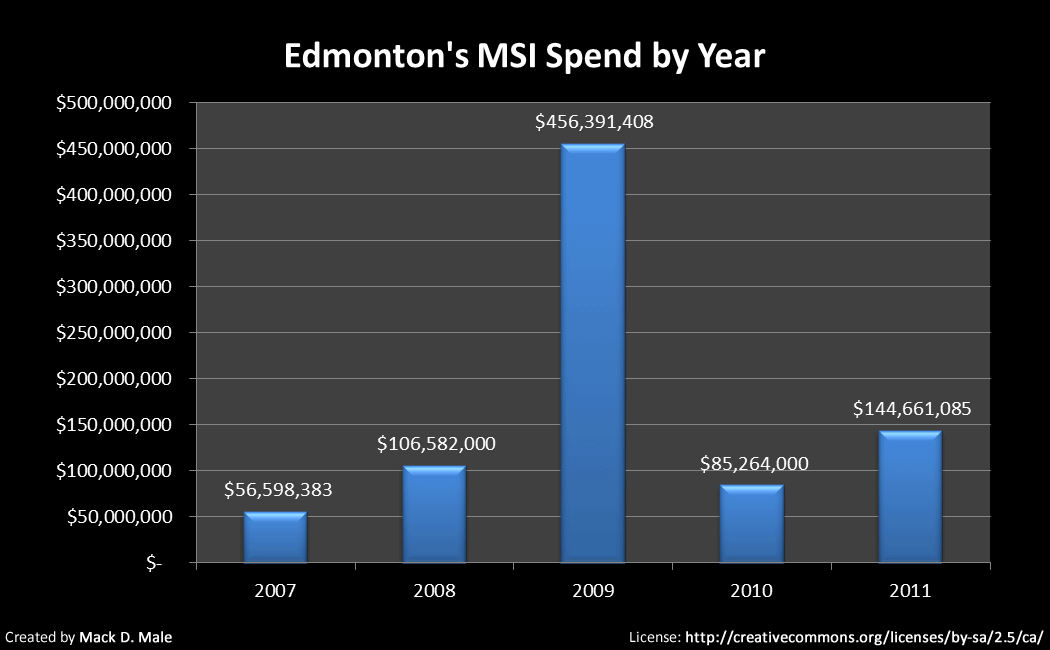
The MSI website provides a list of accepted projects by year for each municipality in PDF. I extracted the data for Edmonton, and organized it in a spreadsheet. Based on the description, I categorized each project as either “new” or “existing” to indicate whether it was for a new asset or to rehabilitate/upgrade/repair an existing one. I also assigned each project a category such as “Parks” or “Transit”. Here’s what we have spent per year:

The total spent is roughly $850 million. The big jump in 2009 was the fast-tracked funding, which allowed us to take advantage of lower construction costs.

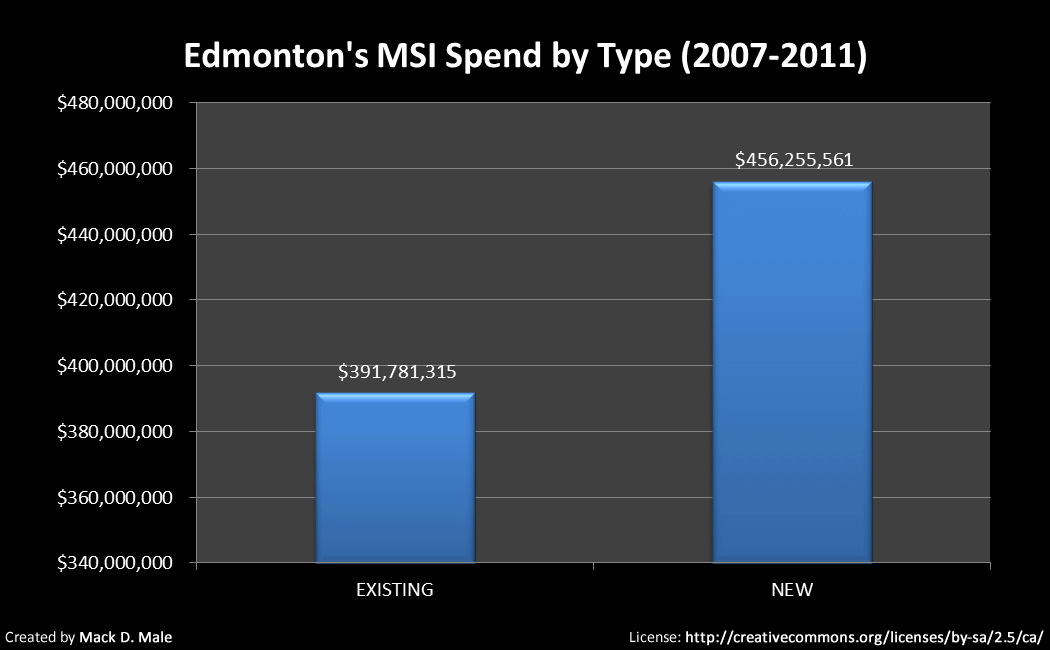
Here’s the breakdown of new vs. existing:

As you can see, roughly 53% of our MSI funding has been spent on “new” projects.

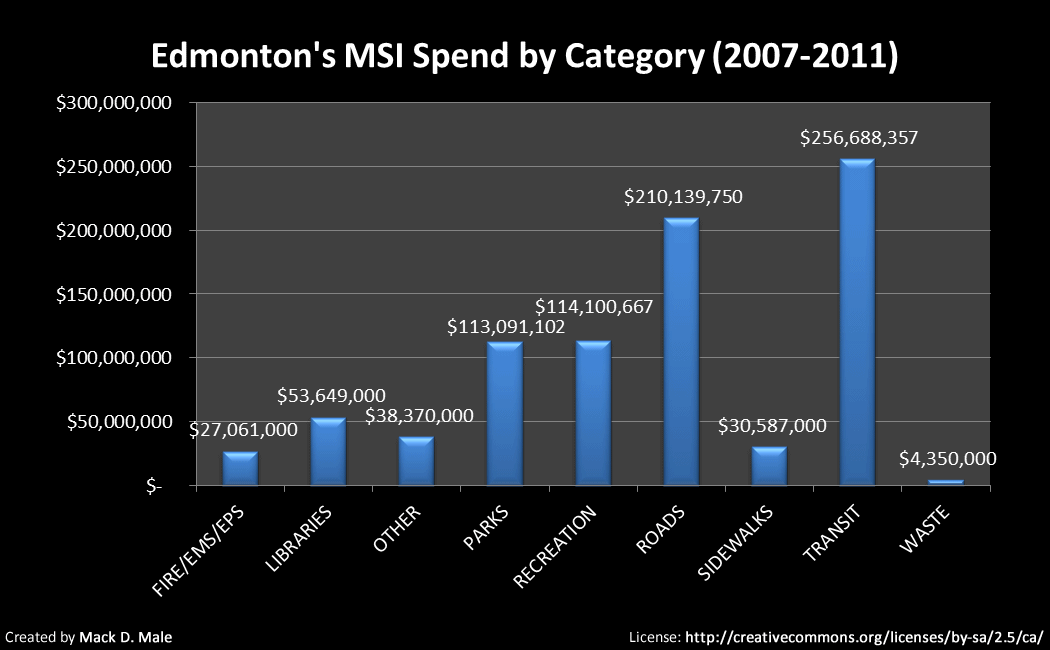
Here’s the breakdown by category:

The bulk of our MSI funding has been spent on transit and roads. Parks and recreation facilities are the only other two categories that have received more than $100 million in funding.

A total of 82 capital projects were listed, with an average project cost of $9.9 million. No project has cost more than $100 million. The largest project we have constructed so far was the new Centennial Garage in southwest Edmonton, which had a total project cost of $99 million ($89.3 million of which came from MSI). It would be fair to call that project an anomaly however – only one other project, to rehabilitate several roads for $61 million, came with a price tag greater than $40 million.

Can we count on an MSI increase in the future?

MSI funding has always been tied to the economy. The amount allocated to municipalities over the first five years of the program was reduced due to weaker than anticipated revenues. The City of Edmonton had expected to receive $802 million over the 2007-2011 period, about $235 million more than the $567 million it ended up receiving. That does not bode well for an increase in the future.

Both Calgary and Edmonton have been pushing for an improved funding framework with the commitment to develop a big city charter. The outcome of that initiative, slated to be considered by the Legislature in the spring, could impact the way Edmonton receives funding from the province.

Should we use MSI funding for the arena?

According to the City, the average age of Edmonton’s infrastructure assets is 30 years. At the end of 2011, more than 150 neighbourhoods required renewal. An average annual reinvestment of $400 million over the next three years, plus an average annual reinvestment of $450 million over the 2015-2021 period, is the minimum amount of funding required to renew Edmonton’s existing infrastructure to achieve a reasonable state of repair. This is a big challenge, and MSI funding provides only a piece of the pie.

As shown above, our MSI spend has been more or less equally split between new projects and upgrades or rehabilitation of existing assets. A total of $87.5 million was spent on seven new recreation facilities (either brand new, or additions to existing) from 2007 through 2011. Would we have rather spent all of that on the arena? A number of new projects would need to be postponed if funding was allocated instead to the arena. A total of $384.8 million was approved by Council for recreation and cultural projects in the 2012-2014 Capital Budget.

In a poll earlier this year, two-thirds of Edmontonians opposed provincial funding going toward the new arena. An equal number supported fast-tracking the southeast LRT line to Mill Woods. It would seem that the use of MSI funding thus far more or less aligns with the desires of Edmontonians, with the largest share going toward transit projects (though not all of that was LRT-related).

This decision would ultimately need to be made by City Council, and as we approach an election next year, I’m not sure many councillors would be willing to take money away from important neighbourhood renewal projects or new facilities like libraries and parks for the arena.

The Past, Present, and Future of Food Truck Bylaws & Guidelines in Edmonton

Well it was bound to happen sooner or later – Edmonton has joined the long list of cities that have had disputes between restaurants and food trucks. As you’ve probably heard, Grandma Lee’s in Petroleum Plaza has complained about Drift, one of our city’s most popular food trucks. It’s an attractive media story as we head into summer and that has contributed to the issue becoming a bigger deal than is necessary. On the plus side, the situation has highlighted the need for a review of the Street Vending Program.

Truck Stop in Old Strathcona

I have been learning about and researching the bylaws and guidelines and how everything works for quite a while now, and this seems like a good opportunity to share what I know!

Why are food trucks allowed in Edmonton?

The Traffic Safety Act (TSA) sets out the basic rules for streets in our province. Among other things, the act outlines how the Alberta Transportation Safety Board should work, the rules for operator’s licenses and vehicle registrations, speed limits and other rules of the road, and the powers of municipalities with respect to streets. Specifically, section 13(1) states that municipalities can pass bylaws that govern the use of highways under its direction, provided they are not inconsistent with the TSA. Here in Edmonton that is bylaw 5590 (Traffic Bylaw, PDF) and in Calgary, that is 26M96 (Traffic Bylaw) and 20M88 (Street Bylaw).

A useful way to think about it is this: All streets in Alberta are governed by the basic rules set forward by the province. In cities like Edmonton and Calgary, bylaws enable each municipality to manage its own streets, building on top of those basic province-wide rules.

In Calgary, the Street Bylaw states in section 5(a) that you cannot sell things on streets. Section 5(b) outlines some exceptions to this, including pushcarts and ice cream trucks, but does not specifically mention food trucks. In Edmonton, section 67 is far less specific, and simply states that you must have a permit in order to sell goods and services. It also grants authority to the City Manager to basically bring the bylaws to life through policies, procedures, guidelines, and enforcement.

That’s why Edmonton has been allowed to have food trucks – our Traffic Bylaw enables permits for selling goods and services on city streets, and it does not specify any restrictions as to what those goods and/or services might be. As long as you have a valid permit, you’re good to go. In Calgary, you’d need to get a letter from the Director of Roads unless you fall under one of the allowed exceptions. Obviously that’s not a very scalable solution, hence the pilot that is underway in Calgary.

How does the City of Edmonton manage food trucks?

Nearly thirty years ago the Street Vending Program was created. According to a City report from 2005, it “was initiated by City Council to aid in the revitalization and enrichment of the downtown core.” Parks & Recreation was originally responsible for the program, though it has also called Community Services home. Currently responsibility falls to Sustainable Development.

The program today consists of the coordinator, the application forms, and the guidelines. You can download the latest package here. If you look at the package, you’ll find that the Street Vending Program deals with all kinds of vendors, not just food trucks. Hotdog carts, ice cream trucks, and any other vendor wanting to sell things on city streets must have four things: a business license (specifically a Travelling or Temporary Food Sales license), a health permit, a minimum of $2 million general liability insurance, and a vending permit. In order to get a vending permit, you need to talk to the Street Vending Coordinator and you need to follow the guidelines. There are slightly different guidelines for sidewalk vendors as opposed to street vendors, and altogether different guidelines for ice cream trucks.

Until very recently, the coordinator was a seasonal position, which means that throughout most of the winter there was no staff person at the City working on street vending. That meant that there was limited time to make improvements to the guidelines or changes to the program, which is part of the reason why they have remained largely the same for years.

What are the guidelines for food trucks in Edmonton?

There are a number of guidelines that apply to all kinds of vendors. For example, vendors are only allowed to operate from 7am until 11pm. Permits apply to a single location only – if you want multiple locations, you need to have multiple permits. Vendors must adhere to a code of conduct and “conduct themselves in a professional manner”. Vending units must not be left unattended, vendors cannot sell illegal or counterfeit products, etc.

In addition to the general street vending guidelines, there are roughly fifteen bullet points under the section for street vendors. Most of these are fairly straightforward, including things like “all existing parking restrictions apply” and “overhead canopies or vertically operating doors must not obstruct or hinder safe pedestrian traffic”. I encourage you to read the document for yourself as it isn’t very long. I’ll highlight the two points that deal with disputes between existing businesses and vendors:

  • Permission will not be granted to Vendors where a conflict with an existing business is evident.
  • Where a conflict arises with an existing business, the Sustainable Development Department reserves the right to relocate the contentious Vendor.

Nowhere else in the guidelines does the topic of conflicts come up. There is no section on how such complaints are handled, nor is there any information on how to appeal a complaint. Under the current guidelines, if you’re a vendor that someone has complained about, you’re automatically labeled “contentious” and there’s not much you can do about it. There are no rules to fall back on, and there is no process to follow to try to resolve the issue.

When was the Street Vending Program last reviewed and updated?

While minor modifications have been made over the years, mostly with respect to title and department name changes but also fees, the current street vending guidelines are largely the same as they were in 2005 (the oldest copy I was able to find). And according to a report from that year, the “program has not had an Administrative or City Council initiated review”. In other words, they haven’t been formally reviewed since they were created!

That report came about because then-Councillor Michael Phair received a complaint about street vending and “especially concerning vendors that sell food” so he made an inquiry to Administration. They brought a report back to the Community Services Committee on September 1, which outlined how the program operates. The committee voted to have Administration bring back a second report comparing the program with “best practices in cities such as Toronto, Montreal, and Vancouver.” That report came back on November 4 and outlined some of the things other cities do with respect to street vending. Here are the two key points from that report:

“Community Services Department surveyed service providers directly and asked a series of questions via telephone with counterparts from Montreal, Ottawa, Toronto, New York, Winnipeg, Regina, Calgary, Vancouver, Victoria and Seattle.”

“After looking at the street vending practices for ten municipalities, it is concluded that Edmonton’s program equals or exceeds that of the other municipalities.”

As a result no further action was taken, and the program has continued the same way ever since.

Why should the guidelines be reviewed and updated now?

Put simply, a lot has changed in the last thirty years since the Street Vending Program was created! Especially in the last five years, interest in food trucks has exploded across North America and expectations about how such businesses operate has changed very quickly. In 2005, the program had about 40 vendors in total. This year, there are 55 vendors (that number includes food trucks, ice cream trucks, carts, and all other sidewalk vendors). That’s not a large jump, but we are seeing new food trucks joining the fray and I expect that trend will continue.

More important than the quantity of vendors is the type of vendor. Back in 2005, we didn’t really have curbside food trucks like Drift. Now we do, and we should expect more! I think there are significant differences between a sidewalk vendor and a food truck, yet the guidelines for the most part don’t reflect that. Whereas it might make sense to restrict a sidewalk vendor’s permit to a single location, the whole point of a food truck is that it is mobile and can move around.

The food trucks of today are serving a completely different kind of product than mobile carts have in the past, and that has an impact on the program too. Sandwiches from Drift are certainly competition for brick-and-mortar restaurants, so it’s no surprise that some disputes will arise. The current street vending program does not outline any process for dealing with such disputes.

The opportunity to realize Council’s original vision for the Street Vending Program – “to aid in the revitalization and enrichment of the downtown core” – has never been stronger than it is today. If we want food trucks to be viable and sustainable into the future, we need to update the program.

What changes should be made?

This is a topic that will need further discussion, but we could do a lot worse than to look to Calgary for guidance. Because their pilot program is so new, they have been able to capture many of the key points that differentiate food trucks from other vendors and those are reflected in the program’s guidelines.

Note that we don’t need to change our bylaws, just the Street Vending Program. Changing the bylaws is a much more difficult process that would require approval by City Council. Changing the Street Vending Program can be much simpler. Remember it’s the bylaws that make food trucks possible but it’s the Street Vending Program that outlines how food trucks are managed and should operate.

Here are some ideas for positive changes to Edmonton’s Street Vending Program:

  • Grant food trucks a permit that applies to multiple locations or a large area, rather than requiring one permit per location. In Calgary they have the concept of “roll zones” and “no-roll zones” which outline where the trucks can and cannot go.
  • Bring the cost of the permit in line with other cities. In Calgary, food trucks pay a flat fee of $700 per year that is not dependent on actual street usage.
  • Make it easier for trucks to serve in the evening. This could be accomplished by establishing some sort of evening roaming rules, by extending the valid operating times past 11pm, or both. In Calgary, food trucks may operate until 3am.
  • Get rid of the restriction that only one truck may operate on a street at a time. We know that food trucks are often more successful when there are many together than when they are going solo, as long as they are complementary, and we know that food truck operators all talk and already team up from time to time!
  • Clearly outline where food trucks are allow to operate. Calgary’s guidelines clearly state that food trucks cannot operate within 25 metres of any restaurant during its operational hours. (Note: Drift is a lot further from Grandma Lee’s than 25 metres!)
  • Outline a process for dealing with complaints. Food trucks need to have some certainty about their business, and if the processes by which they may be asked to move is completely opaque, it’s hard to have that certainty.
  • Revamp the evaluation process for issuing permits. The current “process” is highly subjective and often relies upon the food truck’s relationship with the street vending coordinator. That leads to inconsistent treatment of food trucks, and in some cases, inconsistent fees.
  • Create a proper website. For the longest time, all the Street Vending page said was to call the coordinator and it gave a phone number. At least now it links to the application package, but we could obviously do so much more.

The good news is that discussions regarding these changes have already been taking place, and I anticipate we’ll make significant progress this year. I think if we can make some of these changes a reality, we’ll have a much stronger vending program into the future.

It’s also worth mentioning that perhaps Sustainable Development is not the right home for the Street Vending Program. Sustainable Development is responsible for business licenses, property management, and economic development strategies, among other things, but food trucks in particular need more than that. They also deal with Transportation, Transit, and other departments. I would recommend folding the Street Vending Program into the Civic Events Office, which already coordinates with the various City departments on a regular basis.

If we’re willing to put even more effort in, I think there are significant opportunities to once again have Edmonton’s street vending program be the standard by which other cities are measured. Here’s just one example. Food trucks are different lengths and so are parking stalls. Why not release a dataset of all the parking stalls in Edmonton, or at least those in food-truck-friendly neighbourhoods that includes the location, length, price and other information? It would then be relatively easy for a food truck to scan for potential locations at which to park. We’ve already got the open data catalogue and the parking meter data exists somewhere, so with a bit of effort we could make something like this a reality.

What’s next for Drift and Grandma Lee’s?

As you might have heard, Drift was granted an extension at their current 108 Street location until Friday. They are supposed to file an appeal by then, whatever that means. There is nothing in the guidelines that outlines how exactly Drift is supposed to respond to the situation. Furthermore, the advantage is clearly with Grandma Lee’s – the City can basically tell Drift that they have to move and there’s nothing they can do about it.

I would rather see businesses like Grandma Lee’s choose to compete rather than complain. With a brick-and-mortar location, a restaurant should be able to offer an experience that no food truck can match. Furthermore, we know from our experience with What the Truck?! that having food trucks in an area often draws more people to surrounding businesses, not less. Unfortunately, as Colby Cosh astutely identified last week, Grandma Lee’s has chosen rent-seeking over delivering a better experience, and that means everybody loses.

Drift Sandwich Mob

I hope Drift is not forced to move, but if they are, then I hope it ultimately results in improved guidelines that clearly stipulate how such disputes will be handled in the future. If we want to make it easier for new food trucks to open up in Edmonton – and I think we do – then we need to make the rules clear and consistent.

What’s next for food trucks in Edmonton?

I think Edmonton’s existing food trucks will become even more successful over time as they build up a larger and larger client base and as the food truck movement really takes hold here in Edmonton. We’ll also see new food trucks launch and enjoy success, such as The Act which entered service on Monday. More food trucks means more pedestrian activity and vibrancy on the streets and that ultimately will make Edmonton a better city in which to live. Unless we somehow take a massive step backward, I don’t see any other outcome for food trucks in Edmonton!

By reviewing and updating the Street Vending Program, we can create an environment for food trucks that better reflects the realities of today, and more importantly, better positions us for success in the future. It’ll take some work, but I think it’ll be worth it!

Recap: 2012 State of the City Address

Mayor Stephen Mandel took the stage yesterday during lunch to address the hundreds of local business, community, and government leaders in attendance at the Chamber of Commerce’s annual State of the City event. As expected, most conversations were about Monday’s provincial election and Mayor Mandel did touch on that subject in his remarks. I would characterize the mayor’s speech as upbeat, and as Councillor Iveson remarked, perhaps that was because of Monday’s result!

You can read Mayor Mandel’s speech in its entirety here (PDF). He started strong, recalling a particularly memorable comment he made seven years ago:

“I remember the first time I stood here, and I uttered the words ‘no more crap’. On that day, I not only got away with cursing in public, but touched on a sentiment we had all been feeling for many years.”

Whether you like Mandel or not, I think he’s right to point out that during his tenure as mayor, the city has changed significantly and for the better:

“Seven years ago, we were a city organization with no big plans, that avoided dealing with significant challenges and left our true potential unexplored.

Seven years later, we are Canada’s fastest growing city at the core of the country’s second fastest growing region. And we have shaken off a ‘good enough’ pattern by taking care to invest in ourselves and our future.”

Mandel praised the work of City Council and Administration, especially under City Manager Simon Farbrother, for making that happen.

Mayor's State of the City Address 2012

Throughout this remarks, Mandel mentioned a number of projects and initiatives underway in the city. There was big applause for the new downtown arena, the new Royal Alberta Museum, and the City Centre Redevelopment. But he also touched on some of the challenges we face, including the expansion of the LRT, our ongoing struggle with homelessness, and the strong need to better work with and celebrate our growing Aboriginal community. But he saved his most critical remarks for our city’s identity:

“First, we must have an economic development organization that better demonstrates its understanding of the competitive environment our city faces. It must be hungry enough to undertake a relentless effort to sell our city.

Second, we must finally look past all of our reluctant half-efforts to actually work at promoting Edmonton’s story. Without a commitment to this, the former will be very different.

We must be willing to put proper, long-term resources behind a true effort to sell this city to the world.”

Mandel saved his comments on the province for the end. After congratulating Premier Redford and all of the candidates who ran in the election, he made it clear that Edmonton expects change too.

“From our perspective, this election demonstrated how clearly Alberta’s growing urban reality is a major change that has fully dawned on the provincial stage. This election presented near unanimous agreement that it is time for a new deal for Alberta’s big cities. I look forward to working with Premier Redford and Mayor Nenshi to move this agenda forward. I hope this is a discussion we can begin to have very soon.”

Mayor's State of the City Address 2012

The mayor finished his remarks by talking about the people of Edmonton:

“Our place in this great province, our unique economic advantages, our strong cultural identity, our skills at cultivating knowledge and innovation – and most of all, the passion and drive of our people – are the things that are going to ensure our future success.”

All throughout the speech, tweets were displayed on screen and there was a high level of participation from people in the audience. It was really interesting to see how everyone reacted as Mandel spoke. After he finished, Mayor Mandel received a standing ovation.

Reading the speech is one thing, but actually hearing the mayor deliver it is quite another. Thanks to Robin Bobocel and the Edmonton Chamber of Commerce for inviting me to the luncheon!

2011-2012 State of the City Report

state of the cityIn conjunction with yesterday’s address, the City launched its annual report to citizens. The 35 page document covers a wide range of achievements and ongoing initiatives. Here are some of the highlights:
  • Edmonton’s percentage rate of increase in immigration from 2006 to 2010 was 71%, the highest of seven major cities across Canada.
  • The 2011 Graffiti Audit results show a 43% decrease in graffiti vandalism in 20 high-incident neighbourhoods compared to a 2010 baseline audit.
  • As of December 31, 2011, the Cornerstones initiative increased Edmonton’s supply of affordable housing by funding 3038 safe, affordable housing units for citizens.
  • Edmonton roadcrews repaired 549,000 potholes in 2011, up from 435,000 in 2010.
  • Corporations donated 82,470 transit tickets to the Donate A Ride program in 2011.
  • Weekly cumulative bus and LRT boardings increased from 389,224 in 2010 to 397,402 in 2011.
  • Edmonton has protected 4000 hectares of natural areas, working towards a goal of 5500 ha. Most Edmontonians (75%) are now within a 20-minute walk of a natural area.
  • The City’s total debt in 2011 was $1.974 billion, or 53.7% of the debt limit defined by the Municipal Government Act.
  • 34,800 new jobs were created in Edmonton from December 2010 to December 2011, the fastest rate of job growth in Canada, according to Statistics Canada.

You can download the report in PDF here.

Upcoming public involvement opportunities!

It really feels like this is an unprecedented time for the City of Edmonton – there are so many projects and plans underway that it’s hard to keep track of them all! But that’s a post for another day. For now, here are some upcoming public involvement opportunities you should know about.

Help Create a Vision for Queen Elizabeth Park

“Queen Elizabeth Park has been a well-loved destination park for Edmontonians for almost a century. Given all the planned improvements in the area, including the new Walterdale Bridge and the repurposing of the Rossdale Power Plant, in addition to the demolition of the old Queen Elizabeth Pool, the time is ripe to re-imagine what this park means to us and to explore options for its future.”

There’s an idea gathering workshop scheduled for April 18 from 6:30pm to 8:30pm at the Old Timers’ Cabin. See full details at ShareEdmonton.

Complete Streets: Give us your feedback!

“Complete Streets is a concept. It’s a City of Edmonton initiative that acknowledges a simple truth: when it comes to roads, one size doesn’t fit all.”

This is an online opportunity. Share your thoughts here by April 16.

Survey on Sanitary Utility Rate structure

“The City of Edmonton’s Drainage Services is considering changes to the Sanitary Utility Rate structure. Edmontonians are encouraged to share their thoughts and opinions by completing an on-line survey by April 9, 2012.”

This is an online opportunity. Share your thoughts here by April 9.

Survey on the Urban Traffic Noise Policy (UTNP)

“Since the UTNP was last updated in 2004, it’s time to review the policy and assess the public’s perceptions and opinions on the impact of traffic noise. Public feedback will be included in a revised policy, which will go before City Council in June 2012.”

This is an online opportunity. The survey will be available here soon and will be open until April 20.

Northwest LRT Open House

“The public is invited to participate in the kickoff open house for the Northwest LRT project. City staff will outline the project scope and process for evaluation of the Northwest LRT corridor. Participants will be asked to identify issues and opportunities for the project going forward.”

There’s an open house coming up on April 10 from 4pm to 8pm at the Calder Community Hall. See full details at ShareEdmonton.

Southeast to West LRT Community Conversations

“Public Involvement for this phase will include all 27 km of the line. As this is a large area and stakeholders will have specific interests and concerns, the study area has been broken into six consultation areas. Though information sharing and consultation on the entire 27 km will be a part of every meeting in every area, each meeting will be tailored to the specific area it’s in.”

There are three events still to take place. Strathearn to City Centre West will be discussed on April 11, City Centre West to 149 Street will be discussed on April 24, and 149 Street to Lewis Farms Transit Centre will be discussed on April 26.

The Way We Green Speaker Series 2012

“The Way We Green project is the City’s consultation with Edmontonians to develop a long-term environmental strategy for a sustainable community.”

The next event is scheduled for April 11 during the lunch hour at the Art Gallery of Alberta. See full details at ShareEdmonton. Additional events are scheduled for May 9 and June 5.

The Way We Prosper

“The City of Edmonton is preparing The Way We Prosper, a comprehensive economic development strategy for the city. The strategy is one of the six “Ways” – the 10-year strategic goals identified in the City’s strategic plan The Way Ahead that will help to set direction, guide decisions and align the priorities for transforming Edmonton’s future.”

There’s an economic development workshop scheduled for April 30 from 1pm to 4:30pm at the Shaw Conference Centre. See full details at ShareEdmonton. The City has already been holding focus groups on this plan, and I’m sure additional events will be held in the future.

Other

You might also want to read about the plans for the 2012 construction season. More than $122 million is being invested in projects to enhance Edmonton’s transportation infrastructure. In particular, take note of detours on Jasper Avenue related to the Central Station LRT Rehabilitation.

Oh, and don’t forget that census workers are hitting the streets for the 2012 Municipal Census. Legitimate census workers will have proper identification, they will not ask you for your name or phone number, and they most definitely will not ask to use your computer.

To keep up-to-date on public involvement events, check out the public involvement tag at ShareEdmonton.

It’s time to stop investing in Edmonton Stories

Nearly three years ago the City of Edmonton launched Edmonton Stories, a new approach to marketing Edmonton. The project will be discussed by Executive Committee tomorrow, and at least one Councillor has been quite vocal about his desire to shut it down. Councillor Diotte wrote about the issue yesterday on his blog:

I argue we have no performance measures for the website. Social media gurus tell me the costs surrounding Edmontonstories are astronomically high and we can’t even gauge if it alone has drawn a single person to come live in this city.

I don’t always agree with Councillor Diotte, but in this case I think he’s right – it is time to very seriously ask if continuing to put resources into Edmonton Stories is the right thing to do. I first raised questions about the value we’re getting back in September 2009, and followed up with then Communications Branch Manager Mary Pat Barry in February 2010. My conclusion at the time was that while the cost was high, the site was starting to deliver results. The case study that was created in conjunction with the Edmonton Police Service was a really positive step.

Now, two years later, where are we? Not much further ahead. Here’s the sad reality:

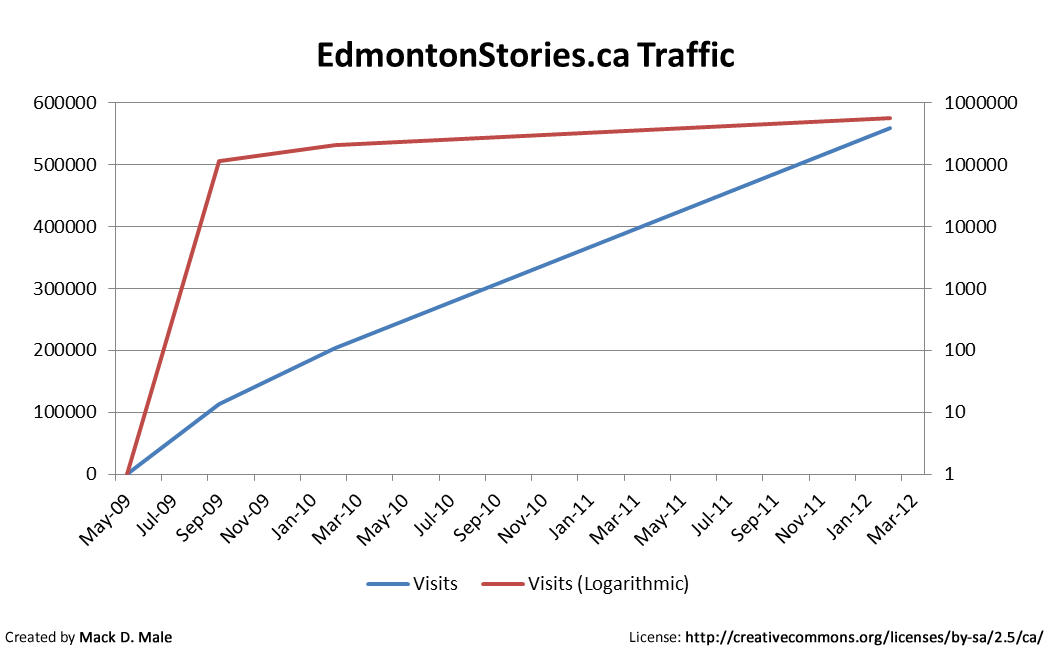
  • In its first four months, EdmontonStories.ca attracted 113,979 total visits. Five months later, that number had grown to 203,685. And in the two years since, it has attracted just 358,691 more visits, bringing the total to 558,376. Most of the growth took place in the first year! Since a picture is worth a thousand words, here’s a graph to show you what the growth curve looks like (linear and logarithmic):

edmonton stories traffic

  • And remember that those numbers are total visits. There’s no word on how many are uniques. The number of people visiting from outside Edmonton is even less, especially when you consider that when an Edmontonian’s story goes up they likely share it with friends and family in the city.
  • The number of stories on the site likewise has grown very slowly. The total now sits at 339 compared to 272 in February 2010.
  • The same case study that was held up in defense of the site two years ago is the one Administration is using now (the EPS one). The report mentions just six organizations that have joined the Recruitment Campaign Partnership. Six! Out of all the organizations in Edmonton!
  • And yes, the budget is a concern. Incredibly, the report does not make it clear how much has been spent on the project. It does state that $1.5 million was allocated in the first year and that a consultant’s estimate of the “right” investment amount was about $5 million. Councillor Diotte says that with this year’s $600,000 budget factored in, a total of $3.5 million will have been spent on the site since it launched.
  • Worse than the overall budget however is the breakdown. UPDATE: The numbers have now been posted at EdmontonStories.ca. Here’s the split identified for the 2012 budget:

So, let me get this straight:

  • $180,000 is being spent to advertise the website to extend its reach, yet we know that the growth rate has declined significantly over time.
  • $144,000 is being spent on the recruitment program, which has attracted just seven partner organizations in the last two years.
  • $126,000 is being spent on “managing, maintaining, monitoring and engaging target audiences of various social media platforms.” You know, the stuff you and I do every day for free.
  • $54,000 is being spent on “research, planning & development.” I’m not exactly sure what this would refer to in the third year of a program like this.
  • $54,000 is being spent on “website development & maintenance.” I pay $90 per month total to host this site and at least half a dozen others on Amazon EC2. And I can confirm that it more than handles the kind of traffic EdmontonStories.ca has.
  • $30,000 is being spent to extend the brand into trade shows and other events.
  • $12,000 is being spent to help people write new stories, yet just 67 new stories have been posted in the last two years.

Clearly the cost is a concern. But perhaps the biggest problem is that the site’s champion is no longer driving the site forward. I don’t think it is a coincidence that after Mary Pat left the City the site received less attention. Reading the report from Administration, it certainly feels like there’s a gap from 2010 until now. It’s hard to look after someone else’s baby.

I recognize that you don’t get results over night and that developing a successful program can often take time. But three years should be enough time to decide whether or not to pull the plug. That’s an eternity in the online world! Incredibly, Administration thinks we should do the opposite by reaching out to more organizations, recruiting student partners, and enhancing the site with things like Google Maps.

I think there’s value in what has been created at EdmontonStories.ca and I believe there are ways to continue to leverage that (perhaps via EEDC, which always did seem like a more suitable home for it), but I don’t think the City should be investing any more into the project.

The City of Edmonton’s transformation continues with latest reorganization

The City of Edmonton’s internal transformation efforts continued this month with a reorganization taking effect on June 1. City administration has now realigned into six departments, plus the Office of the City Manager, in a bid to improve communications and to better align with strategic direction.

While I wouldn’t call the reorganization a “major” one – it’s certainly not like City ‘97 which streamlined 14 departments to just 8 and saved millions of dollars – it nevertheless is a significant step for the current City administration. Under the leadership of City Manager Simon Farbrother, the City of Edmonton has embarked on a major cultural shift known as Transforming Edmonton and Me.

Here are the details on the latest reorganization.

Old departments:

  • Asset Management & Public Works
  • Capital Construction
  • Community Services
  • Corporate Services
  • Finance & Treasury
  • Office of the City Manager
  • Planning & Development
  • Transportation

New departments:

Here’s the new organizational chart (PDF):

Community Services now includes the Parks and Community Standards branches in addition to Fire Rescue Services, Neighbourhood & Community Development, Community Facility Services, and Community Strategies.

Corporate Services remains largely unchanged, consisting of the Human Resources, Information Technology, Law, Materials Management, Fleet Services, and City Clerk branches. There’s also a new Customer Information Services branch, which is responsible for 311 and the website.

Finance & Treasury is now Financial Services, and consists of the Strategic Management, Client Financial Services, Corporate Accounting, and Assessment & Taxation branches. The former Transformation Management branch appears to no longer exist as a separate entity.

Asset Management & Public Works has become Infrastructure Services, and includes all above and below ground infrastructure. It now consists of three branches (Buildings & Landscape Services, Drainage Services, Waste Management Services) instead of four (Corporate Properties, Drainage Services, Parks, Waste Management). It will also contain the Project Management Office.

The Office of the City Manager has not changed since it adopted pieces of the old Deputy City Manager’s Office (DCMO) last year. Corporate Communications and Intergovernmental & External Affairs both report to the City Manager.

Planning & Development has become Sustainable Development, and now consists of four branches (Current Planning, Housing & Economic Sustainability, Urban Planning & Environment, Corporate Properties) instead of five (Assessment & Taxation, Community Standards, Current Planning, Housing, Planning & Policy). There’s also a new area called Transformational Projects, which will be responsible for projects like the proposed downtown arena and the City Centre Redevelopment. Urban Planning & Environment is now responsible for Parks Planning.

Transportation Services has gone from three branches (Transportation Planning, Transportation Operations, ETS) to at least five (Transportation Planning, Transportation Operations, ETS, LRT Design & Construction, Road Design & Construction). This is basically the adoption of the old Capital Construction department. The web page for the department also lists a new LRT Expansion branch, though it doesn’t appear on the org chart. The changes in this department are intended to put The Way We Move into a single area.

Final Thoughts

I think the changes, while mostly cosmetic, are important. Most of the departments now contain “services” right in the name, which better reflects their purpose and mission. The changes also reflect a desire by administration to better align with The Way Ahead, the strategic direction set by City Council. It’s not clear whether any jobs will be lost as a result of the reorganization, but I don’t think so. I also don’t believe it is in any way connected to the projected $31 million deficit the City is facing. The wheels were in motion for this reorganization some time ago.

City Centre Redevelopment ‘shorter-listing’ reveals problems that must be addressed

Last week City Council shorter-listed three of the five finalists in the City Centre Redevelopment Master Plan Design Competition, with the winner set to be named on June 22. The decision to narrow the field to three after a botched media conference was unexpected and was largely overshadowed by last week’s arena news.

The media conference was set to take place on Wednesday afternoon. The advisory had gone out less than 24 hours earlier:

Join City Manager Simon Farbrother for the announcement of City Council’s selected design team to transform the City Centre Redevelopment project into a world leading, environmentally sustainable community. The announcement completes a year-long international competition to select the best team to deliver a master plan to develop this centrally-located land which is approximately 266 CFL football fields in size. A representative from the winning team will be on hand for media interviews after the formal portion of the announcement.

Members of the local media filled the Councillor’s Boardroom at City Hall which had been setup with chairs and the competing teams’ display boards. Mayor Stephen Mandel, City Manager Simon Farbrother, City Centre Redevelopment Executive Director Phil Sande, Fairness Advisor James McKellar, and a representative from each of the five finalists were set to be in attendance. We chatted amongst ourselves as we waited for the proceedings to begin.

ECCA Announcement

Just before four o’clock, Mayor Mandel and Simon Farbrother entered the room, nearly half an hour after the media conference was supposed to begin. The mayor took the podium and revealed that City Council had been discussing the proposals in camera (in private) and still had too many questions outstanding to make a decision. I tweeted the news at 3:57 PM, along with The Charrette and a few other people. Simon Farbrother also said a few words, and said the media would be given an update by the following morning. The whole thing lasted just five minutes.

I remember thinking as I left City Hall that someone must have screwed up. I mean, since when does Council discuss anything quickly? It’s their job to make an informed decision, and that usually takes time. I found out later that inconveniencing the media was just the tip of the iceberg.

Mayor Mandel ECCA Announcement

When Mayor Mandel had told the media that Council still had questions, I assumed they were questioning the finalists directly. Not so, Shafraaz Kaba of Manasc Isaac told me. While the media were sitting in the Councillor’s Boardroom waiting for the announcement, the five finalists were sitting in a windowless room in the City Clerk’s office. Shafraaz said they had been taken there while Council was discussing the selection committee’s recommendation. They were not told how long they’d be waiting. “They provided coffee and drinks, and some fruit and dessert that basically no one touched,” Shafraaz told me. He recalled that everyone was starting to get impatient as they watched the minutes slowly tick by. Finally after an hour and a half they sent someone to find out what was going on. Soon everyone had left the room and was waiting outside the clerk’s office for some kind of update. “That’s when I saw your tweets, about Council not being able to make a decision,” he told me. A few minutes later, Phil Sande arrived and told them that Council would not be making a decision after all. When Shafraaz told him that they already knew that, Phil seemed surprised and asked how they had found out. “It was like he didn’t seem to know that there was a press conference going on,” Shafraaz said.

The next morning, Phil called Shafraaz and told him that their team’s submission had not been chosen as one of the three to move ahead. It was clarified that the Mayor and City Council will make the final decision on the winning team. At the Downtown Business Association’s Spring Luncheon later that day, representatives from all five teams were introduced and then a short, pre-recorded video with Mayor Mandel was shown. In the video, Mandel made reference to “the decision” which brought chuckles to the packed room. Simon Farbrother then made the official announcement about the shortlisting of three teams.

City Centre Airport Design Competition Finalists

The way the finalists were treated last week is completely inexcusable. Five world-class teams are competing to help shape the future of Edmonton and we lock them in a room with no information about what’s going on? It’s completely unacceptable. What are the chances that they’re going to want to work with the City again after being treated like that?

The worst part is that Wednesday was just more of the same, according to Shafraaz. There has been confusion and some disappointing decisions made ever since the start of the competition. “We asked early on who had the final decision, the ‘jury of distinguished experts’ or City Council,” Shafraaz told me. The response from the City was that Council had the final decision but that hopefully they would respect the jury’s decision. The RFP stated that “the jury will ultimately recommend a winning Submission or combination of Submissions to City Council for adoption” and that “City Council reserves the right to accept or reject the recommendation of the jury.” It certainly seemed as though Council’s role was not to conduct its own analysis but was instead to ratify the recommendation of the jury. Why have an independent jury if that wasn’t the case?

There were other bumps along the road too. “It was unclear what the deliverables for a ‘master plan’ should be,” Shafraaz told me. With no guidance, each team likely interpreted the amount of work involved differently. That’s especially problematic given that 25% of the evaluation scoring was price (vision & team philosophy was 30%, primary requirements was 25%, and master plan principles was 20%). “Is it about design or is it about cost?” Shafraaz wondered. “If you want the best design, you pay for it; it should never have been about cost.”

Unsurprisingly, the finalists also had to dig for details on the public involvement aspect of the competition. “We had to ask how much information we could present, how many boards we could have, how long the videos could be,” Shafraaz said. The jury was supposed to consider how the public responded, but teams were given no information about how that would be done. I saw some great coverage at The Charrette, but what little buzz there was about the videos didn’t seem to be sustained or capitalized on by the City, let alone factored into any evaluation.

Shafraaz is obviously disappointed that his team wasn’t shorter-listed, but he doesn’t regret taking part in the competition. “What made losing worth it, in terms of time and energy and all of the hours put in, is the experience of working with amazing designers, engineers, and other consultants that have done this kind of work in other projects.” He hopes other local participants also learned from the experience.

Ultimately, the real work will begin after a winning team is finally selected next month. Shafraaz thinks the project can gain some momentum after that decision is made, “but they’re going to have to work at it.” I don’t think it’s enough to simply hope that the City does indeed work at it. There are clearly some issues that must be addressed. We need to hold the City accountable and we need to ensure the mistakes that have been made so far are not repeated. This project is too important.

Edmonton’s Downtown Arena moves ahead with agreement framework

The Katz Group scored a major victory tonight as City Council voted in private to approve an “agreement framework” for the proposed downtown arena. The framework is the basis for the two sides to negotiate a formal Master Agreement, which will require final approval by City Council. While not a final binding agreement, tonight’s deal nevertheless allows the project to move forward.

Here is the full motion and amendments as voted on back on April 6 (tonight’s was largely the same – see here):

Edmonton Downtown Arena Motion(function() { var scribd = document.createElement(“script”); scribd.type = “text/javascript”; scribd.async = true; scribd.src = “http://www.scribd.com/javascripts/embed_code/inject.js”; var s = document.getElementsByTagName(“script”)[0]; s.parentNode.insertBefore(scribd, s); })();

The vote tonight succeeded 8-5. Who voted in favor of the framework? Who voted against?

For: Mandel, Krushell, Loken, Leibovici, Batty, Henderson, Anderson, Sohi
Against: Sloan, Gibbons, Caterina, Iveson, Diotte

The document outlines $350 million in funding for a $450 million arena. Where does the other $100 million come from?

Answering questions from the media tonight, Mayor Mandel would only say “other orders of government.” There is no confirmation on where the remaining amount will come from, but it is hoped that the Province will support the project.

How much of the total cost will be funded by a CRL?

The motion only states that $20 million be directed at the arena from a CRL. The remaining $105 million (the City’s maximum contribution will be $125 million) could come from direct tax revenues. However, the agreement framework page states that $45 million would come from a CRL. The final mix is likely to change.

What happens to Rexall Place and Northlands?

The motion specifies that City administration will continue “to work with Northlands to ensure the City understands their financial challenges and how these can be addressed.” Answering questions this evening, City Manager Simon Farbrother said that Edmonton cannot sustain two arenas. It would appear that Northlands has lost its seat at the table.

Will the City own the arena? Will it receive the revenue?

Under the agreement, the City would own the building and land. The Katz Group would be responsible for all maintenance, upgrades, operating and capital expense costs. The City also retains the right to access the facility four weeks a year. As for revenue, the motion only states that the City “negotiate options for potential revenue sharing.”

What will the arena look like?

The City stated tonight that the arena will contain 18,500 seats and 350 parking stalls. The design process will still need to happen once the project moves ahead.

What are the next steps?

The City and the Katz Group will now work to complete the Master Agreement. They’ll also be working to secure the remaining $100 million, likely from the Province.

Twitter was buzzing with the news tonight. Here are a few of the tweets that caught my eye:

#yegcc just came back in public – voted on a motion to approve a framework for #yegarena deal – details to be kept in private. Passes 8-5.

News conference upcoming at City Hall for major #yegarena announcement.

City announces framework to build arena!

City and Katz Group agree on agreement framework to build arena http://bit.ly/ipraRy #yegarena #yeg

The City of Edmonton and Katz Group agree to framework that “sustains NHL hockey in #yeg for 35 years.” #yegarena #Oilers

Mandel stresses optimism, forward momentum, believes holes in plan will come together now that framework of deal in place. #yegarena

This arena will built just when the construction labour and materials market explodes. I’m guessing it comes in at $700 million. #yegarena

This arena situation is just like the airport situation; everyone knew it was going to happen, it was just a matter of when. #yegarena #yeg

NOTE: #yegarena dissenters. A friendly reminder; you have until JULY 17th to file your plebiscite application. Just saying.

It’ll be interesting to see what happens next! Much more to come, stay tuned.