Civic Smart Card coming to Edmonton?

At today’s Executive Committee meeting Councillors will discuss a report on Smart Card Solutions, the result of an inquiry Mayor Mandel made back in February. You might remember that the Transportation & Public Works Committee had approved a recommendation that ETS implement a smart card solution. But why should ETS be the only ones to benefit? That’s the thought that prompted the mayor to ask for more information.


A civic smart card would be something like the cards pictured above, presumably more like a modern credit card with a little chip embedded inside. It could serve two primary purposes: payment, like a gift card you’d get at Starbucks, but also identity, like a digital driver’s license.

The new report sidesteps the question about what it would take to implement a civic smart card that would work for all City services, including the Edmonton Public Library, essentially saying that a business case would need to be made, and that more research needs to be done to find similar solutions implemented elsewhere. I suppose that’s prudent, but I would think based on the TPW report that they’d have some idea (the estimate for an ETS solution was close to $23 million, which would pay for itself within 15 years).

Some highlights from the report:

  • Administration would contact the provincial and federal governments “to investigate possible synergies in respect to pilot projects around identity management.” Apparently both have already started exploring similar ideas.
  • ETS, Community Services, EPL, EFCL, and the University of Alberta are just a few of the potential partner organizations mentioned.
  • In response to the mayor’s question about engaging the public: “For a civic smart card to be successful and fully adopted by Edmontonians, Edmontonians must be engaged in the design and implementation planning process as well as the actual implementation of a solution.” Administration would leverage “every channel from town hall meetings to social media.”
  • For the IT folks reading this: “Administration should also engage the IT community by creating a project advisory group made up of Edmonton’s best and brightest technology minds…”

By improving Edmonton’s livability, the civic smart card supports the City’s strategic plan. What are the next steps?

The Information Technology Branch will take the lead, working with city departments and external stakeholders to develop the value assessment to determine if this initiative should be considered in the 2012-2014 capital budget. This project will provide a test case for the new IT governance framework which is being designed to allow the city to make the right technology investment decisions.

I really love the idea of a civic smart card for Edmonton. A quick Google search reveals lots of examples of transit cards, and even some parking cards, but not much for city-wide cards. As Councillor Iveson pointed out back in October, when writing about a smart card for ETS, “this isn’t leading edge stuff anymore. This is now an established practice.” I agree – ETS absolutely needs this. Something city-wide is quite intriguing, however, and I think Edmonton would be one of the innovators there.

Let’s get it done!

If you want to follow along with today’s meeting, you can do so here.

Sign of progress

The new South LRT extension has been the hot topic at water coolers throughout the city this week:

Edmonton Sun

Edmonton Journal

CBC

When was the last time that so many Edmontonians were talking about the LRT? Nothing like a little controversy to bring a topic to the forefront. I’ve almost heard more people talking about the delays at 51 Avenue than about the downtown arena! And you know what they say, there’s no such thing as bad press…

Yes it sucks to wait at a traffic light. The City will get the issues sorted out though, I’m sure of that. In the meantime, we should capitalize on the discussions that are happening! Explain to Edmontonians that we’re forging ahead with new LRT extensions and that we’ll learn from this experience.

And wouldn’t you know it, since I started writing this post I received a notice that Bob Boutilier, GM Transportation at the City of Edmonton, will be addressing strategies and challenges associated with fast tracking the NAIT, southeast, and west LRT lines at a news conference tomorrow morning. Excellent!

Edmonton’s South LRT Grand Opening

Today was the grand opening of the Southgate and Century Park LRT stations (see my previous coverage here). A joint news release issued by all three levels of government declared that “a new era in Edmonton’s transportation history has begun.” Edmonton’s LRT now extends 20.3 kilometers from Clareview Station in the northeast to Century Park in the south.

South LRT Grand OpeningSouth LRT Grand Opening

South LRT Grand OpeningSouth LRT Grand Opening

A number of distinguished guests were on hand for the two ceremonies today, one at Southgate Station and one at Century Park Station. Among others, MP Laurie Hawn spoke on behalf of the federal government, Premier Stelmach surprised many people by appearing himself to congratulate Edmonton, and Mayor Mandel was joined by his Council colleagues.

South LRT Grand OpeningSouth LRT Grand Opening

South LRT Grand Opening

Here are some of MP Laurie Hawn’s remarks:

Here is Premier Ed Stelmach:

Here is Mayor Stephen Mandel and City Councillors:

After the ceremonies ended, everyone joined the fun already underway at the ETS Community Fair! There were information kiosks, activities for kids, and some of the City Centre Market vendors providing a preview of the upcoming market season.

South LRT Grand Opening

I’m very happy that our LRT now extends to Century Park, and I was glad to see so many Edmontonians out to celebrate today. Now we need to move on to the next extension, to keep the momentum going. The LRT system map looks a little odd without any “future LRT station” nodes!

South LRT Grand OpeningSouth LRT Grand Opening

You can see the rest of my photos from today here.

Start offering bus service to EIA from Century Park!

The Transportation and Public Works Committee will be discussing the issue of transit service to Edmonton International Airport (EIA) today. Let me start by saying that I would certainly take a bus to the airport from Century Park if it existed, and that I think public transit to the airport is extremely important. Or as Councillor Don Iveson said so well:

This is one of those litmus tests of whether we’re a city or a town.

I’d like us to be a city.

There are two key reports that are relevant here. The first was written by the Edmonton Transit System Advisory Board (ETSAB), and it recommends that an experimental ETS bus service operate from Century Park to EIA. You no doubt heard about it in the news. The second was written by the Transportation Department, and it recommends that the City of Edmonton not proceed unilaterally with operating service to the airport.

As part of its report, ETSAB did a survey of about 600 passengers in October 2009 and found the following:

The highlight result is that a remarkable 53% of passenger respondents said they are likely or very likely to use airport transit to and from Century Park. Only 1 in 4 of these EIA passengers (13% of all passengers) need actually follow through with their indicated likely usage, and the service will be profitable. Only 1 in 8 of these supporters (7% of all passengers) need follow through for 50% cost recovery level to be achieved.

The accuracy of that survey was not demonstrated, and the Transportation Department’s report rightly pointed that out.

Transportation’s report also makes note of the Capital Region Board’s role in all of this, and I agree it makes sense for surrounding communities to take part. That said, I think Edmonton should be proactive about transit service to the airport.

Beyond that, the report from Transportation just doesn’t add up. Here are the questions I have about it:

  • Why is there such a focus on 100% cost recovery, when the rest of ETS operates at about 45%? Only “special event service” and charters are subject to 100% cost recovery, and even with planned fare increases to $3 by 2013, cost recovery is only expected to rise to about 54% (see Transit System Fare Policy C451D for more info)
  • Why are three new buses required and why would the total cost to acquire them be “at least $1.5 million”? First of all, based on 2008 data (large PDF), the City has no lack of spare buses. With a fleet size of 821 40’ diesels, there are at least 146 spare buses available at any given time, 19 of which are reserved for emergency deployment. So wouldn’t it be cheaper to find a way to reduce the number held for maintenance from 127 to 124? And even if we did want new buses, where does the $1.5 million figure come from? Based on the May 2008 report (large PDF) that discussed trolley buses, the cost for a diesel bus in 2010 was expected to be $425,000 whereas the cost for a hybrid was expected to be $650,000.
  • Of course, the type of bus chosen has an impact on operating costs, which for some reason are $254,000 more in the City report than in the ETSAB report (even though ETSAB used a figure provided by ETS). That same report on trolley buses found that maintenance costs for the hybrid and diesel buses are similar, but that the hybrids use 15% to 20% less fuel.

And perhaps most importantly, why do both reports focus on a ticket price of just $2.50? Especially considering adult fares are up to $2.75 now. I’d be willing to bet that most people who’d use the service would be willing to pay more. I don’t think $5 or perhaps even $10 is out of the question.

And then, on top of all of that, there’s this article in the Edmonton Sun:

The city’s transportation department is proposing to build a dedicated bus lane along the future LRT corridor from city boundaries to the Edmonton International Airport.

So they’re saying bus service to the airport is too expensive, but they want to build an expensive dedicated bus lane for bus service we don’t even offer? To be fair, this was in response to what could be done to move people were the City successful in its bid for EXPO 2017. Still, Transportation boss Bob Boutilier was quoted as saying:

“There are opportunities to build up that ridership now. The cost of building a bus way is a lot less than an LRT route but people will see the value as ridership crawls up and progresses to a higher capacity.”

I can think of a way to build up ridership right now – start offering bus service to EIA from Century Park!

First Look at Edmonton’s South LRT Extension (Southgate & Century Park)

On Saturday, April 24, the two newest LRT stations in Edmonton’s network are officially opening to the public, and ETS is hosting a Community Fair to celebrate (on ShareEdmonton). Yesterday, the local media got a sneak peek at the new Southgate and Century Park stations, both of which have been under construction since the Summer of 2007.

South LRT ExtensionSouth LRT Extension

The total budget for the South LRT Extension from Health Sciences station to Century Park was $690 million, the vast majority of which ($573 million) came from tax supported debt (to be repaid from the New Deal for Cities & Communities). Construction included two new tunnels: one beneath Belgravia road and one beneath the southbound lands of 111th Street. There are also two new bridges: a one-way bridge over Belgravia Road (connects South Campus to Fox Drive) and one across Whitemud Drive. A total of 26 new light rail vehicles were added to help service the extension.

The total length of the South LRT Extension is 7.361 km:

  • Health Sciences to McKernan/Belgravia: 0.9 km (roughly 1 minute, 56 seconds)
  • McKernan/Belgravia to South Campus: 1.375 km (roughly 2 minutes, 24 seconds)
  • South Campus to Southgate: 2.032 km (roughly 3 minutes, 20 seconds)
  • Southgate to Century Park: 3.324 km (roughly 3 minutes, 46 seconds)

The McKernan/Belgravia and South Campus stations opened a year ago, and at the time I complained that the media advisory encouraged driving and parking. I’m happy to report that the media advisory for yesterday’s sneak peek said this:

Please note that there is no public parking available at South Campus Station. Members of the media are urged to use LRT to travel to the event.

Much better – I hope future advisories look the same!

We boarded the train at South Campus, and headed for Southgate station (located on 111th Street between 51st Avenue and Whitemud Drive):

For another view, here’s Southgate back to South Campus. Of the two new stations, I think Southgate is my favorite. It mirrors the recent renovations done to Southgate Shopping Centre very well, so it looks like it belongs. The artwork in the station is called “Immense Mode” and was created by Dawn Detarando and Brian McArthur. We learned about all of the new safety features (including the secure washrooms) and got to wander around. Here are a few photos of the new station:

South LRT ExtensionSouth LRT Extension

South LRT ExtensionSouth LRT Extension

Next up – Century Park (located on 111th Street just north of 23rd Avenue). Unfortunately the batteries in my flip died on the way there, so I don’t have video of Southgate to Century Park. I have the return trip though:

As it is the end of the line (for a while anyway) Century Park will probably be the busiest of the new stations, housing an 1100-stall temporary Park & Ride lot, in addition to 130 existing parking stalls. When the bus routes are changed later this month to feed into the new LRT extension, Century Park will receive the bulk of the traffic. The artwork in the station is called “Continuum” and was created by Cezary and Danielle Gajeweski. Here are a few photos of the new station:

South LRT ExtensionSouth LRT Extension

South LRT ExtensionSouth LRT Extension

If you’d like to check out the new stations for yourself, don’t miss the Community Fair on the 24th. It’ll also be a great opportunity to learn more about the changes to bus routes.

What’s next? Well in addition to needing funds to expand the LRT in other directions, the City is already planning for the next south extension to Ellerslie Road. The preliminary design was approved by City Council in July 2008. You can learn more about the future extension here. The currrent LRT network was built to accommodate four-car trains, but work is underway to upgrade capacity to five-cars. The McKernan/Belgravia and Health Sciences stations are being upgraded now, work which is expected to be complete in October. South Campus, Southgate, and Century Park already support five-car trains.

In just a single year, we’ve had four new LRT stations open in Edmonton. Let’s keep it up! You can see the rest of my photos from the preview here.

Edmonton Transit in 2009

I think 2009 was a very interesting year for transit in Edmonton! There were a number of big successes, such as the launch of trip planning with Google Transit, new LRT cars, the opening of the South Campus LRT Extension, experiments with dedicated bus lanes and smart cards, the release of data for developers, lots of support for transit to the Edmonton International Airport, completion of major construction on the South LRT extension, and of course, the approval of the NAIT, West, and Southeast LRT lines. There was also some sad news, such as the violence against bus drivers and other security issues. And finally, some transit news from 2009 is either positive or negative depending on how you look at it, such as the end of trolley buses.

TransitCamp EdmontonSouth Campus LRT Grand OpeningSouth Campus LRT Grand OpeningMack & DonETS PlatinumMy Bus StopWest & Southeast LRT Announcement

Here are some of the transit-related headlines from 2009:

Also: you can see the monthly In Transit newsletters here.

Some data points for 2009:

  • The 15th annual Stuff A Bus campaign collected 31,000 kg of non perishable food items, and $17,000 in cash donations.
  • On February 1, 2009, the price of an adult monthly pass rose $7.75 to $74.25.
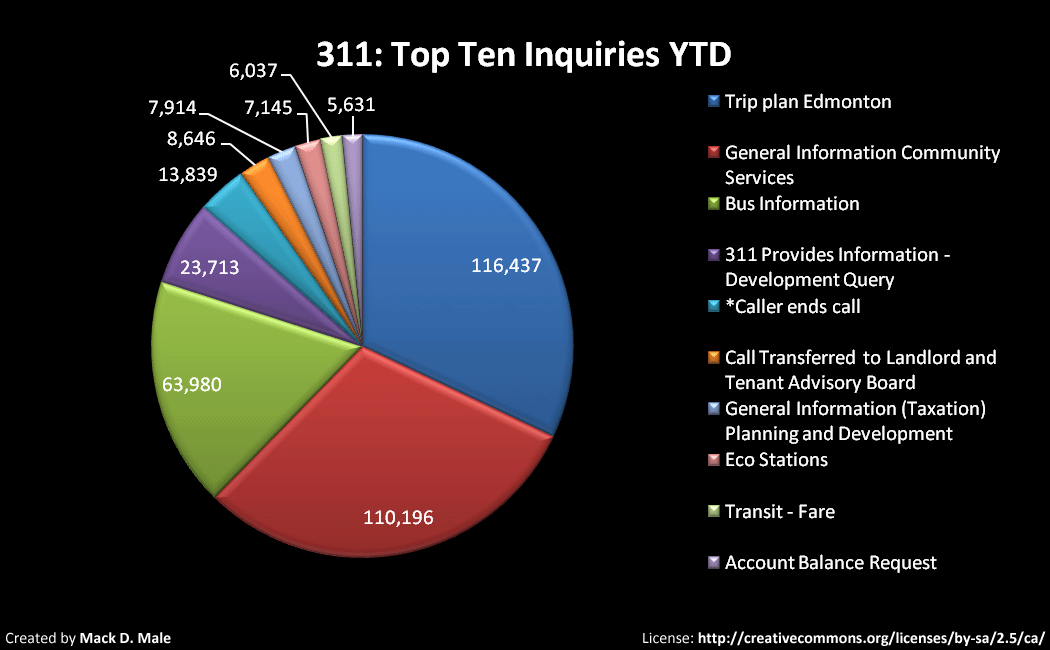
  • In its first six months of operation, 311 fielded 116,437 calls related to trip planning, 63,980 calls related to bus information, and 6,037 calls related to transit fares. Transit was the most commonly requested service.
  • ETS Statistics and ETS Statistics for 2009 (will be updated).

TransitCamp Edmonton Competition

At the TransitCamp Edmonton event on May 30th, it was announced that ETS was releasing route & schedule information in the Google Transit Feed Specification (GTFS) format for everyone to use. We decided to hold a small competition, to spur interest in developing applications that made use of the data! The competition closed November 30th, and I’m happy to finally share our two winners:

  1. MyStops by Grayscale Apps
  2. ETS Trip Planner by Waclaw Lany

MyStops, as you probably know, is a very popular iPhone application that gives you quick access to the schedule information for your favorite bus stops. Waclaw’s trip planner combines the stop number functionality of the official ETS Trip Planner with Google Maps routing.

Our judges, Councillor Don Iveson and Edmonton CIO Chris Moore, evaluated the submissions using three criteria:

  • Usefulness to residents
  • Visual appeal and usability
  • Inventiveness and originality

Congratulations to Andrew, Sinan, Sari, and Waclaw!

2010

This should be another big year for transit in Edmonton. The last of the old GMC vehicles were retired in 2009, which means that ETS is now running a 100% accessible fleet. The South LRT extension is scheduled to open in April, and construction on the North LRT extension has begun. The U-Pass pilot ends this year, so a new deal will be negotiated, and NAIT students might get to join. And hopefully at some point the trolley wires will be completely removed! I can’t wait to see what else 2010 has in store for us.

Don’t forget: the Donate-a-Ride campaign is on until January 31!

Keep up-to-date on the latest transit news and announcements on Twitter using the #yegtransit hashtag!

Did I miss anything? Let me know in the comments or via email.

Leveraging Technical Expertise Locally (LTEL) Application Deadline: December 15

Just a reminder that if you’re planning to participate in the Leveraging Technical Expertise Locally (LTEL) initiative, you have until next Tuesday to declare your interest! If this is the first you’ve heard of LTEL, check out my recap of last month’s open house. Expressing interest is easy – just fill out this online form. You’ll need to provide your personal and business contact details, as well as:

  • A description of your solution in 100 words or less
  • An overview of your solution in 200 words or less (no I don’t know how the description and overview are different)
  • The top 10 features of your solution
  • The technical specifications of your solution
  • Direct & indirect benefits and costs of your solution
  • An explanation of how your solution will address the technical and operational needs of the customer and end-user
  • A preliminary timeline for your solution

Interestingly, there’s also room for three team member profiles, and comments on product differentiation, commercialization potential, and financial considerations. So if you have sales projections or plans to look for investment, you can mention that up front.

The website has a number of useful documents that might be of interest, including a scan of the current Lost & Found form and tag (pictured above). You can also download the City’s IT standards, which have been clarified:

The City does not wish to dictate the technologies proposed by the applicant, however, the solution must run in the City’s technical environment, as City staff are expected to use the application on a daily basis. In addition, the City is open to considering proposals that include hosting of the proposed application.

Emphasis mine – that’s great to hear!

If you’re chosen to continue, the next step in the process is to present your solution to the selection panel on January 28, 2010. Your solution doesn’t need to be complete by that date – mockups, prototypes, or whatever you’re comfortable presenting is fine. The selection will be announced on February 3, 2010.

For more information, check out the LTEL site. If you have questions or other concerns, email LTEL@edmonton.ca. Have a great idea for a new Lost & Found system? Apply now!

Recap: Leveraging Technical Expertise Locally Open House

Last night was the open house for the City’s new Leveraging Technical Expertise Locally (LTEL) initiative (you can read my previous coverage here). The event was meant to provide more details to the community, and to introduce the people behind the scenes. David Faber from the Deputy City Managers Office, Kamren Farr from TEC Edmonton, Keith Chorley from CoE IT, Bruce Beecher from CoE IT/Transit, and Cam Linke were all on hand to introduce the idea and answer questions. Roughly 25 people attended.

Leveraging Technical Expertise Locally

David began by giving the pitch, essentially providing the same information he shared with me last week. He stressed that this is a pilot program, and that it’s okay to fail. The City of Edmonton is hoping to learn from the experience, and will be reporting back to Executive Committee with the results. David highlighted the intent of LTEL:

  • To communicate the services that the City of Edmonton provides.
  • To build bridges with the local community, to enable small tech companies to use the City of Edmonton as a sandbox.

Next up was Bruce, who provided some information on the challenge – creating a replacement for Edmonton Transit’s Lost & Found system. The current database was built with Access 97, and the IT branch is keen to replace it with something more modern. A few details on the system:

  • Roughly 1700 items are tracked per month
  • Items are stored for 30 days, and if not retrieved are then donated, auctioned, or otherwise disposed of. Passports, for example, are returned to the government, and cell phones are returned to the carrier.
  • Items are stored tagged in bins in a storage room that is roughly 20 feet x 20 feet.
  • Most wallets, cell phones, backpacks, and purses are collected within 2 days.

The basic business processes are:

  1. Enter articles – start tracking lost items
  2. Search articles – when someone calls with a description
  3. Claim articles – individual signs the tag upon retrieving the item
  4. Purge articles – items removed from database after retrieval or 30 days

Some of the opportunities identified include:

  • Improved security and access control
  • Multiple item search (currently you can only search one item at a time)
  • Track people inquiring about items
  • Enhance reporting
  • Potentially something generic enough that other CoE departments could use it

Kamren was up next, to provide the preliminary market assessment. He talked about the “lost and found” industry, and highlighted solutions at TransLink and the New York transit authority as best-of-breed. There are four existing types of lost and found systems:

  1. Public – transit, etc.
  2. Private – hotels, etc.
  3. Return service – you pay for tags or some incentive to return
  4. Online classifieds – lost and found posters, basically

He went on to talk about market segments, and highlighted some of the market drivers, opportunities, and challenges.

The challenge was eventually described as:

Use technology to reduce costs for the customer (City of Edmonton) and increase recovery rates for users (people who have lost things).

All of this information will be made available on the LTEL page. The only other pertinent detail is that the upper limit for the budget is $75,000. Technical requirements and other details will also be posted on the website.

Leveraging Technical Expertise Locally

My Thoughts

I talked with a number of people after the session to get their perspective. Most folks seemed excited about the idea. Andrew from dub5, in particular, said he was impressed that the City of Edmonton took the time to get this pilot started, and suggested that it was a big step in the right direction. Bruce Winter echoed that sentiment, but like me, was hoping for something a little more visual.

Here are my thoughts on the open house:

  • The City needs to do a much better job of spreading the word. I realize they wanted to manage expectations, but I don’t think enough people knew about last night’s event.
  • I would have loved to have seen the format of the event mimic DemoCamp. Instead of slides full of bullet points, why not demo what they currently have?
  • I get that a lost and found database isn’t particularly exciting, but that doesn’t mean that the presentation can’t be. Instead of telling us there’s a 20×20 room packed with items, why not show a photo?
  • This is going to sound harsh, but Kamren’s presentation wasn’t much more than a Google search. Very basic business concepts (competition, market segments, opportunities, challenges) and nothing more than the names of some other lost and found systems. I’m still wondering what exactly TEC Edmonton and EEDC bring to the table, besides a couple more names?

My biggest concern however, is related to the very first question I asked. I wanted to know if there were any technical requirements, and specifically, if the application had to be on-premise (meaning the City of Edmonton hosts and manages it). Keith answered yes, tech requirements would be provided, and that yes, the solution needs to run in the City of Edmonton’s existing infrastructure. One of the stated goals of LTEL is to expose the City of Edmonton to some of the innovative ideas of the local tech community, so this seems like a big step in the wrong direction. Maybe there’s a good reason for this particular solution, but if so it was not made clear. I think putting up big restrictions like that right from the start limits the potential solutions the City could learn about. (Also, I was under the impression the City wanted to get out of the tech business, by not doing custom development and reducing the burden of hosting and managing systems.)

This criticism is meant to be constructive. Overall I think LTEL is a good thing, and I want to see it succeed. I look forward to the rest of the process!

Stay tuned to the website for updates and an application form. Companies interested in developing a solution have until December 15 to express interest.

Leveraging Technical Expertise Locally – Open House on November 17

As you may have heard by now, the City of Edmonton is hosting an open house on Tuesday, November 17 (on ShareEdmonton) at City Hall to present a pilot project to interested members of the local tech community. The initiative is known as Leveraging Technical Expertise Locally (LTEL), and the open house follows on the report that was presented to Executive Committee back in August. I’ll get to some of the event details in a second, but first I want to offer some background.

I heard about the open house late on Monday afternoon, and immediately posted a tweet. You might think that the City’s IT department would be behind it, but many of them only learned about it because of my tweet! And that’s where things get interesting.

I had the opportunity this week to sit down with David Faber, one of the folks making this initiative happen. David is the Executive Director of Enterprise Strategic Management in the Deputy City Managers Office. His involvement means that this initiative is happening at a level slightly above IT, as David is (along with his team) charged with strategy, direction, accountability, and stewardship for the entire City of Edmonton, not just IT. David’s job is to bring the City’s Vision and Strategic Plan to life, and LTEL is just one of the ways in which he’s doing that.

As you might expect, David oozes passion for Edmonton. He’s been with the City of Edmonton for 12 years now, and even spent some time working in IT, so he has some experience in the field. For David, the LTEL initiative is about innovation and economic development, as well as the opportunity to simply connect with startups and other small tech firms in Edmonton. He outlined a few key goals of the initiative:

  • To bring the community together with the City, and to open the door at CoE for smaller companies.
  • To build shared learning by using the City as a sandbox and by not being afraid to fail.
  • To be supportive of the City Vision, which is to say that the LTEL pilot must be repeatable and sustainable.

I agree with Chris LaBossiere – this sounds like we’re on the right track.

I did explain to David that I was highly critical of the original report, and that I along with others in the tech community are concerned about EEDC and TEC Edmonton’s involvement. Unfortunately, David didn’t say much to alleviate my concerns when I asked how specifically those organizations would be involved, suggesting only that they would provide resources. I’m willing to wait and see how things turn out, because it certainly sounds like TEC Edmonton is less central to the pilot than was suggested in the original report.

We’ll learn more about the project at Tuesday’s event, but here’s what we know already:

  • The problem is to come up with a replacement for Edmonton Transit’s current electronic Lost and Found system.
  • Prospective participants must be incorporated companies by February 3, 2010, must have annual revenue of $2 million or less, and must be located within the City of Edmonton’s boundaries.
  • Prospective participants have until December 15, 2009 to express interest.
  • Potential solutions will be presented on January 28, 2010.
  • A selection announcement will occur on February 3, 2010 with the pilot project starting March 1, 2010.

The Lost and Found system was selected for two important reasons: it’s tangible, and already has funding attached. Representatives from IT, DCMO, ETS, and TEC Edmonton will be on hand to provide more information.

I’ll be there on Tuesday to learn more about it, and I hope you’ll consider attending as well.

Edmonton’s 311: six month status report

As you’ve probably heard by now, the City’s 311 service is not performing as well as expected. The Sun first reported the story last week, and the Journal followed up with an article yesterday. They key point mentioned in both is that wait times to connect to an operator are far longer than originally anticipated. As a result, an interactive voice response system is being considered for next year. I can’t imagine that will make callers any happier, even if it does make their calls slightly faster.

I personally think they should put more resources into 311 online. How many citizens even realize that they get online access to a lot of the information and services that 311 provides? The best way to reduce call times is to increase self-service options and quality so that citizens can bypass the phone altogether.

Fortunately, there are new self-service features being developed for release in October. The City will still need to communicate their existence effectively, however.

Background

The CRTC approved the use of the 311 phone number for municipal services back in November 2004, and Calgary became the first city to launch 311 on May 8, 2005. Here in Edmonton, City Council approved the service at its May 9, 2006 meeting. Edmonton became the first city in North America to use SAP’s CRM application to deliver 311.

The 311 service officially launched on December 16, 2008. Implementation was approved at a cost not to exceed $10 million (and it is on track to come in about $1.5 million under budget). Half of that amount came from an internal loan, which is to be repaid from operating savings (the other half came from a special dividend in 2005).

Six Months In

The report that went to the Executive Committee this week isn’t incredibly long at 7 pages, but it does have lots of information. Here are some graphics to help make it easier to understand the first six months of 311 operation in Edmonton.

Call lengths are one of the reasons everyone is complaining:

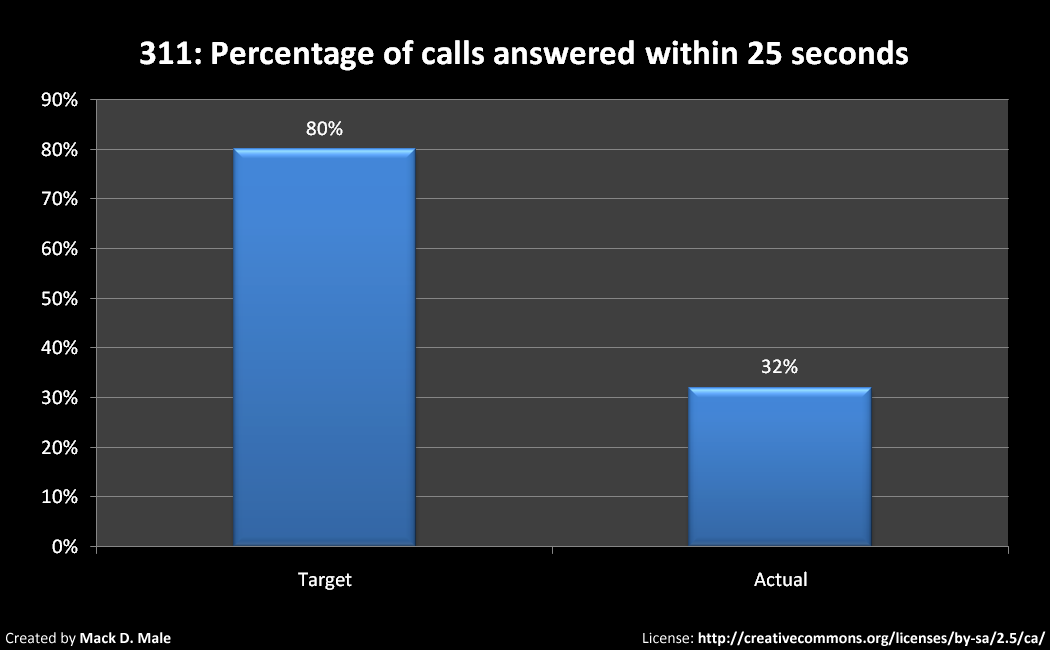
Wait times to get through to an operator are another concern:

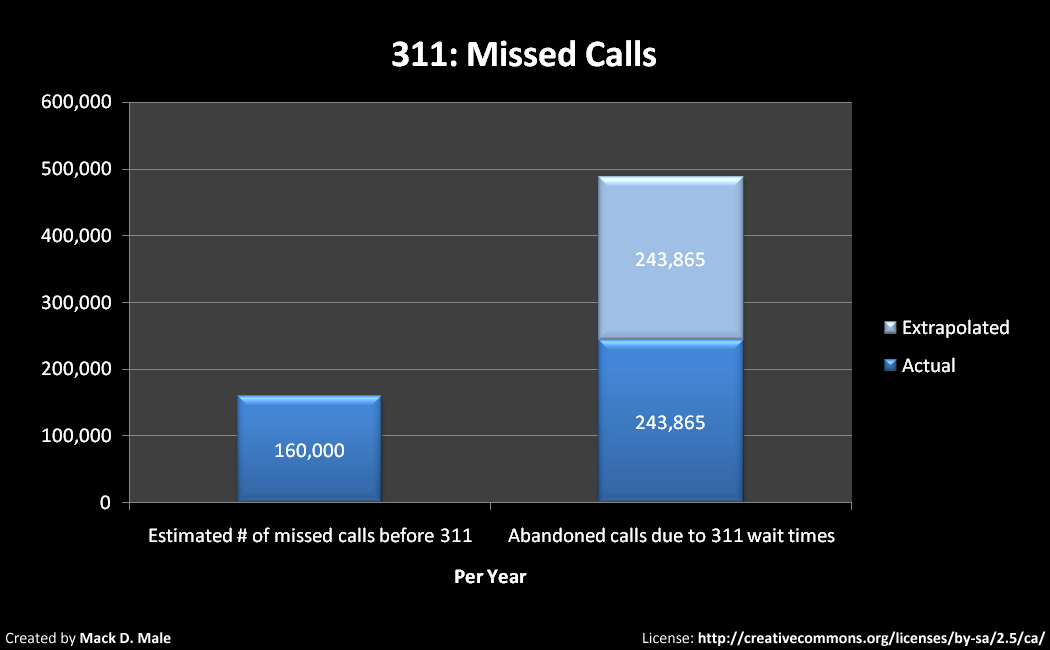
The 311 system was supposed to help the City capture the estimated 160,000 missed calls each year, but so far it is on track to make things much worse:

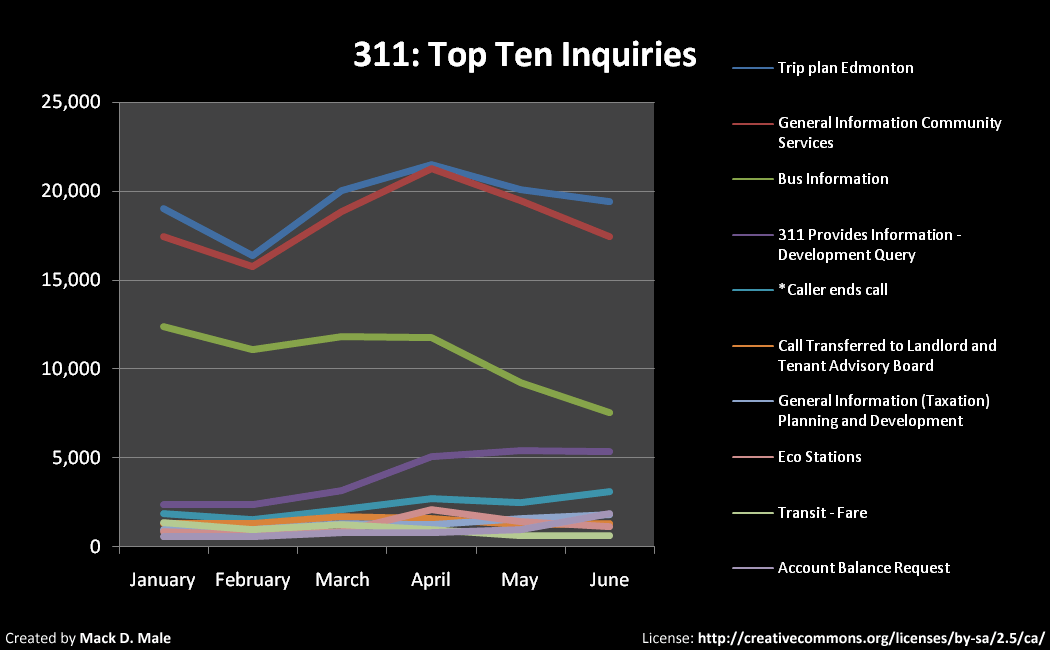
The report contains information about the top ten services:

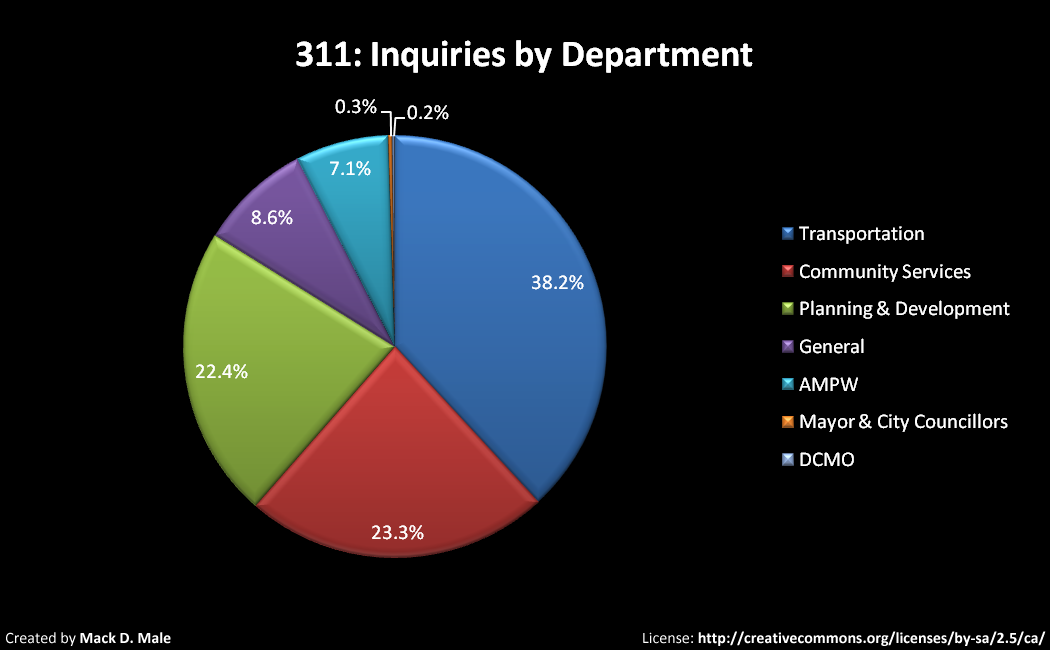
Transit inquiries make up a significant portion of all 311 calls, followed by Community Services inquiries. There’s a clear opportunity for transit to do more to reduce the number of calls going through 311. I find it odd that trip planning is such a common request actually, given that there’s a separate number for that (BusLink) not to mention the online trip planner and Google Maps.

Here’s the breakdown by department:

There are a few more graphs (without data values unfortunately) in the report, so take a look at those too. They show that the number of calls answered within 25 seconds is on the rise, and that the time it takes to get through to someone is declining.

Does this report suggest that 311 is “a disaster”? I don’t think so. All it shows is that there is work to do, and it sounds like the 311 team is on the case. Hopefully the departments they serve are as well.