Edmonton’s Pedway: The Growth Years

This is the second part in a series of posts looking at the past, present, and future of Edmonton’s pedway network.

The pedway system we know today was largely built in the 1980s. According to the Edmonton Journal in 1990, projects with an estimated value of $679 million were completed between 1983 and 1989 downtown, including $20 million on Jasper Avenue, Rice Howard Way, and the pedway system.

One of the biggest projects was the extension of the LRT line, with construction on Bay and Corona stations beginning in 1980. Subterranean downtown Edmonton must have seemed like paradise in those days, because the LRT construction had an extremely large impact on downtown. Jasper Avenue was under construction for years, and that harmed businesses as much if not more than West Edmonton Mall (which first opened in 1981).

LRT Construction 1980s
Downtown construction, photo by ETS

It wasn’t just the LRT being built though. Of the roughly 40 buildings downtown connected to the pedway, half were built between 1974 and 1984. More buildings were constructed in Edmonton during the 70s than any other decade. It’s no surprise then that the pedway grew significantly during the latter part of this period and in the years immediately following it (as pedway construction tended to lag building construction).

Following the completion of Edmonton Centre in 1974, a series of office towers followed. TD Tower opened in 1976, with the Sutton Place Hotel (Four Seasons Hotel) and 101 Street Tower (Oxford Tower) following in 1978. All three had connections to the pedway built. The Citadel Theatre and Sun Life Place also opened in 1978, and the Stanley Milner Library, constructed in 1967, was first added to the pedway network that year. Canadian Western Bank Place, HSBC Place, and the Standard Life Building all opened in 1980. ATCO Centre and Enbridge Place opened in 1981, followed by Bell Tower and Scotia Place in 1982. Manulife Place and the Shaw Conference Centre opened in 1983. Canada Place capped off a busy period of construction in 1986.

Pedway connections were often added years after a building was first completed. Scotia Place was connected via an above-ground bridge in 1990 when Commerce Place (Olympia & York) opened (though it already had an below-ground connection). The Royal Bank Building, built in 1965, didn’t get a pedway connection until April 1993, one month after an above-ground pedway was built connecting Manulife Place and Edmonton City Centre (Eaton’s Centre). Construction of these connections did not always go smoothly. The bridge connecting City Centre and Manulife was delayed for a variety of reasons, but one was that the hallway from City Centre did not line up with existing “knock-out” panels that Manulife Place had for future pedway construction. That meant blasting through a wall that was not designed to be opened. Still, the bridge came in at a relatively inexpensive $200,000 (the typical above-ground bridge could cost up to $500,000 at the time).

Downtown Pedway c. 1980
Existing & Approved pedway connections, ~1980

Downtown wasn’t the only place pedway-like connections were being built. A $64 million renovation of the Alberta Legislature grounds took place from 1978 to 1982, and one of the key features was an extensive underground pedway system. In the spring of 1985, the Business Building opened on the University of Alberta campus with an above-ground connection to Tory and HUB Mall. It would eventually be connected to the larger system in August 1992 when the University LRT Station opened featuring a below-ground connection to the Dental-Pharmacy Centre and above-ground bridge to HUB Mall.

Though connections continue to be added today, many Edmontonians considered the pedway “complete” in 1990 after two key projects. The first was the extension of the LRT to Grandin Station in 1989, finally linking the downtown pedway network with the Legislature pedway network. The second was much more controversial.

The pedway linking Edmonton Centre and Churchill LRT Station was often called “the final link” in the pedway network. When the City first put the project out for tender, no bid came in at the budgeted amount of $4.9 million. The lowest bid was 14% higher, bringing the cost to $6.2 million. The original design called for a glass wall and an amphitheatre under Churchill Square, in addition to the removal of 16 elm trees. Council requested that the design be tweaked and re-tendered. That delayed the project, but the plan worked. The pedway we know today was designed by MB Engineering Ltd. and constructed by Chandros Construction Ltd., right on the original $4.9 million budget.

Edmonton Centre contributed $600,000 of the budget, and insisted on the skylights and planter boxes. Jim Charuk, Edmonton VP of Oxford Development Group, said at the time that anything less would have become a “people sewer.” The pedway connection first opened for Christmas shoppers on December 14, 1990. It closed during January 1991 so that finishing touches could be put on the project. The pedway officially opened to the public on February 18, 1991.

With the addition of City Hall in 1992, the Winspear Centre in 1997, and the Art Gallery of Alberta in 2010, the downtown pedway network has continued to grow. But today’s network was largely built in the 80s, and it shows.

P3, or not P3? That’s the question as we try to fund Edmonton’s future LRT

In October of last year, Council approved the use of a public-private partnership (P3) to fund the Southeast to West LRT project. The decision came just days after the new LRT Governance Board was established, but it was largely overshadowed by the downtown arena news that week. Today Mayor Mandel announced, along with Minister of Finance Ted Menzies and Minister of Public Works and Government Services Rona Ambrose, that PPP Canada will invest up to $250 million to support the construction of the new LRT extension. While the funding is welcome, it is $150 million less than the City was hoping to receive from the federal government (the rest may come from a future Federal Infrastructure Plan).

“The City of Edmonton welcomes this important funding announcement by the federal government,” said Mayor Stephen Mandel. “The Southeast to West LRT is a key part of our transportation infrastructure. It will connect communities in Mill Woods and southeast Edmonton to the central core and is essential to our plans for building a better, more accessible city.”

The decision to apply for funding through PPP Canada was not an easy one, but Council did not have much of a choice. The City simply cannot afford to build the LRT on its own – the provincial and federal governments must come to the table. Though it hasn’t been explicitly stated as such by those involved, it seems the only way the Government of Canada would provide funding was through the P3 Canada fund. Calgary Mayor Naheed Nenshi has been vocal about his concern around being cornered into a P3, saying “the real problem is that the only dedicated federal funding at this moment is through P3 Canada.”

Let’s set aside for a moment the very big issue that the federal government is essentially dictating how municipalities should build and maintain their infrastructure. If given a choice, would we pick a P3 to build our LRT network?

What is a P3?

A public-private partnership is basically an approach to delivering and optionally operating and/or maintaining a project. Here’s how PPP Canada defines a P3:

“P3s are a long-term performance-based approach for procuring public infrastructure where the private sector assumes a major share of the responsibility in terms of risk and financing for the delivery and the performance of the infrastructure, from design and structural planning, to long-term maintenance.”

In theory, a P3 can help to ensure projects are delivered on-time and on-budget. The idea is that having the expertise of the private sector can lead to better, more innovative solutions. Another benefit of a P3 is that the private sector takes on a share of the risk, which means that there is a profit motive to ensure the project is done well (at least in theory). This is often referred to as “pay for performance”.

The other thing that is important to know about the P3 approach is that there are a variety of different delivery models. With traditional procurement, the public sector is responsible for the design of an asset like a bridge or school, with construction being contracted out to the private sector through a competitive bidding process. After construction, the asset is handed back to the public sector for operation and maintenance. This model is known as Design-Build (DB).

Using a P3 for the procurement of new assets, there are three delivery models to consider:

  • Design-Build-Finance (DBF)
  • Design-Build-Finance-Maintain (DBFM)
  • Design-Build-Finance-Operate-Maintain (DBFOM)

The level of private sector involvement goes up which each model. Under the DBF model, the private partner assumes the risk of financing the project until construction is complete and the asset is handed over to the public sector. With the DBFM model, the private sector also assumes the maintenance of the asset in exchange for payments throughout the operating period. And finally, the DBFOM model is used for projects that have long-term operation and maintenance handled by the private sector, such as roads.

The P3 model is relatively new (becoming popular in the 1980s) but is already used all around the world on a variety of different projects. PPP Canada was established in 2009 to oversee the $1.2 billion P3 Canada Fund, but that was certainly not the start of P3s here in Canada. From 1990 to 2001 more than 150 P3s were concluded throughout the country.

Can a P3 really work?

Here in Alberta, we’ve used P3s to build ring roads and schools in both Edmonton and Calgary, as well as a water treatment and wastewater treatment facility in Kananaskis (a project that EPCOR is the private partner on). It hasn’t been all smooth sailing however, as Godfrey Budd explains:

Although 18 Alberta elementary and elementary-junior high schools, built on the P3 model, opened in September, and another 10 such schools are going ahead as a P3, four high schools were dropped from what was to have been a 14-school package. In May 2009, the province, citing "the economic climate," announced that the four schools would instead go ahead on a design-build basis. Also, six months after a September 2008 provincial news release announcing the go-ahead for the 18-school package, one of the partners in the P3, Babcock and Brown, the project’s banker, collapsed under the weight of $3.8 billion of debt, and in August 2009 Deloitte was appointed liquidator.

Another issue has been the lack of transparency that seems to come with P3s – it’s not always clear whether the approach saves money or not. Some, such as Alberta Federation of Labour president Gil McGowan, are convinced that P3s rarely work:

“P3s almost never work out in the public interest. Governments around the world have had experience with P3s, and in almost all cases they end up costing taxpayers more and creating enormous headaches down the line. It may look cheaper up front, but the experience with P3s is clear. The private developers are never satisfied with the amount of money the governments put on the table in the beginning, and come back asking for more.”

For its part, PPP Canada says that a P3 can work for larger public infrastructure projects, but notes that governments can borrow money at far lower rates than the private sector can. It says that “a detailed value for money analysis is required to assess whether the costs exceed the benefits.”

The case for a P3 to build the Southeast to West LRT

A couple of weeks after Council decided to pursue funding through the P3 Canada Fund, I sat down with Nat Alampi, the Program Manager for the Southeast to West LRT project. Nat has had experience on LRT projects in the past – he managed the preliminary engineering designs for the South LRT extension and the Northeast LRT extension to Gorman. I wanted to know why the City thought using a P3 was a good idea, given the risks that seem to go along with that decision. “Every project has its challenges, regardless of whether you use a P3 or not,” he rightly stated.

Nat explained that it was EXPO 2017 that initially caused the City of Edmonton to start exploring the use of a P3. That investigation led to the adoption of the City’s policy on P3s (C555) and an assessment of the entire LRT network. “We determined there would be a net savings to using a P3,” Nat said. In its presentation to Council last October, City Administration suggested that savings could be between 3% and 10% using the DBFOM model.

A private partner operating the LRT?! “Operating the train and maintaining the infrastructure so closely intertwined,” Nat explained, “that separating them carries significant risk.” While the City did assess the feasibility of retaining the operating portion of the project, it ultimately felt it would be better served by pursuing the DBFOM model. “Typically with a P3 just for build, you get a two-year warranty,” Nat told me. “In this case, we’re getting 30-year warranty.” Of course, any contract would have provisions to allow for an extension of the operations and maintenance period, further expansion of the line itself, and there would likely also be a handback condition. For transit users, the new line will still look and feel like an ETS line (though it will use low-floor technology). “We will still set the fares, the look, and deliver security,” Nat said. The City would also be able to prescribe the level of service required, to ensure it matches the rest of the system.

Nat suggested that procuring a P3 like this could take 12-14 months and would generally require having the necessary funding secured. If all goes well, a P3 contract could be in place by the end of the year, with utility relocation and other preliminary work taking place in 2014.

The case against P3s for Public Transit

When I first learned that Council was considering a P3 for the Southeast to West LRT, I immediately thought of Taras Grescoe’s latest book Straphanger. It’s a fantastic read for anyone interested in public transportation and the impact the automobile has had on our cities. Near the end of the book, Taras addresses the notion that the private sector can successfully build and operate public transit projects:

For transit to remain sustainable, we’re going to have to ignore the zealots who call for its complete privatization, which has proven such a disaster in Britain and Australia. There is a reason that the transit network of almost every major city in the developed world was municipalized at some point in its history: while private companies can do a creditable job of operating the busiest lines, time and again they have filed to manage complex transportation networks in the public interest. The lessons of history show that public agencies with regional scope and unified planning oversight do the best job of running public transport.

Taras graciously agreed to speak with me in October, and I asked him to elaborate on this point. “I’ve seen how private lines can be fantastic in a place like Toyko where they have the revenue and density,” he told me. “But I’m skeptical that private companies can get the return in a low-density place like Edmonton.”

In the book Taras talks about the Canada Line in Vancouver, built for the 2010 Winter Olympics:

The Canada Line to the airport…was the first major piece of transit infrastructure in North America to be built with a public-private partnership, an initiative many commentators say was plagued by corner-cutting. Three stations had to be eliminated from the planned route, and the station platforms that were built were too short to allow future expansion. Thanks to cost overruns, the provincial government will be compensating the private company that operates the line with payments up to $21 million a year until 2025.

While many now point to the project as an example of a successful P3, Taras disagrees. “You’re essentially entering another system when you get on the Canada line,” he told me. The line uses the same fare system as the rest of TransLink, but there are some exceptions (such as the $5 YVR AddFare).

Another well-known P3 transit project in Canada is in Waterloo, where officials are also looking at a 30-year DBFOM contract. Much has been written about the potential issues with that project, but this post does an excellent job of summarizing everything. A few highlights:

  • “Probably the biggest problem with a P3 arrangement for Waterloo Region’s LRT is that it would result in higher barriers to expansion of the system in various ways.”
  • “On the one hand, using private companies to build and operate the line ostensibly means that expertise can be brought in when needed, and only when needed. On the other hand, this means that expertise in LRT construction, operation, and efficiencies thereof will never be gained by Waterloo Region.”
  • “Private operation as a 30-year contract is problematic because it locks us into one operator who can make extension difficult, and a contract which may become uncompetitive ten years down the line.”

Those concerns align nicely with the final thought that Taras left me with: “Transit is not about one line, it’s about a network and making it work for everybody.”

Final Thoughts

The first thing Taras said to me when we chatted was that “any transit construction of this kind is better than none.” While I’m definitely excited to see our LRT network expand, I’m not convinced that a P3 is the way to go. History suggests we should tread very carefully indeed. The City has not yet built anything using a P3, and that lack of experience could be an issue. In theory we should be able to take advantage of the lessons learned in other places, but we all know that’s easier said than done.

So long as we can secure the balance of funding required, It would seem there’s no turning back now for the Southeast to West LRT line – Edmonton will soon embark on its first P3 project. Let’s hope that doesn’t turn out to be a costly mistake.

LRT Construction Downtown: Short-term pain, long-term gain!

I’m excited about the expansion of our LRT network and what it’ll mean for Edmonton. It’s going to take a while until the entire network is completed, but work is already underway. While I would definitely fall into the YIMBY camp on LRT construction, that doesn’t mean there aren’t annoyances along the way. I just keep reminding myself – short-term pain, long-term gain!

The North LRT to NAIT is a 3.3 km extension from Churchill Station to NAIT with a total estimated cost of $755 million. Construction began in 2011 and over the last couple of years there has been a lot of activity along 105 Avenue and 105 Street in particular. The new line runs right through Sharon’s route to work, so she has experienced first-hand the inconveniences caused by the construction. The City has been proactive about meeting with affected stakeholders, and they even have an interactive map online, but that doesn’t completely make up for the ongoing issues.

North LRT to NAIT Construction

Closures might mean a slightly different route for motorists or a few extra minutes of travel time, but the impact on pedestrians is often much larger. Closed sidewalks can mean large detours into unfamiliar and poorly marked territory. When it’s cold out, a few extra minutes in a vehicle isn’t such a big deal but for a pedestrian it can be (and that makes jaywalking an attractive option). You’re also much more likely to find signs for vehicles than you are for pedestrians. Other issues include construction noise and, thanks to our up-and-down weather, treacherous and messy conditions.

North LRT to NAIT Construction

The new extension is slated to open in April 2014. Short-term pain, long-term gain!

The Central Station LRT Rehabilitation is a renewal rather than an extension. It will repair issues with the roof and ensure the station is functional for years to come. The City is also taking the opportunity to make streetscape improvements to Jasper Avenue between 100 and 102 Street. I work in the Empire Building at Jasper Avenue and 101 Street, which is basically ground zero for the project (and there’s also the First & Jasper construction right across the avenue).

Central LRT Station Construction

The construction team has been good at keeping everyone in the area up-to-date, with notices in the mail and electronic updates delivered through our property manager. That doesn’t mean the daily maze is any less annoying, however. I try to go through the back of the building to avoid the mess altogether, but every few days I need to use the front entrance for some reason, and determining how to navigate through the ever-changing array of fences gets old fast. There’s always construction noise to deal with too, though thankfully there have only been a few occasions when it has been disruptive.

Central LRT Station Construction

I know that travelling down 101 Street for vehicles sucks because traffic moves so much slower through the construction, but at worst you’re looking at a few minutes of delay. Compare that to the impact on pedestrians. Walking from the Empire Building to Scotia Place used to take a few seconds, we’re talking probably 30 steps or so. Now because of the fencing and detours, it takes probably ten times that! That’s a significant impact (though a little extra walking never hurt anyone).

The project isn’t expected to be complete until October 2013. Short-term pain, long-term gain!

We need to improve public transit between downtown and Old Strathcona

Living downtown, I have excellent access to public transit. The Bay/Enterprise Square LRT stop is just down the block, and major bus routes like the 1, 2, 5, 7, 8, and 9 are all just a short walk away. As a result, I try to take transit whenever I can. While most of my activities and appointments are downtown, the other two key areas for me are 124 Street and Old Strathcona. Travelling to 124 Street or nearly anywhere in-between is quick and easy, but the same cannot be said for getting to Old Strathcona.

If I want to meet with someone who is on the southside, Old Strathcona is an ideal location. It’s also a popular spot for evening events, and of course the unique shops and restaurants along Whyte Avenue are a draw. But I always dread travelling to the area from downtown because it’s almost always easier to drive. Given that Old Strathcona is very central and not very far from downtown, I find that hard to swallow.

If I want to go to High Street, I have a number of options. Google Maps tells me that getting from the Sobeys on Jasper Avenue at 104 Street to the Mountain Equipment Co-op at 124 Street and 102 Avenue should take about 5 minutes to drive (it’s about 2.6 km). If I wanted to walk, which I have done in the summer, it takes about 35 minutes. The bus falls in-between those two, at anywhere from 13 minutes to 21 minutes, depending on the route. More importantly though, I have a number of options, and never have to wait very long. Here are two scenarios.

Let’s say I wanted to get there by 2pm on a weekday. There are many options to choose from:

  • Route 135 departs at 1:35pm and takes 14 minutes
  • Route 111 departs at 1:40pm and takes 7 minutes, followed by a 5 minute walk
  • Route 5 departs at 1:42pm and takes 14 minutes
  • Route 1 departs at 1:43pm and takes 11 minutes
  • Route 2 departs at 1:47pm and takes 6 minutes, followed by a 5 minute walk

And if I miss those, I’m not waiting around forever. At that time of day, route 135 comes every 15 minutes. So does routes 1 and 2. Route 5 and 111 run every 30 minutes.

Let’s say I wanted to get there by 7pm instead. Again, on a weekday, we have a number of options:

  • Route 120 departs at 6:38pm and takes 14 minutes
  • Route 5 departs at 6:42pm and takes 11 minutes
  • Route 1 departs at 6:43pm and takes 11 minutes
  • Route 2 departs at 6:50pm and takes 5 minutes, followed by a 5 minute walk

Again, both routes 1 and 5 run very frequently (actually less than 15 minutes according to Google Maps).

Now let’s compare that with travelling to Old Strathcona. According to Google Maps, the trip from Sobeys on Jasper Avenue at 104 Street to Starbucks on Whyte Avenue at Calgary Trail should take about 9 minutes to drive (it’s about 3.9 km). I haven’t actually tried it (at least not directly) but walking should take about 45 minutes.

Now how about taking transit? Here are your options:

  • Route 52 departs at 1:19pm and takes 20 minutes, followed by a 3 minute walk
  • Route 7 departs at 1:20pm and takes 21 minutes
  • LRT to University departs at 1:32pm and takes 7 minutes, followed by a 6 minute ride on route 57, plus 1 minute to transfer
  • LRT to University departs at 1:42pm and takes 7 minutes, followed by a 6 minute ride on route 4, plus 1 minute to transfer (gets you there 4 minutes late)
  • Route 57 departs at 1:44pm and takes 17 minutes, preceded by a 9 minute walk (gets you there 1 minute late)

Two of those options include a transfer from the LRT to the bus, which is less than ideal. But the real issue is that these routes do not run that frequently. If you miss the 7, you’re waiting half an hour. Same thing with the 52. And those two routes are only 1 minute apart from each other, which means you really are waiting another half hour.

For completeness, let’s look at 7pm again. Here are the options:

  • LRT to University departs at 6:23pm and takes 7 minutes, followed by a 6 minute ride on route 4, plus 1 minute to transfer
  • LRT to University departs at 6:33pm and takes 7 minutes, followed by a 5 minute ride on route 7, plus 1 minute to transfer
  • Route 7 departs at 6:39pm and takes 22 minutes (gets you there 1 minute late)
  • LRT to University departs at 6:43pm and takes 7 minutes, followed by a 6 minute ride on route 4, plus 1 minute to transfer (gets you there 6 minutes late)

Aside from route 7, which only runs every 30 minutes, you basically have to take the LRT and then transfer.

The numbers only tell part of the story. There’s also the actual experience of taking both trips. Going from downtown to High Street is a breeze – with so many routes running down Jasper Avenue, you don’t have to wait long until a bus comes that you can get on. Going from downtown to Old Strathcona is the opposite, especially if you decide to wait at the main stop across from Hotel MacDonald – you see sometimes half a dozen route 8 buses go by before your bus ever comes. It’s depressing.

I definitely feel that travelling between downtown and Old Strathcona on public transit should be better. Is ridership an issue, is that why we don’t have more options or more frequent service? It does seem like a route that could be popular, and it certainly seems like a route that should be easier to travel.

Tomorrow a report on the LRT Central Area Circulator is going to the Transportation & Infrastructure Committee. The Circulator would essentially cover the route I’m talking about – downtown to Old Strathcona. Here’s a look at the map:

The highlighted section would extend from the current Health Sciences Station west to the Bonnie Doon Station on the Southeast LRT line. The alignment for this extension has not been identified yet, but it looks from the map as though it might run slightly south of 82 Avenue. The report highlights the importance of this segment:

Lack of clarity regarding this segment of the LRT network creates public uncertainty. Developing an alignment in full consultation with community stakeholders will improve public understanding around the network, particularly regarding the alignment through the Strathcona and University areas and how the line will cross the river near 109 Street. Designation as a future LRT connection to the Southeast and West LRT line would clarify land use expectations and improve the likelihood of densification and other transit oriented development.

While the recommendation is simply to receive the report, it sounds like funding may finally be coming to allow Administration to move forward:

In order to complete this planning exercise, a one-time budget request is included in the 2013 Operating Budget as an Unfunded Service Package. This budget would be used to retain a consultant to develop an alignment recommendation for the Central Area LRT Circulator.

I think this extension to the LRT would make a lot of sense, but it’s still a long way off. In the meantime, I think either more frequent bus service or additional bus routes between downtown and Old Strathcona would be welcome.

There are two other options worth mentioning. The first is that you could cycle the trip from downtown to Old Strathcona, which Google Maps estimates would take 18 minutes. That’s less than ideal in the winter, but it could be done. Cycling is definitely something I’d like to do more of next year, and it’s exactly this kind of trip that cycling would be perfect for.

The second option is the High Level Streetcar. From the May long weekend until Labour Day, it runs daily every forty minutes (between 11am and 3pm, except during the Fringe when it runs until 10pm). I think the Edmonton Radial Railway Society does a great job running the line, but perhaps we should operationalize it. The track is already there, and while there’s not much in the way of stops along the way, the route is great for getting from downtown to Old Strathcona and back again.

It shouldn’t be so hard to take transit across the river!

The Downtown LRT Connector should run along 102 Avenue

Today City Council is scheduled to vote on the recommendation from the Transportation & Infrastructure Committee to shift the route of the Downtown LRT Connector from 102 Avenue up to 102A/103 Avenue. I’m opposed to this change for a variety of reasons. Here’s what the Journal’s Editorial Board wrote on February 2:

Responsive government is indeed a positive thing, but Edmonton’s city council has done far too much listening at the expense of decisive action on the LRT file. Councillors approved the current east/west downtown leg along 102nd Avenue in 2010 – yes, two years ago – but on Tuesday the smaller transportation committee voted to recommend a route shift and other changes that could increase the project’s cost by $115 million and delay construction by at least a year to entertain more discussion and allow for further planning.

We know that LRT is our top priority, we know that LRT is vital for our city’s future as an enabling technology for our urban centre, and we know it will only get more expensive to construct over time. Further delaying this important infrastructure is not the correct course of action.

I am certainly not a fan of the way the City does public involvement (though there have been some more positive signs lately) but they did do a lot of consultation on this project. It is disappointing to see that if one group screams loud enough, they can render the rest of the consultation process irrelevant. It sets a dangerous precedent for future LRT construction too.

downtown lrt connector

The route that Transportation officials recommended back in 2010 makes the most sense to me. Here are some of the reasons you can find in the report:

  • 102 Avenue is already more developed than 102A Avenue, which means ridership potential is greater along 102 Avenue.
  • Related to that – all of the destinations are along 102 Avenue! The City notes there are 10 activity centres along 102 versus just 3 along 102A. Churchill Square, the Stanley Milner Library, the Citadel, the Winspear Centre, City Centre, the YMCA, Norquest College, the City Market in the summer, the Edmonton Chinatown Multicultural Centre, etc., are all along 102 Avenue.
  • 102 Avenue is closer to Jasper Avenue, and therefore closer for riders to make connections to other routes. 102 Avenue can connect directly to Churchill Station. I also like that 102 Avenue is half-way between 104 Avenue and Jasper Avenue, which will aid connections to MacEwan, the Arena & Entertainment District, etc.
  • Any option other than 102 Avenue will require an amendment to the Transportation System Bylaw and an amendment to the Capital City Downtown Plan. This would further delay any construction on LRT.

There are three key reasons that Council should vote against changing the route from 102 Avenue:

  1. 102 Avenue is more developed, has more people living and working along it, supports connections to existing transit best, and supports the Capital City Downtown Plan best.
  2. The 102A/103 Avenue route would add significant cost and further delays to the construction of this route.
  3. Changing course now sets a dangerous precedent that could negatively impact further LRT construction.

I strongly urge City Council to vote against the recommendation to change the route from 102 Avenue to 102A/103 Avenue.

UPDATE: Well that was a quick meeting! Council voted to keep the route along 102 Avenue as originally proposed. Excellent news!

Leading the Way: LRT Dance Party in Edmonton

Ever wonder what a dance party on the LRT would look like? I had the opportunity last weekend to find out! The Saturday evening activity for delegates of the 2011 Youth Summit on Sustainable Transportation was a DJ Dance Party on a chartered ETS LRT train.

LRT Dance Party

While we were touring the D.L. MacDonald LRT Garage in the afternoon, staff were busy getting the train prepared, adding streamers, disco balls, and lights to the interior. DJ Rob Wong also got setup with all of his gear and two giant speakers, one at each end of the train. After a quick dinner, we all boarded the party train! The train circled the garage a few times, apparently to make the most of our time.

LRT Dance Party

We then travelled the length of the LRT line, from Clareview all the way to Century Park, before travelling back as far as Churchill Station to let some people off downtown. In all, we spent about an hour and half on the train.

The music was loud, and slowly but surely most people started dancing! It was easier than you’d think to dance on the moving train, though whenever there was a sudden jolt it was just another reason for everyone dancing to yell and cheer. There were a few people who chose to just sit through the entire experience. It kind of reminded me of a high school dance in that way – slow to get going, with some people sitting off to the side the entire time.

Here’s DJ Rob doing his thing:

LRT Dance Party

Most of the dancing happened as we passed through a station. People on the platform would look at the train with bewilderment, and occasionally someone would give a thumbs up or clap. Faces filled with confusion just made everyone on the train dance and cheer even more! It became pretty obvious who among us were the exhibitionists. Here’s what it looked like for someone on the platform:

Unsurprisingly, the best part of the trip was the underground portion where it was darker. Tinted windows, dimmed lights, and some…uh, lubricant…would have made the dance party more like a dance party and less like a bunch of people moving around on the train! Maybe I’m just getting old.

That said, it was still a lot of fun. I absolutely love the concept of taking the LRT, normally seen as somewhat mundane (trains just get you from A to B), and using it for a completely different purpose. I think everyone enjoyed themselves! Obviously ETS doesn’t normally charter trains for this purpose, but I think they could if they wanted to. It’s certainly a unique experience!

You can see more photos here, and see more videos here.

Bringing Smart Bus technology to Edmonton

On Tuesday the Transportation & Public Works Committee will receive a report on Smart Bus technology. In short, Smart Bus technology is actually a collection of technologies that will help modernize Edmonton Transit’s entire fleet of nearly 1000 buses. It includes things like automated stop announcements, automated vehicle monitoring, and yes, GPS location services.

There are a number of reasons that this technology is becoming necessary. For instance, between 2000 and 2009:

  • Annual ridership increased from 43 million to 68 million (60% increase)
  • Annual service hours increased from 1.56 million to 2.08 million (30% increase)
  • Annual passenger concerns increased from 8,327 to 13,616 (60% increase)

During the same timeframe, the number of staff to manage service and concerns increased from 25 to 30, which is just a 20% increase. In other words, “staffing has not kept pace with the growth and complexity of the increased workload.” I would add that if we really want to shift Edmonton’s transportation modes, we need to ensure our transit system is modern and efficient.

That’s where Smart Bus technology comes in. The technologies include:

  • Automatic Vehicle Location
  • Computer-Aided Dispatch
  • On-board Mobile Data Terminals
  • Real-Time Passenger Information Systems
  • Automated Stop Announcements
  • Automated Vehicle Monitoring

What will those technologies do for the day-to-day transit rider? Automated Vehicle Location and Real-Time Passenger Information Systems means no more waiting outside when it is 30 degrees below zero for a bus that is running late – you’ll be able to see the real-time location of your bus using the web or a mobile device. Computer-Aided Dispatch and On-board Mobile Data Terminals means that three buses on your route will never be running together – they’ll be evenly spaced out and thus will stay closer to the schedule because ETS control will know where they are and can provide direction. Automated Vehicle Monitoring means fewer buses broken down on the road, and fewer spare buses sitting in the garage – it’ll help ETS monitor the health of its vehicles to ensure they stay on the roads.

The other technology, Automated Stop Announcements, is really what drove this report in the first place. In some jurisdictions, calling out stops has become law, and there have been fines handed out when drivers failed to call out stops. There is no such legislation here, at least not yet, but we shouldn’t have to wait for that to happen. Automated Stop Announcements is an important accessibility feature of modern transit systems, and helps to support Edmonton’s diverse community of transit riders.

The report has been written to highlight the direct benefits to Edmontonians, but there’s important benefits for ETS itself too. The fleet size for 2011 is 959 buses, and that number is not getting any smaller. It’s amazing how much is done manually at the moment, and how “in the dark” ETS control is most of the time. There is no live telemetry from buses right now, which means any information control does receive is via radio transmission. I have heard that even on a normal day, there are a couple thousand calls into control from drivers. Furthermore, bus maintenance is difficult at best right now. There is scheduled maintenance of course, oil changes, etc., but really until a bus breaks down and must be towed into the garage, ETS doesn’t know if something is wrong. And because of the size of the fleet, the garage is packed – buses are parked nose to tail. The automated vehicle monitoring would let ETS know if something was wrong on a bus currently on the roads, and would enable them to pull problem buses into a “trouble lane” when they come back into the garage.

In the implementation details, the report says that tapping into the City’s open data catalogue “could” be possible. I think that once we have GPS technology on the buses, making that information available to citizens is vitally important and should be considered a “must”. In other cities with the technology, coffee shops have mounted LCD screens that show when nearby buses have arrived (kind of like airport display screens). Citizens always know where the bus is simply by glancing at their mobile device. ETS cannot be expected to write all of that software – Edmontonians will, as long as the data is made available (likely as an API rather than in the catalogue, because the data is “live”).

According to the report, outfitting the entire fleet with all of this technology would cost $32.7 million, and would cost $4.3 million to operate each year. It would take between three and five years to roll out completely. A pilot has been proposed (for 50 buses covering 2 routes) which would cost $3.4 million and would likely start by September 2012. For budgetary purposes, a second option has been included, which is just the Automated Stop Announcements. That would cost $11.5 million to equip the entire fleet, and would cost $1.2 million  to operate each year. The corresponding pilot would cost $2 million.

City Council likes options, but they shouldn’t have one in this case. Going with just part of the technology doesn’t make sense. It’ll deliver only partial benefits today, and will cost much more in the future to add the other technologies (which we will have to do at some point). Furthermore, if the Smart Bus technologies are separated, that opens the door for multiple vendors and thus integration problems. I really hope Council recognizes the importance of having all of the Smart Bus technology together at once and doesn’t delay unnecessarily (though I do think it would be worthwhile to figure out if/how Smart Bus technology can be deployed alongside the proposed civic smart card).

I think $33 million to make Smart Bus technology happen across the entire ETS fleet is worth it. The notion of using commodity GPS systems (like cheap cell phones) is attractive, but probably unrealistic given the harsh environment of a bus (hardware needs to be hardened and you can’t be running out to replace components all the time) and other operating requirements. The suite of Smart Bus technologies will provide major benefits to both riders and to ETS itself. And to be frank, the proposed budget is a rounding error compared to the amount of money we plan to spend on LRT, and we need buses to efficiently feed our LRT system to really get the return on investment that is possible.

Let’s bring Smart Bus technology to Edmonton!

You can see the report and attachments here, and you can follow along on Tuesday here.

Edmontonians rank public transportation as the City’s top priority

If it were up to me, that would be the headline on the front of every newspaper and at the top of every news broadcast in Edmonton today. The result was buried in the middle of a report that goes to Council on Monday on the proposed downtown arena, but that makes it no less significant in my mind.

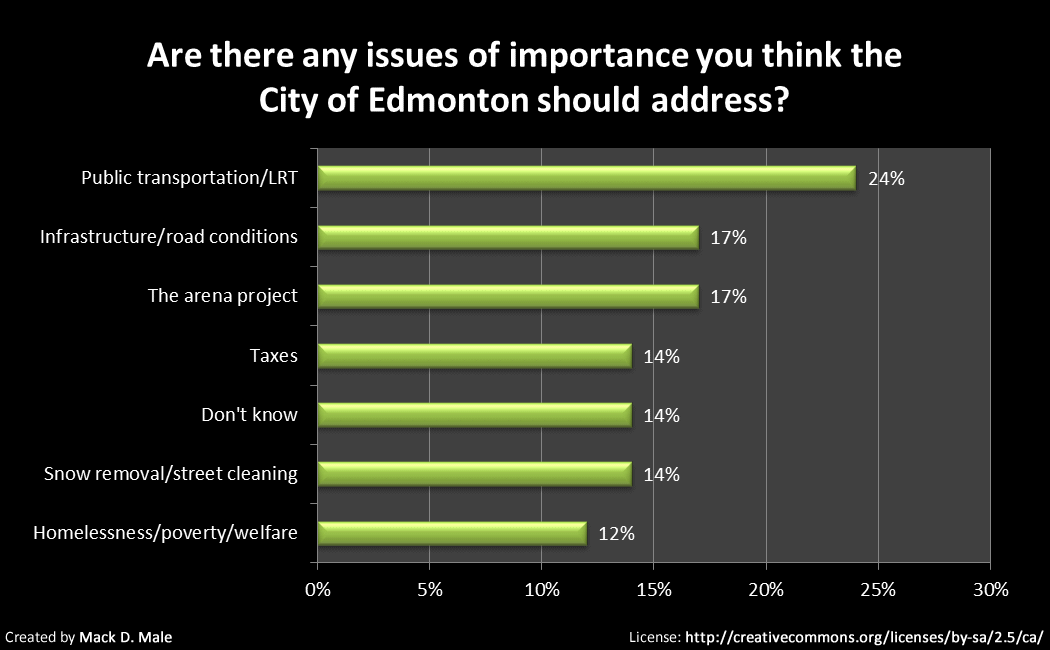
Edmontonians who participated in a statistically valid phone survey from December 20 to December 23 were asked what the key issues are that the City of Edmonton should address. Public transportation, and specifically LRT, came out on top.

The City is addressing this, of course, with an expansive plan to extend the LRT to all corners of the City. Shifting Edmonton’s Transportation Modes is also one of the goals in the City’s 10-year strategic plan, and public transportation is the key to achieving that. But we have to keep pushing. As the City’s Chief Economist John Rose said:

“[LRT is] the urban equivalent of an enabling technology – if you have it, you can do a lot of great things.”

Public transportation is costly – both to build and to operate. No question about that. But it’s worth it, and more importantly, Edmonton’s future success depends on it.

It’s important to remind ourselves, not to mention City Council, that improved public transportation is what Edmonton needs above all else.

LRT Expansion was never just icing on the Edmonton EXPO 2017 cake

Allow me to begin with a passage from the executive summary of The Way We Move, the City of Edmonton’s current Transportation Master Plan:

We are building a 21st century city, shaping an Edmonton that will meet the needs of our diverse and growing urban and regional population. Growing environmental concerns, acknowledgment of the ongoing investment needed to maintain our transportation infrastructure and the rapid growth of our city demand a shift in transportation priority setting. It is a shift from single passenger vehicle use to more public transit; from building outward to a compact urban form. From an auto oriented view of transportation to a more holistic view of an interconnected, multi-modal transportation system where citizens can walk, bike, bus and train efficiently and conveniently to their desired location.

The City of Edmonton is working to achieve this vision through the LRT Network Plan, as well as other initiatives. This vision does not ignore automobiles, but it certainly places greater emphasis on public transit.

At the top of the list of benefits that EXPO 2017 could have brought to Edmonton was funding for infrastructure. Was it the best way to try to get higher levels of government to commit to funding something that Edmonton so desperately needs? Perhaps not. But make no mistake about it: funding for LRT expansion was never just icing on the EXPO 2017 cake. Expanding our LRT network is vital for Edmonton’s future. Here’s what Councillor Don Iveson wrote nearly a year ago:

Projects like this require the alignment of at least two and, properly, three orders of government. It will require the relentless pressure of citizens on Councillors, but more particularly on MLAs and MPs.

He was right then and still is today. Our quest to be Canada’s host city for EXPO 2017 might have failed, but we cannot allow our plans for LRT expansion to fail as well.

At a news conference yesterday, Transportation GM Bob Boutilier questioned why Edmonton had not received the same level of federal support as Toronto has when it comes to funding for public transit, saying “I just think we’re owed. It’s time.” But he also suggested that LRT expansion plans would be delayed by a year or two now that EXPO is no longer in the picture, something that would potentially save money.

This is unacceptable.

It’s unacceptable that the expansion is being delayed, and it’s unacceptable that it’s Boutilier and not Council questioning the federal government’s support.

Why would LRT expansion have been fast-tracked with EXPO 2017 but not without it? Back in April, Boutilier said that meeting the deadline of 2017 was “do-able” with some creativity, noting that “we cannot use the conventional approach to building transit that we’ve used in the city up to this point.” A few weeks later, he suggested a board of directors to oversee the construction as a way to speed up the project. At the time, the cost of the expansion was pegged at “more than $3 billion”. It has since been narrowed down to $3.4 billion. So either it was going to cost significantly more than Boutilier was letting on, or the cost savings of delaying by a year or two are negligible.

I think Boutilier has one of the toughest jobs at the City of Edmonton, overseeing one of the most vital and controversial parts of the business, so I don’t envy the tough decisions he has to make. Boutilier should definitely be willing to make noise about the lack of resources he has, but in the same week that we lost EXPO, I would have liked to have heard some Councillors speak up for LRT as well. Instead, that job has been left to Boutilier and to EXPO bid committee chair Tony Franceschini. I’ve seen only Councillor Ben Henderson comment, saying “I personally don’t want to see us slow down.” Councillor Kerry Diotte also remarked on funding, “With the feds these days, who knows?”

I want my City Council to stand up for The Way We Move. If there’s a window of opportunity with regards to the federal government as a result of the EXPO decision, take advantage of it. Ask Administration to keep going, not to slow down. Make some noise. Show some of the emotion that Mayor Mandel showed on Monday.

The loss of EXPO shouldn’t be an excuse for us to slow down with LRT expansion. It should be a catalyst for increased pressure to get the job done.

Notes on the Downtown LRT Connector Concept Plan

On Tuesday evening the proposed Concept Plan for the Downtown LRT Connector was presented to the public at a very well attended event. The plan is the next step in the process that really kicked off on June 21 when City Council approved a street-level downtown LRT route. The proposed 2.1 km route will serve as a connector for the future West and Southeast LRT lines, with 5 stops and opportunities for transfers to the existing LRT system in the downtown core. The route runs primarily along 102 Avenue, connecting to the West LRT via 107 Street on 104 Avenue and to the Southeast LRT on 102 Avenue near 96 Street.

The Downtown LRT Connector was mentioned as a catalyst project for the Capital City Downtown Plan more than once. It forms an importance piece of both the six-legged LRT Network Plan and the so-called Downtown-University circulator.

Here’s what it looks like (the purple line):

Downtown LRT Connector

The Downtown LRT Connector will use low-floor LRT vehicles, which is the style all future LRT development will use (when possible). Low-floor LRT requires less infrastructure and enables step-free, street-level boarding. And yes, low-floor LRT will work in our winter climate!

Downtown LRT Connector: The Quarters in Winter

There are five proposed stops along the route:

  1. Campus Stop – Located diagonally between 108 Street/104 Avenue and 107 Street/102 Avenue. Land acquisition would be required, including the AADAC building. Potential for development around the stop. Serves MacEwan and NorQuest. Features a third track, which could be used as a staging area to prepare for large events, etc.
  2. 105/106 Street Stop – Located in between the two streets, where there are currently parking lots. Land acquisition would be required.
  3. Centre West Stop – Located across from Manulife Place, in between 102 Street and 101 Street. Requires no land acquisition. Would feature dedicated bicycle lanes in both directions.
  4. Churchill Square Stop – Located across from the Stanley Milner library. Requires no land acquisition. A second set of escalators/elevators would be built on the northwest corner of the 99 Street/102 Avenue intersection. Easy connections to existing LRT.
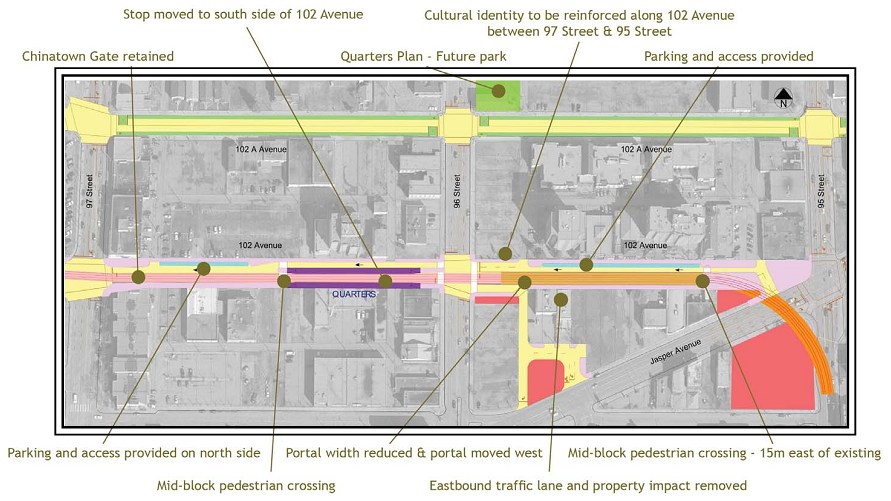
  5. Quarters Stop – Requires no land acquisition. Some traffic impacts: 102 Avenue at 96 Street would be closed to through traffic, and a single eastbound lane would be provided from 97 Street to maintain local access.

Here’s a rendering of the Churchill Square stop:

Downtown LRT Connector: Churchill Square Stop

The question & answer session covered a lot of topics. Here are a few notes I took:

  • The Downtown LRT Connector would use a different signal system. Rather than an exemption (the current LRT always has right-of-way) the LRT would receive priority, but may hold at stations to allow traffic to clear.
  • Buses that currently run along 102 Avenue would of course be re-tooled to feed into the LRT system.
  • The bicycle lanes in the concept plan are primarily shared lanes, but there’s the potential for dedicated lanes in the future.
  • The location of the Quarters stop is further west than would be ideal, but as it dives into an underground tunnel to join the Southeast LRT there isn’t much flexibility. There are significant grade changes.

I also asked about the City Market, as the route would run right through the middle of it. I was told that the City has already had conversations with the City Market, and that they’re confident they’ll make it work (either spreading out along 102 Avenue a little more, or potentially just leaving everything the way it is…but with a train running through every 15 minutes).

I’m particularly excited for this route, living at 104 Street and 102 Avenue. It’ll mean I’m a block or less from both the existing LRT (at Bay/Enterprise Square) and the new lines (at 105/106 Street). Can’t wait to see it happen!

You can download the Downtown LRT Connector Information Booklet here (PDF).

The Concept Plan will be presented to the Transportation & Public Works Committee at a non-statutory public hearing on December 8, after which it will be forwarded to City Council for review in January 2011. You can check out the Downtown LRT Connector page for more information.