How much traffic do the Edmonton Journal and iNews880 get from Twitter?

Depending on who you talk to, Twitter is either killing news media or saving it. A recent analysis by Hitwise found that less than 0.2% of people who use Twitter wind up going to news and media sites (thanks to Karen for the link). Their analysis looks at Twitter as a whole though, and I’m not sure how well it accounts for local news sites. I believe very strongly that social media has the greatest impact at the local level (more on this in a future post). Given that, I have long wondered how Twitter has impacted local news media here in Edmonton. Last night, I finally did some analysis. I decided to explore how much traffic the Edmonton Journal and iNews880, Edmonton’s two top tweeting media outlets, received from Twitter last year.

@EdmontonJournal

First up, the Edmonton Journal. They’ve been tweeting news articles since at least January 2009, so I had lots of data to play with. They used tweetburner to shorten links until September when they switched to bit.ly. Using the APIs available from those services, I added up all the click stats for all the links posted by The Journal. Here’s what I found:
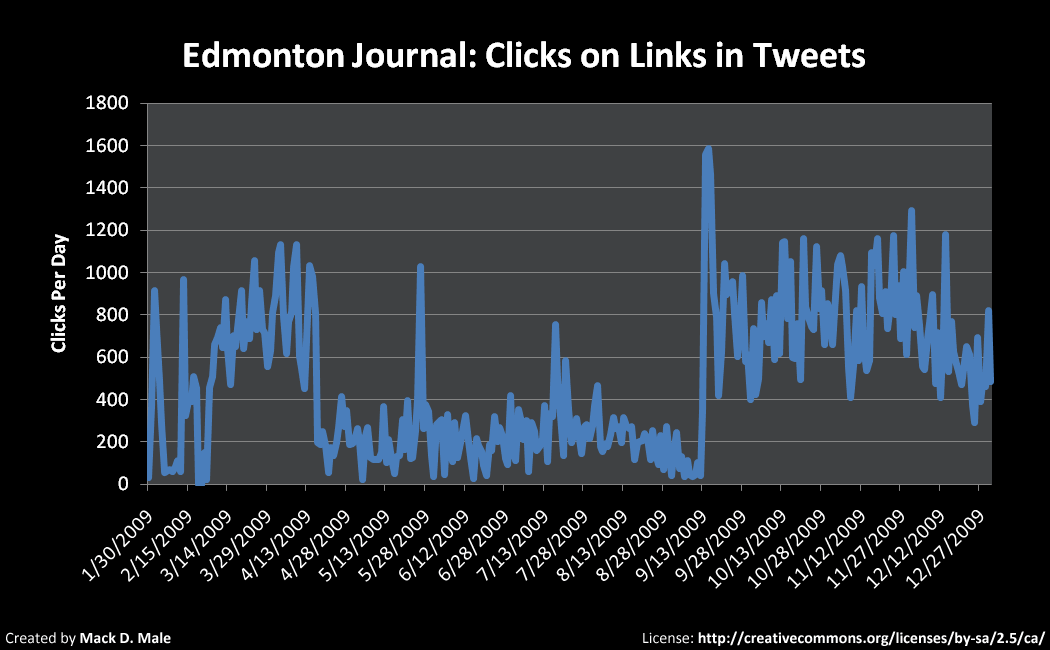
Lots of variation, as you can see. Some of that is down to the use of two services, some of it is because of the number of Twitter users. There are probably dozens of other factors too.

For the period January 30 through December 31:

  • A total of 153,968 clicks were recorded on 4737 links.
  • That’s an average of 33 clicks per link, and an average of 15 links per day.
  • According to the stats on the bit.ly links, 95.4% of clicks come from the Edmonton Journal’s hash*.
  • The link with the most clicks (700) was this one, on May 26. It doesn’t work, because annoyingly The Journal doesn’t display old articles for some reason, but it appears it was about Edmonton’s Poet Laureate Roland Pemberton.
  • The day with the most clicks, September 14, doesn’t appear to be special…just lots of clicks that day for some reason (any ideas?).

@iNews880

Next up, iNews880, one of the first local media organizations to join Twitter. They used tinyurl.com until July, when Twitter switched the default to bit.ly, so unfortunately I only have data for the latter half of the year:
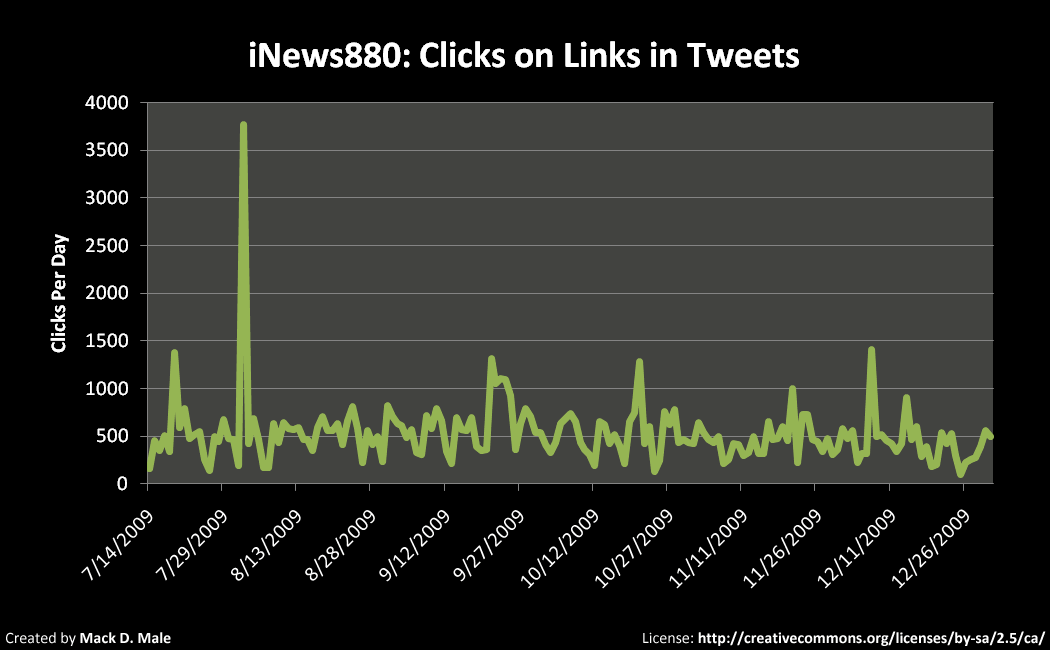
For the period July 14 through December 31:

  • A total of 90,500 clicks were recorded on 3811 links.
  • That’s an average of 24 clicks per link, and an average of 22 links per day.
  • According to the stats on the bit.ly links, 93.8% of clicks come from iNews880’s hash*.
  • The link with the most clicks (1933) was this one, on August 2 (that’s the huge spike in the graph above). The link goes to the report on the Big Valley Jamboree stage collapse, and it was popular because it included before and after photos.

Edmonton Journal vs. iNews880

I wanted to do a quick comparison, so I chose the period September 17 through December 31, because both sites used bit.ly for links during that time. Here’s what it looks like:
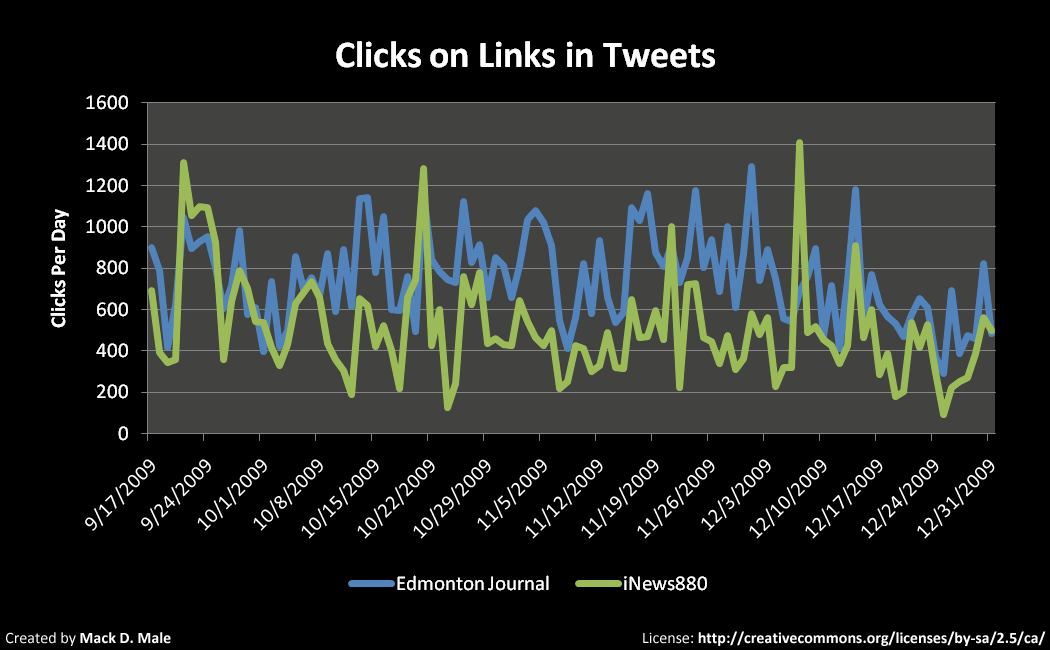
During that time:

  • The Edmonton Journal posted 2369 links (23 per day) and iNews880 posted 2261 links (22 per day).
  • A total of 79,519 clicks were recorded on Edmonton Journal links (an average of 751 per day or 34 per link).
  • A total of 53,815 clicks were recorded on iNews880 links (an average of 508 per day or 24 per link).

Thoughts

That’s a lot of clicks! Clearly Twitter and other social networking sites (where most shortlinks are posted) are having an impact. But how much? According to the latest report by the Newspaper Audience Databank (NADbank), weekly online readership at EdmontonJournal.com increased by 35% last year to 115,900 from 85,800 in 2008. That’s an increase of 30,100 readers per week. According to the click stats above, The Journal received 3208 clicks per week in 2009. So what does that mean?

Roughly 10.7% of the Edmonton Journal’s online readership increase in 2009 came as a result of posting links to Twitter.

And if I had to guess, I’d say my analysis probably underestimates things. Apparently the NADbank data is based on surveys, so I’m not sure how accurate it is, but it’s probably within acceptable margins of error. I’m also not sure what exactly a “reader” is – a page view, a visit, etc.

Caveats

I’ve tried to be as accurate as possible, but I can’t make any guarantees!

  • All the click stats are current as of last night.
  • I’m suggesting that all the clicks come via Twitter, when that’s probably not entirely true. Links get passed around, displayed on websites, etc. But the shortlinks do originate at Twitter.
  • It’s possible that The Journal or iNews880 posted a link to somewhere other than their own sites, but uncommon. I did remove one link from the iNews880 dataset, because it pointed to an Environment Canada site (it was obvious, lots of total clicks as others have linked there too). For the rest, I’m making the assumption that the links point to the news sites.
  • I don’t know how reliable the stats from bit.ly and tweetburner are. I suspect they are quite a bit different than server logs or Google Analytics metrics.
  • I would assume that both services tweaked the way stats are calculated throughout the year, so 15 clicks on a bit.ly link in May is probably different than 15 clicks on a bit.ly link in December.

* – When you shorten a link using bit.ly, you get a unique hash. If I shorten the same link, I get a different hash. The stats are recorded and made available individually and in aggregate, however.

Edmonton Notes for 3/13/2010

Here are my weekly Edmonton notes:

Edmonton Notes for 3/6/2010

Here are my weekly Edmonton notes:

Edmonton Notes for 2/27/2010

Here are my weekly Edmonton notes:

Edmonton Notes for 2/20/2010

Here are my weekly Edmonton notes:

Edmonton

January 2010 Headlines: Edmonton Journal vs. Edmonton Sun

I think it’s fair to say that Edmonton’s two major dailies have strong stereotypes attached to them. The Edmonton Journal, as the capital region’s newspaper of record, is generally considered reliable, encompassing, and important, with an emphasis on politics and current events. The Edmonton Sun, which has just less than half of the Journal’s weekly circulation (according to data from 2008), is generally considered a bit more tabloid-like, with an emphasis on sports and special sections. But I’m not happy with stereotypes – I like data!

There is obviously much more to a newspaper than its headlines, but I figured that was a good starting point for comparison. Using data extracted from Twitter (which means it may be incomplete) I compared headlines from The Journal and The Sun for January 2010. I counted 662 headlines for The Journal (in blue) and 589 headlines for The Sun (in red).


The most frequently used words in The Journal’s headlines were: Edmonton, Alberta, new, fire, man, woman, Oilers, Calgary, gallery, and police.

The most frequently used words in The Sun’s headlines were: Haiti, Canada, city, man, Canadian, Edmonton, Alberta, Hatian, new, and quake.

Here’s a quick comparison of the average length, average number of words, and average Automated Readability Index (ARI) for each headline:

I’m not sure that calculating the ARI for a headline is valid, but calculating it for the collection of headlines isn’t valid either (because they aren’t equivalent to sentences). I did look at the collection though – The Journal used 865 complex words, whereas The Sun used 552 (a complex word is three syllables or more, as determined using this online tool).

I don’t know what the takeaway is here, but I thought it was interesting enough to share. I’ll probably revisit this again in the future, with additional news sources, and probably some sentiment analysis as well. If you have any suggestions, let me know in the comments!

CTV Edmonton launches Inner Tube blog

On Friday afternoon, just hours before the start of the Vancouver 2010 Winter Olympics, CTV Edmonton launched a new blog called Inner Tube. I’m not sure if the timing was just a coincidence or if CTV Edmonton purposefully wanted to “soft launch” the blog, but either way, this “online experiment of sorts” is something that’s worth paying attention to.

First, the key points:

  • Inner Tube is a group blog. Entries will be written by a variety of people at CTV Edmonton, including Carrie Doll and Josh Classen.
  • This is an Edmonton project, not something that came from Toronto.
  • Posts are edited for clarity, comments are moderated.
  • From the about blurb: “You’ll read stories about the inner workings of the news process, how we develop our stories, or just casual observations about what makes north central Alberta so special.”

I called Stewart Shaw, web guru at CTV Edmonton, to learn more about the site that he has been working to launch for the last six months or so. My first question was why it took so long! Stewart very democratically explained that many people just aren’t as comfortable with technology as the rest of us, and that convincing all of the necessary people took time (as it would have in any typical corporate environment). He was pleased with how things progressed.

Stewart told me that CTV Edmonton sees this as an extension of what they’ve been doing for more than 50 years. The station has always felt that it was part of the community, and the blog is just a modern way of ensuring that remains true. And while the CTV Edmonton account on Twitter has been quite successful, and most stories on the news website offer the ability to leave comments, neither offers the same kind of connection that the blog can (though Carrie Doll, Josh Classen, and other personalities regularly interact with other Twitter users). Stewart said that the Save Local TV open house last year opened some eyes – it was the first time in a long time that CTV Edmonton had invited the public to the station, and they were overwhelmed by the response. The idea with Inner Tube is to open up a little, to provide a glimpse behind the curtain from the people that make CTV Edmonton tick.

Local media blogs are not new, of course. The Edmonton Journal, iNews880, and Edmonton Sun have had blogs on their websites for a long time, with varying levels of success. The difference is that CTV Edmonton has created a group blog that everyone will contribute to, rather than individual blogs for each employee or personality. The idea is that it’ll be a little easier to keep fresh, and also to build a following with. I think the jury’s still out on which approach is more successful, but I like that CTV Edmonton is experimenting with something different.

Inner Tube is off to a good start, with roughly half a dozen posts already up on the blog. It’ll be interesting to see how it evolves – I hope it opens the door to even more online activity from the local media. Congrats to Stewart and everyone else at CTV Edmonton for launching Inner Tube, and good luck!

Edmonton Notes for 2/13/2010

Here are my weekly Edmonton notes:

Edmonton Notes for 2/6/2010

Here are my weekly Edmonton notes:

Edmonton Notes for 1/30/2010

Here are my weekly Edmonton notes:

Next Gen Engage YCYVNext Gen Engage YCYV

Photos of the Next Gen Engage event that took place on Thursday evening.