Edmonton Election 2013: Nomination Day Recap

Yesterday was nomination day at City Hall, the day that all candidates running in the municipal election needed to file their paperwork and pay their fees. As many of them remarked after making it through the line, “now it’s real!” It was exciting to be there to see the dozens of Edmontonians that were willing to put their names forward, not to mention all of their supporters. Of course, there was real business to be done.

Nomination Day
Returning Office Alayne Sinclair speaks to the media on Nomination Day

Dave Cournoyer and I were at City Hall for all the action, and last night along with Ryan Hastman we held a special edition of our EdmontonPolitics.com hangout to discuss nomination day. Here’s the archive:

Let’s take a look at the nomination day statistics (here are the 2010 stats). There are 119 candidates total, an increase of six from 2010. Here are the numbers broken down by race:

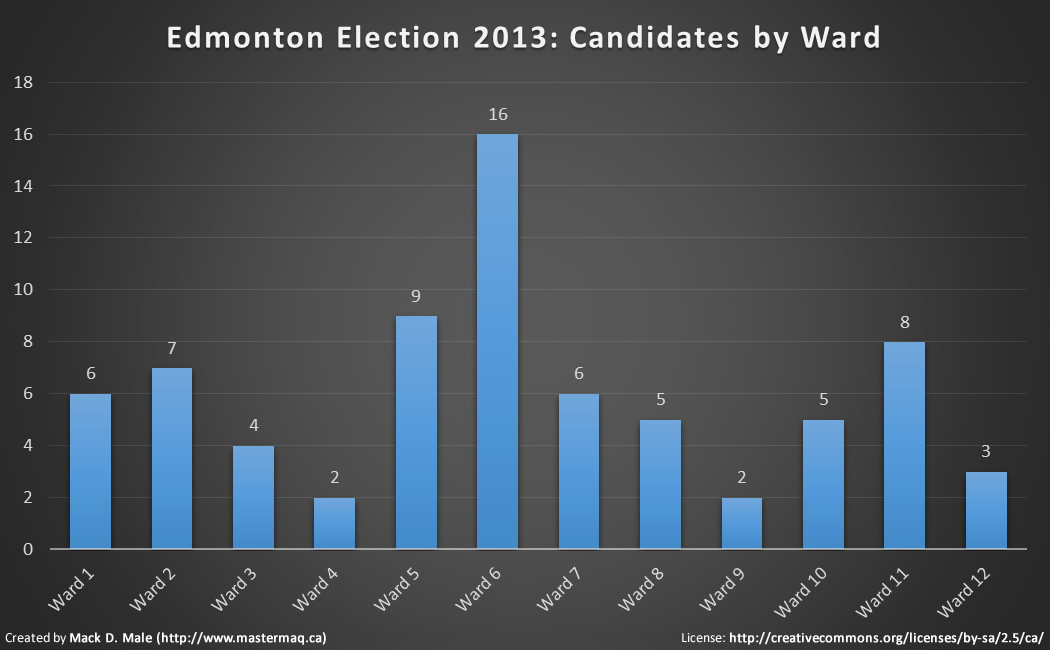
And here’s a closer look at the Council races in particular:

I wanted to include that chart to show just how different some of the races will be. Ward 6 has a crazy number of candidates at 16, whereas both Wards 4 and 9 have just one other candidate aside from the incumbent. The big surprise was Ward 8, which basically went from 1 candidate to 5 in a day.

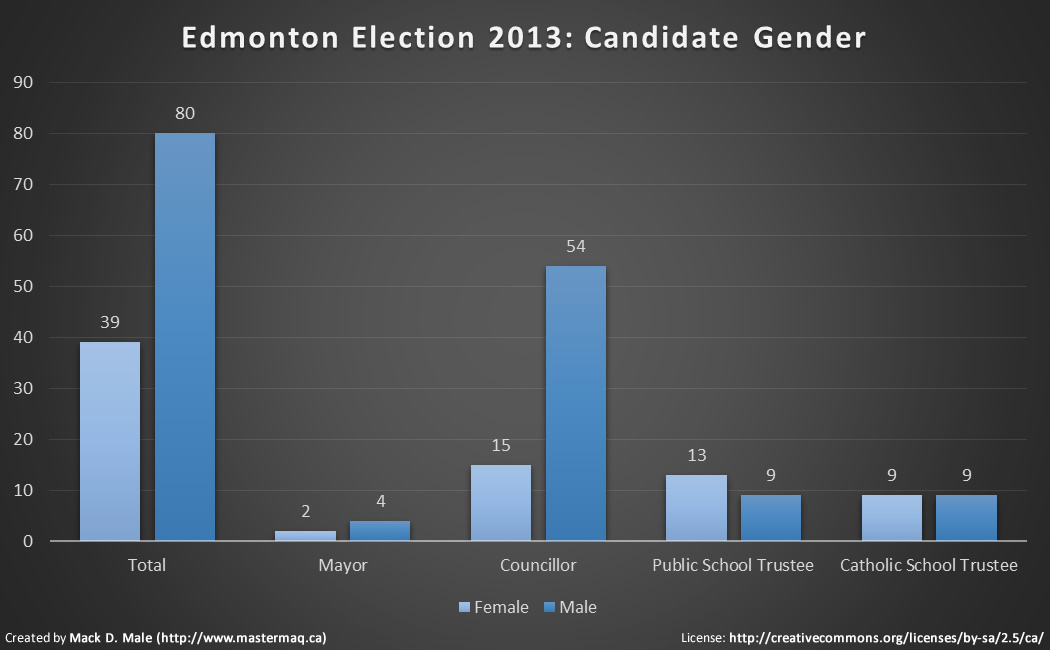
Here’s a look at the candidate breakdown by gender:

Roughly 32.7% of the field is female, which is actually the same percentage as 2010. While there were no female candidates for mayor in 2010, there are two this year (including one viable candidate). The number of female candidates for Council has decreased slightly from 22.6% in 2010 to 21.7% in this election.

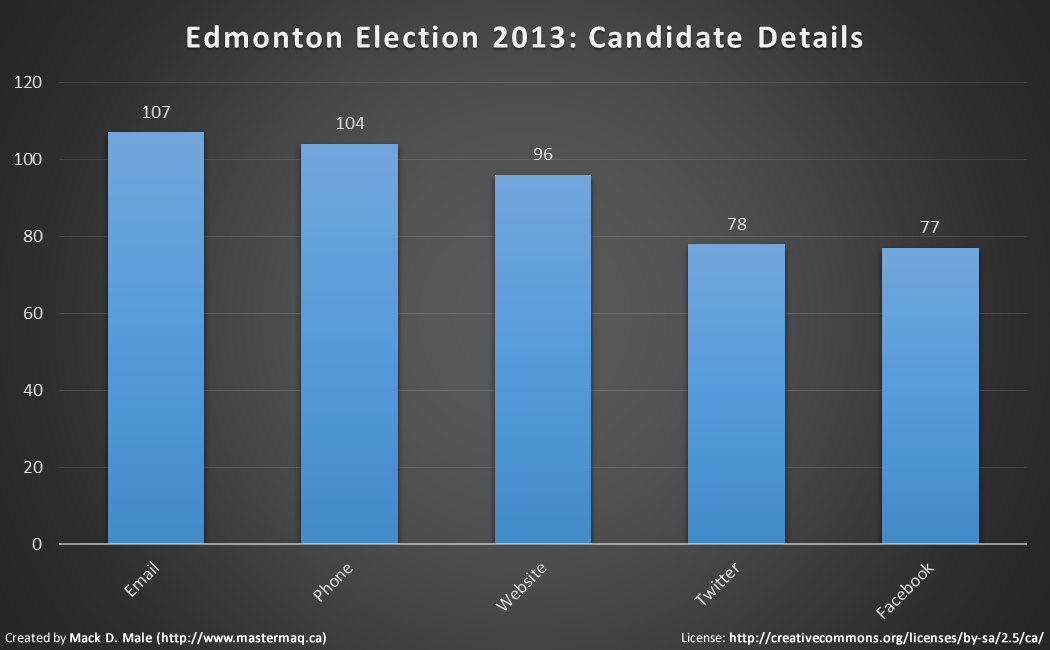
Here’s a look at how many candidates had contact details available on nomination day:

I was a little surprised to see email above phones, actually. And to see Twitter above Facebook. Of course, there could be more candidates with Twitter and Facebook accounts, but they hadn’t been discovered by myself or on Dave’s list by today at noon.

Speaking of email, here’s a look at which email domains candidates are using:

I am pleasantly surprised by the number of candidates that are using vanity domains! The reality is that not everyone is going to spend the $10 or so to get a vanity domain, but at least they outrank Gmail.

Nomination Day

No candidates had withdrawn their candidacy by the deadline today, so those 119 names will all appear on ballots come October 21!

If you’re looking to browse through the candidates, ShareEdmonton has you covered:

You’ll find contact details for each candidate, related tweets, and more. Stay tuned as ShareEdmonton aggregates everything you need to know about the election races.

For more photos from nomination day, check out my photoset and Dave’s photoset.

UPDATE: The original version of this post incorrectly stated that the number of female candidates was slightly higher in 2013 than in 2010, when in fact the percentage is the same.

Recap: OCL/DECL Ward 6 Candidate Forum

Tonight the Oliver Community League and Downtown Edmonton Community League co-hosted a candidate forum for Ward 6. Held at Oliver School, the forum was moderated by Beth Sanders. Along with a couple of other volunteers, she did a good job of keeping the eleven candidates in attendance on track (there are 13 on Dave’s list, but Bryan Kapitza and Javed Sommers did not take part). The turnout was pretty good for a Tuesday evening in mid-September, with approximately 125 people in attendance.

OCL/DECL Ward 6 Forum

From left to right, here are the candidates who participated tonight: Taz Bouchier, Kyle Brown, Candas Jane Dorsey, Derrick Forsythe, Melinda Hollis, Heather MacKenzie, Scott McKeen, Erin Northey, Adil Pirbhai, Alfie White, and Dexx Williams.

After opening statements in that order, Beth asked five questions from the organizers of the forum, then opened the floor to questions from those in attendance. There was time for five of those before candidates gave their closing remarks (in reverse order).

Here are the five questions asked by the organizers:

  1. If elected to Council, how would you continue the momentum of building Downtown as a centre of commerce and culture and a destination for all citizens of the city?
  2. Do you feel that the decision on the redevelopment of the Molson Crosstown site was the correct one? What would you do as Councillor to improve the City’s engagement process?
  3. As Councillor, how would you work to address the spike in violent crimes in recent months in the Oliver/Downtown neighbourhoods?
  4. Is there an adequate balance of housing options in the Oliver/Downtown core? If not, what deficiencies do you see and how would you work to address them as Councillor?
  5. If elected to Council, what important issue facing Oliver/Downtown would you give the most attention to and what would you do to ensure that it’s adequately addressed?

Each candidate had one minute to answer the question. The order was random – names were drawn from a hat. For the most part, the candidates kept to the time allotted and stayed on track with their answers. The five questions asked by citizens in attendance included one about the need for public washrooms in the core, one about supporting the arts, one about P3s, and one about regional cooperation. The only question that every candidate had the opportunity to answer was the one that received applause from the crowd: How will you make yourself more accessible?

On the question of improving the City’s engagement process, there were far too many non-answers along the lines of “I believe citizens need to have their voices heard.” This is an important issue that I’m confident will be repeatedly asked throughout the election, so I hope all of the candidates give it due consideration. Adil’s answer was that he’d hold numerous Town Halls, which isn’t a bad idea if you went about it the right way (hello technology!).

I was a little surprised at how many candidates were happy with the Molson Crosstown decision. More than a couple mentioned that they were happy to see the development going forward so that something could be done with the parking lots. Scott probably gave the answer the Oliver Community League members were looking for, saying  that “developers too often plan for Edmonton’s past.”

Far too many candidates completely bombed on the housing options question. Some, like Taz, took it to be a question about homelessness. Others offered nothing beyond saying diversity is good. Drawing on her own experience, Heather made a strong case for more diverse housing options in the core.

It was really interesting to hear what candidates felt the most important issue was. Dexx mentioned the issue of parking being unavailable for residents because non-residents use it all. Melinda claimed that the Municipal Development Plan isn’t actually a plan, and said she’d want to do something about that. Candas talked about the need for consultation. Scott mentioned the arena. Some mentioned housing, others mentioned tackling crime.

The vast majority of the answers tonight were “I believe” or “I think” answers, lacking substance or concrete ideas for action. I suppose it’s difficult to go much beyond that with just a minute to answer, but it still would have been nice to hear some specifics. I did not feel a great deal of confidence that the candidates up at the front of the room tonight have a solid understanding of what being a Councillor would entail.

OCL/DECL Ward 6 Forum

Here are my notes on the closing remarks:

  • Dexx highlighted his passion for the ward and reiterated that he’d work hard to ensure residents’ concerns were addressed.
  • Alfie admitted that this was all a new experience for him, but that he hoped to be able to represent the ward.
  • Adil expressed his distaste for projects like the arena, Indy, and EXPO 2017, and then went on to suggest that Council hadn’t said anything about the post secondary cuts. I guess he missed the State of the City Address.
  • Erin also admitted that this was a new experience and suggested that she’d be happy to just learn and make connections.
  • Scott praised the strong field of candidates, and said that Ward 6 could become the ward that slows urban sprawl.
  • Heather said responsiveness to the community and attracting more people to the core are both priorities.
  • Melinda said she’s passionate about the ward, and that city must grow responsibly, taking care to maintain the uniqueness of each neighbourhood.
  • Derrick focused his closing remarks on improving public consultation, and said a commitment to work with communities is needed.
  • Candas said that cities need to have big dreams, but also need to know how to pay for them.
  • Kyle said the ward needs someone who can represent the diversity you’ll find within it.
  • Taz highlighted her experience in community development, and said she’s familiar with legislation, bylaws, and the orders of government.

There were an awful lot of repetitive answers tonight, which is no surprise given the large number of candidates running (already there are five more declared than officially ran in the last election). I have no doubt the field will narrow in the weeks ahead (or at the very least some clear frontrunners will emerge).

Instead of picking “a winner” for tonight, let me simply mention the candidates that I thought did well. The two names most often mentioned as frontrunners are Scott and Heather, and I thought both did well. Scott only mentioned his journalism background a couple times, and had strong answers for all the questions. Heather cited her experience as a school board trustee a few times, and though she generally read from her notes, gave strong answers as well. Candas did well and had some of the more thoughtful answers of the evening. I think Dexx impressed me most tonight – he delivered a good amount of passion and was articulate in his answers.

Monday is nomination day, after which we’ll know exactly who’s running. The official Ward 6 forum will take place on October 9, so mark your calendars.

Thanks to the organizers of tonight’s event and to all the candidates who participated!

Edmonton does not have a debt problem

There has been a lot of talk about Edmonton’s debt recently, with some candidates going so far as to highlight debt as a key election issue. Debt is one of those topics that is easy to complain about but difficult to understand. Throwing out a billion-dollar number and proclaiming it bad is easy, understanding how we got to that number in the first place and how it fits into the broader context of the City’s financial situation takes more effort.

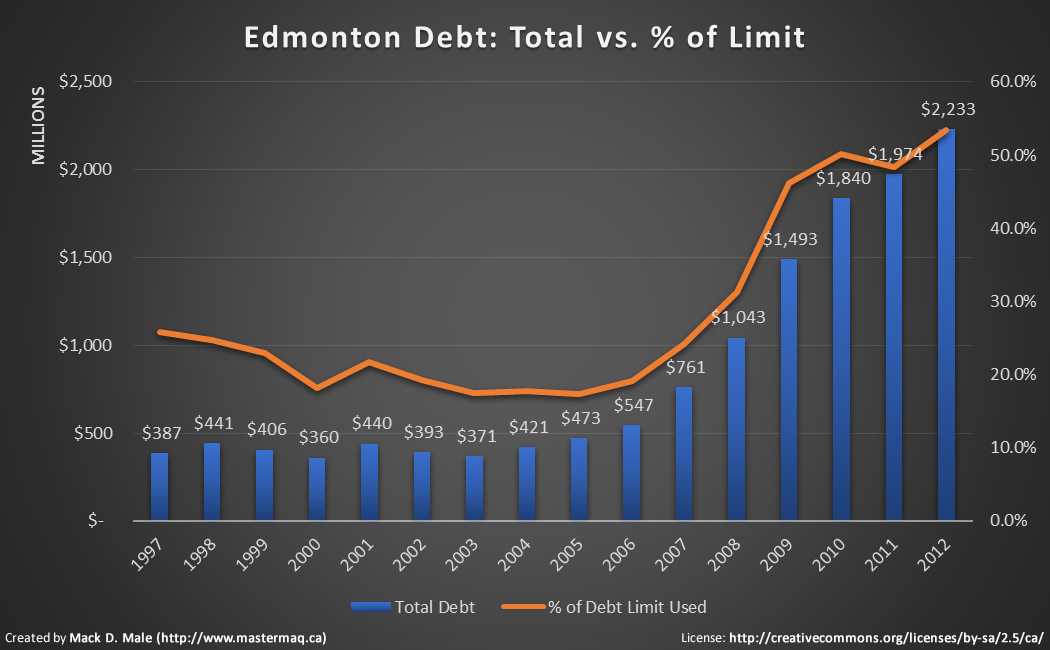
Here’s a look at Edmonton’s debt history for the last fifteen years:

So we can see that at the end of 2012 our city’s debt totaled $2.2 billion, which is 53.4% of our debt limit as outlined by provincial legislation. Is that high or low? Let’s make some comparisons. Here’s what Edmonton’s per capita debt looks like compared with Calgary:

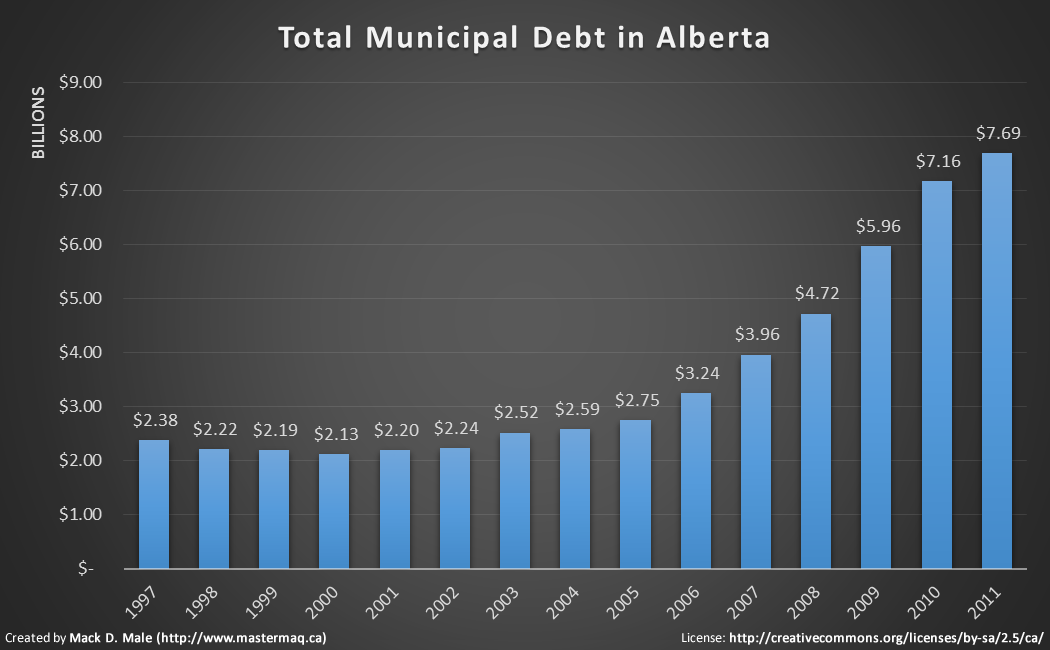
So we’ve got less debt per person than Calgary does, and have had significantly less over the last decade. What about the rest of the province? Municipalities collectively owed about $7.7 billion at the end of 2011, with Calgary and Edmonton together accounting for 69% of that amount.

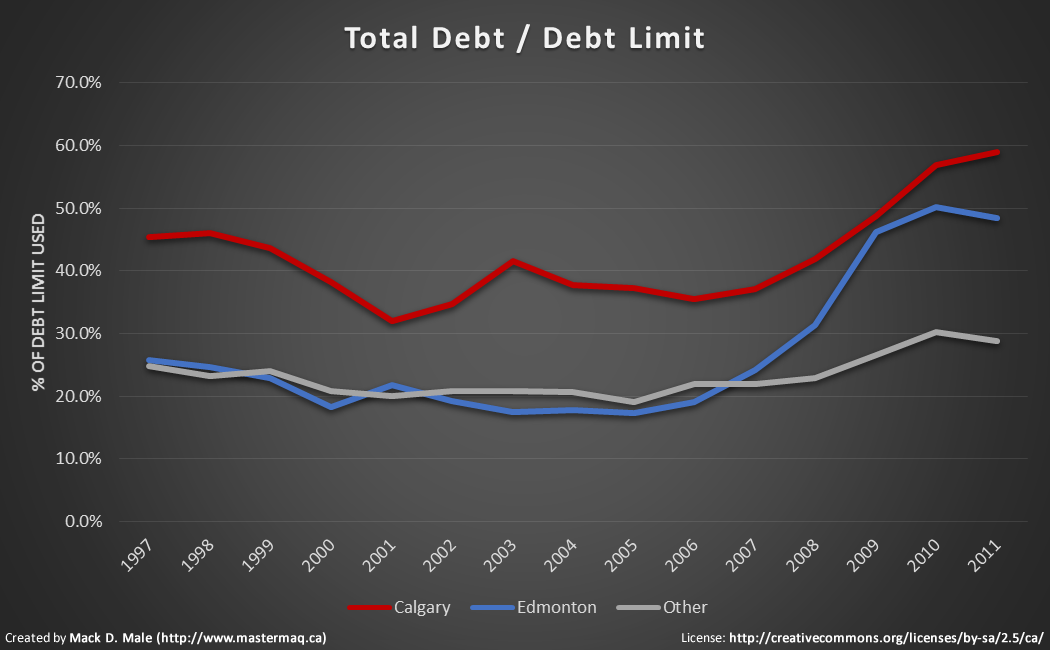
Here’s a comparison of the amount of available debt used by Calgary, Edmonton, and all other municipalities grouped together:

Notably Edmonton has used less of its available debt than Calgary, with the gap narrowing only in the last few years. It wasn’t until 2003 that we started to take on more debt. Why is that? And what is the impact?

Here’s what current Ward 6 candidate Scott McKeen wrote in the Edmonton Journal back in 2003:

And of all the cities in Canada, Edmonton stands out for being a skinflint among cheapskates. Our per capita debt is about one-fifth of Calgary’s and one-tenth of Vancouver’s.

As you’re maybe already aware, Edmonton’s hell-bent determination these past two decades to eliminate civic debt has created its own set of problems: neglected and decaying roads; inferior civic services; dated, second-class public facilities.

But we so loved the idea of getting out of debt that we ignored our mounting repair bills. We also ignored the fact that some other cities — Calgary and Vancouver, for example — were busy borrowing money to pave the way for growth.

The kind of debt Edmonton has taken on in recent years is “smart debt”, money for which the debt servicing costs are tied to revenue. It’s not debt for operating costs, it’s another financing tool the City can use to build the infrastructure we desperately need.

The 2007 Debt Management Fiscal Policy Review also discussed this history:

At the end of the 1970s, tremendous growth pressure resulted in a relaxation of the City’s debt limit, leading to a threefold increase in the City’s annual borrowing.  This resulted in Edmonton’s tax-supported debt being higher than most other major Canadian cities at that time.

The recession of the early 1980s and high interest rates necessitated a revised Policy.  Under this new debt policy, tax-supported debt issues were limited to $25 million per year.  Moreover, new tax-supported borrowing was prohibited after 1990. Subsequent to 1990, an exclusive pay-as-you-go approach was adopted for capital expenditures. Shorter borrowing terms for utility debt (self-liquidating) were also required.

In 2002, to address growing infrastructure issues and flat sources of financing, tax-supported debt was reintroduced through an amended Policy.  A five-year borrowing guideline called for an annual approval of $50 million in debt-financed projects for 2003-2007, totalling $250 million.  Adoption of the five year guideline has enabled the City to construct a number of much needed projects such as fire halls, a senior’s centre, libraries, parks, an interchange and other road works.

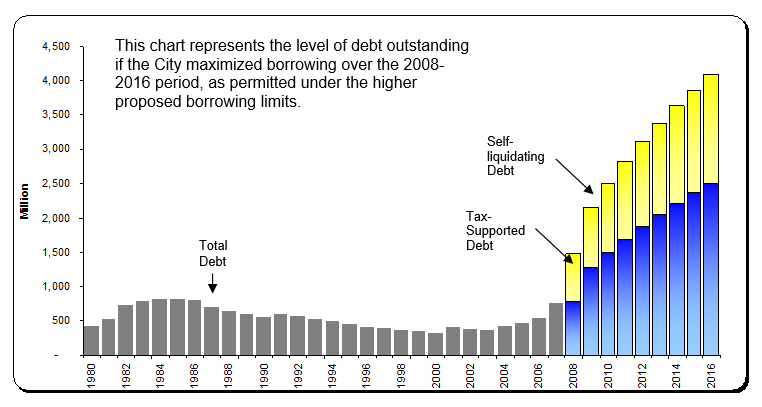
It also included this chart which shows the amount of debt Edmonton had outstanding throughout the 1980s and projected amounts through 2016 as permitted under higher borrowing limits:

The jump might look significant, but Edmonton’s outstanding debt is still well within both the provincial debt limits and the City’s own more strict debt limits. The City’s credit ratings remain very strong.

It’s true that Edmonton’s debt has grown significantly over the last decade. But it’s also true that taking on that debt has enabled us to invest in much-needed infrastructure to support our growing city. Candidates that don’t recognize this risk pursuing a policy that would take us back to the 1990s, reversing any progress we’ve made toward tackling our ever-growing infrastructure deficit. As the City says, “an appropriate and sustainable level of tax-supported debt is recognized as a legitimate part of any long-term capital financing plan.”

Note: Much of the data in this post came from the Government of Alberta. While figures are available for 1994-1996 at that site, I excluded them because the values for Edmonton were highly inconsistent with the rest of the data and were extremely different from the City of Edmonton’s published values for those years. I have submitted an inquiry about the validity of the data.

Make Something Edmonton moves forward with 8 recommendations

Today the Mayor’s Task Force on Image and Reputation submitted its final report to Executive Committee. The task force is better known by its adopted name, Make Something Edmonton. In summarizing the work that has been done thus far and recommending next steps, the report draws the task force to a close and marks the start of Make Something Edmonton as a more official thing. Exactly what that thing is however, must still be determined.

Here are the recommendations outlined in the report (which you can download here):

  1. Adopt Edmonton’s Brand
  2. Open the Make Something Edmonton Office
  3. Preserve and Maintain the Citizen-Driven Focus
  4. Recognize and Reward Excellence: The Builders Prize
  5. Promote a “Make Something” Culture
  6. Appoint a Make Something Edmonton “Champion”
  7. Implement an Image and Reputation Strategy
  8. Create and Activate Ambassador & Mentor Networks

Some of these recommendations are obvious while others are a little more interesting.

The first recommendation would see “Make Something Edmonton” become Edmonton’s “brand platform”, the foundation for an image and reputation strategy. This doesn’t necessarily mean that “Make Something Edmonton” replaces “City of Champions” as some have suggested, but it does assert that the story behind MSE is our brand.

The second recommendation calls for the creation of an organization similar in structure to the Edmonton Arts Council, perhaps operating under the umbrella of EEDC. The purpose of the office would be “to develop the words, the tools, and the expertise” to help existing organizations and Edmontonians in general to launch new businesses, promote events and initiatives, and attract others to our city. It would guide the brand. The third recommendation is obvious and somewhat related, calling for an advisory council with representatives from a broad range of sectors.

The fourth recommendation is to create The Builders Prize, an annual cash prize to recognize MSE projects. “$30,000 will be awarded to one outstanding and completed Make Something Edmonton project. The recipient of the $30,000 prize will then award four $5,000 Catalyst Prizes to other Make Something Edmonton projects in progress.” I love the twist there – the grand prize winner must award the smaller prizes.

The fifth recommendation is again fairly obvious, and also probably the most difficult to action. Some suggestions include offering a MSE award as part of the Awards of Excellence, and embedding “What are you making? How can we help?” on City of Edmonton business cards.

I’m perhaps most excited to see the sixth recommendation, which calls for a “champion” to operate out of the City Manager’s office. This person’s job would be something like an ombudsperson for MSE. They would help navigate City of Edmonton bylaws and rules, and would work to streamline things for future makers. City Manager Simon Farbrother has endorsed this idea.

The seventh recommendation is really for the organization created out of recommendation #2 and its to implement a strategy and communications plan. As a result of this you should see the brand story and image appear throughout communications from all of Edmonton’s prominent organizations, businesses and institutions.

The final recommendation is really something the task force has already been doing. The idea is to create “an informal training program” to go out and tell the MSE story to anyone who will listen. An addition would be the mentor network, made up of people who have already made and built things in Edmonton, to help new makers get their own ideas off the ground.

The report concludes with:

This is only the beginning of Make Something Edmonton. The first phase of our work was to discover the Edmonton Story and to activate it with early adopters. Now we begin to actively find – to use marketing parlance – the “early majority.”

It also promised a new website and advertising campaign to launch this fall.

I feel like the report and recommendations address many of the concerns I raised in my post from July. Executive Committee this morning decided to request that a funding package be put forward as part of the budget in order to move these recommendations forward. I think this is an initiative that deserves ongoing support from the City of Edmonton, even if it ultimately lives with EEDC or elsewhere, and I am optimistic that Council feels the same way.

Kudos to everyone involved with Make Something Edmonton on progressing to this point!

The Make Something Edmonton Rope

What’s a rope? "A rope is a linear collection of plies, yarns or strands which are twisted or braided together in order to combine them into a larger and stronger form," according to Wikipedia. I like to think of Make Something Edmonton (MSE) as a rope. As such, it’s made up of a number of different strands that had to come together. There are three strands that I want to highlight.

strand

The first started with a wall.

In the spring of 2011 while still working at the Edmonton Journal, Todd Babiak wrote a series of stories on what he called "interventions". It began with the blank, unattractive wall that he saw every day when looking out the window. Todd wanted to do something about it, so he wrote about it. And he encouraged readers to email him with their suggestions.

A few months later at the downtown-focused Pecha Kucha 10, Todd spoke about the interventions project. He stole the show that night with a hilarious, entertaining, and thought-provoking presentation. Todd called Edmonton "a magpie town" and shared with us a lesson he learned through the interventions process: "I should have asked people to do something, then email me."

Six months later, Todd had a new startup called Story Engine, and he found himself pitching the City of Edmonton. "I had worked on the City Vision for 2040, and I had noticed — in community halls all over the city — that citizens were obsessed with the Edmonton story," he later wrote. Todd wanted to help tell that story. He was persuaded to start a blog, appropriately called magpietown, and he used it to explore the ideas that would form the groundwork for Make Something Edmonton.

The second strand is a long one. If you follow it back far enough, you might find yourself at Edmonton’s beginning.

Like most cities, we aspire to be recognized and loved on the world stage. We want our city’s image to be positive and well-received. Branding is a part of forming that image, and over the years there have been numerous attempts at identifying or creating our brand. We’ve always had this inferiority complex, and many Edmontonians have tried to do something about it. Most recently, the City of Edmonton embarked on a project called Edmonton Stories. By most accounts it was a disappointment, masked only by the repositioning of the project as a tool for recruiting rather than as a tool for emboldening Edmonton’s image.

Last year, the issue once again came up at City Council. One of the outcomes of The Way We Propser was a desire by those involved to better define and communicate our city identity. So in July 2012, Council decided to strike a task force. It got off to a rocky start due to significant differences in approach, but by the fall everything was in place.

That’s when Brad Ferguson, the new CEO of EEDC, spoke up about the issue. "On a scale of one to 10, we’re a one and a half. I’m not going to sugar-coat it," he told Council. All of a sudden, the new task force on image and branding became even more important.

The third and final strand I want to highlight is probably pretty boring to most people, but it’s highly intriguing to a City-watcher like myself.

Since 2006, the "big C" City (the City of Edmonton) has been undergoing a significant transformation. A new City Manager, a new approach to visioning and planning, and a progressive Council working cohesively to move things forward all contributed to a very different mood around City Hall.

One of the side effects of that transformation, in my opinion, has been an expansion in the kinds of things the City is willing to take on. Whereas in the past certain things may have been ignored because they were not seen as central to the City’s mandate (such as establishing a Food Council), today there’s almost an expectation that the City tackle such endeavours. On the whole this has probably been a good thing for citizens.

I think the City has gone back-and-forth on who should own the image and branding piece. Should it be Communications? Should it be a new City-led office? Should it be a partner, most logically EEDC? If the expansion trend continues, I would not be surprised to see some within the City push for MSE to remain a City-led initiative.

These and other strands all came together to form Make Something Edmonton. How exactly the strands came together, I don’t know for sure. But I like to imagine that the committee was sitting around trying to figure out how to get from being 1.5 out of 10 to something better, and Todd said, "I have an idea!" He pitched Make Something Edmonton and everyone declared, "our work here is done!" That’s probably unfair to everyone who put some significant volunteer time into the project, and I don’t mean to belittle that effort. But I also think it’s probably not far from the truth.

The initiative, or movement, or experiment – take your pick – officially launched in March of this year with a splashy party attended by the same people who always show up at these sorts of things. It was a good start, and the launch party was energizing and created a certain amount of momentum. There have been a number of really successful projects added to the website, and the Twitter hashtag remains as popular as ever. It’s a great way to showcase the many exciting things happening in Edmonton.

There is, however, a certain amount of spin surrounding Make Something Edmonton. It was evident at the launch party, and has become somewhat more evident in recent weeks.

Is MSE a grassroots movement, by the people for the people? The funding and committee structure behind it would suggest otherwise. There’s a big MSE committee, and a number of smaller sub-committees, all made up of the same 300 or so people who get involved in most things. Furthermore, that committee is expected to submit a report back to Council. It is, after all, just an expanded form of the task force that Council struck.

Is MSE a new approach to city branding, because traditional branding doesn’t work? The process would seem to suggest otherwise. The City hired a firm to design the MSE logo and identity, and another firm to build the website. There was Brand Camp a few weeks ago, but the only element of it that didn’t resemble a traditional branding exercise was that it was called Brand Camp. It was a bunch of people in room talking with no clear idea about what the outcome should be. Pretty typical consultation piece for a branding exercise if you ask me.

Does MSE tap into a fundamental truth about Edmonton? I feel it does, but many others dispute this point. "Can’t I make things in Winnipeg?" they ask. "Maker is too exclusive," others will say. If MSE isn’t resonating with the smaller group of the same 3000 people that are already hyper-engaged, how can we ever hope to get to 30,000? Or to 300,000?

Since March there have been a number of smaller MSE-related events (like Brand Camp), but the big success has undoubtedly been the creation of the website and its listing of hundreds of projects. I think "maker" is absolutely the right word, because otherwise we’ll end up with the lowest common denominator and that’ll get us exactly nowhere. It needs to be aspirational. Seeing all of the projects on the website and thinking about all of the people behind them gets me incredibly excited about our city.

But as great as that website and all of those projects are, thinking about them inevitably leads to the question that I’ve been hearing people ask more and more: what’s next?

The City of Edmonton has funded MSE so far (by way of the task force on image and reputation) which means they not only feel a sense of ownership, but need to be careful about how they spend the money. It also means that MSE is going up against everything else the City does for resources. And practically it means there will need to be a report that goes back to Council.

Another thing is that while our current Mayor and City Council support the initiative, they’re gone in October. There’s no guarantee that the next Council will be as supportive. So you can almost certainly expect the report to come out before then.

Beyond that, I’m not sure anyone knows what’s next. Maybe there’s not even a correct answer. Let’s phrase the question differently: what are we going to do with this rope?

Are we going to have a tug-of-war to see who hangs on the tightest? Are we going to give up and let it collapse into a pile on the ground? Or are we going to keep using it to climb ahead?

I hope we can use it to keep climbing ahead, but to do so we’ll need to know what outcome we’re moving toward.

Here are some suggestions on how we can establish that:

  • Let’s figure out where Make Something Edmonton will live. Right now I think it should be EEDC, because if it remains City-led there’s too great a risk that politics and/or bureaucracy will cause it to fail (or at least to hold it back). (And if we’re going to give it to EEDC, let’s ask them to drop something that doesn’t align as closely with their vision and strategic plan as a consequence.)
  • Let’s recognize that there’s a difference between the organization that funds & supports Make Something Edmonton, and the people who lead it. EEDC can provide meeting space, coffee, and administrative support, but it doesn’t need to be EEDC staff setting the direction.
  • Let’s identify the gaps between the successful projects and the ones that haven’t gotten off the ground. That’ll help us seed opportunities and remove barriers for makers, hopefully resulting in even more great projects for our city.
  • Let’s clearly define our desired outcomes. We want the language, tools, and confidence to be able to talk about Edmonton. From there, we want the City of Edmonton, EEDC, the University of Alberta, Northlands, and everyone else to make use of that toolkit.

Thoughts?

EdmontonPolitics.com: #yegvote Hangout #2

Tonight we held our second #yegvote hangout over at EdmontonPolitics.com. What’s a #yegvote hangout? Basically it’s a video conversation that you get to tune into! Dave Cournoyer, Ryan Hastman, and myself decided this would be an interesting way to offer coverage of the municipal election. If you missed our first episode, you can watch it here.

We covered a range of topics tonight, prompted mostly by questions from viewers on Twitter using the #yegvote hashtag. Here’s the archived video if you’d like to watch it:

One of the things we talked about briefly was voting records. Councillor Diotte has a reputation for voting no, but if you look at the data it turns out that Councillor Sloan is actually the contrarian on council. Here’s a visualization of the data (which is available to anyone at the open data catalogue):

http://public.tableausoftware.com/javascripts/api/viz_v1.js

<a href=”#”><img style=”border-top-style: none; border-left-style: none; border-bottom-style: none; border-right-style: none” alt=” ” src=”http://public.tableausoftware.com/static/images/Mo/MotionsVotes2011-2013/Whovotesno/1_rss.png&#8221; /></a> 

There are other tabs there for a few other data points such as who makes the most motions and who seconds the most motions. Very interesting stuff to dig into, something I’ll be doing more of in the coming weeks.

If you have suggestions on topics we should cover in the future or guests we should invite, let us know!

Under Mayor Mandel’s leadership, Edmonton has thrived

Mayor Stephen Mandel announced today that he will not seek a fourth term as mayor. It’s the first time since 1988 that an Edmonton mayor has left the position voluntarily, when Laurence Decore resigned to enter provincial politics.

Had Mandel run again, he would have won. Councillor Diotte was the only person on Council who was willing to run against him, and it is doubtful that another serious challenger would have come forward, let alone had a chance at victory.

The change this year to four year terms likely had an impact on his decision – Mandel would have been into his 70s had he won another term. Three year terms were introduced in 1968, and Mandel has supported the idea of adding another year in the past. "My belief is that a four-year term allows you to be successful," he told the Journal in 2005. "It’s a more substantive time for trying to complete an agenda."

Mandel has also supported the notion of term limits for mayors, noting the demands of the job. "That takes a great deal of energy, and to be creative for a long period of time, there is a simply a limit," he said in 2005. "I mean, how many years can you do it and still be effective?" Like his predecessor Bill Smith, Mandel’s three consecutive terms are more than he or anyone else expected him to serve.

Stephen Mandel at Candi{date} Sept 29, 2010

After failing to win a seat on the public school board in 1995, Mandel was elected to City Council by just 33 votes in 2001. Working alongside Karen Leibovici in Ward 1, commentators at the time noted that Mandel learned a lot and matured politically over those three years.

As the 2004 election approached, Mandel found himself deciding to run for mayor. He did not want to serve another term under Bill Smith, who aside from being a cheerleader was often described as a "lone wolf." Mandel also felt that Robert Noce, the other serious contender that year, was not someone he wanted to work with. "We can wait forever for somebody else to do it, but I’m not going to do that. I believe that one of the real problems of our city is that we wait for everybody," he said at the time.

Mandel handily won the election that year, defeating Smith by more than 17,000 votes. "You have no idea how I feel. This is unbelievable," he told supporters after the results had come in. Despite being snowy on election day, turnout was relatively good at 41.8%. In 2007, Mandel earned 66% of the vote, defeating Don Koziak by more than 60,000 votes. It was a clear mandate for Mandel and the big city vision he had brought to Edmonton. Turnout was just a dismal 27% that year, a sign that Edmontonians were happy with the direction Mandel was headed.

Mayor Stephen Mandel

In the last election in 2010, Mandel earned 55% of the vote, defeating David Dorward by more than 50,000 votes. Turnout improved slightly from 2007, jumping to 33.4%. It was an important election for Mandel. "This election was about building a positive future for Edmonton," he said in his 2010 swearing-in address. "It embraced long-term thinking and a broad vision of an ambitious Edmonton." Just two new councillors were elected that year, suggesting once again that Edmontonians liked where things were going.

Mandel has accomplished a number of the things he originally set out to achieve. Expansion of the LRT, tackling the problem of homelessness, reducing crime, and raising the profile of the arts, to name just a few. He has always pushed for improved relations with the Province, and for Edmonton to get its fair share of attention and money. On regional issues, Mandel regularly pushed for more cooperation rather than competition, though he was willing to be the bully if he felt it was appropriate.

Mayor Stephen Mandel

Mandel wanted Edmonton to be a capital city again, to be a big city. As he said today, “we want our city not just to exist but to thrive.” Under his leadership, it has happened. The feeling of being left behind that Edmontonians felt in 2004 no longer lingers, and any jealousy of Calgary has given way to the realization that the two cities need to work together.

These are not easy challenges to have tackled, and they have certainly demanded a lot of Mandel. He was known to have a temper before becoming mayor, and Edmontonians got a glimpse of that during his first term on Council. While Mandel has learned to control his language in public, he’s been known to passionately express his viewpoint behind closed doors. Occasionally his anger got the better of him, such as when he learned that Edmonton had lost federal support for its bid to host EXPO 2017.

Mandel will certainly be remembered for many of the capital projects he had a hand in, such as the South LRT extension, the closing of the City Centre Airport, and of course the downtown arena, but I think his true legacy is actually a little less tangible.

Edmonton City Council Swearing in Ceremony

I have always appreciated Mandel’s view that councillors should be involved in citywide issues, not just ward issues. In his 2007 swearing-in address, Mandel stated: "No matter what community has sent us here, we all share a responsibility to do what’s right for the city as a whole." His approach as mayor was markedly different than Smith’s before him. Mandel often complained of feeling excluded as a councillor under Smith, and that certainly influenced his style. In his remarks today, Mandel again reiterated his view that the mayor “is just one small voice” on Council.

Over his three terms, Mandel has brought an increasing level of sophistication to the City of Edmonton and to the way City Council operates. He showed us what could be achieved by building consensus and working together. He showed us what’s possible when everyone is aligned, both inside and outside of City Hall. That to me is his lasting legacy. He’s changed the way we do things. In Mandel’s Edmonton, we make things happen together.

Mayor Mandel

I’m very grateful that Mandel dedicated over a decade of his life to this city; Edmonton is a better place because of his efforts. I wish him all the best in his next adventure!

Will he retire? If not, what will Mandel do next? Here’s what he told the National Post in 2010:

"I’m not a hobby guy. I like to volunteer when I’m not doing this job, but right now this is busy and I don’t. So I don’t have a hobby, but I wish I did, you know. I wish I was a woodworker. I think when I retire I’m going to try to learn how to cook. I like to cook. I’m not any good at it."

Mandel did hint today that he has been discussing future plans with his family, but said today was not the time to share them.

Mandel’s announcement makes the election this fall much more exciting. Not only does it mean we’ll have a new mayor, but it likely means a large number of new faces on Council. Expect to see a number of campaign announcements over the next month. On that, Mandel shared a few thoughts as well. “I’m excited to know that our citizens will have many diverse options to consider this fall. I want to wish the best of luck to all those who will put their names forward to be Edmonton’s next mayor.”

Edmonton’s downtown arena is finally approved; get on board and help make it a success

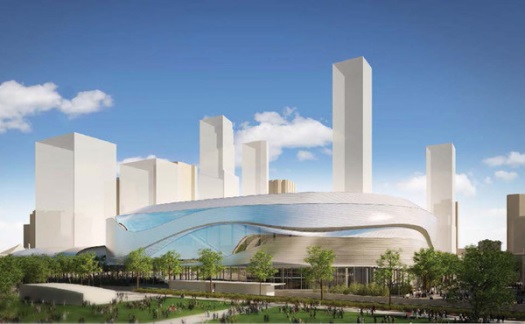
City Council voted in favor of the arena today by a vote of 10-3, and while there are some things still outstanding (final approval of the CRL, approval of the regional grant) the project is most likely going to move ahead. This one feels final. We could argue about the deal forever, but it’s now done. I’m not happy about all the specifics, but I’m happy that we can move past this endless debate and get on to more important things.

Now that we know there’s going to be a shiny new arena downtown, it’s time to get on board and help to ensure that the project is as successful as possible. The hard work doesn’t stop with approval of the deal…it’s really just beginning.

There’s a lot of outstanding questions that need to be explored, including:

  • How does the deal impact the City of Edmonton’s debt and debt servicing levels?
  • What will the marketing/branding partnership with the Oilers actually look like?
  • Will the Gretzky statue get relocated?
  • What happens to the Baccarat Casino?
  • What is the impact of this decision on Rexall Place and Northlands? Can we sustain two large venues?
  • I’d rather see local restaurants and shops in the new arena than chains. How can we ensure the arena benefits local?
  • How does replacing MSI funding with additional CRL funding impact other downtown projects? How can we ensure those still move forward?
  • Where is the list of property developers ready to announce projects in the downtown area? What else do we need to do to ensure that surrounding development goes ahead?
  • What happens if the CRL doesn’t result in the lift we all hope for? What’s plan B, C, and D?
  • If the arena is the carrot to entice speculators to do something with their empty parking lots, taxation/policy changes are the stick. How can we get the stick implemented too?
  • How are Administration and Council going to learn from this to ensure future large projects follow a much smoother process, with more communication and transparency, and less ambiguity?
  • How will construction of the arena impact residents and businesses downtown, especially considering it’ll take place alongside a number of other large construction projects like the LRT?  How can we reduce that impact?
  • What else is the City of Edmonton prepared to do to support downtown’s ongoing revitalization? How soon can we get other related projects off the ground?

And my favorite:

  • When will Mayor Mandel announce he’s not running in the October election?

In his closing remarks, Councillor Henderson noted that the downtown arena “is not a magic wand”. For it to work, a lot of other things need to happen alongside and around the project. It’s a big step, but it’s just one step, in ensuring our downtown continues to grow. We need to make sure we take those other steps too.

Edmonton’s downtown is being held hostage by the arena

Edmonton’s downtown hasn’t gotten its fair shake when it comes to capital funding over the last decade. There’s now a pretty pie chart that magically appeared to illustrate that (I’m not sure where the data comes from specifically, but it seems more or less accurate to me). I am totally on board with the idea that we should be putting our money where our mouths are. If downtown is so important to Edmonton, and I believe it is, we should be willing to back that up with dollars.

I think it’s fair to say I’m one of the biggest downtown supporters in the city. I talk about it all the time. I’ve organized plenty of events for downtown. I seeded the I ❤ YEGDT campaign. I built and operate the website. I work downtown. Sharon and I chose to live downtown and purchased a condo here.

With all of that said, I want to support what the newly formed Downtown Vibrancy Coalition is trying to do, but I’m finding it very difficult to get on board. Here’s what their backgrounder states:

“If we lose the arena – over a missing $55 million – approximately $3 billion in downtown revitalization projects will be shelved or scrapped. The arena represents only one-sixth of the proposed investment. But if the arena fails, Edmonton’s downtown will lose $2 billion of private investment in the related entertainment district – new hotels, office towers, retail shops, clubs – as well as downtown parks, a river valley promenade and Jasper Avenue streetscape enhancements.”

Every single time I read that, I can’t help but think: bullshit. Is downtown important or not?

This all stems from the August 2011 decision to make the proposed arena the centerpiece of the Community Revitalization Levy. I wrote in that post that I was worried we’d be doing more harm than good for downtown by tying the two together. Now, as we’re about the lose the arena, the impact of that decision is becoming clear. We’ve put all of our eggs in one basket, or at least that’s what it looks like.

But I see no reason why downtown revitalization has to die along with the arena. The notion that you need an anchor or catalyst project for a CRL to work is false (as proven by the existence of CRLs for The Quarters and Fort Road). Furthermore, we know that programs like housing incentives work and lead to the outcomes we want. There are ways to ensure downtown gets the funding it deserves with or without a shiny new arena. Why would everything need to be shelved or scrapped?

I would love to see a new arena built downtown, and I do agree that $55 million seems like a surmountable barrier. But I don’t like that MSI funding is being used to help pay for the arena and I really don’t like that our downtown is being held hostage by it.

Full disclosure: I’m a member of the Downtown Vibrancy Task Force and of ONEdmonton.

Recap: 2013 State of the City Address

Thousands of Edmontonians filled the Shaw Conference Centre during lunch today for the Chamber of Commerce’s annual State of the City event. Featuring Mayor Mandel, the event was an opportunity for our city’s business, community, and government leaders to reflect on the past year and to talk about the challenges and opportunities that lie ahead. Or at least, that’s what we were supposed to be talking about. Instead, the only thing on the minds of those in attendance was Mandel’s decision – would he be running again in October or not?

State of the City Address 2013

Many members of Mandel’s family joined him at the head table, including his adorable grandson, and that only fueled speculation that he would be announcing his retirement. As Mandel took the stage, he received a thunderous standing ovation. It was the kind of standing-O that said, “thanks for nine great years.” But it turned out to be premature.

“I know that there is expectation in this moment – one that I set myself – that I would answer a key question today about whether I would seek re-election this fall.

And as much as I pride myself on giving clear answers – I do not have an answer today.”

There was an audible gasp as he spoke the words. Most people were expecting a yes or no – the possibility of a maybe hadn’t even registered! I’ll admit that I was fairly certain he was going to announce that the current term would be his last, but it seems Mandel had more difficulty making a decision than anticipated. “Key issues affecting the state of our City are genuinely unsettled in my mind,” he said.

While Mandel touched on Make Something Edmonton and some of our city’s successes in his slightly-longer-than-normal speech, most of his comments were directed at the Province. And they weren’t positive. Specifically, Mandel focused on spending cuts to the post-secondary sector, and the imbalance of regional costs and funding.

State of the City Address 2013

First, he addressed the post-secondary sector and it’s very large impact on Edmonton, both to our economy now and to our future competitiveness.

“We should expect nothing less than passionate, relentless defense of this sector from our provincial representatives who should know better than to just stand by. We should expect that our Minister would actually engage this sector and challenge them to find solutions.”

Mandel stated that our post-secondary institutions have the potential to be “amongst the best in the world.” He went on to discuss his concerns with short-term thinking, and called for real leadership. “It means setting a course that people can believe in, and being clear about long-term intent.”

Next, Mandel addressed regional issues. While the Capital Region Board has at least started to address the issue of collaboration and planning together, the imbalance in provincial grant allocations “has not been touched,” he told us.

“The taxpayers of a city of 850,000 cannot continue to pay an unfair share of the costs of urban services for a region of 1.2 million. Making all municipalities responsible on both sides of the ledger is the only way to make growth fair – it is also the only way Edmonton can sustain itself.”

Here again, Mandel questioned decisions made by the provincial government in its most recent budget.

“If you really want to make a difference, not just for Edmonton – but for Alberta’s bottom line – this is a great opportunity for change. Because it will cost billions less to pay for a single coordinated regional plan – than for the wish lists of 25 municipalities.”

Mandel clearly had the element of surprise on his side today, and that helped to make the speech even more impactful. Advanced Education Minister Thomas Lukaszuk reacted strongly to Mandel’s criticisms. “I don’t know who pissed into his corn flakes, and you can quote me on that,” he told the Journal.

State of the City Address 2013

Mandel very much positioned himself as the defender of Edmonton today, and his call-to-action was to speak up for the city. “You know, Edmonton is a funny city,” he said. “We are so fiercely proud of what we have, but too often scared to tell others that we have it.”

Though he acknowledged that his eventual decision about whether or not to run again will impact this year’s election, Mandel urged candidates who may want to run to make their intentions known on their own schedules, not his. That’s easier said than done, of course. No one on City Council seems willing to run against Mandel. If he were to run for an unprecedented fourth term, it’s widely expected that he would win.

Mandel’s non-announcement today has the speculation engines revving. Is there funding news about the downtown arena forthcoming? Is he considering a jump into provincial politics? Who knows, maybe he simply hasn’t made up his mind yet. My own sense is that Mandel must feel as though he can resolve a couple of those “key unsettled issues” over the next few months, otherwise, why not just announce that he’s running again?

Edmonton is a better place because Mandel has been our mayor for the last nine years. He’s given so much to this city and it must be taking a toll, but clearly Mandel feels he has more to give. “My focus remains on the job at hand, on what I owe to Edmonton, and what Edmonton needs.”

Thanks to the Chamber of Commerce for inviting me today. You can read my recap of previous State of the City events here: 2011, 2012. You can read the full transcript of Mayor Mandel’s speech here (PDF), and the rest of his speeches here.