P3, or not P3? That’s the question as we try to fund Edmonton’s future LRT

In October of last year, Council approved the use of a public-private partnership (P3) to fund the Southeast to West LRT project. The decision came just days after the new LRT Governance Board was established, but it was largely overshadowed by the downtown arena news that week. Today Mayor Mandel announced, along with Minister of Finance Ted Menzies and Minister of Public Works and Government Services Rona Ambrose, that PPP Canada will invest up to $250 million to support the construction of the new LRT extension. While the funding is welcome, it is $150 million less than the City was hoping to receive from the federal government (the rest may come from a future Federal Infrastructure Plan).

“The City of Edmonton welcomes this important funding announcement by the federal government,” said Mayor Stephen Mandel. “The Southeast to West LRT is a key part of our transportation infrastructure. It will connect communities in Mill Woods and southeast Edmonton to the central core and is essential to our plans for building a better, more accessible city.”

The decision to apply for funding through PPP Canada was not an easy one, but Council did not have much of a choice. The City simply cannot afford to build the LRT on its own – the provincial and federal governments must come to the table. Though it hasn’t been explicitly stated as such by those involved, it seems the only way the Government of Canada would provide funding was through the P3 Canada fund. Calgary Mayor Naheed Nenshi has been vocal about his concern around being cornered into a P3, saying “the real problem is that the only dedicated federal funding at this moment is through P3 Canada.”

Let’s set aside for a moment the very big issue that the federal government is essentially dictating how municipalities should build and maintain their infrastructure. If given a choice, would we pick a P3 to build our LRT network?

What is a P3?

A public-private partnership is basically an approach to delivering and optionally operating and/or maintaining a project. Here’s how PPP Canada defines a P3:

“P3s are a long-term performance-based approach for procuring public infrastructure where the private sector assumes a major share of the responsibility in terms of risk and financing for the delivery and the performance of the infrastructure, from design and structural planning, to long-term maintenance.”

In theory, a P3 can help to ensure projects are delivered on-time and on-budget. The idea is that having the expertise of the private sector can lead to better, more innovative solutions. Another benefit of a P3 is that the private sector takes on a share of the risk, which means that there is a profit motive to ensure the project is done well (at least in theory). This is often referred to as “pay for performance”.

The other thing that is important to know about the P3 approach is that there are a variety of different delivery models. With traditional procurement, the public sector is responsible for the design of an asset like a bridge or school, with construction being contracted out to the private sector through a competitive bidding process. After construction, the asset is handed back to the public sector for operation and maintenance. This model is known as Design-Build (DB).

Using a P3 for the procurement of new assets, there are three delivery models to consider:

  • Design-Build-Finance (DBF)
  • Design-Build-Finance-Maintain (DBFM)
  • Design-Build-Finance-Operate-Maintain (DBFOM)

The level of private sector involvement goes up which each model. Under the DBF model, the private partner assumes the risk of financing the project until construction is complete and the asset is handed over to the public sector. With the DBFM model, the private sector also assumes the maintenance of the asset in exchange for payments throughout the operating period. And finally, the DBFOM model is used for projects that have long-term operation and maintenance handled by the private sector, such as roads.

The P3 model is relatively new (becoming popular in the 1980s) but is already used all around the world on a variety of different projects. PPP Canada was established in 2009 to oversee the $1.2 billion P3 Canada Fund, but that was certainly not the start of P3s here in Canada. From 1990 to 2001 more than 150 P3s were concluded throughout the country.

Can a P3 really work?

Here in Alberta, we’ve used P3s to build ring roads and schools in both Edmonton and Calgary, as well as a water treatment and wastewater treatment facility in Kananaskis (a project that EPCOR is the private partner on). It hasn’t been all smooth sailing however, as Godfrey Budd explains:

Although 18 Alberta elementary and elementary-junior high schools, built on the P3 model, opened in September, and another 10 such schools are going ahead as a P3, four high schools were dropped from what was to have been a 14-school package. In May 2009, the province, citing "the economic climate," announced that the four schools would instead go ahead on a design-build basis. Also, six months after a September 2008 provincial news release announcing the go-ahead for the 18-school package, one of the partners in the P3, Babcock and Brown, the project’s banker, collapsed under the weight of $3.8 billion of debt, and in August 2009 Deloitte was appointed liquidator.

Another issue has been the lack of transparency that seems to come with P3s – it’s not always clear whether the approach saves money or not. Some, such as Alberta Federation of Labour president Gil McGowan, are convinced that P3s rarely work:

“P3s almost never work out in the public interest. Governments around the world have had experience with P3s, and in almost all cases they end up costing taxpayers more and creating enormous headaches down the line. It may look cheaper up front, but the experience with P3s is clear. The private developers are never satisfied with the amount of money the governments put on the table in the beginning, and come back asking for more.”

For its part, PPP Canada says that a P3 can work for larger public infrastructure projects, but notes that governments can borrow money at far lower rates than the private sector can. It says that “a detailed value for money analysis is required to assess whether the costs exceed the benefits.”

The case for a P3 to build the Southeast to West LRT

A couple of weeks after Council decided to pursue funding through the P3 Canada Fund, I sat down with Nat Alampi, the Program Manager for the Southeast to West LRT project. Nat has had experience on LRT projects in the past – he managed the preliminary engineering designs for the South LRT extension and the Northeast LRT extension to Gorman. I wanted to know why the City thought using a P3 was a good idea, given the risks that seem to go along with that decision. “Every project has its challenges, regardless of whether you use a P3 or not,” he rightly stated.

Nat explained that it was EXPO 2017 that initially caused the City of Edmonton to start exploring the use of a P3. That investigation led to the adoption of the City’s policy on P3s (C555) and an assessment of the entire LRT network. “We determined there would be a net savings to using a P3,” Nat said. In its presentation to Council last October, City Administration suggested that savings could be between 3% and 10% using the DBFOM model.

A private partner operating the LRT?! “Operating the train and maintaining the infrastructure so closely intertwined,” Nat explained, “that separating them carries significant risk.” While the City did assess the feasibility of retaining the operating portion of the project, it ultimately felt it would be better served by pursuing the DBFOM model. “Typically with a P3 just for build, you get a two-year warranty,” Nat told me. “In this case, we’re getting 30-year warranty.” Of course, any contract would have provisions to allow for an extension of the operations and maintenance period, further expansion of the line itself, and there would likely also be a handback condition. For transit users, the new line will still look and feel like an ETS line (though it will use low-floor technology). “We will still set the fares, the look, and deliver security,” Nat said. The City would also be able to prescribe the level of service required, to ensure it matches the rest of the system.

Nat suggested that procuring a P3 like this could take 12-14 months and would generally require having the necessary funding secured. If all goes well, a P3 contract could be in place by the end of the year, with utility relocation and other preliminary work taking place in 2014.

The case against P3s for Public Transit

When I first learned that Council was considering a P3 for the Southeast to West LRT, I immediately thought of Taras Grescoe’s latest book Straphanger. It’s a fantastic read for anyone interested in public transportation and the impact the automobile has had on our cities. Near the end of the book, Taras addresses the notion that the private sector can successfully build and operate public transit projects:

For transit to remain sustainable, we’re going to have to ignore the zealots who call for its complete privatization, which has proven such a disaster in Britain and Australia. There is a reason that the transit network of almost every major city in the developed world was municipalized at some point in its history: while private companies can do a creditable job of operating the busiest lines, time and again they have filed to manage complex transportation networks in the public interest. The lessons of history show that public agencies with regional scope and unified planning oversight do the best job of running public transport.

Taras graciously agreed to speak with me in October, and I asked him to elaborate on this point. “I’ve seen how private lines can be fantastic in a place like Toyko where they have the revenue and density,” he told me. “But I’m skeptical that private companies can get the return in a low-density place like Edmonton.”

In the book Taras talks about the Canada Line in Vancouver, built for the 2010 Winter Olympics:

The Canada Line to the airport…was the first major piece of transit infrastructure in North America to be built with a public-private partnership, an initiative many commentators say was plagued by corner-cutting. Three stations had to be eliminated from the planned route, and the station platforms that were built were too short to allow future expansion. Thanks to cost overruns, the provincial government will be compensating the private company that operates the line with payments up to $21 million a year until 2025.

While many now point to the project as an example of a successful P3, Taras disagrees. “You’re essentially entering another system when you get on the Canada line,” he told me. The line uses the same fare system as the rest of TransLink, but there are some exceptions (such as the $5 YVR AddFare).

Another well-known P3 transit project in Canada is in Waterloo, where officials are also looking at a 30-year DBFOM contract. Much has been written about the potential issues with that project, but this post does an excellent job of summarizing everything. A few highlights:

  • “Probably the biggest problem with a P3 arrangement for Waterloo Region’s LRT is that it would result in higher barriers to expansion of the system in various ways.”
  • “On the one hand, using private companies to build and operate the line ostensibly means that expertise can be brought in when needed, and only when needed. On the other hand, this means that expertise in LRT construction, operation, and efficiencies thereof will never be gained by Waterloo Region.”
  • “Private operation as a 30-year contract is problematic because it locks us into one operator who can make extension difficult, and a contract which may become uncompetitive ten years down the line.”

Those concerns align nicely with the final thought that Taras left me with: “Transit is not about one line, it’s about a network and making it work for everybody.”

Final Thoughts

The first thing Taras said to me when we chatted was that “any transit construction of this kind is better than none.” While I’m definitely excited to see our LRT network expand, I’m not convinced that a P3 is the way to go. History suggests we should tread very carefully indeed. The City has not yet built anything using a P3, and that lack of experience could be an issue. In theory we should be able to take advantage of the lessons learned in other places, but we all know that’s easier said than done.

So long as we can secure the balance of funding required, It would seem there’s no turning back now for the Southeast to West LRT line – Edmonton will soon embark on its first P3 project. Let’s hope that doesn’t turn out to be a costly mistake.
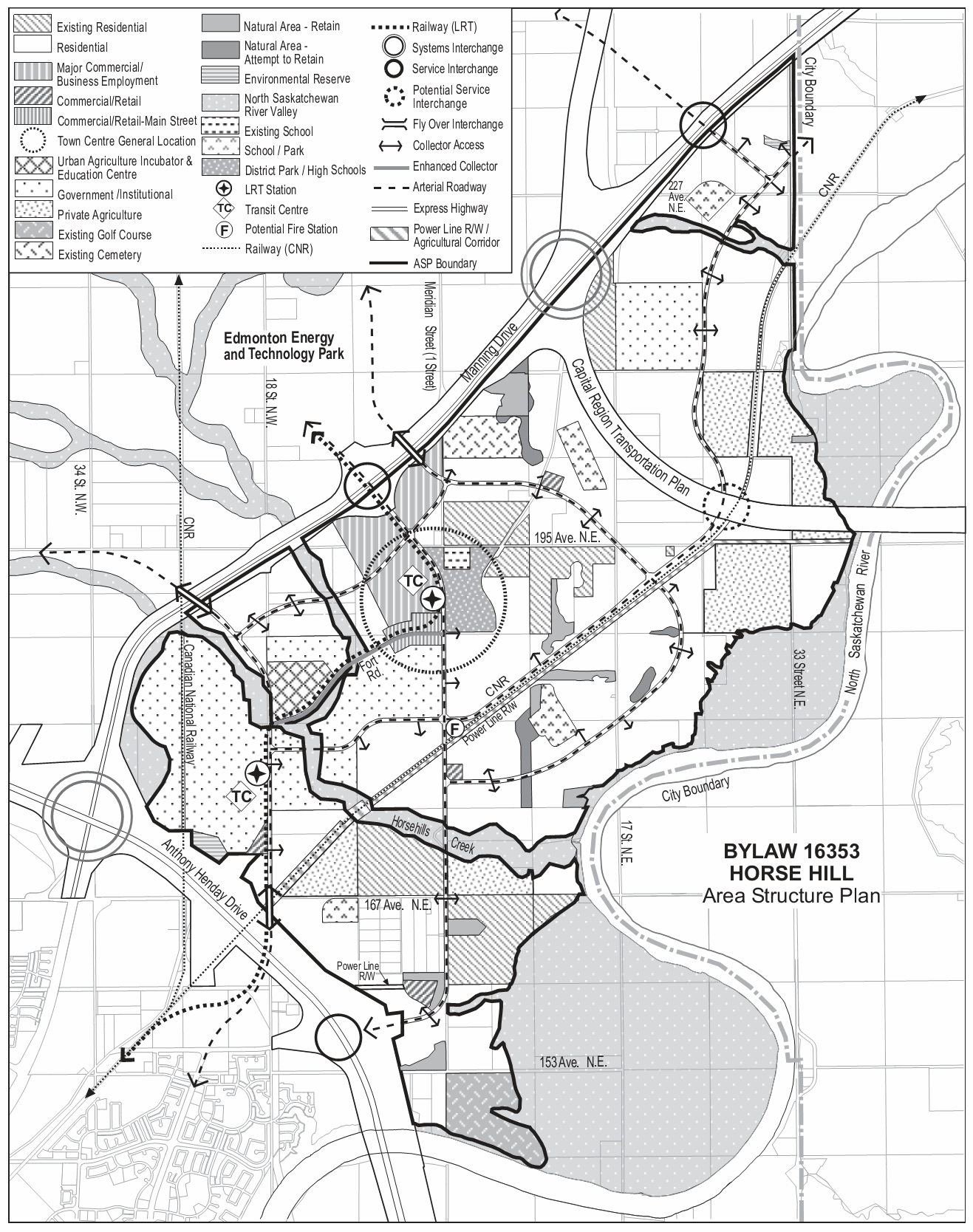
Horse Hill ASP: More proof that Edmonton is addicted to sprawl

The proposed Horse Hill Area Structure Plan (ASP) will be debated at a special public hearing on Monday and Tuesday. Known as bylaw 16353, the Horse Hill ASP outlines a development framework for the area east of the Edmonton Energy & Technology Park (EETP). It encompasses roughly 2,806 hectares of land and barely meets the density target of the Capital Region Growth Plan with a proposed density of 31 units per net residential hectare based on a proposed population of about 71,000 people. Proponents would like to see the area developed over the next 30-40 years.

 
Horse Hill ASP, click for a larger version

There are many people opposed to the plan, including over 2100 who have signed an online petition asking Council to “get full information about the true costs and benefits of this current plan and alternative development scenarios”. Some are concerned with the loss of agricultural land, and others are concerned with the unsustainable sprawl of our city. I expect we’ll hear a lot from those perspectives during the public hearing. I wrote about this battle last July and I would encourage you to read or re-read that post for background.

After the public hearing has completed, the bylaw will be ready for first and second reading. Third reading will take place after the Capital Region Board has given its approval of the plan. It’s important to remember where we are in the larger process:

An ASP is a relatively high-level document. It contains more detail than the Municipal Development Plan, but less than the Neighbourhood Structure Plans (NSP). The Horse Hill ASP proposes five neighbourhoods, each of which would require an NSP.

The Horse Hill ASP falls into the Northeast Urban Growth Area, one of three identified in the Municipal Development Plan. Preparation of ASPs for these areas was authorized along with the MDP, but approval was dependent on Council accepting the Growth Coordination Strategy (GCS), the Integrated Infrastructure Management Plan (IIMP), and the City-Wide Food and Agriculture Strategy. Technically all three documents were approved in 2012, but they were not received without criticism. I wrote about some of my concerns with the documents here, here, and here. Furthermore, it’s hard to swallow that the Horse Hill ASP has been developed in adherence with those plans, considering that the Growth Coordination Committee and the Annual Growth Monitoring Report do not yet exist. Both were identified as key methods by which the GCS would be implemented.

At 135 pages, the bylaw, application, and supporting documentation for the Horse Hill ASP contains lots of information (PDF, 15.8 MB). I have slowly been digesting it, and I was particularly interested in the IIMP document that was included as attachment 2c (on pages 113-135). This is the first time such a document has been prepared for Council’s consideration.

From the background section of the IIMP:

The challenges facing the City are to balance development costs with the strategic benefits of sustainable growth, to achieve an appropriate balance of residential to commercial/industrial development. Although the City of Edmonton has achieved some success in diversifying its revenue base, property tax remains the largest component of City revenue.

The IIMP estimates that roughly $2.5 billion worth of infrastructure will need to be built, with developers contributing 66% and the City contributing 34%. The GCS reminds us however that “the City assumes ownership of developer funded infrastructure, generally two years after construction, and is responsible for ongoing maintenance, periodic rehabilitation, and eventual replacement.”

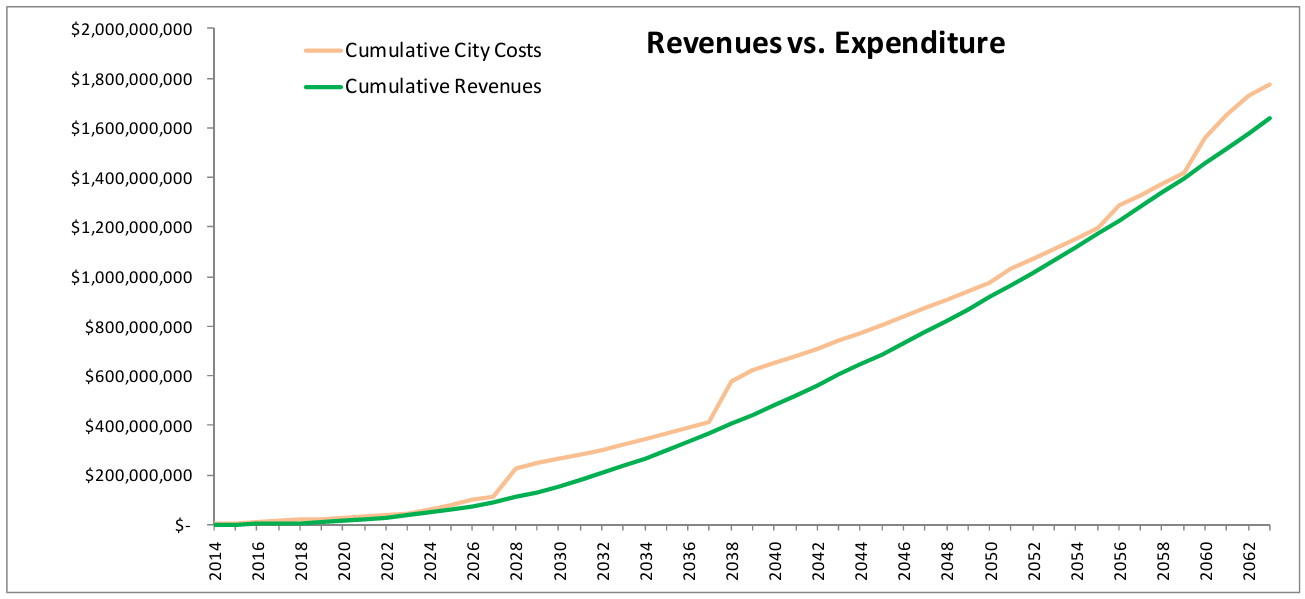
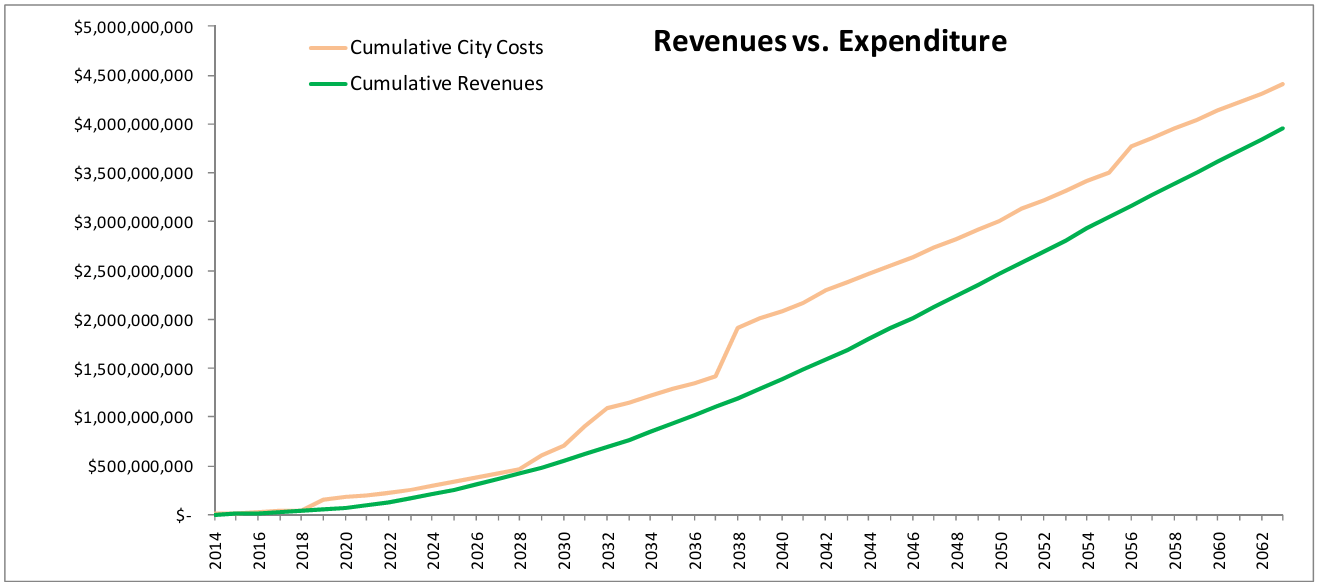
To estimate revenue and expenditures, the IIMP considers two scenarios. The first uses demographic projections from 2008 and assumes that only 52% of the population is achieved within 50 years. The second uses demographic projections from 2012 and assumes that the full population is achieved within 35 years.

Here’s the revenue vs. expenditures for the first scenario:

Here’s the revenue vs. expenditures for the second scenario:

The first takeaway is that new neighbourhoods do not pay for themselves, even (and especially) in the long-run. The IIMP notes that in comparison those charts “seem to contradict the general theory that a faster build-out time would result in a better cost recovery ratio.” It goes on to attribute this paradox to “the timing of certain large capital assets.”

What follows those two charts is a discussion about the balance of residential and non-residential land throughout the city. The IIMP notes that non-residential assessment makes up approximately 25% of the total tax base of the City.

How does the proposed development affect this balance? Generally, residential neighbourhoods have less than 25% of their assessment base as non-residential, and the proposed Horse Hill Area Structure Plan is projected to have 4.3% of its assessment as non-residential. So as the City grows this and other residential areas, it must also grow its non-residential areas to maintain balanced growth.

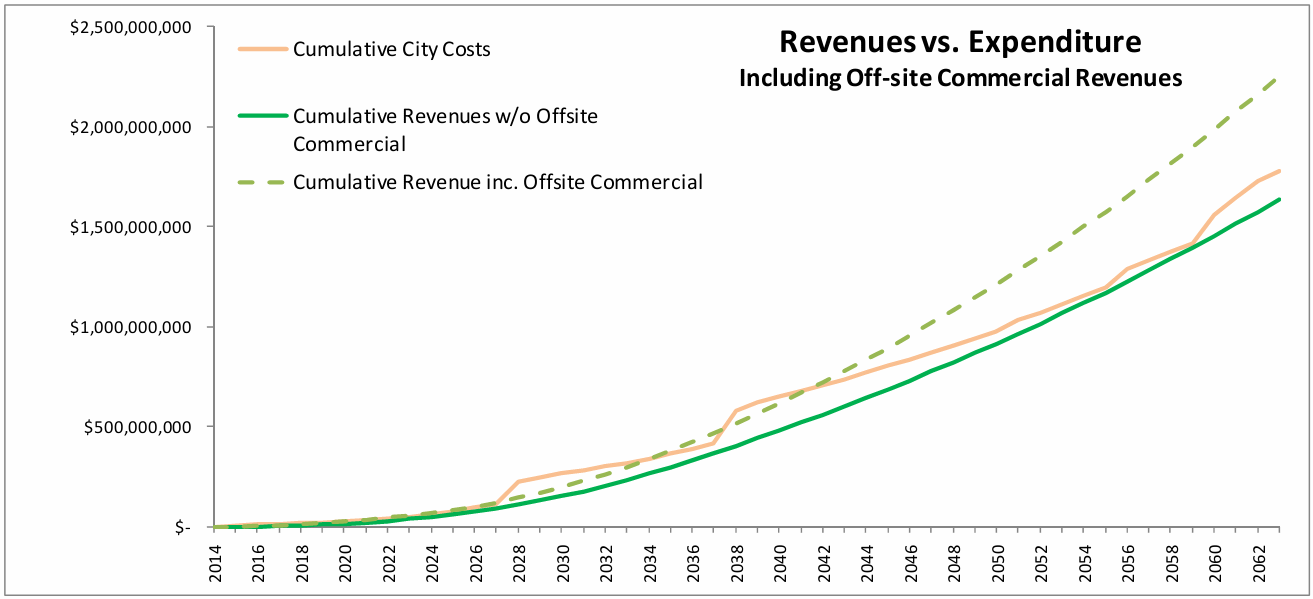
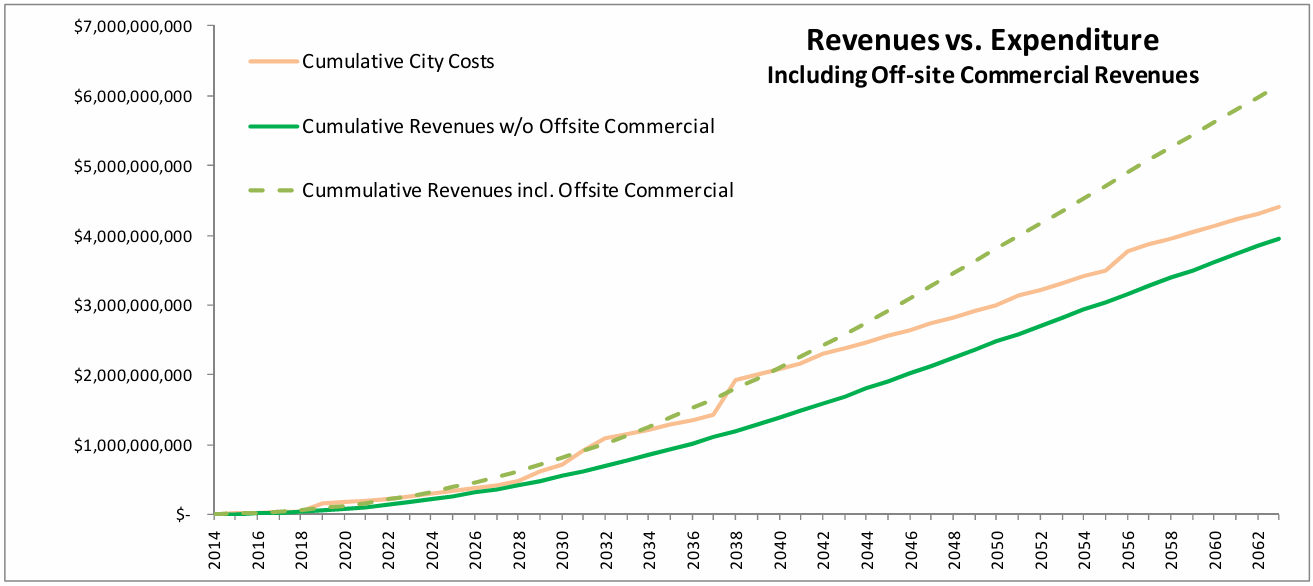
Incredibly, the IIMP then provides updated versions of the two charts above that “illustrate the importance of balanced growth and the benefit of maintaining the current non-residential assessment ratio.” The estimated revenue is combined with “off-site commercial assessment” to paint a much rosier picture of how we can afford to build out the plan as proposed.

Here’s the updated chart for the first scenario:

And here’s the updated chart for the second scenario:

The IIMP states:

The premise in these figures is that if the City maintains its current balance of 25% non-residential assessment, by developing commercial areas throughout the City, this additional revenue helps to offset the fiscal imbalance indicated by looking at the Horse Hill ASP by itself.

So we need to continue building commercial areas like the EETP to prevent residential taxes from going up dramatically. But to support those commercial areas we need to build new residential areas like the one proposed by the Horse Hill ASP. But to pay for those new residential neighbourhoods, we need to construct still more commercial areas. It’s a vicious cycle.

In other words, we’re addicted to sprawl.

The worst part is that we know this and yet we continually fail to do anything about it. From the MDP:

The Municipal Development Plan proposes a new direction for growth and it will take time to effect change. The Plan is a long term strategy and will require incremental decisions that support our commitment to saying “yes” to the things we want and need and “no” to the things that do not advance our City Vision and goals.

So far we’ve said “yes” to eight NSPs that were supposed to wait for the GCS and other documents, “yes” to a dramatically scaled back Growth Coordination Strategy, “yes” to a Food & Agriculture Strategy that lacks teeth, and we’ll likely say “yes” to the Horse Hill ASP.

We’re addicted to sprawl and we just can’t seem to say “no”.

What good are (bike) plans without implementation?

Bike lanes have been in the news again, largely thanks to Mayor Mandel referring to the plans as a “nightmare” on Wednesday. It’s pretty clear that our poor public consultation practices are part of the problem here, but there’s another issue at play. As a city we’re good at talking the talk, but we too often fail at walking the walk.

From The Way Ahead:

In shifting Edmonton’s transportation modes the City recognizes the importance of mobility shifts to contribute to the achievement of other related goals. To do so suggests the need to transform the mix of transport modes, with emphasis on road use for goods movement and transiting people and transit use for moving people.

From The Way We Move’s Strategic Goals:

Public transportation and active transportation are the preferred choice for more people, making it possible for the transportation system to move more people more efficiently in fewer vehicles.

From The Way We Move’s Implementation Plan:

Active transportation includes any form of human-powered transportation, the most common modes being walking and biking. A key direction of The Way We Move is to develop an integrated and sustainable transportation system in Edmonton to enable citizens to shift to these modes.

And then of course there is the Active Transportation Policy which declares, “the City of Edmonton strives to be pedestrian- and bicycle-friendly.”

Our plans and goals and policies all seem to support taking steps to make cycling in Edmonton more common. We know that doing so will help to reduce traffic congestion, preserve our road infrastructure, protect the environment, and make us healthier. Our goal of building 500 km of on-street cycling facilities in the next 10 to 20 years is achievable, and we can be confident it’ll help shift our transportation modes because just as you get more drivers when you add more roads, research suggests you get more cyclists if you add more bike lanes (pdf).

So why does it seem so difficult to make any actual progress?

Isaak Kornelsen Memorial Ride - August 31, 2012

When the 2012-2014 Capital Budget was being discussed, Active Transportation nearly missed out on funding. After lots of public feedback and discussion, Council amended the budget and did include $20 million. Now we get around to actually spending some of that money on cycling – $2 million or less this year – and we once again seem to be forced into the position of having to fight to move things forward. One step forward, two steps backward.

Without question the way the City does public consultation contributed to this mess – there’s a lot of room for improvement. But “poor public consultation” is also a convenient scapegoat for politicians and citizens opposed to the plans. There’s no conspiracy here. The notion of adding bike lanes to our streets didn’t suddenly appear one day out of thin air. These plans have been in the works for years.

All we need to do now is walk the walk.

You can learn more about Cycling in Edmonton here, and note the City is running a survey on the 2013 Bike Routes until February 27.

Two other thoughts:

  • Why wasn’t there any outrage about the loss of parking when the bike parking corrals were put in place over the summer? Was it just because they were temporary?
  • Am I the only one annoyed that we’re spending 10 to 30 times more on a “mechanized access” project for the River Valley that has no clear plan than we are on bike lanes?

Edmonton should introduce online voting

City Council will decide tomorrow whether or not to go ahead with online voting in municipal elections. Executive Committee referred the item back to Council without a recommendation, but Administration’s position is clear. Their recommendation states:

  1. That an internet voting option for the 2013 General Election be approved, subject to the necessary Local Authorities Election Act regulation changes.
  2. That Administration request that Alberta Municipal Affairs make the necessary regulation changes to allow implementation of an internet voting option.
  3. That Administration bring forward amendments to Election Bylaw 15307 to address legislative requirements for internet voting.

You’ve probably heard about the Jellybean Election that was held last year to test the viability of online voting. The feedback from that and other public involvement activities was also clear:

Overall, the responses from those who participated in all of the public involvement processes indicated support for the use of internet voting as another voting option. The responses were qualified with an expectation that the City ensure that the voting option provide auditability, security, reliability, be user friendly and be provided at a reasonable cost.

With a projected cost of $400,000 to implement online voting for the 2013 General Election, I think the City can meet those qualifications. Online voting is a viable option right now, and we should offer it in Edmonton.

Voting Station
Is this the best we can do?

I could write about how pretty much everything can be done online now. We pay our bills, share our thoughts, file our taxes, buy goods and services, look for love, and much, much more, all online. I could write about how Scytl, the company we used for the online voting system in the Jellybean election, “has provided internet voting for elections all over the world including France, Madrid and Halifax.” But I’m not sure any of that would convince you more than this CNN article from 2011:

In all, 80 Canadian cities and towns have experimented with Internet voting in municipal elections. The town of Markham, in Ontario, has offered online ballots in local elections since 2003.

We’re not even close to leading the pack in Canada, let alone the world! Estonia has allowed online voting in its national elections since 2007. Online voting may be new to Edmonton, but its old hat elsewhere.

Read just about any article about online voting and amidst any concern you invariably hear that online voting is the future. The article in the Journal last week was no exception:

While Coun. Karen Leibovici feels online elections are the way of the future, she’s not sure the city can be ready to introduce this approach in less than nine months.

Online voting may be the future, but it’s not futuristic. As this Mashable article discussing online voting in the US says, “Internet voting systems are already being used in elections of consequence” and “widespread online elections will be a reality in the near future.”

Understandably, the most vocal concerns about online voting have to do with security. No system is 100% secure, but generally speaking it’s not the technology that is the weakest link, it’s us. For an eye-opening look at the human side of security, I’d encourage you to read Kevin Mitnick’s book The Art of Deception. In it, “Mitnick explains why all the firewalls and encryption protocols in the world will never be enough to stop a savvy grifter intent on rifling a corporate database or an irate employee determined to crash a system.” Or someone motivated to interfere with an election. If you really want to hack the system, you’ll find a way.

For me the question becomes, is online voting any less secure than offline voting? I don’t think it is. How do you know that that piece of paper you drop into a cardboard box ends up where it should and is counted accurately? How do you know that someone hasn’t interfered with the system somewhere in between you voting and the results being published? You don’t. A technology-based system would still require a certain amount of trust, but unlike with paper-based systems, that trust can be backed up with audit records and digital copies.

No one is suggesting that we get rid of paper-based voting and move entirely online (at least not yet). But adding online voting as an option would make the next election more accessible, and would give us the opportunity to gain some insight and knowledge on how to improve the system in the future.

The corporate outcomes section of the report going to Council states:

Providing voters with secure voting options enhances the democratic process and our citizens’ connection to their community, and supports the goals of the Way We Live.

I can’t say it any better than that. Let’s move forward with online voting in Edmonton.

Edmonton City Council and Katz Group move forward on new downtown arena

Today was the latest episode in the downtown arena saga and it was a weird one. Council received an update from Administration on negotiations with the Katz Group and ultimately voted 10-3 to move forward with an altered deal, though one that still closely resembles the framework that was approved in October 2011. Today is being called a “landmark” day for Edmonton, and supporters of the arena are understandably happy that the project is moving ahead, even though they may not be entirely sure why.

Let’s start with what’s new. The price of the arena has gone up $30 million to $480 million, and that pushes the total cost of the project (including the community rink, land, and other elements) to more than $600 million. The other changes include:

  • The additional $30-million for the arena over the previous framework will be split between the City and the Katz Group
  • The LRT connection, solely funded by the City, has been reduced from $17-million to $7-million
  • Katz Group will pay for the slightly increased costs of the Winter Garden
  • Under the new framework, the City will own the arena and land, and the Katz Group will pay all operating costs and receive all revenues

There are some other changes too, such as a property tax clause that no one seems to understand. But the biggest difference? Congratulations and optimism all around. Speaking to the media afterward, Mayor Mandel declared:

“It’s 100%, a deal is done. All the other stuff is just going through some steps. I’m absolutely totally confident that we will go ahead…”

And here’s the statement from the Katz Group:

“This is a milestone agreement for a world class facility that will drive the ongoing revitalization of downtown Edmonton,” said Daryl Katz, Chair of the Katz Group. "It also helps to ensure the Oilers’ long-term sustainability in Edmonton. This has been a challenging process for all concerned but we are confident we will all look back on the end result with pride and satisfaction at what we have achieved. I want to thank City Council and City Administration for their work on this file. This is a great day for Edmonton and we are excited to get to work on realizing this incredible opportunity.”

You may recall that when the original agreement was passed in October 2011, there was quite a bit of optimism then too. But it wasn’t along the lines of “the deal is done” as much as it was about moving forward. To be fair, it’s not like there was cheering in Council Chambers today, as Paula noted:

“After all the years of negotiations, the vote was greeted by silence — followed by an awkwardly belated round of quiet applause from the Katz Group and their supporters.”

But for Mayor Mandel and Daryl Katz in particular, their comments represent a complete turnaround. Last September, the mayor was “frustrated” and issued a statement calling for “the Katz Group to clarify its full position.” In response, Daryl Katz wrote a letter in October in which he called for “more time and political leadership.” He said negotiations had “gone backwards” and noted there were 15 open issues. In December, the Mayor said “we’ve gone as far as we’re going to go” and said a deal had to be reached within six weeks.

My read of the report suggests fewer than 15 changes were made, but maybe Katz was just grandstanding in his letter. What’s most interesting of course are the things that have not changed.

There’s still $100 million missing from other orders of government (plus another $14 million for the community rink). Mayor Mandel today said he is “very confident” that the province will come to the table for that amount, but no one knows when or how. There’s also no guarantee that that province would approve the proposed downtown CRL (though it seems unlikely they would reject it) nor that the Katz Group will actually invest in the commercial development surrounding the arena (it’s all “subject to commercial viability”).

I don’t see much of a difference between today’s deal and the agreement from October 2011, but apparently it was enough for Mandel and Katz to declare that we’ve crossed the finish line.

So what’s next? Well someone needs to come forward with $114 million, for starters. Given that the City expects construction to start as early as August 2013, getting the remaining funding issues sorted out would seem to be the priority. But perhaps more importantly, this agreement significantly increases the likelihood that Mayor Mandel will decide not to run again in the next election. As Paula noted, that means “a new political game is just beginning.”

I’ll give Don Iveson the last word on today’s proceedings: “I don’t want our city to fight about this anymore. It’s been an open wound in Edmonton.”

Why the City of Edmonton should pay to light up our bridges and landmarks

Who knew that Dave Mowat’s presentation at Pecha Kucha Night 14 back in October would become such a big deal? Maybe he did, but I sure didn’t. It was a great presentation, but we’ve had lots of people come forward with ideas on how to beautify the city, and none of those took off. Furthermore, Dave wasn’t the first one to suggest lighting up the High Level Bridge, something he readily admits. So what made his presentation different?

Pecha Kucha Night

Well for one thing, Dave Mowat is no ordinary citizen (despite how down-to-earth and approachable his bio sounds). He’s the President and CEO of ATB Financial, an organization with assets of about $27.4 billion, making it the largest Alberta-based financial institution. If we brought together a group of the city’s “power brokers” , Dave would probably have a seat at the table. When he picks up the phone to call EPCOR and asks for a couple hundred thousand dollars for his project, he gets it. I couldn’t do that, could you?

That’s one reason why I’m not a big fan of the proposed fundraising campaign. With an estimated cost of anywhere from $400,000 to nearly $2 million, Dave is going to need more than just the $225,000 committed by EPCOR. Gordon Kent reports:

He would like a few corporate sponsors to pay the bulk of the expenses, with 100 to 200 businesses making smaller contributions and 10,000 to 30,000 people donating about $10 each to “buy a diode.”

When he spoke to Executive Committee on January 14, Dave said, “I think a project like this lends itself toward grassroots funding.” We can disguise this as a “community project” by launching such a fundraising campaign, but that feels a bit disingenuous to me. Dave recognizes that selling diodes for $10 isn’t going to pay for the project, but will build awareness. Still, I’m concerned it’ll do more harm than good.

Now don’t get me wrong, I think it is fantastic that Dave and ATB have taken such an active role in driving this forward. I love that he decided to take action with his idea, rather than just talk about it, and I hope he has inspired other businesses and leaders in Edmonton to do the same.

And I think that lighting up our bridges is a great idea. It aligns nicely with our Winter City Strategy, I think it’ll make Edmontonians feel safer and happier crossing the bridge, and it could become our “signature shot” which would be a great thing for tourism, not to mention civic pride.

light it up

There are always going to be naysayers, but it seems to me that most people like the idea of lighting up the High Level Bridge, especially for its 100th anniversary this June. So why would we rely on the private sector to make it happen? If it’s such a good idea, why do we need to raise funds for it?

I think the City of Edmonton should pay for it. Maybe not all of it, but a majority of it. The High Level Bridge is an important piece of municipal infrastructure, it’s an important part of Edmonton’s history, and this project will benefit all Edmontonians.

There’s precedent for this too, as the report that went to Executive Committee noted:

The Langevin Bridge in Calgary was equipped with decorative LED lighting in 2009 at a cost of $370,000. Funding for this project was provided by the Calgary Municipal Land Corporation as part of a revitalization initiative in the East Village. The project included the installation of over 5600 LEDs with roughly the same power consumption of just three Alberta households.

City Manager Simon Farbrother made it clear that Edmonton would not be unique in providing funding to the project. “The reality is that large cities today illuminate themselves at night, and they do it in many ways, and the city has some work to do to catch up in this area.”

We’re spending $2 million this year on Edmonton’s image and brand, and millions more over the next few years. Why not take some of that budget and apply it to a concrete project like this, one that will actually help our brand? Or how about the 1% for Art program? Do you know what 1% of the estimated cost of the Southeast to West LRT expansion is? About $34 million. Considering we spent just 0.08% of the approved 2009-2011 Capital Budget on art, I’d be shocked if we spent anywhere close to that amount along the LRT line. Why not take some of that funding and apply it to the lighting project? It would certainly qualify as a “highly visible” project (and a quick read of policy C458C suggests this is possible).

I recognize that lighting up the High Level Bridge has never been considered in any of the City’s budgets. And I recognize that especially in an election year, this is going to be a tough sell. But I think this is a conversation that needs to take place.

When news first spread that Executive Committee had decided to take a look at contributing to the project, a number of people expressed their displeasure. It was unfortunate that it happened around the same time as YESS announced it could not meet its funding requirements, causing some people to incorrectly link the two. We should help YESS instead of beautifying our city, they said. I think Ryan Jespersen responded to that criticism well:

Along those lines, I wish that Dave had gone to Council and said something like, “this is an important project for Edmonton, and I want to help you make it happen.” Instead, he essentially said “this is a great idea and since we’re both resigned to the fact that spending public money on this can’t ever be a priority, I’m just going to go and fundraise it myself.” Good on him for taking action, but it doesn’t help to shift the conversation in the direction it needs to go. We need to be willing as a city to spend money on projects like this.

So what’s next? Executive Committee directed Administration to come back on March 11 with “a plan, including a budget proposal and a schedule” for the project. It also asked for a report on an integrated program for illuminating other key landmarks, including City Hall and other bridges, and that report should be finished by April 15. In the meantime, I’ve heard that Dave’s fundraising campaign is starting to take shape.

While we’re definitely running out of time to make something happen for June, I’m hopeful that we don’t rush the project. I think the magic happens when we can light up more than just the High Level Bridge. A phased approach is sensible, but it would be nice to have a vision for something larger.

As Councillor Henderson said, “If we’re going to do it, we should do it right.”

My comments at the Food & Agriculture Strategy public hearing

Good morning Mr. Mayor, members of Council,

My name is Mack Male and I’m here today on behalf of myself, in the capacity of a citizen who loves both food and Edmonton.

There are very few things in this world that impact us on a daily basis as much as food. I firmly believe that food should be an important part of our city’s long-term planning, so I am very pleased that we’re discussing a Food & Agriculture Strategy in Edmonton. Unfortunately, I cannot endorse the document as it currently exists.

After reading the strategy, it was abundantly clear to me that it was not created with a goal of transforming Edmonton into a leading food city. Should we aim that high? Absolutely yes. We have an extremely vibrant and growing food community in Edmonton, and a long history of urban food production. Unfortunately the strategy is not only for the most part vague and non-committal, its almost unfathomably uninformed, or at best, incomplete. There is no mention of Operation Fruit Rescue, the River City Chickens Collective, Eat Alberta, or perhaps most shocking of all, Edmonton’s Food Bank, the first in Canada and a key supporter of food security in Edmonton for more than three decades. These and other omissions reflect the highly compressed timeframe in which the strategy was created, and the failure to include key stakeholders from the food community.

This should be a strategy about food, not about land in the northeast, but citizens have no other opportunity to comment on that development. I’ve heard the argument that at this point, the land is too valuable to be used for agricultural purposes. If that is true, it’s a direct result of the actions of City Council. You approved the Edmonton Energy & Technology Park directly across from the land in question in June 2010, thereby setting the stage for a large centre of employment that will require nearby residential areas. At no point in recent memory has there been any indication from Council that development in the northeast was anything but a foregone conclusion. I regularly and publicly praise your efforts and leadership on our city’s vision and strategic plan, but I think this issue illustrates that you need to do more when it comes to the issue of growing strategically and sustainably.

On Tuesday, the Community Services Committee recommended that Council approve the WinterCity Strategy and that Administration report back with a status update. Today it has been suggested that you endorse the Food & Agriculture Strategy in principle and that Administration first come back with options and costs before starting any implementation. I think that recommendation is another indication that this strategy has been rushed and is not ready to be endorsed by Council.

If we’re going to endorse a Food & Agriculture Strategy, let’s make sure it is one that we’re proud of and one that provides a solid foundation on which we can build.

I will leave you with three requests:

  1. First, reject the draft Food & Agriculture Strategy
  2. Second, schedule a public hearing on the Growth Coordination Strategy so that citizens can provide input into that very important document and the discussion about land use can move to a more appropriate place
  3. Third, establish the Edmonton Food Council as an official Council Committee and task it with the creation of a new Food & Agriculture Strategy that reflects the vibrancy and creativity found in Edmonton’s food community

Thank you very much.

The non-statutory public hearing continues this afternoon. For background, read these links. To follow along, use the #yegfoodag hashtag on Twitter.

We all have skin in the game

I’m registered to speak during tomorrow’s non-statutory public hearing on the Food & Agriculture Strategy. I’m looking forward to the opportunity to share my thoughts with Executive Committee (though I expect we’ll see more than just the five standing members in attendance). I’m yet to hear anyone on Council say they are looking forward to it, however.

“If you own the land and you want to grow berries, go ahead. If you don’t own the land, I would say the same thing, get the heck out of the way. You have no interest. We’re going to have everybody with no interest, financially or otherwise, coming forward supporting something that they really have no skin in the game about, and those that do, are going to suffer the consequences.”

That was what Councillor Caterina said at the September 5 meeting of Executive Committee, voicing his opposition to the public hearing (ultimately he did vote for it along with the rest of the Committee).

No interest? No skin in the game? Councillor Caterina could not be more wrong, and let me tell you why.

First of all, we’re talking about the Food & Agriculture Strategy, not the “What To Do With Land In The Northeast Strategy.” Food is something that touches all of us, and if we’re going to take a position as a City on the importance of food to our community, I want a say in that.

I think we screwed up by attaching the Food & Agriculture Strategy to the specific land issue in the northeast. I want a WinterCity Strategy-like approach to food. There is so much that was left unexplored, and so many people that were not involved that have important, valuable contributions to make, and that’s largely because the discussion was dominated by the northeast.

Secondly, Council is largely responsible for turning this into the “What To Do With Land In The Northeast Strategy.”

I have not seen any concrete evidence to suggest that we can sustain our outward growth, nor have I seen any concrete evidence to suggest we can’t. There’s lots of anecdotal information, and certainly there are dozens of other places we can point to that clearly demonstrate the unsustainability of sprawl, but we need facts and figures for Edmonton. We need to know, for every unit of housing we add into new areas, what that costs the city. We need to know, for every unit of housing we add into existing areas, what that costs the city. Then we can start to determine whether or not we can afford to move ahead with more sprawl. My educated guess is that we can’t.

We should have had those numbers from the Integrated Infrastructure Management Plan (IIMP) and the Growth Coordination Strategy (GCS), but that’s not going to happen. In September, Administration asked for the IIMP to be treated as a “framework” rather than a plan, then provided a meaningless two-page document to serve as the framework. Council let them get away with it.

The GCS is slated to go to Council on November 19. A draft was released in May, but it has been rewritten and was distributed to select stakeholders at the end of the day on Tuesday. The deadline for comments? Tomorrow. And beyond that select group, there has been zero public consultation, and there’s no indication that a public hearing will be held for the GCS. The purpose of the GCS is to “manage future public obligations and growth opportunities” so can you guess what was removed from the latest draft? Anything related to mature areas, transit oriented development, and infill. So much for the “coordination” part of our growth strategy.

As our elected representatives, Council should be the ones asking why. Why do we still lack the information we need to make smart decisions? Why have we rushed these documents? Why haven’t we included the public in their creation?

In short, Council has not provided citizens with confidence that we can grow sustainably, nor have they provided opportunities for citizens to have a say on the plans that will affect where and how we grow. The only opportunity we have is the Food & Agriculture Strategy.

Thirdly, and most importantly, I pay taxes like everyone else. It costs money to provide services to an ever-expanding list of neighbourhoods, and that means there is upward pressure on my taxes. Police stations, libraries, and parks do not build themselves. There are no magic fairies that remove snow in the winter or fix potholes in the summer. Taxes pay for those civic services.

I have an interest in ensuring Edmonton’s food security because food is central to my everyday life. I have an interest in what happens in the northeast because I have an interest in living in a sustainable city. I have “skin in the game” because I pay taxes like everyone else. And above all, I as a citizen of Edmonton, have a right to be involved in decisions that affect me.

The ten year cycle of food security in Edmonton

The more I learn about the history of the Food & Agriculture Strategy, the more I find myself wondering: are we going to be at this again in 2022? It turns out that 1992 and 2002 were both key years in the history of “food security” here in Edmonton, yet here we are in 2012 talking about it again. Here’s a look back at two previous efforts to get food security on the municipal agenda.

1992: The Edmonton Food Policy Council

The first and most concrete recommendation that the current draft strategy makes is to “establish the Edmonton Food Council by June 1, 2013.” It’s one of the recommendations that I think everyone can agree upon, and indeed the preamble notes that “it was also strongly supported by stakeholders and the community during the consultation phase as a key pillar in implementing the Strategy and in making Edmonton a leader in food and urban agriculture over the long term.”

The strategy notes that these councils generally exist as advisory bodies for city councils:

Food councils may take many forms, sometimes commissioned by government and sometimes through a strong grassroots and community effort. Food councils have been successful at educating officials and the public, shaping policy, improving coordination between existing programs and starting new initiatives.

If the draft strategy is approved and implementation moves forward, Edmonton will join the long list of more than 200 municipalities across North America that have formed food councils. But what I learned recently is that it would not be our first.

In 1988, a group of community health and social agencies came together to form what was known as the Edmonton Food Policy Council (EFPC). According to a handout produced for a conference a few years later, “the group believed that the community needed to find new solutions through joint action on hunger-related issues.” The initial member organizations included:

  • Boyle Street Community Services Co-operative
  • Edmonton Board of Health
  • Edmonton City Centre Church Corporation (E4C)
  • Edmonton Gleaners Association (Food Bank)
  • Edmonton Social Planning Council

The group was later expanded to include CANDORA, KARA Family Support Services, Edmonton Potato Growers Ltd., Christian Farmers Federation of Alberta, Edmonton Community and Family Services, and Grant MacEwan Community College.

Edmonton Food Policy Council Report

The EFPC scored a victory two years into the effort, receiving $158,000 from the federal government in 1990 to conduct a study on the problems of food availability. Led by Kathryn Olson, the project completed in May 1992 with the release of the final report entitled “Community food needs assessment – a community development approach.” A total of 460 low income Edmontonians were interviewed and the study found that “three-quarters of them were having trouble getting enough healthy food on a regular basis.”

The term “food security” appears on the cover of the report, but when Liane Faulder wrote about it in the January 21, 1991 edition of the Edmonton Journal, she used the term “food insecurity” which she defined in laymen’s terms as “going hungry.” We generally define food security differently today, but in the 1980s and 1990s, the definition was more akin to what we now call food justice.

It was a difficult time for many Edmontonians. The project’s background noted that between January 1983 and December 1984, “the amount of food being distributed by the Edmonton Food Bank increased by a factor of seven from 18,000 pounds to 135,000 pounds of food per month.” By 1987, the Edmonton Food Bank was serving nearly 60,000 families in Edmonton. In 1992, the year the report was released, 105,086 people used the Edmonton Food Bank, according to data from the Edmonton Social Planning Council (totals do not represent unique individuals, and some may access the food bank multiple times per year). Usage peaked in 1996 at 192,067 individuals, and after falling to a 14-year low in 2007 at 125,069 individuals, usage has risen again in the last few years to more than 170,000 individuals per year. But to put those numbers into context, remember that the city’s population has increased from just over 605,538 in 1990 to 817,498 today.

edmonton food bank use

The report was met with a significant amount of criticism. Some attacked the methodology, others demonstrated a lack of understanding of what hunger is – “it doesn’t mean ribs sticking out,” was how Liane Faulder put it at the time. “There are a lot of pieces to hunger,” Kathryn Olson said. A total of ten recommendations for action were made, ranging from reducing the cost of shelter to increasing the opportunity to increase nutritional knowledge and food preparation skills.

I wanted to find out what happened next, so I tracked down Lorraine Green who served as the EFPC’s chairperson from the end of 1991 on. She’s currently the coordinator of the Health For Two program at Alberta Health Services here in Edmonton. We had a great discussion about the council, the report, and other initiatives that were underway at the time. “Edmonton Food Policy Council was probably not the most apt name,” she told me, noting that the group did not actually create any policy.

The EFPC was very active, however. They engaged Planning & Development to work on community gardening, they organized a conference called Food Fight! to discuss issues of food security, they talked to Edmonton Transit about needs they heard in the community, they met with grocery store managers, they met with people from Alberta Agriculture, and they regularly reviewed information and research from other sources. That information sharing proved to be very valuable as each member organization pursued its own initiatives.

While the group mostly served as a place for members to get together to discuss strategies and ideas, a few small projects did get off the ground. Lorraine told me about the “Shopper Shuttle” that was piloted in 1992. In talking with low income families, it was discovered that transportation was a major hurdle for getting to the “mega” grocery stores that had lower prices. Safeway opened its first Food For Less store in Edmonton at 3803 Calgary Trail on July 29, 1984, and Superstore followed suit the following year. Like big box stores today, they were built far from the established residential areas where most lower income folks lived, and with limited bus service you needed a car to get there. The shuttle would drive people from their neighbourhood to the big box stores so they could do their grocery shopping. Enthusiasm for the service was high, but usage turned out to be smaller than expected. Looking back, Lorraine identified a number of practical issues that hampered the shuttle. One was scheduling – if the shuttle came on Friday but you didn’t get paid until Friday, you likely wouldn’t be able to go (you had to get your cheque and cash/deposit it first). Another was perception – the shuttle was quite large and it parked right in front of the grocery store, which meant anyone getting on or off stood out. In the end, the pilot only last about six months.

The EFPC was never an officially registered organization, so there was nothing to really shut down when the time came. “By the end of 1992,” Lorraine remembered, “it had become more of an information sharing group.” Once the funding for the study came to an end, the group was faced with determining next steps. “Coalescing the group around a longer-term mandate was difficult,” she said. The issue was not that there was a lack of interest, but rather that the members were busy with other projects. Their energies were being put into initiatives that are still around today, such as the school lunch program and WECAN.

2002: Edmonton’s Food Charter

The second recommendation that the current draft strategy makes is to “explore the creation of an Edmonton Food Charter.” While the recommendation is a good example of the passive, non-committal language found throughout the document, it does recognize the value in having a food charter. Toronto adopted its food charter in 2001, and I discovered recently that Edmonton nearly followed suit just a year later in 2002.

It was the action in Toronto that prompted Marjorie Bencz of Edmonton’s Food Bank to start exploring the adoption of a food charter in earnest. She had attended a national food security conference there, and discussed Toronto’s new charter with her board members. Despite some reservations about the content of Toronto’s Food Charter, the Food Bank did send a letter to Mayor Bill Smith expressing interest in working on a similar initiative here in Edmonton.

He referred the letter to the Family and Community Services Department, and thus began a series of discussions between the City and the group of stakeholders that Marjorie had helped to bring together (many of the same folks were involved in the Edmonton Food Policy Council actually). Throughout 2002, the group met on a number of times to discuss what a food charter should include and how it might be adopted. While the drafts created were certainly broader than the work the EFPC had done ten years earlier, they still dealt primarily with food justice.

Community Services drafted a report for Council in September 2002, but it never actually got onto an agenda. I wanted to know what happened, so I got in touch with Joyce Tustian, who was the general manager of Community Services at the time. “There was concern that perhaps we were moving beyond the City’s mandate,” she recalled. Her department was trying to plan for the future, but there was lots of uncertainty about what should be considered municipal work and what was out of scope. “The boundaries weren’t as clear as they are today,” she told me.

The lack of clarity around what role the City would play and the lack of support outside the initial stakeholder group may have been factors that caused the effort to stall. One of the biggest differences between then and now is that the City now has an established policy framework to work with. The Way Ahead and associated plans have been very effective at providing a context within which Administration can operate. In the absence of that sort of framework, initiatives such as the food charter “had to be held up individually,” Joyce said.

There was some early work taking place on establishing a policy framework, but it hadn’t progressed very far. Council had a vision for dealing with economic development, but not much else. In 1999, Councillor Michael Phair pushed for a broader vision, an effort that ultimately led to the adoption of City Council’s Vision for Social Well-Being and Quality of Life in September 2000. The draft report in September 2002 recommended that Edmonton’s Food Charter be incorporated into that vision.

Here’s an early draft of the charter (undated, but I think it was from early-mid 2002):

It seems the final draft of the food charter was lost, but here’s what was circulating in early 2003:

In concert with City Council’s Vision for Social Well Being and Quality of Life and Canada’s national commitment to food security by signing the United Nations Covenant on Social, Economic and Cultural Rights that includes the right to be free of hunger, the City of Edmonton supports the following beliefs:

Every Edmonton citizen has the right to adequate, safe, nutritious, affordable and culturally appropriate food.

Food security contributes to the health and well-being of citizens while reducing the need for medical care and improving their quality of life.

Sustainability of our food supply means ensuring that citizens have a safe and high quality food supply for now and the future.

Food security can only be achieved when it is approached within the context of increased self-sufficiency through supportive community environments and enhanced economic opportunity.

It’s fascinating to think that Edmonton could have been one of the first cities in Canada to adopt a food charter.

Final Thoughts

When I first came across the previous Edmonton Food Policy Council and draft Edmonton Food Charter, a thousand questions popped into my head. I wondered why I had never heard of them before, and why the current initiative made no mention of previous efforts. I wondered why both the Food Policy Council and the Food Charter seemed to fail, and if there were lessons there that could be applied to today.

What stands out for me is that in both instances there was a groundswell of community support and that is what really got things moving. Neither effort was initiated by the City, though it supported both. Maybe the Food Policy Council and Food Charter were just ahead of their time for Edmonton (certainly finding information now was difficult because it’s not archived online somewhere, it’s in folders and boxes in people’s offices).

I asked Hani Quan, principal planner on the Food & Agriculture Strategy, what he thought and he agreed that we simply may not have been ready for a Food Council or Food Charter in the past. “Today people recognize food is one of the levers that has potential to help address complex issues,” he said.

The context in which today’s Food & Agriculture Strategy is being considered is certainly much different than that of 1992 or 2002. Everything has changed, demographically, economically, and politically. We have a City Council now that has shown great leadership in establishing a forward-looking vision for the City of Edmonton, and I think that’s the key that will make a future Food Council and Food Charter successful.

Maybe we should have just had a food strategy

When it comes to the Food & Agriculture Strategy, there’s perhaps no organization more deserving of credit for getting us to where we are today than the Greater Edmonton Alliance (GEA). They worked hard during the development of the MDP to ensure that the importance of local food and agricultural land was recognized, and those efforts ultimately led to the creation of the strategy that is now in draft form. But GEA is also largely responsible for tying the development of that strategy to the land in the northeast, which has resulted in a document that fails to adequately address the importance of food to our city.

City Market 2012

Instead of a strategy to transform Edmonton into a world leading food city, the Food & Agriculture Strategy is viewed by most as simply one of the final remaining hurdles to the continuation of urban sprawl that has plagued our city for decades. Whereas the WinterCity Strategy was created to “highlight Edmonton as a leading winter city,” the Food & Agriculture Strategy was created to allow the development of ASPs to move forward.

The Advisory Committee, created to “offer guidance and experience in exploring the development” of the strategy, was doomed to fail from the beginning. Because the land issue was not resolved, it was made up of fifteen members representing very diverse interests, rather than fifteen members all focused on food. It’s no surprise that farmers and developers could not see eye-to-eye on what should happen with the land in the northeast and that the issue dominated discussions.

Think about all of the other advisory committees and task forces that have been created over the last few years. We’ve had groups come together to talk about community safety, homelessness, winter, and dozens of other topics. The makeup of the Food & Agriculture Advisory Committee is like putting people that hate winter on the WinterCity Strategy committee, or people who love crime on the REACH committee, or people who think we should have more homelessness on the Homeless Commission.

So, how did we get here? There are lots of reasons of course, but here are a couple thoughts.

MDP Second Reading

One issue is that GEA’s leaders don’t care about food as much as they care about power. This was made abundantly clear at the ward meeting GEA held on October 9. A significant amount of time was spent discussing the power struggles that take place behind-the-scenes inside and outside City Hall. “One of the tools GEA uses in organizing is the power analysis,” GEA’s Monique Nutter told us. She said that in organizing there are two forms of power: organized money and organized people. The latter is the approach that GEA has taken, and for a while it seemed to work well. They filled City Hall with citizens, and they got the attention of their opponents as well as City Council.

But somewhere along the line, GEA lost the room. Any support they may have had from Council during the MDP deliberations has largely evaporated. Were they too aggressive in their demands, or disrespectful in their communications? Does organized money speak louder than organized people? It doesn’t matter. The fact is, Council is unhappy with GEA right now. That’s a problem for those of us who care about the same issues as GEA but are not associated with them, because I think at least some Councillors now treat GEA and others who feel strongly about food and/or agricultural land as one and the same. Which means that if GEA is being viewed negatively, so are the rest of us.

I don’t mean to suggest that GEA deserves all the blame for the turnaround in support. Certainly Councillor Loken has not done the strategy any favors by “trying to add some reality to the discussions.” He claims his efforts have made him a target on the Advisory Committee. Rather than diffusing an already tense situation, it seems Councillor Loken has actually made things worse.

Food in the City

The second issue is that as far as I can tell, GEA didn’t have any other choice. Tying the development of the land to the creation of the strategy was really the best they could accomplish at the time. There was no support from Council for a stronger stance on urban sprawl, as evidenced by policy 3.1.1.2 in the MDP which establishes that just 25% of city-wide housing unit growth be located in the downtown and mature neighbourhoods.

In an ideal world, a Food & Agriculture Strategy would have been initiated without the need to incorporate a contentious debate over land use (of course, any strategy on food would have included something about the importance of agricultural land, but in broad strokes rather than specifics). Then again in an ideal world, the true cost of sprawl would be known and factor prominently in decisions about how our city should grow. We don’t live in an ideal world.

Untitled

On Friday, City Hall will fill up with citizens eager to have their say on the Food & Agriculture Strategy. We know that Executive Committee is not looking forward to the public hearing, they’ve made that clear. They’re expecting to hear the same thing over and over, and I admit that’s not an enticing prospect. But I think that’s because they’re viewing this strategy through the lens of land, rather than the lens of food. I hope there’s a large turnout on Friday, that at least a few people talk about the importance of food to Edmonton’s future, and that Executive Committee chooses to listen to them.